KAS Current Affairs: Current Affairs is the living pulse of the KPSC syllabus. It is not a standalone subject to be memorized in isolation; rather, it is a dynamic thread that weaves together History, Economy, Polity, and Ethics across both the Preliminary and Main stages. In the context of the upcoming examinations, transitioning from simply “reading the news” to “studying the syllabus through the news” is the critical shift that separates a serious aspirant from a casual reader.
The “Syllabus-First” Philosophy
By following a current affairs pattern strictly mapped to the KPSC syllabus, you ensure that every hour spent reading the newspaper is an hour spent building your exam rank.
Preliminary Examination
Paper-I: Current Events of National and International Importance
Paper-II: Current Events of State Importance and Important Government
Schemes and Programs
Main Examination
Paper-I: Essays
Essay – 1: Topic of International/National Importance
Essay-2: Topic of State importance/Local Importance
Paper-II: General Studies 1
Banking FDI for nuclear power projects on cards
Context: Initiatives to secure infusion of foreign direct investment (FDI) and from the banking sector to finance nuclear power projects are in the pipeline and headed for inter-ministerial consultation, informed Seema Jain, Member of Finance at the Department of Atomic Energy (DAE).
- “Financing will require all sorts of innovative measures to happen so that the kind of money and financial space is made for the sector.” “For that, banking FDI initiatives are also in the pipeline, the Atomic Energy Commission has already approved the [FDI] policy, and is now going for inter-ministerial consultations,”.
- Considering a standard baseline cost requirement for setting up of a nuclear reactor is about ₹22 crore per megawatt, instituting 100 gigawatts of nuclear energy-based power would require about ₹20 lakh crore financing.
Paper-III: General Studies 2
Finally, Rohith Vemula Bill to safeguard SC/ST students gets Cabinet nod
Context: It lists out about 30 ways in which atrocities may be committed against an SC/ST student in a higher education institution.
- The Karnataka Rohith Vemula (Prevention of Discrimination, Exclusion or Injustice) (Right to Education and Dignity) Bill, 2026, which had been widely debated but stuck in red tape for long, was cleared by the State Cabinet on Thursday.
- Law and Parliamentary Affairs Minister H.K. Patil, brienfing the press after the Cabinet meeting, said that the Bill — which aims to safeguard the right to education and dignity of the Scheduled Caste (SC), Scheduled Tribe (ST) students, teaching faculty and non-teaching staff in institutions of higher learning — will be moved during the next legislature session.
- “We will not take the Ordinance route for this. There are some modifications from the original draft Bill,” he said, adding that the penal provisions of the Bill may undergo some modifications. It applies to public, private, charitable and deemed-to-be universities in Karnataka.
- As per the provisions of the draft Bill, for any violation of the law, the person in charge of the affairs of the institution is liable to imprisonment and a fine of up to ₹10 lakh.
Atrocities
- The Bill lists out about 30 ways in which atrocities may be committed against an SC/ST student in a higher education institution, ranging from denial of admission, denial of amenities, bringing financial pressure, using casteist slurs, etc.
- It also details the mechanism of enquiry and appeal that an institution needs to adapt. Though an earlier draft of the Bill had been discussed in the Cabinet in June 2025 and was meant to be presented in the monsoon session, it did not happen. Several Dalit organisations had been building pressure on the government to ensure that the Bill is enacted and implemented at the earliest.
- Leader of the Opposition in the Lok Sabha Rahul Gandhi had last year written to Chief Minister Siddaramaiah, urging him to implement this law. Following this, the Chief Minister had written back assuring that his government would enact the law to eliminate caste- and identity-based discrimination in educational institutions.
Constitution Amendment Bill, part of delimitation package, defeated
Context: The Bill falls short of the two-thirds mark of 352 votes, with 298 in favour and 230 against in the House where 528 members were present at the time of voting.
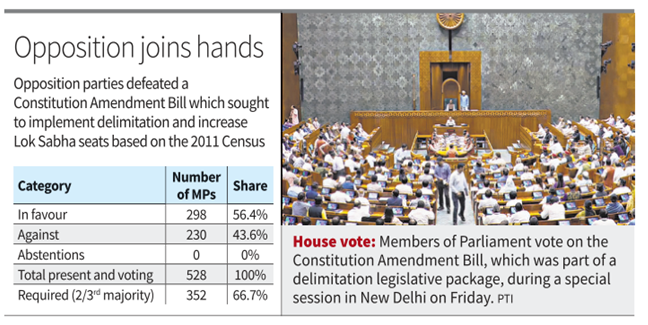
- A united Opposition defeated the Constitution (131st Amendment) Bill, 2026, which sought to redistribute Lok Sabha seats on the basis of the 2011 Census to expedite the implementation of women’s reservation.
- A total of 298 members voted in favour of the Bill and 230 against it, with the House strength at the time of voting being 528. It failed to meet the two-thirds majority mark of 352 required for a Constitution Amendment Bill to pass.
- Following the defeat, the government withdrew two allied legislations — the Union Territories Laws (Amendment) Bill, 2026, and the Delimitation Bill, 2026 — which were linked to the constitutional amendment.
Paper-IV: General Studies 3
Kerala botanist wins WWF award for app
Context: A botany researcher who developed an AI-powered mobile application to identify invasive plant species in Kerala has been awarded the WWF (World Wide Fund for Nature) National Award.
- N. Alim Yusuf, a researcher at the Malabar Botanical Garden and Institute for Plant Sciences (MBGIPS), Olavanna, Kozhikode, received the honour for his innovative application capable of identifying nearly 100 invasive plant species recorded in Kerala.
- He was presented the award at the National ECHO Youth Innovation Summit 2026, held as part of the International Youth Biodiversity Conference in Telangana. As part of the recognition, he will also receive a seed grant of ₹1.5 lakh from the WWF to further develop and scale his project. His application, Neophyte ID, was earlier launched at the Kerala Science Congress held in Kochi in February this year.
- Powered by the advanced machine learning model YOLOv11, the app allows users to identify whether a plant is invasive simply by capturing its image.
- Available in both Malayalam and English, it also integrates geospatial tracking to map the spread of invasive species, offering valuable data for researchers and the Forest department.
Auto sector reaches ‘broad’ consensuson CAFE-III norms
Context: Latest proposal applies flatter compliance curve across five years rather than steep annual tightening, removes relaxations for lighter vehicles.
- A “broad” consensus emerged on the long-contested, upcoming carbon emission norms for cars for 2027 at a high-level inter-ministerial meeting, with small car makers making only “minor suggestions”, industry sources said.
- The draft proposal of Carbon Average Fuel Efficiency-3 floated by the Bureau of Energy Efficiency in September 2025, which has gone through multiple iterations, had reached a deadlock as the industry remained split between small and large car manufacturers over relaxations to the former.
- The latest proposal circulated last week applies a flatter compliance curve across five years rather than steep annual tightening, and removes relaxations offered to lighter vehicles.
- Auto industry sources said there was a “broad agreement” over the latest version of CAFE-3 norms at a discussion held with the industry representatives and top officials of the Ministry of Power, Ministry of Heavy Industries and Ministry of Road Transport and Highways.
Cabinet approves AI Centre of Excellence at E-City
Context: The State Cabinet has approved the establishment of a Centre of Excellence for Artificial Intelligence in Biotechnology (AI-CoE) at the Institute of Bioinformatics and Applied Biotechnology (IBAB) in Electronics City (Phase 1), Bengaluru.
- The centre will be set up over a period of four years with a total outlay of ₹20 crore, in partnership with IBAB and the Centre for Cellular and Molecular Platforms (C-CAMP).
- “As we enter the decade of deep tech, our focus is on building future-ready capabilities at the intersection of Artificial Intelligence and biotechnology. This Centre of Excellence will strengthen our research ecosystem, accelerate innovation, and enable Karnataka to lead in high-impact, next-generation technologies,”.
Paper-V: General Studies 4
Source: The Hindu