KAS Current Affairs: Current Affairs is the living pulse of the KPSC syllabus. It is not a standalone subject to be memorized in isolation; rather, it is a dynamic thread that weaves together History, Economy, Polity, and Ethics across both the Preliminary and Main stages. In the context of the upcoming examinations, transitioning from simply “reading the news” to “studying the syllabus through the news” is the critical shift that separates a serious aspirant from a casual reader.
The “Syllabus-First” Philosophy By following a current affairs pattern strictly mapped to the KPSC syllabus, you ensure that every hour spent reading the newspaper is an hour spent building your exam rank.
Preliminary Examination
Paper-I: Current Events of National and International Importance
Gyan Bharatam Survey & App
This is a massive national undertaking to digitize and catalog India’s vast, often undocumented, wealth of ancient knowledge.
Objective: To create a comprehensive national database of manuscripts (handwritten documents on palm leaves, paper, bark, or cloth) scattered across private collections, temples, and local libraries.
The App: The Gyan Bharatam App serves as a crowdsourcing platform where citizens can upload images and metadata of manuscripts in their possession.
Verification Process: To ensure academic and historical integrity, every entry submitted by the public undergoes a multi-tier verification by experts before being officially recorded in the national register.
Significance: It prevents the physical loss of ancient texts and makes India’s intellectual heritage accessible for global research in fields like Ayurveda, Astronomy, Mathematics, and Literature.
MY Bharat Budget Quest
Operating under the MY Bharat (Madhyamik Yuva Bharat) platform, this initiative focuses on “Jan Bhagidari” (People’s Participation) in economic policy.
Objective: To demystify the Union Budget and policymaking process for the youth, fostering a generation that understands fiscal responsibility and national priorities.
Format: A nationwide digital quiz and quest that challenged participants on various aspects of the 2026-27 Budget, including key schemes, allocations, and economic concepts like the 11G Model Economy.
Scale of Participation: Approximately 12 lakh (1.2 million) youth participated, signaling a high level of interest in how the country’s finances are managed.
Strategic Goal: By connecting youth with the budget, the government aims to increase transparency and ensure that the “Amrit Kaal” goals are understood by the primary stakeholders—the young population.
Paper-II: Current Events of State Importance and Important Government Schemes and Programs
How delayed polls choked city’s air quality Context: The delay in holding civic body polls has not only affected local administration in Bengaluru but has also led to the stalling of a whopping ₹1,475.90 crore under the 15th Finance Commission’s million-plus cities challenge, aimed at improving air quality.
While the stalled funds themselves appear mammoth, the impact of losing them has also affected air quality and particulate matter levels in Bengaluru, which have seen a steady rise over the last five years. For example, the Air Quality Index (AQI), which earlier averaged between the 60s and 90s in the city, has now crossed the 120 mark. In March 2026, the highest recorded AQI stood at 141, according to the city AQI dashboard.
What is the programme?
The Union government launched the National Clean Air Programme (NCAP) in 2019 to improve air quality across the country. Cities receive funds to improve air quality either under NCAP or under the 15th Finance Commission’s scheme called the million-plus cities challenge, a performance-based incentive for air quality improvement and solid waste management. Bengaluru was deemed eligible to receive grants from the 15th Finance Commission.
Accordingly, documents accessed by The Hindu show that Bengaluru received funds for two consecutive financial years, FY 2021–22 and FY 2022–23. However, after that, the city received no funding.
According to Greater Bengaluru Authority (GBA) sources, the criteria to receive grants were amended in 2023, making it mandatory to have an elected urban local body. For the erstwhile Bruhat Bengaluru Mahanagara Palike (BBMP) area, civic polls were last held in 2015, and councillors’ terms ended in 2020, after which elections have not been conducted.
As a result, BBMP has missed out on securing ₹1,475.90 crore, which could have been used to address the rising levels of Particulate Matter 10 (PM10) in the city.
Compounding the problem, BBMP also failed to utilise the funds it had earlier received. Between 2021 and 2023, the 15th Finance Commission released ₹572 crore under the Solid Waste Management (SWM) component and ₹256 crore under the air quality component.
Although the local body had ₹828 crore at its disposal, its utilisation began only in 2023, according to the PRAANA portal set up to monitor the release and usage of funds.
Where were the funds used?
Recently, Bangalore Central MP P.C. Mohan raised a question in the Lok Sabha regarding NCAP/15th Finance Commission funds allocated to Bengaluru and their utilisation.
The response showed that Bengaluru has used the funds to plant green cover over 1,25,290 square metres, collect 2,72,000 tonnes of construction and demolition (C&D) waste, procure and deploy 127 new electric buses, and intervene at 20 traffic congestion points, among several other measures.
In what comes as a welcome move, the civic authority has finally started discussions on improving air quality and greening urban spaces. According to GBA sources, Chief Commissioner M. Maheshwar Rao has been emphasising the need to green urban spaces and median lines during meetings.
“Once GBA elections are conducted and a local governance body is elected, we will be eligible for funds and start receiving them. The action plan for intervention is ready, and we have obtained government approval,” a GBA source told The Hindu.
Further, a city-level monitoring and implementation committee has been formed to oversee the approved city action plan. An emergency response plan has also been prepared to tackle air pollution during critical situations. The committee has identified nine hotspots (high-emission zones), and action plans have been formulated to address them.
Main Examination
Paper-I: Essays
Essay – 1: Topic of International/National Importance
Essay-2: Topic of State importance/Local Importance
Paper-II: General Studies 1
Russia’s Baltic port of Ust-Luga
In the current geopolitical landscape of March 2026, Russia’s Ust-Luga port has emerged as a high-stakes flashpoint. As one of Russia’s most critical energy export hubs on the Baltic Sea, it has become a primary target in the ongoing conflict between Russia and Ukraine.
Strategic Importance of Ust-Luga Located approximately 110 km west of St. Petersburg, Ust-Luga is a multi-purpose port that serves as Russia’s “Western Gateway.”
Energy Hub: It is a vital artery for the export of crude oil, gas condensate, and refined petroleum products. It handles approximately 700,000 to 1.15 million barrels of oil per day.
Revenue Source: The port is essential for generating the foreign currency that sustains Russia’s economy. Together with the nearby port of Primorsk, it handles nearly 45% of Russia’s seaborne crude exports.
Global Reach: Much of the oil from Ust-Luga is destined for markets in Asia, specifically India and China, especially as European markets remain largely closed due to sanctions.
Impact on Global Markets The disruption at Ust-Luga is happening simultaneously with the U.S.-Israel-Iran war in West Asia, creating a “perfect storm” for global energy:
Price Surge: With the Strait of Hormuz effectively closed or restricted and Ust-Luga offline, global oil prices have soared past $100 per barrel.
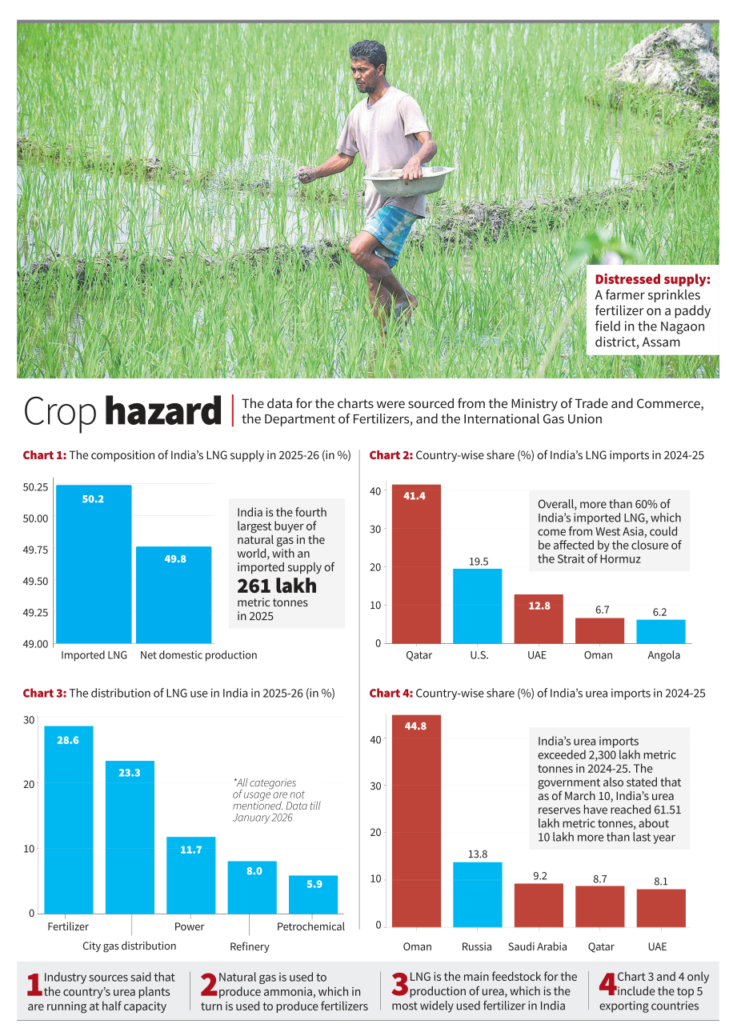
Supply Shock: The combined disruption across these major nodes has removed millions of barrels from the daily global supply, causing acute stress in aviation, shipping, and fertilizer production.
Sanction Easing: Due to these extreme price pressures, the U.S. Treasury recently issued temporary licenses (March 12, 2026) to allow some Russian oil already at sea to reach markets, despite ongoing sanctions.
Paper-III: General Studies 2
Paper-IV: General Studies 3
Despite assurance from Centre, MGNREGS workers denied work Context: From Bihar to Rajasthan, thousands of rural workers say work has been halted; as the Centre continues talks with the States on the VB-G RAM G Act, some district officials say they have been directed not to start new work under the old scheme.
For the past 87 days, MGNREGS workers have been protesting at the Muzaffarpur district headquarters in Bihar. The Union government had assured them that until the Viksit Bharat-Guarantee for Rozgar and Ajeevika Mission (Gramin) (VB-G RAM G) Act, 2025, passed by Parliament in December, is rolled out, the Mahatma Gandhi National Rural Employment Guarantee Scheme (MGNREGS) will continue unchanged. But on the ground, workers say the story is very different.
The protest in Muzaffarpur began on January 2. Nearly 12,000 workers in the district have not received work for the past three or four months — even before the new rural employment law was introduced.
Uncertainty continues
There is no clarity on when the new scheme under the VB-G RAM G Act will be implemented on the ground, as the Centre is still holding talks with the States to establish the necessary framework.
“Usually, no work is given during the rain. We waited for the monsoon to end, then for the waterlogged areas to drain. By December, the MGNREGA season normally begins. But despite repeated demand, no work has been provided.
This is a blatant violation of the law,” said Sanjay Sahni of MGNREGA Watch-Bihar, an organisation working with rural workers. Facing repeated rejections, around 16,000 workers — most of them women — gathered at the district headquarters to demand work. A delegation also travelled to Delhi on March 25 to meet senior officials in the Rural Development Ministry.
“The district officials claim they have instructions not to start any new work. But the Ministry officials insist that no such order exists,” Mr. Sahni said. He wonders whether it is lack of information or whether there is an informal signal from the Centre to stop all work under the MGNREGS.
Ground reality
In Dungarpur district of Rajasthan, similar complaints have emerged. At Balwarha panchayat, around 40 women workers arrived on March 23 to complete paperwork for April’s work cycle. Panchayat officials asked them to return later, citing a lack of clarity. On Saturday, they were told that the MGNREGS had been discontinued and no further work would be available under the scheme.
At Padarmarhi Mewarha panchayat, nearly 30 women workers sat for four hours last Friday, demanding work for the first week of April. Local officials initially claimed that directions had been issued not to start new MGNREGS works. After the women refused to leave, their applications were eventually accepted, but uncertainty continues whether any work will actually be assigned.
“For each household, MGNREGA work brings in about ₹25,000 to ₹28,000 annually. In some women-led households, MGNREGA and government pensions are the only sources of income,” said Madhulika of the Rajasthan Asangathit Mazdoor Union.
“There are no formal orders. The VB-G RAM G Act clearly states that until it is implemented, MGNREGA will continue. But on the ground, we are being told otherwise,” she said.
KAS Current Affairs: Current Affairs is the living pulse of the KPSC syllabus. It is not a standalone subject to be memorized in isolation; rather, it is a dynamic thread that weaves together History, Economy, Polity, and Ethics across both the Preliminary and Main stages. In the context of the upcoming examinations, transitioning from simply “reading the news” to “studying the syllabus through the news” is the critical shift that separates a serious aspirant from a casual reader.
The “Syllabus-First” Philosophy By following a current affairs pattern strictly mapped to the KPSC syllabus, you ensure that every hour spent reading the newspaper is an hour spent building your exam rank.
Preliminary Examination
Paper-I: Current Events of National and International Importance
India signs ₹858-cr. defence deals with Russian, U.S. firms Context: The Ministry of Defence signed contracts worth ₹858 crore for the procurement of air defence systems for the Army and maintenance support for the Navy’s reconnaissance fleet, reinforcing India’s balanced defence partnerships with Russia and the United States.
A contract worth ₹445 crore was signed with Russian agency JSC Rosoboronexport for the procurement of the Tunguska Air Defence Missile System for the Army. The system is expected to significantly enhance India’s multi-layered air defence capabilities against aerial threats such as aircraft, drones and cruise missiles, while further strengthening the Indo-Russian strategic defence partnership.
In a parallel move, the Ministry signed a ₹413-crore contract with U.S. firm Boeing India Defense Private Limited for depot-level inspection of the Navy’s P-8I Long-Range Maritime Reconnaissance Aircraft under the ‘Buy Indian category with 100% Indigenous Content’.
The contract will enable in-country maintenance, repair and overhaul (MRO) of the P-8I fleet, enhancing operational readiness, in line with the government’s Aatmanirbhar Bharat and Make in India push. The agreements underline India’s focus on strengthening combat capabilities.
Stronger trade corridors and supply chains needed, says Jaishankar Context: External Affairs Minister S. Jaishankar’s recent address at the G7 Foreign Ministers’ Meeting in France (March 2026) highlights a critical shift in India’s strategic focus toward resilient trade corridors and supply chain security. This comes at a high-stakes moment, as the conflict in West Asia—which began on February 28, 2026—enters its second month, directly threatening the global economy.
Key Highlights: Jaishankar at G7 (March 2026)
The “Resilience” Mandate Against the backdrop of the U.S.-Israel war against Iran, Jaishankar argued that traditional trade routes are increasingly vulnerable. The Problem: The Strait of Hormuz (controlled by Iran) is currently a flashpoint. Since 20% of the world’s energy passes through it, the conflict has caused immediate “shocks” in food, fuel, and fertilizer markets. The Solution: India is pushing for “Resilient Trade Corridors” that can bypass single-point chokepoints. This isn’t just about speed; it’s about economic survival for the Global South.
IMEC and the “FTA Advantage” A major focus was the India-Middle East-Europe Economic Corridor (IMEC). Jaishankar noted that the project is now more relevant than ever due to: India-EU FTA: The political conclusion of the India-European Union Free Trade Agreement in January 2026 (expected to enter force by 2027) provides the legal and economic framework to make IMEC viable. Synergy: Combined with the EFTA (European Free Trade Association) and UK FTA, IMEC is no longer just a connectivity project but a high-utility trade highway linking India to the heart of Europe.
Freedom of Navigation & Narco-Terrorism Jaishankar underscored two non-traditional security threats: Freedom of Navigation: With merchant shipping under attack in the Gulf and Red Sea, India insists that international waterways must remain open for global economic security. Narco-Terror Linkages: He raised concerns about the “Captagon” synthetic drug trade and organized crime, which thrive in conflict zones and fund destabilizing activities.
Strategic Context: The West Asia Crisis
Aspect
Current Reality (March 2026)
Energy Security
India has expanded crude oil imports to 41 countries and is rapidly filling its Strategic Petroleum Reserves (targeting 65+ lakh metric tonnes).
Diaspora Safety
Over 375,000 Indians have been evacuated from the Gulf region since the war began.
Trade Impact
Direct shipping costs have spiked due to the closure/risk of the Strait of Hormuz, making MD15 (Methanol) fuel and other domestic alternatives a priority for the Indian economy.
India’s Stance: “Pragmatic Neutrality” Notably, while India has called for an end to the conflict and expressed concern over civilian lives, it has maintained strategic autonomy. India has: Avoided direct condemnation of U.S. or Israeli military actions. Focused on dialogue and diplomacy to reopen trade routes. Positioned itself as the “Voice of the Global South,” ensuring that the concerns of developing nations (who suffer most from fuel/fertilizer inflation) are heard by the G7.
Paper-II: Current Events of State Importance and Important Government Schemes and Programs
Main Examination
Paper-I: Essays
Essay – 1: Topic of International/National Importance
“While the G7 views the West Asian conflict through the lens of ‘Global Security and Democratic Solidarity,’ the BRICS+ framework emphasizes ‘Strategic Autonomy and Multi-polarity.’ Evaluate the conflicting and converging roles of these two blocs in mediating the 2026 U.S.-Israel-Iran war.”
“The inability of the UN Security Council to prevent the escalation of the U.S.-Israel-Iran conflict has led to the ‘Club-based Diplomacy’ of the G7 and BRICS. Assess whether this shift toward informal blocs strengthens or weakens global peace and stability.”
Essay-2: Topic of State importance/Local Importance
Paper-II: General Studies 1
Paper-III: General Studies 2
Zojila Pass, which connects the Kashmir Valley with Ladakh
Context: The Zojila Pass, situated at an altitude of approximately 3,528 meters (11,575 feet), is one of the most strategic and treacherous mountain passes in the world. It serves as the vital terrestrial link between the Kashmir Valley (Srinagar) and the high-altitude desert of Ladakh (Kargil and Leh) via National Highway 1 (NH-1).
Strategic and Geographical Significance The Gateway: It acts as the natural divide between the lush, green Kashmir Valley and the arid, brown mountains of the Dras and Suru Valleys. Military Lifeline: It is the primary route for transporting military logistics, fuel, and essential supplies to the troops stationed along the Line of Actual Control (LAC) and the Siachen Glacier. Historical Feat (Operation Bison): In 1948, during the Indo-Pakistani War, the Indian Army made history by deploying Stuart light tanks at this altitude to recapture the pass—the highest altitude at which tanks have ever been used in combat.
Current Status & Recent Events (March 2026) Recent Avalanche (March 27, 2026): Just days ago, a massive snow avalanche struck near “Zero Point” on the Zojila Pass. Tragically, several vehicles were buried, leading to the loss of seven lives. This event has highlighted the persistent dangers of the pass, especially during the spring when rising temperatures destabilize heavy snow layers.
The Zojila Tunnel: A Game Changer To solve the problem of seasonal isolation, the Zojila Tunnel project is currently under construction.Length: At 14.15 km, it will be India’s longest road tunnel and Asia’s longest bi-directional tunnel.Progress (March 2026): The project has achieved approximately 60% physical progress. A critical breakthrough (where both ends of the tunnel meet) is expected by May 2026.Impact: Once completed (targeted for late 2027 to 2028), it will reduce the travel time across the pass from 3.5 hours to just 15 minutes. Crucially, it will provide all-weather connectivity, ensuring Ladakh is never cut off from the rest of India.
Quick Comparison: Pass vs. Tunnel
Feature
Zojila Pass (Current)
Zojila Tunnel (Future)
Travel Time
~3 to 4 hours
~15 minutes
Condition
Seasonal (closed in peak winter)
All-weather (365 days)
Safety
High avalanche/landslide risk
Avalanche-proof corridor
Connectivity
Narrow, steep hairpin bends
Modern 2-lane highway
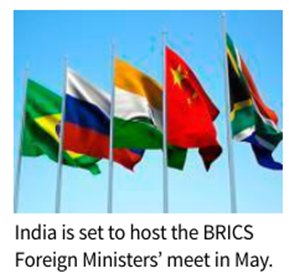
Amid conflict, India sends out invites for key BRICS meetings Context: Hoping to forge an elusive consensus over the war in West Asia, New Delhi is going ahead with planning key meetings of BRICS countries this year in India, and has sent out invitations for the BRICS Foreign Ministers’ Meeting to be held in May and the 18th BRICS Summit in September.
According to officials and diplomats, the invitations to the 10-nation grouping that also includes Iran and the United Arab Emirates went out in mid-March. Both countries have rebuffed several attempts by India — the current Chair of BRICS — for a joint statement.
Officials said it is unclear whether they will attend the meeting together, but “as of now” the BRICS Foreign Ministers’ Meeting is due to be held in-person in mid-May.
The summit, which could bring Russian President Vladimir Putin, Chinese President Xi Jinping and leaders from Brazil, South Africa, Egypt, Ethiopia, Indonesia, Iran and the UAE together in Delhi, is expected to be held on September 9-10.
“One of the key events on the political track, in addition to the traditional leaders’ meeting [in September], will be the BRICS Foreign Ministers’ Meeting, scheduled for May,” Russian government spokesperson Maria Zakharova told journalists in Moscow this week.
“This will be a good opportunity for a thorough discussion of current issues on the international agenda, the role of BRICS in the world, and opportunities for joint action,” she said, responding to questions about how the grouping would tackle the war in West Asia.
Diplomats have openly acknowledged difficulties in forging a statement that is agreeable to both Tehran and Abu Dhabi. “We have an ongoing conversation with BRICS members on the conflict in West Asia,” External Affairs Ministry spokesperson Randhir Jaiswal said at a media briefing on Friday.
“As you’re aware, some of the BRICS members are also involved directly in the conflict… Because we have differing opinions, it has been difficult for us to forge a consensus on this particular conflict.”
In June 2025, the BRICS then chaired by Brazil had managed to issue a strong statement when the U.S. and Israel jointly struck a number of Iranian nuclear sites, condemning the military strikes against Iran.
G-7 allies press Rubio for clarity on American plans for Iran war Context: G-7 allies were pressing U.S. Secretary of State Marco Rubio for clarity on American plans for Iran almost one month into the war in the West Asia, with concern also intensifying over the extent of cooperation between Russia and the Islamic republic.
German Foreign Minister Johann Wadephul said the international community needed to collaborate even more closely now it was dealing with two wars — including the conflict sparked by Moscow’s invasion of Ukraine — in which Russia and Iran were cooperating.
In contrast to usual protocol, and in a sign of the distance between the United States and its allies, there is to be no joint communique at the end of the meeting.
The UK’s Foreign Minister Yvette Cooper urged a “swift resolution to this conflict that restores regional stability”.
Mr. Rubio said earlier that it was in the “interest” of all G-7 nations to push for the reopening of the Strait of Hormuz.
Paper-I: Current Events of National and International Importance
Paper-II: Current Events of State Importance and Important Government Schemes and Programs
Main Examination
Paper-I: Essays
Essay – 1: Topic of International/National Importance
“From the NALSA Judgment to the 2026 Amendment Bill: An Analysis of the Right to Self-Identification, Challenges of Medical Screening, and the Constitutional Conflict in the Pursuit of Social Justice for Transgender Persons.”
Essay-2: Topic of State importance/Local Importance
“Karnataka is past its demographic peak: Discuss the strategic shift required from ‘Generating Employment’ to ‘Ensuring Job Quality’ to sustain the state’s economic growth.”
Paper-II: General Studies 1
‘Only 5% of households received mandated 100 days of employment under MGNREGA’ Context: Even as the Congress government in Karnataka opposed any move to dilute the Mahatma Gandhi National Rural Employment Guarantee Act (MGNREGA) by the Centre, a report by the Comptroller and Auditor General of India (CAG) flagged several shortcomings in the scheme’s implementation in the State.
The CAG report, tabled in the Legislative Assembly for the period 2019–20 to 2023–24, noted that only 5% of households received the mandated 100 days of employment.
Most households were provided just 1 to 30 days of work, while demand for employment did not exceed 48% of issued job cards during the audit period.
Contract management
The report highlighted irregularities in contract management, stating that outsourcing contracts were extended without fresh tenders, leading to higher service charges. It also pointed to violations in recruitment, where contract staff were hired without adhering to reservation norms, resulting in inadequate representation of women, Scheduled Castes, Scheduled Tribes, and persons with disabilities.
Further, the audit found gaps in data systems, noting that NREGASoft lacked provisions to track employment demand and allocation for vulnerable groups such as nomadic tribes and HIV-positive individuals. Cross-verification with housing scheme records indicated their significant exclusion from the programme.
Serious financial irregularities were flagged, including fraudulent payments for completed or non-existent housing works, payments to ineligible beneficiaries, and fabrication of records in projects such as solid waste management, check dams, and social forestry.
Pendency rate
While ombudspersons had been appointed across districts, the report noted a high pendency rate of 59% in grievance disposal, with less than 20% of imposed penalties actually recovered.
The audit observed a decline in wage expenditure during 2022–23 and 2023–24, underutilisation of funds under the material component, and inadmissible administrative expenditure of ₹32.78 crore. Additionally, Aadhaar mapping remained incomplete for 3.11 lakh workers out of 84.98 lakh active workers as of March 2024, with ₹35.10 crore worth of transactions pending due to rejected payments.
The CAG observed irregularities such as printing of muster rolls without utilising NREGASoft and irregular payments on such manipulated muster rolls.
The State government has urged the Centre to scrap the “Viksit Bharat–Guarantee for Rozgar Ajeevika Mission (Gramin)” and restore MGNREGA in its original form to safeguard employment and livelihoods for rural workers.
Karnataka received less than 50% of funds allocated by Centre under JJM: Audit report Context: Karnataka received less than 50% of the funds allocated by the Centre under the Jal Jeevan Mission (JJM), primarily due to poor utilisation of released funds, according to a report by the Comptroller and Auditor General of India (CAG).
The report, tabled in the Legislative Assembly, for the period 2019-20 to 2023-24, noted that the State received ₹11,189.37 crore — about 45% of the total allocation of ₹24,819.48 crore.
It attributed low fund utilisation to the reduced engagement of implementation support agencies. Spending on water quality monitoring and surveillance dropped sharply, from 50% in 2019-20 to just 2% in 2023-24, leading to infrastructure gaps such as inadequate water testing laboratories and equipment.
The audit further highlighted negligible community participation, with only ₹22.75 crore mobilised against an expected ₹1,594.90 crore.
Delays of three to nine months in submitting utilisation certificates and audited accounts contributed to the State not receiving the remaining central assistance.
The findings are seen as a setback for the State government, which has been criticising the Union government for insufficient fund release under the scheme, implemented by the Rural Development and Panchayat Raj Department.
Against a target of 72.14 lakh households, tap water connections were provided to 47.62 lakh households (66%) as of November 2024. The shortfall was attributed to delays in tendering, execution of works without ensuring land availability, and slow approvals, the report said.
Paper-III: General Studies 2
Karnataka home to 274 springs; Belagavi district tops list with 59 Context: The Karnataka Minor Irrigation and Groundwater Development Department has successfully completed the State’s first spring census. According to the census, 274 springs have been enumerated across 31 districts, with Belagavi reporting the highest number with 59.
Hot spring
The census also noted that there is one hot spring at Bendru Theertha in Dakshina Kannada district.
B.K. Pavithra, Secretary, Minor Irrigation and Groundwater Development Department, said that despite the logistical challenges posed by the monsoon, field enumerators leveraged a digital framework to successfully identify and document a total of 247 springs.
Highlighting the regional distribution and ecological health of these waterbodies, he added: “Our data reveals that Belagavi district leads the State, reporting the highest number with 59 springs. Furthermore, a significant majority of these vital water sources remain active, with 144 springs classified as perennial and 114 as seasonal, while 16 have dried up over time.”
Key rivers
The census report has mapped the origins of key rivers to these springs, noting that the Cauvery originates at Talacauvery in Kodagu, the Hemavati at Javali in Chikkamagaluru, and the Sharavati at Ambutheertha in Shivamogga.
This digitised data will now serve as a foundational database for future spring conservation, rejuvenation projects, groundwater management, and comprehensive water resource planning across Karnataka.
Springs are natural outlets where groundwater flows to the surface through openings in the earth’s crust. They typically occur when the water table intersects with the ground surface or when groundwater is forced out through fractures, faults, or permeable rock layers.
Western Ghats
“The Western Ghats and Malnad region, including districts like Kodagu, Chikkamagaluru, Uttara Kannada, Dakshina Kannada, Belagavi, and Shivamogga, are primary hubs for spring formation due to high rainfall and favourable geological conditions. Owing to a unique hydrological feature, a hot spring in Bendru Theertha, is located in Dakshina Kannada district,” the Karnataka Minor Irrigation and Groundwater Development Department added.
The department has received a certificate of appreciation from the Union Ministry of Jal Shakti for its first sprint census.
‘State past its demographic peak, job quality is key’ Context: The median age for Karnataka, as per report, is 32; the highest is recorded by Kerala at 39.
Karnataka has entered a state of demographic transition where a large working-age population will no longer be enough to drive economic growth, and future gains will depend on how productively people are employed, the ‘State of Working India 2026’ report said.
The report by Azim Premji University was released here on Tuesday. It examines how India’s school-to-work transition has evolved over the last 40 years.
Among ‘older’ States
The report places Karnataka among relatively “older” Indian States, alongside Kerala and Tamil Nadu, where the share of the working-age population is no longer rising significantly. In economic terms, this means that the boost to growth that comes from a rising working-age population, the demographic dividend, has largely played out.
According to the report, India is still young (with more young people entering the workforce currently), with a median age of 28, and accounts for a significant share of the world’s youth population. However, this window is narrowing quickly. The number of young people has already begun to decline, it said. The report highlights that the demographic dividend only translates into economic growth if there are enough jobs for people to take up. Without job creation, a large working-age population can just as easily become a burden.
Sharp contrasts
The State-level picture shows sharp contrasts. While southern and western States such as Karnataka are ageing faster and must now depend on productivity gains, northern States like Uttar Pradesh and Bihar still have a growing youth population. The median age for Karnataka, as per the report, is 32. The highest is recorded by Kerala at 39, while Bihar has the lowest median age of 22.
The report finds that younger States are not necessarily doing better at employing their youth. When it comes to overall employment, there is little difference between younger and older States. However, older and more industrialised States, including Karnataka, perform better in generating regular salaried jobs, which are typically more stable and better paid than casual or self-employment.
The link between economic growth and job quality is crucial here, the report said. States such as Karnataka, Gujarat and Tamil Nadu, which have seen relatively stronger economic growth, also show a clearer rise in salaried employment among young people. In contrast, poorer States have struggled to convert growth into such jobs at the same pace.
At the national level, the report traces how young Indians have moved between education and work over the past 40 years. Within education, enrollment among teenagers (15-19 years) has risen sharply since the 1980s, with girls nearly closing the gap with boys. More young people are staying in school longer, and more are entering higher education than before, the report said.
Employment story
But the employment story is more uneven. Between 2004-05 and 2017-18, rising education levels meant fewer young people were working, as they stayed in school or college longer. Since 2017-18, however, this trend has reversed. Employment among youth has increased but partly because some are leaving education earlier.
This shift is particularly visible among young men. Data shows a noticeable decline in the share of boys aged 15-19 in education in recent years, including in secondary and higher secondary levels. This decline began around the pandemic period and has not fully reversed, the report notes.
Young women
Among young women, the trend is different. The recent rise in employment has come mainly from fewer women remaining outside both education and work, rather than from dropping out of education. However, female workforce participation remains a major concern. A large share of women in their early 20s are still neither studying nor employed, the report mentioned, pointing to persistent structural and social barriers.
SC status only for Hindus, Buddhists, Sikhs: top court
Context: Conversion to any other religion will lead to complete loss of Scheduled Caste status, regardless of birth, says Supreme Court Bench as it invokes Clause 3 of Constitution (Scheduled Castes) Order.
The Supreme Court held in a judgment that a person professing any religion other than Hinduism, Buddhism, or Sikhism should not be considered a member of a Schedule Caste community.
The court concluded that conversion to any other religion would result in “immediate and complete loss of Scheduled Caste status from the moment of conversion, regardless of birth”.
A Bench of Justices Prashant Kumar Mishra and Manmohan invoked Clause 3 of the Constitution (Scheduled Castes) Order, 1950, which mandates that “no person who professes a religion different from Hinduism shall be deemed to be a member of a Scheduled Caste”. The Sikh religion was added to the ambit of Clause 3 in 1956. The provision was further amended in 1990 to include persons professing Buddhism.
“This bar under Clause 3 of the Constitution (Scheduled Castes) Order, 1950 is categorical and absolute,” Justice Mishra, who authored the judgment, interpreted the 1950 Order.
The court was hearing an appeal filed by Chinthada Anand, who was born a Hindu-Madiga (Scheduled Caste) but converted to Christianity to become a pastor.
Mr. Anand had filed a case under the Scheduled Castes and Scheduled Tribes (Prevention of Atrocities) Act of 1989 after he alleged that he had suffered repeated attacks and caste slurs.
The Andhra Pradesh High Court, in a decision in April last year, quashed the criminal proceedings on the ground that Mr. Anand could no longer claim protection under the 1989 Act as he professed Christianity and had been a pastor for about a decade. The High Court was of the view that the caste system was not recognised in Christianity.
Confirming the High Court’s decision in the plea by Mr. Anand, the top court drew attention to the term “profess” in Clause 3 of the 1950 Order.
“The term ‘profess’ connotes to publicly declare or practice a religion. The essence of the word lies in the open avowal of one’s religious beliefs in a manner discernible to the public at large. It is not merely a question of personal belief or private conviction, but requires an outward manifestation of one’s faith. It may be observed that Christianity, by its very theological foundation, does not recognise or incorporate the institution of caste,” Justice Mishra said.
The top court said a convert who did not profess any of the three religions in Clause 3 of the 1950 Order could not claim any “statutory benefit, protection, reservation or entitlement” of a Scheduled Caste (SC) member. Justice Mishra said the bar admitted no exception. A person cannot simultaneously profess and practice a religion other than the ones specified in Clause 3 and claim membership of a Scheduled Caste at the same time, the court said.
“A person who professes and practices such religion for personal, social and spiritual purposes cannot, in law, assert membership of a Scheduled Caste for the purpose of securing statutory benefits. The two positions are mutually exclusive and contrary to the Constitutional scheme,” Justice Mishra observed. A person claiming to have “re-converted” to Hinduism, Sikhism, or Buddhism must “cumulatively and conclusively establish” clear proof of his earlier caste; provide credible and unimpeachable evidence of bona fide reconversion to the original religion; and show satisfactory evidence that members of his original caste have accepted and assimilated him into the community. The court said renunciation of the new religion by the convert must be unequivocal. It should translate to the adoption and observance of the customs, usages, practices, rituals, and religious obligations of the original caste. Failure to establish even one condition renders the claim of re-conversion unsustainable, the court said.
The judgment also dealt with the Constitution (Scheduled Tribes) Order, 1950, which did not prescribe religion-based exclusion as in the case of the Scheduled Caste community. Justice Mishra said a person could claim benefits under the Constitution (Scheduled Tribes) Order, 1950, only if he or she continued to belong to that particular tribe “in substance”.
LS passes new transgender Bill as MPs stage walkout Context: Amid an Opposition-led walkout, the Lok Sabha passed by voice vote the Transgender Persons (Protection of Rights) Amendment Bill, 2026, which proposes to remove transgender people’s right to self-determination of gender, and introduces a clause for examination by a medical board to determine their gender.
The Bill sought to stop adults and children from being “forced or compelled” to become or present as transgender persons through hormone therapy or other interventions and strengthened punishments for crimes against transgender persons.
Paper-IV: General Studies 3
AssamSAT: Assam floats tender for satellites to monitor floods Context: Chief Minister Sarma announced the project in the 2025-26 State Budget; The procurement is for at least five satellites in low-earth orbit.
Assam has become the first Indian State to float a tender for a group of earth-observation satellites that it says will strengthen disaster response along the flood-prone Brahmaputra valley and help survey the State’s borders.
The Assam Science Technology and Environment Council issued an Expression of Interest (EOI) on March 16 inviting private aerospace companies to design, build, launch, operate, and eventually transfer the satellites to State ownership. The mission has been named AssamSAT.
Chief Minister Himanta Biswa Sarma announced the project in the 2025-26 State Budget as a means to achieve what he has repeatedly described as an “infiltration-free Assam”.
Mr. Sarma has argued that conventional border fencing is inadequate for the State’s chars, the seasonally inundated river islands along the Bangladesh border, and that real-time satellite monitoring is the sole practical alternative.
The procurement is structured around at least five satellites in low-earth orbit. The brief EOI doesn’t say whether the satellites will operate separately or together, in a constellation. As Per the brief, qualifying parties can avail the full EOI for a fee of ₹30,000.
Assuming it’s a constellation, the satellites will be able to scan the same part of the ground once every few hours and map it at high resolution — a useful task for disaster response during floods, where the extent of waters can change within hours.
The EOI also doesn’t specify the sensors the satellites will carry. But since the State has cloudy weather for almost half the year, the satellites may carry synthetic aperture radars (SAR), whose gaze can pierce clouds and darkness.
Currently, State disaster management agencies seeking satellite data must submit requests to the National Remote Sensing Centre, which will process and fulfill those requests.
The State sits close to the Siliguri Corridor, a strip of land colloquially called the chicken’s neck that physically connects the Northeast to the rest of India, and which State and Central security agencies have been preoccupied with monitoring.
Mr. Sarma has also extended the satellite’s mandate to include tracking drug-trafficking routes and monitoring poaching in the Kaziranga National Park.
In 2024, NewSpace India, Ltd. cleared a private-sector earth observation constellation led by Dhruva Space and Pixxel.
The plan combines small satellites carrying optical and hyperspectral sensors in low-earth orbit to deliver near real-time imagery for agriculture, disaster response, and national security users while being owned and operated by industry.
Paper-V: General Studies 4
Ethics Case Study: The Harish Rana Landmark Judgment
The case of Harish Rana is a profound intersection of medical ethics, constitutional law, and human compassion. It serves as a landmark Ethics Case Study for those analyzing the concepts of “Right to Life” versus “Right to Die with Dignity.”
1. Case Summary In a historic first for India, the Supreme Court permitted the withdrawal of Clinically Assisted Nutrition and Hydration (CANH) for 32-year-old Harish Rana. Rana had been in a Permanent Vegetative State (PVS) for 13 years following a tragic fall in 2013 that left him with 100% quadriplegic disability. Following the legal withdrawal of life support, Rana passed away at AIIMS Delhi. In a final act of altruism, his family donated his corneas and heart valves.
2. Key Ethical Dilemmas
Sanctity of Life vs. Quality of Life: While Article 21 of the Indian Constitution guarantees the “Right to Life,” does this mandate the mechanical preservation of a body in a state where there is zero clinical hope of recovery or consciousness?
Non-Maleficence (Do No Harm): Is it more harmful to “let go” or to continue invasive medical interventions that merely prolong a vegetative existence without the patient’s consent?
Parental Autonomy vs. Moral Duty: The struggle of parents who must decide between the instinct to keep a child alive and the compassionate duty to end their prolonged suffering.
Altruism in Grief: The ethical strength required to pivot from a moment of profound loss to the decision of organ donation, benefiting strangers while the family is in mourning.
3. Analytical Framework for Ethics
Perspective
Ethical Application
Utilitarianism
Focuses on the “greatest happiness.” Prolonging a vegetative state for 13 years causes immense emotional and financial “disutility” to the family and the state with no “utility” (recovery) for the patient.
Deontology (Duty)
Doctors have a duty to preserve life (Hippocratic Oath), but they also have a duty to respect human dignity. The court ruled that “prolonging agony” is a violation of that duty.
Virtue Ethics
The family’s decision to donate organs reflects the virtues of Compassion, Fortitude, and Selflessness, turning a private tragedy into a public good.
4. Legal & Ethical Evolution in India
Aruna Shanbaug Case (2011): The starting point for the conversation on passive euthanasia in India.
Common Cause vs. Union of India (2018): Recognized that the “Right to Life” includes the “Right to Die with Dignity,” establishing the concept of a Living Will.
The Rana Judgment (2026): Goes a step further by allowing the withdrawal of basic nutrition/hydration in specific clinical scenarios, moving past just “ventilator support.”
Conclusion The Harish Rana case teaches us that Compassion is sometimes found in the courage to let go. It reinforces the ethical principle that the “Right to Life” is not merely about biological existence, but about the dignity of the human spirit. His family’s decision to donate organs serves as a powerful testament to the idea that life can have meaning and impact even after it has technically ended.
Paper-I: Current Events of National and International Importance
Paper-II: Current Events of State Importance and Important Government Schemes and Programs
Karnataka received less than 50% of funds allocated by Centre under JJM: Audit report
Context: Karnataka received less than 50% of the funds allocated by the Centre under the Jal Jeevan Mission (JJM), primarily due to poor utilisation of released funds, according to a report by the Comptroller and Auditor General of India (CAG).
The report, tabled in the Legislative Assembly on Tuesday, for the period 2019-20 to 2023-24, noted that the State received ₹11,189.37 crore — about 45% of the total allocation of ₹24,819.48 crore.
It attributed low fund utilisation to the reduced engagement of implementation support agencies. Spending on water quality monitoring and surveillance dropped sharply, from 50% in 2019-20 to just 2% in 2023-24, leading to infrastructure gaps such as inadequate water testing laboratories and equipment.
The audit further highlighted negligible community participation, with only ₹22.75 crore mobilised against an expected ₹1,594.90 crore.
Delays of three to nine months in submitting utilisation certificates and audited accounts contributed to the State not receiving the remaining central assistance.
The findings are seen as a setback for the State government, which has been criticising the Union government for insufficient fund release under the scheme, implemented by the Rural Development and Panchayat Raj Department.
Against a target of 72.14 lakh households, tap water connections were provided to 47.62 lakh households (66%) as of November 2024. The shortfall was attributed to delays in tendering, execution of works without ensuring land availability, and slow approvals, the report said.
Main Examination
Paper-I: Essays
Essay – 1: Topic of International/National Importance
“Discuss the historical background, legislative journey, and political implications of women’s reservation in the Indian Parliament and State Assemblies. In your answer, critically evaluate the proposed constitutional amendments for increasing Lok Sabha seats and ensuring 33% representation for women by 2029.”
Essay-2: Topic of State importance/Local Importance
“Critically examine the implementation of the Jal Jeevan Mission in Karnataka. Why has the state been able to utilize only ₹11,189 crore out of the ₹24,819.48 crore allocated by the Centre? Discuss the challenges, audit findings, and suggest measures for effective utilization of funds to achieve the goal of providing piped drinking water to every household.”
Paper-II: General Studies 1
‘State past its demographic peak, job quality is key’ Context: The median age for Karnataka, as per report, is 32; the highest is recorded by Kerala at 39.
Karnataka has entered a state of demographic transition where a large working-age population will no longer be enough to drive economic growth, and future gains will depend on how productively people are employed, the ‘State of Working India 2026’ report said.
The report by Azim Premji University was released here on Tuesday. It examines how India’s school-to-work transition has evolved over the last 40 years.
Among ‘older’ States
The report places Karnataka among relatively “older” Indian States, alongside Kerala and Tamil Nadu, where the share of the working-age population is no longer rising significantly. In economic terms, this means that the boost to growth that comes from a rising working-age population, the demographic dividend, has largely played out.
According to the report, India is still young (with more young people entering the workforce currently), with a median age of 28, and accounts for a significant share of the world’s youth population. However, this window is narrowing quickly. The number of young people has already begun to decline, it said. The report highlights that the demographic dividend only translates into economic growth if there are enough jobs for people to take up. Without job creation, a large working-age population can just as easily become a burden.
Sharp contrasts
The State-level picture shows sharp contrasts. While southern and western States such as Karnataka are ageing faster and must now depend on productivity gains, northern States like Uttar Pradesh and Bihar still have a growing youth population. The median age for Karnataka, as per the report, is 32. The highest is recorded by Kerala at 39, while Bihar has the lowest median age of 22.
The report finds that younger States are not necessarily doing better at employing their youth. When it comes to overall employment, there is little difference between younger and older States. However, older and more industrialised States, including Karnataka, perform better in generating regular salaried jobs, which are typically more stable and better paid than casual or self-employment.
The link between economic growth and job quality is crucial here, the report said. States such as Karnataka, Gujarat and Tamil Nadu, which have seen relatively stronger economic growth, also show a clearer rise in salaried employment among young people. In contrast, poorer States have struggled to convert growth into such jobs at the same pace.
At the national level, the report traces how young Indians have moved between education and work over the past 40 years. Within education, enrollment among teenagers (15-19 years) has risen sharply since the 1980s, with girls nearly closing the gap with boys. More young people are staying in school longer, and more are entering higher education than before, the report said.
Employment story
But the employment story is more uneven. Between 2004-05 and 2017-18, rising education levels meant fewer young people were working, as they stayed in school or college longer. Since 2017-18, however, this trend has reversed. Employment among youth has increased but partly because some are leaving education earlier.
This shift is particularly visible among young men. Data shows a noticeable decline in the share of boys aged 15-19 in education in recent years, including in secondary and higher secondary levels. This decline began around the pandemic period and has not fully reversed, the report notes.
Young women
Among young women, the trend is different. The recent rise in employment has come mainly from fewer women remaining outside both education and work, rather than from dropping out of education. However, female workforce participation remains a major concern. A large share of women in their early 20s are still neither studying nor employed, the report mentioned, pointing to persistent structural and social barriers.
‘Only 5% of households received mandated 100 days of employment under MGNREGA’ Context: Even as the Congress government in Karnataka opposed any move to dilute the Mahatma Gandhi National Rural Employment Guarantee Act (MGNREGA) by the Centre, a report by the Comptroller and Auditor General of India (CAG) flagged several shortcomings in the scheme’s implementation in the State.
The CAG report, tabled in the Legislative Assembly for the period 2019–20 to 2023–24, noted that only 5% of households received the mandated 100 days of employment.
Most households were provided just 1 to 30 days of work, while demand for employment did not exceed 48% of issued job cards during the audit period.
Contract management
The report highlighted irregularities in contract management, stating that outsourcing contracts were extended without fresh tenders, leading to higher service charges. It also pointed to violations in recruitment, where contract staff were hired without adhering to reservation norms, resulting in inadequate representation of women, Scheduled Castes, Scheduled Tribes, and persons with disabilities.
Further, the audit found gaps in data systems, noting that NREGASoft lacked provisions to track employment demand and allocation for vulnerable groups such as nomadic tribes and HIV-positive individuals. Cross-verification with housing scheme records indicated their significant exclusion from the programme.
Serious financial irregularities were flagged, including fraudulent payments for completed or non-existent housing works, payments to ineligible beneficiaries, and fabrication of records in projects such as solid waste management, check dams, and social forestry.
Pendency rate
While ombudspersons had been appointed across districts, the report noted a high pendency rate of 59% in grievance disposal, with less than 20% of imposed penalties actually recovered.
The audit observed a decline in wage expenditure during 2022–23 and 2023–24, underutilisation of funds under the material component, and inadmissible administrative expenditure of ₹32.78 crore. Additionally, Aadhaar mapping remained incomplete for 3.11 lakh workers out of 84.98 lakh active workers as of March 2024, with ₹35.10 crore worth of transactions pending due to rejected payments.
The CAG observed irregularities such as printing of muster rolls without utilising NREGASoft and irregular payments on such manipulated muster rolls.
The State government has urged the Centre to scrap the “Viksit Bharat–Guarantee for Rozgar Ajeevika Mission (Gramin)” and restore MGNREGA in its original form to safeguard employment and livelihoods for rural workers.
Paper-III: General Studies 2
SC status only for Hindus, Buddhists, Sikhs: top court Context: Conversion to any other religion will lead to complete loss of Scheduled Caste status, regardless of birth, says Supreme Court Bench as it invokes Clause 3 of Constitution (Scheduled Castes) Order.
The Supreme Court held in a judgment that a person professing any religion other than Hinduism, Buddhism, or Sikhism should not be considered a member of a Schedule Caste community.
The court concluded that conversion to any other religion would result in “immediate and complete loss of Scheduled Caste status from the moment of conversion, regardless of birth”.
A Bench of Justices Prashant Kumar Mishra and Manmohan invoked Clause 3 of the Constitution (Scheduled Castes) Order, 1950, which mandates that “no person who professes a religion different from Hinduism shall be deemed to be a member of a Scheduled Caste”. The Sikh religion was added to the ambit of Clause 3 in 1956. The provision was further amended in 1990 to include persons professing Buddhism.
“This bar under Clause 3 of the Constitution (Scheduled Castes) Order, 1950 is categorical and absolute,” Justice Mishra, who authored the judgment, interpreted the 1950 Order.
The court was hearing an appeal filed by Chinthada Anand, who was born a Hindu-Madiga (Scheduled Caste) but converted to Christianity to become a pastor.
Mr. Anand had filed a case under the Scheduled Castes and Scheduled Tribes (Prevention of Atrocities) Act of 1989 after he alleged that he had suffered repeated attacks and caste slurs.
The Andhra Pradesh High Court, in a decision in April last year, quashed the criminal proceedings on the ground that Mr. Anand could no longer claim protection under the 1989 Act as he professed Christianity and had been a pastor for about a decade. The High Court was of the view that the caste system was not recognised in Christianity.
Confirming the High Court’s decision in the plea by Mr. Anand, the top court drew attention to the term “profess” in Clause 3 of the 1950 Order.
“The term ‘profess’ connotes to publicly declare or practice a religion. The essence of the word lies in the open avowal of one’s religious beliefs in a manner discernible to the public at large. It is not merely a question of personal belief or private conviction, but requires an outward manifestation of one’s faith. It may be observed that Christianity, by its very theological foundation, does not recognise or incorporate the institution of caste,” Justice Mishra said.
The top court said a convert who did not profess any of the three religions in Clause 3 of the 1950 Order could not claim any “statutory benefit, protection, reservation or entitlement” of a Scheduled Caste (SC) member. Justice Mishra said the bar admitted no exception. A person cannot simultaneously profess and practice a religion other than the ones specified in Clause 3 and claim membership of a Scheduled Caste at the same time, the court said.
“A person who professes and practices such religion for personal, social and spiritual purposes cannot, in law, assert membership of a Scheduled Caste for the purpose of securing statutory benefits. The two positions are mutually exclusive and contrary to the Constitutional scheme,” Justice Mishra observed. A person claiming to have “re-converted” to Hinduism, Sikhism, or Buddhism must “cumulatively and conclusively establish” clear proof of his earlier caste; provide credible and unimpeachable evidence of bona fide reconversion to the original religion; and show satisfactory evidence that members of his original caste have accepted and assimilated him into the community. The court said renunciation of the new religion by the convert must be unequivocal. It should translate to the adoption and observance of the customs, usages, practices, rituals, and religious obligations of the original caste. Failure to establish even one condition renders the claim of re-conversion unsustainable, the court said.
The judgment also dealt with the Constitution (Scheduled Tribes) Order, 1950, which did not prescribe religion-based exclusion as in the case of the Scheduled Caste community. Justice Mishra said a person could claim benefits under the Constitution (Scheduled Tribes) Order, 1950, only if he or she continued to belong to that particular tribe “in substance”.
LS passes new transgender Bill
Context: Amid an Opposition-led walkout, the Lok Sabha passed by voice vote the Transgender Persons (Protection of Rights) Amendment Bill, 2026, which proposes to remove transgender people’s right to self-determination of gender, and introduces a clause for examination by a medical board to determine their gender.
The MPs who walked out of the House were from parties such as the Congress, Samajwadi Party, Trinamool Congress, DMK, Shiv Sena (UBT), Nationalist Congress Party, and the CPI(M). Congress whip Manickam Tagore said they walked out as they were “not satisfied with the reply” of the Minister on the Bill. Transgender rights groups, civil society leaders, and several prominent members of the community condemned the passing of the Bill as an “injustice”.
Union Minister for Social Justice Virendra Kumar said the Bill sought to stop adults and children from being “forced or compelled” to become or present as transgender persons through hormone therapy or other interventions, and strengthened punishments for crimes against transgender persons. He said the Bill was aimed at empowering the transgender community.
Karnataka home to 274 springs; Belagavi district tops list with 59 Context: The Karnataka Minor Irrigation and Groundwater Development Department has successfully completed the State’s first spring census. According to the census, 274 springs have been enumerated across 31 districts, with Belagavi reporting the highest number with 59.
Hot spring
The census also noted that there is one hot spring at Bendru Theertha in Dakshina Kannada district.
B.K. Pavithra, Secretary, Minor Irrigation and Groundwater Development Department, said that despite the logistical challenges posed by the monsoon, field enumerators leveraged a digital framework to successfully identify and document a total of 247 springs.
Highlighting the regional distribution and ecological health of these waterbodies, he added: “Our data reveals that Belagavi district leads the State, reporting the highest number with 59 springs. Furthermore, a significant majority of these vital water sources remain active, with 144 springs classified as perennial and 114 as seasonal, while 16 have dried up over time.”
Key rivers
The census report has mapped the origins of key rivers to these springs, noting that the Cauvery originates at Talacauvery in Kodagu, the Hemavati at Javali in Chikkamagaluru, and the Sharavati at Ambutheertha in Shivamogga.
This digitised data will now serve as a foundational database for future spring conservation, rejuvenation projects, groundwater management, and comprehensive water resource planning across Karnataka.
Springs are natural outlets where groundwater flows to the surface through openings in the earth’s crust. They typically occur when the water table intersects with the ground surface or when groundwater is forced out through fractures, faults, or permeable rock layers.
Western Ghats
“The Western Ghats and Malnad region, including districts like Kodagu, Chikkamagaluru, Uttara Kannada, Dakshina Kannada, Belagavi, and Shivamogga, are primary hubs for spring formation due to high rainfall and favourable geological conditions. Owing to a unique hydrological feature, a hot spring in Bendru Theertha, is located in Dakshina Kannada district,” the Karnataka Minor Irrigation and Groundwater Development Department added.
The department has received a certificate of appreciation from the Union Ministry of Jal Shakti for its first sprint census.
Paper-IV: General Studies 3
Assam floats tender for satellites to monitor floods
Context: Chief Minister Sarma announced the project in the 2025-26 State Budget; The procurement is for at least five satellites in low-earth orbit.
Assam has become the first Indian State to float a tender for a group of earth-observation satellites that it says will strengthen disaster response along the flood-prone Brahmaputra valley and help survey the State’s borders.
The Assam Science Technology and Environment Council issued an Expression of Interest (EOI) on March 16 inviting private aerospace companies to design, build, launch, operate, and eventually transfer the satellites to State ownership. The mission has been named AssamSAT.
Chief Minister Himanta Biswa Sarma announced the project in the 2025-26 State Budget as a means to achieve what he has repeatedly described as an “infiltration-free Assam”.
Mr. Sarma has argued that conventional border fencing is inadequate for the State’s chars, the seasonally inundated river islands along the Bangladesh border, and that real-time satellite monitoring is the sole practical alternative.
The procurement is structured around at least five satellites in low-earth orbit. The brief EOI doesn’t say whether the satellites will operate separately or together, in a constellation. Per the brief, qualifying parties can avail the full EOI for a fee of ₹30,000.
Assuming it’s a constellation, the satellites will be able to scan the same part of the ground once every few hours and map it at high resolution — a useful task for disaster response during floods, where the extent of waters can change within hours.
The EOI also doesn’t specify the sensors the satellites will carry. But since the State has cloudy weather for almost half the year, the satellites may carry synthetic aperture radars (SAR), whose gaze can pierce clouds and darkness.
Currently, State disaster management agencies seeking satellite data must submit requests to the National Remote Sensing Centre, which will process and fulfill those requests.
The State sits close to the Siliguri Corridor, a strip of land colloquially called the chicken’s neck that physically connects the Northeast to the rest of India, and which State and Central security agencies have been preoccupied with monitoring.
Mr. Sarma has also extended the satellite’s mandate to include tracking drug-trafficking routes and monitoring poaching in the Kaziranga National Park.
In 2024, NewSpace India, Ltd. cleared a private-sector earth observation constellation led by Dhruva Space and Pixxel.
The plan combines small satellites carrying optical and hyperspectral sensors in low-earth orbit to deliver near real-time imagery for agriculture, disaster response, and national security users while being owned and operated by industry.
Paper-I: Current Events of National and International Importance
IEA chief warns oil shock worse than 1970s crises Context: The crisis in West Asia, he said, has had a worse impact on oil than the two oil shocks of the 1970s combined, and a worse effect on gas than the Russia-Ukraine war.
Comparison of Current West Asia Oil Shock vs 1970s Oil Crises & Russia–Ukraine Gas Shock
Russia’s invasion of Ukraine → Europe lost access to Russian gas pipelines.
Iran war & regional conflict damaging energy assets across 9 countries.
Oil Supply Loss
~10 million barrels/day combined (1973 + 1979).
Not oil-focused; mainly gas disruption.
~11 million barrels/day lost already – greater than both 1970s shocks combined.
Gas Supply Loss
Limited impact in 1970s (oil-centric).
~75 BCM lost in Europe.
~140 BCM lost – almost double Russia–Ukraine shock.
Economic Impact
Severe global recessions, inflation spikes, stagflation in many economies.
Europe faced energy crisis, high gas prices, inflation, industrial slowdown.
Inflation risk globally, petrochemical/fertilizer/helium trade disrupted, potential prolonged high prices.
Energy Assets
Oil fields & supply chains disrupted.
Pipelines & gas infrastructure targeted.
40 energy assets in 9 countries severely damaged.
Global Response
Strategic reserves, alternative suppliers, conservation measures.
LNG imports, diversification of supply, subsidies for households.
IEA released 400 million barrels of oil (historic largest release). Calls to reopen Hormuz Strait.
Long-Term Effect
Shift towards energy conservation, alternative sources, beginning of renewable debates.
Accelerated Europe’s transition to renewables & LNG diversification.
Could reshape global energy security, accelerate renewables, but immediate inflationary shock feared.
The current West Asia crisis is already worse in terms of oil and gas supply loss compared to both the 1970s oil shocks and the Russia–Ukraine gas shock.
Unlike earlier crises, this one affects multiple energy commodities (oil, gas, petrochemicals, fertilizers, helium, sulfur).
The IEA’s emergency release of 400 million barrels shows the scale of concern.
The Hormuz Strait remains the single most critical chokepoint for stabilising global energy flows.
Impact of Current West Asia Oil Shock on India
India, being the third-largest oil importer and heavily dependent on West Asian supplies, faces significant consequences from the ongoing crisis.
Dimension
Details
Energy Security
India imports ~85% of its crude oil, with a large share from West Asia. Disruption in supply raises risks of shortages and dependence on costlier alternatives.
Price Shock
Rising crude oil prices → higher petrol, diesel, LPG costs domestically. This fuels inflation, affecting households and industries.
Fiscal Pressure
Government spends more on subsidies (fuel, fertilizer, food) to shield citizens. This strains fiscal deficit and budgetary balance.
Trade Balance
Higher import bill worsens current account deficit (CAD), weakens rupee against dollar.
Industrial Impact
Petrochemical, fertilizer, and energy-intensive industries face higher input costs, reducing competitiveness.
Agriculture
Fertilizer prices rise due to disrupted global supply chains (sulfur, ammonia, urea). Farmers face higher costs.
Inflationary Ripple
Transport, logistics, and food prices rise, hitting poor households hardest.
Strategic Response
– India may tap Strategic Petroleum Reserves (SPR).<br/>- Diversify imports (Russia, U.S., Africa).<br/>- Accelerate renewable energy adoption (solar, wind, green hydrogen).
Geopolitical Position
India must balance relations with West Asian nations, U.S., and global energy markets to secure supplies.
India is highly vulnerable to West Asia’s oil shock due to import dependence.
The crisis could raise inflation, weaken rupee, and strain fiscal health.
It may also accelerate India’s push for renewable energy and diversification of supply sources.
Paper-II: Current Events of State Importance and Important Government Schemes and Programs
Main Examination
Paper-I: Essays
Essay – 1: Topic of International/National Importance
Essay-2: Topic of State importance/Local Importance
Paper-II: General Studies 1
Centre to amend the Foreign Contribution (Regulation) Act
Context: The Union government is likely to amend the Foreign Contribution (Regulation) Act in the ongoing session of Parliament session. One of the key changes proposed is the appointment of a “designated authority” to take over, manage or dispose of assets created out of foreign funds by an NGO or association, which has had its FCRA registration suspended, cancelled, or not renewed.
Another proposed amendment is expanding the definition of “key functionary” of an NGO beyond an “office bearer/director” to include directors; partners; trustees; the karta (head) of a Hindu Undivided Family; office-bearers or members of the governing body or managing committee of a society, trust, trade union or association; and any other person who has control over or responsibility for the management or affairs of such an organisation.
The amendment also proposes to make key functionaries liable for offences under the FCRA.
Registration under the FCRA is mandatory for an NGO to receive foreign funds. Till now, the 2010 parent Act only had the provision to regulate the flow of foreign funds, and not the statutory framework to manage the assets created out of such funds.
The Foreign Contribution (Regulation) Amendment Bill, 2026 also proposes to amend Section 43 of the parent Act, which will require any law enforcement agency or State government to seek prior approval of the Central government for initiation of investigation into FCRA-related complaints.
The Statement of Objects and Reasons of the Bill circulated by Home Minister Amit Shah said that, at present, around 16,000 associations are registered under the FCRA and they receive around ₹22,000 crore annually.
The Bill proposes to reduce the maximum imprisonment for FCRA offences from five years to one year. It also proposes fixed timelines for the utilisation of foreign funds received under the “prior permission” category, unlike the open-ended provision under the 2010 Act.
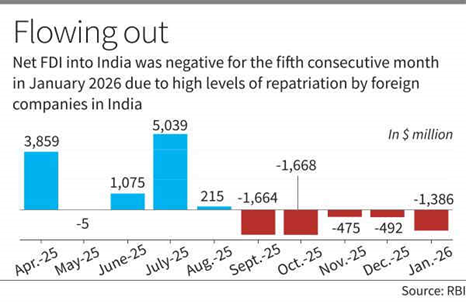
Net FDI negative for fifth straight month Context: Net FDI into India contracted for the fifth consecutive month in January 2026, with outflows exceeding inflows by nearly $1.4 billion, a three-month high. The data shows this was because inflows into India fell nearly 7% while the amount repatriated out of the country nearly doubled.
According to data released by the Reserve Bank of India on Monday as part of its monthly bulletin, the total amount of money entering India as direct investment, or gross FDI, stood at about $5.7 billion in January 2026.
This was 7% lower than in January last year, and only two-thirds of the amount that came in December 2025. The RBI, however, looked at a longer time period to draw some positive conclusions.
“During April 2025 – January 2026, gross FDI inflows remained strong, higher than the corresponding period a year ago,” the central bank noted in its report. “Sector-wise, manufacturing received the highest share of equity inflows, followed by computer services, electricity and other energy, and financial services — these sectors together accounted for over 60% of total inflows.”
With regard to outflows, the outward FDI by Indian companies increased by 5.4% in January 2026 to $2.1 billion. This was, however, nearly 30% lower than the outward FDI in December 2025.
“Around 75% of the outward FDI flows were directed to the U.S., Singapore, the UK, and the UAE during the [April 2025 – January 2026] period,” the RBI said. Repatriation and disinvestment by foreign companies doing business in India, on the other hand, increased by 97.3% to $4.9 billion in January 2026. But this was nearly 18% lower than the amount in December 2025.
As a result, net FDI stood at about -$1.4 billion, the lowest since October 2025.
The central bank noted that portfolio investments again flowed out more than they flowed in in March this year.
Centre restores RoDTEP benefits for exporters Context: The government has restored the complete benefits provided to exporters under the Remission of Duties and Taxes on Exported Products (RoDTEP) scheme. In a notification it said the rates and values applicable 22 this year and were reduced by 50% are now being restored to earlier levels from February 23 to March 31.
According to GTRI, while the DGFT decision is welcome, the initial reduction is hard to justify as RoDTEP is not a subsidy.
Subsidies & Karnataka’s Economy – Positives vs Negatives
Definition Subsidy: A financial support or incentive provided by the government to reduce the burden on citizens or producers, making essential goods, services, or welfare schemes more affordable. It can be in the form of cash transfers, reduced prices, tax exemptions, or guarantees. Objective: Social justice + Economic stimulus + Welfare support.
Types of Subsidies in India
Type
Examples
Food Subsidy
Public Distribution System (PDS), free rice/wheat under NFSA.
Fertilizer Subsidy
Urea, DAP, and other fertilizers provided at lower cost to farmers.
Risk of creating dependency; beneficiaries may not become self-reliant.
Political Perception
Minister argued subsidies should not be “villainised or criminalised” – they are a legitimate tool of welfare.
Opposition cautioned against over-reliance and demanded better targeting to ensure only the poor benefit.
Fiscal Balance
Government claims it is mindful of challenges and maintaining fiscal discipline.
Concerns remain about future sustainability if guarantees continue at current scale.
Paper-III: General Studies 2
Centre signals early delimitation, women’s quota for 2029 polls Context: The Union government has indicated that it will bring an amendment Bill proposing a delimitation exercise based on the 2011 Census to ensure the implementation of the Women’s Reservation Act, 2023, ahead of the 2029 Lok Sabha election.
Under the proposed amendments, the number of Lok Sabha seats will increase from 543 to 816, with 273 seats, 33%, reserved for women. The amendments could be brought in the ongoing Budget Session or in a Special Session called for the purpose.
States’ concern
Though the draft of the amendments are yet to be circulated, that care would be taken so that the existing proportion of seats will be maintained for all States, amid concerns that States that had showed success in population control programmes would lose out on representation vis a vis more populous States. Southern States had in particular expressed this concern. Overall, each State is likely to see a 50% rise in seats, but the pro rata basis would be maintained.
As per Article 82 of the Constitution, the next delimitation exercise was to be done based on the first Census after 2026, but these amendments could mean that the 2011 Census data will be applied and the remaking of constituencies can proceed without the current Census exercise being concluded. The proposals may include the expansion of State Assemblies as well.
The Act originally passed in September 2023 envisaged the conduct of the Decadal Census, followed by delimitation of seats. The 2021 Decadal Census, which got delayed because of COVID, beginning next month. As per the current timelines, implementation of the Act could be pushed beyond 2030. However, by bringing in fresh amendments, the government is now seeking to bring forward the implementation of the Act.
“The amendments will require a two-thirds majority of both Houses.
The Women’s Reservation Act, 2023, known as the Constitution (106th Amendment) Act, 2023, mandates a 33% reservation for women in the Lok Sabha and State Assemblies.
Kolar water table has risen to 50-100 ft. under K.C. Valley project, says IISc Context: The groundwater level in parts of Kolar has risen significantly under the K.C. Valley project, with water now available at depths of just 50 to 100 ft. compared to nearly 1,800 ft. earlier, said the Indian Institute of Science (IISc), adding that sustained monitoring since 2019 has found no adverse impact on water quality, public health, soil, crops, or livestock.
The K.C. Valley Project (Koramangala–Challaghatta Valley Project) is Karnataka’s flagship initiative to recharge groundwater in the parched districts of Kolar and Chikkaballapur by pumping treated wastewater from Bengaluru’s sewage treatment plants into local lakes. It has raised water tables significantly, but concerns remain about untreated sewage inflows and water quality.
IISc officials said the project has significantly improved groundwater availability across Kolar and surrounding districts, with 144 lakes being replenished and wells in the region also showing increased water level.
They said groundwater is being treated through a five-stage purification process, resulting in clean water that is free from odour and colour. Multiple rounds of research conducted by the IISc have found no traces of harmful metal elements in the water.
The officials also noted that there had been no impact on human or animal health.
“Crops such as fenugreek, cucumber, beetroot, tomato, and other flowering plants are being cultivated successfully, while soil quality has improved across the region,” the institute said, dismissing allegations of excessive nitrogen content in the soil, stating that there is no difference in soil quality between irrigated and non-irrigated ones.
The institute said there is also an increase in bird populations and healthy aquatic life in lakes. IISc said surveys conducted three times among residents revealed no complaints, with many reporting improved access to water and better living conditions. Farmers’ livelihood had improved, and officials pointed out to increase in milk production. They also pointed out that instances of kidney stones among residents have reduced attributing it to acess to cleaner water.
While presenting the findings, IISc officials said several organisations have recommended that the K.C. Valley model be replicated across the country. However, concerns were raised during the meeting over the discharge of untreated sewage into lakes, particularly in parts of Chickballapur, where city sewage is reportedly being let directly into waterbodies.
Aspect
Details
What
A lift irrigation and lake rejuvenation project that pumps secondary treated wastewater from Bengaluru’s sewage treatment plants (STPs) into ~122 rain-fed tanks in Kolar and Chikkaballapur districts.
Why
• To address acute groundwater depletion in Kolar & Chikkaballapur. • To provide sustainable irrigation support. • To recharge aquifers and revive lakes in drought-prone regions.
How
• Wastewater from 5 Bengaluru STPs is treated and pumped ~60 km. • Water is released into lakes, where it percolates into the groundwater table. • Implemented at a cost of ₹1,342 crore. • Managed by the Karnataka Minor Irrigation Department with IISc monitoring.
Where
• Origin: Koramangala–Challaghatta Valley, Bengaluru. • Destination: 122 lakes in Kolar (Dakshina Pinakini & Palar river sub-catchments) and extended to Chikkaballapur.
Impact (Positive)
• Water table rise: IISc reports groundwater rose by 50–100 ft in many wells. • Lake revival: 144 lakes replenished. • Agriculture: Farmers report significantly improved irrigation availability. • Health & crops: IISc studies clarified no adverse impact on crops or livestock.
Challenges (Negative)
• Untreated sewage inflow: Reports of municipal sewage mixing into lakes, reducing project credibility. • Water quality concerns: Farmers demand tertiary treatment for safer long-term use. • Frothing incidents: Lakshmisagara lake showed froth, raising environmental alarms.
Status (2026)
• Project is fully operational but remains under heavy public and scientific scrutiny. • Farmers in Chikkaballapur have staged protests demanding higher-quality treated water. • Ministers (Krishna Byre Gowda, NS Boseraju) have issued warnings to municipal bodies against operational lapses.
Planned Outcomes
• Long-term groundwater recharge. • Sustainable irrigation for drought-prone districts. • Reduction in dependence on deep borewells. • Potential global model for other water-scarce urban-rural corridors.
Significance of the Project Environmental: Effectively reuses urban wastewater, significantly reducing the pressure on finite freshwater sources. Agricultural: Acts as a lifeline for farmers in semi-arid districts, supporting dairy and crop production. Social: Revives traditional lake ecosystems and strengthens rural water security, preventing migration. Policy: Demonstrates Karnataka’s innovative and aggressive approach to integrated water management.
‘U.S.-led Pax Silica
The U.S.-led initiative is aimed at building resilient supply chains for critical minerals and Artificial Intelligence (AI) technologies. India joined the coalition in February 2026, during the AI Impact summit held in New Delhi.
Lok Sabha sends Corporate Law Amendment Bill 2026 to JPC
Context: The government introduced the Corporate Laws (Amendment) Bill, 2026 in the Lok Sabha following which the House adopted a motion to send the proposed legislation to a Joint Parliamentary Committee (JPC) for detailed examination.
The JPC will comprise members from both Houses of Parliament for detailed analysis and recommendations, Union Finance Minister Nirmala Sitharaman said while proposing the motion for JPC reference. The motion was adopted by a voice vote.
The Bill seeks further amendments to the Limited Liability Partnership Act, 2008 and the Companies Act, 2013 to facilitate ease of doing business and address the gaps identified by the Company Law Committee in its 2022 report.
The proposed amendments are expected to rationalise penalties, shift several minor procedural lapses from criminal liability to monetary penalties, and streamline regulatory processes to promote ease of doing business.
The FM said the Bill was aimed at promoting ease of doing business and ease of living for corporates by decriminalising more provisions.
‘Diluting provisions’
When the Bill was introduced in Lok Sabha, Opposition members Manish Tewari (Congress), Saugata Roy (Trinamool Congress) and T. Sumathy (DMK) opposed the same claiming the legislation sought to dilute the provisions of law under which companies mandatorily had to pay 2% of profit towards corporate social responsibility (CSR).
The FM refuted the claim and said that the Bill had been introduced after two years of deliberations and the apprehensions of the members were unfounded as the proposed legislation sought to amend only the criteria for net profit, not the entire clause related to CSR.
Mr. Tewari also said since a Parliamentary Standing Committee on Corporate Affairs was already in place, the Bill must be sent there rather than setting up new JPC.
Home Minister Amit Shah, intervening, said none of the Opposition members talked about referring the Bill to a panel and now, when the FM has herself sought it, they were arguing as to which panel the Bill should be sent.
Greater cooperation needed between India and Russia, says Jaishankar
Context: Against the backdrop of the war in West Asia, External Affairs Minister S. Jaishankar, said the “evolving multipolar order” calls for “greater cooperation” between India and Russia both bilaterally as well as multilaterally through groupings such as BRICS, SCO, G-20, and the United Nations.
In the context of the 2026 geopolitical landscape, this dialogue underscores India’s mastery of Strategic Autonomy—maintaining a deep, functional bond with Moscow while navigating a world fractured by conflicts in West Asia and Eurasia.
India-Russia Bilateral Agenda (2026)
Dimension
Analytical Insight
Geopolitical Context
The relationship is being recalibrated against the “acute crisis in the Persian Gulf” (US-Israel-Iran tensions). India is positioning itself as a stabilizing force that uses its BRICS Chairmanship to promote a “Humanity First” approach.
Economic Sovereignty
A breakthrough in De-dollarization: 96% of bilateral trade is now conducted in national currencies (Rupee-Ruble). This insulates the partnership from Western-led financial sanctions and streamlines commerce.
Multipolarity & Groups
India and Russia are leveraging BRICS, SCO, and G-20 to challenge unipolarity. Russia’s explicit support for India’s 2026 BRICS Chairmanship signals a unified front in the “Global South” discourse.
Strategic Pillars
Civil Nuclear Energy remains the bedrock, with the Kudankulam project serving as a “stellar example.” Additionally, the push for the Eurasian Economic Union (EAEU) FTA suggests a shift toward deeper regional economic integration.
New Frontiers
Post-Putin’s Dec 2025 visit, the focus has expanded beyond defense to skilled professional mobility, food safety, and maritime cooperation, diversifying the relationship to be more resilient.
Key Strategic Takeaways:
The “Strategic Autonomy” Litmus Test By engaging deeply with Russia amidst the West Asian war, India is signaling to the global community that its foreign policy is dictated by its own national interests. Lavrov’s praise for India’s “strategic autonomy” suggests that Russia views India not just as a buyer, but as an independent pole in the Evolving Multipolar Order.
Economic Decoupling from the West The transition of nearly all trade (96%) to national currencies is a massive shift. It reduces transaction costs and creates a closed-loop economic system that is “sanction-proof,” ensuring that essential supplies like fertilizers, oil, and nuclear tech remain uninterrupted regardless of global political pressure.
BRICS 2026: “Humanity First” Under India’s leadership, BRICS is moving toward a people-centric agenda. This softens the “anti-West” image often associated with the bloc, instead focusing on shared global challenges like food security and health, where Russian resources and Indian manufacturing/human capital create a perfect synergy.
Connectivity & Energy Security The mention of Maritime Cooperation and the EAEU FTA points toward the operationalization of the International North-South Transport Corridor (INSTC) and the Chennai-Vladivostok Maritime Route. This ensures India has a stable, alternate supply chain for energy and minerals from the Russian Far East.
Summary The India-Russia Annual Summit 2026 is set to be a milestone. While the West focuses on containment strategies, India is focusing on “Inclusive Multipolarity.” By bridging the gap between its ties with the West and its “special” bond with Russia, India is effectively acting as the diplomatic “hinge” of the 21st century.
This dialogue is a classic example of Realpolitik. India is balancing its “Global Strategic Partnership” with the US against its “Privileged” partnership with Russia to maximize its influence in the Persian Gulf and Eurasia.
Paper-IV: General Studies 3
Karnataka accounted for 9% of India’s ransomware cases in 2025-26: Report Context: Nearly 9% of the total ransomware cases in India in 2025–26 were from Karnataka, according to the Centre of Excellence for Cybersecurity – Karnataka (CySecK) annual compendium report released.
The report also stated that 4.3% of the total malware detections were from Karnataka.
Bengaluru, too, witnessed cyberattacks that were four times higher than the previous year, according to the report.
Vulnerable sectors
Among the most vulnerable sectors for cyberattacks are government departments, education, and healthcare, which, according to the report, collectively witnessed more than 6.8 million malware detections in Karnataka.
CySecK is a flagship initiative by the State government through the Department of Electronics, IT, and BT, established in 2019 to drive cybersecurity innovation, research, and ecosystem development across Karnataka.
CySecK held its annual cybersecurity conference on March 17.
The report, published as part of the conference, outlines the State’s cybersecurity landscape, key risks, and strategic priorities to strengthen digital resilience.
Major attacks
The report also details major cybersecurity incidents in the State.
The most significant was the Kaveri 2.0 Distributed Denial-of-Service (DDoS) attack in February 2025, which led to service disruption and an estimated ₹47.75 crore in daily revenue loss.
DDoS attacks are launched to slow down or crash websites, servers, or networks, making them unavailable to genuine users.
The second major incident was a ransomware attack on a private hospital that led to encrypted medical records and disruption in patient care. There were also telecom API data breaches, highlighting third-party security risks.
“As digital adoption accelerates across governance, education, healthcare, finance, and industry, the state’s exposure to cyber risks has increased significantly,” the report noted.
It also underscored that the growing reliance on digital infrastructure has widened the cyberattack surface across sectors and regions, including cloud platforms, digital payments, connected systems, and data-driven services.
Ignored area
A senior police officer explained that in the backdrop of technological advancement, cybercrimes are widely discussed and reported, but cybersecurity is less talked about.
However, Karnataka notified its cybersecurity policy as early as 2024, adopting a dual approach: strengthening government cybersecurity while fostering a robust public cybersecurity ecosystem.
Aligning with the objectives of the policy, the Karnataka government has launched several initiatives, including CySecK. A major stride has been made by bringing cybersecurity under the Cyber Command Unit.
CySecK plays this role by working across academia, government, industry, and startups to strengthen Karnataka’s overall cybersecurity readiness.
Draft policy on ‘Responsible Digital Use Among Students’ sets goals for parents, schools Context: It recommends that schools include digital well-being and social media literacy in the curriculum.
The draft policy for “Responsible Digital Use Among Students”, released by the Department of Health and Family Welfare, has recommended that parents set structured routines with clear screen-time rules and prioritise privacy, safety, and open conversation with children on digital well-being.
It recommended that schools incorporate digital well-being and social media literacy in their curriculum, besides implementing special programmes for digital detox and identifying early mental health red flags.
The policy has been drafted in collaboration with the Karnataka State Mental Health Authority, NIMHANS, and the School Education Department, based on deliberations with stakeholders. It further recommended a set of “preventive, promotive, and responsive strategies for all schools to implement”. “Parents should facilitate more peer interactions and conversations without screens, invite friends over for offline play, promote role play, group reading, or drama at home, and model face-to-face communication,” the draft said.
The government announced it would bring in a policy to restrict social media use among children below 16. The draft policy aims “to create a safe, balanced, and psychologically healthy digital environment for students”.
“Parents should define screen time limits (as per age), mandatory screen-free time during meals, sleep hours, and study periods, tech curfew all screens off 1 hour before bedtime,” it recommended for parents, advocating marking digital free zones like bedroom, dining table, kitchen, bathroom, and motorised vehicle where no family members use technology. “Decide upon digital fasting time where no family members use any device,” said the draft.
On the responsibility of schools, the draft policy states, “Schools must incorporate digital well-being and social media literacy within the life skills, value education, and ICT (Information and Communication Technology) curriculum. Age-appropriate lessons on responsible digital behaviour, privacy, online safety, and screen-time balance should be taught regularly.”
Centre launches AI skilling drive with Google, YouTube Context: Part of initiatives unveiled by Ashwini Vaishnaw to boost creative economy; a citizen creator platform, and in-built satellite tuners in television sets for access to DD Free Dish launched.
Union Minister Ashwini Vaishnaw on Monday unveiled three new initiatives aimed at strengthening India’s media, broadcasting, and digital sector and promoting the “orange economy”, or the creative economy.
The creative economy includes industries where economic value is generated primarily from creativity, culture, technology, and intellectual property.
The three initiatives are named the National AI Skilling Initiative in partnership with Google and YouTube through the Indian Institute of Creative Technologies (IICT); MyWAVES, a citizen creator platform on WAVES OTT; and the rollout of advanced Electronic Programme Guide and in-built satellite tuners in television sets for enhancing access to DD Free Dish services.
Key media and entertainment industry representatives, the head of YouTube India along with senior Ministry officials took part in the event.
Underscoring Prime Minister Narendra Modi’s vision of democratising technology, Mr. Vaishnaw said the initiatives will make technology more affordable and accessible. He said that with in-built satellite tuners and an advanced programme guide, citizens can now access content easily without additional equipment.
He described MyWAVES as a powerful platform for content creators, enabling them to create, upload, and share content.
Referring to the Union Budget announcements, he underlined the government’s commitment to promoting the “orange economy” and supporting the creative sector.
The Union Minister said under the National AI Skilling Initiative, being implemented with the support of YouTube, about 15,000 youth will be trained without levying any fee.
He spoke about the “Creators’ Corner” scheme and urged content creators to actively use Doordarshan and platforms such as MyWAVES to showcase India’s rich culture and regional diversity.
Speaking about the partnership’s impact, YouTube India managing director Gunjan Soni said: “We believe that AI has the potential to open up remarkable opportunities for India’s dynamic creative economy. Through our collaboration with the Ministry of Information & Broadcasting and IICT, we aim to equip creators and professionals with the skills required to master the tools of the future, leverage AI to tell more compelling stories… expand their reach to new audiences, and play a role in shaping the future of media.”
The AI skilling programme will be conducted in two phases — Phase I from March 23 to June 30 2026, and Phase II from July to December 2026.
The first phase will focus on foundational AI learning at scale through Google Career Certificates and Google Cloud Generative AI learning paths. Participants will undergo courses such as AI Essentials, Prompting Essentials, Introduction to Generative AI, and Generative AI Leader Path.
The second phase will involve advanced, project-based specialisation for the creative industry. The curriculum will include modules on the art of storytelling, YouTube best practices, and advanced training using AI tools such as Gemini 3 and Vertex AI.
Paper-I: Current Events of National and International Importance
KIA ranked 11th most punctual large airport in Feb. Context: The Kempegowda International Airport (KIA) was ranked the 11th most punctual airport among large airports in February 2026, according to aviation analytics firm Cirium’s On-time Performance (OTP) monthly report for airlines and airports.
The KIA, which has led the large airports category as the most punctual airport several times in the past, did not make it to the top 20 most on-time large airports list in January this year.
According to the report, in February, KIA served 109 routes and recorded an on-time departure of 84.86%.
The only other large Indian airport to feature in the February list was the Chennai International Airport, which secured the 10th position among the most punctual airports with an on-time departure of 85.23%.
The Chennai airport served 67 routes. Harbin Taiping International Airport in China was the most punctual large airport, followed by Mexico City Benito Juárez International Airport, and Houston George Bush Intercontinental Airport in February.
In the Cirium OTP Review 2025, KIA featured among the top 20 in the large airport category. The airport was ranked 11th with an on-time departure of 82.83%.
The only other Indian airport to feature among the top 20 was the Chennai International Airport which bagged the 12th spot.
Modi sets new record with 8,931 days in public office
Context:Prime MinisterNarendra Modi became the longest-serving head of a government in India, serving 8,931 days in office, first as the Chief Minister of Gujarat and now as the Prime Minister. He has surpassed former Sikkim Chief Minister Pawan Chamling’s record of 8,930 days in office.
Longest-Serving Heads of Government (CM and/or PM)
Rank
Name
Total Days in Office
State / UT Represented
1
Narendra Modi
8,931+
Gujarat (as CM) & India (as PM)
2
Pawan Kumar Chamling
8,930
Sikkim
3
Naveen Patnaik
8,800+
Odisha
4
Jyoti Basu
8,539
West Bengal
5
Gegong Apang
8,156
Arunachal Pradesh
6
Lal Thanhawla
7,746
Mizoram
7
Virbhadra Singh
7,642
Himachal Pradesh
8
Manik Sarkar
7,300
Tripura
9
M. Karunanidhi
6,863
Tamil Nadu
10
Parkash Singh Badal
6,835
Punjab
Longest-Serving Chief Ministers of Karnataka
Rank
Name
Total Days in Office
Tenure Highlights
1
D. Devaraj Urs
2,907
Known for land reforms and social justice; served two terms (1972-77 and 1978-80).
2
S. Nijalingappa
2,739
The first CM of Unified Karnataka; served three separate terms (1956-58, 1962-67, 1967-68).
3
Ramakrishna Hegde
2,036
The first non-Congress CM; served three terms between 1983 and 1988.
4
Siddaramaiah
2,000+
Served a full 5-year term (2013-18) and is currently serving his second term (2023–Present).
5
B. S. Yediyurappa
1,911
Served four separate terms; holds the record for most swearings-in as CM in Karnataka.
6
S. M. Krishna
1,659
Credited with the “IT/BT Boom” in Bengaluru (1999-2004).
Paper-II: Current Events of State Importance and Important Government Schemes and Programs
Main Examination
Paper-I: Essays
Essay – 1: Topic of International/National Importance
“India’s relationship with West Asia is one of its most strategically vital foreign policy priorities, shaped by energy dependence, diaspora ties, trade, and evolving geopolitical challenges. Discuss how India balances economic cooperation with Gulf states, cultural and historical links with Iran and Iraq, and sensitive diplomacy with Israel and Palestine.”
Essay-2: Topic of State importance/Local Importance
“Mahadayi Water Dispute: Balancing Karnataka’s Development Needs with Ecological and Inter-State Concerns”
Paper-II: General Studies 1
Paper-III: General Studies 2
Details sought on inquiry, prosecution wings of the Lokpal
A parliamentary committee has sought details of what is being done to fully operationalise the inquiry and prosecution wings of the Lokpal, over a decade after a law governing it was enacted.
The law governing the anti-corruption ombudsman — The Lokpal and Lokayuktas Act 2013 — came into force on January 1, 2014. However, it began functioning only on March 27, 2019, following the appointment of its chairperson and members.
To discharge its statutory functions, Section 11 of the Act obligates the Lokpal to constitute an inquiry wing to be led by a director of inquiry for conducting a preliminary inquiry into corruption-related offences.
The Lokpal Act also has a provision for the constitution of a prosecution wing headed by the ‘director of prosecution’ for the prosecution of public servants.
Process ongoing
In its latest report, the Department-related Parliamentary Standing Committee on Personnel, Public Grievances, Law and Justice noted that the appointment of the director of inquiry and staffing of the inquiry wing in accordance with the approved organogram is still in process.
The committee, therefore, desires to be apprised of the present status of appointment of the director and the steps taken to operationalise the inquiry wing in its full statutory form, while ensuring coordination with existing investigative agencies, it said.
The panel, in its 160th report, said the prosecution wing of the Lokpal had been formally constituted through an order dated June 6, 2025.
The committee noted that, at present, matters relating to prosecution are being handled through the Central Bureau of Investigation (CBI), which has its own prosecution mechanism.
Paper-IV: General Studies 3
India’s dual dependence on West Asia for urea production Context: Data indicate that the West Asian conflict threatens both domestic urea production and the stability of its global supply chain
The ongoing conflict in West Asia has disrupted global trade, leading to LPG shortages and a surge in crude oil prices. Data show that the crisis could also affect India’s supply of Liquefied Natural Gas (LNG), putting at risk the production of urea, a key fertilizer in the country’s majorly agrarian economy.
The conflict has already started to impact India’s urea supply. As of Sunday, industry sources told PTI that the country’s urea plants are running at half capacity, with Petronet LNG Ltd, which operates India’s largest liquefied natural gas receiving terminal, declaring force majeure amid disruptions to cargoes. The move triggered supply curtailments by state-owned gas distributors GAIL (India) Ltd, Indian Oil Corporation Ltd and Bharat Petroleum Corporation Ltd.
India is heavily dependent on imports for its LNG supply, exposing many of its sectors to global shocks such as the U.S.-Israel attacks on Iran. Data show that in 2025, India bought more than 50% of its natural gas from the international market (Chart 1). In fact, India is the fourth largest buyer of natural gas in the world, with an imported supply of 261 lakh metric tonnes in 2025.
A majority of these imports — more than 40% of it — are tied to long-term contracts with suppliers in Qatar (Chart 2). This supply may be in jeopardy as Qatar’s LNG cargoes pass through the Strait of Hormuz, which has now become a central chokepoint in the Iran-Israel conflict. The UAE and Oman also ship LNG along this route, and both countries contribute to India’s imported LNG supply. Overall, more than 60% of India’s imported LNG could be affected by the closure of the Strait.
In India, natural gas is primarily used to produce ammonia, which in turn is used to produce fertilizers. In FY26, about 30% of India’s LNG supply was used for the production of fertilizers (Chart 3). Demand also comes from industry and gas-fired power and city gas networks which supply to households and vehicles.
LNG is the main feedstock for the production of urea, which is the most widely used fertilizer in India. Many urea plants use naphtha or fuel oil — both derived from crude oil – as their main input. However, as urea production is a highly energy-intensive process, these plants have switched to natural gas, which produces fewer emissions.
National urea consumption hit 387 lakh metric tonnes in 2025, following a decade of steady growth. While domestic production has also been increasing (India produced about 306 lakh metric tonnes of urea in 2025), it does not cover the country’s demand. Due to this, India also relies on imports of urea.
Data indicate that the West Asian conflict threatens both domestic urea production and the stability of its supply chain. In 2025, India’s urea imports exceeded 2,300 lakh metric tonnes, with a staggering 71% of these imports coming from West Asia (Chart 4). This total comprises 45% from Oman and a combined 26% from Saudi Arabia, Qatar, and the UAE, all of which rely on the Strait of Hormuz for transit.
Amidst this scenario, the Government of India issued the Natural Gas (Supply Regulation) Order, 2026, officially including the fertilizer sector in its priority list.
The government also stated that as of March 10, India’s urea reserves have reached 61.51 lakh metric tonnes, about 10 lakh more than last year, ahead of the Kharif sowing season. However, only time can tell if India’s import dependence for both domestic production and global supply trade will weather the ongoing geopolitical instability.
Rice, wheat procurement is ‘consistently’ low: panel
Context: Standing Committee led by DMK MP asks Food Ministry to strengthen its procurement planning and coordination with States to minimise the gap between estimated and actual procurement
Expressing concern that actual procurement of rice and wheat has consistently remained below estimates in recent years and below targets in States such as Bihar, Gujarat, Punjab, and Uttar Pradesh, the Parliamentary Standing Committee on Consumer Affairs, Food, and Public Distribution, headed by DMK MP Kanimozhi, has asked the Union Food Ministry to strengthen its procurement planning and coordination with States to minimise the gap between estimated and actual procurement of both the food grains.
In a report on the Demands for Grants of the Department of Food and Public Distribution, the panel noted that since 2022-23, the procurement of wheat and rice had been less than 30% of the total production.
“Moreover, actual procurement of wheat has been 76.71%, 71.35% and 87.29% of the estimate for the years 2023-24, 2024-25 and 2025-26 respectively. Similarly, the actual procurement of rice has been less than target since 2022-23,” the report revealed.
During the kharif marketing season of 2024-25, the procurement of rice from Andhra Pradesh, Karnataka, and Punjab was 25.60 lakh tonnes, 0.003 lakh tonnes, and 116.13 lakh tonnes against the target of 35 lakh tonnes, 5.29 lakh tonnes, and 124 lakh tonnes, respectively, the panel said.
Similarly, during the rabi marketing season of 2025-26, the procurement of wheat was less than the target in the States of Bihar, Gujarat, Punjab, and Uttar Pradesh, it added.
Multiple factors at play
The government told the panel that any fluctuation in estimated production and actual production resulted in variation in procurement. “Procurement depends on multiple factors like production, market surplus, minimum support price (MSP), prevailing market rates, demand-supply situation, and participation of private traders, etc., the government informed.
Noting these factors, the panel asked the government to strengthen its procurement planning and coordination with the States to minimise the gap between estimated and actual procurement of wheat and rice.
“While noting the Department’s submission that procurement levels are influenced by multiple factors, the Committee is concerned that actual procurement has consistently remained below estimates in recent years and below targets in several States,” the report said.
The panel asked the Union government to review the methodology used for estimating procurement requirements, enhance real-time monitoring of production and market arrivals, and work closely with State governments — particularly in States where procurement has significantly fallen short of targets — to ensure that procurement operations are more realistic, responsive and effective. It asked the government to apprise it of the corrective measures taken on the suggestions.
Paper-I: Current Events of National and International Importance
KIA named best regional airport in India and South Asia for third year Context: The Kempegowda International Airport (KIA) has been recognised as the Best Regional Airport in India and South Asia for the third consecutive year at the Skytrax World Airport Awards 2026.
The airport has advanced in the global airport rankings in 2026, moving up from 48 to 41.
The Skytrax World Airport Awards, widely regarded as a global benchmark for airport excellence, recognise airports that deliver outstanding customer experience across key touchpoints, including check-in, arrivals, transfers, retail, security, immigration and departures.
“This recognition builds on KIA’s consistent performance across both experience and scale. The airport has received global recognition recently, including being named Best Airport in Arrivals Globally for the fourth time.
While Terminal 2 became the first in India to receive a 5-star Skytrax rating, the airport has achieved the highest Level 5 Accreditation under ACI’s Airport Carbon,” the Bangalore International Airport Ltd. (BIAL).
KIA served 43.82 million passengers and handled 520,985 tonnes of cargo in Calendar Year 2025.
Paper-II: Current Events of State Importance and Important Government Schemes and Programs
Main Examination
Paper-I: Essays
Essay – 1: Topic of International/National Importance
“Global climate change is no longer just a subject of debate on international platforms; today, it has arrived at the doorstep of the common farmer’s field. Discuss the impacts of climate change on Karnataka’s agricultural sector and the sustainable measures needed to address them.”
Essay-2: Topic of State importance/Local Importance
“The Development Mantra of New Karnataka and Environmental Protection of the Western Ghats: The conflict between Power, Water, and Tourism projects and the necessity of a Sustainable Balance.”
Paper-II: General Studies 1
RBI injects ₹25,101 cr. in banking system via 3-day VRR auction Context: The Reserve Bank of India (RBI) injected ₹25,101 crore transient liquidity in the banking system through a three-day variable rate repo (VRR) auction.
The RBI injected the funds at cut-off and weighted average rates of 5.26%, the central bank.
The liquidity injected was much lower than the notified amount of ₹75,000 crore, despite a sharp drop in surplus liquidity in the banking system due to advance tax payments. On March 17, the RBI injected ₹48,014 crore liquidity into the banking system via VRR.
A Variable Rate Repo (VRR) auction is a monetary tool used by the Reserve Bank of India (RBI) to manage liquidity (the amount of cash available) within the banking system. When there is a shortage of funds in the market, the RBI conducts these auctions to inject liquidity for a short period.
Core Features of VRR Auctions
Feature
Description
Objective
To inject liquidity into the banking system when it faces a deficit.
Interest Rate
It is not fixed. Banks bid for funds, and the rate is determined by the market demand during the auction.
Tenure
Typically 14 days, but can range from 1 to 28 days depending on the requirement.
Collateral
Banks must provide Government Securities (G-Secs) to the RBI as collateral to receive funds.
How the Auction Works Announcement: When the RBI observes a cash crunch (e.g., due to tax outflows), it announces an auction for a specific amount (e.g., ₹75,000 crore). Bidding: Commercial banks submit bids stating the amount they need and the interest rate they are willing to pay (usually higher than the fixed Repo rate). Allotment: The RBI accepts bids starting from the highest interest rate offered until the notified amount is exhausted. This is known as a “Multiple Price Auction.”
Why are VRR Auctions Necessary? Tax Payments: When corporations pay Advance Tax or GST, large sums of money move from bank accounts to the Government’s account, creating a temporary shortage in the banking system. Festive Season: During major festivals, public demand for physical cash increases, leading to a dip in bank liquidity. Government Spending Lapses: If the government collects taxes but delays its own spending, money gets “locked” in the government account instead of circulating in the economy.
VRR vs. Fixed Rate Repo Fixed Rate Repo: The interest rate is pre-decided by the RBI (currently 6.50%). It is usually available to banks daily up to a certain limit. VRR: The rate is market-driven. If the demand for money is very high, the VRR auction rate will be significantly higher than the standard Repo rate.
Paper-III: General Studies 2
CAPF Bill gives priority to IPS officers; govt. says new law will curb litigation Context: The Central Armed Police Forces (General Administration) Bill, 2026, which is likely to be tabled in the Rajya Sabha next week, states that in all Central Armed Police Forces (CAPFs) posts, 50% of the total posts in the rank of Inspector General, at least 67% posts in the rank of Additional Director General and all posts in the rank of Special Director General and Director General shall be filled by Indian Police Service (IPS) officers on deputation.
Till now, such postings were done based on executive orders, and the Bill will codify the provisions. The Bill seeks to negate a May 23, 2025 Supreme Court judgment which had asked the Ministry of Home Affairs (MHA) to “progressively reduce” IPS deputation in CAPFs up to the rank of I-Gs.
Retired CAPF officials have opposed the Bill stating that the government is discriminating against cadre officers who won the case after 10 years of litigation. Due to absence of senior-level posts, it takes an officer who joins as an Assistant Commandant in the CAPFs, at least 15-18 years for her/his first promotion. The officers have argued that despite leading operations from the front, they face career stagnation.
The Bill, circulated among Rajya Sabha members, said the CAPFs perform functions of national security in close coordination with State authorities and, in the interest of maintaining Centre-State relationship, IPS officers are necessary for effective functioning of these forces.
The statement of objects and reasons by Home Minister Amit Shah said that, in recent years, due to the absence of an umbrella law, regulatory provisions have evolved in a fragmented manner resulting in several litigations on service-related matters. It added that the Bill was being brought to “avoid unnecessary litigations.”
CJI shifts petitions against CEC selection law to another Bench Context: The Chief Justice of India (CJI) Surya Kant expressed his reluctance to continue hearing a series of petitions challenging a law that replaced the CJI with a Union Minister in the selection panel for the appointments of the Chief Election Commissioner (CEC) and Election Commissioners (ECs).
Chief Justice Kant said that as the petitions challenging the Chief Election Commissioner and other Election Commissioners (Appointment, Conditions of Service, and Term of Office) Act of 2023 relate to the office of the CJI, he would not like a Supreme Court Bench headed by him to hear the case as that would expose his office to criticism of conflict of interest. Advocate Prashant Bhushan, appearing for one of the petitioners, the Association for Democratic Reforms, suggested the case be shifted to a Bench which does not have a prospective CJI either as the lead or associate judge.
Acknowledging Mr. Bhushan’s recommendation, the Chief Justice said, “I should mark this matter to a Bench where the judge may not be in line to become the CJI. Then nobody can say anything.” The Bench listed the case on April 7 before an appropriate Bench.
The main contention
The petitioners argued that the 2023 law was introduced to dilute a Constitution Bench ruling delivered in March 2023 in Anoop Baranwal vs Union of India, which had included the CJI as a member of the high-powered selection committee involved in the appointments of the CEC and the ECs.
The bone of contention is the validity of Section 7(1) of the statute. The provision mandated that the President would appoint the CECs and ECs on the recommendation of a selection committee comprising the Prime Minister, the Leader of Opposition in the Lok Sabha and a Union Cabinet Minister to be nominated by the Prime Minister. The statute, in short, gave the government an upper hand in appointments to the Election Commission of India.
Paper-IV: General Studies 3
Renewable Energy Ministry demands sweeping powers Context: Ministry says it should be recognised as ‘Central Government’ in matters pertaining to renewables under Electricity Act; Power Ministry currently exercises primary authority over Act’s provisions.
The New and Renewable Energy Ministry has made a case before a parliamentary committee for a significant expansion of its administrative authority over India’s renewable energy sector, arguing that it should be recognised as the “Central Government” in all matters pertaining to renewables under the Electricity Act, 2003.
The demand, part of a detailed reply furnished to the committee in February but made public this month, in response to “stakeholder requests” for a standalone Renewable Energy Act, effectively seeks to redraw the institutional boundaries between the Renewable Energy Ministry and the Power Ministry, which currently exercises primary authority over the Electricity Act’s provisions, including those governing grid-connected renewable energy.
As of January 31, 2026 — the Renewable Energy Ministry cited in a submission — India has installed 271.96 GW of capacity from non-fossil fuel sources, a little over half the country’s total installed generation capacity of 520.50 GW. Of this, 263.18 GW is from renewable energy. However, the actual electricity generated from non-fossil sources is about 25%.
While the Ministry conceded that a separate Act was unnecessary as electricity from renewable sources is already integrated into the grid and governed under the existing framework, it laid out a sweeping list of empowerments it believes are needed to bring “institutional clarity and effective administration” to the sector.
The Ministry wants the power to design electricity markets for renewable energy, prepare and notify bidding guidelines for renewable energy projects, frame tariff determination principles for the Central Electricity Regulatory Commission (CERC), and guide the CERC on matters related to renewables.
It has also sought oversight of the planning and monitoring of Renewable Purchase Obligations, the mechanism that compels distribution companies and large consumers to procure a minimum share of their electricity from clean sources. Several States are laggards in these aspects.
The Renewable Energy Ministry has further asked that the Central Electricity Authority (CEA) coordinate with it while framing regulations related to renewable energy, and that the National Committee on Transmission work under the Ministry’s guidance — a significant institutional claim, given that transmission planning has traditionally been the turf of the Power Ministry and the CEA.
Karnataka’s total installed power generation capacity
Energy mix
Karnataka currently has a total installed power generation capacity of about 36,472 megawatts (MW), with renewable energy accounting for a larger share than conventional sources. Of the total, around 20,162 MW comes from renewable sources, while 16,310 MW is generated from thermal, hydro, and gas-based plants.
Among conventional sources, State-owned thermal power plants contribute 5,020 MW, while Karnataka receives 4,081 MW as its share from Central Generating Stations. Hydropower accounts for another 3,798 MW. Additional sources include 1,200 MW from Udupi Power Corporation Limited, 1,391 MW from captive mini-thermal plants, 450 MW from the Damodar Valley Corporation, and 370 MW from the Yelahanka Combined Cycle Power Plant.
Renewables form the largest portion of the State’s installed capacity, with solar alone contributing about 9,805 MW, followed by wind at 7,536 MW. Other sources include 1,742 MW from co-generation, 940 MW from mini hydel projects, and 139 MW from biomass. Together, these account for more than half of Karnataka’s installed electricity capacity.
However, despite the rapid expansion of renewable energy in the State, this shift has not translated into viable alternatives for small eateries and commercial kitchens, which continue to rely almost entirely on LPG — a dependence now exposed by the ongoing supply disruption. Most households too continue to depend on LPG.
Practical barriers
Even in situations where alternatives are considered, operational constraints remain,Other alternatives such as piped natural gas (PNG) and biomass also face constraints. PNG infrastructure remains limited to certain areas, leaving many eateries without access, while installation requires time and upfront investment. Biomass-based fuels, on the other hand, require additional space, ventilation and handling due to smoke and residue, conditions that are difficult to manage in dense urban kitchens.
Waste-to-energy solutions face a more fundamental challenge; the lack of consistent waste segregation at source. Mixed waste, in practice, significantly reduces the efficiency of such systems.
Despite policy push and infrastructure in place, poor segregation by households and commercial establishments continues to limit the viability of waste-to-energy at an individual or decentralised level.
Beyond fuel availability
While alternatives exist, their adoption needs more policy support.
“If you look purely at the cost of use, electric cooking can turn out to be one of the cheapest option today. Electricity-based cooking is cheaper than both PNG and non-subsidised LPG, and is comparable to subsidised LPG for many consumers. PNG can be around 14% more expensive than electricity-based cooking, and non-subsidised LPG up to 37% more for a family of four in Delhi.”
However, operating costs alone does not drive adoption. “The real challenge lies in the upfront cost of procurement and awareness. LPG continues to dominate because most users already have the connection, equipment, and utensils. Even for a new connection, the initial cost is relatively low compared to other options,”.
Rooftop solar
This gap between potential and adoption is also visible in rooftop solar uptake across Bengaluru. According to data from the Energy Ddepartment, 14,944 buildings under the Bangalore Electricity Supply Company Limited have installed rooftop solar systems, including 215 government buildings, together generating about 352.35 MW of electricity.
Within Bengaluru Urban and Rural districts alone, there are 5,370 such installations, with 4,984 in urban areas.
Alternatives such as PNG and induction cooking come with higher entry barriers. “For PNG, the upfront cost of getting a connection, including deposits, is significantly higher, and more importantly, it is only available in areas where pipeline infrastructure exists. That geographic limitation itself becomes a constraint.”
Induction cooking, she added, faces both cost and design challenges. “The cost of buying induction cooktops and compatible utensils is higher, and the design itself can be a barrier. In India, even the most basic cooking setup typically involves at least two burners. Most induction systems are single-cooktop units, and upgrading to multiple units increases costs further. That becomes a constraint, especially for households or commercial kitchens used to cooking multiple dishes simultaneously.”
The way forward
“In a country like India, no single fuel can replace another entirely,” she added. “The focus should be on optimising different energy sources based on context, which requires long-term planning, not just short-term responses during crises.”
Paper-V: General Studies 4
Public Service and Administrative Responsibility
1. The Scenario You are the Chief Executive Officer (CEO) of a Zilla Panchayat. Summer has begun, and several villages under your jurisdiction are facing a severe drinking water crisis. Months ago, the government had issued an order to “repair and keep all Reverse Osmosis (RO) water plants ready.” However, due to the negligence of your subordinate officers, more than 70 plants remain non-functional. People are struggling for drinking water, and critical reports against the government are appearing in the media.
Challenges: Pressure from Above: There is immense pressure from senior officials and Ministers to take immediate action. Procedural Delays: Utilizing funds reserved for repairs involves technical and bureaucratic processes that take time. Exploitation: Private tanker mafias are exploiting the situation by overcharging desperate villagers.
2. Ethical Dilemmas Dereliction of Duty vs. Accountability: Even if subordinates failed to perform, the ultimate accountability rests with you. Should you focus on punishing them first or getting the work done? Transparency vs. Emergency: Bypassing tender processes during an emergency might lead to “corruption” allegations later. However, following every rule strictly will delay water reaching the people. Public Interest vs. Administrative Delay: What is more important—saving lives or following office filing procedures?
3. Options Available Option 1: Following rules strictly (Status Quo). Consequence: You remain procedurally safe, but water supply is delayed, increasing public anger. This is termed “Bureaucratic Apathy.”
Option 2: Immediate suspension of negligent officers. Consequence: While it looks like a strict disciplinary move, it doesn’t solve the immediate water crisis and might lead to a shortage of staff to execute repairs.
Option 3: Working in ‘Mission Mode’ and creating alternative arrangements. Consequence: This is the most ethical path. Responding to public suffering must be the top priority.
4. Recommended Action Plan As an ethical officer, you should take the following steps: Immediate Relief: Order the supply of water through hired borewells and tankers until repairs are finished. Use GPS-based monitoring to prevent the tanker mafia from overcharging or skipping deliveries. Parallel Repair: Appoint technical teams on a “War Footing” to repair the 71 plants. Utilize the “Contingency Fund” to prevent financial delays from hindering the work. Fixing Responsibility: Issue “show-cause notices” to the officers responsible for the delay. To prevent future recurrences, mandate Annual Maintenance Contracts (AMC) for all plants. Transparency: Publicly publish data regarding which village is receiving how much water to gain public trust and ensure transparency.
Ethical Lesson: In civil services, “Service to the public is the highest goal.” Rules are meant to serve the people; people should not suffer for the sake of rules. Responsiveness in times of crisis is the hallmark of an efficient and ethical administrator.
Paper-I: Current Events of National and International Importance
India showing steady progress in reducing child deaths amid slowing global gains: report Context: An estimated 4.9 million children died before their fifth birthday in 2024 worldwide, including 2.3 million newborns, according to the latest estimates released by a UN report on child mortality. The report, released, said that most of these deaths were preventable with proven, low-cost interventions, and access to quality healthcare.
The report titled “Levels and Trends in Child Mortality” added that under-five deaths globally have fallen by more than half since 2000. However, since 2015, this pace has slowed by more than 60%.
However, India is among the countries demonstrating steady progress in reducing child mortality through sustained public health efforts. The latest United Nations Inter-Agency Group for Child Mortality Estimation (UNIGME) Report, 2025 states that the status of neonatal mortality rate reduction in India has shown progress.
The Union Health Ministry added that India, over the past two decades, has played a pivotal role in reducing child mortality in the South Asia region.
The Ministry, in its release, said that the Neonatal Mortality Rate (NMR) recorded a decline since 1990. In 1990, India had an NMR of 57 per 1,000 live births, which fell to 17 in 2024.
Also, the Under-5 Mortality Rate (U5MR) witnessed a sharp fall — in 1990, the U5MR stood at 127 per 1,000 live births, while in 2024, it declined to 27.
“This sharp reduction is due to targeted public health interventions, improved institutional delivery systems, and expanded immunisation coverage,” the Ministry said.
The UN report found that an estimated 2.1 million children, adolescents, and youth – in the age group of 5-24 – died in 2024. Infectious diseases and injuries remain leading causes among younger children, while self-harm is the leading cause among girls aged 15 to 19, and road traffic injuries among boys.
“This year’s report for the first time estimates deaths directly caused by severe acute malnutrition. It found more than 1,00,000 children aged 1-59 months — or 5% — died from it in 2024. The toll is far greater when indirect effects are considered, as malnutrition weakens children’s immunity and increases their risk of dying from common childhood diseases,’’ the report by the UNIGME states.
Mortality data also frequently fail to capture severe acute malnutrition as an underlying cause of death, suggesting the burden is likely substantially underestimated. Some of the countries with the highest numbers of direct deaths from severe acute malnutrition include Pakistan, Somalia, and Sudan.
Newborn deaths account for nearly half of all under-five deaths. Leading causes of newborn deaths were complications from preterm birth (36%), and complications during labour and delivery (21%).
Beyond the first month, infectious diseases, including malaria, diarrhoea, and pneumonia were major killers. Malaria remained the single largest killer in this age group (17%), with most deaths occurring in endemic areas of sub-Saharan Africa.
In 2024, sub-Saharan Africa accounted for 58% of all under-five deaths.
A.P. CM launches free bus travel for differently abled
Andhra Pradesh Chief Minister N. Chandrababu Naidu launched the ‘Divyang Shakti’ scheme, which offers free bus travel to differently abled persons.
Under the scheme, those with more than 40% disability can travel free of cost in APSRTC buses. Attendants will get a 50 per cent concession on the fare.
Paper-II: Current Events of State Importance and Important Government Schemes and Programs
Main Examination
Paper-I: Essays
Essay – 1: Topic of International/National Importance
The ‘Creamy Layer’ Policy in Indian Reservation System: Constitutional Intentions, Judicial Interventions, and Challenges before Social Justice
Essay-2: Topic of State importance/Local Importance
Karnataka’s 11G Model Economy: A New Compass for Inclusive and Sustainable Development
Paper-II: General Studies 1
Paper-III: General Studies 2
State Information Commission brings Apex Bank under RTI Act Context: As the State Co-op Apex Bank has now been declared as public authority, the information relating to its functioning, including financial decisions, will now be subject to public scrutiny under RTI.
In a significant order that goes a long way in ensuring transparency in the cooperative banking sector, the Karnataka Information Commission has ruled that the Karnataka State Co-operative Apex Bank qualifies as a public authority under the Right to Information Act, 2005, directing it to comply with provisions of this transparency law.
The ruling came while hearing a second appeal filed by Hanumantha Vasanth Shinde, who had sought copies of documents submitted by Nirani Sugars Ltd. while availing loans from the Apex Bank between March 2022 and June 2024. The bank had declined the request, stating that it was a cooperative society and hence did not come under the purview of the RTI Act.
The bank argued that it was neither owned nor substantially financed by the State government and therefore did not fall within the definition of “public authority” under Section 2(h) of the RTI Act.
However, State Information Commissioner Rajashekara S., who heard the case, rejected the argument, observing that the institution functions under deep and pervasive state control.
In his order, the Commissioner examined the historical evolution of the bank, statutory provisions governing cooperative institutions, and the extent of administrative and financial oversight exercised by the State.
The order pointed out that the bank traces its origins to the cooperative movement in the erstwhile Mysore State and was founded by the Registrar of Cooperative Societies in his official capacity. Over the decades, the State government has continued to influence its functioning through policy directions and institutional oversight, it noted.
The commission observed that the Registrar of Cooperative Societies serves as an ex-officio director on the bank’s board and retains statutory powers to inspect records, conduct inquiries, and order audits under the Karnataka Co-operative Societies Act, 1959.
Further, audit reports of apex cooperative institutions are required to be submitted to the State government and placed before the legislature. The bank is also regulated by the Reserve Bank of India and supervised by the National Bank for Agriculture and Rural Development for rural credit operations, the order pointed out.
The commission relied on several judicial precedents to determine whether the bank could be treated as an instrumentality of the State.
It cited the Supreme Court judgment in Ajay Hasia v/s International Airport Authority case, which laid down tests for identifying State-controlled bodies.
It referred to the Karnataka High Court ruling in B.T. Krishnegowda v/s Karnataka State Co-Operative Apex Bank, which held that the Apex Bank is an instrumentality of the state and therefore subject to writ jurisdiction.
The commission directed the Apex Bank to appoint Public Information Officers (PIOs) and First Appellate Authorities (FAAs) across its offices and comply with the proactive disclosure requirements under Sections 4(1)(A) and 4(1)(B) of the RTI Act. It instructed the Principal Secretary of the Cooperation Department and the Registrar of Cooperative Societies to ensure that the bank implements the RTI framework without delay.
Wider implications
The order could have broader implications for cooperative financial institutions in Karnataka as many of which have resisted RTI requests citing their cooperative status.
With the Apex Bank now being declared a public authority, information relating to its functioning — including governance practices and financial decisions — may be subject to public scrutiny under the RTI Act. This is expected to have wider implications as this institution that wields significant political influence, especially at grass-roots, is now being opened to public scrutiny.
Bill seeking to prevent ‘honour killings’, caste-based crimes tabled in Assembly Context: The State government tabled the Karnataka Freedom of Choice in Marriage and Prevention and Prohibition of Crimes in the Name of Honour and Tradition (Eva Nammava, Eva Nammava) Bill, 2026, in the Legislative Assembly. It aims to curb “honour killings” and violence arising from caste-based objections to inter-caste marriages.
The Bill notes that caste-based discrimination continues to persist in the State and often manifests in brutal forms of violence, including honour killings, particularly against young adults who exercise their constitutional right to choose their life partners through inter-caste marriages.
The proposed legislation seeks to ensure freedom of choice in marriage, prevent caste-based crimes, safeguard human rights, and promote dignity in inter-caste unions. It also proposes the creation of an Eva Nammava, Eva Nammava Vedike (meaning “he/she is ours”) to solemnise and support inter-caste marriages.
The government decided to introduce the Bill in view of rising incidents of violence and killings linked to inter-caste marriages.
Stringent punishments
The Bill guarantees protection for consenting adults entering into marriage and provides safeguards against family or community coercion. It proposes a minimum punishment of five years’ imprisonment in cases where a person or couple is killed in the name of “honour”.
In cases of injury inflicted in the name of “honour”, the punishment includes a minimum of two years’ imprisonment along with a fine of ₹2 lakh.
Unlawful gatherings
The legislation prohibits the assembly of five or more persons with the intention of condemning or opposing a marriage on grounds of caste, tribe, community, tradition, or family objections.
Those found guilty of participating in unlawful assemblies or engaging in criminal intimidation will face up to three years’ imprisonment and a fine of ₹2 lakh.
All State government officials will be required and empowered to assist law enforcement agencies in implementing the provisions of the law.
The government will identify districts, sub-divisions, and villages where such crimes have been reported over the past five years. Each district magistrate will constitute a monitoring committee to oversee implementation, review relief and rehabilitation measures, and track prosecution of cases.
Additionally, an Eva Nammava Vedike will be set up in every district, comprising a retired judge, police officer, revenue officer, sub-registrar, and other members as prescribed.
The government, in consultation with the High Court, will designate certain district courts as special fast-track courts to try cases related to crimes committed in the name of “honour”.
Tax Bill
The Karnataka Tax on Profession, Trades, Callings and Employments (Amendment) Bill, 2026, was also tabled in the Assembly. It aims to simplify compliance, reduce paperwork, and improve ease of doing business.
The Bill proposes that filing of returns may be deemed complete in cases where an enrolled person has paid the due tax for the year.
The move is expected to streamline tax administration, improve voluntary compliance, and enable more efficient use of departmental resources.
Commercial ads to be banned near heritage structures Context: The State Legislative Council passed two amendment Bills related to advertisements in urban areas and the transfer of police officers. Both the Bills were adopted by the Karnataka Assembly.
Urban Development Minister Byrathi Suresh, who tabled the Bill, announced a ban on commercial advertisements in and around heritage structures. Moving the amendments to the Karnataka Municipal Corporations Act, 1976, and the Karnataka Municipalities Act, 1964, the Minister said the decision is intended to protect the aesthetic and cultural value of heritage buildings while also streamlining advertisement regulation.
Mr. Suresh said that over the past seven to eight years, thousands of unauthorised advertisements have come up across the State without payment of any fee or tax to local bodies, resulting in significant revenue losses running into hundreds of crores.
“The amendments are aimed at curbing such unauthorised advertisements and ensuring that urban local bodies receive due revenue,” he said.
In cases where advertisements are displayed on private property, the property owner will not be taxed. Instead, the advertiser or company concerned will be held responsible for payment. Advertisements will be permitted only in designated locations identified by local bodies, ensuring that they do not inconvenience the public. However, no advertisements will be allowed on the walls of heritage structures or in their immediate surroundings in a manner that affects their appearance.
Exemptions have been provided for professionals such as doctors and lawyers. However, political parties and leaders who put up flex boards, banners and buntings will be required to pay fees based on size, as determined by local authorities.
The Minister said that advertisement charges will be fixed based on the location and category of urban areas, and the revenue generated will be utilised exclusively for the development of the respective local bodies.
Responding to members’ queries, he said separate rates will be prescribed for LED advertisement boards.
Police Bill
The Karnataka Police Bill, 2026, moved by Home Minister G. Parameshwara, empowers the Police Establishment Board to immediately transfer police officers up to the rank of Deputy Superintendent of Police for misconduct, negligence, or dereliction of duty.
This amendment allows for action before the mandatory two-year tenure expires. The Act covers cases of “misconduct or gross negligence or dereliction of duty or an act of moral turpitude”.
The Police Establishment Board is authorised to take action directly rather than waiting for lengthy government approval, aiming to reduce political interference and speed up disciplinary actions.
Paper-IV: General Studies 3
Indian wolf gives birth to 7 pups
Seven pups of an Indian wolf born at Pilikula Biological Park in January have now been let in the display enclosure. This is the first time an Indian wolf under captivity gave birth to pups at the park.
Centre offers 10% additional LPG to States, UTs that fast track CGD network
Context: Seeking to enhance penetration of piped natural gas (PNG) among commercial entities whilst attempting to support supplies of liquified petroleum gas (LPG), which has been constrained due to tensions in West Asia, the Ministry of Petroleum and Natural Gas (MoPNG) has written to State governments and Union Territories, offering to allocate them an additional 10% of cooking gas provided they facilitated speedy expansion of city gas distribution (CGD) networks.
LPG vs. PNG: Strategic Shift in India’s Energy Policy
1. The Core Context: Why the Shift? India is currently facing a constraint in Liquefied Petroleum Gas (LPG) supplies due to geopolitical tensions in West Asia. Import Dependency: India imports 60% of its LPG consumption. Logistical Bottleneck: Approximately 90% of these imports pass through the Strait of Hormuz, which is currently facing effective closure/disruption. The Solution: To ease this pressure, the Centre is pushing for a rapid transition to Piped Natural Gas (PNG) for commercial and domestic use.
Comparative Analysis: LPG vs. PNG
Feature
LPG (Liquefied Petroleum Gas)
PNG (Piped Natural Gas)
Composition
Propane and Butane (By-product of oil refining).
Primarily Methane (Natural Gas).
Delivery
Stored in cylinders under high pressure.
Delivered via underground pipelines.
Safety
Heavier than air; settles on the floor during leaks (higher fire risk).
Lighter than air; disperses quickly into the atmosphere (safer).
Supply Chain
Requires physical transport, booking, and replacement of cylinders.
24/7 continuous supply; no storage or booking required.
Environmental Impact
Moderate carbon footprint.
Cleanest fossil fuel; lower emissions than LPG.
Cost & Efficiency
Subject to international crude price volatility.
Generally more economical for high-volume users.
Solar ingot plan to take off June ’28, boost local output Context: In a bid to boost local output of solar ingots and wafers – constituents of solar cells fitted on solar panels – the Ministry for New and Renewable Energy (MNRE) said from June 2028, only ingots and wafers made in India would be eligible for domestic projects.
It did this by announcing the Approved List of Module Manufacturers (ALMM) List-III for Ingots and Wafers — a list of firms making the components — on Wednesday. As of date, such an ALMM list exists for manufacturers of solar cells and modules. The ALMM is a compulsory registration regime by the MNRE, first issued in 2019.
In Govt.-funded plans
Only ALMM-listed modules can be used in government-funded, open-access and net-metering solar projects such as PM Surya Ghar and PM Kusum scheme and Solar Energy Corporation of India tenders. Only domestic produce are eligible for Production-Linked incentives.
Grandfathering clauses
“Suitable grandfathering provisions have been built in to protect projects already in the pipeline. The current order of MNRE extends mandatory sourcing needs from ALMM lists already in place for modules and cells, one step further up the solar supply chain to include ingots and wafers, which now are heavily import-dependent,” the MNRE said.
India has targeted adding 280 GW of solar capacity by 2030 and installed about 132 GW as of November 2025.
Cabinet okays ₹33,660-cr. BHAVYA plan for 100 industrial parks by ’32 Context: The Union Cabinet approved the Bharat Audyogik Vikas Yojna (BHAVYA), with an allocation of ₹33,660 crore for the development of 100 ‘plug-and-play’ industrial parks across the country.
The aim was to create 100 “future ready” industrial parks integrated with the PM GatiShakti to make use of the latter’s multi-modal connectivity and last-mile access.
“These parks will set new benchmarks in industrial infrastructure, ensuring reliability, reducing inefficiencies and enhancing productivity across sectors,” the government said.
As per Department for Promotion of Industry and Internal Trade Secretary Amardeep Singh Bhatia, the scheme’s duration would be for six years starting 2026-27. The first phase would see 50 parks being set up.
The minimum land need for the parks would be 100 acre in most cases, and 25 acre for industrial parks in hilly or North Eastern States. The maximum size is 1,000 acre.
States, pvt. sector
While the Union government will provide up to ₹1 crore per acre, the scheme is meant to involve State governments as well as the private sector.
“At the heart of BHAVYA lies a strong push for deregulation and ease of doing business, with streamlined approvals, effective single-window systems, and investor-friendly reforms led by States,” the government said.
CCI gets ₹1,719 crore to pay support price
Context: The Cabinet Committee on Economic Affairs has approved a funding of ₹ 1,718.56 crore to the Cotton Corporation of India (CCI) to meet the minimum support price (MSP) needs for the cotton season 2023–24. The Government said the move is aimed at providing direct price support to cotton farmers in India.
The Centre hoped this intervention would stabilise cotton prices, prevent distress sales, and ensure better returns to farmers.
The MSP per quintal of medium staple cotton was ₹6,620 and ₹7,020 for long staple cotton, in the 2023-24 season. During that season, with an estimated 114.47 lakh hectares under cultivation and production pegged at 325.22 lakh bales, this accounted for nearly 25% of global cotton output, the release noted.
Large Hadron Collider discovers a new particle Context: The Large Hadron Collider has discovered a new particle, the 80th identified so far by the world’s most powerful particle smasher, Europe’s CERN physics laboratory announced.
The new particle has been named “Xi-cc-plus”. Scientists have expressed hope that the particle — which is similar to a proton but four times heavier — will reveal more about the strange behaviour of quantum mechanics.
All the matter around us, including the protons and neutrons that make up the nucleus of atoms, are made of baryons. These common particles are composed of three quarks, which are fundamental building blocks of matter.
Quarks come in six “flavours”: up, down, charm, strange, top and bottom. Each has varying mass, electric charge and quantum properties. In theory, there could be many different types of baryons that mix these flavours. However, most are extremely difficult to observe.
To chase them down, the Large Hadron Collider sends particles whizzing around an underground ring at phenomenal speeds until they smash into each other. This gives scientists a brief chance to measure how the more stable elements decay, then deduce the properties of the original particle.
The newly discovered Xi-cc-plus contains two “charm” quarks and one “down” quark. Normal protons have two “up” quarks and one “down” quark. Because the new particle has two heavier “charm” quarks instead of “up” ones, it is much heavier.
Vincenzo Vagnoni, spokesman for the Large Hadron Collider beauty (LHCb) experiment, said it was “only the second time a baryon with two heavy quarks has been observed”. It is also “the first new particle identified after the upgrades to the LHCb detector that were completed in 2023,” he said in a statement.
“The result will help theorists test models of quantum chromodynamics, the theory of the strong force that binds quarks into not only conventional baryons and mesons but also more exotic hadrons such as tetraquarks and pentaquarks.”
In 2017, the LHCb experiment announced that it had discovered a similar particle, made of two “charmed” quarks and one “up” quark. The new particle differs only in having a “down” quark in place of the “up” quark — a small change that has profound consequences.
Due to complex quantum effects, the new particle has a predicted lifetime up to six times shorter than its counterpart, making it far more tricky to spot, CERN said.
The collaboration observed the new baryon by analysing data from proton-proton collisions recorded during the third run of the LHC, achieving a statistical significance of 7 sigma, well above the 5 sigma threshold required to claim a discovery. CERN Director-General Mark Thomson called it “a fantastic example of how LHCb’s unique capabilities play a vital role in the success of the LHC.”
The Large Hadron Collider is a 27-km long proton-smashing ring running 100 metres below France and Switzerland. Famously, it proved the existence of the Higgs boson — known colloquially as the “God particle” — in 2012.
Paper-V: General Studies 4
Ethics and Human Rights As AI systems continue to be deployed in a number of sectors that have an impact on the social, economic and political structure of society (prompting experts to declare a “Fourth Industrial Revolution“), the question of whether AI is “good” or “bad” for humankind continues to be debated.
Some issues that arise for consideration are: will we face mass-scale unemployment due to AI systems replacing humans? how to avoid AI being used for inappropriate or dangerous purposes? the impact of AI on human dignity and personhood? and the implications of private and/or public ownership of AI systems on society’s structure issues such as manipulating information in the run up to elections and potential hacking into the election process itself are now becoming realities that democracies have to contend with.
According to the World Economic Forum, unemployment, inequality, racism, security and the rights of a robot are some of the ethical concerns raised by the existence of AI systems. Some of these questions are being considered by national and international organizations of late, as part of an examination of policy to govern AI systems.
The private sector is also putting out its views, along with industry associations and non-profits.For instance, private companies like Microsoft, Google, SAP and IBM have also formulated ethics guidelines to be considered while developing AI systems. Considering the scale and reach of these companies, and the fact that they are at the forefront of the development of AI technology, the perspectives of private companies on the ethical principles governing the use of AI systems is valuable.
The calls for ethical principles to guide AI converge around the following principles, although the discussion around each of these principles may vary in terms of their exact constituents and the context in which each is prioritised:
Transparency – transparency is typically broken down into improving explainability and ensuring disclosure, and in the areas of data use, human-AI interaction, automated decision-making and understanding the purpose of AI systems, primarily with a view to increase trust in AI systems and as an important step to protect legal rights while using AI systems. There is a push to greater disclosure, in a manner that is understandable by non-experts, although the understanding of what may be disclosed is still uncertain, given the push to protect intellectual property rights of the developers of AI systems.
Justice and fairness – the focus in this category is typically fairness or prevention of bias or discrimination; but in some cases, discussion has extended to the impact of AI on diversity, the labour market, democratic governance, due process rights, etc. There have been suggestions to improve AI systems in these areas by incorporating these norms into technical standards and codes; increasing transparency; increasing public awareness and education about the possible influences of AI systems on rights; increased auditing or monitoring of AI systems’ performance; strengthening existing legal systems to account for the issues that arise from AI systems, etc.
Non-malfeasance – the discussion around this principle has largely pertaining to the need for security and safety in the deployment of AI systems, i.e. that AI systems should not cause any foreseeable or unintentional harm. More specifically, these discussions have considered cybersecurity threats such as hacking, and the risk that technology advancements may outpace the ability to regulate. The various kinds of harm that have been considered are erosion of privacy, safety, negative impact on social well-being, and even physical harm. Proposed solutions include interventions in AI at the design stage, including privacy by design, multidisciplinary cooperation, establishing industry standards, increased oversight, etc.
Responsibility and accountability – the discussion relating to these principles have been quite varied, including recommendations on integrity, clarification on liability, and providing for remedies where AI systems could potentially cause harm. There is also lack of clarity on whether there is a difference in the way accountability is considered in the case of AI systems vis-à-vis humans.
Privacy – in the case of privacy, most jurisdictions connect the discussion to the right to privacy, which must be protected, and the issue is generally presented as a data protection or data security issue. In terms of potential solutions, stakeholders have considered privacy by design, differential privacy, data minimization and access control. There have been calls for privacy laws to adapt to AI..
Beneficence – this principle relates to the promotion of wellbeing, peace and happiness, the creation of socio-economic opportunities and economic prosperity, for all people or all society.
Freedom and autonomy – the discussion around freedom and autonomy relates to measures ensuring that users are at the core of the system, protecting the freedom of expression, informational self-determination, freedom to use different platforms and other aspects of positive freedom. However, in some cases, freedom and autonomy has been interpreted to mean negative aspects of freedom as well, such as the freedom against technological experimentation, manipulation and surveillance. In most cases, freedom is believed to be served by ensuring that individuals have sufficient options and information about AI and its interactions with the world.
Trust – discussions around the principle of trust have typically involved ensuring trust in AI systems from users and society in general. This is ensured through other aspects mentioned above, such as accountability, explainability, transparency, etc. as a means to fulfil public expectations.
Dignity – dignity is discussed purely in the context of human beings, and that AI systems should be constructed such that they do not destroy, diminish or reduce human dignity in any way, and on the contrary, work to preserve and promote human dignity.
Sustainability – the idea of sustainability is referenced in the context of developing and using AI to protect the environment, contribute to fairer and more equal societies, and create systems that are sustainable and endure over time.
Solidarity – the principle of solidarity has been discussed as a fallout of AI systems on the labour market, and with the push for a strong safety net. The goal with this principle is to push for greater protections for vulnerable groups and ensure that AI does not destabilize social cohesion.
One of the most prominent AI ethics guidelines are the OECD Principles on AI in 2019 that formed the base for the human centred principles adopted in the G-20 Summit also in 2019. Both the instruments present a list of five principles that were adopted by the member nations, that included human-centred values and fairness, transparency and explainability, robustness, security and safety and accountability.
Similarly, the Global Partnership on AI (GPAI) was established in June 2020, with a view to support the responsible and human-centric development and use of AI in a manner consistent with human rights, fundamental freedoms, and our shared democratic values, as elaborated in the OECD Recommendations on AI. The GPAI proposes to involve multiple stakeholders across industry, civil society, governments and academia to collaborate across four Working Groups – (a) Responsible AI; (b) Data Governance; (c) the Future of Work; and (d) Innovation & Commercialisation. One of the first priorities of the GPAI is to consider how AI can be used to better respond to the COVID-19 pandemic. The GPAI is to comprise a Secretariat hosted by the OECD, along with two Centres of Expertise. The first GPAI Multistakeholder Experts Group Plenary is proposed to be held in December 2020, and hosted in Canada.
Paper-I: Current Events of National and International Importance
India and Seychelles carryout joint military exercise
The ongoing 11th edition of the India–Seychelles Joint Military Exercise LAMITIYE-2026, being conducted at the Seychelles Defence Academy from March 10 to 22, witnessed professional exchanges and joint training aimed at strengthening defence cooperation between the two countries.
The exercise marks the first tri-services edition, bringing together personnel from the Indian Army, Navy and Air Force alongside the Seychelles Defence Forces. The training focuses on enhancing interoperability in sub-conventional operations in semi-urban environments, particularly within the framework of United Nations peacekeeping missions.
Paper-II: Current Events of State Importance and Important Government Schemes and Programs
Bill for levy and collection of fees on ads tabled
The Karnataka Municipalities and Certain Other Law (Amendment) Bill, 2026, was tabled in the Legislative Assembly to make provisions for advertisements on a par with the provisions of the Greater Bengaluru Governance Act, 2024, for levying and collection of fees on advertisements, regulation of unauthorised advertisements, and validation of fees and penalties in municipalities and municipal corporations.
Minister for Urban Development tabled the Bill in the House, and it would be taken up for discussion.
Main Examination
Paper-I: Essays
Essay – 1: Topic of International/National Importance
“To what extent can BRICS evolve from an economic cooperation forum into a credible platform for global security architecture? Discuss the challenges India faces in balancing Iran’s expectations for ‘condemnation’ against its own strategic commitment to neutrality in the US-Israel-Iran conflict.”
Essay-2: Topic of State importance/Local Importance
“Greater Bengaluru Authority (GBA): A Unified Governance Body for Tackling Urban Challenges of Traffic Congestion and Flood Management”
Paper-II: General Studies 1
Paper-III: General Studies 2
Lokpal asks SC to clarify on procedurefor grant of sanctions
Context: The Supreme Court agreed to clarify the procedure for the Lokpal to grant sanction in corruption complaints, after the top anti-graft ombudsman was criticised by the Delhi High Court for “mutilating” the law while dealing with the cash-for-query allegations against Trinamool Congress MP Mahua Moitra.
1. The Core Legal Dispute: Section 20 of the Lokpal Act The Lokpal is seeking clarity on Section 20 of the Lokpal and Lokayuktas Act, 2013. This section outlines the procedure for the Lokpal to handle complaints and grant “sanction” (official permission) to proceed with a chargesheet.
The conflict arises from two different interpretations: The Lokpal’s View: As an independent ombudsman, it believes it has the inherent power to order a probe and subsequently sanction a chargesheet based on reports (like the CBI’s) if it finds a prima facie case. The High Court’s Critique: The Delhi HC accused the Lokpal of “statutory re-engineering.” Essentially, the court felt the Lokpal bypassed specific legal safeguards or procedural steps mandated by the 2013 Act before jumping to the sanctioning phase.
2. Why the Mahua Moitra Case Triggered This The case involving former MP Mahua Moitra acts as the “test case” for this procedural clarity.
Key Aspect
Details
The Allegation
“Cash-for-query” — allegedly accepting favors to ask specific questions in Parliament to benefit a businessman.
The Defense
Sharing login credentials was a clerical necessity, not a crime; the Lokpal lacked the jurisdiction to interfere in internal parliamentary functioning.
The Procedural Flaw
The Delhi HC set aside the Lokpal’s sanction, ruling that the ombudsman “mutilated” the law by not following the exact sequence of inquiry/investigation laid out in the Act.
3. Role of the Supreme Court The Supreme Court, led by CJI Surya Kant, has now stepped in to act as the final arbiter. The “Halt”: The SC has stayed the High Court’s “request” (which told the Lokpal to redo the process). This means the Lokpal isn’t immediately forced to change its stance until the SC decides on the law. The Goal: The SC will now define a Standard Operating Procedure (SOP) for the Lokpal. This will ensure that in future cases, the Lokpal knows exactly when and how it can authorize a criminal chargesheet without being accused of overstepping its statutory bounds.
Summary: The implementation of the Delhi HC’s critical judgment is currently paused. The Supreme Court will now hear arguments to decide if the Lokpal acted within its rights or if it needs to strictly follow a more rigid, multi-step process before it can greenlight the prosecution of an MP.
Bill to redefine ‘transgender person’, drop ‘self-perceived’ identity tabled
Context: The Centre introduced a Bill to amend the Transgender Persons (Protection of Rights) Act, 2019, amid claims it takes away transgender people’s “right to self-perceived gender identity” and alters the definition of a “transgender person”.
The move drew condemnation from the community and activists told The Hindu that the proposed amendments are in variance of the landmark 2014 NALSA judgment.
Union Minister for Social Justice and Empowerment, introduced the Bill.
The government said the “existing vague definition” of transgender persons had made it “impossible to identify the genuine oppressed persons to whom the benefits of the Act are intended to reach”. It said the law was never meant to protect “each and every class of persons with various gender identities, self-perceived sex/gender identities or gender fluidities” and “was and is intended to protect only those who face severe social exclusion due to biological reasons for no fault of their own and no choice of their own.”
Under the 2019 Act, a transgender person is one “whose gender does not match with the gender assigned to that person at birth and includes trans-man or trans-woman (whether or not such person has undergone Sex Reassignment Surgery or hormone therapy or laser therapy or such other therapy), person with intersex variations, genderqueer and person having such socio-cultural identities as kinner, hijra, aravani and jogta.”
The proposed definition says transgender persons are people “having such socio-cultural identities as kinner, hijra, aravani, and jogta, or eunuch”, people with intersex variations, and people who have “congenital variations” compared to the “male or female development” in their “primary sexual characteristics, external genitalia, chromosomal patterns, gonadal development, endogenous hormone production or response or such other medical conditions”.
It goes on to say that any person or child who was “compelled to assume, adopt, or outwardly present a transgender identity, by mutilation, emasculation, castration, amputation, or any surgical, chemical, or hormonal procedure or otherwise” would also be included in this definition. However, it adds that this definition shall not include “persons with different sexual orientations and self-perceived sexual identities”.
Activists said the community fought to ensure that the right to self-identification was codified into law when the Act was drafted in 2019.
Aqsa Shaikh, a transwoman who teaches community medicine in Delhi, expressed shock. “I am wondering who I am, if I am not a transgender person as per this amendment,” she told The Hindu.
Tamil Nadu-based trans activist Grace Banu, a key community leader, said, “Our entire fight when the 2019 Act was being drafted was to ensure that the right to self-identification of our gender was included explicitly in the law.”
The amendments introduce a Section on crimes against transgender persons and children, and prescribe specific punishments. These offences include denial of access to public spaces to trans people, forcing transgender people to perform bonded labour, or forcing them to leave their homes or places of residence.
Paper-IV: General Studies 3
Bengaluru shows consistently low PM2.5 levels Context: A report states that Bengaluru shows consistently low PM2.5 levels compared to other cities and stands out for maintaining the lowest and most stable air quality.
The report says that median concentrations remain relatively stable, with a slight increase during the winter months.
A new report states that Bengaluru shows consistently low PM2.5 levels compared to other cities and stands out for maintaining the lowest and most stable air quality.
The report, ‘Meteorology-Driven Persistence of PM2.5 Pollution in Indian Cities: Implications for NCAP Phase-III’, by Climate Trends, analyses how meteorological conditions influence the persistence of PM2.5 pollution across six major Indian cities: Delhi, Patna, Kolkata, Mumbai, Chennai, and Bengaluru.
On CPCB data
The report is based on the Central Pollution Control Board’s (CPCB) air quality monitoring data from 2024–2025, and the analysis integrates station-averaged CPCB observations with meteorological clustering to characterise PM2.5 behaviour across monthly, seasonal, and regime-specific scales.
“Bengaluru shows consistently low PM2.5 levels compared to other cities. Median concentrations remain relatively stable, with only a slight increase during the winter months. The narrow interquartile ranges across most months indicate low variability and fewer extreme pollution events, making Bengaluru the least polluted city among those analysed,” the report states.
It added that the seasonal mean PM2.5 concentrations in Bengaluru indicate better air quality when compared to northern cities, with clear seasonal variability across both years.
According to the report in 2024, the seasonal mean values were 37.4 micrograms per cubic metre in the winter, 35.7 micrograms per cubic metre in the summer, 15.7 micrograms per cubic metre during the monsoon, and 33.3 micrograms per cubic metre in the post-monsoon season.
During colder months
“In 2025, winter pollution increased to 42.4 micrograms per cubic metre, indicating slightly poorer air quality during colder months, while significant improvements were observed in other seasons.
The summer mean dropped sharply to 24.7 micrograms per cubic metre, the monsoon mean declined further to 13.4 micrograms per cubic metre, and the post-monsoon mean reduced to 28.6 micrograms per cubic metre, reflecting overall seasonal improvement outside winter in 2025,” the report states.
The monthly average PM2.5 values further illustrate these patterns.
In 2024, the highest monthly mean was observed in March (46.2 micrograms per cubic metre), followed by January (39.6 micrograms per cubic metre) and February (39.4 micrograms per cubic metre), while the cleanest months were June and July (both ~11-12 micrograms per cubic metre) due to the monsoon influence.
In 2025, most months recorded lower mean values compared to 2024, particularly in April (26.9 micrograms per cubic metre) and May (15.2 micrograms per cubic metre).
However, winter months showed mixed trends, with January (40.4 micrograms per cubic metre) remaining high and a sharp increase in December (52.2 micrograms per cubic metre), the highest monthly mean across both years.
“Overall, the mean PM2.5 levels suggest that Bengaluru experienced cleaner air in 2025 during summer, monsoon, and post-monsoon seasons, although episodic winter pollution remains a concern,” the report stated.
Delhi highest
The report identifies Delhi as the most severely polluted city, recording the highest annual PM2.5 levels and extended periods of severe air quality in winter. Patna emerges as the second-most polluted city, while Mumbai and Chennai saw a rise in annual pollution levels in 2025.
Airports in tier-II cities are not financially viable after end of UDAN scheme: M.B. Patil
Context: Airports in tier-II cities and district headquarters have proved to be not financially viable after the end of the UDAN scheme, Industry and Infrastructure Development Minister said in the Legislative Assembly.
Airports in tier-II cities such as Kalaburagi, Bidar and Shivamogga are not financially sustainable after the completion of the three-year incentive period under the scheme, which provides concessional airfares to passengers.
Across country
Noting that several airports located in district and divisional headquarters across the country are facing similar financial challenges, he said the airport at Bidar is currently operating with financial support from the Kalyana Karnataka Region Development Board (KKRDB). There has also been a demand to resume operations at the Kalaburagi airport with similar support from the Board, he added.
To improve the viability of district airports, Mr. Patil said he had proposed to the Union Civil Aviation Minister that the UDAN scheme be extended from three years to five years. For the subsequent five years, the Centre and the State governments could jointly support operations in a 50:50 ratio, he suggested.
He also said the State government is planning to introduce an aviation policy — on the lines of those adopted by Madhya Pradesh and Uttar Pradesh — to develop airports in tier-II cities and make them financially viable.
Ballari airport proposal
The government intends to establish an airport in Ballari to serve the regions of Vijayanagara and Koppal districts as well as neighbouring areas of Andhra Pradesh.
The airport project was first proposed in Ballari in 2010, but no groundwork commenced after the private firm associated with the project withdrew. In 2022, the previous BJP government decided to take up the project with State funding. However, no consensus has been reached regarding the 900 acres acquired nearly 15 years ago for the project.
Mr. Patil said the Karnataka Industrial Areas Development Board (KIADB) has now identified two alternative sites in Ballari district measuring about 800 acres and 1,200 acres for the proposed project.
Meeting with CM
Mr. Patil said a meeting of public representatives from Ballari, Vijayanagara and Koppal districts will soon be convened under the chairmanship of the Chief Minister to discuss the merits and challenges of the project.
However, the suitability of the proposed site will have to be assessed by the Airports Authority of India before a final decision is taken.
Mr. Patil said airports must be planned with long-term foresight to avoid repeating the mistakes seen in places such as Hubballi, Belagavi and Vijayapura.
Paper-I: Current Events of National and International Importance
Rajendra Vishwanath Arlekar assumes charge as T.N. Governor Context: Kerala Governor Rajendra Vishwanath Arlekar, who was appointed by President Droupadi Murmu on March 5 to discharge the functions of the Governor of Tamil Nadu, assumed his gubernatorial office at Lok Bhavan in Chennai.
Chief Justice of the Madras High Court Sushrut Arvind Dharmadhikari administered the oath of office to Mr. Arlekar.
The outgoing Governor R.N. Ravi, who served as the Governor of Tamil Nadu for nearly 54 months since September 2021, has been posted as the Governor of West Bengal.
Paper-II: Current Events of State Importance and Important Government Schemes and Programs
Cabinet clears Eva Nammava Eva Nammava Bill Context: The State Cabinet on Thursday cleared The Karnataka Freedom of Choice in Marriage and Prevention and Prohibition of Crimes in the name of Honour and Tradition (Eva Nammava Eva Nammava) Bill, 2026.
The decision came at a Cabinet meeting , and is likely to be placed in the ongoing Budget session of the legislature.
The Bill had come with certain modifications from the previous one. The Cabinet also cleared the Advertisement Policy, 2026. The State Cabinet also cleared the decks for a new international stadium to be built at Surya Nagar 4th Phase in Anekal taluk.
State expands tie-up with British Council to boost Arivu Kendras Context: Karnataka’s Rural Development and Panchayat Raj (RDPR) Department has expanded its partnership with the British Council to strengthen English language learning, library services, and knowledge access in rural areas through the State’s Gram Panchayat Arivu Kendras (Knowledge Centres).
Under this expanded collaboration, the number of British Council Library Corners in Gram Panchayat Arivu Kendras will be increased from 10 to 70, with 60 additional centers being established across the state. As part of the initiative, the British Council will provide 3,000 children’s English books and extend free access to its digital library resources, enabling rural readers to connect with global knowledge platforms and curated English learning content.
“Gram panchayat libraries have evolved into vibrant Arivu Kendras. During the pandemic, these libraries became critical learning spaces for children, and by offering free membership to those in the age group of 6 to 18, we have brought over 5 million young readers into this ecosystem,”.
“For many young people in rural Karnataka, English language skills are an important pathway to higher education, employability, and social mobility. Our partnership with the British Council helps bring high-quality English learning resources, books, and digital content closer to these learners,”.
Key Features and Overview of Arivu Kendras:
Feature
Description
Origin & Establishment
Rebranded from traditional Gram Panchayat libraries (under RDPR Department) since 2019.
Core Philosophy
Democratizing knowledge; shifting from mere “book storage” to “community knowledge hubs.”
Digital Infrastructure
Equipped with high-speed internet, computers, tablets, and digital content databases.
Target Audience
Rural students, competitive exam aspirants, farmers, and digital-literacy learners.
Educational Services
Access to career guidance, competitive exam study materials, and English language training.
Special Initiatives
Implementation of assistive technologies (like ‘Tarangini’/’Darshini’ for PwDs) and science outreach programs.
Total Coverage
Currently 5,884 active centres (as of March 2026), with a target network of over 12,000.
Operational Role
Act as facilitators for government scheme information and digital form-filling.
Main Examination
Paper-I: Essays
Essay – 1: Topic of International/National Importance
“Cauvery Water Dispute: Implementation of Tribunal Awards, Mekedatu Project, and Challenges in Inter-State Sharing.”
Essay-2: Topic of State importance/Local Importance
“Bengaluru’s Traffic Labyrinth: Problems, Challenges, and Sustainable Solutions.”
Paper-II: General Studies 1
Paper-III: General Studies 2
India co-sponsors UN resolution condemning Iran Context: India has co-sponsored a resolution at the United Nations Security Council that condemned actions by Iran aimed at interfering with navigation through the Strait of Hormuz.
The resolution demands the ‘immediate cessation of all attacks by the Islamic Republic of Iran’ on GCC countries; India prioritises the safety of ‘all civilians’, says Ministry in wake of criticism over unbalanced responses on conflict in West Asia.
India has prioritised the safety of “all civilians”, the government in an effort to deflect criticism that it had only condemned Iran’s actions, and not those by the U.S. and Israel in the ongoing war in West Asia.
India co-sponsored a Gulf Cooperation Council (GCC) resolution at the United Nations Security Council (UNSC) along with 134 countries that demanded the “immediate cessation of all attacks by the Islamic Republic of Iran” against GCC countries Bahrain, Kuwait, Oman, Qatar, Saudi Arabia, the United Arab Emirates, and Jordan. The resolution was passed with 13 UNSC members voting in favour while Russia and China abstained.
It condemned “any actions or threats by the Islamic Republic of Iran aimed at closing, obstructing, or otherwise interfering with international navigation through the Strait of Hormuz”.
“The resolution reflects several of our positions,” said Ministry of External Affairs spokesperson Randhir Jaiswal at a weekly press briefing on Thursday.
“We have a large diaspora in the GCC countries, and their well-being and welfare are of utmost importance. The Gulf is also very important for our energy security needs,” Mr. Jaiswal added, in references to about 10 million Indians who live and work in West Asia, and India’s energy purchases from the region that make up about 50% of its crude oil and 90% of its liquefied petroleum gas (LPG) imports.
In contrast, there are about 9,000 Indians in Iran and India has discontinued its energy imports from Iran since 2019, under threat of U.S. sanctions. The Indian support for the UNSC resolution comes on the heels of a number of statements by the Ministry condemning specific Iranian actions such as the attacks on various countries across the West Asian region, buildings in Dubai, Omani facilities and a Thai ship bound for India.
U.S.-Israeli actions
However, India has not similarly condemned the attacks by the U.S. and Israel on Iran, in which an estimated 1,255 people have been killed, including Iran’s Supreme Leader Ayatollah Ali Khamenei, his family and advisors; the sinking of Iranian ship IRIS Dena in the Indian Ocean that had been hosted for exercises by India; or the bombing of a school in Mubin in which 150 schoolgirls are believed to have been killed. Nor has India or the GCC-led resolution spoken about Israel’s strikes on Lebanon, where the government said more than 630 people have been killed, and 8,00,000 displaced from their homes.
Mr. Jaiswal said that the MEA had issued statements, and External Affairs Minister S. Jaishankar had made suo motu statements in both Houses of Parliament that regretted the loss of lives.
“As far as the question of the schoolchildren is concerned… we have issued several statements on the ongoing conflict. We have underlined the need for prioritising the safety of all civilians. We regret the precious lives lost, and express our grief in that regard,” Mr. Jaiswal said.
In the past few days, India’s “silence” on U.S. and Israeli actions has come in for criticism from a number of senior former diplomats speaking to the media and at various public events.
“Diplomacy should recognise complexity, not reduce it to a single culprit,” former Indian Foreign Secretary and former Ambassador to the U.S. Nirupama Menon Rao said on Thursday in a post referring to the Ministry of External Affairs statement, suggesting that India’s sponsorship of the UN resolution would “endorse a narrative that begins the story with Iranian retaliation rather than the escalation that preceded it”.
Former Foreign Secretary Kanwal Sibal said India should have issued a statement condoling the death of Ayatollah Khamenei “to recognise that the head of state contrary to norms of international law has been politically assassinated”.
Speaking about the March 4 submarine torpedo attack that sank the IRIS Dena “very close to India shores”, former Foreign Secretary Shyam Saran said that India must assert itself in the face of U.S. actions. “Tactical subservience can easily result in strategic irrelevance,” he added.
SC to study what constitutes ‘personal data’ in DPDP laws
Context: Chief Justice of India says a balance has to be struck between privacy and the right to information; court issues formal notice to Union government and asks advocate to frame questions of law.
The Supreme Court agreed to examine what constitutes “personal data” under India’s new digital personal data law, which is being accused of using data privacy norms to block the right to information.
A three-judge Bench headed by Chief Justice of India Surya Kant said the need to define “public data” and “personal data” has arisen following the implementation of the Digital Personal Data Protection (DPDP) Act, 2023 and its corresponding Digital Personal Data Protection Rules, 2025.
The court issued formal notice to the Union government on a petition jointly filed by journalist Geeta Seshu and the Software Freedom Law Center, represented by senior advocate Indira Jaising and advocate Paras Nath Singh, who said the DPDP laws effectively stall journalists from accessing data of public interest concerning those who hold public offices.
“The term ‘public interest’ has been deleted from the DPDP Act. Journalists cannot access data which is in public interest. A journalist need not have personal data, but needs information which is in the public interest to satisfy the public’s right to information and knowledge,” Ms. Jaising submitted.
She said the Act does not clearly define terms such as “information” and “personal”. The state could mount sweeping surveillance on anyone, Ms. Jaising said.
She highlighted how the Act allowed compensation for illegally accessing personal data to go directly to the government and not the injured person.
“While the DPDP Act introduces a penalty-centric framework with fines running into hundreds of crores, such penalties are payable exclusively to the Consolidated Fund of India. The data principal whose privacy is violated receives no compensation, restitution or restoration, even in cases involving identity theft, financial fraud, reputational harm or dignitary injury,” the petition said.
The Chief Justice said a balance had to be struck between privacy and the right to information. One right should not compromise the other, the court said.
“At what point should data regarding a respectable person holding public office be treated as public and when should it be seen as personal,” the CJI asked. The Chief Justice pointed out that an individual’s data privacy has to be protected against sweeping provisions of law.
“Entire personal data of the citizenry from a substantial part of the globe are flowing into bigwig private entities. Data has become the true wealth of the day,” Chief Justice Kant said.
The court asked Ms. Jaising to frame questions of law and scheduled the case for detailed hearing on March 23.
‘Parental income alone cannot set creamy layer status’
Context: Settling the decades-long confusion over how to calculate wealth or income to determine the creamy layer status of OBC candidates for reservation, the Supreme Court ruled this week that it “cannot be decided solely on the basis of the [parental] income”.
This is likely to widen the reservation pool to include the children of senior public sector officials who had earlier been excluded on the basis of their parents’ annual salary income being above the ₹8 lakh threshold.
The court said the framework to exclude the creamy layer from the OBC quota is clear that parental income from salaries and agricultural land are to be kept out while applying the income/wealth test.
A Bench of Justices P.S. Narasimha and R. Mahadevan was hearing an appeal by the Union government against lower court rulings in favour of such OBC candidates. The cases arise from confusion over how to apply the income/wealth test for OBC children of PSU/PSB officials in the absence of equivalence with government posts, and whether income from salaries can be included in these calculations. During the hearings, OBC candidates selected in civil services examinations over the past decade argued that the Centre had incorrectly deemed them as part of the excluded creamy layer by including the salaries of their parents who worked in Central and State PSUs.
‘Based on status’
In its March 11 judgment, the court noted that the creamy layer exclusion criteria were “status-based rather than purely income-based, reflecting the policy understanding that advancement within the governmental service hierarchy denotes social progression independent of fluctuating salary levels”.
When the OBC quota was introduced in 1993, a guiding charter was created to exclude OBC candidates whose families had accumulated certain social and economic privileges over the years, known as the creamy layer.
This would then allow reservation benefits only for those declared as “non-creamy layer” candidates, based on several criteria, including a crucial income or wealth test.
The 1993 charter of the Department of Personnel and Training (DoPT) had declared some OBC families ineligible on the basis of their occupations.
Thus, children of people in constitutional posts, senior Central and State government employees, members of the armed forces, and property owners supposedly could not avail themselves of the OBC quota for the civil services.
However, exceptions were carved out of these exclusions: for instance, children of MPs and MLAs; government officials who have been promoted, not hired, into senior positions; and owners of unirrigated agricultural land, among others, are all eligible for OBC quotas, subject to a parental annual income limit of ₹8 lakh.
However, the DoPT has differentiated in how this income test is applied. With the help of a clarificatory letter issued in October 2004, the interpretation that has been applied was that parental salaries could be counted separately to apply the income test for determining the creamy layer for candidates whose parents worked in Central or State PSUs, an interpretation that was contested in the present cases.
‘Unequal treatment’
Delivering the judgment in this batch of cases, the Supreme Court said, “Treating the children of those employed in PSUs or private employment, etc., as being excluded from the benefit of reservation only on the basis of their income derived from salaries, and without reference to their posts (whether Group A or B, or Group C or D) would certainly lead to hostile discrimination between parties who are similarly placed and would amount to equals being treated unequally.”
1. The Core Issue: “Creamy Layer” Determination
The central conflict arose because the Department of Personnel and Training (DoPT) had been mechanically classifying candidates as “Creamy Layer” (and thus ineligible for reservation) solely based on the income of their parents, even if those parents were employed in PSUs, banks, or the private sector.
The Court’s Ruling (March 11, 2026): A bench consisting of Justices P.S. Narasimha and R. Mahadevan ruled that a candidate’s status cannot be determined solely by parental income. The court emphasized that the “social and occupational status” of the parents must be the primary consideration, as stipulated in the 1993 and 2004 DoPT guidelines.
2.Historical Background of the “Creamy Layer” Concept
Era/Event
Key Developments
Significance
1979 (Mandal Commission)
Identified Socially and Educationally Backward Classes (SEBC).
Laid the foundation for reservation policies.
1990 (V.P. Singh Govt)
Implemented 27% OBC reservation in central government jobs.
Formalized the reservation structure.
1992 (Indira Sawhney Case)
SC upheld reservations but mandated the exclusion of the “Creamy Layer.”
Legal birth of the “Creamy Layer” concept.
1993 (DoPT Memo)
Defined criteria for identifying the Creamy Layer.
Introduced social and occupational status criteria.
2004 (DoPT Clarification)
Stated that salary and agricultural income should not be the sole basis for exclusion.
Used by the SC in 2026 to strike down mechanical income-based rejections.
2026 (SC Judgment)
Ruled that occupation status is paramount; rejected income-only criteria.
Corrected administrative misuse of reservation guidelines.
Paper-IV: General Studies 3
Committee on Responsible AI formed Context: The Government of Karnataka has constituted a Committee on Responsible Artificial Intelligence (AI) to develop a comprehensive framework to guide the safe, ethical and transparent adoption of AI across government systems and public services.
The committee, chaired by Kris Gopalakrishnan, co-founder of Infosys, and co-chaired by N. Manjula, Secretary, Department of Electronics, IT, Biotechnology and Science & Technology, brings together leading experts from industry, academia, policy and law.
According to a government communique, the first meeting of the committee was held on Thursday (March 12, 2026) in Bengaluru, where members discussed the rapidly evolving AI landscape and the need to establish strong governance frameworks to ensure the responsible use of AI technologies, particularly in systems that impact citizens.
The committee would develop a Responsible AI Policy and implementation road map for Karnataka, aimed at enabling innovation while ensuring that AI systems deployed across government are safe, fair, transparent and accountable, it said.
Commenting on the initiative, Priyank Kharge, Minister for Electronics, IT, Biotechnology and Rural Development & Panchayat Raj, said, “As Karnataka enters its Deeptech Decade, the State is focused not only on accelerating AI innovation but also on ensuring that these technologies are deployed responsibly and in the public interest.’’
The Responsible AI Committee brought together leading experts from industry, academia and policy to help shape a governance framework that promotes innovation while safeguarding transparency, accountability and citizen trust, said Mr. Kharge, adding, this initiative would help the State to continue to lead in building an AI ecosystem that is both cutting-edge and responsible.
AI for growth
“Artificial Intelligence is a highly disruptive technology, and we are already seeing its potential to significantly accelerate the growth of Karnataka’s economy. If we are able to leverage this opportunity effectively, Karnataka can become the first in the country to develop a comprehensive framework for responsible AI—one that drives better citizen services, creates the jobs of the 21st century, and strengthens our innovation ecosystem,’’ said Mr. Gopalakrishnan, chairperson, Committee on Responsible Artificial Intelligence.
By harnessing AI thoughtfully and responsibly, Karnataka would be able to significantly accelerate the growth of its economy, he further said.
Some of the topics which came under discussion at the maiden meeting of the Responsible AI Committee included establishing responsible AI principles and policy guidelines for the State, aligned with India’s AI governance guidelines and global best practices, including legality, fairness, non-discrimination, privacy, safety, security, transparency, accountability, human oversight, inclusion and national interest.
Bengaluru woman becomes life-saving stem cell donor for teenager with severe aplastic anaemia
Context: A young aplastic anaemia survivor, who received a second chance at life through a life-saving blood stem cell transplant, met his donor in Bengaluru.
Nineteen-year-old Anandu received the blood stem cells from 32-year-old Swathi, a resident of Bengaluru, after being diagnosed with severe aplastic anaemia – a life-threatening blood disorder.
Life-saving decision
At 15 years, when he was in 10th grade, Anandu was diagnosed with the illness. Aplastic anaemia is a life-threatening condition in which the bone marrow fails to produce enough new blood cells. Physician V.P. Krishnan, consultant, pediatric hemato-oncology and BMT, MVR Cancer Centre and Research Institute, Kozhikode, advised that he undergo a stem cell transplant as it was the only curative option.
Swathi, an IT consultant, had participated in a donor recruitment drive at her workplace in 2016, organised by DKMS Foundation, a non-profit organisation dedicated to fight against blood cancer and other blood disorders.
In 2022, she received a call from DKMS requesting that she donate her stem cells, to which she agreed. Anandu had received support through the DKMS Patient Funding Programme, India, which provides partial financial assistance to eligible patients undergoing blood stem cell transplantation.
More donors crucial
Reflecting on Anandu’s journey, Dr. Krishnan said, “He underwent a matched unrelated donor hematopoietic cell transplant in early 2023. Although he experienced expected complications such as febrile neutropenia and mucositis during the transplant period, his recovery progressed well.”
Today, Anandu is leading a healthy life and is preparing for his 12th board examinations.
“Anandu and Swathi’s story highlights why more people need to register as potential blood stem cell donors. It is the generosity of donors like Swathi that makes life-saving transplants possible. With only 0.09% of India’s eligible population currently registered as donors, the chances of finding a match remain limited,” said Patrick Paul, executive chairman, DKMS, India.
He also added that in Karnataka, more than 49,000 individuals have registered as potential blood stem cell donors with the DKMS Foundation India. Bengaluru alone accounts for approximately 38,000 registered donors.
Individuals between 18 and 55 years of age, in good general health, with a BMI under 40, and not already registered are eligible to sign up as potential blood stem cell donors.
Paper-V: General Studies 4
Ethics Case Study: The Conflict of Public Health vs. Administrative Revenue Targets
1. Case Overview The Karnataka government is currently managing two critical sectors—Excise and Dairy—where the pursuit of financial targets and operational efficiency is clashing with public health and safety. While the government aims for an excise collection target of ₹45,000 crore, it is simultaneously battling widespread liquor smuggling. Concurrently, the dairy sector reports that 3,049 milk samples were found to be adulterated, yet no criminal cases have been filed against the offenders.
2. Facts of the Case Excise & Liquor Smuggling: Target: ₹45,000 crore revenue; ₹32,492 crore collected as of February 2026. Enforcement: 1,489 illegal liquor smuggling cases recorded in three years, primarily from Goa, Telangana, and Andhra Pradesh. Border districts like Belagavi, Raichur, and Kalaburagi are the most affected zones.
Milk Adulteration: Scale: 3,049 samples adulterated out of over 1.5 million tested. Hotspots: Hassan (788 samples), Ballari (588), and Shivamogga (434). Administrative Response: Despite the presence of harmful substances like salt and sugar, no criminal cases have been filed; offenders receive only counseling and warnings.
3. Ethical Dilemmas Revenue vs. Responsibility: Does the state’s focus on hitting high revenue targets in the liquor sector undermine the urgency of curbing illegal consumption and smuggling? Deterrence vs. Counseling (The Milk Adulteration Issue): Is “counseling” an adequate ethical response to the contamination of a staple food consumed by children and the elderly, or does it reflect a lack of accountability? Institutional Integrity: When enforcement is lax (as seen in the lack of criminal cases for food adulteration), does the state lose its moral authority to regulate the public?
4. Stakeholders and Values Government: Responsible for fiscal stability (revenue) and ensuring Article 47 (improving public health) of the Constitution. Public: Consumers rely on the state to ensure the safety of food and the regulation of intoxicating substances. Enforcement Agencies (Excise/Food Safety): Expected to balance strict law enforcement with administrative efficiency.
5. Options for Action (The Policy/Ethics Committee View) If I were a member of a high-level committee reviewing these issues, I would propose the following multi-dimensional strategy:
A. For Excise Policy (Liquor Smuggling) Move beyond “Revenue-only” KPIs: Transition from purely monetary targets to “enforcement-quality” targets. Performance should be measured by the reduction in illegal smuggling incidents, not just tax collected. Technological Integration: Implement E2E (End-to-End) tracking using QR codes on liquor bottles to eliminate leakage and ensure taxation is based on ABV (Alcohol By Volume) as proposed, which is a scientifically more ethical way to tax. Inter-State Cooperation: Establish joint task forces with border states to choke the supply chain of illicit liquor.
B. For Food Safety (Milk Adulteration) Zero Tolerance Policy: Shift from a “counseling-only” approach to a “graded penalty” system. First offenses could involve heavy fines, and repeat offenses must result in criminal prosecution and license cancellation. Transparency & Disclosure: Publicly name the primary cooperatives or private dairies where repeated adulteration is detected to ensure consumer trust is backed by transparency. Strengthen Legal Framework: Ensure that food safety laws are applied consistently, regardless of whether the supplier is a primary cooperative or a large private firm.
Ethics Case Study: The Conflict of Public Health vs. Administrative Accountability
1. Case Overview The state of Karnataka is currently facing a dual crisis in essential supply chains: the systemic adulteration of milk (a staple food) and the severe chemical contamination of vegetables supplied to Bengaluru. While the government is pursuing revenue targets in sectors like excise, these reports highlight a breakdown in regulatory oversight, where economic interests and “administrative convenience” appear to be taking precedence over the fundamental right to safe food and public health.
2. Key Facts Milk Adulteration: 3,049 samples were found adulterated with salt, sugar, and other substances. Despite the legal provision for criminal prosecution (up to life imprisonment), no cases have been filed. Offenders are merely “counseled.” Vegetable Contamination: A CPCB report indicates severe contamination of vegetables with lead, pesticides, and heavy metals. Sewage Treatment Plants (STPs) are reportedly non-functional, and there is a significant gap between existing sewage treatment capacity (1,200 MLD) and the required capacity (1,800 MLD). Excise Policy & Smuggling: High revenue targets (₹45,000 crore) for excise have been linked to systemic challenges in controlling illegal liquor smuggling across borders (Goa, Telangana, Andhra Pradesh).
3. Ethical Dilemmas Revenue vs. Life (The Excise Dilemma): Is it ethical for the state to set aggressive revenue targets that may lead to the neglect of enforcement, thereby allowing illegal trade to flourish? The “Counseling” Trap (The Accountability Dilemma): In cases of food adulteration (milk), choosing to “counsel” offenders instead of filing criminal charges is a failure of deterrence. It prioritizes the comfort of the supplier over the health of the consumer. Negligence vs. Rights (The Environmental Dilemma): The contamination of vegetables through untreated sewage is a violation of the citizens’ right to health. The state’s failure to maintain STPs indicates a breach of the social contract.
4. Stakeholders and Values The State/Government: Bound by Article 47 of the Constitution to improve public health; however, it is currently struggling to balance this with fiscal revenue goals. Public/Consumers: Victims of silent health crises (e.g., fatty liver, nervous system issues mentioned in the vegetable report). They hold a legitimate expectation of safety. Regulatory/Enforcement Agencies: Expected to exercise impartial and stringent oversight, which is currently being undermined by a preference for “soft” enforcement.
5. Proposed Governance Framework (Ethical Solutions) As a member of an ethics review committee, I propose the following shifts:
A. Shift from “Counseling” to “Compliance” Zero-Tolerance Prosecution: Food safety is non-negotiable. Any detected adulteration must trigger an automated legal process. “Counseling” is appropriate for educational settings, not for criminal food adulteration. Public Audits: Create a public digital dashboard that names cooperatives and dairies that have failed quality tests, ensuring market-driven accountability.
B. Aligning Revenue with Public Good Earmarked “Health Cess”: A portion of the revenue collected from excise and other high-growth sectors should be legally ring-fenced for public health infrastructure, such as modernizing STPs and water treatment. Performance-Based Enforcement: The performance metrics for officials should include “reduction in contamination cases” rather than just “tax collected.”
C. Inter-Departmental Accountability Integrated Monitoring: Since the vegetable crisis involves Irrigation, Agriculture, and Urban Development, the proposed inter-departmental committee must have a time-bound mandate with personal liability for officials if water quality standards are not met.