KAS Current Affairs: Current Affairs is the living pulse of the KPSC syllabus. It is not a standalone subject to be memorized in isolation; rather, it is a dynamic thread that weaves together History, Economy, Polity, and Ethics across both the Preliminary and Main stages. In the context of the upcoming examinations, transitioning from simply “reading the news” to “studying the syllabus through the news” is the critical shift that separates a serious aspirant from a casual reader.
The “Syllabus-First” Philosophy
By following a current affairs pattern strictly mapped to the KPSC syllabus, you ensure that every hour spent reading the newspaper is an hour spent building your exam rank.
Preliminary Examination
Paper-I: Current Events of National and International Importance
India signs ₹858-cr. defence deals with Russian, U.S. firms
Context: The Ministry of Defence signed contracts worth ₹858 crore for the procurement of air defence systems for the Army and maintenance support for the Navy’s reconnaissance fleet, reinforcing India’s balanced defence partnerships with Russia and the United States.
- A contract worth ₹445 crore was signed with Russian agency JSC Rosoboronexport for the procurement of the Tunguska Air Defence Missile System for the Army. The system is expected to significantly enhance India’s multi-layered air defence capabilities against aerial threats such as aircraft, drones and cruise missiles, while further strengthening the Indo-Russian strategic defence partnership.
- In a parallel move, the Ministry signed a ₹413-crore contract with U.S. firm Boeing India Defense Private Limited for depot-level inspection of the Navy’s P-8I Long-Range Maritime Reconnaissance Aircraft under the ‘Buy Indian category with 100% Indigenous Content’.
- The contract will enable in-country maintenance, repair and overhaul (MRO) of the P-8I fleet, enhancing operational readiness, in line with the government’s Aatmanirbhar Bharat and Make in India push. The agreements underline India’s focus on strengthening combat capabilities.
Stronger trade corridors and supply chains needed, says Jaishankar
Context: External Affairs Minister S. Jaishankar’s recent address at the G7 Foreign Ministers’ Meeting in France (March 2026) highlights a critical shift in India’s strategic focus toward resilient trade corridors and supply chain security.
This comes at a high-stakes moment, as the conflict in West Asia—which began on February 28, 2026—enters its second month, directly threatening the global economy.
Key Highlights: Jaishankar at G7 (March 2026)
- The “Resilience” Mandate
Against the backdrop of the U.S.-Israel war against Iran, Jaishankar argued that traditional trade routes are increasingly vulnerable.
The Problem: The Strait of Hormuz (controlled by Iran) is currently a flashpoint. Since 20% of the world’s energy passes through it, the conflict has caused immediate “shocks” in food, fuel, and fertilizer markets.
The Solution: India is pushing for “Resilient Trade Corridors” that can bypass single-point chokepoints. This isn’t just about speed; it’s about economic survival for the Global South. - IMEC and the “FTA Advantage”
A major focus was the India-Middle East-Europe Economic Corridor (IMEC). Jaishankar noted that the project is now more relevant than ever due to:
India-EU FTA: The political conclusion of the India-European Union Free Trade Agreement in January 2026 (expected to enter force by 2027) provides the legal and economic framework to make IMEC viable.
Synergy: Combined with the EFTA (European Free Trade Association) and UK FTA, IMEC is no longer just a connectivity project but a high-utility trade highway linking India to the heart of Europe. - Freedom of Navigation & Narco-Terrorism
Jaishankar underscored two non-traditional security threats:
Freedom of Navigation: With merchant shipping under attack in the Gulf and Red Sea, India insists that international waterways must remain open for global economic security.
Narco-Terror Linkages: He raised concerns about the “Captagon” synthetic drug trade and organized crime, which thrive in conflict zones and fund destabilizing activities.
Strategic Context: The West Asia Crisis
| Aspect | Current Reality (March 2026) |
| Energy Security | India has expanded crude oil imports to 41 countries and is rapidly filling its Strategic Petroleum Reserves (targeting 65+ lakh metric tonnes). |
| Diaspora Safety | Over 375,000 Indians have been evacuated from the Gulf region since the war began. |
| Trade Impact | Direct shipping costs have spiked due to the closure/risk of the Strait of Hormuz, making MD15 (Methanol) fuel and other domestic alternatives a priority for the Indian economy. |
India’s Stance: “Pragmatic Neutrality”
Notably, while India has called for an end to the conflict and expressed concern over civilian lives, it has maintained strategic autonomy. India has:
Avoided direct condemnation of U.S. or Israeli military actions.
Focused on dialogue and diplomacy to reopen trade routes.
Positioned itself as the “Voice of the Global South,” ensuring that the concerns of developing nations (who suffer most from fuel/fertilizer inflation) are heard by the G7.
Paper-II: Current Events of State Importance and Important Government Schemes and Programs
Main Examination
Paper-I: Essays
Essay – 1: Topic of International/National Importance
“While the G7 views the West Asian conflict through the lens of ‘Global Security and Democratic Solidarity,’ the BRICS+ framework emphasizes ‘Strategic Autonomy and Multi-polarity.’ Evaluate the conflicting and converging roles of these two blocs in mediating the 2026 U.S.-Israel-Iran war.”
“The inability of the UN Security Council to prevent the escalation of the U.S.-Israel-Iran conflict has led to the ‘Club-based Diplomacy’ of the G7 and BRICS. Assess whether this shift toward informal blocs strengthens or weakens global peace and stability.”
Essay-2: Topic of State importance/Local Importance
Paper-II: General Studies 1
Paper-III: General Studies 2
Zojila Pass, which connects the Kashmir Valley with Ladakh
Context: The Zojila Pass, situated at an altitude of approximately 3,528 meters (11,575 feet), is one of the most strategic and treacherous mountain passes in the world. It serves as the vital terrestrial link between the Kashmir Valley (Srinagar) and the high-altitude desert of Ladakh (Kargil and Leh) via National Highway 1 (NH-1).
- Strategic and Geographical Significance
The Gateway: It acts as the natural divide between the lush, green Kashmir Valley and the arid, brown mountains of the Dras and Suru Valleys.
Military Lifeline: It is the primary route for transporting military logistics, fuel, and essential supplies to the troops stationed along the Line of Actual Control (LAC) and the Siachen Glacier.
Historical Feat (Operation Bison): In 1948, during the Indo-Pakistani War, the Indian Army made history by deploying Stuart light tanks at this altitude to recapture the pass—the highest altitude at which tanks have ever been used in combat. - Current Status & Recent Events (March 2026)
Recent Avalanche (March 27, 2026): Just days ago, a massive snow avalanche struck near “Zero Point” on the Zojila Pass. Tragically, several vehicles were buried, leading to the loss of seven lives. This event has highlighted the persistent dangers of the pass, especially during the spring when rising temperatures destabilize heavy snow layers. - The Zojila Tunnel: A Game Changer To solve the problem of seasonal isolation, the Zojila Tunnel project is currently under construction.Length: At 14.15 km, it will be India’s longest road tunnel and Asia’s longest bi-directional tunnel.Progress (March 2026): The project has achieved approximately 60% physical progress. A critical breakthrough (where both ends of the tunnel meet) is expected by May 2026.Impact: Once completed (targeted for late 2027 to 2028), it will reduce the travel time across the pass from 3.5 hours to just 15 minutes. Crucially, it will provide all-weather connectivity, ensuring Ladakh is never cut off from the rest of India.
Quick Comparison: Pass vs. Tunnel
| Feature | Zojila Pass (Current) | Zojila Tunnel (Future) |
| Travel Time | ~3 to 4 hours | ~15 minutes |
| Condition | Seasonal (closed in peak winter) | All-weather (365 days) |
| Safety | High avalanche/landslide risk | Avalanche-proof corridor |
| Connectivity | Narrow, steep hairpin bends | Modern 2-lane highway |
Amid conflict, India sends out invites for key BRICS meetings
Context: Hoping to forge an elusive consensus over the war in West Asia, New Delhi is going ahead with planning key meetings of BRICS countries this year in India, and has sent out invitations for the BRICS Foreign Ministers’ Meeting to be held in May and the 18th BRICS Summit in September.
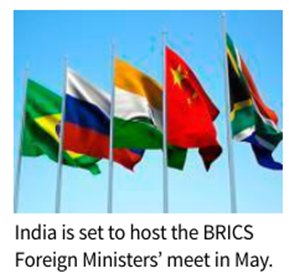
- According to officials and diplomats, the invitations to the 10-nation grouping that also includes Iran and the United Arab Emirates went out in mid-March. Both countries have rebuffed several attempts by India — the current Chair of BRICS — for a joint statement.
- Officials said it is unclear whether they will attend the meeting together, but “as of now” the BRICS Foreign Ministers’ Meeting is due to be held in-person in mid-May.
- The summit, which could bring Russian President Vladimir Putin, Chinese President Xi Jinping and leaders from Brazil, South Africa, Egypt, Ethiopia, Indonesia, Iran and the UAE together in Delhi, is expected to be held on September 9-10.
- “One of the key events on the political track, in addition to the traditional leaders’ meeting [in September], will be the BRICS Foreign Ministers’ Meeting, scheduled for May,” Russian government spokesperson Maria Zakharova told journalists in Moscow this week.
- “This will be a good opportunity for a thorough discussion of current issues on the international agenda, the role of BRICS in the world, and opportunities for joint action,” she said, responding to questions about how the grouping would tackle the war in West Asia.
- Diplomats have openly acknowledged difficulties in forging a statement that is agreeable to both Tehran and Abu Dhabi. “We have an ongoing conversation with BRICS members on the conflict in West Asia,” External Affairs Ministry spokesperson Randhir Jaiswal said at a media briefing on Friday.
- “As you’re aware, some of the BRICS members are also involved directly in the conflict… Because we have differing opinions, it has been difficult for us to forge a consensus on this particular conflict.”
- In June 2025, the BRICS then chaired by Brazil had managed to issue a strong statement when the U.S. and Israel jointly struck a number of Iranian nuclear sites, condemning the military strikes against Iran.
G-7 allies press Rubio for clarity on American plans for Iran war
Context: G-7 allies were pressing U.S. Secretary of State Marco Rubio for clarity on American plans for Iran almost one month into the war in the West Asia, with concern also intensifying over the extent of cooperation between Russia and the Islamic republic.
- German Foreign Minister Johann Wadephul said the international community needed to collaborate even more closely now it was dealing with two wars — including the conflict sparked by Moscow’s invasion of Ukraine — in which Russia and Iran were cooperating.
- In contrast to usual protocol, and in a sign of the distance between the United States and its allies, there is to be no joint communique at the end of the meeting.
- The UK’s Foreign Minister Yvette Cooper urged a “swift resolution to this conflict that restores regional stability”.
- Mr. Rubio said earlier that it was in the “interest” of all G-7 nations to push for the reopening of the Strait of Hormuz.
Paper-IV: General Studies 3
Paper-V: General Studies 4