Paper-I: Current Events of National and International Importance
Paper-II: Current Events of State Importance and Important Government Schemes and Programs
Karnataka includes root canal treatment underAB PMJAY-CM’s ArK scheme Context: In a move aimed at improving access to dental care and reducing avoidable tooth loss, the Karnataka government has approved the inclusion of root canal treatment (RCT) under the Ayushman Bharat Pradhan Mantri Jan Arogya Yojana-Chief Minister’s Arogya Karnataka (AB PMJAY-CM’s ArK) scheme.
A Government Order (GO) issued provides for the addition of specific procedure codes for root canal treatment under the Dental and Oral and Maxillofacial Surgery specialty of the scheme.
The root canal treatment is undertaken to treat infection or inflammation of the dental pulp. If left untreated, it can spread to surrounding tissues, leading to complications such as abscess formation and eventual tooth loss. Officials said the decision is expected to benefit a large number of patients who currently opt for tooth extraction due to the high cost of root canal treatment.
2 procedures notified
The order includes two categories- root canal treatment for anterior teeth and posterior teeth- which have been classified as Complex Secondary Procedures (2B) under the scheme.
The Suvarna Arogya Suraksha Trust (SAST), the nodal agency that facilitates the scheme, has been directed to adopt Central Government Health Scheme (CGHS) Tier-3 (non-NABH) rates.
Accordingly, the package rate has been fixed at ₹1,360 for anterior teeth and ₹2,040 for posterior teeth, inclusive of all consumables and procedure-related costs.
Addressing the gap
At present, the scheme covers 12 procedures under dental and oral surgery, but does not include root canal treatment. The inclusion follows a proposal submitted by the SAST. Officials noted that preserving natural teeth helps maintain chewing function and avoids the need for costlier interventions.
Cap on cases
The government has capped the benefit at 50,000 cases or a financial outlay of ₹5 crore, whichever is lower. The approval has been granted under powers delegated to the Health Department to include new procedures within a specified budget ceiling. The standard guidelines of the AB PMJAY-CM’s ArK scheme will apply to these procedures.
Main Examination
Paper-I: Essays
Essay – 1: Topic of International/National Importance
Essay-2: Topic of State importance/Local Importance
Paper-II: General Studies 1
‘India’s FY 27 growth outlook cut to 6.6%’ Context: The World Bank has revised downwards India’s growth outlook for 2026-27 to 6.6% from 7.2%, citing the impact of the war in West Asia on household and government consumption, as well as on industrial activity.
The India Development Update report by the World Bank said that “in the absence of the conflict”, India’s GDP growth was projected at 7.2%, a reflection of better-than-expected growth in 2025-26, “strong initial momentum” in the fourth quarter of that year and a “broad pro-growth reform agenda”.
“Growth is now projected at 6.6% in FY27, reflecting headwinds from the Middle East conflict — assuming an extended disruption in global energy (oil and gas) supply till end-2026,” the report said.
The India Development Update report is a companion to the South Asia Economic Update 2026. That report had projected growth in South Asia to slow to 6.3% in 2026 from 7% in 2025.
The World Bank’s Acting Director for India Paul Procee noted that there are things that can be done to boost growth. “Boosting private sector-led growth will be critical to strengthening economic resilience and supporting more young people to enter the workforce,” Mr. Procee said.
The report said that industrial activity is expected to slow to 7.5% in 2026-27 from 8.8% in the previous year. It said that the manufacturing sector — especially electronics, automobiles, and other tradable goods — will prop up industrial growth.
“However, higher input costs and decreased export demand from the Gulf region will weigh on overall industrial growth,” the report said. “Business services are likely to be impacted by the global economic slowdown and higher input costs will adversely impact food and accommodation services.”
Paper-III: General Studies 2
Government notifies CAPF law; families protest, say it undermines rights of forces Context: On a day when the families of Central Armed Police Force (CAPF) personnel protested at the Rajghat against the passing of the CAPF (General Administration) Bill, 2026, by Parliament on April 2, the President gave it her assent. Subsequently the CAPF, General Administration Act, 2026 was notified in the Gazette of India.
The Act stated that in all CAPFs, 50% of the total posts in the rank of Inspector-General, at least 67% in the rank of Additional Director-General and all posts in the rank of Special Director-General and Director-General shall be filled by IPS officers on deputation.
Till now, such postings were done based on executive orders. The Act will negate a May 23, 2025, Supreme Court order which asked the Home Ministry to “progressively reduce” IPS deputation in CAPFs up to the rank of I-Gs in the next two years.
Paper-I: Current Events of National and International Importance
Paper-II: Current Events of State Importance and Important Government Schemes and Programs
Main Examination
Paper-I: Essays
Essay – 1: Topic of International/National Importance
Essay-2: Topic of State importance/Local Importance
Paper-II: General Studies 1
Steps into the past: 1,500-year-old reservoir unearthed on Elephanta Island near Mumbai Context: As we trudged through the scrub jungle on a hill on the Elephanta Island off the Mumbai coast on March 17, Abhijit Ambekar declared with a flourish, “We will show you the wonder-discovery of our excavation.” Professor Abhijit Dandekar chipped in, “It is a show-stopper.”
As we reached the trench, where several men and women were excavating the soil deep below, it was clear that it was a spectacular discovery. There it was: a series of steps leading to a reservoir below. In other words, it was a stepped reservoir or a reservoir built with a wide staircase of perfectly aligned stone blocks.
Dr. Ambekar, director of the current excavation and Superintending Archaeologist, Mumbai Circle of the Archaeological Survey of India (ASI), estimated the stepped reservoir to be about 1,500 years old.
“It is a massive structure — about 14.7 metres long, and 6.7 metres and 10.8 metres wide, forming a T-shape. The excavation has reached a depth of five metres so far. We have exposed 20 steps. The steps are built with stone-blocks which are not from the island. They were ferried from the mainland,” he said.
While rock-cut cisterns have been found earlier on the Elephanta Island, the discovery of this stepped reservoir was important because it was a carefully designed architecture for storing water, Dr. Ambekar said. “Although the island receives a large amount of rainfall from the monsoon, very little seeps into the soil because of the island’s rocky nature, and the water runs off into the sea,” he said. Hence, this stepped reservoir, which was “a remarkable engineering work.”
The ASI’s Mumbai Circle began the excavation here in November 2025. It has excavated 19 trenches, each measuring 10 metres x 10 metres.
The excavation has so far yielded a beautifully built brick structure, which could be a dyeing vat for colouring textiles, a big storage pot, terracotta figurines, glass and stone bangles, beads made of carnelian and quartz and stone anchors. A total of about 3,000 amphorae sherds of Mediterranean origin and torpedo jar sherds from West Asia, including Mesopotamia, have been unearthed. Amphorae and torpedo jars were used for storing wine, oil and fish sauce. Their potsherds showed the island’s long-distance maritime contacts.
Importantly, 60 copper, lead and silver coins have so far been found in the excavations. Several copper coins have been identified as belonging to ruler Krishnaraja of the Kalachuri dynasty of the sixth century CE, said Dr. Abhijit Dandekar, Department of Ancient Indian History, Culture and Archaeology of Deccan College, Pune.
The identification was made on the basis of the motif of a seated bull on the obverse and a temple symbol with the legend of Sri Krishnaraja on the reverse, he said.
Paper-III: General Studies 2
Groundwater extraction in State saw reduction in 2025 Context: Releasing the 2025 Groundwater Assessment Report, Minister Boseraju says the gains have been made owing to good rainfall, policy interventions, and large-scale water conservation initiatives implemented over the past two years.
Karnataka has recorded a significant decline in groundwater usage along with a notable increase in annual recharge capacity, reflecting the impact of sustained water conservation efforts and good rainfall.
Improved indicators
According to the report, overall groundwater extraction reduced from 68.44% in 2024 to 66.49% in 2025, indicating more responsible and sustainable usage patterns across the State.
Also, the annual groundwater recharge capacity has increased from 18.74 billion cubic metres (BCM) in 2024 to 19.28 BCM in 2025, while annual extractable groundwater resources rose from 16.88 BCM to 17.41 BCM.
The improvement has been driven largely by the expansion of water conservation structures across the State. Recharge through these structures increased by 29.11%, from 0.81 BCM to 1.04 BCM in a year.
Rural impact
The report indicates improvement in groundwater status across 11 taluks, with several regions moving to safer categories. Chamarajanagar taluk has improved from ‘over-exploited’ to ‘critical’.
Domestic groundwater extraction has declined by 0.58%, from 1,21,731 hectare-metres in 2024 to 1,21,023 hectare-metres in 2025. Officials attributed this reduction to increased reliance on surface water under the Jal Jeevan Mission.
Mr. Boseraju said initiatives such as lake rejuvenation, year-round water supply through treated and surface water, sustained public awareness campaigns, and good rainfall have played a key role in reducing over-extraction and improving recharge.
“Instead of depending solely on the 120-day monsoon, we are ensuring water availability across all 365 days through scientific management. This has strengthened long-term water security for both farmers and urban residents,” he said.
Digital Water Stack initiative
Under this framework, the government will introduce space technology and AI-based satellite surveillance to obtain real-time data for continuous groundwater monitoring.
Cabinet clears draft amendment Bill over women’s reservation Context: The Union Cabinet approved a draft amendment Bill to implement the Women’s Reservation Act by the 2029 Lok Sabha elections.
The decision was taken at a Cabinet meeting chaired by Prime Minister Narendra Modi, sources said. The amendment seeks to revise the implementation framework of the Nari Shakti Vandan Adhiniyam, formally known as the Constitution (106th Amendment) Act, passed in 2023. Under the proposal, the strength of the Lok Sabha is set to rise from 543 to 816, following a fresh delimitation exercise.
Of the expanded House, 273 seats, around one-third will be reserved for women. The quota will be applied vertically, providing reservation for women within the Scheduled Caste and Scheduled Tribe categories as well.
In a significant departure from the existing law, the government plans to carry out delimitation based on the 2011 Census, rather than waiting for Census data from 2027.
The Bill will be taken up for debate at the Budget Session from April 16-18.
Paper-IV: General Studies 3
‘Over 4,600 objects placed in orbit in 2025 after 315 space launches’ Context: The year 2025 saw 315 successful space launches globally, with about 4,651 objects placed in orbit. According to the Indian Space Situational Assessment Report (ISSAR) for 2025 released, a maximum number of payloads were deployed during 2025.
The report stated that 4,651 objects were launched to orbits and 1,911 re-entered the atmosphere with a net annual growth of 74.5%.
27 satellites operational
With regard to the Indian space assets in 2025, eight satellites were launched and four rocket bodies were placed in orbit. The report said that 12 Indian objects re-entered the atmosphere.
It added that the IRNSS-1 D satellite was decommissioned 600 km above geosynchronous orbit. In total, there are 86 Indian satellites in orbit of which 27 are operational, 23 are defunct (still in orbit), and 36 decayed.
Among the Indian rocket bodies, three Launch Vehicle Mark-3 (LVM-3) are still in orbit and five are decayed; four Small Satellite Launch Vehicles are decayed; four Geosynchronous Satellite Launch Vehicles (GSLV) are in orbit and 10 have decayed, and 42 Polar Satellite Launch Vehicles (PSLV) are in orbit and 19 have decayed.
The report also said that 563 and 519 orbital manoeuvres were carried out in low-earth orbit and geostationary orbit, respectively.
Fourteen collision avoidance measures were carried out in low-earth orbit along with four in geostationary orbit, the ISSAR report said.
72-year-old man from Shivamogga dies of Kyasanur Forest Disease Context: A 72-year-old man from Sagar taluk died of Kyasanur Forest Disease (KFD) at a private hospital in Manipal, Udupi district.
Tick-borne disease
The KFD is a tick-borne disease, and people living near forest areas are particularly vulnerable to infection. The district administration and officials of the Health and Family Welfare Department are conducting awareness campaigns on preventing its spread. People visiting forest areas have been advised to apply tick-repellent oil on their hands and legs.’
India withdraws bid to host climate summit in 2028 Context: The government cites a review of its 2028 commitments, says report; the country had last hosted the summit in 2002, when it was a low-key affair.
India has withdrawn its bid to host the 33rd edition of the Conference of Parties (COP 33) in 2028 — the annual United Nations climate talks, according to a report by Climate Home News (CHN).
Prime Minister Narendra Modi had announced India’s interest in hosting the COP33 at the COP28 in Dubai in 2023.
The Ministry for Environment, Forests and Climate Change did not comment on the report, but The Hindu has independently confirmed its veracity.
According to the CHN report, an April 2 letter by Rajat Agrawal, Joint Secretary in the Environment Ministry, to the United Nations Framework Convention on Climate Change (UNFCCC) stated that India was withdrawing its candidacy following a “review of its commitments for 2028”.
In July 2025, the Environment Ministry set up a dedicated cell for the “professional and logistical requirements” for organising the COP33. This followed a joint declaration at the 17th BRICS summit on July 7, where the member countries “welcomed” India’s candidacy.
The hosting of the COP rotates among the UN’s five regional groups, with India belonging to the Asia Pacific group.
The COP30 was held in Brazil. The edition this year is to be jointly hosted by Turkiye and Australia and the 2027 summit (COP32) is scheduled to be held in Ethiopia. With India withdrawing, South Korea is the only country that has so far expressed interest in hosting the COP33. India has hosted the summit only once — in 2002 (COP8) — when it was a relatively low-key affair.
On March 25, India announced its updated Nationally Determined Contributions (NDCs), committing by 2035 to source 60% of its installed electricity capacity from non-fossil sources, reduce emissions intensity of GDP by 47%, and increase its carbon sink by 3.5-4 billion tonnes of CO₂ equivalent.
NTPC inks MoU with Électricité de France
State-owned National Thermal Power Corp Ltd. (NTPC) said it had inked a non-binding memorandum of understanding (MoU) with French counterpart Électricité de France (EDF) to explore opportunities in India’s nuclear power space.
According to a statement, the two entities would seek to establish a framework for jointly assessing “feasibility and approach for collaboration”.
NTPC is targeting to institute 30 GW of nuclear capacity by 2047.
Indian scientists find new way to measure distances in deep space Context: The dense and rapidly spinning remnant cores of dead stars are called pulsars; they emit beams of radio waves that sweep across the earthlike light from a lighthouse sweeps across ships at sea; pulsars have an extraordinarily fixed spinning rate, so the pulses arrive very regularly.
Indian astronomers, including from IIT-Kanpur, have developed a new way to measure distances in the universe using the pulsating cores of dead stars, by studying how their radio emissions are distorted as they travel through space. The technique combines a pair of subtle effects that occur when pulsar signals pass through clouds of ionised gas in the Milky Way.
The dense and rapidly spinning remnant cores of dead stars are called pulsars. They emit beams of radio waves that sweep across the earth like light from a lighthouse sweeps across ships at sea. Pulsars have an extraordinarily fixed spinning rate, so the pulses arrive very regularly. So astronomers have used them as cosmic clocks.
Pulsar timing experiments use millisecond pulsars, which spin hundreds of times per second, to create precise timing models that predict the arrival of following pulses. Any difference in arrival time indicates the presence of another astrophysical event, such as those producing gravitational waves.
But as these radio waves travel through the galaxy before reaching the earth, they also pass through clouds of ionised gas, or plasma, that contain free electrons that slightly alter the radio signal.
Way of light
Astronomers measure one of these effects using a quantity called the dispersion measure (DM). As radio waves travel through the interstellar medium, free electrons slow down lower frequency waves more than higher frequency ones. This causes different frequencies to arrive at the earth at slightly different times. By measuring the delay caused by dispersion, astronomers can estimate how many electrons lie between the earth and the pulsar.
In general, signals from more distant pulsars pass through more interstellar plasma and encounter more electrons. As a result, DM provides a rough estimate of how far away the pulsar is.
Astronomers have long used DM to estimate the distance to pulsars. However, this method relies on models of electron distribution throughout the Milky Way that can be unreliable in complex regions such as the Gum Nebula, a vast region of ionised gas and one of the largest known nebulae in our galaxy. Possibly associated with a supernova explosion or ionisation by hot stars, the nebula contains the Vela Pulsar and regions that can strongly influence radio signals passing through it.
Wobbling signals
The interstellar medium also affects pulsar signals in another way. As plasma is not perfectly smooth, its irregularities scatter radio waves as they travel through it. This scattering causes the signals to follow multiple paths before reaching the earth. The scattered waves interfere with each other, causing the pulsar’s brightness to vary with time.
The term for this is scintillation, similar to the twinkling of stars in the night sky. Since the signals arrive by different paths and at slightly different times, the signal appears stretched out or smeared. This effect is known as scatter broadening.
In the new study, published in the Monthly Notices of Royal Astronomical Society, the team combined DM with scatter broadening to refine the distance estimates. As scattering depends on how turbulent the plasma is, the electron density, and the location of the scattering region along the line of sight, the joint method revealed where the turbulent plasma is located between the earth and the pulsar much more accurately.
“Previously, we had only one ‘soldier’— dispersion — to solve the problem,” the study’s lead author Ashish Kumar, formerly at IIT-Kanpur and now at the National Centre for Radio Astrophysics, said. “Now we have two: dispersion and scattering.”
The study was carried out with co-authors Avinash Deshpande, former professor at the Raman Research Institute, and Pankaj Jain, a professor at IIT-Kanpur.
Systematic application
“The authors have done a careful job of utilising a variety of measurements on 10 pulsars to constrain the structure of the interstellar medium in this region, including the distance to the dominant scattering region [the Gum Nebula],” Cornell University professor James Cordes, who wasn’t involved in the study, said.
He also said combining scattering and dispersion to estimate pulsar distances is not entirely new and has been explored in pulsar studies for decades. In this study, however, the team applied the approach in a systematic way: they used both dispersion and scattering measurements together and adjusted their model step by step until it matched both the observed DM and the scatter broadening.
The distance where the model and observations agreed was then taken to be the pulsar’s distance.
Their work shows that much of the scattering affecting pulsars in this direction likely comes from turbulent layers of the Gum Nebula. Using observations of 10 pulsars in the same region of the sky as Gum Nebula, researchers also developed a refined model of the nebula’s electron distribution. Results showed that the Vela pulsar lies behind the nebula’s front shell.
No hard limit
Scatter broadening depends on how strongly a pulsar’s signal is scattered along the line of sight. Calculating this exactly requires extensive analysis. So to simplify it, researchers combined the dependencies into a single parameter, called the k-factor, at a given frequency.
Estimating the k-factor was the main technical challenge of the study, Dr. Kumar said, as it varies significantly in complex regions. However, one can determine its value for the target pulsar from a nearby pulsar at a known distance.
For the Gum Nebula, the team analysed several pulsars in the region and calculated their individual k-factors. Instead of adopting a single number, they used a range of possible values to account for uncertainties in the scattering properties of the plasma. The team is now working on a follow-up study of roughly 300 pulsars across our galaxy to determine how the k-factor varies in different directions.
Parallax-based measurements are extensively used in distance measurements. While the novel method offers several advantages over DM-only estimates, it cannot beat the “gold standards” of the parallax method in terms of accuracy, Dr. Kumar said.
However, while certain parallax techniques have a “hard limit” on distance, the new method has no specific distance limitation. It could even be used to measure distances to objects outside the Milky Way, like the enigmatic fast radio bursts.
Why India wants fast breeder reactors
In an important milestone, the prototype fast breeder reactor (PFBR) at Kalpakkam achieved criticality on April 6. The term ‘criticality’ is familiar to India: over the decades, it has been associated with the slow and tedious successes of India’s nuclear power programme. At the same time, in keeping with many terms in the nuclear vocabulary, ‘criticality’ is also often mistaken as an end goal. In reality, it is actually the first step.
What is criticality?
A nuclear reactor becomes critical when its chain reaction is able to sustain itself. That is, when an atom’s nucleus undergoes nuclear fission, it releases neutrons that trigger at least one more fission reaction in the surrounding nuclei. Reactor engineers ensure this happens by controlling the composition of the fuel (the material whose nuclei undergo fission), how well the neutrons are able to ‘access’ more nuclei, and the temperature of the reactor. Once a reactor is critical, it also means it is in a kind of stable state. However, it does not mean that it is operating in a commercially viable way. That comes much later. After criticality, the operators keep the reactor running as it produces a low amount of power, for months if necessary, while they check if its operating parameters are within design limits. If an operator is sure that the parameters are, they can go to the next stage.
How do FBRs work?
Most of India’s currently operating nuclear reactors are pressurised heavy water reactors (PHWRs). They are designed to support the fission of natural uranium. Natural uranium consists of 99.3% of uranium-238 and 0.7% of uranium-235. ‘235’ and ‘238’ denote the total number of protons and neutrons in the nucleus. In a PHWR, neutrons are introduced into the reactor, where a device called a moderator slows them down. This is necessary for the neutrons to cause uranium-235 to undergo fission. When it does, it releases heat, which the PHWR converts to electricity; a small amount of plutonium; and a few neutrons.
PHWRs are inefficient because only a small fraction of the fuel, around 1%, undergoes fission before it becomes unusable.
A fast-breeder reactor (FBR) is more efficient, achieving a fuel use rate of around 10% or more. Mainly, the fuel consists of plutonium, not uranium. The reactor core is surrounded by a ‘blanket’ of depleted uranium, like the unusable fuel produced by PHWRs. When a fast neutron bombards the blanket, the uranium nuclei are transmutated to plutonium nuclei, which are reprocessed as nuclear fuel. The plutonium-based fuel also uses the fast neutrons to undergo fission, releasing more fast neutrons.
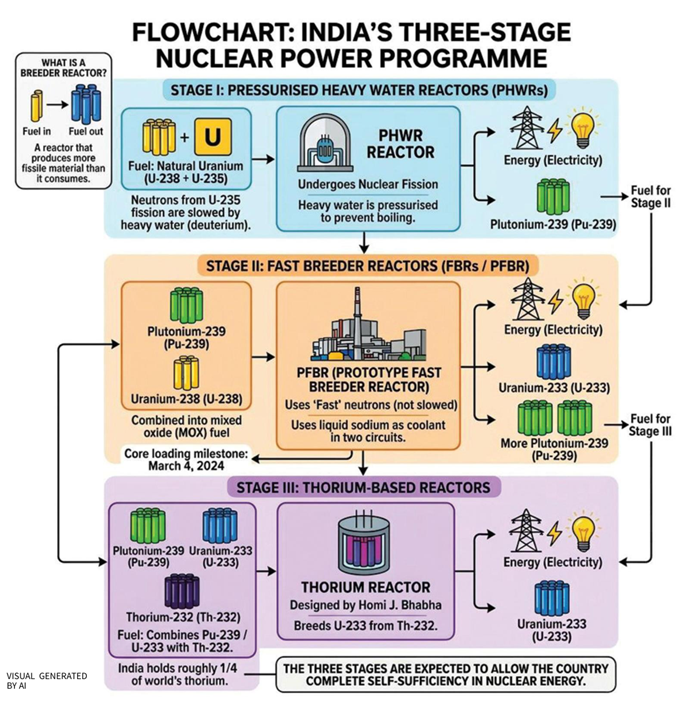
What is India’s three-stage programme?
The nuclear physicist Homi Bhabha is widely credited with conceiving India’s nuclear programme in the first years of its independence. The programme has three stages. In the first stage, PHWRs will use natural uranium to produce plutonium and depleted uranium and electricity. In the second stage, FBRs will use the plutonium and depleted uranium from the first stage to produce even more plutonium and electricity. Finally, future nuclear reactors will use plutonium and thorium to produce electricity.
Bhabha came up with this programme because India has abundant quantities of thorium but only modest reserves of uranium.
And in this scheme, FBRs have been envisaged as a bridge between the initial step, to use what we have, and the final step, to complete the cycle and thus make India self-sufficient in nuclear power.
Why are FBRs challenging?
That an FBR is easier said than done would be a gross underestimate. The Indian government approved the PFBR more than two decades ago. It was designed by the Indira Gandhi Centre for Atomic Research and built by the Bharatiya Nabhikiya Vidyut Nigam, Ltd. The latter proved to be more challenging than first expected.
Among other features, the PFBR uses liquid sodium as coolant. Sodium becomes liquid at a higher temperature, and at higher temperature heat transfer is more efficient. Liquid sodium also does not need to be pressurised. However, it reacts violently with air and water, so the pumps, pipes, and tanks exposed to liquid sodium need to be perfectly sealed, with stringent leak detection protocols. Water-cooled reactors do not have such operational complexities, nor the additional cost.
India is also not alone in confronting these challenges. Japan’s Monju Nuclear Power Plant suffered a sodium leak and fire in 1995, leading to long shutdowns; the plant eventually had to be decommissioned. The Superphénix in France was once the world’s largest breeder reactor but it was shut down as well, due to technical issues and high operating costs, which also fanned political opposition. Russia, however, has continued to maintain a small fleet of fast-breeder reactors.
In other words, operators have shown FBRs to be technically feasible but they are not yet economically feasible; they have also not won broader public acceptance. Aside from the costs of making them, they also demand rigorous oversight — which depends on both engineering excellence and the safety culture.
How has India pursued FBRs?
India is pursuing FBRs because, as discussed earlier, the three-stage nuclear programme prioritises long-term fuel security. Importantly, it is able to do so because India’s nuclear sector remains largely driven by the state. Its decision-making structure is relatively insulated from the ruling establishment: the Department of Atomic Energy (DAE) reports directly to the Prime Minister’s Office. As a result, as long as there has been political stability, India has been able to sustain nuclear projects across electoral cycles.
On the flip side, this insulation has reduced scrutiny of the nuclear power programme and protected it from the same pressure to deliver that assails other public sector enterprises like the Indian Railways and the National Highways Authority of India. Engineers have taken on projects with limited transparency on timelines and budgets. When one or both have slipped, the accountability has been spread across agencies. The PFBR’s original cost was ₹3,500 crore. It came to ₹6,800 crore in 2019. The DAE also sought multiple deadline extensions. In 2020, it said the PFBR would be commercialised in October 2022. That milestone is still pending.
The economics of FBRs also remain uncertain. In addition to the aforementioned issues, the broader fuel cycle — especially the reprocessing of spent fuel and the fabrication of new fuel assemblies — will require its own infrastructure. And for this the nuclear establishment will have to set up new regulatory processes.
What next for the PFBR?
The PFBR will be operated at a low power level to check its behaviour in different operating conditions. Engineers will collect the data from these tests to inform decisions about raising the reactor’s power output and refining safety protocols. Eventually, they will seek approval from the Atomic Energy Regulatory Board to operate the reactor in commercial mode.
This entails running the PFBR at or near its rated capacity to generate electricity for the grid on a sustained basis, with standard operating procedures and clear regulatory oversight. At this point in time, the reactor will also have transitioned from being experimental to a commercial power plant.
In parallel, the DAE will also develop fuel reprocessing facilities and plan for future FBRs. Once these aims are closer to being realised, the government and India will develop a clearer sense of whether the broader vision of a closed fuel cycle can be realised.
Paper-I: Current Events of National and International Importance
Paper-II: Current Events of State Importance and Important Government Schemes and Programs
State urges Maharashtra govt. to give Kannada option in TET Context: The Karnataka government has urged the Maharashtra government to provide an option for candidates to appear for the Teachers Eligibility Test (TET) in Kannada medium also for those who are serving in Kannada-medium schools in Maharashtra.
With the Supreme Court mandating all serving teachers to clear the TET by 2027 to ensure job security, the Maharashtra government has issued Kannada-medium school teachers recruitment notification to fill up vacancies in Kannada-medium schools of Maharashtra.
The current-unavailability of TET in Kannada medium has caused significant distress and professional uncertainty among those serving as Kannada medium teachers in these schools.
“These linguistic minority students and teachers come under the protection of constitutional provision of Articles 30, 347, 350, 350A and 350B,”.
There was around 377 Kannada-medium schools with 44,860 students in Jatta, Akkalkot, Dakshin Solapur where about 80% linguistic minority Kannadigas live.
In recognition of Basavanna’s ideology, State of Kansas proclaims April 20 as ‘Basava Day’ Context: The State of Kansas in the U.S. has recognised the ideology of Karnataka’s 12th century social reformer Basavanna by proclaiming April 20, Basava Jayanti, as “Basava Day” in Kansas. The proclamation was made by Kansas Governor Laura Kelly.
The proclamation said: “Basava Day honours the birth and teachings of Jagadguru Basavanna, also known as Basava, a 12th century Indian philosopher and a social reformer who was said to have been a mystic by temperament, an idealist by choice, a statesman by profession, a man of letters by taste, a humanist by sympathy, and a social reformer by conviction, whose message continues to inspire people around the world.”
It also observes that Basava’s vision remains highly relevant today of a just society, free from all discrimination.
This proclamation celebrates the vibrant contributions of the Lingayat community and the broader Indian-American diaspora to the cultural fabric of Kansas.”
Karnataka makes audit of adolescent pregnancies mandatory Context: In a move aimed at strengthening adolescent health and addressing early pregnancies, the State government has made it mandatory to audit all adolescent pregnancy cases involving girls aged 10 to 18 years.
The audit will be carried out by the respective Taluk Health Officers across the State, covering all such cases reported through both government and private health establishments.
Adolescent pregnancy continues to be a significant public health and social concern, with implications for maternal health, neonatal outcomes and long-term socio-economic development. Pregnancies in this age group are associated with higher risks of complications, adverse birth outcomes, school dropout and increased social vulnerability. Citing global estimates, nearly half of adolescent pregnancies are unintended.
The Health Department had directed private hospitals to mandatorily report cases of minor pregnancies under the POCSO Act, warning that failure to do so will invite legal action against both doctors and hospital managements.
While programmes such as the National Health Mission and the Rashtriya Kishor Swasthya Karyakram (RKSK) focus on adolescent health through counselling, awareness and access to services, the persistence of teenage pregnancies points to gaps that require systematic review.
Under the new framework, all adolescent pregnancies must be mandatorily reported on the Reproductive and Child Health platform. The audit will examine factors such as age at marriage, educational status, awareness of reproductive health, access to contraception and counselling services, and socio-economic vulnerabilities. It will assess linkages with schemes such as RKSK, ICDS and school health programmes.
At the taluk level, an audit committee headed by the THO will be set up, with members including health inspectors, Primary Health Centre medical officer, ASHA supervisors, anganwadi supervisors and, where applicable, school representatives.
Based on the findings, the health system will undertake measures including counselling through designated centres, provision of contraceptive services and pregnancy testing kits, and identification of vulnerable adolescents such as school dropouts, migrants and those from socially disadvantaged backgrounds.
Main Examination
Paper-I: Essays
Essay – 1: Topic of International/National Importance
Essay-2: Topic of State importance/Local Importance
Paper-II: General Studies 1
Paper-III: General Studies 2
‘Records on caste census decision can’t be disclosed’ Context: The Union government has stated that records of the Inter-Ministerial deliberations, inputs, and suggestions referred to in making the decision to enumerate caste in the 2027 Census are exempt from public disclosure under the Right to Information Act, 2005.
Responding to a request for these records filed by The Hindu under the RTI Act, the Union Cabinet Secretariat said that these records were exempt from disclosure under Section 8(1)(i) of the 2005 law. This section says the government is not obligated to disclose Cabinet papers, provided that “the matter is over” or “complete”; and provided that “the decisions of Council of Ministers, the reasons thereof, and the material on the basis of which the decisions were taken shall be made public after the decision has been taken”.
On April 30, the Centre posted a statement, saying, “Cabinet Committee on Political Affairs has decided to include caste enumeration in the upcoming Census.” On March 25, responding to requests for information on records relied upon for this decision, the Cabinet Secretariat said, “The information sought is exempted from disclosure under Section 8(1)(i) of the RTI Act.”
Paper-IV: General Studies 3
Fast breeder nuclear reactor at Kalpakkam takes ‘critical’ leap forward Context: The prototype fast breeder reactor (PFBR) at Kalpakkam, Chennai, had achieved “criticality”. This means that the nuclear reaction in the reactor had become safely self-sustaining, and was on its way to being able to produce electricity.
While it will be some months before the PFBR is powered up to its full capacity, and even longer before it produces useful electricity, multiple experiments have to be conducted at low power to check if it’s running as expected, which must be evaluated by the Atomic Energy Regulatory Board before it grants a go-ahead for commercial power operation, this the beginning of the second stage of India’s nuclear programme.
Since it was first formally approved as a project by the government in 2003, the PFBR at Kalpakkam has taken over two decades to reach this stage.
PFBR as a bridge
India’s nuclear reactors are heavily dependent on imported uranium. The country’s three-stage programme, conceived in the 1950s, envisages being able to be independent of imported uranium, creating its own stockpile of suitable uranium, and eventually harnessing thorium, of which it has vast stores. The PFBR development serves as an essential bridge.
“What this means is that we are now on our way to extract 80-100 times more energy from a given quantity of uranium.”
The PFBR is a 500 MW sodium-cooled, pool-type fast breeder reactor designed by the Indira Gandhi Centre for Atomic Research and built by Bharatiya Nabhikiya Vidyut Nigam Limited, both operating under the Department of Atomic Energy.
Uranium powerhouse
India’s pressurised heavy water reactors (PHWR) burn up uranium to produce electricity and small quantities of plutonium. However, less than 1% of the energy from this uranium (that can be used as heat and make electricity) is extracted from these reactors. The ‘depleted’ uranium in India isn’t considered ‘waste’ but is reprocessed and stored. It, however, cannot be used back in the existing PHWRs.
“The PFBR reactor is designed to use the ‘spent’ uranium from the PHWR as well as produce more plutonium. We are no longer using fresh, mined uranium here. As a thumb rule, this means that the 1% energy extracted can go up to nearly 10% for a single cycle and for every additional cycle 10% more. The efficiency of the uranium that is mined goes up substantially.
“The burn-up or the energy extracted goes from about 8,000 units (in a PHWR) to nearly 100,000 units,”.
Two more reactors
India’s current plan, Mr. Grover said, was to construct two more PFBR at Kalpakkam, though this would only be following a proper assessment of the performance of the PFBR for a year. In the current scheme of things, the PFBR will produce only “marginally more” plutonium.
“Our current priority is to use the uranium that we have far more efficiently. There is a reprocessing plant to come up on site at Kalpakkam which will use the processed spent fuel from the PFBR and for the two future PFBR. The PFBR will use depleted uranium (from the Pressurised Heavy Water Reactors or PHWRs).
In the future, we will use thorium, but that is still a long time away, and what kind of reactors we will use for that, we need more work and have to wait and watch,” he said, adding, “These reactors are self-sustaining but as and when we need more plutonium in the future, the design has to be optimised to extract more plutonium.”
Currently, India has a fleet of 18-20 PHWRs that use natural uranium as fuel and produce plutonium-239 (Pu-239) as a by-product in spent fuel. India’s full fleet of 23 nuclear reactors have a combined capacity of 7.48 GW. India hopes to have 100 GW by 2047 and this is premised on a larger fleet of Bharat Small Modular Reactors (which are scaled down PHWR) that are in the pipeline.
A significant technological challenge that has led to delays in the PFBR is the use of liquid sodium as a coolant to manage the extremely high heat from fissioning uranium atoms in the PFBR. In India’s current reactors, the heat is largely absorbed by ‘heavy water’, or in some cases, ordinary water. Once fully operational, the PFBR is expected to generate 500 MW of electricity, with a design life of 40 years.
Paper-I: Current Events of National and International Importance
Paper-II: Current Events of State Importance and Important Government Schemes and Programs
Karnataka frames guidelines for multi-pair kidney swap transplants Context: Expanding access for those unable to undergo renal transplantation due to biological incompatibility, the State government has issued detailed administrative guidelines enabling multi-pair kidney paired exchange (swap) transplants. Karnataka is the first State to frame such guidelines in the country, officials said.
A Government Order (GO), issued on April 4, operationalises provisions under the Transplantation of Human Organs and Tissues Act (THOTA), 1994, to permit kidney swaps involving three or more donor-recipient pairs, while laying down a structured regulatory and procedural framework.
Officials said a significant number of patients in Karnataka are unable to undergo transplantation due to incompatibility factors such as ABO blood group mismatch, positive crossmatch, or HLA incompatibility. Kidney Paired Exchange (KPE), an internationally accepted and scientifically validated approach, allows such incompatible pairs to exchange donors with other pairs to achieve compatible matches.
“While Section 9(3A) of THOTA explicitly allows swap transplants between two pairs, it does not directly address multi-pair exchanges. However, the absence of any prohibition, along with the Supreme Court’s 2025 judgment in Indian Society of Organ Transplantation vs. Union of India and a supporting legal opinion obtained by the State, has enabled the government to permit three-way and higher-order swaps,” officials said.
Safeguards
The guidelines stipulate that multi-pair swaps will be allowed only under strict conditions.
Each donor must be a ‘near relative’ of the intended recipient, and each pair must have documented medical evidence of incompatibility.
At the same time, compatibility must be established across the swap group through cross-match and HLA reports certified by NABL-accredited laboratories.
All donors and recipients are required to enter into a single joint agreement consenting to the exchange. The order mandates that all clinical, immunological, psychological and legal evaluations prescribed under the Act and Rules be completed to the satisfaction of the Appropriate Authority and the Authorisation Committee. It also explicitly prohibits any form of commercial transaction.
Approval and oversight
Every multi-pair swap transplant will require prior approval from the Authorisation Committee, with the State-Level Authorisation Committee vested with jurisdiction over all such cases, including those involving multiple hospitals or districts.
The Committee has been tasked with additional scrutiny, including verifying that the swap group comprises only near-relative pairs, ensuring that no participant is substituted after the agreement without fresh approval, and conducting individual interviews of all donors and recipients, which must be video-recorded.
Timeline
The guidelines also prescribe a timeline, requiring the Authorisation Committee to take a decision within 24 hours of convening its meeting.
Documentation and procedure
Hospitals must submit extensive documentation, including Form 11 applications jointly executed by donors and recipients, proof of relationship, medical fitness certificates, incompatibility reports, and declarations affirming the absence of financial transactions.
A single joint agreement signed by all participants is mandatory, along with certification from the Authorisation Committee. Surgical procedures are to be conducted simultaneously, as far as possible, to prevent breakdown of the swap arrangement.
Where this is not feasible, transplants may be carried out in a closely coordinated sequence with prior approval, stated the GO.
In cases involving multiple hospitals, a detailed inter-hospital coordination plan must be submitted in advance, and organ transport must comply with protocols under the THOTA Rules, 2014.
A designated transplant coordinator will oversee the process.
Monitoring and reporting
The guidelines emphasise post-transplant monitoring and data reporting. All participating hospitals must report details of such transplants to the State Organ Transplant Organisation (SOTTO) and the national registry in prescribed formats, while also maintaining long-term follow-up data for donors and recipients.
The State will compile consolidated data and submit periodic reports. Recognising that multi-pair swaps are relatively new in Karnataka, the government has directed that initial cases be treated as special cases, with decisions subject to additional review or guidance, if required.
Clarification
The GO clarifies that the guidelines are administrative in nature and consistent with the provisions of THOTA and the 2025 Supreme Court judgment and will remain in force until any formal amendments are made to the central law.
Main Examination
Paper-I: Essays
Essay – 1: Topic of International/National Importance
Essay-2: Topic of State importance/Local Importance
Paper-II: General Studies 1
Paper-III: General Studies 2
Paper-IV: General Studies 3
With 2,039 stations, Karnataka second in EV charging network Context: It is ahead of major States such as Maharashtra, Tamil Nadu, and Gujarat in terms of operational OMC-run charging stations.
Karnataka has emerged as the second-largest hub for Electric Vehicle public charging stations in India, with 2,039 operational units installed by oil marketing companies. This puts Karnataka just behind Uttar Pradesh in the national rankings, according to data by Ministry of Heavy Industries.
According to the data accessed by The Hindu, a total of 2,039 EV public charging stations (EV PCS) installed by oil marketing companies (OMCs) are currently operational in Karnataka. A year-wise analysis shows a steady acceleration in deployment. Karnataka had just 36 charging stations in 2020–21, which rose over fourfold to 153 in 2021–22. The pace picked up significantly in 2022–23, when installations jumped to 542 stations, reflecting adoption of EVs.
While 2023–24 saw a marginal dip to 478 stations, the overall trajectory remained upward. The most notable surge came in 2024–25, when installations more than doubled to 1,034 stations, marking the single largest annual addition in the five-year period.
In the current financial year (2025–26, up to March 1), an additional 157 stations have been installed, taking the cumulative installations over five years to 2,400, out of which 2,039 are operational.
A senior official said that the sharp rise, particularly after 2022–23, indicates increasing alignment between infrastructure rollout and EV adoption trends in urban centres such as Bengaluru, as well as along key highways.
“The expansion has largely been driven by OMCs, alongside private sector participation, as setting up EV charging stations remains an unlicensed activity,” the official added.
Karnataka is ahead of major States such as Maharashtra, Tamil Nadu, and Gujarat in terms of operational OMC-run EV charging stations. Only Uttar Pradesh, with 2,893 stations, has a larger network.
Adequacy
However, despite the rapid expansion, an official source noted that there is currently no centralised assessment of the adequacy of charging infrastructure relative to the number of registered EVs, nor a detailed roadmap for future expansion.
Meanwhile, across India, OMCs have installed a total of 27,737 EV public charging stations, of which 22,753 are currently operational, at the same time, a small number of stations (21) across the country have been decommissioned. According to the data, under the FAME-II scheme, ₹912.5 crore has been sanctioned for EV charging infrastructure, of which ₹895.48 crore has been released and ₹655.43 crore utilised so far. Additionally, the government has earmarked ₹2,000 crore under the PM E-DRIVE scheme to expand charging infrastructure nationwide, although no funds have been released yet.
To tackle LPG deficit, Jindal uses syngas in furnaces
Jindal Steel said it has deployed syngas in galvanising and colour coating line furnaces to counter the shortage of natural gas, LPG and propane, enabling the company to sustain operations amid supply disruptions.
Syngas, or synthesis gas, is a clean-burning fuel that offers a way to turn waste and biomass into valuable energy, acting as a circular energy source. The switch allowed the firm to mitigate fuel constraints.
KAS Current Affairs: Current Affairs is the living pulse of the KPSC syllabus. It is not a standalone subject to be memorized in isolation; rather, it is a dynamic thread that weaves together History, Economy, Polity, and Ethics across both the Preliminary and Main stages. In the context of the upcoming examinations, transitioning from simply “reading the news” to “studying the syllabus through the news” is the critical shift that separates a serious aspirant from a casual reader.
The “Syllabus-First” Philosophy By following a current affairs pattern strictly mapped to the KPSC syllabus, you ensure that every hour spent reading the newspaper is an hour spent building your exam rank.
KAS Current Affairs: Current Affairs is the living pulse of the KPSC syllabus. It is not a standalone subject to be memorized in isolation; rather, it is a dynamic thread that weaves together History, Economy, Polity, and Ethics across both the Preliminary and Main stages. In the context of the upcoming examinations, transitioning from simply “reading the news” to “studying the syllabus through the news” is the critical shift that separates a serious aspirant from a casual reader.
The “Syllabus-First” Philosophy By following a current affairs pattern strictly mapped to the KPSC syllabus, you ensure that every hour spent reading the newspaper is an hour spent building your exam rank.
Preliminary Examination
Paper-I: Current Events of National and International Importance
‘Private hospitals should mandatorily report minor pregnancy cases under POCSO Act’ Context: The Health Department has directed private hospitals to mandatorily report cases of minor pregnancies under the Protection of Children from Sexual Offences (POCSO) Act, warning that failure to do so would invite legal action against both doctors and hospital managements.
As per the provisions of the Act, all cases involving pregnant girls below 18 years must be reported to the authorities.
Guidelines issued by the Health Commissioner on April 1, 2026 stated that if a minor is admitted to a private hospital, the treating doctor must immediately inform the nearest Special Juvenile Police Unit or the local police station.
Officials have also instructed that such cases should be promptly reported to the Child Helpline by dialling Childline 1098, to facilitate timely protection and rehabilitation measures.
Documentation
Private hospitals have been asked to maintain proper documentation of POCSO cases and ensure that medical records are preserved in accordance with legal requirements.
They must also safeguard patient confidentiality while extending necessary cooperation to investigating authorities.
Further, the Department has emphasised the need for all private hospitals to sensitise their doctors and staff about the provisions and responsibilities under the POCSO Act.
Patented drug tariffs: ‘India more or less shielded’
Context: India is unlikely to be significantly impacted by U.S. President Donald Trump’s announcement of 100% tariffs on certain patented drugs, as the country primarily exports low-cost generic medicines to America, think tank GTRI said.
Mr. Trump signed an executive order on April 2, announcing the imposition of a 100% ad valorem duty on the import of certain patented pharmaceuticals and associated pharmaceutical ingredients.
The order builds on a Section 232 investigation launched on May 1, 2025, which cited national security risks from dependence on foreign drug supplies.
The Global Trade Research Initiative (GTRI) said the move has left “India largely protected, given its dominance in low-cost generic drug exports to the U.S.” In 2025, India exported $9.7 billion pharmaceuticals to the U.S.
Paper-II: Current Events of State Importance and Important Government Schemes and Programs
State rolls out free reading glasses scheme Context: The government has partnered with Restoring Vision to roll out a programme aimed at providing free vision screening and reading glasses to citizens aged 40 years and above across the State, beginning with Yadgir district.
The State government has partnered with RestoringVision to roll out a programme aimed at providing free vision screening and reading glasses to citizens aged 40 years and above across the State, beginning with Yadgir district.
The initiative, implemented through Ayushman Arogya Mandir Sub Centres, marks the first such collaboration in India to address presbyopia at scale at the sub-centre level. In the first phase, about one lakh reading glasses will be distributed free of cost across 216 government health facilities in Yadgir, covering hospitals, Community Health Centres, Primary Health Centres and sub-centres.
The programme is expected to benefit nearly 3.28 lakh residents aged 40 and above in the district. Officials said Yadgir was chosen for the pilot as the initial supply is sufficient to meet the district’s near-vision correction needs.
Presbyopia, an age-related decline in the ability to focus on nearby objects, is a leading cause of vision impairment. Health officials estimate that nearly 28% of Yadgir’s population is affected by the condition, which can be corrected with reading glasses.
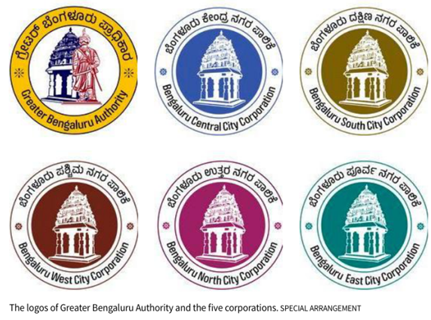
GBA, five corporations unveil logos Context: The GBA has unveiled official logos for the authority and the five city corporations on its website. The GBA logo features the image of Kempe Gowda along with the iconic Kempe Gowda tower.
GBA logo with image of Kempe Gowda and logos of five corporations unveiled
The Greater Bengaluru Authority (GBA) has unveiled official logos for both the authority and the five city corporations on its website.
While the GBA logo features the image of Kempe Gowda along with the iconic Kempe Gowda tower, the logos of the five corporations retain only the tower, each distinguished by a different colour.
English and Kannada
All the logos carry the respective corporation names in both Kannada and English.
According to a GBA official, the designs were approved during an executive meeting chaired by Deputy Chief Minister D.K. Shivakumar in March.
The logos have been released on the corporations’ websites and were said to have been developed as part of their maiden budgets.
Until now, all five corporations continued to function under the erstwhile Bruhat Bengaluru Mahanagara Palike (BBMP) website, even seven months after their formation. During their maiden budget announcements, all corporations except the East City Corporation had indicated plans to launch independent websites to bring “transparency”, the GBA official said.
The East City Corporation, however, had only proposed setting up a “public dashboard”.
Third language grading row: Governor asks State government to re-examine decision Context: Following a representation by the Association for Preservation of Local Languages, Bengaluru, the Karnataka Governor’s office has written to the Chief Secretary to examine the recent decision to award grading to third languages, including Hindi, instead of marking, in SSLC examination.
In his letter to Chief Secretary Shalini Rajneesh, R. Prabhu Shankar, special secretary to Governor Thaawarchand Gehlot, said that the representation submitted recently highlighted “the significant role played by the third language in fostering linguistic diversity, awareness, and intellectual development among students.”
Academic importance
“It has been pointed out that the proposed system of awarding only grades, in place of marks, may inadvertently diminish the academic importance of the subject and affect students’ motivation to engage seriously with it. The concerns raised also reflect apprehensions among teachers, parents, and educationists regarding the long-term implications of such a policy decision on the overall quality and inclusiveness of school education in the State,” the letter said.
Further the letter stated that the Governor had taken note of the issues raised in the representation and desired that the matter be examined comprehensively, keeping in view its academic and administrative aspects across the education sector.
“Therefore, examine the matter in consultation with the Department of School Education and other authorities concerned, and take such action as deemed appropriate in the larger interest of students and the State’s educational objectives,” he requested.
Recently School Education Minister Madhu Bangarappa announced shifting from marks to grading system for third language in the State.
The decision has received mixed reaction, with some welcoming the move and some others raising objections. The announcement had come even as the SSLC examinations were under way, creating confusion among students. Over 7.5 lakh students have Hindi as their third language, followed by English (32,000) and Kannada (11,400). Urdu, Sanskrit, Tulu, Konkani and Marathi are the other third languages.
Karnataka tops under ‘Namo Drone Didi Yojana’ Context: Karnataka, which is one of the leading aviation hubs in the country, also has the most number of women self-help groups (SHGs) to have undergone training as drone pilots under the ‘Namo Drone Didi Yojana’ (NDDY).
Under the initiative, 145 members of SHGs from the State have been given drone pilot training which is the highest in the country followed by Uttar Pradesh (128) and Andhra Pradesh (108).
In Karnataka, Koppal district topped the list, with 13 members of SHGs followed by Kalaburagi (12) and Mandya (11).
One of the main objectives of this scheme, apart from empowering the SHGs, is to improve efficiency in agricultural practices and enhance crop yield. The programme’s success breaks the stereotype of SHGs being mostly engaged in the making of home-based products such as papads and pickles.
Asha Rani C.S., from Churchugundi village in Shikaripur taluk of Shivamogga district, is among those who underwent this training in Mysuru in January, 2024. For the last two years, she has been operating drone to spray medicines in maize and paddy farms.
“The training is helping me financially too. Under the scheme I got drone as well. In a year for about four to five months, I get work to spray medicine in the farm fields. Sometimes, my earnings go up to ₹1 lakh a month,” she said.
As per information by Minister of State for Civil Aviation Murlidhar Mohol to a question in the Lok Sabha during the ongoing Budget session of Parliament a total of 1,094 SHG members have been trained as drone pilots in the country.
Across India, Prayagraj in Uttar Pradesh was ranked first, with 16 members of SHGs. The NDDY was launched by the Central government for providing 15,000 drones to the Women SHGs with an outlay of ₹1,261 crore for the period from 2023-24 to 2025-26. “The NDDY was approved by the government as a Central Sector Scheme with an outlay of ₹1,261 crore for the period from the financial year 2023-24 to FY 2025-26. The scheme aims to provide 15,000 agricultural drones to select women SHGs,” the Minister said in his reply.
He added that in 2023, 1,094 drones were distributed to SHGs by lead fertilizer companies using their internal resources. Out of these 1,094 drones, 500 were distributed under the NDDY scheme.
According to the Ministry of Agriculture and Farmers Welfare, 15 days drone pilot training for one of the members of SHGs and five days drone assistant training for other member/family members of SHGs is provided as a part of the drone package.
Main Examination
Paper-I: Essays
Essay – 1: Topic of International/National Importance
Essay-2: Topic of State importance/Local Importance
Paper-II: General Studies 1
Paper-III: General Studies 2
Home Ministry revises classification ofdistricts affected by left-wing extremism Context: The Union Home Ministry has re-categorised the total number of districts affected by left-wing extremism (LWE) in the country replacing the earlier classification of “most affected” with “LWE affected,” “districts of concern” and “legacy and thrust districts”.
While the number of districts in the LWE category remains unchanged at 38 compared to 2024-25, the classification now reflects shifts in the severity of violence reported in these areas.
The red corridor has significantly contracted — from over 200 districts in 2005 to just two in 2026 — and its definition has also been revised.
On March 27, three days before Home Minister Amit Shah declared in Lok Sabha that the country is now “Naxal-free,” the Ministry reviewed the “categorisation of districts affected by LWE” and sent the fresh list to the Home Secretaries and Directors-General of Police (DGP) of Andhra Pradesh, Bihar, Chhattisgarh, Jharkhand, Madhya Pradesh, Maharashtra, Odisha, Telangana, and West Bengal. While Bijapur in Chhattisgarh and West Singbhum in Jharkhand are the only two districts that have been characterised as “LWE affected”, Kanker in Chhattisgarh is a “district of concern”, and there are 35 other “legacy and thrust districts” across nine States.
These districts are Alluri Sitaramraju in Andhra Pradesh; Aurangabad, Gaya, Jamui, Lakhisarai in Bihar; Bastar, Narayanpur, Kondagaon, Bijapur, Dhamtari, Kabirdham, Khairagarh-Chhuikhadan-Gandai, Mohla-Manpur-Ambagarh Chowki, Gariyaband, Sukma and Dantewada in Chattisgarh; Bokaro, Chatra and Latehar in Jharkhand; Balaghat and Mandla in Madhya Pradesh; Gadchiroli and Gondia in Maharashtra; Boudh, Sundargarh, Kalahandi, Koraput, Malkangiri, Nabarangpur, Nuapada, Rayagada, Kandhamal in Odisha; Bhadradri-Kothagudem, Mulugu in Telangana and Jhargram in West Bengal.
Till November 2025, Bijapur, Sukma and Narayanpur, in Chhattisgarh were included in the category of “most affected”.
“The categorisation of districts provides the basis for deployment of resources under various schemes. The evolving LWE situation necessitates a periodic review of the districts in order to ensure that the focus of anti-LWE efforts remains aligned to the ground realities,” the Ministry said.
It added that the districts covered under the Security Related Expenditure (SRE) Scheme have been comprehensively revised again.
Rajasthan High Court expunges remarks on Transgender Act Context: The Rajasthan High Court has modified its March 30 verdict to expunge certain portions criticising the recently enacted Transgender Persons (Protection of Rights) Amendment Act, 2026. In a clarificatory order issued on Thursday, the court said that its observations that the amendment diluted constitutional guarantees had been included “by mistake” and were “neither intended nor necessary.”
The March 30 ruling on a petition filed by a transgender woman included an epilogue authored by Justice Arun Monga, which observed that the new law, by curtailing the right to gender self-identification, departs from the “constitutional baseline” set by the Supreme Court’s 2014 ruling in National Legal Services Authority v. Union of India. It noted that the amendment risked reducing what the top court had recognised as an “inviolable aspect of personhood” to a “contingent, State-mediated entitlement”.
The amendment Bill was passed in Parliament last week and became law with the President’s assent late on Monday.
In its Thursday order, the High Court Bench observed that certain portions had been inadvertently included in the epilogue of the earlier judgment and directed the deletion of paragraphs which stated that the rights of transgender persons must not be “rendered illusory by procedural constraints” and which criticised the amendment for making legal recognition of gender identity contingent upon “certification, scrutiny, or other forms of administrative endorsement”.
“Upon our re-reading of the epilogue, it appears that by mistake the following text was included therein, although it was neither intended nor necessary,” said the Bench, which included Justice Yogendra Kumar Purohit. However, the judges declined a request that the epilogue be excluded from the judgment or disregarded for precedential purposes.
In the revised epilogue, the Bench retained its position that the right to self-identify one’s gender is an “intrinsic facet of dignity, autonomy, and personal liberty under Articles 14, 15, 16 and 21” and “not a matter of concession, but a matter of right”. It, however, added that the epilogue is to be treated as a “statement of facts in the process of a changing legal landscape”.
Paper-IV: General Studies 3
Great Nicobar plan stirs fresh concerns Context: A draft plan outlining the “relocation” of Nicobarese tribal communities affected by the Union government’s Great Nicobar Island (GNI) mega-infrastructure project “to their ancestral lands” has created confusion and is exacerbating existing apprehensions among locals. They have been, for four years, protesting the clearance for the ₹92,000-crore project after withdrawing their consent in 2022, alleging that their forest rights had not been settled.
This draft “Comprehensive Tribal Welfare Plan”, prepared by the Andaman and Nicobar Islands administration and circulated on March 13 for consultation with line departments and the Tribal Council of Great Nicobar, proposes a ₹42.52-crore outlay over 24 months for the “relocation of Nicobarese tribal communities from tsunami-affected or project-impacted areas”, which involves housing, land development and basic infrastructure.
However, details of where the proposed relocation will take place and who will be relocated have left members of the Tribal Council of Great and Little Nicobar confused, according to Nicobarese community leaders who spoke to The Hindu.
They said they were handed a copy of the draft plan on March 28 and have since been called for two meetings by the district administration in Campbell Bay to sign off on it. This comes as the Union government told a Calcutta High Court Bench on March 30 that it needed 15 days to “demonstrate that consent has been taken from the tribal people” for its project. At a meeting on April 1, the Tribal Council submitted a letter pointing out that some aspects of the draft were unclear and requested a Hindi translation of it. They said they would need at least a month to review the translated document.
Notably, while the draft plan states the GNI project “involves relocation”, the Centre has repeatedly said the project would not “disturb or displace tribes”.
Unclear relocation plans
According to a letter attached to the draft, the plan was prepared after Tribal Council leaders demanded a return to ancestral villages on the west coast of GNI that were destroyed in the 2004 tsunami, after which communities were shifted to encampments in Rajiv Nagar and New Chingenh near Campbell Bay. However, the draft plan states, “The project involves relocation to Rajiv Nagar (32 households, 101 persons) and New Chingenh (30 households, 117 persons).”
In a section, the plan proposes Pulobhabi for “community purposes” of residents in Rajiv Nagar, to “facilitate periodic visits to ancestral lands”, while adding, “an option shall remain open” for families to return to ancestral villages outside the project area. For New Chingenh residents, the plan records their desire to return to Old Chingenh and Pulo Baha, but notes a final decision will be taken after assessing land availability and consultations, while their existing accommodations will be upgraded.
Further, the plan lists all enumerated families in Rajiv Nagar and New Chingenh (62 families in total) and then states: “Proposed relocation site: Pulobhabi, western coast of GNI”.
The tables in the draft also add to the ambiguity: allocations are made for upgrading 62 homes and building only 30 new homes, while another section states permanent shelters “will be built for all 62 households” — neither part explicitly mentions where these homes would come up. District authorities have not yet responded to The Hindu’s queries on what exactly the plan proposes.
A leader of the Tribal Council said Pulobhabi is just one among several ancestral village sites, and the proposal lists only about 13 pre-tsunami Nicobarese villages when there are many more.
In New Delhi on March 20, Great and Little Nicobar Tribal Council chief Barnabas Manju had said the community has long demanded a return to all ancestral villages along the west coast since displacement in 2004.
Soon after the project was granted Stage-I clearance in 2022, the community withdrew their consent, fearing that it would encroach on their forest lands, including ancestral villages, preventing their return. Council leaders say the apprehension has been exacerbated as the administration has not clearly explained project boundaries.
Major hurdle for Yettinahole project cleared: MoEFCC gives in-principle approval for diversion of forestland Context: The Ministry of Environment, Forest and Climate Change (MoEFCC), Government of India, has accorded in-principle (stage-1) approval for diversion of 111.02 hectares of forestland in Hassan and Tumakuru districts for the Yettinahole Drinking Water Project, targeted to provide water to drought-prone areas in Karnataka.
In a letter dated April 1, 2026, the Forest Conservation Division of the MoEFCC informed the Additional Chief Secretary (Forest, Ecology and Environment) in Karnataka that the Centre accorded the stage-1 approval under the Van (Samrakshan Evam Samvardhan) Abdhiniyam, 1980, for diverting the land to construct a gravity canal passing through the two districts.
Deputy Chief Minister D.K. Shivakumar, who holds the portfolio of Water Resources, had met Minister for Environment and Forests Bhupendra Yadav several times to request approval for the proposal.
The MoEFCC has placed certain conditions with regard to compensatory afforestation, online transfer of the Net Present Value (NPV) of the forestland being diverted, settlement of the rights with respect to Scheduled Tribes and traditional forest-dwellers in the forestland, among others.
The Visvesvaraya Jala Nigama Ltd., the project proponent, has to fulfil the conditions and take the working permit to begin the canal work in the forest. A senior official stated that, with the approval, a major hurdle for the project had been cleared. Earlier, the proposal was for the diversion of 173.31 hectares. However, it was revised to 111.02 hectares, due to which the estimation cost of the project went up by ₹425 crore.
“Now, we have to show compliance for the condition and make necessary payments to get the permission to begin the work on the ground. The technical procedures will follow,” the official said.
Of the 252-km-long canal, about 208 km has been completed. The work on the 25 km-long is under progress and the work of another 16 kms is yet to begin. “We are seeking cooperation from the departments of Revenue, Home, Forest to continue the civil work,” said the official.
The first phase of the work, which includes constructing eight weirs at different locations in Sakleshpur, has been completed. The second phase was stuck due to the delay in getting forest clearance.
As a result, the project implementation agency was forced to divert water to Vani Vilas Sagar in Hiriyur in Chitradurga district. The officials are now hopeful of directing the water to Tumakuru district by October this year.
The project has been designed to ease drinking water woes of nearly 75 lakh people in drought-prone Kolar, Chickballapur, Ramanagara, Tumakuru, Bengaluru Rural, Chikkamagaluru, and Hassan districts.
VJNL hopeful of supplying water to Tumakuru by October Context: Rainfall data collected since 2017 shows average availability of 18 tmcft of water from the streams in the Western Ghats; VJNL claims the water available is more than sufficient for drinking purposes.
With the Ministry of Environment, Forest and Climate Change (MoEFCC) according in-principle (stage-1) approval for diversion of 111.02 hectares of forest land in Hassan and Tumakuru districts for the Yettinahole Drinking Water Project, officials of Visvesvaraya Jala Nigam Limited are hopeful of supplying water from the Western Ghats to Tumakuru district by October 2026, and completing the project by October 2027, provided funds are made available.
The project aims to provide drinking water and fill the tanks in the drought-prone districts with a total population over 75 lakhs.
As per the design, 24.01 tmcft of water will be diverted during the monsoon from four streams — Yettinahole, Kadumane Hole, Keri Hole and Hongadahalla. Of this, 14.056 tmcft is earmarked for drinking water supply, while the remaining water will be used to fill 527 tanks up to 50% of their capacity.
Approved in 2012
The project was approved by the Karnataka government in July 2012 at an estimated cost of ₹8,323.5 crore. The cost was revised in February 2014 to ₹12,912.36 crore and again in January 2023 to ₹23,251.66 crore. As of the end of February 2026, the cumulative expenditure stood at ₹18,205.55 crore.
The project is being executed in two stages. The first stage, lift component, has been completed. Eight weirs were constructed to tap water from the streams. The stage that has been completed was commissioned in September 2024. In the absence of the gravity canal, the lifted water was temporarily diverted to Vani Vilas Sagar in Chitradurga district. Over the last two years, 3.283 tmcft of water has been diverted to the reservoir.
Sannachittaiah, Managing Director of VJNL, told The Hindu on Friday that in the second stage, the construction of gravity canal was going on. “Of the 252-km-long canal, work on 208 km has been completed. The work on 25 km is under progress. We could not tackle the remaining 16 km due to the forest issue. Now it has been resolved,” said the officer.
The crucial 16-km stretch passes through Belur, Arsikere taluks of Hassan and Gubbi of Tumakuru. The officials are hopeful of completing the stretch with the cooperation of other departments and flow water up to Tumakuru by October 31, 2026.
“The feeder canals of Madhugiri, Pavagada and Gowribidanur have been completed and the T.G. Halli feeder is 90% complete. We are confident of taking water to Tumakuru district by October,” the MD said. Similarly, if the government provided the remaining funds in two years, the project would be completed and people of Chikkaballapur and Kolar would get drinking water by October 2027.
Water availability
Since the start of the project, many have questioned the availability of 24.01 tmcft of water from the streams in the Western Ghats. The Comptroller and Auditor General (CAG) also questioned the VJNL’s calculation of water availability.
The rainfall data collected from the rain gauges at the weirs in Sakaleshpur since 2017 projected average availability of 18 tmcft, which is 6 tmcft less than the designed quantity.
Mr. Sannachittaiah, however, claimed that there was no shortage of water for drinking water purposes. “This is primarily a drinking water project. Whenever there is excess availability of water, tanks will be filled up. Anyhow, there is no shortage to provide drinking water for people of 6,657 villages in 29 taluks of seven districts, besides 38 urban local bodies, covering over 75 lakh people,” said the MD.
He added that VJNL has engaged consultants to conduct a pre-feasibility study to explore additional water availability at the Netravathi and Kumaradhara river junction to make up the shortfall of 6 tmcft.
Gaganyaan: ISRO’s Mission MITRA commences in Leh Context: As part of the Gaganyaan mission, the Indian Space Research Organisation (ISRO) is undertaking Mission MITRA (Mapping of Interoperable Traits and Response Assessment) in Leh.
Mission MITRA, a first-of-its-kind team behavioral study designed by ISRO and the India Air Force’s (IAF) Institute of Aerospace Medicine, commenced on April 2 and will go on till April 9.
ISRO said that the crew safety and performance are the most critical elements of all human space flight missions.
“The ability of crew to communicate effectively, adapt to stress, maintain psychological resilience and support one another determines the success and safety of any mission. Analog missions conducted under controlled yet realistic conditions are utilised to understand how crew perform under challenging conditions,” ISRO said.
Towards this ISRO has undertaken mission MITRA in Leh where the altitude is approximately 3,500 metres. Besides Leh also has the environmental conditions of hypoxia, low temperature, and isolation as a natural analog for spaceflight operations.
Indigenous stealth frigate INS Taragiri commissioned
In a significant boost to India’s maritime security and the ‘Aatmanirbharta’ initiative, the guided-missile stealth frigate INS Taragiri was commissioned into the Indian Navy at the Eastern Naval Command base in Visakhapatnam on Friday. The ceremony, attended by Defence Minister Rajnath Singh, Chief of Defence Staff General Anil Chauhan, and Chief of the Naval Staff Admiral Dinesh K. Tripathi, marked the induction of a vessel that represents a generational leap in naval engineering. Powered by a combined diesel or gas propulsion engine and equipped with supersonic surface-to-surface missiles and advanced anti-submarine suites, the frigate is now a cornerstone of the Eastern Fleet.
INS Aridhaman, nuclear-powered submarine, enters India’s naval fleet Context: Defence Minister Rajnath Singh presided over a brief ceremony to formally commission the country’s third nuclear submarine, INS Aridhaman (S4), which is the third in the Arihant-class of SSBNs (Submersible Ship Ballistic Nuclear), on Friday at Visakhapatnam.
The vessel, being part of the strategic weapons programme, falls under the domain of the Strategic Forces and is part of the country’s nuclear triad. As per sources in the Navy, the commissioning was not made public and was carried out quietly, but Mr. Singh dropped enough hints to acknowledge the commissioning of the vessel.
While the event was kept under wraps, Defence Minister Rajnath Singh posted a cryptic message on X, describing the submarine as: “It’s not words but power, ‘Aridhaman’!”
Sources in the Navy said that the commissioning of INS Aridhaman was on the cards, as the submarine had already undergone extensive sea trials, and it coincided with Mr. Singh’s visit to Visakhapatnam for the commissioning of the stealth guided-missile frigate INS Taragiri.
The closely guarded SSBN project, initially launched as the Advanced Technology Vessel (ATV) project, is being executed by the Ship Building Centre (SBC) in Visakhapatnam. The first vessel was launched in July 2009 and was quietly commissioned in 2016. The second indigenously built SSBN, INS Arighaat, was commissioned in August 2024.
While Arihant and Arighaat are smaller vessels of about 6,000 tonnes, Aridhaman (S4) and S4* are bigger vessels of about 7,000 tonnes. The S4* (which may be named Arisudan) is currently undergoing sea trials.
Compared to its predecessors, Aridhaman and its successor S4* will have more firepower.
India is already one of the nations, along with the U.S., Russia, China, and France, to possess a nuclear triad capability, which means it has the ability to launch nuclear-tipped missiles from air, land, and sea.
KAS Current Affairs: Current Affairs is the living pulse of the KPSC syllabus. It is not a standalone subject to be memorized in isolation; rather, it is a dynamic thread that weaves together History, Economy, Polity, and Ethics across both the Preliminary and Main stages. In the context of the upcoming examinations, transitioning from simply “reading the news” to “studying the syllabus through the news” is the critical shift that separates a serious aspirant from a casual reader.
The “Syllabus-First” Philosophy By following a current affairs pattern strictly mapped to the KPSC syllabus, you ensure that every hour spent reading the newspaper is an hour spent building your exam rank.
Preliminary Examination
Paper-I: Current Events of National and International Importance
Paper-II: Current Events of State Importance and Important Government Schemes and Programs
Main Examination
Paper-I: Essays
Essay – 1: Topic of International/National Importance
Essay-2: Topic of State importance/Local Importance
KAS Current Affairs: Current Affairs is the living pulse of the KPSC syllabus. It is not a standalone subject to be memorized in isolation; rather, it is a dynamic thread that weaves together History, Economy, Polity, and Ethics across both the Preliminary and Main stages. In the context of the upcoming examinations, transitioning from simply “reading the news” to “studying the syllabus through the news” is the critical shift that separates a serious aspirant from a casual reader.
The “Syllabus-First” Philosophy By following a current affairs pattern strictly mapped to the KPSC syllabus, you ensure that every hour spent reading the newspaper is an hour spent building your exam rank.
Preliminary Examination
Paper-I: Current Events of National and International Importance
Paper-II: Current Events of State Importance and Important Government Schemes and Programs
Main Examination
Paper-I: Essays
Essay – 1: Topic of International/National Importance
Essay-2: Topic of State importance/Local Importance
Paper-II: General Studies 1
GST collection grew by 11.6% Context: In a year where the GST rate rationalisation threw up a huge challenge, data shared by the Commercial Taxes Department shows that a total of ₹1.58 lakh crore was collected as GST in the State, a growth of 11.6% from 2024-2025.
In a year where the GST rate rationalisation threw up a huge challenge for the State to mop up resources, Karnataka received ₹87,256 crore as part of the SGST, and the SGST portion of the IGST settlement during 2025-2026, about 5% more than 2024-2025 when the settlement was ₹82,808 crore.
Data shared by the Commercial Taxes Department shows that a total of ₹1.58 lakh crore was collected as GST in the State, a growth of 11.6% over the collection in 2024-2025. Collection in Karnataka is the second highest in the country after Maharashtra where the GST collection stood at ₹3.61 lakh crore during 2025-2026.
Of the total collection of ₹1.58 lakh crore, ₹40,621 crore was CGST, ₹50,245 crore was SGST, and ₹67,351 crore was IGST.
The State government had estimated the revenue loss at about ₹10,000 crore owing to GST rate rationalisation in 2025-2026, and is estimating a revenue loss of about ₹15,000 crore in 2026-27.
Paper-III: General Studies 2
Exclusion from rolls doesn’t repeal voting rights forever, says SC Context: The rights of West Bengal voters purged from the electoral rolls during the special intensive revision (SIR), and unable to make it to any of the supplementary lists ahead of the Assembly election, cannot be “washed away forever”, the Supreme Court said.
A three-judge Bench headed by Chief Justice of India (CJI) Surya Kant made the observation in the context of 19 tribunals constituted by the Election Commission of India (EC) to hear appeals of persons excluded from the electoral roll. Justice Joymalya Bagchi, on the Bench, said the adjudication and appellate processes of the SIR exercise must be taken to its logical conclusion, and anything less would lead to an “extremely oppressive” situation.
The Bench also highlighted a Calcutta High Court communication saying nearly 47 lakh of a total 60 lakh claims under adjudication had already been disposed of and the remaining would be cleared by April 7. The appellate hearings would ensure justice for those excluded incorrectly, CJI Kant said.
Bill to establish Amaravati as sole capital of A.P. gets Lok Sabha nod Context: The Lok Sabha passed a Bill to recognise Amaravati as the sole and permanent capital of Andhra Pradesh, with the principal Opposition party Congress extending support to the legislation. The YSR Congress Party – which had earlier proposed a three-capital plan for the State – walked out in protest.
The Andhra Pradesh Reorganisation (Amendment) Bill, 2026, was passed by a voice vote after a nearly two-hour debate. It will now be sent to the Rajya Sabha, and then to the President for assent.
Once enacted, it will give statutory backing to Amaravati as the State’s capital with effect from June 2, 2024, effectively foreclosing any future attempt to alter the decision.
Initiating the discussion, Congress member Manickam Tagore said his party supported the Bill but reiterated the demand for special category status for the State.
Supporting the legislation, BJP member C.M. Ramesh said it was perhaps the first instance of Parliament enacting a law to formally declare a specific location as a State capital.
The YSRCP, however, opposed the measure, arguing that the interests of farmers who had parted with land for the project remained unaddressed.
CAPF Bill passed by Rajya Sabha after Opposition walkout Context: The Central Armed Police Forces (General Administration) Bill, which was passed in the Rajya Sabha, will further strengthen the security system of the country, Minister of State for Home Affairs Nityanand Rai said, while replying to the debate on the legislation.
The Opposition walked out after Mr. Rai’s speech, alleging that the government had not addressed any concerns about the Bill raised by their MPs and senior officers of the Central Armed Police Forces (CAPF).
Mr. Rai maintained that the Bill was an important step in resolving several inconsistencies in CAPF service rules, cadre management, and appointment-related issues, among others, to boost the efficiency and morale of the forces.
“The Bill aims to create an umbrella structure for resolving several such anomalies and streamlining its structure for better coordination and implementation,” Mr. Rai said, while maintaining that the Bill is not against the federal structure.
Soon after Mr. Rai’s speech, Opposition Leader Mallikarjun Kharge reiterated the demand that the Bill should be referred to a select committee of Parliament. He alleged that Mr. Rai had not addressed the core issues raised by the Opposition on the institutionalisation of deputation, adverse impact on morale and career progression, lack of consultation and representation, and lack of concern for judicial direction.
Nationalist Congress Party (Sharad Pawar) MP Fauzia Khan said the Bill was judicial invasion wearing the clothes of law.
“Imagine joining one of these forces as an Assistant Commandant, young, ready to serve, 16 years have passed, you have fought insurgents, you have earned your promotion, and yet you have not received it,” Ms. Khan said.
NSCN-K seeks ‘religious conversion’, Arunachal govt. tells UAPA tribunal Context: The Arunachal Pradesh government told an Unlawful Activities Prevention Act (UAPA) tribunal recently that the National Socialist Council of Nagaland-Khaplang (NSCN-K), a banned outfit which seeks the merger of Naga-dominated areas in India and Myanmar, wants to “convert people to Christianity” in order to have a “homogenous society for a common cause”.
A UAPA tribunal on March 19 upheld a Ministry of Home Affairs (MHA) notification of September 22, 2025 to declare the NSCN-K an unlawful association under the UAPA, 1967 for another five years. The group was involved in the June 4, 2015 ambush of an Army convoy in Manipur in which 18 Army personnel were killed.
In its deposition, the Arunachal Pradesh government said other than the forceful conversion of locals to Christianity, the group intends to “bring all the sub-tribes under one banner Tangsang-Naga” and “this is indicative of a deeper conspiracy to create homogenous demographic structure”.
The outfit is active in the Tirap, Changlang and Longding (TCL) districts of Arunachal Pradesh. The State government did not depose on these lines before the tribunal that was set up in 2015, when the outfit was banned first.
It added that the group indulges in unlawful interference in electoral process, drug trafficking and has established hideouts/camps in the three districts to attack/ambush security force personnel.
Named after its leader S.S. Khaplang, who died in Myanmar in 2017, the NSCN-K was formed in January 1990 after a split from the parent group, the National Socialist Council of Nagaland, in 1988. The latter is now known as the NSCN (Isak-Muivah) and has been in peace talks with the government since 1997. The National Investigation Agency had declared a reward of ₹17 lakh for Khaplang’s arrest for executing the ambush on the Army convoy. The NSCN-K was initially banned for five years in 2020, extended for another five years in 2025.
The Ministry informed the tribunal that in the past five years, NSCN-K factions were involved in 29 incidents of violence, in which 18 deaths and injuries to 16 security personnel and civilians occurred; 71 cases were registered with chargesheets filed in 56 cases and 35 cadres were prosecuted or convicted. Eighty-five cadres were arrested, 69 cadres surrendered and 51 other criminal activities, including kidnappings, were reported.
The Ministry submitted that the group reportedly has an approximate strength of 400-500 cadres in Myanmar, including 50-75 Indian Naga cadres.
LS passes Jan Vishwas Amendment Bill 2026 Context: The Lok Sabha on Wednesday passed the Jan Vishwas (Amendment of Provisions) Bill, 2026, by voice vote, aiming to decriminalise minor offences across various laws and further promote ease of doing business and living.
The Bill proposes to amend 784 provisions of 79 Central Acts administered by 23 Ministries. It seeks to decriminalise 717 provisions and amend 67 provisions to facilitate ease of living.
It also seeks to rationalise more than 1,000 offences, removing outdated and redundant provisions, thereby improving the overall regulatory environment. Replying to the debate on the Bill, Commerce and Industry Minister Piyush Goyal said it will help people and MSMEs. Amendments moved by Congress member K. Kavya were rejected by voice vote.
Paper-IV: General Studies 3
Karnataka seeks public feedback on draft policy for students’ digital use Context: The Karnataka Health Department has opened its draft policy on responsible digital use among students for public feedback, inviting objections and suggestions until April 15. The draft policy was released last week.
Prepared in collaboration with the NIMHANS and other stakeholders, the draft policy is aimed at tackling growing concerns over excessive and unsafe use of digital devices among schoolchildren. Students, parents, and the general public can submit their responses via email to dd6mhkar@gmail.com and ddehospital-hfws@karnataka.gov.in.
Addressing presspersons on Wednesday, Health Minister Dinesh Gundu Rao said, “The public is increasingly aware of the negative effects of mobile phones on health and education, including anxiety, cyberbullying, sleeplessness and social isolation. You may also notice that family members are speaking less with each other because of mobile phone use.
It is disturbing our social structure.” “While we have learnt how to use technology, we have not adequately understood its adverse effects, including digital addiction and its impact on the mind,” the Minister said, emphasising that the policy stresses training parents and teachers to help reduce excessive mobile phone use among children.
One in four
The draft highlights that nearly one in four adolescents shows signs of problematic internet use, linking excessive screen time to mental health concerns such as anxiety, sleep disturbances, poor academic performance, and social isolation, along with risks like cyberbullying and online exploitation.
The framework promotes digital well-being, emotional resilience, and responsible technology use.
Training of teachers
“Schools will be required to frame their own digital use guidelines, including setting limits on recreational screen time – recommended at no more than one hour a day – addressing cyber misconduct, and ensuring access to counselling support.
Teachers will be trained to identify early signs of digital distress and guide students to appropriate services,” the Minister said.
The policy urges them to enforce screen-time rules, create device-free spaces at home, and model responsible digital behaviour, while schools are expected to strengthen engagement with families, he said.
NASA begins fuelling rocket for first lunar trip in 50 years Context: NASA began fuelling its moon rocket for humanity’s first lunar trip in more than half a century, aiming for an evening lift-off with four astronauts.
Tensions were high as hydrogen fuel started flowing into the rocket hours ahead of the planned launch. Dangerous hydrogen leaks erupted during a countdown test earlier this year, forcing a lengthy flight delay.
The launch team needs to load more than 2.6 million litres into the 32-story Space Launch System rocket on the pad before the Artemis II crew can board.
“It is time to fly,” commander Reid Wiseman said on the eve of launch via X. Favourable weather was forecast.
Three Americans and one Canadian will fly around the moon without stopping or even orbiting — then head straight back for a Pacific splashdown. They will set a new distance record for the farthest humans have travelled from Earth as they zoom some 6,400 km beyond the moon and then hang a U-turn.
Astronauts last flew to the moon during Apollo 17 in 1972.
KAS Current Affairs: Current Affairs is the living pulse of the KPSC syllabus. It is not a standalone subject to be memorized in isolation; rather, it is a dynamic thread that weaves together History, Economy, Polity, and Ethics across both the Preliminary and Main stages. In the context of the upcoming examinations, transitioning from simply “reading the news” to “studying the syllabus through the news” is the critical shift that separates a serious aspirant from a casual reader.
The “Syllabus-First” Philosophy By following a current affairs pattern strictly mapped to the KPSC syllabus, you ensure that every hour spent reading the newspaper is an hour spent building your exam rank.
KAS Current Affairs: Current Affairs is the living pulse of the KPSC syllabus. It is not a standalone subject to be memorized in isolation; rather, it is a dynamic thread that weaves together History, Economy, Polity, and Ethics across both the Preliminary and Main stages. In the context of the upcoming examinations, transitioning from simply “reading the news” to “studying the syllabus through the news” is the critical shift that separates a serious aspirant from a casual reader.
The “Syllabus-First” Philosophy By following a current affairs pattern strictly mapped to the KPSC syllabus, you ensure that every hour spent reading the newspaper is an hour spent building your exam rank.
Preliminary Examination
Paper-I: Current Events of National and International Importance
Telangana passes Bill to protect gig workers Context: In a decisive move to protect the rapidly expanding gig workforce, the Telangana Assembly on Monday passed The Telangana Platform Based Gig Workers (Registration, Social Security and Welfare) Bill, 2026, giving platform-based workers a clear social security framework and statutory safeguards for the first time.
The government had crafted the legislation after extensive consultations with workers and companies, Labour and Employment Minister G. Vivek Venkataswamy said. “If gig workers are not taken care of, penalties will be imposed on aggregators,” he said, adding that the government “firmly stands with the workers”.
The Bill establishes a Social Security and Welfare Board , with representation of women and persons with disabilities.
In a major structural shift, aggregators — including delivery, ride-hailing, and service apps — must contribute up to 2% of their transaction value to a State-managed welfare fund. The corpus will support insurance, pension, and maternity benefits.
The law also introduces a strong grievance redressal system to protect workers from sudden termination or payment stoppages.
For the first time, companies will be required to maintain full transparency in order allocation and payment calculations.
Paper-II: Current Events of State Importance and Important Government Schemes and Programs
Peenya, Hennur among pockets emerging as heat islands; GBA plans cooling measures Context: While Bengaluru is not classified as a heatwave-prone city, pockets in it — such as Peenya, Nagawara, Hennur, and HBR Layout — are emerging as “urban heat islands”, with temperatures up to 4 degrees Celsius higher than other parts of the city, according to a baseline study.
Urban heat islands occur when dense construction, asphalt roads, and reduced greenery trap heat during the day and release it at night, making these areas hotter than their surroundings.
The baseline study by the C40 Cities Climate Leadership Group, in which Greater Bengaluru Authority (GBA) corporations had also participated, shows that land-use changes are a key driver of the heat island effect. Industrial zones like Peenya, dominated by concrete and corrugated structures, and mixed-use corridors such as Nagawara-Hennur, with heavy construction and major transit intersections, re-radiate heat and remain warmer at night.
Interventions planned
To tackle this, city corporations — West and North, under which the mentioned areas fall — are developing a targeted heat action framework, combining immediate mitigation with a long-term “Heat and Health” protocol.
Measures include reflective “cool roof” interventions for public buildings (such as painting hospitals and schools white), expansion of tree cover, and restoration of water bodies to reintroduce natural cooling.
West Corporation Commissioner K.V. Rajendra said the corporation will begin with the rollout of cool roofing across all primary health centres (PHCs).
GBA officials say that marginalised communities, like labourers and frontline workers, operating within heat hotspots face disproportionate risks
In neighbourhoods such as Peenya, Hennur, and Nagawara, identified as Bengaluru’s emerging heat hotspots in a baseline study by the C40 Cities Climate Leadership Group, the impact of rising temperatures is most visible in the daily routines of those who work outdoors.
Nearly 44% of the city’s workforce is engaged in outdoor occupations, and for them, these pockets translate into prolonged exposure to heat with no scope for relief during the day, according to surveys referenced by the Greater Bengaluru Authority’s (GBA) corporations, which are now planning targeted cooling measures in these areas.
Most vulnerable
Field insights and reports cited by officials, including those by Hasiru Dala, an organisation working with informal labourers, show that over 73% of waste workers continue to toil during peak heat hours, with 92% reporting that the heat directly affects them. This is a trend that extends to construction labourers, traffic personnel, and street vendors. Workers report fatigue, dehydration, reduced productivity, and heat-related health stress, as daily-wage and location-dependent livelihoods leave little room to pause work or move to better conditions.
Officials said their assessment also drew on data from the National Crime Records Bureau and the State Health Department, which show that in India, 730 deaths due to heat or sunstroke were reported in 2022, 374 in 2021, and 530 in 2020. A study by the Centre for Study of Science, Technology and Policy, which mapped a Heatwave Health Risk Index for Karnataka, categorises Bengaluru as a moderate-risk city, driven by factors such as declining green cover and high population density. However, the study’s Exposure Index places the city in a “high exposure” category, highlighting the concentration of people, livelihoods, and infrastructure at risk, specifically flagging outdoor workers as particularly vulnerable to heat stress.
Marginalised communities and frontline workers operating within heat hotspots face disproportionate risks, GBA officials said. In one documented case from a food processing unit in Nayandahalli, located near an aluminium-smelting facility, workers reported that trapped heat combined with polluted exhaust created extreme indoor conditions, leading to breathing difficulty, dehydration, and fatigue during peak summer afternoons.
Disproportionate risk
“After noon, it gets unbearable — especially in recent years. Though there’s a park nearby, it gets closed early. Sometimes we manage by keeping cold rags over the head, but that does not help for long. We can’t leave the spot because we will lose our customers,” Naseer Giyas, a vegetable seller in Nagawara, said.
Construction workers describe a similar strain, where heat combined with dust worsens physical exhaustion and health risks. Many pointed out that summer months often see higher construction activity as dry conditions make processes like cementing and curing easier, leaving them exposed to peak heat for longer hours.
Rakesh Shenoy, a traffic personnel, said that there have been talks for a long time about providing drinking water and shade near junctions, but it has barely translated into action on the ground. “If properly implemented, it will make a big difference, because we stand for long, continuous shifts without proper breaks,” he said.
Gaps in preparedness
Officials acknowledged key gaps in the city’s preparedness, noting that the Bengaluru Climate Action Plan lacks statutory enforcement powers, while funding for heat mitigation is spread across multiple departments. At the operational level, infrastructure such as cooling shelters and emergency water distribution remains sparse, and informal workers continue to lack dedicated cooling or rest spaces.
Officials added that the plans focus on immediate measures to protect vulnerable populations, while the long-term strategy aims to build a responsive heat management system for the city.
Main Examination
Paper-I: Essays
Essay – 1: Topic of International/National Importance
Democracy is about fair voice, and not just raw numbers. In the Indian context, federal stability matters as much as electoral arithmetic – Discuss.
Essay-2: Topic of State importance/Local Importance
“In the wake of the global energy crisis and environmental pollution, to what extent has Karnataka’s Electric Vehicle (EV) policy been successful in steering the state towards sustainable transport? Critically examine.”
Paper-II: General Studies 1
Manufacturing, capital goods lift IIP growth to 5.2% in Feb. Context: Growth in India’s industrial activity accelerated marginally to 5.2% in February, driven by a quickening of growth in the manufacturing and capital goods sectors.
The data on the Index of Industrial Production for February, released by the Ministry of Statistics and Programme Implementation, shows that the final growth for January was also upgraded to 5.1% from the provisional 4.8% stated as part of last month’s data release.
Within the Index, growth in the manufacturing sector accelerated to 6% in February, from 5.3% in the previous month. This was also considerably faster than the 2.8% in growth in February last year. The mining and quarrying sector, on the other hand, saw growth slowing to a four-month low of 3.1% in February 2026, down from 4.3% in January. This was, however, faster than the 1.6% seen in February 2025.
Growth in the electricity sector, too, slowed to 2.3% in February 2026 from 5.1% in January.
“The growth is investment led, with basic metals, automobiles, machinery, and double digit gains in capital goods and infrastructure/construction goods pointing to a capex and infrastructure driven upcycle,”.
Notably, growth in the capital goods sector accelerated to a nine-month high of 12.5% in February 2026 from 4.1% in the previous month. This performance on the back of a relatively strong performance of 8.1% in February of last year.
Consumer demand, however, seems to have slumped, according to the data. The consumer durables sector contracted 2.1% in February 2026, the sector’s worst performance in 27 months. The consumer non-durables sector, too, contracted 0.6%, the second consecutive month of contraction.
Weightage of Eight Core Industries in India The “Core Industries” comprise nearly 40.27% of the total weight of items included in the Index of Industrial Production (IIP).
Sl. No.
Core Industry Sector
Weightage (in %)
1
Refinery Products
28.04% (Highest)
2
Electricity
19.85%
3
Steel
17.92%
4
Coal
10.33%
5
Crude Oil
8.98%
6
Natural Gas
6.88%
7
Cement
5.37%
8
Fertilizers
2.63% (Lowest)
Total
Combined Weight of 8 Core Industries
40.27%
Base Year: The current weightage is calculated based on the 2011-12 base year. IIP Connection: Since these eight industries have a 40.27% share in the Index of Industrial Production, any fluctuations here significantly impact India’s overall industrial growth data. Sectoral Weightage in IIP (Broad Categories) If you look at the entire IIP (100%), it is divided into three main sectors: 1.Manufacturing: 77.63% (Highest Share) 2.Mining: 14.37% 3.Electricity: 7.99% Note: While “Electricity” is a core industry, in the broader IIP classification, it is treated as a separate sector alongside Manufacturing and Mining.
Govt. retains interest rates on small savings schemes
The Union government on Monday left interest rates unchanged for various small savings schemes, including PPF and NSC, for the eighth straight quarter, beginning April 1, 2026.
As per a Finance Ministry notification, the Sukanya Samriddhi Scheme will attract an interest rate of 8.2%, while the rate on a three-year term deposit remains at 7.1%.
The interest rates for Public Provident Fund (PPF), National Savings Certificate (NSC) and post office savings deposit schemes have been retained at 7.1%, 7.7% and 4%, respectively.
The government last changed the interest rate on some schemes in the fourth quarter of the financial year 2023-24.
IRDAI approves India AS framework for insurers
IRDAI has approved amendments mandating insurers to prepare and present financial statements in accordance with applicable Indian Accounting Standards effective April 1, 2026.
The implementation of Ind AS will be applicable to all categories of insurers – life, general, stand alone health insurers and reinsurers. The amendment sets out the regulatory framework governing the recognition, measurement, presentation and disclosure of financial statements under Ind AS. Introduction of Ind AS aims to enhance consistency, transparency and comparability in financial reporting across the insurance sector, in alignment with globally accepted standards, IRDAI said, announcing approval for the Insurance Regulatory and Development Authority of India (Actuarial, Finance and Investment Functions of Insurers) (Amendment) Regulations, 2026.
Sitharaman defends IBC citing higher recoveries, turnarounds Context: Finance Minister Nirmala Sitharaman on Monday defended the Insolvency and Bankruptcy Code (IBC) in Parliament, citing the high level of realisations from distressed assets, recovery for creditors, and turnaround of companies that have emerged from the resolution process.
Replying to the debate on the Insolvency and Bankruptcy (Amendment) Bill 2026, Ms. Sitharaman said the point of the IBC was not debt recovery, but the rescue of viable businesses and addressing their financial stress.
“The IBC is a framework for rescuing viable businesses and resolving financial stress while preserving the enterprise value,” Ms. Sitharaman said. “It was never intended to be a debt-recovery tool. Recovery values are a by-product,” she added.
She said, the IBC process is market-driven and recoveries reflect the underlying asset quality and commercial viability of the distressed enterprise. “The IBC actually realises 94.95% of the fair value of the company at the time of admission,” she said.
The Lok Sabha passed the Bill to amend the insolvency law to provide for strict timelines, an out-of-court settlement option and enable the framework for cross-border insolvency processes.
April-February fiscal deficit at 80% of FY 26 target Context: India’s fiscal deficit in April-February was ₹12.5 trillion ($132 billion) or 80.4% of the estimate for the financial year ending March 31, government data showed.
Net tax receipts stood at ₹21.5 trillion, an increase from ₹20.2 trillion collected in the same period a year ago.
NHAI on track to secure asset monetisationof ₹30,000 cr. Context: The National Highways Authority of India (NHAI) said it is on track to meet the Centre’s budgeted target of ₹30,000 crore for asset monetisation in the current financial year.
The NHAI said it has already mobilised ₹28,307 crore through a mix of Public and Private Infrastructure Investment Trust (InvIT) and the Toll-Operate-Transfer (TOT) model.
Bids for TOT Bundle-19 have been received and are currently under technical evaluation, NHAI said.
Last financial year, NHAI monetised assets for a total of ₹28,724 crore.
Paper-III: General Studies 2
Iranian Parliament mulls possible exit from nuclear treaty Context: Iran’s Parliament is reviewing a possible exit from the Nuclear Non-Proliferation Treaty (NPT), Foreign Ministry spokesperson Esmail Baghaei said on Monday, while insisting that Tehran has not and will not seek nuclear weapons.
Iran says its nuclear programme is for peaceful purpose and that as a signatory of the NPT it has the right to peaceful nuclear enrichment.
The Nuclear Non-Proliferation Treaty (NPT) is a landmark international treaty whose objective is to prevent the spread of nuclear weapons and weapons technology, to promote cooperation in the peaceful uses of nuclear energy, and to further the goal of achieving nuclear disarmament. Opened for signature in 1968 and entering into force in 1970, it represents the only binding commitment in a multilateral treaty to the goal of disarmament by the nuclear-weapon states.
The Three Pillars of the NPT The treaty is generally interpreted as a “grand bargain” between the Nuclear-Weapon States (NWS) and the Non-Nuclear-Weapon States (NNWS) based on three central pillars:
Non-Proliferation Nuclear-Weapon States (NWS): Defined as those that manufactured and exploded a nuclear weapon or other nuclear explosive device prior to January 1, 1967 (USA, Russia, UK, France, and China). They agree not to transfer nuclear weapons to any recipient. Non-Nuclear-Weapon States (NNWS): Agree not to receive, manufacture, or otherwise acquire nuclear weapons. They must also accept International Atomic Energy Agency (IAEA) safeguards to verify that their nuclear activities remain peaceful.
Disarmament Under Article VI, all parties undertake to pursue negotiations in good faith on effective measures relating to the cessation of the nuclear arms race and to nuclear disarmament. This is often a point of contention, as NNWS frequently argue that the NWS have not made sufficient progress toward total elimination of their arsenals.
Peaceful Use of Nuclear Energy The treaty recognizes the “inalienable right” of all parties to develop research, production, and use of nuclear energy for peaceful purposes (such as medicine, agriculture, and power generation) without discrimination.
Membership and Universalization The NPT has the widest adherence of any arms control agreement, with 191 states parties. However, its “universality” faces challenges: Non-Signatories: India, Israel, and Pakistan have never signed the treaty. South Sudan is also a non-signatory. Withdrawal: North Korea joined the NPT but announced its withdrawal in 2003, subsequently conducting nuclear tests.
India’s Position: India has consistently refused to sign the NPT, viewing it as discriminatory. India argues that the treaty creates a “nuclear haves” and “nuclear have-nots” divide by imposing restrictions on non-nuclear states while failing to mandate a concrete, time-bound plan for disarmament by the five recognized nuclear powers.
Challenges and Current Context As we look at the global security landscape in 2026, the NPT faces several modern pressures: Modernization of Arsenals: Many NWS are currently upgrading their nuclear delivery systems, which critics argue contradicts the spirit of Article VI. Review Conferences: Held every five years, these conferences are intended to assess the treaty’s implementation. Recent sessions have struggled to reach a consensus Final Document due to geopolitical tensions.
TPNW: The Treaty on the Prohibition of Nuclear Weapons (TPNW), which entered into force in 2021, was born out of frustration with the perceived slow pace of disarmament under the NPT. While many NNWS support it, nuclear-armed states and NATO members generally do not.
Key Terminology IAEA (International Atomic Energy Agency): The “nuclear watchdog” of the UN, responsible for verifying that states comply with their NPT obligations. Additional Protocol: A legal document granting the IAEA expanded rights of access to information and locations in a state to provide assurances regarding both declared and undeclared nuclear activities.
Paper-IV: General Studies 3
Centre eyes new regulation to cover social media users Context: It plans to amend IT Rules and allow I&B Ministry to send takedown notices to individual users for posts; Internet Freedom Foundation calls it ‘massive expansion of unconstitutional censorship’.
The Union government is planning to allow the Ministry of Information and Broadcasting (I&B) to send takedown notices to individual users for their social media posts. Under the IT Rules, 2021, the Ministry could issue such notices only to online news platforms.
In addition, any advisories to social media platforms by the Ministry of Electronics and Information Technology would, if not complied with, affect the firms’ so-called “safe harbour”, allowing them to be held liable in court for users’ content.
These changes have been put forth in a draft amendment on Monday to the Information Technology (Intermediary Guidelines and Digital Media Ethics Code) Rules, 2021, which were amended as recently as February.
In an explanatory memorandum to the proposed amendment, the IT Ministry said that the addition of individual user posts was a “[c]larification of applicability” of those rules to “news and current affairs content hosted by non-publisher users”.
In a statement, Internet Freedom Foundation (IFF), an Indian digital rights advocacy organisation, decried the proposal as a “massive expansion of unconstitutional censorship and regulatory power”.
The Ministry said these “amendments are clarificatory and procedural in nature and are intended to improve legal certainty, strengthen enforceability of Ministry directions, and ensure effective oversight of intermediary-hosted content, particularly news and current affairs.”
IFF pushed back on that claim, pointing to a key change in the proposal – an inter-departmental committee (IDC) to hear appeals against complaint outcomes, which broadened its mandate. “The original Rule 14(2) required the IDC to hear “complaints regarding violation or contravention of the Code of Ethics.” “The amended version removes this requirement entirely.The IDC now hears: (a) grievances arising from decisions at Level I or II; or (b) “matters” referred to by the Ministry.”
The government uses Section 79 of the IT Act, under which the IT Rules were notified, to warn social media platforms that content under a takedown notice, if retained, would lead to the loss of their safe harbour. Since February’s amendment abruptly changed takedown timelines to retain safe harbour to two-three hours from 24-36 hours, Meta has been taking down more posts and accounts under such notices. Blocking orders that are more legally binding are issued under Section 69A.
IFF accused the Centre of trying to sidestep orders by the Madras and Bombay High Courts, which have stayed certain parts of the IT Rules. “The cumulative effect of the amendments to Rules 8 and 14 is to reconstruct the oversight machinery that the Bombay and Madras High Courts found constitutionally suspect, in a form designed to evade the interim orders,” IFF said.
Several notices
The government has been increasingly issuing broad takedown orders in the past few weeks against posts and accounts that are anti-establishment, and ones that mocked Prime Minister Narendra Modi. Asked about the recent spurt in takedowns, IT Minister Ashwini Vaishnaw said that the Centre was targeting “AI-generated deepfakes” and “fake news”.
Paper-V: General Studies 4
On the implications of euthanasia Context: The Supreme Court reaffirmed the right to die with dignity under Article 21, allowing withdrawal of life support and emphasising patient autonomy; it shows a shift towards dignity and relief from suffering, while raising concerns about misuse and social inequality.
The recent judgment by the Supreme Court in the Harish Rana v. Union of India (2026) case has raised questions regarding the ethical, legal, and social implications (ELSI) of passive euthanasia.
Euthanasia is related to the right to die with dignity, which was recognised by the Supreme Court in Common Cause v. Union of India (2018). The court held that the right to die with dignity is inseparable from the right to receive quality palliative care. Hence, in the Harish Rana case, the court, for the first time, allowed the withdrawal of the applicant’s Clinically Assisted Nutrition and Hydration (CANH).
The court had held in the Common Cause case that the right to die with dignity is an integral part of the right to life under Article 21 of the Constitution. Allowing passive euthanasia and recognising the Advance Medical Directives (living wills) for terminally ill patients to refuse life-prolonging treatment was laid down in Aruna Shanbaug v. Union of India (2011). Following this, in Common Cause v. Union of India (2023), the court streamlined the process of passive euthanasia, making its implementation easier.
In the new guidelines, the court changed the requirement for two medical boards, a hospital board and a district-level board, refining it to make the process smoother, and mandatory immediate judicial oversight in every case was removed. While addressing advance directives (living wills), the court emphasised patient autonomy, allowing individuals to refuse life-sustaining treatment and die naturally with dignity.
Considering the above, a few questions arise regarding euthanasia and its relevance in India. First, whether granting passive euthanasia is ethical. It is logically perceived that birth and death are natural processes; hence, nature should decide when a person dies and how the body responds to illness. In this context, any interference with the rules of nature may be considered unethical.
However, it is also a fact that life is the period between birth and death, and it is spent in a society where dignity is of utmost importance. Life, therefore, can be viewed as more sociological than biological. Both the birth and the death should be dignified. In this context, the right to die with dignity assumes greater significance.
Ethical aspects of euthanasia
The ethical principles enshrined in this act of granting passive euthanasia further clarify this issue. The primary and probably the most significant aspect is the principle of autonomy, which grants the patient — or, in cases of terminal illness, their next of kin — the right to make decisions. Second is the principle of beneficence, which is related to the patient’s benefit, which the doctors treating the patient should consider. Third is the principle of non-maleficence, which suggests that the decision to allow passive euthanasia should not cause harm. Finally, the principle of justice must be protected to ensure that no injustice is done to the patient.
Apart from these principles, we may look at the decision from the viewpoint of the Theory of Double Effect proposed by St. Thomas Aquinas. According to this theory, every action creates two effects, and the one that is less harmful or beneficial should be considered ethical. In the case of passive euthanasia, the action — withdrawal of life support, or CANH in the Harish Rana case — leads to two effects. First, the death of the patient, and second, relief from suffering. If the decision is taken without malice, the act can be considered ethical as the patient was relieved of his pain.
Social implications
The right to die with dignity or passive euthanasia in India reflects a progressive but cautious approach, mainly due to a transition in societal values. This transition is from rigid moral traditions to a more compassionate, rights-based approach. While it promotes dignity, autonomy, and relief from suffering, it also raises concerns about misuse, ethical conflicts, and social inequality. There has also been a transition from the social attitude of protecting life at any cost to the quality of life being more important than its length.
Another major implication is economic in nature, as long-term life-support treatment without any hope of recovery would put the family under severe economic stress, especially in the middle- and lower-income groups. In this context, the right to die with dignity appears to be justified.
Further, social implications may include its possible misuse and especially vulnerable people like the elderly, disabled and poor may face coercion. This may create a situation where the decision may be driven by financial constraints, social neglect, and family pressure. Hence, critics may point out that it would amount to disguised abandonment.
The court has taken utmost care while delivering the judgment and stated that “passive euthanasia is an obsolete and incorrect term, and should not be used either in common usage or legal writing and discussions”. It unnecessarily confuses the legal position on the issue, as the debate cannot be neatly divided into ‘acts’ and ‘omissions’. Further, the court also held that the patient is not abandoned by withdrawing or withholding medical treatment. Palliative and end-of-life care must continue for these patients.