Tue. Jun 23rd, 2026

English

Current Affairs: 13th October 2025

  • Ready for talks with Pak., but options open: Muttaqi

Context: Taliban say 58 Pakistani soldiers killed in operations by Afghan forces across Durand Line; Foreign Minister says women journalists left out of Friday’s press meet in Delhi due to a ‘technical error’.

  • Afghanistan is open to dialogue and diplomacy for a peaceful resolution of its conflict with Pakistan, but if the efforts do not succeed, it has “other means”, the acting Foreign Minister of the Taliban administration, Amir Khan Muttaqi, said here in response to the border clashes between the two countries.
  • “There are some special groups in Pakistan that are trying to disturb our relation. After they initiated hostile activities last week, we responded to defend our territory, and after that, our friends Saudi Arabia and Qatar intervened. Our doors are open for dialogue, but if Pakistan does not take this opportunity, then we have other means,” he said.
  • Pakistan carried out airstrikes against targets in Kabul and in response, the Afghan Defence Forces conducted operations across the Durand Line in which 58 Pakistani soldiers were killed, said Zabiullah Mujahid, spokesperson of the Taliban administration.
  • Mr. Mujahid accused Pakistan of sheltering IS fighters from multiple countries in West Asia, and said Pakistan-based IS elements were behind the attacks in Russia and Iran.
  • Pakistan had claimed that Thursday’s airstrikes in Kabul eliminated leader of the Tehreek-e-Taliban Pakistan (TTP) Mufti Noor Wali Mehsood, a claim that was denied by sources in the TTP.
  • Pakistan has been claiming that TTP is drawing support from the Afghan Taliban administration and is using Afghan territory to launch attacks against it. Responding to the accusations, Mr. Muttaqi said the real problem is Pakistan’s inability in maintaining law and order along the Durand Line and the forced expulsion of the Afghan refugees from Pakistan.
  • “There are no terror groups inside Afghanistan. We have removed them all over the last four years. Pakistan, which carried out attacks deep inside Afghanistan, is unable to stop attacks that are taking place deep inside its own territory. They should look into their internal failures,” said Mr. Muttaqi, urging Pakistan to control the law and order situation along the Durand Line.
  • Faced with multiple questions on the condition of women in Taliban-ruled Afghanistan, Mr. Muttaqi said, “Afghanistan has Islamic rule. In Islam, everyone’s rights are protected, be it men or women. Everyone has rights.
  • ‘Mane Manege Police’

Context: Enumerators of the Social and Educational Survey and the police are visiting houses in Bengaluru these days, for different purposes.

  • While enumerators are conducting the survey, asking multiple questions, the police have launched a unique initiative called ‘Mane Manege Police’ (police to every home) in an attempt to build stronger ties with communities and make policing more approachable.
  • The police have been collecting information about the number of people residing in the house, their names, and their phone numbers.
  • The exercise is aimed at building trust between the police and the community within all police station limits.
  • State to appoint three Information Commissioners soon

Context: The State government has reportedly finalised the names of three candidates for filling vacancies in the Karnataka Information Commission.

  • A meeting chaired by Chief Minister Siddaramaiah is said to have finalised the names of former IAS officer Richard Vincent D’Souza, journalist Venkat Singh, and former journalist and currently officer on special duty to Legislative Council Chairman Basavaraj Horatti, Mahesh Valvekar.
  • State government is expected to issue a notification on the appointment of the three information commissioners.
  • Chief Information Commissioner Ashit Mohan Prasad is expected to retire on October 31.
  • India sends Minister to Egypt for Gaza summit

Context: India will send Minister of State for External Affairs Kirtivardhan Singh to represent the country at the Peace Summit on Gaza in Sharm el-Sheikh to be co-hosted by Egypt and the United States.

  • Prime Minister Narendra Modi was among more than 20 world leaders invited over the weekend to attend the summit, which will be co-hosted by Egyptian President Abdel Fattah el-Sisi and U.S. President Donald Trump, to discuss the ceasefire deal between Israel and Hamas, brokered mainly by negotiators from the U.S., Egypt, and Qatar.

Egypt’s FM to visit Delhi

  • Mr. Singh left for Cairo and will travel to Sharm el-Sheikh, the officials said. Mr. Modi is, however, expected to meet Egyptian Foreign Minister Badr Abdelatty later this week, who is travelling to Delhi to hold the India-Egypt Strategic Dialogue.
  • According to sources, Mr. Abdelatty’s visit is part of the Sisi-Modi Strategic Partnership Agreement signed in January 2023, and this is his first visit to India since taking over in 2024.
  • Mr. Abdelatty is also expected to brief the government on the plans for the reconstruction of Gaza.
  • Although Egypt is not a member of the India-Middle East-Europe Economic Corridor (IMEC), it has been keen to discuss alternative route alignments through Sharm el-Sheikh with India, given the security issues with Israel’s Haifa port, where the current alignment lies.

Finalise truce deal

  • “The summit seeks to help restore regional stability and alleviate the suffering of the Palestinian people in Gaza, in line with U.S. President Donald Trump’s vision for peace in the region,” it added.
  • Mr. Modi had welcomed the Gaza ceasefire agreement last week.
  • Email accounts of 12 lakh Central govt. employees now run on Zoho’s platform

Context: Over the past one year, all 12 lakh email addresses of Union government employees, including those of the Prime Minister’s Office (PMO), have migrated from a National Informatics Centre-based system to a platform developed by Zoho,. Zoho is a multinational firm based in Tamil Nadu.

  • A senior official said Zoho’s suite had also been activated to ensure that government employees did not use open source applications to create text files, spreadsheets and presentations.
  • Though the suite was available earlier, not many employees were using it.
  • “It was found that many government employees were using open source tools, which could compromise security of files, and it was decided to make them aware of, and display, the suite’s features prominently on the internal mail platform,” the official said. On October 3, the Union Education Ministry issued an order to its officials to use the Zoho suite “in alignment with the Government of India’s broader vision of transforming the nation from a service economy into a product nation, and in pursuit of building a self-reliant ecosystem in technology, hardware, and software solutions”.
  • It said the Zoho Office Suite was already incorporated in the NIC mail system and “by embracing Zoho’s indigenous office productivity tools, we take a bold step in the Swadeshi movement, empowering India to lead with home-grown innovation, strengthen digital sovereignty, and secure our data for a self-reliant future.”
  • Another official added that the domain name of the emails remained the same — nic.in or gov.in — but the host storing and processing the data has changed from NIC to Zoho. The private firm was awarded the contract in 2023 for seven years, the official added.
  • The NIC, established in 1976 under the Ministry of Electronics and Information Technology, is the technology partner of the Union government and provides technology-driven solutions to it and the State governments.
  • Environment Minister heads to Brazil for key pre-COP talks

Context: Union Environment Minister Bhupender Yadav will attend the pre-COP meeting in Brasília on October 13 and 14 as India steps up preparations for the UN climate summit COP30, which will be held in Belém, Brazil, in November.

  • The two-day pre-COP brings together environment ministers, senior negotiators and observers to narrow differences on politically sensitive topics and try to build ministerial consensus ahead of the UN climate conference.
  • India plans to submit two important documents ahead of or at COP30: an updated Nationally Determined Contribution (NDC) extending commitments to 2035 and India’s first national adaptation plan (NAP).
  • Natural farming gains traction in Himachal

Context: The hill State’s flagship Prakritik Kheti Khushhal Kisan Yojana and MSPs have helped farmers to steadily shift away from chemical-based agriculture toward sustainable, non-chemical practices.

  • Amid a national push for natural farming, farmers in Himachal Pradesh are gradually adopting chemical-free agricultural practices. Supported by State policies aligned with sustainable farming, the hill State is witnessing a quiet transformation that seeks to balance farmer welfare with environmental conservation.
  • Sunil Kumar, 42, a farmer from Balakrupi village in Kangra district, expressed satisfaction after receiving a payment of ₹2.25 lakh for 25 quintals of turmeric this year. “Earlier, I used to sell naturally grown raw turmeric at ₹60 a kilogram locally. This time, the State government procured it at ₹90 a kg,” he said.
  • Natural farming has not only improved soil and plant health on my farm, but has also helped me reap better yields and profits than chemical-based farming,” he added. Mr. Kumar shifted to non-chemical natural farming three years ago after receiving training under the State government’s flagship Prakritik Kheti Khushhal Kisan Yojana (PK3Y).
  • Launched seven years ago, PK3Y promotes non-chemical farming practices. So far, 3.06 lakh farmers have been trained under the scheme, and 2.22 lakh farmers are practising it partially or fully on 38,437 hectares across the State. Over two lakh farmers are certified under CETARA–NF (Certified Evaluation Tool for Agriculture Resource Analysis), a self-assessment tool devised under PK3Y to certify natural farming practitioners.
  • Rishu Kumari, 37, a master trainer and natural farmer from Jamanabad village in Kangra district, said she sold 10 quintals of naturally grown wheat to a government agency at ₹60 a kg compared with ₹22 a kg in the local market earlier. Ms. Kumari and other women farmers now plan to increase the area under wheat cultivation.
  • “The farmers are far more independent now with natural farming, as it has reduced our dependence on the market. We can produce all inputs on our farms,” she said.
  • The State government has been promoting natural farming by introducing a minimum support price (MSP) for naturally grown crops such as maize (40 a kg), wheat (60 a kg), and raw turmeric (90 a kg) under PK3Y.
  • “With the government now supporting us through MSP, it will build up a market for such crops. Until now, natural and chemically grown produce were treated alike for pricing in local mandis,” said Ramesh Chand, a farmer from Mandi district.
  • Chief Minister Sukhvinder Singh Sukhu said, “We want people to take up natural farming as it is sustainable. It is not only healthy for farmers, who often fell ill due to chemical sprays, but also environmentally friendly and yields chemical-free, nutrition-rich crops.”
  • Diane Keaton, Oscar winner, star of Annie Hall, Godfather, dead

Context: Actress Diane Keaton, known for her Oscar-winning performance in 1977’s Annie Hall and her role in The Godfather films, has died at age 79.

  • Keaton was a frequent collaborator of director Woody Allen, portraying the titular character in Annie Hall, the charming girlfriend of Allen’s comic Alvy Singer.
  • The film also garnered Oscars for best picture, best director and best original screenplay, cementing Keaton’s place as one of the industry’s top actresses and an offbeat style icon as well.
  • The actress made her mark co-starring in eight Allen movies, from Play It Again, Sam (1972) to Manhattan (1979) and Manhattan Murder Mystery (1993).
  • In The Godfather films, she played Kay Adams, the girlfriend and eventual wife of Al Pacino’s Michael Corleone.

Current Affairs: 12th October 2025

Trump envoy meets PM, raising hopes of a thaw
Ambassador-designate meets with Jaishankar, Doval, and Misri; discussions cover defence, trade, technology, and cooperation on critical minerals; strains in ties stem from tariffs, visa restrictions

The intensity of the meetings with India’s foreign policy leadership is an indicator of the U.S. government’s eagerness to get India-U.S. relations back on the rails after months of strain over the 50% tariffs on Indian goods, visa crackdowns, U.S. pressure over ending India’s Russian oil imports, and differences over the narrative on Operation Sindoor. However, Mr. Modi and Mr. Trump have had two telephone calls in the past month, which have raised hopes they can repair the rupture in ties.

In particular, any move by India to reduce its intake of Russian Ural will be watched closely, with the import level having dipped already despite larger discounts being offered in recent weeks.

Mr. Modi’s praise of Mr. Trump’s Gaza peace proposal and tweets in seven different languages are believed to be aimed at addressing Mr. Trump’s obvious annoyance that India did not join other countries in endorsing him for the Nobel Peace Prize and has denied that the U.S. had any role in ending the Operation Sindoor conflict with Pakistan.

“Discussed the India-U.S. relationship and its global significance,” Mr. Jaishankar posted on social media after the meeting with Mr. Gor, wishing him for his new responsibility in Delhi. According to the Ministry of External Affairs Spokesperson, Mr. Gor and Mr. Misri had a “productive exchange on the India-U.S. Comprehensive Global Strategic Partnership and its shared priorities”.

Mr. Gor is accompanied by Deputy Secretary for Management and Resources Michael J. Rigas, arriving days after the U.S. Senate confirmed his appointment as the U.S. Ambassador to India. His visit is unusual, as according to normal protocol, he would arrive in Delhi, and conduct meetings only after he has presented his credentials to President Droupadi Murmu.

However, the timing of the meeting, just weeks before the ASEAN summit, as well as the unorthodox manner of U.S. diplomacy are seen as reasons for the sudden visit. In particular, Mr. Gor is believed to have conveyed the urgency of finalising the India-U.S. trade agreement at the earliest, before the leaders meet.

According to a U.S. State Department release, Mr. Gor was to be in India from October 9 to 14. However, he attended the Indian Embassy Deepavali party in Washington on October 10 before arriving in Delhi on Saturday for the meetings. According to sources, Mr. Gor will stay on for the next few days for meetings inside the U.S. embassy as well as with other stakeholders in Delhi. He is expected to return at a later date to present his credentials and take charge of the U.S. embassy in Delhi as well as his role in the region.

India-Afghan ties will grow in the coming days: Taliban Minister
India-Afghanistan relations have a bright future, said visiting Afghan Taliban administration’s Foreign Minister Amir Khan Muttaqi on Saturday.

Mr. Muttaqi, the first top-level Taliban leader to be hosted by the famed seminary, Darul Uloom in Deoband, was honoured by the Rector of the Darul Uloom, Maulana Mufti Abul Qasim Nomani.

Mr. Muttaqi described Darul Uloom of Deoband as his group’s “alma mater”.

“God willing, India-Afghanistan relations will advance a lot in the coming days. I am thankful for such a grand welcome and the affection shown by the people of the region and by the students and teachers of Darul Uloom. I am hoping that we will exchange more visits with India in the coming days. My discussion in Delhi was also very good. India-Afghanistan relations will have a bright future and we are about to send our diplomats to Delhi,” said Mr. Muttaqi, following his meeting with the students and teachers at the seminary.

Mr. Muttaqi is on a six-day visit to India.
At the packed venue at Deoband, Mr. Muttaqi took the microphone and said, “Deoband hamara madar-e-ilmi hei (Deoband is our alma mater)”, indicating the role that the tradition of Deoband’s Darul Uloom has played in strengthening the Taliban movement during the years of occupation of Afghanistan under the Soviet era in the 1980s and the U.S.-led NATO in the 21st century.

Darul Uloom Deoband had been the inspiration behind the seminary of Darul Uloom Haqqania in Khyber Pakhtunkhwa in Pakistan. The seminary, started by Abdul Haq, a teacher in Darul Uloom Deoband, was one of the main centres of the Taliban movement during the Soviet occupation of Afghanistan when the Mujahideen fighters fought Soviet troops on Afghan soil. The tradition then spread across the Af-Pak frontiers.

Mr. Muttaqi met External Affairs Minister S. Jaishankar on Thursday and raised the case of Afghan prisoners in Indian jails, and discussed intensifying Indian humanitarian aid to Afghanistan. Following Mr. Jaishankar’s assurance on Friday, the Indian technical mission in Kabul handed over a substantial consignment of humanitarian assistance to the Taliban administration in Kabul on Saturday. The consignment will be sent to the earthquake-hit eastern Afghanistan’s Kunar.

Mr. Muttaqi prayed with a large number of students and teachers and read a Hadith (Prophet’s teachings) alongside the congregation. The special honour bestowed on him at Deoband qualifies him to be a teacher at the seminary.

Grow export-oriented crops, Modi tells farmers
Launching the Dhan Dhaanya Krishi Yojana and the Pulses Self-Reliance Mission, the Prime Minister calls for reducing the dependence on imports and focusing on export-oriented crops
The reforms in Goods and Services Taxes (GST) have resulted in double the savings for rural households and lowered costs on both daily-use items and farming tools, Prime Minister Narendra Modi said here on Saturday while launching two schemes — the Dhan Dhaanya Krishi Yojana and the Pulses Self-Reliance Mission — for the agriculture sector. He asked farmers to not only work towards self-sufficiency but also target the global market by growing export-oriented crops that can reduce imports and boost India’s agricultural exports.

Beyond flour, rice

The Prime Minister said the Pulse Self-Reliance Mission is also a mission to empower future generations. He asked farmers to think beyond flour and rice. “While flour and rice can satisfy hunger, adequate nutrition requires more, and we need to plan for that. Protein is crucial for India’s nutrition today, especially for vegetarians. Protein is one of the things we need. It is equally important for our children, for their physical development as well as mental development,” he said, adding that pulses are the way to go.

“Today, the country imports pulses in large quantities from other countries. And therefore, the Pulse Self-Reliance Mission is crucial,” he said. The scheme is worth more than ₹11,000 crore. The target is to increase the cultivation of pulses by 35 lakh hectares. “This will directly benefit about two crore pulse farmers of the country,” Mr. Modi said.

He said Indian farmers will have to focus on crops that become popular in the world markets. “We have to reduce imports and should not lag when it comes to exports. The PM Dhan Dhanya Krishi Yojana and the Pulse Self-Reliance Mission would play a major role in this,” he said.

Tractor sales

Maintaining that the Centre’s effort is to reduce the expenses of every farmer and provide them with more profits, he said that following the GST reforms, the news coming from the market showed that farmers are buying tractors in large numbers during the festive season. “Because tractors have become even cheaper. When the Congress government was in power, everything was expensive for the farmers. Just look at tractors; the Congress government used to charge a tax of ₹ 70,000 on a tractor. After the new GST reforms, the same tractor has become cheaper by about ₹ 40,000,” he said.

India, EU may close trade deal this year
Following the 14th round of negotiations in Brussels, officials optimistic about finalising pact; while bilateral trade reached €120 billion in 2014, challenges remain over tariffs, sustainability, and carbon regulations; another round of talks is expected to be held in New Delhi in November
Indian and European Union officials remained confident that a trade deal between the two sides could be concluded by the end of the year, as the 14th round of negotiations drew to a close on Friday in Brussels.

“I can’t imagine a scenario where we’re not close to or have not concluded the FTA at the end of the year,” an EU official, who did not want to be named, told The Hindu.

Rajesh Agrawal, who has thus far led the negotiations with the U.S. and taken over as Commerce Secretary on October 1, was in Brussels this week, and left the city on Friday evening. The Hindu understands that with Mr. Agrawal’s appointment as Commerce Secretary, the Ministry’s Darpan Jain will lead India’s negotiations with the U.S., with Mr. Agrawal still having a very hands-on role in those talks.

The Indian negotiating team for the EU is led by L. Satya Srinivas. Another round of talks is expected in New Delhi in November but discussions will continue in the interregnum.

Bilateral trade in goods in 2024 stood at €120 billion ($139 billion) but difficulties remain and both sides complain of tariff and non-tariff barriers. Challenging areas have included services, agricultural and dairy sectors, pharma, automobiles, and wines and spirits. The sides have decided to set aside the most sensitive areas from the negotiations.

Political mandate

While officials are under a political mandate set by Prime Minister Narendra Modi and European Commission President Ursula von der Leyen in February this year to conclude an agreement by the end of 2025, some of these tough issues remain, including “trade and sustainable development”.

India has for long objected to the EU’s Carbon Border Adjustment Mechanism (CBAM). The tax, which seeks to price emissions released during the production of goods, including imports, is due to come into full effect on January 1, after a two-year transition period.

Commerce and Industry Minister Piyush Goyal has repeatedly said that India will retaliate if its products are subject to the mechanism. Mr. Goyal had warned, in a speech in New York at the end of September, that the CBAM “trap” could isolate Europe and cause inflation there. The government has also objected to bundling climate action with trade.

The issues around the CBAM and sustainability were very much still under discussion as of Friday afternoon, The Hindu learned from a source with direct knowledge of the negotiations.

The EU would need to adjust its approach on trade and sustainable development so the outcome is “something India can live with”, Chief Negotiator Christophe Kiener had told the European Parliament’s trade committee on September 25, saying a chapter on trade and sustainable development will still, however, be needed. Mr. Kiener had also said that while the sides had not made progress in the 13th round in New Delhi, they had improved their understanding of each other. Towards the end of such negotiations “things are bound to be difficult”, Mr. Kiener had said.

For the EU, India’s Quality Control Orders (QCOs) are among the oft-cited difficulties.

India’s Ambassador in Brussels, Saurabh Kumar, is optimistic about the trade talks.

“It is not a single point or one particular aspect that has overarching weight. Trade negotiations by definition are not easy and there are difficulties, but both sides are committed to it [the FTA] and determined to complete it,” Mr. Kumar told The Hindu, adding, “There is a strong political directive to complete discussions by December.”

Mr. Goyal is expected in Brussels at the end of the month.

IMEC ‘Sherpa’ meet

Brussels has been busy this week, with more than just trade. The Global Gateway Forum (the bloc’s strategy for investment in other jurisdictions) was also held this week along with a steering meeting (i.e., a ‘Sherpa’ meeting) for the India-Middle East-Europe Economic Corridor (IMEC). Deputy National Security Adviser Pavan Kapoor, who represented India at the meeting, participated virtually.

With a ceasefire kicking off between Israel and Gaza and the possibility of less fighting in the future, Brussels is keen on the project that was announced at the G-20 Summit in New Delhi in September 2023.

Key corridor

The corridor, when built, will provide transport, fibre optic and energy routes from India to Europe via West Asia.

“We are very keen on it, and the Indians are very keen on it, as are others. And we have these various investments we’re making to support legs of it. The key thing is the Middle East being sorted out,” the EU official said, adding that Washington’s attention to the issue was still necessary.

“We need the oomph of the Americans as well,” the official said.

Asked if there was any specific limiting factor to operationalise the IMEC project, Mr. Kumar said the countries involved in the project were now identifying their responsibilities.

“There is no limiting factor. The countries involved are trying to organise themselves as to how they are to move ahead and who looks after which aspect,” he said.

Centre asks States to adopt digital payments in schools
The Ministry of Education has written to States and Union Territories to adopt Unified Payments Interface (UPI), mobile payments, and Net banking for school-related financial transactions, the Centre said in a statement on Saturday. The Department of of School Education and Literacy sent this letter as part of its efforts to promote “Ease of living and schooling”. The Ministry cited “multiple advantages” of transitioning from cash to digital transactions, including convenience and transparency, the statement said. The government said the shift to digital payments would be an “important stride” in the government’s broader goal of digital transformation.

Overcoming U.S. tariffs, the U.P. way
Uttar Pradesh has introduced a range of financial schemes under the new Export Promotion Policy 2025–30 to support exporters impacted by tariffs and to strengthen their presence in new markets such as Europe and Asia; these schemes provide wider and more practical assistance than before
Uttar Pradesh has stepped up efforts to diversify its exports amid the challenge of the 50% U.S. tariffs that came into effect from August 27 this year. Our State’s key industries- carpets, leather, textiles, and handicrafts, form an important part of India’s $86.5 billion exports to the United States. We see this challenge as an opportunity to build a stronger and more resilient export base for Uttar Pradesh.

As Uttar Pradesh’s Minister for Export Promotion, I want to assure that the State is adopting a comprehensive and multi-pronged approach to support our exporters. Through initiatives like One District One Product (ODOP), we have been extending financial assistance and providing artisans and small businesses with the skills and tools to meet international standards, while also strengthening global connectivity so that our products can access newer markets. Also, at this crucial juncture, the Government of Uttar Pradesh has rolled out the Export Promotion Policy 2025–30, a landmark initiative that expands the scope of assistance and introduces new incentives, ensuring that our businesses are better equipped to withstand tariff pressures, diversify into alternative markets, and seize emerging opportunities across the world.

The recent U.S. tariffs have created difficulties for several export sectors of Uttar Pradesh. Leather factories have reduced production due to lower orders from the U.S., while Bhadohi’s carpet industry — contributing nearly 60% of India’s carpet exports to the U.S. — now faces about a 35% cost disadvantage compared with competitors such as Vietnam, which may affect employment. Gems, jewellery, and textiles are also likely to see an impact, with industry estimates suggesting a possible decline of over $4 billion.

These tariffs add to existing challenges such as higher shipping costs due to distance from ports, the need for greater skilling support for artisans to meet global standards, and U.P.’s current share of about 4.89% in India’s total exports (2024-25). While the situation is challenging, I want to assure our exporters and stakeholders that we are addressing these issues with practical and timely solutions.

Financial aid

Uttar Pradesh has introduced a range of financial schemes under the new Export Promotion Policy 2025–30 to support exporters impacted by tariffs and to strengthen their presence in new markets such as Europe and Asia. These schemes provide wider and more practical assistance than before, ensuring that both large and small exporters can compete globally.

Through the enhanced Marketing Development Assistance (MDA), exporters now get reimbursements at the rate of 75% across categories, with a cap of up to ₹25 lakh per exporter per year, including support for participation in international, domestic, and virtual trade fairs, as well as reimbursement for stall costs, airfare, publicity, certifications, and sending product samples. This will help our exporters showcase their products widely, build international networks, and diversify beyond the U.S. market.

Logistics support

As a landlocked State, U.P.’s exporters face higher transport costs to reach seaports. To ease this burden, the new policy provides 30% freight assistance up to ₹30 lakh per exporter annually, including air freight support up to ₹10 lakh. Special incentives have also been introduced for small exporters using LCL shipments, so they too can access global markets competitively. These steps will reduce logistics costs and help our exporters overcome the landlocked disadvantage.

To strengthen our exporters in the face of global challenges, the policy provides 30% reimbursement of ECGC premiums up to ₹5 lakh annually, a one-time 75% support on e-commerce onboarding fees capped at ₹3 lakh, and 75% reimbursement of postage charges through Dak Ghar Niryat Kendras up to ₹1 lakh per year. These measures reduce risks, cut costs, and open new global channels for Uttar Pradesh’s exporters.

To drive expansion and new investments, the policy introduces performance-linked rewards of 1% on year-on-year incremental export growth, up to ₹20 lakh annually per exporter. Further, new export-oriented projects will be supported with a capital subsidy of 40% of project cost, capped at ₹10 crore. These measures encourage both scaling of existing enterprises and the setting up of fresh, export-led industries in Uttar Pradesh.

Empowering artisans

Launched in 2018, the One District One Product (ODOP) scheme has become a strong driver of growth by promoting the unique products of all 75 districts of Uttar Pradesh—be it Banarasi sarees or Moradabad brassware.

Through skilling and provision of modern tools, the scheme ensures that our artisans produce quality goods aligned with international standards. In FY 2024-25 alone, 1,829 projects worth ₹1.06 crore were approved under ODOP. This initiative is not only enhancing production standards but also helping our artisans tap into emerging markets like Southeast Asia, Europe etc. Complementing this, the new U.P. MSME Audyogik Aasthan Prabandhan Policy offers further relief to the MSME sector. Nearly 700 acres are being developed as MSME parks, with land allotment to be facilitated through the GeM portal at a reserve price of ₹2,500 per sq. metre in central U.P. and ₹2,000 per sq. metre in the Bundelkhand region.

Building connections

The government under Chief Minister Yogi Adityanath, with the guidance of Prime Minister Narendra Modi, is committed to creating world-class infrastructure that makes exports seamless and cost-effective. Uttar Pradesh today has four international airports and nine domestic airports, with the upcoming Jewar airport poised to be a game-changer. Once operational, it will have an initial cargo capacity of 1 lakh tonnes.

At the same time, platforms like the Uttar Pradesh International Trade Show (UPITS) are strengthening our exporters’ linkages with global buyers.

$1-trillion goal

Through financial assistance, the ODOP initiative, improved connectivity, and focused skilling of artisans, we are strengthening the backbone of our export ecosystem. The recently launched U.P. Export Promotion Policy 2025–30, along with dedicated policies for footwear, leather, non-leather, and MSMEs, is attracting foreign investment and giving industries confidence to expand. These efforts not only create jobs and boost foreign exchange earnings but also pave way for U.P.’s $1 trillion economy vision.

Why did MOFs pioneers win the chemistry Nobel?
How are metal-organic frameworks being put to use across different applications? Why are they significant?
An MOF called CALF-20 can efficiently capture carbon dioxide from factory exhaust and is already being tested in industrial plants
For centuries, chemistry’s main terrain was to craft ever more complex molecules but it soon became clear to scientists that they were all confined to their own boundaries. The Nobel Prize in Chemistry 2025 honours three scientists who expanded that horizon. Susumu Kitagawa, Richard Robson, and Omar Yaghi have been feted for developing metal-organic frameworks (MOFs), little molecular scaffolds with vast internal spaces where other atoms and molecules can move, react or stay.

What is an MOF?

MOFs are crystalline structures in which metal ions serve as nodes and organic molecules as connectors. The resulting structure can have enormous internal surface areas — thousands of square metres per gram — and their pores can be customised to attract or hold specific molecules. By carefully choosing the building blocks, researchers can control the size and shape of the cavities and the chemical environment within. MOFs are thus among the most versatile materials ever created.

What did Robson and Kitagawa achieve?

In the 1970s, Richard Robson at the University of Melbourne was preparing ball-and-stick models to show students how atoms connect. He realised that the positions of the holes drilled into each atom contained all the information needed to determine the molecule’s shape. If that logic worked for small molecules, he wondered if it could be scaled up.

A decade later, Robson combined copper ions, which like to bond in a tetrahedral arrangement, with an organic molecule bearing four arms ending in nitrile groups. To everyone’s surprise, instead of a messy tangle, the components self-assembled into a diamond-like crystal. This lattice wasn’t dense like a diamond but full of empty cavities, each capable of hosting other molecules. Robson predicted that such “frameworks” could be tailored to trap ions, catalyse reactions, and sieve molecules by size.

However, Robson’s early crystals were fragile. Susumu Kitagawa in Japan made them stable and functional. Guided by his philosophy of finding “usefulness in the useless”, Kitagawa pursued porous materials even when they seemed too delicate to matter. In 1997, he used cobalt, nickel or zinc ions linked by a bridging molecule called 4,4’-bipyridine to build a true three-dimensional MOF. When the material was dried and refilled, gases such as methane, nitrogen, and oxygen could flow in and out without damaging the structure.

Kitagawa also recognised that MOFs could be soft rather than rigid, with flexible molecular joints allowing them to expand, contract or bend around depending on temperature, pressure, and the molecules inside.

What was Yaghi’s contribution?

Omar Yaghi in the U.S. gave MOFs their structural strength and reproducibility. Having grown up in modest circumstances in Jordan, Yaghi was fascinated by chemistry’s ability to create new forms of order. At Arizona State University in the 1990s, he sought a way to build extended materials by design, not by chance, using metal ions as joints and organic molecules as struts. In 1995, he made the first two-dimensional frameworks linked by cobalt or copper ions that could host other molecules without collapsing. Four years later, he achieved a landmark with MOF-5, a robust three-dimensional lattice made from zinc ions and benzene-dicarboxylate linkers. MOF-5 was strong and, notably, just a few grams had an internal surface area comparable to a football field. It was also intact when heated to 300°C and emptied of all ‘guest’ molecules.

By the early 2000s, his team had built entire families of MOFs with the same underlying geometry but different pore sizes and functions.

Why are MOFs important?

Chemists can easily make use of them for different applications. An MOF called CALF-20 can efficiently capture carbon dioxide from factory exhaust and is already being tested in industrial plants. MOF-303 can harvest drinking water from arid desert air by absorbing vapour at night and releasing it in sunlight. UiO-67 can remove persistent forever chemicals (PFAS) from water. MIL-101 and ZIF-8 can speed up the breakdown of pollutants and recover rare-earth metals from wastewater.

In the energy sector, NU-1501 and MOF-177 can store hydrogen or methane safely at moderate pressure, a crucial step toward clean-fuel vehicles. Others serve as containers for toxic gases in semiconductor manufacturing and as drug-delivery capsules that release medicines in response to biological cues.

How is the immune system kept in check?
What did the three Medicine Nobel awardees discover and why is it important? How do regulatory T cells function? How does their work on regulatory T cells lay the ground for a new field of research leading to new treatments for cancer and autoimmune diseases?
The Nobel Prize season for 2025 began with the announcement of the Physiology or Medicine Prize on October 6. The three awardees — U.S.-based researchers, Mary E. Brunkow and Fred Ramsdell, and Japan’s Shimon Sakaguchi — were chosen for their “discoveries concerning peripheral immune tolerance.” Their discovery enabled a fundamental understanding of how the immune system works — how it is regulated and kept in check. This has led to the evolution of several new potential treatment options, currently being tested, including for cancer.

What does their discovery mean?

Unless the body’s immune system is kept in check, it can attack its own organs. In that case, why do most people not develop autoimmune conditions where the body turns on itself? U.S. and Japanese scientists, working independently, arrived at an explanation for how the immune system is kept in check. It is for their work in making discoveries concerning what prevents the immune system from attacking the body that the Nobel was awarded. The laureates identified the immune system’s regulatory T cells which perform the precise task of preventing immune cells from launching an attack on the body.

Literally every day the immune system, a formidable army, is on guard, battling pathogens that try to invade the body. The question here is how do these cells “know what they should attack and what they should defend”, as the Nobel Committee pointed out. “Their discoveries have been decisive for our understanding of how the immune system functions and why we do not all develop serious autoimmune diseases,” said Olle Kämpe, chair of the Nobel Committee.

What are regulatory T cells?

The story goes back to Sakaguchi when he was working at the Aichi Cancer Centre Research Institute, Japan, some four decades ago. All T cells have special proteins called T-cell receptors on their surface. These receptors can be likened to a type of sensor. Using them, T cells can scan other cells to discover whether the body is under attack. There are a vast number of T cells with different receptors that can detect invaders, including new viruses. But they also have receptors that can attach to human tissues. But then, intuitively, is there a switch mechanism that warns the T cells off body cells?

In the 1980s, scientists realised that when T cells mature in the thymus, a small gland located in the upper chest behind the breastbone and in front of the heart that plays a crucial role in the immune system, they are taught to recognise and eliminate the body’s own proteins in a process called central tolerance. By the time Sakaguchi began his research into trying to understand this mechanism, his colleagues had already reportedly performed an experiment on newborn mice. They hypothesised that the mice would develop fewer T cells and have a weaker immune system if they removed the thymus. Instead, the immune system went into overdrive and ran amok, with the little mice developing several autoimmune conditions. This experiment might not have satisfied its primary goal, but in it was the idea for a Nobel that would come about 30 years later. Sakaguchi took off from where the experiment stopped. He injected these mice with T cells and it appeared that the T cells could protect the mice from autoimmune diseases.

Veering off from the current scientific wisdom of the time, Sakaguchi was convinced that the immune system must have some form of security guard — one that calms down T cells and keeps them in check; in this case, protecting the mice from the autoimmune condition. It took him over a decade, but in 1995, he presented to the world, a new class of T cells to the world, those that carried an extra protein called CD25 on their surface. This was called the regulatory T cell. But other researchers were not convinced yet of this idea.

It would take a second act, and efforts from Brunkow and Ramsdell, to concretely prove the experiment. A new set of mice, being studied since the Manhattan Project in fact, stood up to the occasion. In this instance, half of all the male mice were sickly and died in a few weeks, while the females thrived. It turned out the male’s organs were being attacked by T cells that destroyed the tissues. The Nobel-winning pair, who were then working at a biotech company Celltech Chiroscience in the U.S., realised that the mice could provide important clues in their work. After years of study, at an age when molecular biology was at best infantile, with a great deal of patience, they narrowed down on the faulty, mutant gene and named it Foxp3. They finally had an explanation for why a specific mouse strain was particularly vulnerable to autoimmune diseases. They also showed that mutations in the human equivalent of this gene cause a serious autoimmune disease, IPEX.

Two years later, Sakaguchi and others could prove, this time, convincingly, that the Foxp3 gene controls the development of the regulatory T cells, being able to prevent other T cells from mistakenly attacking the body’s own tissue, in a process that is called peripheral immune tolerance. Regulatory T cells also ensure that the immune system calms down after it has attacked invaders, answering Sakaguchi’s initial question.

What are the specific uses in medicine?

While specific therapies are yet to hit the market, over 200 studies involving regulatory T cells are currently in progress, said Thomas Perlmann, secretary-general of the Nobel Assembly, while making the announcement of the prize on October 6. These stand testimony to the potential slew of new treatment modalities to address various conditions.

This includes work on cancer — dismantling the regulatory T cells so that the immune system can access the tumours and set to work on them; and on autoimmune disorders where researchers are trying to promote the growth of more regulatory T cells, inside the body, but also outside of it, in order to make sure that the immune system does not attack its own body.

It is also believed that this research will have far-reaching implications for organ transplantation by regulating organ acceptance. Clinical studies are afoot to test many of these pathbreaking treatment modalities.

What is macroscopic quantum tunnelling?
What did the three physics Nobel laureates conduct research on? How will their findings open the door to emerging technologies used to collect information? What can a circuit with a Josephson junction mimic? How will it help superconducting quantum processors?
Particles can sometimes cross barriers they don’t have the energy to climb, like boring through a mountain instead of scaling it first, as per quantum mechanics. This process, called tunnelling, is common in nuclear and atomic physics. The 2025 physics Nobel Prize laureates John Clarke, Michel Devoret, and John Martinis showed that such behaviour can occur not only in subatomic particles but also in an electrical circuit made of superconductors.

What is a Josephson junction?

The fundamental unit of the award-winning experiments the trio conducted is a device called a Josephson junction. Here, two superconductors are separated by a very thin insulator. The trio wanted to know if a parameter of the circuit as a whole, in this case the junction’s phase difference, could behave like a single quantum particle. They came away from their experiments with a resounding ‘yes’, by observing both macroscopic quantum mechanical tunnelling and discrete energy levels in the circuit. In a superconductor, many electrons pair up and move without resistance. In a Josephson junction, the phase difference between the two superconductors measures how out of step the collective quantum wave of paired electrons is on one side compared with the other. This phase’s value controls how easily the pairs can cross the insulating barrier. When this phase becomes trapped in an ‘energy valley’, quantum mechanics allows it to tunnel through to the other side, producing a small but measurable voltage across the junction.

When the scientists sent a current through the Josephson junction, they found that if it was small enough, the flow of paired electrons was stalled by the insulator and the circuit produced no voltage. In classical physics, this state would never change: the electrons’ flow would remain blocked. But in the quantum world, the current has a small chance of suddenly tunnelling through the insulator and flowing freely on the other side, creating that voltage.

Why was the circuit fragile?

In the early 1980s, several groups searched for this tunnelling by varying the current and recording the value at which the junction produced a voltage. If the electron pairs were simply escaping to the other side due to thermal fluctuations — akin to being heated enough to jump across the mountain — cooling the device ought to steadily increase the amount of current required to produce a voltage. On the other hand, if the electron pairs were tunnelling through, the rate of crossing over would eventually stop changing with temperature. Simple though the setup was, the challenge was in keeping stray microwave radiation from affecting the circuit and producing data consistent with the temperature-independent behaviour. So the experimenters needed to reduce and characterise environmental noise with great care.

The team led by Clarke, working with Devoret and Martinis, solved this problem by redesigning their setup so stray signals couldn’t interfere. They used special filters and shielding to block unwanted microwaves and kept every part of the experiment extremely cold and stable. Then they sent in faint yet precisely tuned microwave pulses to gently test how the circuit responded, allowing them to measure its electrical properties accurately. When they finally cooled the system to very low temperatures, they saw that its behaviour matched the exact patterns predicted by quantum tunnelling theory.

How did the circuit show quantum effects?

The researchers also wanted to find out if the circuit’s trapped state behaved like a quantum system with distinct energy steps — a hallmark of a quantum state — instead of a smooth range. They shone microwaves of different frequencies onto the junction while adjusting the current. When the frequency exactly matched the gap between two allowed energy levels, the circuit suddenly escaped more easily from its trapped state. The higher the level, the faster this escape happened. These patterns showed that the circuit’s overall state could only receive or emit fixed packets of energy, which is also how a single particle following the rules of quantum mechanics would behave. In short, the circuit as a whole behaved like a quantum particle.

Put together, the results revealed two facts. First, a macroscopic electrical circuit — one that you could see with the naked eye — could display quantum behaviour when sufficiently isolated from its environment. Second, a relevant macroscopic variable in that circuit could be understood using the standard tools of quantum mechanics. These experiments also pointed to a practical path for controlling and ‘reading’ macroscopic quantum states — in this case using a bias current, weak microwaves, and sufficient protections to shield from external radiation — one that gave the field a template to make reliable quantum measurements in solid-state devices. Subsequent work extended these ideas, developing superconducting qubits, embedding them in microwave resonators, and improving their coherence.

What are the applications of this work?

The technological applications flow from the same physics. A circuit with a Josephson junction can be made to mimic the quantised energy levels of an atom; microwaves could drive the circuit to jump between these energy levels; and carefully coupling the circuit to a resonator could allow an operator to measure changes in the circuit without disturbing it. This architecture, known as circuit quantum electrodynamics, is the foundation of many of today’s superconducting quantum processors (The resonator is like an echo chamber for microwaves. When the circuit is coupled to a resonator, the two can exchange energy in a controlled way, allowing scientists to measure the circuit’s state indirectly by observing changes in the resonator’s behaviour).

Superconducting circuits that exploit macroscopic quantum effects are central to several emerging technologies. They are quantum amplifiers that boost extremely weak signals without adding noise — a useful ability in diagnostics as much as searches for dark matter. They are used to measure current and voltage with extraordinary precision. They can be microwave-to-optical converters that link quantum processors to fibre-optic networks. They are components in quantum simulators used to model complex materials or even chemical reactions atom by atom.
Current Affairs: 11th October 2025

  • Menstrual leave: Challenges of implementation

Context: The decision to grant one menstrual leave per month has raised concerns about its implementation with many questioning how will workflow be maintained without disruptions.

  • A union leader pointed out that while many employers argue that menstrual leave will discourage hiring women, similar arguments were raised globally against maternity leave at one point in time.
  • A day after the Karnataka Cabinet’s landmark decision to approve the Karnataka Menstrual Leave Policy-2025 that will ensure one day’s paid leave in a month across government and private sectors, many women workers welcomed the move.
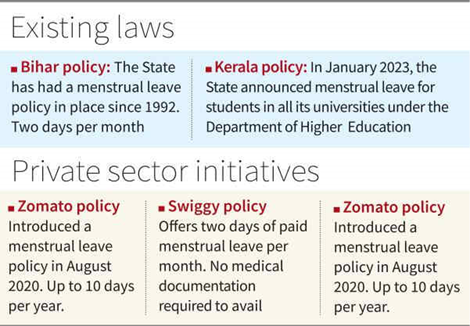
  • With this decision, Karnataka becomes the first State to cover both the government and private sectors in its menstrual leave policy. Odisha and Bihar have a policy for government employees while Kerala has implemented the policy in universities.
  • Gargi M., who works with a semiconductor firm in the city, said that while their work may not involve physical labour, women still need rest during menstruation. She added that the option of working from home does not necessarily help in such situations, and therefore, the policy approval is welcome.
  • Meanwhile, union leaders from multiple unorganised sectors stressed the need for inclusion of menstrual leave policy in unorganised sector too, under the provision through Labour Welfare Boards or similar mechanisms.

Menstrual leave: Challenges of implementation

  • Umesh A.H., Deputy Labour Commissioner, (Region-1), said that main challenge is workforce adjustments and understanding who will handle the work of those on leave, especially since manpower remains limited in both government and private sectors.
  • “Convincing private firms to implement a paid menstrual leave is also a challenge as most companies operate on a five-day work week. However, as society, we can overcome these challenges and will consider these aspects carefully while notifying the policy,” he said.
  • India’s Kabul mission to be upgraded to embassy

Context: Jaishankar makes announcement during meeting with Taliban Foreign Minister, raises concerns over forced repatriation of Afghan refugees by Pak., calls ‘cross-border terror’ a common challenge.

  • India will upgrade its ‘technical mission’ in Kabul to the status of an embassy, External Affairs Minister S. Jaishankar said.
  • The announcement came during Mr. Jaishankar’s meeting with Amir Khan Muttaqi, Foreign Minister of the Taliban administration in Afghanistan, at Hyderabad House. Mr. Jaishankar also raised India’s concerns over the forced repatriation of Afghan refugees by Pakistan and described “cross-border terrorism” as a common challenge to both India and Afghanistan.
  • “India is fully committed to the sovereignty, territorial integrity and independence of Afghanistan. Closer cooperation between us contributes to your national development, as well as regional stability and resilience. To enhance that, I am pleased to announce today the upgrading of India’s technical mission in Kabul to the status of Embassy of India,” said Mr. Jaishankar.
  • India had shut its embassy in Kabul in 2021 after the U.S.-led forces withdrew from Afghanistan.
  • In an interaction at the Embassy of Afghanistan, Mr. Muttaqi welcomed the decision and said, “We will send our diplomats to the Embassy of Afghanistan.” He clarified that the Taliban may not send an ambassador at the beginning.
  • Mr. Jaishankar noted that India and Afghanistan share a “common commitment towards growth and prosperity” but cautioned that “these are endangered by the shared threat of cross-border terrorism that both our nations face.” He did not name Pakistan but urged Mr. Muttaqi to “coordinate efforts” to counter the threat.
  • The meeting took place hours after an explosion in Kabul reportedly killed Tehreek-e-Taliban Pakistan (TTP) leader Mufti Noor Wali Mehsud, a claim later denied by TTP sources.
  • Mr. Jaishankar thanked Kabul for condemning the terror attack in Pahalgam on April 22, saying, “We appreciate your sensitivity towards India’s security concerns.” He also reiterated India’s commitment to facilitating travel for Afghan nationals through a new visa module introduced in April, with more medical, business, and student visas being issued. A joint statement issued after the meeting said that scholarships from the Indian Council for Cultural Relations (ICCR) and other organisations are “under active consideration” to enable more Afghan students to study in India.
  • The joint statement welcomed starting of the India-Afghanistan Air Freight Corridor, which is expected to “streamline connectivity and boost bilateral trade”.
  • It further said that both sides “agreed to cooperate on hydroelectric projects with a view to addressing Afghanistan’s energy needs and support its agricultural development.”
  • Mr. Jaishankar also announced six new health projects for Afghanistan, with details to be shared soon. India will gift 20 ambulances to Afghanistan as a “symbolic step” and provide MRI and CT scan machines to hospitals. He further confirmed that India will continue supplying vaccines, cancer medicines, and relief material to earthquake-affected areas in eastern Afghanistan, adding, “We would like to contribute to the reconstruction of residences in the affected areas.”
  • Ceasefire takes effect as Israel forces pull back to agreed area

Context: A ceasefire between Israel and Hamas came into effect in Gaza on Friday, the Israeli military said, hours after Israel’s Cabinet approved a deal to pause the fighting and exchange the remaining hostages for Palestinian prisoners.

  • Israeli forces have withdrawn to agreed deployment lines for the first stage of the ceasefire, it added.
  • Tens of thousands of people who had gathered in Wadi Gaza in central Gaza started walking north after the military’s announcement at noon. Beforehand, Palestinians reported heavy shelling in parts of Gaza throughout Friday morning, but no significant bombardment was reported after.
  • Israeli Prime Minister Benjamin Netanyahu insisted in a televised statement on Friday that the next stages would see Hamas disarmed and Gaza demilitarised.
  • “If this is achieved the easy way — so be it. If not — it will be achieved the hard way,” he said.
  • Under the deal, all 48 hostages are expected to be released. In exchange, Israel will release around 2,000 Palestinian prisoners.
  • The ceasefire marks a key step toward ending a ruinous two-year war that has killed tens of thousands of Palestinians, reduced much of Gaza to rubble, destabilised West Asia, and left dozens of hostages, living and dead, in the territory.
  • Israeli Brig. General Effie Defrin, a military spokesman, said that troops had completed their withdrawal to the deployment lines by Friday afternoon, a few hours after the ceasefire officially went into effect.
  • Earlier, an Israeli security official, speaking on condition of anonymity, said the military would control around 50% of Gaza in their new positions.
  • In Israel’s offensive, more than 67,000 Palestinians have been killed in Gaza and nearly 1,70,000 wounded, according to Gaza’s Health Ministry. The hostage and prisoner releases are expected to begin on Monday, two Egyptian officials briefed on the talks and a Hamas official said, though another official said they could occur as early as Sunday night.
  • All living hostages are expected to be released at the same time, followed by the bodies of the deceased, which could take more time.
  • Five border crossings are expected to reopen, including the Rafah crossing between Gaza and Egypt, the Egyptian and Hamas officials said. That will allow aid to flow into the territory, parts of which are experiencing famine.
  • Private hospitals threaten to halt paediatric surgeries under RBSK

Context: Demanding immediate reimbursement of over 23 crore dues pending since 2017 for paediatric surgeries done under Rashtriya Bal Swasthya Karyakram (RBSK), small and medium private hospitals in Karnataka have threatened to suspend their participation in the State’s health schemes.

  • The hospitals, which said they are left with no option but to take legal recourse, said if the dues are not cleared at the earliest, they will halt paediatric surgeries under the State’s Ayushman Bharat Arogya Karnataka (AB-ArK) health scheme. The dispute dates back to 2016, when the State government introduced additional procedure codes under RBSK, a centrally-funded health scheme under the National Health Mission (NHM), without prior approval from the Centre.
  • Private hospital authorities claimed that they acted in good faith on the published codes and provided critical services to ailing children between 2016 and 2018. However, audits later flagged that these codes lacked central clearance, leaving the claims stuck.

Technical glitch

  • Officials attribute the delay to a technical glitch in the listing of procedures on the portal of Suvarna Arogya Suraksha Trust (SAST), the nodal agency implementing the State’s health schemes. The issue is now before the government.
  • RBSK was launched in 2013-2014 to improve survival, growth and development of children in the 0-18 years group.
  • Focusing on the screening of infants, children and young adults for 4 D’s — Defects at birth, Deficiencies, Diseases, Developmental delays and Disabilities — the scheme initially covered a total of 40 medical procedures which subsequently increased to 104.
  • The scheme ensured children diagnosed with illness received follow-up care including early intervention services at the district level and including surgeries at tertiary level, free of cost under NHM. Services not available in government hospitals are made available in private empanelled hospitals.
  • Mr. Gupta added that the matter is under review and will be placed before the State Cabinet. He clarified that if the Centre has not approved the additional procedures, the State government will have to bear the expenditure.
  • SC gives Centre four weeks to respondto pleas for restoration of J&K Statehood

Context: Urging the Supreme Court to weigh the constitutional implications for India’s federal structure, petitioners on Friday pressed the Union Government to honour its “solemn promise” of restoring Jammu and Kashmir’s Statehood.

  • A Bench of Chief Justice of India B.R. Gavai and Justice K. Vinod Chandran asked Solicitor-General Tushar Mehta, appearing for the Union Government, to respond to the submissions within four weeks, even as it acknowledged that “various considerations” had to be factored in while making such a decision, including the April 22 Pahalgam terror attack.
  • The Bench was hearing an application seeking the restoration of Statehood within a specified time frame, preferably two months. The petitioners, an academic and a social activist, contended that the continued Union Territory status “violates the idea of federalism”, an essential feature of the Constitution’s basic structure. They further pointed out that the smooth conduct of both the Assembly and Lok Sabha elections showed there were no longer any security concerns hindering the restoration of Statehood.

Institutional promise

  • Senior advocate Menaka Guruswamy, appearing for MLA Irfan Hafiz Lone, argued that the assurance of restoring Statehood was not a mere political declaration but an “institutional promise” made by the Centre before a constitutional court. She urged the court to consider the “larger question” of what it would signify for Indian federalism if a State could be reduced to a Union Territory “in this fashion”.
  • Senior advocate Gopal Sankaranarayanan, appearing for petitioners Zahoor Ahmad Bhat and Khurshaid Ahmad Malik, read from the Supreme Court’s December 2023 judgment on the abrogation of Article 370 to emphasise that the court had refrained from deciding the Statehood issue only because the Solicitor-General had assured it would be restored after elections.
  • Sea phase of KONKAN 25 ends with high operational tempo
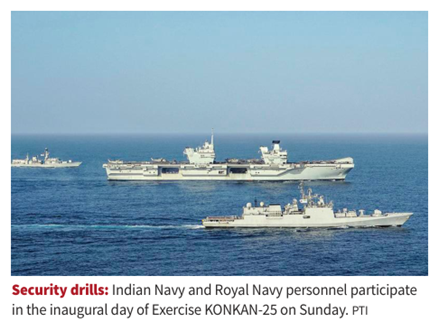
  • The sea phase of the bilateral maritime exercise KONKAN 25 between the Indian Navy and U.K.’s Royal Navy concluded following a series of high-tempo naval operations designed to enhance interoperability, operational readiness, and maritime cooperation between the participating navies.
  • Indian Navy informed that during the sea phase, the forces undertook a wide spectrum of complex maritime drills encompassing tactical air warfare, air defence, surface and anti-submarine operations, and underway replenishment. The sea phase ended with a ceremonial steampast, where participating units exchanged traditional naval courtesies.
  • Hydropower project on Chenab gets clearance

Context: The Sawalkote project was first accorded an environmental clearance in 2017; the suspension of the Indus Waters Treaty with Pakistan added momentum to the approval process, says official

  • An apex committee of the Environment Ministry has accorded a fresh environmental clearance to the Sawalkote hydroelectric project, proposed to come up on Chenab river in Ramban, Jammu and Kashmir.
  • Planned as a run-of-the-river project utilising the flow of the Chenab to generate electricity, it is reportedly the first major hydropower project on the Indus rivers to be accorded environmental clearance following India’s suspension of the Indus Waters Treaty (IWT) on April 23, following the Pahalgam terror attack.
  • “The Expert Appraisal Committee (EAC), after examining the information submitted and detailed deliberations, reiterated its earlier recommendation on the project and recommended the proposal for grant of prior Environmental Clearance to Sawalkote H.E. Project,” said the minutes of a meeting conducted on September 26.
  • The project was first accorded an environmental clearance by a designated committee in 2017, when it was originally being steered by the Jammu and Kashmir Power Development Corporation (JKPDC). However, the JKPDC signed a deal with the National Hydro Power Corporation (NHPC) Ltd. in 2021 to build and commission the project and be effectively in charge of it until 2061.
  • Despite the designated committee’s nod, the Environment Ministry could not clear the project as the JKPDC could not procure a forest clearance – which follows a parallel approval process. In September 2023, the project was first accorded a ‘stage 1 forest clearance’ as per publicly available records.
  • While the process of transferring the project to the NHPC has been on since 2021, a slew of approvals from the Central Electricity Authority and the Central Water Commission were accorded in July 2025. Public hearings, required to be done under the provisions of the Forest Rights Act, were done between December 2022 to February 2023.
  • “The Sawalkote project was already going through various stages of approval. Given its size — though it does not have a storage dam — it will be the largest project of its kind and has always had certain strategic importance. The suspension of the IWT and the plan to utilise the full potential of the eastern Indus rivers have added momentum to the approval process,” a senior official, aware of the approval process of hydroelectric projects, but declined to be identified.
  • Centre issues guidelines for retiring govt. employees; welfare officer to assist them

Context: The Department of Pensions and Pensioners’ Welfare (DPPW) under the Centre said that it has finalised guidelines for timely payment of retirement dues of Union government officials, which entail appointment of a welfare officer, or pension mitra, for each employee.

  • The officer would be deputed by the head of office and assigned to each retiring employee to facilitate filling up of forms and other formalities. The officer shall also be responsible for hand-holding the dependents for documentation and verification in the event of death of the pensioner while submitting the claim for family pension.
  • The guidelines have been issued for effective inter-ministerial coordination for timely payment of retirement dues (pension and pensionary dues) and issue of Pension Payment Orders (PPOs)/e-PPOs of Central Civil Services (CCS) employees.
  • “Major procedural reforms such as clarification on vigilance clearance before the retirement has been included for reducing the delay in issuance of PPOs/ePPOs. It has been clarified that no pension can be delayed for the want of vigilance clearance as per the specific provisions under CCS(Pension) Rules, 2021. It has been underlined that each ministry/department should ensure that vigilance clearance in respect of their retiring employees is issued three months prior to retirement since the validity of the clearance is of three months as per extant norms,” the Department stated.
  • 6 State-level RTI panels are defunct; appeals can take years to be heard: report

Context: As the 20th anniversary of the Right to Information Act, 2005 approaches, many State Information Commissions (SICs) and the Central Information Commission (CIC) are either paralysed or so understaffed that hearings could take years to happen, according to a report by a citizens’ group working to promote transparency in government functioning.

  • The SICs and the CIC hear appeals and complaints when citizens are dissatisfied with the result of an RTI application. There were over 2.4 lakh appeals in 2024.
  • The latest edition of the Satark Nagrik Sangathan (SNS)’s annual assessment shows that six SICs — Jharkhand, Himachal Pradesh, Telangana, Goa, Tripura and Madhya Pradesh — were defunct for varying periods of time between July 1, 2024 to October 7, 2025 as no new Commissioners were appointed upon the incumbents demitting office.”
  • The SICs of Karnataka, Maharashtra, Madhya Pradesh, Tamil Nadu and Bihar are functioning without a full strength of Commissioners.
  • Meanwhile, the Central Information Commission, which hears appeals against RTI responses to Union government organisations, is functioning with only two Information Commissioners, with nine vacancies, including for the Chief Information Commissioner, and hearings can take over a year to come up.
  • The backlog is mounting, with Commissions only able to dispose of 1.8 lakh cases in a year with 2.4 lakh appeals. In some States, the current speed of hearings taking place is far slower: the SNS’s report “shows that the Telangana SIC would take an estimated 29 years and two months — a matter filed on July 1, 2025 would be disposed [of] in the year 2054.”
  • Over 4 lakh appeals and complaints were pending as of June, with Maharashtra (95,340), Karnataka (47,825) and Tamil Nadu (41,059) with the largest outstanding backlog.
  • Govt. notifies land acquisition to raise Almatti dam height

Context: A total of 1,33,867 acres will be acquired for increasing the height of the dam from 519.60 metres to 524.25 metres.

  • The State government has issued a notification for the acquisition of lands for implementing the much-delayed Upper Krishna Project (UKP) Phase III, and the land acquisition process is expected to begin soon.
  • A total of 1,33,867 acres would be acquired for increasing the height of the Almatti dam from 519.60 metres to 524.25 metres. Land would be acquired for submergence of land by raising the height of the dam as well for canal projects.

Annual spend

  • An estimated ₹75,000 crore would be spent for implementing the project, including land acquisition, reconstruction and rehabilitation, in the next four years.
  • Annually, ₹18,000 crore would be provided to the Water Resources Department, it said. The notification said 75,563 acres would be acquired for submerging the land for raising the height of the dam, 6,467 acres for rehabilitation of 20 villages and portion of the Bagalkot town and 51,837 acres for canals.
  • When completed, the UKP Phase-III would irrigate 5.94 lakh hectares of land in North Karnataka districts of Vijayapura, Bagalkot, Raichur, Kalaburagi, Yadgir, Koppal and Gadag.

Cabinet clearance

  • The special Cabinet meeting held on September 16, 2025, gave clearance for the acquisition of land in one go through “consent award or direct purchase” from farmers.
  • The compensation amount, totalling approximately ₹70,000 crore, would be paid over three financial years starting from the current year.
  • Farmers whose lands would be submerged due to the increase in dam height would receive ₹40 lakh and ₹30 lakh per acre of wet and dry land, respectively. Farmers whose lands would have to be acquired for building canals would receive ₹30 lakh and ₹25 lakh per acre of wet and dry land, respectively.
  • The entire land acquisition process will be taken up through consent or direct purchase to expedite the process, while legal measures would be taken to move the cases related to land acquisition that are pending before various courts to a mediation process.
  • Microfinance loan defaults surged in 2024-25: Sa-Dhan data

Context: Bihar performed the worst, not only accounting for the highest amounts of loans outstanding, but also the highest rates of default on these loans.

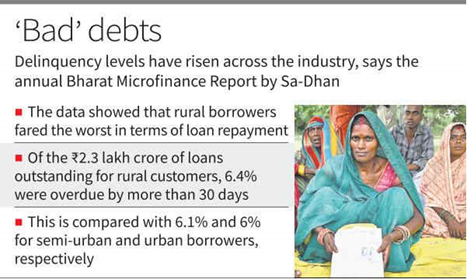
  • The rate of delinquencies of microfinance loans rose sharply in 2024-25, according to the latest report by microfinance self-regulatory body Sa-Dhan. The percentage of microfinance loans overdue by more than 30 days increased to 6.2% from 2.1% in 2023-24.
  • Similarly, the share of loans more than 90 days overdue increased to 4.8% by the end of March 2025 compared with 1.6% in the previous year.
  • “Delinquency levels have risen across the industry,” the 2025 edition of the annual Bharat Microfinance Report by Sa-Dhan said. “The Portfolio at Risk (PAR) 30+ days past due (dpd) surged to 6.2%, up significantly from 2.1% in the last financial year.”
  • “State-wise data further corroborate this upward trend in delinquency across the industry,” the report added.
  • According to the data, Bihar had ₹57,712 crore worth of microfinance loans outstanding as of March-end 2025.
  • Of these, 7.2% were more than 30 days overdue compared with the national average of 6.2%. About 4.6% of the loans were overdue by more than 90 days, the conventional benchmark used to categorise a loan as a non-performing asset.
  • The data also showed that rural borrowers fared the worst in terms of loan repayment.
  • Of the ₹2.3 lakh crore of loans outstanding for rural customers, 6.4% were overdue by more than 30 days, compared with 6.1% and 6% for semi-urban and urban borrowers, respectively.
  • India may open retail power to private firms

Context: India plans to open up its retail electricity market for private companies nationwide, ending the dominance of State-run distributors in most States, a draft bill by the federal power ministry showed.

  • The move will allow private companies such as Adani Enterprises, Tata Power, Torrent Power and CESC to strengthen their presence across India. A similar attempt in 2022 faced opposition from State distribution companies (discoms).
  • Only a handful of India’s electricity distribution zones — including the national capital region, Odisha and industrial States like Maharashtra and Gujarat — are currently privatised as the rules do not specifically provide for it. Most are under State control and are burdened with deep financial losses.
  • New Delhi has been pushing State-run power utilities to cut losses, clean up balance sheets and upgrade age-old infrastructure. Earlier this year, the country’s most populous State Uttar Pradesh invited bids to privatise two of its four power distribution companies. As of June, State discoms owed power generators about $6.78 billion.
  • Venezuela’s María Machado wins Nobel Peace Prize

Context: Venezuelan Opposition leader María Corina Machado won the Nobel Peace Prize on Friday for her struggle to achieve a democratic transition in the South American nation, winning recognition as a woman “who keeps the flame of democracy burning amid a growing darkness”.

  • The former Opposition presidential candidate is a “key, unifying figure” in the once deeply divided Opposition to President Nicolas Maduro’s government, said Jørgen Watne Frydnes, chair of the Norwegian Nobel committee.
  • Reacting to the honour, Ms. Machado said she was confident the Opposition would succeed in securing a peaceful transition to democracy in her country.
  • “We’re not there yet. We’re working very hard to achieve it, but I’m sure that we will prevail,” she told Kristian Berg Harpviken, the director of the Nobel Institute and secretary of the Nobel Committee.

Dedicates win to Trump

  • “I dedicate this prize to the suffering people of Venezuela and to President Trump for his decisive support of our cause!” she later wrote on X.
  • Mr. Maduro’s government has routinely targeted its real or perceived opponents.
  • Ms. Machado, who turned 58 this week, was set to run against Mr. Maduro in last year’s presidential election, but the government disqualified her.
  • The crackdown on dissent only increased after the country’s National Electoral Council, which is stacked with Maduro loyalists, declared him the winner despite credible evidence to the contrary. The election results announced by the Electoral Council sparked protests to which the government responded with force that ended with more than 20 people dead.
  • Ms. Machado becomes the 20th woman to win the Nobel Peace Prize.

Current Affairs: 10th October 2025

  • India inks £350-mn deal with U.K. to buy missiles

Context: As many as 64 Indian firms commit to invest £1.3 billion in the U.K.; Modi and the visiting U.K. PM Starmer agree on a £250-million deal to advance collaboration on electric engines for Naval ships.

  • India has signed a £350-million defence deal with the U.K. to buy missiles for the Indian Army, the British government.
  • Prime Minister Narendra Modi and his U.K. counterpart, Keir Starmer, also agreed to take forward their collaboration on electric-powered engines for Naval ships, worth an initial £250 million.
  • In a separate release, the U.K. government said 64 Indian companies had so far committed to invest £1.3 billion (or ₹15,430 crore) in the U.K., a sign of the growing business confidence boosted by the India-U.K. trade deal.

U.K. varsities in India

  • However, the U.K. government also said that the University of Lancaster and the University of Surrey had been given approval to open campuses in India to help meet booming demand from Indian students.
  • The missile deal paves the way for a “broader complex weapons partnership” between the U.K. and India, which is currently under negotiation between the two governments, the U.K. government said in its statement.
  • “The contract is set to deliver U.K.-manufactured Lightweight Multirole Missiles (LMM) built in Belfast to the Indian Army, delivering on the Government’s Plan for Change in another significant boost for the U.K. defence industry,” it said.
  • “A new milestone has also been reached in the U.K. and India’s cooperation on electric-powered engines for naval ships as both countries signed the Implementing Arrangement to advance collaboration to the next stage, worth an initial £250 million,” it added.

Indian investments in the U.K.

  • “Nearly 7,000 brand new jobs will be created in the United Kingdom thanks to a raft of major new deals secured by the Prime Minister during his visit to India this week,” the U.K. government said. “As a result, Indian investment will flow into a range of U.K. sectors including engineering, technology and the creative industries, driving growth and creating jobs across every region of the country – from Basingstoke to Birmingham,” it added.
  • Among the major investment announcements are TVS Motor’s plan to invest £250 million in Solihull to expand its Norton Motorcycles operations and develop next-generation electric vehicles.
  • “Engineering company Cyient is investing £100 million to boost innovation in semiconductors, geospatial tech, mobility, clean energy, and digital domains – creating 300 U.K. jobs and strengthening its long-standing presence in the country,” the release said.
  • Muthoot Finance UK Limited, a part of the Muthoot Group, plans to invest £100 million to expand its branch network to 20 locations in the U.K. Hero Motors plans to invest £100 million in the U.K. over the next five years in its e-mobility, e-bicycles and aerospace divisions.
  • On the first day of Mr. Starmer’s visit to India, Rolls-Royce CEO Tufan Erginbilgic said that his company has “deep ambitions to develop India as a home for Rolls-Royce”. He did not, however, mention any specific investment details.
  • “The Prime Minister has confirmed that the University of Lancaster and the University of Surrey have been given approval to open new campuses in India, to help meet their booming demand for higher education places,” the U.K. government said in a separate release.
  • State nod for one day paid menstrual leave in govt., pvt. sectors

Context: In a landmark decision, the State Cabinet approved the Karnataka Menstrual Leave Policy-2025 that will ensure one day’s paid leave in a month across government and private sectors.

  • With this decision, Karnataka becomes the first State to cover both the government and private sectors in its menstrual leave policy. Odisha and Bihar have policy for government employees while Kerala has implemented the policy in universities.
  • The policy moved by the Karnataka’s Labour Department follows a recommendation from a committee that submitted its report and had pushed for paid menstrual leave. It is applicable to all sectors where women are employed.
  • Though there has been no uniform policy on menstrual leave in the country, several States and private companies have had menstrual leave policy, a Cabinet note said.
  • Welcoming the decision, the All-India Trade Union Congress (AITUC) said that the move would empower millions of women in both sectors and was a progressive measure to protect the rights of women.
  • It noted that when the trade unions had strongly urged for menstrual leave policy for one day a month, the employers were against it while the Labour Department had recommended six days per year. “We now request the government to immediately take measures to implement the decision through legislative action,” AITUC said in a note.
  • The government approved ₹405.55 crore to construct 11 residential schools for children of construction workers, ₹2,000 crore for rebuilding 39 major bridges, and a ₹16 crore aerial ladder platform that can reach up to 54 metres to meet the needs of high-rise buildings in case of fire accidents.
  • It also approved ₹550 crore to set up an autonomous medical college at Kanakapura with an initial intake of 150 students for MBBS, approved amendment to Karnataka Workers Welfare Fund Act and ₹38 crore to improve security of the State Data Centre.
  • India sees increase in international and domestic airfares from 2019 to 2025

Context: India has witnessed a 13% increase in international airfares in H1 (first half) 2025 versus H1 2019, as per the 2025 edition of the Airfare Trends for the Asia-Pacific and Middle East regions.

  • The 2025 trends were released by the Airports Council International Asia-Pacific & Middle East (ACI APAC & MID) which is the trade association representing airports.

Top five countries

  • While, India witnessed a 13% increase in international airfares in H1 2025 versus 2019, the top five countries which had an increase in the international fare are Chinese Taipei (34%), Singapore (33%), South Korea (31%), Vietnam (24%), and Indonesia (24%).
  • However, India figured among the top five countries which saw an increase in domestic airfares as it saw a 38% increase in H1 2025 as compared to 2019.
  • The top five countries which saw an increase in the domestic fare are New Zealand (63%), Malaysia (53%), Vietnam (52%), Indonesia (47%) and India (38%). “Despite substantial recovery of passenger traffic, across the region, an increasing trend is witnessed from H1 2019 to H1 2025, in contrast to the decreasing pattern observed during pre-pandemic years. The surge is largely driven by inflation (CPI) and reduced airline competition in some key sectors,” ACI APAC & MID said.

Average increase

  • The analysis, developed with the assistance of Flare Aviation Consulting further stated that the Asia-Pacific region has witnessed an average +8% increase in H1 2019 to H1 2025 as compared to an average -18% decrease observed during H1 2014 to H1 2019.
  • “However, the increase reported over the first half of the current year has been much more acute at country level, especially in the Oceania and ASEAN regions. The Middle East has seen +15% surge in H1 2019 to H1 2025 as compared to an average -9% decrease observed during H1 2014 to H1 2019,” it stated.

Other key findings

  • Other key findings of the 2025 trends include that airfares have surged across all markets except China and that India and China are currently below the regional average in terms of airfare levels.
  • “China has seen domestic airfares decrease by 39% as compared to H1 2019. Oceania has higher general domestic airfares; a high deviation between countries is observed,” it stated.

Study

  • Director General of the ACI APAC & MID, Stefano Baronci said that this study proves that lowering airport charges does not translate into reduction in ticket prices, instead, it limits airports ability to invest in capacity and technology to enhance service quality.
  • “To make air travel more affordable from a consumer perspective, policymakers should focus on liberalising markets such as open skies, market access and efficient slot policy that can strengthen airline competition while ensuring airports can continue to invest to build capacity to support the growth in the coming years,” Mr. Baronci said.
  • ‘Indira food kit’ to replace 5 kg rice under Anna Bhagya scheme

Context:  It will benefit about 4.48 crore population holding below poverty line cards and will include toor dal, oil, sugar and salt.

  • Considering the misuse of rice being supplied to beneficiaries of the public distribution system (PDS) and to ensure better diversity in consumption, the Karnataka government on Thursday decided to provide “Indira food kit” to about 1.26 crore households in the State in lieu of the five kg rice being provided under the Anna Bhagya scheme currently. The kit will benefit about 4.48 crore population holding below poverty line (BPL) cards and will include toor dal, oil, sugar and salt.

Additional cost

  • Law and Parliamentary Affairs Minister H.K. Patil told presspersons in the post-Cabinet meeting briefing that tender would be invited soon for the supply of food items other than rice. He said that the new scheme could cost an additional ₹61.19 crore to the exchequer, which was approved by the Cabinet.
  • Acknowledging that the decision was based on reports of widespread misuse of rice being supplied through the PDS, Food and Civil Supplies Minister K.H. Muniyappa told presspersons that surveys showed the misuse of rice being supplied, and feedback from beneficiaries provided insights to the need to replace five kg rice supply with food items.
  • “About 90 % of the surveyed felt that other food items would help the households and will add to nutrition. The government also felt that the quantum of rice could be high. The misuse was also noted,” he said
  • The Congress government, which promised an additional five kg rice under Anna Bhagya along with the five kg rice supplied by the Centre ahead of the 2023 Assembly polls, could not supply rice initially and provided ₹170 per person per month in lieu of rice as the Centre refused to supply the required quantum of rice for the Anna Bhagya scheme.
  • Since last year, as the Centre resumed supply, the DBT of ₹170 was withdrawn and rice supply had commenced.
  • However, large scale diversion of rice and misuse by beneficiaries had also been reported.

Food kit

  • Providing details about the new project, the Minister said that the quantum of food kit will be dependent on the size of the family. “Quality and quantity will be ensured in the supply of food kit and transparency will be maintained,” he said, adding that the current allocation would be enough to switch from supply of rice to the other food items since it is expected to cost a similar amount.

Subject to family size

  • According to him, a household consisting of one or two persons would get half kg of each item whereas a family comprising three to four persons will one kg each while families with five or more persons will get one and a half kg of each item.
  • As per data provided by him, of about 1.26 crore households holding BPL cards, about 32.56 lakh households have one or two persons totalling to about 53.27 lakhs, about 63 lakh households have three to four persons totalling to about 2.26 crore and about 30 lakh households have five or more persons totalling to about 1.69 crore.
  • Karnataka Sahitya Academy awards

Context: Writers Shudra Srinivas, Pratibha Nandakumar, M. Basavanna, D.B. Nayak and Vishvanath Karnad and have been honoured with the Karnataka Sahitya Academy honorary award for the year 2024.

  • The awards were announced at an all-member meeting held headed by L.N. Mukudaraj, Chairman of the Academy, at Kannada Bhavana in Bengaluru.
  • In consideration of the remarkable service given to the field of Kannada literature, 10 writers are being given the ‘Sahitya Shri’ award of Karnataka Sahitya Academy for the year 2024. They are: K.Y. Naranaswamy, B.M. Puttaiah, Padmalaya Nagaraj, B.U. Suma, Mamata Sagara, Sabita Bannadi, Abdul Hai Toranagal, Gurulingappa Dabale, H.S. Anupama and Amaresha Yatagal.
  • Modi, Starmer call for a ‘two-state solution’ to Israel-Palestine conflict

Context: The two PMs support ‘an immediate, lasting ceasefire’; relationship with the U.K. is an ‘important pillar of global stability, economic progress’ in turbulent times, says Modi; he speaks to Trump over phone, congratulates him on Gaza peace plan.

  • Prime Minister Narendra Modi and his U.K. counterpart, Keir Starmer, gave a joint call for a “two-state solution” to end the Israel-Palestine conflict and expressed support for U.S. President Donald Trump’s peace plan for Gaza.
  • Mr. Modi also spoke with Mr. Trump over the phone and congratulated him on the Gaza peace initiative. “Spoke to my friend, President Trump and congratulated him on the success of the historic Gaza peace plan. Also reviewed the good progress achieved in trade negotiations. Agreed to stay in close touch over the coming weeks,” the Prime Minister posted on X.
  • Mr. Modi, who welcomed Mr. Starmer to India, said the partnership between India and the U.K. serves as an “important pillar of global stability” in the current turbulent international scenario. The two leaders also called for “a just and lasting peace” in war-ravaged Ukraine.
  • “India and the U.K. are natural partners. In the current era of global instability, this partnership remains a vital pillar of global stability and economic progress,” said Mr. Modi, adding that the government is working to combine the U.K.’s industrial expertise and R&D with India’s talent and scale.
  • Mr. Modi highlighted the importance of “dialogue and diplomacy” in resolving the conflicts in Gaza and Ukraine, and said India and U.K. are “committed” to enhancing “maritime security cooperation” in the Indo-Pacific region.
  • Resolution of the enduring conflicts in West Asia and Ukraine featured in a joint statement issued at the end of official-level talks held in Mumbai. The two Prime Ministers supported “an immediate and lasting ceasefire, the release of the hostages and the delivery of humanitarian aid, and their shared commitment to a lasting and just peace as a step towards a two-state solution, with a safe and secure Israel, alongside a viable Palestinian state.”
  • Mr. Starmer and Mr. Modi highlighted cooperation between the two sides within the context of the Commonwealth and agreed to work closely on “climate change, sustainable development, and youth engagement” for the 2.5 billion population of the Commonwealth member countries. The statement reiterated shared commitment to “global peace, prosperity and rules-based international order”. They also expressed support to continue the dialogue on Migration and Mobility Partnership.
  • In his remarks following the delegation-level talks, Foreign Secretary Vikram Misri reiterated India’s commitment to talks on streamlining migration and said, “We don’t support illegal immigration.” Mr. Starmer expressed U.K.’s condemnation of the Pahalgam attack and Mr. Modi condemned the attack outside a synagogue that left two persons dead in Manchester during Yom Kippur last week.
  • India and Australia sign key defence agreements

Context: Australia and India have taken significant steps to strengthen their defence partnership, with both nations committing to an expanded framework of cooperation across land, air, maritime, and industrial domains.

  • The announcements came after the inaugural Australia–India Defence Ministers’ dialogue, co-chaired by Australia’s Deputy Prime Minister and Minister for Defence Richard Marles and India’s Defence Minister Rajnath Singh in Canberra.
  • Mr. Singh is on a two-day official visit to Australia. The meeting marked five years of the India-Australia comprehensive strategic partnership.
  • The discussions culminated in the signing of three key agreements — an agreement on information sharing, a Memorandum of Understanding on submarine search and rescue cooperation, and terms of reference for establishing joint staff talks.
  • Taliban Minister Muttaqi gets ‘warm welcome’; to meet Jaishankar today

Context: External Affairs Minister S. Jaishankar will meet Afghanistan’s Acting Foreign Minister Amir Khan Muttaqi for a formal meeting, the first time New Delhi has officially hosted a leader of the Taliban regime that took power in Kabul in 2021.

  • Mr. Muttaqi, who is on a week-long official visit to India, arrived in Delhi morning accompanied by a delegation of five Taliban officials to a “warm welcome” from the Modi government.
  • The delegation will also travel to Deoband to visit the Dar ul Uloom seminary, the home of the ideological roots of the Taliban group, on Saturday. On Sunday, Mr. Muttaqi will travel to Agra to see the Taj Mahal, which sources said he had requested.
  • “A warm welcome to Afghan Foreign Minister, Mawlawi Amir Khan Muttaqi on his arrival in New Delhi,” the Ministry of External Affairs (MEA) said on its channel on Thursday. “We look forward to engaging discussions with him on bilateral relations and regional issues,” it added.
  • Mr. Muttaqi, who was a Minister in the previous Taliban regime from 1996-2001, is also on the United Nations Security Council’s List of sanctioned terrorists. He is in Delhi after two attempts by India to request permission for the visit. During the visit allowed from October 9 to 16, Mr. Muttaqi will address the media, speak at the Vivekananda International Foundation think-tank, and interact with businessmen and Afghan traders at an event hosted by business chamber FICCI.
  • He is also expected to meet with National Security Advisor Ajit Doval.  If that meeting is confirmed, it will be particularly significant as Mr. Doval was the seniormost official who travelled to Kandahar in December 1999 to negotiate the release of hostages on board IC-814, where the Taliban government facilitated the handover of Jaish-e-Mohammad chief Masood Azhar and other terrorists freed from Indian prisons, to Pakistani officials.
  • Army inducts ‘Saksham’ to neutralise aerial threats

Context: The Indian Army has initiated procurement of the indigenously developed ‘Saksham’ Counter-Unmanned Aerial System Grid System.

  • Developed in collaboration with the Bharat Electronics Limited, Ghaziabad, Saksham, or Situational Awareness for Kinetic Soft and Hard Kill Assets Management, is a modular, high-end Command and Control system operating on the secure Army Data Network.
  • The system is designed to detect, track, identify, and neutralise hostile drones and unmanned aerial systems, ensuring comprehensive airspace security across the newly defined Tactical Battlefield Space.
  • Judicial officers with seven years’ experience in Bar can become District Judges: SC

Context: In a bid to infuse young talent into the upper echelons of the district judiciary, a Constitution Bench headed by Chief Justice of India B.R. Gavai held that judicial officers with seven years in the Bar before their recruitment to the subordinate judicial service are entitled to be appointed as District or Additional District Judges.

  • District Judges are considered for appointment to the High Court. So far, only practising lawyers with seven years’ experience were eligible for direct recruitment as District Judges. In-service judicial officers, even with seven years of previous practice as advocates, were not considered, leading to lack of drive, which the court observed may be one of the reasons for pendency in lower courts.
  • Chief Justice Gavai reasoned that a lawyer does not cease to be one upon joining the judicial service.
  • The court noted that no eligibility criteria are prescribed under Article 233(2) for a person already in judicial service of the Union or the State for being appointed as District Judge. “A person who has been or who is in judicial service and has a combined experience of seven years or more as an advocate or a Judicial Officer would be eligible for being considered and appointed as a District Judge/Additional District Judge under Article 233 of the Constitution,” the Bench held in its judgment.
  • Further, the Constitution Bench directed that the minimum age for being considered and appointed as a District Judge or Additional District Judge, both for advocates and judicial officers, would be 35 years as on the date of application.
  • EC cautions against misuse of AI during poll campaign

Context: The Election Commission has directed parties to refrain from misusing artificial intelligence (AI)-based tools to create deepfakes that distort information or spread misinformation on social media platforms.

  • “Further, all parties and their leaders, candidates, and star campaigners shall take necessary measures for prominent labelling of AI-generated/synthetic content, if any, being shared for campaigning through their social media platforms or in the form of advertisements using clear notations such as ‘AI-Generated’, ‘Digitally Enhanced’, or ‘Synthetic Content’,” the EC said in a statement.
  • A strict watch is being kept on social media posts to ensure that the election atmosphere is not vitiated. The EC has made elaborate arrangements for effective implementation of the Model Code of Conduct guidelines, warning that any violation would be dealt with firmly.
  • Help excluded Bihar voters file appeals: SC to legal aid workers

Context: Experience in State must have made EC wiser ahead of pan-India SIR, says court; information about the 3.66 lakh excluded from list should be collated by the legal service authority and submitted as a status report to the court in a week, it added.

  • The Supreme Court said the litigious road traversed in the Bihar Special Intensive Revision (SIR) exercise must have made the Election Commission (EC) “wiser”, even as it activated paralegal volunteers and legal aid lawyers in Bihar to help 3.66 lakh people excluded from the final voter list file appeals without delay.
  • “You have decided to carry out SIR on a pan-India basis. So, this experience [with Bihar] would have made you wiser now… The next time you introduce a SIR module, owing to what you experienced now, you would also bring some improvement,” Justice Surya Kant, heading a Bench including Justice Joymalya Bagchi, addressed the EC orally.
  • CDSCO calls for list of all Indian cough syrup makers

Context: The Central Drugs Standard Control Organisation (CDSCO) has asked the State governments to submit a list of cough syrup manufacturers while initiating a joint audit of these companies, said a senior Health Ministry official.

  • The CDSCO has also informed the World Health Organization (WHO) that it had identified three contaminated cough syrups – Coldrif, Respifresh and ReLife — linked to the recent child deaths in India as containing diethylene glycol (DEG). It stated that none of the products were exported from India.
  • It said that the products had been recalled and identified manufacturers had been ordered to stop production of all medical products.
  • The WHO said that it was “ready to support national authorities in investigating and responding to these tragic events”, adding that it had not received official information on the source of the DEG contamination.
  • The organisation also flagged the “regulatory gap in DEG/EG screening for domestically marketed medicines in India.”
  • Retrospective age limits under surrogacy law violate reproductive autonomy: SC

Context: Observing that concerns over a couple’s parenting abilities cannot be invoked retrospectively to restrict their reproductive choice, the Supreme Court on Thursday ruled that the age limits under the Surrogacy (Regulation) Act, 2021, do not apply to couples who had frozen their embryos and initiated the surrogacy process before the law came into force on January 25, 2022.

  • A Bench of Justices B.V. Nagarathna and K.V. Viswanathan delivered concurring opinions while hearing applications filed by three couples who argued that they had created and preserved embryos long before the enactment of the 2021 law and were therefore, unfairly disqualified by the subsequent age limits.
  • Under the Act, an intending couple is eligible for surrogacy only if the woman is between 23 and 50 years of age and the man is between 26 and 55 years.
  • The petitioners contended that these limits could not retrospectively disqualify those who had already completed the medical procedures culminating in embryo freezing.
  • Justice Nagarathna observed that the law should not draw a distinction between couples who conceive naturally and those who require medical assistance to do so.
  • The Bench clarified that it was not “questioning the wisdom of Parliament” in imposing age limits or examining the validity of those restrictions but was confined to the issue of their retrospective application.
  • It also held that the exemption would extend to cases where embryos were created and frozen before the commencement of the Act, even if implantation in the surrogate’s womb had not yet taken place.
  • India to launch ‘Red List’ survey to assess extinction risks to plants and animals

Context: The goal of the project is to publish National Red Data Books on flora and fauna by 2030. India is set to conduct a first-of-its-kind assessment of nearly 11,000 species of plants and animals and assess how vulnerable they are to extinction.

  • While India already lists endangered animals in various “schedules”, this proposed exercise, called the National Red List Assessment of Indian Flora and Fauna, will, according to officials, give the most accurate assessment of the threats faced and thereby, inform conservation measures. The exercise is expected to go on till 2030.
  • The methodology adopted for the exercise will be as per that followed by the International Union for the Conservation of Nature (IUCN) Red List, currently the global standard which lists species worldwide on the basis of the extinction threats.
  • “The vision of the initiative is to establish a coordinated, science-based red listing system that accurately reflects the conservation status of Indian species.
  • The project’s goal is to publish National Red Data Books on flora and fauna by 2030, forming a central resource for conservation planning and threat mitigation. With this, a pool of 300 certified assessors will be created within the country enhancing the capacity and expertise,” according to a statement from the Environment Ministry.
  • “To fulfil our commitments under the Convention on Biological Diversity (CBD) and the Kunming–Montreal Global Biodiversity Framework (KM-GBF), India has launched the National Red List Assessment initiative, aligned with IUCN global standards,” said Kirtivardhan Singh, Minister of State for Environment.
  • Mr. Singh was leading an Indian delegation at the IUCN World Conservation Congress in Abu Dhabi.
  • The project will be entirely funded using public funds, Pratyush Mahapatra, Scientist, Zoological Survey of India. The estimated budget is ₹95 crore.
  • India rolls out pilot fore-com payments via ChatGPT

Context: The National Payments Corporation of India and fintech firm Razorpay have collaborated with Microsoft-backed OpenAI to introduce AI-driven payments on ChatGPT.

  • The pilot will evaluate how the service can be expanded across verticals and how UPI can be used to enable AI agents with payment credentials “to autonomously complete transactions on behalf of users in a safe, secure, and user-controlled manner,” the companies said.
  • NTPC REL, Gujarat govt. inkMoU for solar, wind projects
  • NTPC Renewable Energy (NTPC REL), a wholly owned subsidiary of NTPC’s Green Energy arm, said that it had signed an MoU with the Gujarat government to develop solar parks and projects with a cumulative capacity of 10 GW and wind projects of 5 GW.
  • At present, NTPC REL has four solar energy projects with a cumulative capacity of 2.36 GW, 3 wind energy projects of 354 MW and one 226 MW hybrid energy project in varied stages of implementation in Gujarat.
  • PM pitches India’s fintech start-ups to Global South

Context: Prime Minister Narendra Modi pitched India as a fintech hub for the Global South to “enhance digital cooperation and partnership across the world,” at an event where he shared the stage with Prime Minister of U.K. Keir Starmer, at Mumbai.

  • Speaking at the last day of Global Fintech Fest 2025, Mr.Modi said, “India’s success in technology is not just for its own benefit — it is a beacon of hope for the Global South. India wishes to enhance digital cooperation and partnership across the world, sharing its experience and open-source frameworks as global public goods,” adding India’s AI journey also is to make it resilient, sustainable and inclusive.
  • Echoing this, Mr.Starmer named four fintech companies — Razorpay, Cred, Paytm and Perfios — which plan to invest in the U.K. During his speech, he said he had come to India with a 126-member delegation of British businesses comprising who’s who of the Indian finance and technology sector.
  • He further cited instances of such collaborations like the COVID vaccination programme in India, which was an outcome of Oxford, AstraZeneca and the Serum Institute of India collaboration.

Investment office

  • The U.K. premier also said the country is set to open a dedicated investment office for fintech firms intending to enter the U.K. Mr. Starmer lauded the U.K.-India FTA as the largest post-Brexit deal for the U.K. India-U.K. bilateral trade is currently worth $56 billion and in five years, it needs to be doubled but the target can be reached earlier than that, said Mr. Modi.
  • Centre eases PLI scheme rules for MMF industry

Context: The Ministry of Textiles has notified revisions to the Production Linked Incentive (PLI) Scheme for MMF Apparel, MMF Fabrics, and products of technical textiles, reducing the minimum investment and turnover limits.

  • A statement said applications received from August 1, apart from adding eight new products of manmade fibre (MMF) apparel and nine new varieties of MMF fabrics under the scheme, the minimum investment from the applicants should be ₹150 crore (for part one) and ₹50 crore (for part two) categories. It was ₹300 crore and ₹100 crore respectively earlier.
  • Israel, Hamas agree to Trump-led ceasefire deal and hostage release

Context:  Israel’s Cabinet to meet to discuss the release plan, with the deal expected to be signed in Egypt after indirect negotiations; the deal follows a 20-point peace plan announced by Trump; Israel’s Finance Minister Bezalel Smotrich opposes the deal.

  • Israel and Hamas agreed a Gaza ceasefire deal to free the remaining living hostages, in a major step towards ending a war that has killed tens of thousands of people and unleashed a humanitarian catastrophe.
  • Israel’s Cabinet will meet at 1500 GMT to discuss a plan for the release of all hostages, while a deal should be signed later on Thursday in Egypt, where indirect negotiations are under way.
  • The agreement follows a 20-point peace plan for Gaza announced last month by U.S. President Donald Trump, under which Israel should withdraw from Gaza and release hundreds of Palestinian prisoners in exchange for the hostages.
  • After more than two years of war sparked by Hamas’s October 2023 attack on Israel, the deal also envisions a surge of aid into Gaza, where the UN has declared famine.
  • The Israeli army said it was preparing to pull back troops in Gaza, in line with the agreement, while the office of Prime Minister Benjamin Netanyahu said the agreement would only take effect with Cabinet approval.

Smotrich opposes

  • However, Israel’s far-right Finance Minister Bezalel Smotrich said he opposed the Gaza ceasefire deal, insisting that he would vote against it.
  • “There is immense fear of the consequences of emptying the prisons and releasing the next generation of terrorist leaders who will do everything to continue to pour rivers of Jewish blood here, God forbid,” Mr. Smotrich said on X.
  • “For this reason alone, we cannot join in short-sighted celebrations or vote in favour of the deal.”
  • He added that the militant group must be destroyed following the return of hostages from Gaza.
  • Mr. Trump’s plan also calls for the disarmament of Hamas and for Gaza to be ruled by a transitional authority headed by the U.S. President himself, though these points have yet to be addressed in any discussions.
  • A source within Hamas said the group will exchange 20 living hostages all at the same time for nearly 2,000 Palestinian prisoners as part of the deal’s first phase, with the swap to happen within 72 hours of its implementation.
  • László Krasznahorkai wins Nobel Prize in literature

Context: Hungarian writer László Krasznahorkai, whose philosophical, bleakly funny novels often unfold in single sentences, won the Nobel Prize in literature for his “compelling and visionary oeuvre that, in the midst of apocalyptic terror, reaffirms the power of art”.

  • The Nobel judges praised his “artistic gaze which is entirely free of illusion, and which sees through the fragility of the social order combined with his unwavering belief in the power of art,” Steve Sem-Sandberg of the Nobel committee said at the announcement.
  • “László Krasznahorkai is a great epic writer in the Central European tradition that extends through [Franz] Kafka to Thomas Bernhard, and is characterised by absurdism and grotesque excess,” the Nobel judges said.
  • Several works, including his debut, “Satantango,” and “The Melancholy of Resistance” were turned into films by Hungarian director Béla Tarr.
  • Mr. Krasznahorkai, 71, could not immediately be reached for his reaction. He did not speak at the announcement. He was born in the southeastern Hungarian city of Gyula, near the border with Romania, and has since travelled the world. Throughout the 1970s, he studied law at universities in Szeged and Budapest before shifting his focus to literature.
  • Mr. Krasznahorkai has been a vocal critic of autocratic Hungarian Prime Minister Viktor Orbán, especially his government’s lack of support for Ukraine after the Russian invasion.
  • But in a post on Facebook, Mr. Orbán was quick to congratulate the writer, saying: “The pride of Hungary, the first Nobel Prize winner from Gyula, László Krasznahorkai. Congratulations!”
  • Mr. Krasznahorkai has received many awards, including the 2015 Man Booker International Prize.
  • Nobel Prize award ceremonies are held on December 10, the anniversary of Alfred Nobel’s death.
  • China outlines curbs on exports of rare earths, technology

Context: China outlined new curbs on exports of rare earths and related technologies, extending controls over use of the elements critical for many products ahead of a meeting later this month between U.S. President Donald Trump and Chinese leader Xi Jinping.

  • The regulations announced by the Ministry of Commerce require foreign companies to get special approval to export items that contain even small traces of rare earths elements sourced from China.
  • Beijing also will impose permitting requirements on exports of technologies related to rare earths mining, smelting, recycling and magnet-making, it said.
  • China accounts for nearly 70% of the world’s rare earths mining. It also controls roughly 90% of global rare earths processing.
  • UN to cut 25% of its global peacekeeping force in response to U.S. funding strains

Context: The United Nations will begin slashing its peacekeeping force and operations, forcing thousands of soldiers in the next several months to evacuate far-flung global hotspots as a result of the latest U.S. funding cuts to the world body, a senior UN official said.

  • The official, who spoke on the condition of anonymity to discuss a private meeting, briefed presspersons on the 25% reduction in peacekeepers worldwide as the United States, the largest UN donor, makes changes to align with President Donald Trump’s “America First” vision.
  • Roughly 13,000 to 14,000 military and police personnel out of more than 50,000 peacekeepers deployed across nine global missions will be sent back to their home countries.
  • The decision to institute a major overhaul of the peacekeeping force — known globally for their distinctive blue berets or helmets — followed a meeting on Tuesday between UN Secretary General Antonio Guterres and representatives from major donor countries, including Mike Waltz, the new U.S. Ambassador to the United Nations.
  • ‘Russia’s gas supplies down by 20% after Ukrainian attacks’

Context:  Ukrainian long-range strikes on Russian energy facilities may have reduced gasoline supplies in Russia by up to a fifth, President Volodymyr Zelenskyy said, as both sides step up attacks on each other’s energy infrastructure.

  • With diplomatic efforts to end the war largely stalled and little movement along the fiercely contested front line, Russian forces have focused on crippling Ukrainian gas production while Ukraine has been targeting Russia’s oil refining capacity.
  • “This still needs to be verified, but we believe that they’ve lost up to 20% of their gasoline supply — directly as a result of our strikes,” Mr. Zelenskyy said in remarks to presspersons released on Thursday.
  • However, the Kremlin has said that Russia’s domestic fuel market is fully supplied.
  • What are the various electoral forms?

Context: The Election Commission (EC) has just concluded the special intensive revision (SIR) of electoral rolls in Bihar. It proposes to roll it out in other States in a phased manner.

What is the current significance?

  • Section 21 of the Representation of the People Act, 1950 (RP Act), deals with the preparation and revision of electoral rolls. A summary revision is carried out before each general election or by-election in any constituency. The RP Act also authorises the EC to carry out a special revision of the electoral roll at any time.
  • The EC, through its order dated June 24, had decided to conduct SIR for the entire country. Since the Bihar Assembly elections are due in November, the Commission issued guidelines for the SIR of the Bihar electoral roll, with July 1 as the qualifying date.
  • The SIR process in Bihar involved submission of enumeration forms by all registered voters, submission of any eligible documents to prove citizenship (for electors registered after 2003), publication of draft electoral rolls based on forms submitted, a period for filing claims and objections, verification and disposal of claims and objections by the Electoral Registration Officers (ERO), and publication of final roll.
  • The SIR process was challenged in the Supreme Court. In its interim orders, the court had directed the EC to accept Aadhaar as one of the eligible documents to be submitted along with the enumeration forms as proof of identity. The final roll for Bihar was released by the EC on September 30. The Commission proposes to complete the SIR process for the entire country in a phased manner based on the Assembly election schedules for various States.

What are the various forms?

  • In the present context, it is important for citizens to be aware of the various forms that deal with electoral rolls. These forms are provided in the Registration of Electors Rules, 1960 (RER).
  • A brief summary of all the important forms as per RER is provided in the Table given above. It also contains detailed guidelines for filling out the application with respect to each of these forms.

What should citizens do?

  • There are political arguments both for and against the SIR exercise as carried out in Bihar. However, clean electoral rolls are paramount for the conduct of free and fair elections, which is essential for our functioning democracy. The EC would hopefully devise a more spread-out schedule in future SIRs that provides adequate time for hassle-free participation by voters. The list of eligible documents is also likely to include Aadhaar as proof of identity, in subsequent SIRs as per the Supreme Court directive.
  • Meanwhile, citizens should ensure that they verify the published draft rolls. They should fill out the enumeration forms as required.
  • New voters and electors who have migrated to different constituencies should fill out the relevant forms. Political parties and civil society groups should assist citizens, especially the most marginalised sections, throughout the process. This would ensure a clean electoral roll without compromising on the right to vote of every eligible citizen

Current Affairs: 9th October 2025

  • Trade deal is a launchpad for growth, says British PM

Context: India-U.K. Comprehensive Economic and Trade Agreement presents unparalleled opportunities, says Starmer as he begins two-day visit; he will hold wide-ranging talks with Narendra Modi.

  • The opportunities waiting to be seized under the India-U.K. Free Trade Agreement are “unparalleled”, British Prime Minister Keir Starmer said in Mumbai as he kick-started his first visit to India after assuming charge.
  • “It’s the biggest deal we’ve struck since we left the European Union,” Mr. Starmer said. “I think it’s also the biggest deal that India has ever struck, so it’s hugely important.”
  • Mr. Starmer, accompanied by a delegation of nearly 100 entrepreneurs, cultural representatives, and university Vice-Chancellors, arrived in Mumbai for a two-day visit to take advantage of the opportunities brought about by the India-U.K. Comprehensive Economic and Trade Agreement signed in July.
  • “It’s not just a piece of paper, it’s a launchpad for growth. With India set to be the third biggest economy in the world by 2028, and trade with them about to become quicker and cheaper, the opportunities waiting to be seized are unparalleled,” he said.
  • “Welcome Mr. Starmer on your historic first visit to India,” Mr. Modi said on X. “Looking forward to our meeting tomorrow for advancing our shared vision of a stronger, mutually prosperous future.”
  • “During the visit, on October 9 in Mumbai, the two Prime Ministers will take stock of progress in diverse aspects of the India-U.K. Comprehensive Strategic Partnership in line with ‘Vision 2035’, a focused and time bound 10-year road map of programmes and initiatives in key pillars of trade and investment, technology and innovation, defence and security, climate and energy, health, education and people to people relations,” the External Affairs Ministry said.
  • Both leaders would engage with business and industry leaders regarding the opportunities presented by the trade agreement. “They will also exchange views on issues of regional and global importance,” it added.
  • The India-U.K. CETA aims at boosting bilateral trade by £25.5 billion annually. It provides substantial tariff reductions on a range of goods, including textiles, whisky, and cars, enhancing competitiveness for exporters in both markets.
  • Specifically, the U.K. will offer duty-free access on 99.1% of its tariff lines, covering 100% of the trade value immediately upon enforcement.

Investments and visas

  • Mr. Starmer’s trip to India has yielded positive statements from some U.K. companies, such as Rolls-Royce, about their future plans in India.
  • “We have deep ambitions to develop India as a home for Rolls-Royce, building on our strong and successful partnership,” Tufan Erginbilgic, CEO of Rolls-Royce, said in Mumbai. “Our competitively advantaged technologies across air, land, and sea applications position us to successfully build in-country capabilities and foster strategic partnerships that will accelerate India’s progress towards a Viksit Bharat,” he said.
  • Mr. Starmer, however, reportedly indicated that the U.K. would not be revisiting its visa requirements for Indians. According to the BBC, Mr. Starmer reportedly said that no business leaders he had met so far raised the question of visas. It added that, during the flight to India, Mr. Starmer said that visas “played no part” in the CETA and that the situation had not changed.
  • Mr. Starmer also visited the Yash Raj Films (YRF) studio, where he met Indian producers and film stars, such as Rani Mukherjee.
  • The British Prime Minister is reportedly keen to strengthen cultural ties between India and the U.K. and promote collaboration between the film industries of the two countries.
  • The U.K. government issued a release saying that three new Bollywood movies would be made in the U.K. from next year, with YRF having confirmed plans to bring their major productions to locations across the U.K. from early 2026.
  • Commerce and Industries Minister Piyush Goyal met Peter Kyle, the U.K.’s Secretary of State for Business and Trade, in Mumbai with a view to moving forward with the operationalisation of the India-U.K. CETA, the Commerce and Industry Ministry said in a statement. Mr. Kyle is part of the delegation accompanying Mr. Starmer.
  • IISc, IIT-M join forces with GBA for World Bank-funded water security and resilience project

Context: The Greater Bengaluru Authority (GBA) has roped in the Indian Institute of Science (IISc) and the Indian Institute of Technology Madras (IIT-M) to drive the progress of its ambitious World Bank-funded Bengaluru Water Resilience Project.

  • The project will receive over 3,500 crore in funding from the World Bank, with key stakeholders including the GBA, BWSSB, Minor Irrigation, and the Karnataka State Natural Disaster Monitoring Centre (KSNDMC).
  • The project is expected to be modelled on IISc’s Urban Flood model for Bengaluru, with crucial modifications to align with GBA’s objectives. This development follows discussions between GBA officials and World Bank representatives.
  • M. Maheshwar Rao, Chief Commissioner of GBA, stated that the initial meeting with World Bank officials was fruitful and that the water resilience project will soon move into the implementation phase. “Not just this, but the World Bank has offered technical assistance for GBA projects, which are currently under discussion and will be explored,” Mr. Rao.
  • In addition to IISc and IIT-M, the project will involve the Karnataka State Natural Disaster Management Authority (KSDMA), Bengaluru-based WELL Labs, and think tank CSTEP. Munish Moudgil, Special Commissioner (Revenue), GBA, confirmed that the two private agencies will contribute their services under a non-financial memorandum.
  • A GBA source involved in the project explained that the civic authority aims not only to mitigate flooding caused by poor stormwater drain infrastructure but also to improve overall water security in the city. This includes rainwater storage and harvesting, watershed development, and addressing long-term challenges such as floods, droughts, and other climate-related risks.
  • For example, the project will strengthen stormwater drains (SWDs), prevent the concretisation of drains and lakes to raise underground water levels, identify natural solutions for flood-prone areas, and establish maintenance plans for SWDs during summer months.
  • The implementation of the project will be managed by Bengaluru Smart Infrastructure Ltd. (BSMILE), a special-purpose vehicle established for mega projects.
  • Neeriddare Nale scheme to be launched

Context: The State government will implement the Neeriddare Nale (water is future) initiative across 525 gram panchayats in 27 taluks of 15 districts, which have been identified as areas where the groundwater is exploited.

  • Chief Minister Siddaramaiah and Deputy Chief Minister D.K. Shivakumar will formally launch the programme.
  • Minister for Minor Irrigation, Science and Technology N.S. Boseraju told reporters here that the initiative aimed to lay a strong foundation for a water-secure and prosperous Karnataka by improving groundwater levels.
  • The Neeriddre Nale concept seeks to create public awareness about water conservation, develop strategic plans for sustainable water management, and make citizens active partners in protecting water resources.
  • In the first phase, the project will cover 525 groundwater-stressed gram panchayats, including over 100 GPs in Kalyana Karnataka, where groundwater depletion is the most severe, Mr. Boseraju said.
  • U.S. Senate confirms Sergio Gor as Indian Ambassador, Kapur as regional official

Context: After months of rocky relations, the India-U.S. engagement is set to get a boost as the U.S. Senate confirmed the nominations of Sergio Gor as Ambassador to India and S. Paul Kapur, an American of Indian origin as the U.S. Assistant Secretary of State for South and Central Asia.

  • Mr. Gor has also been appointed U.S. President Donald Trump’s special envoy on South and Central Asia, a new post that did not require confirmation. His role in the region has been watched keenly, and with some misgivings in New Delhi, especially as Mr. Gor met with leaders of Bangladesh, Sri Lanka and Bhutan in New York last month, and Pakistani leadership had travelled to Washington.
  • Officials did not indicate a date for Mr. Gor to take up his post as Ambassador in Delhi, but did not rule out his arrival in the next few weeks in his role as special envoy, ahead of a possible meeting between Prime Minister Narendra Modi and Mr. Trump on the sidelines of the upcoming ASEAN-related summits in Kuala Lumpur on October 26-27, where they may repair ties and discuss scheduling the Quad summit.
  • At the Senate hearing on September 11, Mr. Gor, who said the U.S.-India relationship would “define the 21st century”, indicated that he and U.S. Deputy Secretary of State Christopher Landau would travel to the region in October, and set out the tasks before him. Mr. Gor said that he would work to advance the India-U.S. trade relationship so that it is “fair” to American businesses, adding that “India’s protectionist policies and regulatory barriers have prevented [the two countries] from fully realising this partnership”. He also said that “getting” India to stop buying Russian oil is a “top priority”.
  • Mr. Gor and Mr. Kapur, who will be the point-persons for India and the region, were confirmed among 107 nominees in a single vote with 51 Senators in favour and 47 against, who convened despite the U.S. government shutdown.
  • “Ambassador Gor’s confirmation is a signal to New Delhi that the U.S.-India relationship is a top priority for the administration and the region, and together, through the right diplomatic channels, [India and the U.S.] can iron out the creases and reach consensus,” Mukesh Aghi, president and CEO of the U.S.-India Strategic Partnership Forum, said, referring to Mr. Gor as a “trusted confidant” of Mr. Trump, and Mr. Kapur as a “stellar academic and a South Asia scholar who is second to none in understanding the security of the region and New Delhi’s concerns vis-a-vis Beijing and Islamabad”.

Kapur, a seasoned hand

  • While Mr. Gor, a 38-year-old close Trump aide and MAGA (Make America Great Again campaign) insider, has no previous experience on India, Mr. Kapur is an experienced analyst on India and the region, known well in South Block. He has worked in the U.S. State Department’s policy planning division in 2020-21. The author of several books and papers on Pakistan-sponsored jihadist groups in South Asia, U.S.-India relations, and India and Pakistan’s nuclear programmes, Mr. Kapur has been a frequent visitor to the region and was a visiting fellow at the Delhi-based Observer Research Foundation until recently.
  • EC to facilitate elderly to vote using postal ballot in Bihar

Context: The Election Commission will facilitate the elderly, Persons with Disabilities (PwD), and service electors to vote using postal ballots in the Bihar Assembly polls.

  • “Such electors can avail themselves of this facility using Form 12 D and submit to the Returning Officer through their Booth-Level Officer within five days of the issuance of the notification of election. Polling teams will collect their votes at their homes,” said the poll body.
  • The electors on essential services on the date of poll can apply for the postal ballot facility through the designated nodal officer of their respective department.
  • Draft labour policy unites social security schemes

Context: It aims at creating universal, portable social security accounts for all workers by 2030; it also seeks to raise women’s labour participation to 35%, offer single-window digital compliance for MSMEs.

  • Universal and portable social security is a major component of the draft National Labour and Employment Policy, which proposes to create a universal account by integrating the Employees Provident Fund Organisation, Employees State Insurance Corporation, Pradhan Mantri Jan Arogya Yojana, e-SHRAM, and State welfare Boards.
  • The draft policy, known as the Shram Shakti Niti, 2025, was released for public consultation.
  • The proposals include the implementation of the Occupational Safety and Health Code with risk-based inspections, gender-sensitive standards, and the convergence of various skills schemes. The draft policy presents a renewed vision for a fair, inclusive, and future-ready world of work aligned with the national aspiration of a developed India by 2047, Union Labour Minister Mansukh Mandaviya said.
  • “Rooted in India’s civilisational ethos of śrama dharma, the dignity and moral value of work, the policy envisions a labour ecosystem that ensures protection, productivity, and participation for every worker. It seeks to create a balanced framework that upholds workers’ welfare while enabling enterprises to grow and generate sustainable livelihoods,” Mr. Mandaviya said.

Policy outcomes

  • Expected outcomes of the policy include universal worker registration and social security portability, near-zero workplace fatalities, increased female labour-force participation, a sharp reduction in informal jobs through digital compliance, AI-driven labour-governance capacity in all States, the creation of millions of green and decent jobs, and a fully converged “One Nation Integrated Workforce” ecosystem.
  • The draft policy seeks to increase women’s participation in the labour force to 35% by 2030, and expand entrepreneurship and career guidance initiatives for youth. It also proposes a single-window for digital compliance, with self-certification and simplified returns for MSMEs. Promotion of green jobs, AI-enabled safety systems, just-transition pathways for workers, and a unified national labour data architecture ensuring inter-ministerial coherence and transparent monitoring are also part of the policy document.

Accountability plan

  • Policy implementation will proceed in three phases. Phase I (2025–27) focuses on institutional setup and social-security integration.
  • During Phase II (2027–30), the nationwide rollout of universal social security accounts, along with skill-credit systems, and district-level Employment Facilitation Cells. Phase III (beyond 2030) will bring in paperless governance, predictive analytics, and continuous policy renewal.
  • “Progress will be tracked through real-time dashboards, a Labour & Employment Policy Evaluation Index (LPEI) benchmarking States, and an Annual National Labour Report to Parliament,” the document says.
  • After delays, IAF set to receive first Tejas Mk1A fighter jet

Context: The Indian Air Force (IAF) is set to receive its first light combat aircraft (LCA) Tejas Mk1A on October 17 during a ceremony in Nashik, marking a significant milestone in India’s indigenous fighter jet programme.

  • According to officials, two Tejas Mk1A jets will be handed over to the IAF in the presence of Defence Minister Rajnath Singh. He will visit the Hindustan Aeronautics Limited (HAL) facility and interact with the staff involved in production.
  • HAL’s contract to deliver 83 Tejas Mk1A aircraft — originally scheduled to begin in February 2024 — has faced delays primarily due to slow engine deliveries from General Electric (GE Aerospace). With only one or two engines being supplied per month, HAL now targets completing deliveries within four years.
  • Negotiations for an additional 97 Tejas Mk1A fighters are in the final stages, with talks between the Ministry of Defence and GE Aerospace under way.
  • Defence analysts point out that the IAF is operating with 29 squadrons and that it may take at least five years to bridge the capability gap. Even months after Operation Sindoor, no significant progress has been made in replenishing the depleted fighter squadrons. Recently, two MiG-21 squadrons have been decommissioned.
  • IAF chief Air Chief Marshal Amar Preet Singh recently voiced his concern, “Hungry mouths are ready; we are waiting for the food,” he said, emphasising that to maintain optimal strength, the force requires two squadrons — 30 to 40 aircraft — produced every year. Meanwhile, the IAF’s proposal to acquire 114 multi-role fighter aircraft (MRFA) continues to progress through procedural stages.
  • The Defence Ministry is considering a plan to procure “Made in India” Rafales, with at least 18 expected to be delivered off-the-shelf in the near term.
  • WHO seeks clarification from India if cough syrup has been exported to other countries

Context: The World Health Organization (WHO) has sought clarification from India on whether the cough syrup linked to over 15 child deaths in the country have been exported to other countries, a senior official of the global health agency said.

  • The WHO is yet to issue a Global Medical Products Alert on Coldrif syrup, the cough syrup which has allegedly caused the child deaths in Madhya Pradesh and Rajasthan. The official added that the need for an alert will be investigated only after receiving a response from Indian health authorities.
  • So far at least 17 children aged below five have died in India allegedly after consuming cough syrup containing a toxic compound diethylene glycol (DEG). Coldrif was manufactured by Sresan Pharmaceuticals, based in Tamil Nadu. The company is currently under investigation.
  • The Central government, in an order dated December 18, 2023, had said that the fixed-dose combination (FDC) of chlorpheniramine maleate IP 2mg and phenylephrine HCl IP 5mg drop/ml “should not be used in children below four years of age.”
  • Prescribed to treat symptoms of cold and cough, including runny nose, sneezing and sore throat and watery eyes, Coldrif contains chlorpheniramine maleate, paracetamol and phenylephrine.
  • The Central Drugs Standard Control Organisation issued a directive to all State and Union Territory Drug Controllers, calling for strict enforcement of the Drugs Rules, 1945, with specific emphasis on the mandatory testing of raw materials and finished pharmaceutical products before release in the market.
  • India to boost solar pumps scheme in Africa, island nations

Context: The Union government is looking to showcase the PM-KUSUM (Pradhan Mantri Kisan Urja Suraksha evam Utthan Mahabhiyan) programme to several African countries and island nations, Union Minister for Renewable Energy (MNRE) Pralhad Joshi said.

  • “We are looking to showcase both the PM-KUSUM and the PM Surya Ghar (for rooftop solar installations) programme in countries which have problems with connectivity. We are doing this in Africa and island countries through the ISA (International Solar Alliance) platform,” Mr. Joshi said at a curtain-raiser event for the ISA’s eighth General Assembly, scheduled later this month.
  • The 34,000-crore PM-KUSUM programme is meant to boost solar energy infrastructure in agriculture by setting up 100 GW of solar power plants in farmer-owned land. Launched in 2019, it was to have added a solar capacity of 308 GW by 2022, but has missed targets. The Centre then set a new target, of 348 GW with a deadline of March 2026.
  • As of September 30, only one part of the scheme, where 17.5 lakh standalone solar pumps were to be installed has made notable progress. About 70% of the pumps have been installed. On the other hand, only 6% of decentralised grid-connected renewable energy power plants, and 16%-25% of grid-connected solar pumps have been installed.
  • ‘NMIA set to make Mumbai one of Asia’s biggest aviation hubs’

Context: Navi Mumbai International Airport will connect Maharashtra farmers to supermarkets in Europe, Middle East; reduce export costs for SMEs: PM

  • Prime Minister Narendra Modi inaugurated the first phase of the Navi Mumbai International Airport (NMIA) and said the airport would play a major role in establishing the region as one of Asia’s largest connectivity hubs.
  • He also remarked that the new airport would connect Maharashtra’s farmers to supermarkets in Europe and the Middle East, enabling fresh produce, fruits, vegetables, and fishery products to reach global markets swiftly.
  • He noted that the airport would reduce export costs for nearby small and medium industries, boost investment, and lead to the establishment of new enterprises. The greenfield NMIA is built at a cost of about ₹19,650 crore.
  • It is expected to become operational in December this year. As the second international airport for the Mumbai Metropolitan Region, NMIA will work in tandem with Mumbai’s Chhatrapati Shivaji Maharaj International Airport (CSMIA) to ease congestion and elevate Mumbai to the league of global multi-airport systems. To be run by the Adani Group, the airport will handle 90 million passengers annually and 3.25 million metric tonnes of cargo. Among its unique offerings is an Automated People Mover (APM), a transit system planned to connect all four passenger terminals, as well as a landside APM linking the city-side infrastructure.
  • The airport will feature a dedicated storage for Sustainable Aviation Fuel, solar power generation of approximately 47 MW, and EV bus services.
  • NMIA will also be the first airport in the country to be connected by water taxis.
  • PM pitches India as global data hub

Context: Prime Minister Narendra Modi pitched India as a potential ‘global data hub’, emphasising the importance of “issues like storage, security and sovereignty” of data that is generated globally. “The world wants reliable partners for the design and manufacturing of telecom equipment,” he said.

  • “Can’t Indian companies become reliable global suppliers and design partners?” Mr. Modi asked, while speaking at the inauguration of the India Mobile Congress, conducted by the Department of Telecommunications. The established telcos in India “provide stability, scale and direction” in the telecom sector, and their role is “continuously increasing,” Mr. Modi said.
  • Communications Minister Jyotiraditya Scindia said in his remarks that India hoped to secure at least “10% of 6G patents,” to establish the country’s presence in developing the subsequent generation of telecommunications technology. Mr. Scindia called on Indian firms to “design here, solve for here, and scale for everywhere.”
  • At a roundtable held during the event with States and Union Territories, officials discussed issues in implementing the roll out of the 4G saturation scheme, which aims to provide high speed fibre optic connectivity to all of India’s gram panchayats.
  • Tamil Nadu IT Minister Palanivel Thiaga Rajan urged Mr. Scindia during the discussion to “cap the market share” of telcos, to maintain a healthy market. Mr. Scindia responded saying the telecom sector was “deregulated”.
  • Mr. Rajan also requested changes to the Right of Way portal, explaining the site did not address State-level issues, which was why TN had not signed on to the model Right of Way rules. The rules provide a framework for applications to local authorities for laying fiber cables and installing telecom equipment.
  • RBI envisages unified markets interface

Context: The Reserve Bank of India (RBI) has conceptualised a unified markets interface (UMI) to tokenise financial assets and enable settlements using central bank digital currency.

  • At the Global Fintech Fest 2025, RBI Governor Sanjay Malhotra said, “This interface will have the capability to tokenise financial assets and settlements using wholesale CBDC. Early efforts and results from the inaugural pilot in improving market efficiency here are encouraging.”
  • The event also saw the launch of other features such as UPI Reserve, Internet of Things compatibility of UPI, among others.
  • Scientists win Chemistry Nobel Prize for bridging metals and organics

Context: An Australian, a Japanese and a Jordanian-American scientists were announced winners of the Nobel Prize in Chemistry for discovering and creating a class of materials, called metal-organic frameworks (MOF).

  • Metallic and organic substances are as far apart in the chemical world as Australia and the U.S. geographically and it was inconceivable that stable, useful products could be made out of materials formed by integrating them.
  • But beginning Richard Robson’s initial conception of them in the mid 1970s, sparked from a science project for his Melbourne University students; to Susumu Kitagawa’s dogged determination, in Kyoto University, at creating porous molecules — despite knowing that they were “useless” — but tinkering with them until he created the right kind of structures that were useful enough to work as a filter whilst remaining flexible and pliant; to finally Omar Yaghi at the University of California, Berkley, making a variety of metal-organic frameworks, as he named them, that were capable of drawing water vapour out of desert air at night and releasing them as water in the day.
  • The three will equally share the prize of 11 million Swedish kroner, about ₹1 crore.
  • Following the laureates’ groundbreaking discoveries, chemists have since built tens of thousands of different MOFs. Some of these may contribute to solving some of humankind’s greatest challenges, with applications that include separating PFAS (a family of chemicals that are believed to be toxic) from water, breaking down traces of pharmaceuticals in the environment, capturing carbon dioxide or harvesting water from desert air, a press statement noted.

Molecular kit

  • Researchers have developed a molecular kit with a wide range of different pieces that can be used to create new MOFs. These have different shapes and characters, providing incredible potential for the rational —or AI-based — design of MOFs for different purposes.
  • First of the block and inspired by a project to make wooden block representations of chemical bonds, Mr. Robson began by testing the inherent properties of atoms in a new way. He combined positively charged copper ions with a four-armed molecule; this had a chemical group that was attracted to copper ions at the end of each arm. When they were combined, they bonded to form a well-ordered, spacious crystal. It was like a diamond filled with innumerable cavities.
  • Mr. Robson immediately recognised the potential of his molecular construction, but it was unstable and collapsed easily. However, Mr. Kitagawa and Mr. Yaghi provided this building method with a firm foundation; between 1992 and 2003 they made, separately, a series of revolutionary discoveries.
  • Mr. Kitagawa showed that gases can flow in and out of the constructions and predicted that MOFs could be made flexible.
  • Mr. Yaghi created a very stable MOF and showed that it can be modified using rational design, giving it new and desirable properties.
  • Initially, it was challenging for the broader scientific community to appreciate MOF as they didn’t seem to be much better than a class of materials called zeolites. But things changed when they succeeded in developing soft MOFs — a step up over zeolites that were hard.

Current Affairs: 8th October 2025

  • SC tells EC to be open onnames in final Bihar rolls

Context: It says there is confusion about whether names added in final list are those deleted from draft roll; it asks if the poll panel individually informed the excluded voters, to facilitate their right to appeal

  • The Supreme Court reminded the Election Commission that “the degree of transparency and access to information form the hallmarks of an open democracy”.
  • It also questioned the top poll body about the individual details of voters added to the final list of voters in Bihar after the special intensive revision (SIR) of the State’s electoral roll.
  • Over 21.5 lakh voters have been added in the final roll, and 3.66 lakh removed.
  • “There is a confusion about the names added on in the final list… What is the identity of the people added on? Is it an add-on of names taken from the 65 lakh voters deleted in the draft roll or are they new and independent names? The final list shows an appreciation of the number of voters… This exercise we want you to do is in aid of the electoral process, to maintain intact the faith in the electoral process,” Justice Joymalya Bagchi, who was part of the Bench headed by Justice Surya Kant, asked the poll body.

Final list

  • The final list shows that there are 7.42 crore eligible voters in the State. This was higher than the 7.24 crore voters listed in the draft electoral roll published after the first phase of the SIR, which had seen the removal of 65 lakh names, given that Bihar had 7.89 crore voters on June 24, the date of notification of the SIR exercise.
  • The court asked the EC whether the 3.66 lakh voters deleted from the final list were individually informed through a formal order of deletion to facilitate the filing of appeals against their exclusion. “They have a right to appeal,” Justice Kant told the poll body.
  • The Bench also asked whether a separate list of the names and details of the 3.66 lakh excluded voters had been published and made easily accessible at the grass roots level.
  • Justice Bagchi referred to Rule 21A of the Registration of Electors’ Rules, 1960, which requires poll authorities to display the names and details of deleted voters on the notice boards of district electoral offices.
  • Senior advocate Rakesh Dwivedi, for the EC, said the disaggregated data was still being collected from ground-level officers and processed. However, there has not been a single complaint against any exclusion of names in the final list, he said, noting that the final electoral roll has already been shared with political parties.
  • “Who is deleted and who is not requires only a basic comparison between the draft roll and the final list,” Mr. Dwivedi argued.
  • Justice Kant, at one point in the hearing, threw the EC’s line of argument at the petitioners’ lawyers, advocates Prashant Bhushan and Neha Rathi.
  • “Mr. Bhushan, but where are the aggrieved people? The draft voter list is available on the EC website, the final voter list is also available. You could compare and identify the excluded names. Show us specific cases in the 3.66 lakh deleted voters whose names were deleted without any communication… This cannot be a roving enquiry… For whom are you doing this? They may be illegals who were deleted from the voter list, would they come out and complain?” Justice Kant asked them.

‘Population estimate mismatch’

  • Mr. Bhushan said the SIR, instead of cleaning up the electoral process, has only compounded the problems due to the EC’s opacity.
  • The court asked the EC to address the issues raised in Mr. Bhushan’s written submissions on Thursday.
  • These submissions contended that though the official estimate of the adult population in Bihar for September 2025 was 8.22 crore, the number of electors in the final rolls was only 7.42 crore.
  • “Thus, 80 lakh, that is, approximately 10% of the total adult population of Bihar has been denied their right to vote. Such a sharp fall in the adult population to electors’ ratio is a record for India and for Bihar,” the written submissions said.

Missing women, Muslims

  • In no State of the country previously have as much as 10% of the electorate been excluded from the electoral roll, Mr. Bhushan said. He added that lakhs of women were ‘missing’ from Bihar’s electoral rolls.
  • “After SIR, while Bihar’s gender ratio is 934 in September 2025, the gender ratio in the final electoral rolls has fallen sharply to 892. This translates into 17 lakh missing women… SIR has wiped out a whole decade’s gains in the gender ratio of electoral rolls,” said the submissions presented in court.
  • The SIR exercise has also resulted in the disproportionate exclusion of Muslims, Mr. Bhushan claimed.
  • “Our analysis based on name recognition software, shows that Muslims were 25% among the 65 lakh voters excluded from the draft rolls and 34% among the 3.66 lakh deleted electors from the final rolls… This disproportionate exclusion accounts for the reduction of about six lakh Muslim voters,” he submitted.

‘Respond to analysis’

  • The court asked the EC to respond to Mr. Bhushan’s analysis that at least 5.17 lakh names on the final rolls appear to be duplicates. “There are over 2.5 lakh cases of blank or junk households numbers, over 25,000 electors with gibberish names and nearly 60,000 entries with invalid gender or relation or gender relations mismatch,” the written submissions alleged.
  • Bigg Boss Kannada 12 gets KSPCB notice for violation of norms

Context: KSPCB order says Vels Studio and Entertainment Limited, the amusement park where the reality show is being shot, was operating without obtaining valid consent from the pollution control board.

  • The Karnataka State Pollution Control Board (KSPCB) has ordered the closure of M/s. Vels Studio and Entertainment Limited located in Bidadi Industrial Area, Bengaluru South district, for non-compliance of environmental norms.
  • M/s. Vels Studio and Entertainment Limited (M/s. Jolly Wood Studios and Adventures) is where the current edition of the Bigg Boss Kannada reality television show is being shot.
  • According to a KSPCB order issued on October 6, 2025, M/s. Vels Studio and Entertainment Limited is an amusement park established and operating without obtaining valid consent from the board which falls under Green Category.

Waste water

  • It added that during inspection it was found that waste water generated from different domains of the amusement park was discharged outside the premises without any treatment and causing pollution to the surrounding environment.
  • It further said that the park authorities have provided a Sewerage Treatment Plant (STP) of 250 kilo liters per day (KLD). “However, no sewer, no inflow of sewerage to STP was observed, all STP units installed were empty and discharging the waste water outside the premises without any treatment,” it said.
  • During inspection it was also found that the housekeeping near STP is very poor and there is no flowchart displayed.
  • Diesel Generating sets of capacity 625 KVA and 500 KVA were also installed and operating in the premises.
  • “The park authorities have disposed of the solid waste generated viz., disposable paper plates, cups, and plastic waste near STP area without any segregation in an unscientific manner,” it added.
  • KSPCB has issued closure orders under Section 33(A) of the Water (Prevention and Control of Pollution) Act, 1974, read with Rule 34 of Karnataka Board for the Prevention and Control of Water Pollution (Procedure for Transaction of Business), and the Water (Prevention and Control of Pollution) Rules, 1976.

In 2024

  • Environment Minister Eshwar Khandre said the KSPCB Regional Office in Ramanagara had issued notices to the studio twice in 2024, which its ​promoters did not comply with. He said that the studio was operating without obtaining permission under the Water Act and Air Act.
  • SWR begins phased rollout of Kavach train protection system

Context: The South Western Railway (SWR) has initiated the process of implementing the indigenously developed Kavach, an electronic rail safety mechanism system, across its network, covering a total of 3,692 route km (RKM). Developed by the Research Design and Standards Organisation (RDSO) in collaboration with the Indian industry, Kavach is an Automatic Train Protection (ATP) system designed to significantly enhance safety of the railways.

In two stages

  • According to SWR officials, the project will be executed in two stages. The first phase will cover 1,568 RKM at an estimated cost of ₹628.63 crore, while the second phase will extend the system to the remaining 2,124 RKM.
  • Officials explained that Kavach is a state-of-the-art electronic safety mechanism built to Safety Integrity Level-4 (SIL-4) standards, the highest benchmark in railway safety.
  • “Its primary function is to prevent trains from passing signals set at danger (red) and to avert collisions. If a loco pilot fails to slow down as per prescribed speed restrictions, Kavach automatically triggers the braking system. It also ensures that two locomotives fitted with functional Kavach systems do not collide. Another crucial feature is the ​automatic relay of SoS messages during emergencies, along with live centralised monitoring of train movements via the Network Monitor System,” the official said.
  • The system functions as a Traffic Collision Avoidance System (TCAS), using on-board equipment and transmission towers at stations linked through Radio Frequency Identification (RFID) tags.
  • “This facilitates two-way communication between the station master and the loco pilot during emergencies. Inside the locomotive cabin, an instrument panel provides advance signal information, permissible speed limits, and warnings. In cases where a red signal is ignored, or trains are on a collision course, the system intervenes instantly by applying emergency brakes. Kavach also automatically activates a hooter while approaching level crossings, aiding loco-pilots in low-visibility conditions such as fog,” official added.
  • Meanwhile, the Railways has sanctioned work to equip 299 locomotives under SWR with Loco Kavach. Officials said the detailed project estimate is currently under vetting by the accounts department.
  • PRADA delegation meets Kolhapuri chappal artisans

Context: A delegation from PRADA, the European fashion house that faced allegations of copying the design of the Kolhapuri chappal, visited Athani in Belagavi district recently and interacted with artisans.

  • The team led by Gautam Mehra, PRADA’s Indian representative, visited the houses of some artisans and spoke to them. It also visited the Kolhapuri chappal cluster in Athani and documented the working styles of the artisans and took pictures of their portfolio. “They told us that they are willing to work with the government and cooperate with the artisans. They offered to train batches of five to 10 artisans in their design centres in India,” Shivaraj Soudagar, cluster coordinator, told The Hindu.
  • “We asked the officers to give us some orders so that we could access a bigger market and get better prices for our product. They agreed to consider our demand,” Mr. Soudagar said.
  • Another round of meeting between artisans, LIDKAR officers, and PRADA designers has been scheduled in Bengaluru this week.
  • ZP CEO Rahul Shinde said that the district administration had planned a series of actions for the Athani artisans.
  • “We want to organise a series of workshops for artisans, in association with agencies like EXIM bank and National Institute of Design. They will not only be aimed at training them in understanding market trends, but also in new designs and use of diverse materials. We will also train them in using e-commerce portals for boosting their sales, standard methods and processes of packing and logistics management. Another set of resource persons will provide soft skills training, and consumer relations. We will also tie up with legal experts to help our artisans better understand the implications of the Geographical Indication and other laws,” Mr Shinde said.
  • MP for Chikkodi Priyanka Jarkiholi said that she would urge the State government and LIDKAR to work with PRADA and find a solution in which the artisans get assured orders and remunerative wages. She said she would speak to LIDKAR officers and artisans in Karnataka and Maharashtra to find a common solution.
  • India edges closer to recognising Taliban as Muttaqi to arrive in Delhi for a five-day visit

Context: Two days before the visit of Amir Khan Muttaqi, Acting Foreign Minister of the Taliban regime ruling Afghanistan, the Indian government came one step closer to formally recognising the Taliban, as a regional grouping that India is a part of admitted Mr. Muttaqi as a “member” for the first time.

  • Mr. Muttaqi, who is on the UN Security Council’s list of banned terrorists, was given special permission to travel to India, and officials said he would arrive in for a five-day visit.
  • According to sources, Mr. Muttaqi will be accorded full protocol as a visiting Foreign Minister, including being hosted by the government. He will be received at the official venue, Hyderabad House, by External Affairs Minister S. Jaishankar for talks on October 10.
  • India’s Ambassador to Russia Vinay Kumar attended the 10-nation Moscow Format Consultations hosted by Russian Foreign Minister Sergey Lavrov. Others in attendance were Pakistan’s special envoy on Afghanistan Mohammad Sadiq and other representatives from China, Iran and Central Asian countries.
  • Apart from Russia, no country has recognised the Taliban government thus far, and since the Taliban takeover of Kabul in August 2021, representatives of the ‘Acting government’ in Afghanistan have attended the meeting as observers only. However, a photograph released after the meeting on Tuesday showed Mr. Muttaqi amongst the delegates.
  • “For the first time the Afghan delegation headed by Foreign Minister Amir Khan Muttaqi participated in the meeting as a member,” said a joint statement issued by all the participants at the meeting, calling for more economic exchanges, provision of humanitarian assistance, and regional connectivity initiatives with Afghanistan, as well as steps to strengthen counter-terrorism cooperation.
  • Mr. Muttaqi is expected to travel next to India, arriving on October 9. It is unclear whether Mr. Muttaqi would also call on Mr. Modi later in the visit, the first such official visit by a senior Taliban Minister since 2021. During the five-day visit, Mr. Muttaqi, who received special permission to travel from the UN Sanctions committee on September 30, is expected to meet a number of officials and interact with business groups and Afghan nationals living in India.
  • Former diplomats said that inviting Mr. Muttaqi to India was a pragmatic move, given India’s interests in Afghanistan, but warned against giving the Taliban regime full recognition until the United Nations decides to do so.
  • “India should await international consensus,” said Vivek Katju, who has managed Afghanistan relations at the MEA in the past. However, he added that India should post a more senior Charge d’Affaires at its Embassy in Kabul, which currently runs as a “technical mission”.
  • Former Ambassador to Afghanistan Gautam Mukhopadhyay said that the move to invite Mr. Muttaqi reflects a “convergence of security interests at the expense of certain values and internal security concerns that held the relationship in check”.
  • However, Afghanistan’s former Foreign Minister and National Security Adviser Rangin Dadfar Spanta said, “India’s current policy towards Afghanistan is mainly determined by an anti-Pakistan approach. Both Pakistan and the government in Delhi are looking for proxies. This is not about good neighbourliness or peace in our region. Unfortunately, the opposite is true.”
  • Trio wins Physics Nobel for building device showing ‘quantum tunnelling’

Context: The Nobel Prize for Physics this year will be awarded to three scientists — John Clarke, Michel Devoret and John Martinis, the Royal Swedish Academy of Sciences.

  • The scientists worked together and devised experiments to tease greater insight into the workings of the quantum world: the realm of the ultra-small when objects, broken down to single, constituent particles, cease to behave in the way we ordinarily expect them to.
  • One of the mind-boggling behaviours that particles are capable of here is “tunnelling”, literally, the ability of particles to pass through physical walls.
  • It is as if a cricket ball hitting the pitch will surely bounce up, but the odd cricket-ball particle will simply burrow into the ground. Such behaviour cannot be observed at the macroscopic level but the scientists showed that it was possible to organise a multitude of single particles and coerce them to exhibit “tunnelling” properties in a system, big enough to be held in the hand.

Electrical circuit

  • Much like early insight into quantum mechanics paved the way for transistors and silicon chips in the 1950s, the three scientists devised an electrical circuit with two superconductors, components that can conduct a current without any electrical resistance.
  • They separated these with a thin layer of material — called a Josephson junction — that did not conduct any current at all.
  • In this experiment, they showed that they could control and investigate a phenomenon in which all the charged particles in the superconductor behave in unison, as if they are a single ‘particle’ that fills the entire circuit.
  • Following this, they were able to demonstrate that such a particle could be made to behave simulating the flow of electricity even without voltage, a prerequisite for the flow of current.
  • These were akin to the first ‘super-conducting circuits’ that could potentially realise practical, useful quantum computers and quantum sensors.
  • Quantum computers, unlike contemporary computers, deal in ‘qubits’, rather than binary bits. This allows them to perform calculations exponentially faster but also threaten all kinds of encryption systems that are premised on bit-based computers.
  • ‘No State has fully complied with key drug quality norms’

Context: While 18 State drug control authorities across the country have adopted the Online National Drugs Licensing System (ONDLS) for processing drug-related licences, no State has yet fully complied with the Corrective and Preventive Action (CAPA) guidelines, confirmed a source in the Union Health Ministry.

  • Both the ONDLS and CAPA are provisions under the Central government’s revised Schedule M, which is a critical update to India’s pharmaceutical manufacturing regulations.

Safety standards

  • “CAPA is crucial for ensuring safety and maintaining high standards in regulated industries such as pharmaceuticals.  It is a universal quality management methodology for process improvement,’’ the official said.
  • Voluntary compliance [with CAPA] is crucial for quality maintenance, he said, while speaking about the recent deaths of children in Madhya Pradesh and Rajasthan due to consumption of adulterated cough syrup.
  • CAPA also focuses on systematically investigating and resolving problems in managment issues.  “Compliance with CAPA will ensure that drug violation is registered and corrective action is taken,’’ the official said.
  • The ONDLS is a digital, single-window platform for processing various drug-related licences in India and has been developed by the Centre for Development of Advanced Computing in coordination with the Central Drugs Standard Control Organization (CDSCO).
  • “The system is designed to create a uniform, transparent, and accountable process for drug licensing across all States and Union Territories. It handles applications for manufacturing and sales licences, blood banks, and various certificates, such as WHO-GMP,’’ said the official.
  • Data shared show that of the total 5,308 MSME pharma companiesin India, 3,838 have already complied with the revised Schedule M GMP.
  • Waiting for other countries to unveil digital currency: RBI

Context: The Reserve Bank of India (RBI) is waiting for other countries to launch digital currency and is in no hurry to roll out Central Bank Digital Currency (CBDC) nation wide for retail, said Deputy Governor Rabi Sankar.

  • “We’re in no hurry because, you see, for this system to launch, you also have to have other countries launching it simultaneously,” Mr. Sankar said on the sidelines of Global Fintech Fest on Tuesday. He said the most appropriate use-case for a CBDC was cross border payments, although he did not rule out a retail unveiling.

Use UPI with biometrics

  • Mr. Sankar’s comments assume significance in light of Finance Minister Nirmala Sitharaman’s recent observation that it was time for nations to prepare for adoption of stable coins.
  • The Global Fintech Fest saw the unveiling of biometric authentication for UPI payments by the National Payments Corporation of India (NPCI). The biometric authentication on-device can be used in place of the PIN that has been in use since UPI was launched in 2016.
  • Secretary to the Department of Financial Services at the Ministry of Finance M. Nagaraju unveiled the feature. The facility will be made available to customers who choose to opt, giving them control over their preferred mode of authentication, the announcement said. “Each transaction is independently verified by the issuing bank using robust cryptographic checks, ensuring the highest level of safety while keeping the experience simple and seamless,” the NPCI said.
  • The biometric system is expected to widely benefit senior citizens and first-time users.
  • World Bank raises India’s FY26 growth outlook to 6.5%

Context: The World Bank has upgraded its growth outlook for India to 6.5% in 2025-26, from the earlier 6.3%, citing stronger domestic conditions and also the impact of the GST rate cuts. However, it has revised downward its forecast for 2026-27 to 6.3%, saying the impact of the U.S. tariffs will dampen growth.

  • In its South Asia Development Update released, the World Bank said India’s real GDP growth “exceeded expectations” in the April-June 2025 quarter, accelerating to 7.8%. It noted that growth was bolstered by strong private consumption and investment and boosted by lower-than-expected prices.
  • For the current financial year, the World Bank said India’s growth has been revised upwards to 6.5% from the earlier prediction of 6.3%.
  • “India is expected to remain the world’s fastest growing major economy, underpinned by continued strength in consumption growth,” the report said. “Domestic conditions, particularly agricultural output and rural wage growth, have been better than expected.”
  • “The government’s reforms to the Goods and Services Tax (GST) — reducing the number of tax brackets and simplifying compliance — are expected to support activity,” it added.
  • However, it said that the forecast for 2026-27 has been downgraded from 6.5% to 6.3% as a result of the imposition of the 50% tariff on about three-quarters of India’s goods exports to the U.S.
  • Modernisation of financial architecture: how India is adopting stablecoins

Context: Stablecoins are blockchain-based digital assets designed to maintain a consistent value over time. Until recently, India’s approach to stablecoins was cautious. But now Finance Minister Nirmala Sitharaman has stated that India needs to be ready to engage with crypto assets such as stablecoins

  • Stablecoins are a category of crypto assets that aim to maintain a stable value relative to a specified asset, or basket of assets, providing perceived stability. Various definitions of stablecoins exist, with different countries; standard-setting bodies such as the Financial Stability Board, Bank for International Settlements and International Monetary Fund; and many central banks contributing to these definitions.
  • Largely, stablecoins are blockchain-based digital assets designed to maintain a consistent value over time. They achieve this by being backed by reserves such as fiat currencies, commodities, or other crypto assets. They are a distinct class of Virtual Digital Assets (VDAs) backed by fiat currencies, commodities, or other assets. They aim to maintain a stable value, thereby distinguishing them from other VDAs.

Broadly, there are three types of stablecoins:

  • Fiat-backed stablecoins — these are backed by reserves of traditional currencies such as the U.S. dollar or Euro, held in banks or regulated institutions. Examples include the USDT and USDC.
  • Crypto-backed stablecoins — these are collateralised by other crypto assets. DAI, backed by Ethereum, is a leading example.
  • Algorithmic stablecoins — these maintain stability through automated algorithms that adjust supply and demand, without relying on reserves. They are more experimental and risk-prone, as seen with projects like TerraUSD.

New financial plumbing

  • In the traditional financial world, cross-border payments are expensive, slow, and fragmented. Stablecoins are digital tokens backed by fiat reserves and powered by blockchain rails which are rewriting that equation.
  • According to Visa’s 2025 report Making Crypto Real, over $220 billion worth of stablecoins are already in circulation, with transactions settling in seconds rather than days, and at a fraction of traditional costs. The average remittance via stablecoin costs as little as $0.01, compared to $44 through conventional banking routes.
  • This efficiency is not just a technical feat; it’s economic evolution. In the same way that HTTP allowed information to flow seamlessly across the web, stablecoins could enable value to flow over digital rails in real time. The emerging vision, often described as “agentic payments,” imagines a world where AI systems autonomously initiate transactions paying cloud providers, renewing subscriptions, or even reallocating treasury funds over stablecoin protocols.

A maturing global order

  • Stablecoins have outgrown their niche origins. Institutional finance has taken notice. BlackRock, Fidelity, and Bank of America have each announced or launched stablecoin initiatives, while Societe Generale became the first major European bank to issue a dollar-pegged coin in 2025.
  • Regulators, once sceptical, are now codifying legitimacy. The EU’s MiCA framework and the U.S. GENIUS Act provide clear definitions, reserve standards, and consumer protections, transforming stablecoins into regulated financial instruments.
  • In effect, what we are witnessing is not the replacement of traditional money but its modernisation. A new three-layered structure is emerging— the blockchain base layer which is decentralised, auditable, and interoperable; the reserve layer which includes regulated institutions backing stablecoins with transparent fiat or treasury reserves; and the interface layer where payment cards, APIs, and digital wallets are making stablecoins usable in everyday commerce.
  • Visa and Mastercard’s moves to support stablecoin settlement on Ethereum and Solana are not experiments; they are strategic recalibrations.
  • Stablecoins are fast emerging as a new settlement layer for global finance. Value can now move as seamlessly as information flows online. By bypassing legacy rails like SWIFT, they transform cross-border transfers from days to seconds, creating a real-time, programmable foundation for the internet economy.

India’s evolving stance

  • Until recently, India’s approach to stablecoins was cautious. But the global tide is shifting, and so is New Delhi’s calculus. Recently, Finance Minister Nirmala Sitharaman has stated that India needs to be ready to engage with crypto assets, like stablecoins.
  • The maturation of stablecoins mirrors the path the Internet itself once took: from anarchic experimentation to institutional adoption. What was once a tool for traders is now morphing into a universal payment backbone. In emerging markets, stablecoins are filling gaps that banks find tough to reach; in developed markets, they are cutting inefficiencies that banks long tolerated.
  • In Visa’s language, stablecoins are “crypto’s superpower.” Their functional advantages, that is, speed, low cost, and transparency are undeniable. But their real promise lies in what they can enable. In an AI-driven, hyper-connected economy, money must move at machine speed.

The road ahead

  • India’s digital infrastructure built on UPI, Aadhaar, and account aggregators has already redefined inclusion. The next leap is interoperability: not just between banks, but between blockchains, currencies, and algorithms. Stablecoins, with clear regulation and institutional backing, could provide that bridge.
  • The debate, then, is no longer whether stablecoins will shape the future of finance but how India chooses to shape stablecoins. As the world’s financial plumbing gets rewired, nations that embrace stable, programmable, and globally interoperable money will define the rules of the new digital economy. Stablecoins will not replace fiat but they will redefine what fiat feels like in an Internet-operated world.

Current Affairs: 7th October 2025

  • Converted SCs can identify as Buddhists

Context: The State Government issued orders to allow persons from Scheduled Castes to identify themselves as “Buddhist” in the religion column that is part of the Scheduled Castes certificate.

  • Order issued by the Social Welfare Department enables those from 101 Scheduled Castes who have converted to Buddhism to declare their religion in the caste certificate, it also allows the families to declare their religion as “Buddhism” in the religion column in the documents of schools coming under Department of Education and Literacy, private schools and other educational institutions.
  • The latest GO has been issued under the Karnataka Scheduled Castes, Scheduled Tribes and Other Backward Classes (Reservation in appointments) Act 1990 which has been amended in 2024.
  • The order said that though a circular had been issued earlier, several organisations and associations had sought clarification on the issue and petitioned the government to issue an order in this regard. The order quoted directions issued by the Union government’s Ministry of Welfare in November 1990, order by Ministry of Social Justice and Empowerment, 2016 and 2017, which were based on the Constitution (Scheduled Castes) Orders (Amendment) Act, 1990.
  • SC rejects petition against Telangana order for 67% quota

Context: The Supreme Court declined to entertain a petition challenging a Telangana government order enhancing the Backward Classes’ quota in municipalities and panchayats to 42%, leading to the total reservation of seats in local bodies in the State to touch 67%.

  • A Bench of Justices Vikram Nath and Sandeep Mehta, however, gave the petitioner, Vanga Gopal Reddy, liberty to approach the Telangana High Court against the September 26 order of the State government.
  • The Bench had queried why Mr. Vanga Gopal had moved the top court in the first instance and not the High Court. The petition, filed through advocate Somiran Sharma, raised the question whether States could increase the total reservation of seats in local bodies to breach the 50% ceiling. 
  • Mr. Somiran pointed out the enhancement in the OBC quota had come prior to a notification issued by the Telangana State Election Commission announcing that the panchayat election process in the State would commence from October 9.
  • Polling for the local bodies’ election in Telangana would happen in two phases on October 23 and October 27.

Breaching limit

  • “Together with the existing 15% for Scheduled Castes and 10% for Scheduled Tribes, the aggregate reservation exceeds 67%, directly violating the 50% ceiling judicially prescribed by the Supreme Court,” the petition had argued. The 50% ceiling rule in reservation was established by a nine-judge Bench of the Supreme Court in the Mandal Commission case judgment of 1992.
  • The September 26 order issued by Telangana had followed an attempt by the State to enact a law, the Telangana Backward Classes (Reservations of Seats in Rural and Urban Local Bodies) Bill, 2025, to enhance OBC seats in local bodies by 42%.
  • However, the petition said, the Bill had been neither assented to by the Governor nor by the President.
  • Mr. Vanga Gopal had said the Telangana government’s order augmenting OBC quota in local bodies violated Section 285A of the Telangana Panchayat Raj Act, 2018, which expressly codified the 50% ceiling in reservation in local bodies’ seats.
  • Kerala govt. tables Malayalam Language Bill in Assembly to conserve linguistic rights. The Left Democratic Front (LDF) government tabled the Malayalam Language Bill, 2025, in the Assembly on Monday.
  • Law Minister P. Rajeeve said the Bill aimed to enshrine the Malayalam language at the heart of official communications in the State. It also sought to render it the legal language in courts trying lesser offences under the respective District and Sessions Courts.
  • Mr. Rajeeve said the Bill also sought to protect the rights of linguistic minorities, including citizens who considered Tamil, Kannada, Tulu, and Kongu their mother tongues.
  • “The Bill conserves their right to use their respective language or English for their communications with the government,” he added.
  • He said the Bill sought to render Malayalam as Kerala’s sole official language. The State now recognised English and Malayalam as official languages. The draft law also proposed to make Malayalam the first language in schools.
  • The Bill proposed the creation of a Malayalam Language Development Directorate under the aegis of the Official Language Wing for Personnel and Administrative Reforms.
  • Mr. Rajeeve said the Bill rendered Malayalam as the official language of ordinances promulgated by the Kerala Governor, bills introduced in the Assembly, Acts passed by the legislature, and also rules, orders, regulations, and bylaws of the government, with English translations provided.
  • Mr. Rajeeve said that earlier versions of the Bill, aimed at preserving, nurturing, and developing Malayalam against the backdrop of the global march of foreign languages, chiefly English, had failed to receive gubernatorial and presidential assent.
  • He said the Union government had raised objections regarding provisions concerned with the rights of linguistic minorities, trilingual education in compliance with the national curriculum and the Right to Education Act, 2009.
  • Mr. Rajeeve said the Bill sought to rectify the anomalies while safeguarding and promoting the Malayalam language and culture.
  • India, Australia to sign joint defence and security cooperation declaration

Context:  Australia has acknowledged India’s growing capabilities in producing high-end defence equipment, signalling potential for greater engagement with Indian defence manufacturers in the future. While Canberra has traditionally relied on American and other Western systems, sources said that they see India as an emerging and reliable partner in defence production.

  • Defence Minister Rajnath Singh’s upcoming visit to Australia underscores the growing momentum in the defence partnership and its pivotal role in ensuring stability across the Indo-Pacific, an official said.
  • Mr. Singh will be on a two-day visit on October 9 and 10, during which he will meet Australian Deputy Prime Minister and Minister for Defence Richard Marles in Sydney and observe live air-to-air refuelling activities aboard a Royal Australian Air Force (RAAF) KC-30A multi-role tanker.
  • Hinting at broader strategic discussions, the senior official said deliberations during the visit are expected to cover major bilateral and regional issues, including countries of mutual concern.

Maritime strategy

  • Australia and India are also developing a Maritime Security Road Map to enhance collaboration on maritime domain awareness in the Indian Ocean.
  • According to sources, both countries are working toward a new Joint Declaration on Defence and Security Cooperation to set the parameters for future engagement.
  • This year also marks the fifth anniversary of the India–Australia Comprehensive Strategic Partnership, which has witnessed unprecedented progress across diverse sectors — from trade and investment to education, sports, and renewable energy.
  • “Defence and security cooperation now stand as one of the strongest pillars of our partnership. Australia and India have emerged as top-tier security partners, with defence engagements more than tripling in the past decade — from 11 activities in 2014 to 33 in 2024,” said a source. “Our partnership enhances each other’s strategic autonomy, options, and capabilities. The Air-to-Air Refuelling Implementing Arrangement – India’s first with any partner – exemplifies growing interoperability,” the source added.
  • Australia is also a strong supporter of India’s defence industry ambitions.
  • Jaishankar says India’s interests are best secured by strategic autonomy

Context:  India has always exerted its strategic autonomy, External Affairs Minister S. Jaishankar said on Monday, referring to the country’s decision to sign a friendship pact with the Soviet Union in 1971 as a “necessary” choice, given the triangular threats India faced from the other big powers, the United States and China.

  • Speaking at the launch of the Aravalli Summit, organised by the Jawaharlal Nehru University’s School of International Studies, marking its 70th anniversary, Mr. Jaishankar, an alumnus of the school himself, said that it was necessary for students of foreign policy to factor in a future of multi-alignment and multipolarity. Mr. Jaishankar said recent global volatility, including the imposition of tariffs by the U.S., had made the case for multi-alignment, more than allying with any one power, much stronger.
  • “Imagine if [India were] not today adopting strategic autonomy. Please tell me, which country in the world would you like to join up with and put [India’s] future in their hands,” he asked. “I can’t think of anybody. [India’s] interest is best secured by maximising its options, maintaining [its] freedom of choices,” he said.
  • Mr. Jaishankar’s comments came a day after he said that trade negotiations with the U.S. would have to respect India’s “red-lines”.

National interest

  • The government has also been facing increased pressure from the U.S. over the issue of Russian oil imports. While Mr. Jaishankar did not refer directly to India’s position, amidst reports that Russian oil imports in September have been considerably reduced, he praised India’s stand during the 1971 war with Pakistan and Liberation of Bangladesh, when India signed a Friendship Treaty with Soviet Union.
  • “What we did was in our national interest — we were dealing with a U.S.-China triangle and we had to find a way out of this,” Mr. Jaishankar said, answering questions from students at the event, which was co-hosted by the Ministry of External Affairs, and the newly launched Delhi-based Adani Group-owned think tank Chintan Research Foundation. “So, the decision we took in the midst of an acute national security crisis, was necessary,” he added, addressing the audience, which included a number of diplomats, including the Ambassador of Russia to India Denis Alipov, and Bangladesh High Commissioner Riaz Hamidullah.
  • Asked about India’s neighbourhood first policy amid signs of strains with a number of neighbours including Bangladesh, and protest-led regime changes in Sri Lanka and Nepal, Mr. Jaishankar said India has to be prepared to unilaterally “underwrite the infrastructure for cooperation” with countries in the region, and should become the “go-to option” for neighbouring countries when in need.

Managing relations

  • “Every country has problematic neighbours, and every big country has more problematic neighbours,” the External Affairs Minister said, stressing that the purpose of India’s policy was not merely to solve problems, but to “manage relationships to national advantage”. Without directly naming Pakistan, he said that barring one country, India has effected “transformational change” in projects with neighbouring countries, in the areas of energy, roads, railway lines, and the movement of people.
  • Asked about the “re-hyphenation” of India with Pakistan, post Operation Sindoor, and a reference to recent developments where the U.S., Saudi Arabia, China, Turkiye, and other countries have forged closer ties with Islamabad, Mr. Jaishankar said India “cannot wish away a difficult neighbour”, as that is a “reality”. But he said that other countries no longer draw an equivalence between India and Pakistan.
  • Navy commissions its second ASW-class ship INS Androth
  • The Indian Navy commissioned INS Androth, the second Anti-Submarine Warfare Shallow Water Craft (ASW-SWC), at the Naval Dockyard in Visakhapatnam.
  • The first ship to be commissioned in this category was INS Arnala in June. The ceremony was presided over by Vice-Admiral Rajesh Pendharkar, Flag Officer Commanding-in-Chief, Eastern Naval Command. Senior naval officers and representatives of Garden Reach Shipbuilders & Engineers were present.
  • The ship has a length of 77m and displaces 1,500 tonnes. It is designed to undertake anti-submarine operations in coastal and shallow waters. The vessel is equipped with advanced machinery and control systems.
  • Deliberations continue on proposed nuclear Bill

Context:  Questions on private sector’s role, radioactive waste disposal yet to be settled; Finance Minister said in Feb. that govt. intends to amend Atomic Energy Act, Civil Liability for Nuclear Damage Act.

  • Deliberations within the government continue on bringing in new legislation to allow the private sector to operate nuclear plants in India with questions regarding management of nuclear waste and determining if private players can conduct core research into nuclear technologies still being ironed out.
  • Drafts of the proposed new Bill were still being deliberated upon by an intergovernmental committee of experts as well as the Law Ministry though there was a “good chance” of it being introduced in the forthcoming Winter Session of Parliament, an official privy to the proceedings told The Hindu on condition of anonymity.
  • Currently, only Nuclear Power Corporation of India Ltd. (NPCIL), Bhartiya Nabhikiya Vidyut Nigam Ltd. (BHAVINI), and NPCIL-NTPC joint venture Anushakti Vidhyut Nigam Limited (ASHVINI) can build and operate nuclear power plants in the country.
  • In February, however, Finance Minister Nirmala Sitharaman said in her Budget speech that the government intended to amend two Acts — the Atomic Energy Act and the Civil Liability for Nuclear Damage Act — to enable private companies, including foreign companies, to form partnerships, and build and operate nuclear plants in India.
  • Despite the India-U.S. nuclear deal of 2008 formally allowing sale of nuclear technologies to India, though with built-in periodic checks and scrutiny by the International Atomic Energy Agency, clauses in India’s Atomic Energy Act and the Civil Liability for Nuclear Damage Act (2010) have been impediments since they impose practically unlimited liability on foreign suppliers of nuclear equipment in case of an accident.

Alignment of laws

  • “The effort is to align India’s laws on liability with that of conventions such as the Convention on Supplementary Compensation for Nuclear Damage (CSC),” the official noted. “However, we also have to bring clarity on questions such as who will be responsible, whether it is the private sector or the government power plant operators, for safe disposal of nuclear waste as well as the re-processing of spent nuclear fuel. There is also discussion on enabling research and development of core nuclear technologies.”
  • The government’s thrust to encourage greater private sector participation is with the larger objective of installing 100 GW of nuclear capacity by 2047. This is premised not only on importing foreign reactors but also developing Bharat Small Reactors (BSRs) and exploring partnerships with the private sector. BSRs are 220 MW Pressurized Heavy Water Reactors (PHWRs). These reactors are being upgraded to reduce land requirements, making them suitable for deployment near industries such as steel, aluminium, and metals units, serving as captive power plants to aid in decarbonisation efforts.
  • The plan involves private entities providing land, cooling water, and capital, while the NPCIL handles design, quality assurance, and operation and maintenance. This initiative aligns with India’s commitment to achieving 500 GW of non-fossil fuel-based energy generation and meeting 50% of requirements from renewable energy by 2030.
  • Fisheries sector hopes to beatU.S. curbs with sustainability label

Context:  About 10 Indian marine and saline fish and shrimp varieties are set to get the global Marine Stewardship Council (MSC) certification soon. The first batch is set to be submitted for the certification in 2026.

  • According to experts, the certification is likely to increase the revenue of the fisheries sector by 30% and help fishermen and traders find new markets other than the U.S. in the event of further trade restrictions due to the higher tariffs.
  • The certification will also help fishing communities begin ecologically sustainable fishing practices and ensure steady incomes.
  • Fisheries Development Commissioner K. Mohammed Koya told The Hindu that the Union Government, under the Pradhan Mantri Matsya Sampada Yojana (PMMSY), would subsidise the certification process, which is done by third-party auditors.
  • Mr. Koya said that global affluent markets, such as European and Japanese ones, are looking for sustainably sourced fish.
  • “Sustainability is part of our fisheries. Some of our fish varieties may not immediately qualify for sustainable segregations, but many of the varieties are amenable to certification. Once we re-certify the fish, the advantages that we get include access to the best markets. It is a way of certifying the fish so that it gets a better price,” he said.
  • Experts said the certification process is in its final stages and they are addressing the technical gaps, including stock assessments for shrimp, squid, cuttlefish and octopus, which are part of the varieties that await MSC certification.
  • It is primarily based on the Food and Agriculture Organisation’s (FAO) Code of Conduct for Responsible Fishing and Guidelines for the Eco-labelling of Fish and Fishery Products from Marine Capture Fisheries.

Advanced stages

  • Speaking recently at a technical session jointly hosted by the MSC and the Sustainable Seafood Network India (SSNI) and the Seafood Exporters Association of India (SEAI), MSC’s India head Ranjit Suseelan said the prioritised fisheries are in the advanced stages of assessment, raising expectations of MSC certification in the next year.
  • SC to decide on securities transaction tax’s constitutionality

Context: Petition contends that the direct tax on securities transactions violates fundamental rights to equality and to trade or earn a livelihood.

  • The Supreme Court of India decided to examine a plea challenging the constitutional validity of the Securities Transaction Tax (STT), a direct tax levied on securities transactions through a listed stock exchange, as imposed under the Finance Act, 2004.
  • A Bench headed by Justice J.B. Pardiwala issued formal notice to the Union Government, through the Ministry of Finance, on the petition filed by Aseem Juneja, represented by advocate Siddhartha K. Garg, who contended that the STT violated fundamental rights to equality and to trade or earn a livelihood and the basic right to live with dignity.
  • The petition clarified that the challenge to the STT was not because the taxation on the stock market participants had increased or that the taxation was currently high.
  • “The current petition is instead questioning the legality of the tax imposed in the form of STT… Firstly, it violates the principle of double taxation as the petitioner (a stock market trader) pays capital gains tax on the profit made in the market and then also has to pay STT, over and above this capital gains tax already paid on the same transaction,” the plea submitted.
  • Secondly, Mr. Juneja contended that STT was the only tax in India which was imposed on the “sheer act of carrying out a profession and has to be paid irrespective of whether there is a profit made or not, which makes it almost punitive or deterrent in nature.”
  • “Every tax in India is on the profit at the year-end but STT is applicable even if the stock market trader is operating in a loss. STT was introduced in 2004 to combat tax evasion in the stock market. This means that STT to stock market participants is what TDS is to salaried individuals. But the problem is that the TDS is refunded at the end of the year or adjusted with the income tax but no such provision is made for STT and the trader has to pay both,” Mr. Juneja noted.
  • SC issues notice on plea for portal on financial holdings

Context: The Supreme Court issued notices to the Union Government and several financial regulators on a public interest litigation petition seeking the creation of an integrated digital platform that would allow citizens to access information about all their financial holdings, whether operational, inactive, or unclaimed, across entities regulated by the Reserve Bank of India (RBI), the Securities and Exchange Board of India (SEBI), and the Insurance Regulatory and Development Authority of India (IRDAI).

  • A Bench of Justices Vikram Nath and Sandeep Mehta sought responses from the Union of India, the Ministry of Consumer Affairs, the RBI, SEBI, IRDAI, the National Savings Institute, the Employees’ Provident Fund Organisation (EPFO), and the Pension Fund Regulatory and Development Authority (PFRDA).
  • Sonowal accords ceremonial welcome to ‘Very Large Gas Carrier’ Shivalik

Context: Union Minister of Ports, Shipping and Waterways Sarbananda Sonowal accorded a ceremonial welcome to the nation’s first Very Large Gas Carrier (VLGC) Shivalik at the Visakhapatnam port, on its maiden call to the nation.

  • Shivalik, recently inducted under the Indian flag by the Shipping Corporation of India (SCI) Ltd. on September 10, represents a significant leap in India’s maritime and energy logistics capability.
  • Mr. Sonowal congratulated the SCI team and lauded the Visakhapatnam Port Authority (VPA) for facilitating the vessel’s smooth handling during its inaugural LPG consignment operation, at the port’s LPG terminal.

Other projects

  • Mr. Sonowal also inaugurated several developmental projects at Visakhapatnam Port Authority at Sagarmala Conventions, Saligrampuram.
  • These included the Operation & Maintenance of East Quay (EQ)-1A Terminal, awarded to M/s Green Energy Resources with an investment of ₹130 crore.
  • The project includes deployment of two 120-tonne Harbour Mobile Cranes (HMCs) and connected infrastructure for a 5+1 year period, enhancing capacity by 3 MMTPA.
  • The initiative is expected to generate around 150 jobs, reduce logistics costs, and strengthen Visakhapatnam Port’s position as a key cargo hub on the East Coast.
  • The Minister also inaugurated the Smart Video Surveillance Project, valued at ₹37.53 crore, executed by M/s RailTel Corporation of India Ltd., Hyderabad. The initiative integrates AI/ML-based Video Analytics, IoT technologies, and an Integrated Command Control Centre (ICCC) with five years of O&M support.
  • Designed to be implemented within 12 months, the project enhances port security, operational efficiency, and compliance while enabling real-time monitoring, asset tracking, and predictive analytics —making VPA a future-ready ‘smart port.’
  • Another major project inaugurated was the Digital Health Card System, implemented by M/s Triunfador Pvt. Ltd., Visakhapatnam, at a cost of ₹1 crore.
  • The project, to be completed in three months, enables digital access to health records for employees, pensioners, and dependents through QR/Aadhaar-linked smart health cards. Visakhapatnam MP M. Sribharat accompanied Mr. Sonowal, among others.
  • India’s services PMI easesto 60.9 in September

Context: The growth of India’s services sector eased in September from the recent high in August, as new business and activity expanded at slower rates, according to a private monthly survey released.

  • The seasonally adjusted HSBC India Services PMI Business Activity Index fell to 60.9 in September, from a 15-year high of 62.9 in August, amid competitive conditions and cost-control measures.
  • Notwithstanding the moderation, the September Services PMI index was well above the neutral mark of 50 to signal another substantial upturn in output.
  • India ‘firm’ on ‘free and fair’ election in Bangladesh: Misri

Context: Bangladesh should hold the next general election “without delay” and that India is in favour of “free, fair, inclusive and participatory” election in the country, said Foreign Secretary Vikram Misri.

  • Speaking to a group of visiting journalists from Bangladesh, Mr. Misri described the scheduled February 2026 election in Bangladesh as a “globally” important event and said India will engage with “any government” that is chosen by the people of Bangladesh. He added that the election will have to acquire both “domestic” and “external” legitimacy.
  • “I want to be very very clear in this one matter – if there is any doubt in anybody’s mind – that India is firmly in favour of free, fair, inclusive and participatory elections in Bangladesh and it is in favour of these elections being held at the earliest possible,” said Mr. Misri.
  • The election in Bangladesh was announced earlier this year, and Chief Adviser of the interim government of Muhammad Yunus reiterated on multiple occasions that the election would be held in February.
  • However, there have been questions about how inclusive would the election be as the Awami League, the party that governed Bangladesh between 2009 and 2024 remains banned, with its leader and former Prime Minister Sheikh Hasina staying in India.
  • Bangladesh has been demanding the extradition of Ms. Hasina to face trial in the International Crimes Tribunal (ICT) for the killing of protesters in July-August 2024 when Ms. Hasina faced a student-led uprising that overthrew her government.
  • Medicine Nobel for scientists who demystified the immune system

Context: The annual Nobel Week — when the world’s most prestigious prizes for scientific achievement are announced — kicked off with three scientists, two Americans and one Japanese, sharing the Nobel Prize in Physiology or Medicine for unravelling tantalising aspects of the human immune system.

  • Their discovery has helped blaze new paths into treating cancer as well as auto-immune disease — a condition by which the immune system ends up harming healthy cells they are meant to protect.
  • Human immune system is a complex of several cells — B cells, T cells, neutrophils and macrophages — that have a role in identifying and eliminating foreign bodies that may bring with it disease. This year’s prize to Mary Brunkow, Fred Ramsdell and Shimon Sakaguchi was for discovering the mechanism and key constituents of the so-called ‘peripheral immune tolerance’.
  • The laureates identified the immune system’s security guards, regulatory T cells, which prevent immune cells from attacking our own body.
  • “Their discoveries have been decisive for our understanding of how the immune system functions and why we do not all develop serious autoimmune diseases,” Olle Kämpe, chair of the Nobel Committee, said in a statement.
  • Shimon Sakaguchi made the first key discovery in 1995. At the time, many researchers were convinced that immune tolerance only developed due to potentially harmful immune cells being eliminated through a process called central tolerance. Mr. Sakaguchi showed that the immune system is more complex and discovered a previously unknown class of immune cells, which protects the body from autoimmune diseases.
  • Mary Brunkow and Fred Ramsdell made the other key discovery in 2001, when they presented the explanation for why a specific mouse strain was particularly vulnerable to autoimmune diseases. They had discovered that mice have a mutation in a gene that they named Foxp3. They also showed that mutations in the human equivalent of this gene triggered a serious autoimmune disease, IPEX.
  • Two years after this, Mr. Sakaguchi was able to link these discoveries. He proved that the Foxp3 gene governs the development of the cells he identified in 1995. These cells, now known as ‘regulatory T cells’, monitor other immune cells and ensure that our immune system tolerates our own tissues.
  • The laureates’ discoveries launched the field of peripheral tolerance, spurring the development of medical treatments for cancer and autoimmune diseases. This may also lead to more successful transplantations. Several of these treatments are now undergoing clinical trials.
  • UN to probe human rights violations in Afghanistan

Context: The UN Human Rights Council decided to launch a probe into serious rights violations in Afghanistan, amid growing alarm over the Taliban’s measures targeting women and girls.

  • The United Nations’ top rights body decided to set up an investigation to gather and preserve evidence of international crimes. A draft resolution brought forward by the European Union was adopted without a vote in Geneva.
  • “Four years since the Taliban takeover by force, the human rights situation has only deteriorated amid a deepening humanitarian crisis,” said Denmark’s ambassador Ib Petersen, introducing the resolution on behalf of the EU. The scope of the probe notably includes violations and abuses against women and girls.
  • The resolution “deplores the Taliban’s institutionalisation of its system of discrimination, segregation, domination, disrespect for human dignity and exclusion of women and girls”.
  • Council member China disassociated itself from the consensus, saying the resolution “fails to acknowledge the positive progress achieved” in Afghanistan.

Current Affairs: 6th October 2025

  • Tiger deaths trigger demand to reject mini-hydel proposals in M.M. Hills, ESZ of Cauvery Wildlife Sanctuary

Context: Consequent to a spate of tiger deaths in the M.M. Hills Wildlife Sanctuary, the State government has been petitioned to reject forest diversion proposals that will pave the way for mini-hydel projects along the river Cauvery in the M.M. Hills Wildlife Division and the Eco-Sensitive Zone of the Cauvery Wildlife Sanctuary.

  • Wildlife conservationist Giridhar Kulkarni has red-flagged the issue on grounds that the proposed projects for which forestland diversion has been sought would further fragment the habitat which was already witnessing an increase in conflict situations, and drew attention to the recent poisoning of six tigers in M.M. Hills Wildlife Sanctuary during the last four months.
  • Mr. Kulkarni has written a letter to Eshwar B. Khandre, Minister for Forest, Ecology, and Environment, and stated that the three proposals involve the Ranganathaswamy Mini Hydel Project by Pioneer Power Corporation, the Barachukki 2×2.5 MW Mini Hydel Project by Madhyaranga Energy Pvt. Ltd., and a 24.5 MW Hydroelectric Project by Balaji Cauvery Power Pvt. Ltd. — all of which are located near Shivanasamudra and Sathegala in Kollegal taluk.
  • Mr. Kulkarni cited the death of five tigers in June 2025 in the Hoogyam range of M.M. Hills Wildlife Sanctuary and another tiger death reported on October 3, all of which were allegedly poisoned, and said that these incidents could be attributed to shrinking habitats and disruption in the predator-prey dynamics.
  • He cautioned that the proposed project involving tree felling, blasting, tunnelling, and construction near the river would obstruct wildlife movement and escalate conflict in the adjoining villages.

Ecological importance

  • Underlining the ecological importance of the Cauvery-M.M. Hills landscape, Mr. Kulkarni said that the Cauvery riverine belt and the adjoining forests form a vital elephant habitat which is recognised by the Karnataka Elephant Task Force, 2012. The petitioner pointed out that the mini hydel projects create physical barriers for elephant and wildlife movement leading to disruption of migration and ranging patterns, increased crop depredation in nearby villages, and an escalation of conflict situations resulting in retaliatory killing of wild animals.
  • Mr. Kulkarni said that the significance of the M.M. Hills-Cauvery Wildlife Sanctuary (CWS) as a connectivity zone linking CWS, M.M. Hills and the BRT Tiger Reserve are well documented.
  • He pointed out that an earlier expert committee, which had suggested that one of these projects may be permitted with “minimum intervention and safeguards”, was misleading and no longer relevant. This was because tiger mortality due to conflict has drastically increased in recent years and human-elephant conflicts across Chamarajanagar and Kollegal have intensified.
  • Mr. Kulkarni said that these projects, if approved, would fragment crucial habitats of tigers and elephants, and exacerbate human–wildlife conflict. The petition, he said, underscores the serious ecological consequences of these projects and added that the consequent habitat fragmentation could lead to further tragic incidents.
  • Telangana tops States in UPI transaction intensity: RBI paper

Context: Karnataka, Andhra Pradesh, Delhi and Maharashtra also recorded high UPI usage intensity.

  • The usage intensity of Unified Payments Interface (UPI) transactions — measured in per capita volume terms — is highest in Telangana among all the States, according to a recent paper published in the Reserve Bank of India’s bulletin. The study used PhonePe transaction data as a proxy to assess UPI intensity. Karnataka, Andhra Pradesh, Delhi and Maharashtra also recorded high UPI usage intensity.
  • The rise of UPI is likely a major factor driving the decline in cash demand in the economy, the paper notes. This shift is evident in the steady fall in ATM cash withdrawals as a percentage of GDP (Chart 1). The growing use of UPI for low-value, everyday transactions is reflected in the rising share of peer-to-merchant (P2M) payments, while the average value of a single UPI transaction — or the ‘ticket size’ — has been declining over time (Chart 2). The bulk of peer-to-merchant (P2M) transactions by volume fall within the sub-₹500 value range (Chart 3).
  • The RBI paper used data from PhonePe — a payment service that accounts for 58% of total UPI transaction volume (Chart 4) and 53% of the total transaction value (Chart 5). As noted earlier, UPI usage intensity is highest in several southern and western States, and in Delhi. The paper attributes this to the presence of urban centres, economic hubs, and high levels of employment-driven migration in these regions.
  • Cash withdrawal intensity remains higher in many northeastern States, as well as in Kerala and Goa. Delhi features on this list too.
  • According to the paper, this could be due to factors such as tourism and service-led cash usage, remittance inflows, the continued cash dependence of rural areas, and limited digital infrastructure.
  • British and Indian warships begin four-day maritime exercise Konkan in Indian Ocean

Context: The United Kingdom’s Carrier Strike Group (CSG), led by the aircraft carrier HMS Prince of Wales, commenced Exercise Konkan with the Indian Navy in the Western Indian Ocean.

  • The four-day maritime drill aims to enhance combined maritime and air capabilities between the two navies. First held in 2004, Exercise.
  • Konkan has traditionally been a biennial engagement. This edition, however, marks the first-ever exercise involving the CSG of both nations — the U.K.’s HMS Prince of Wales and India’s INS Vikrant.
  • The U.K. CSG, currently on an eight-month global deployment dubbed Operation Highmast, has linked up with the Indian Navy’s carrier task force for complex multi-domain operations, including anti-submarine warfare, cross-deck flying operations, and air defence drills.
  • Following the exercise, the British warships will make port calls in Mumbai and Goa, highlighting deepening defence ties while showcasing British trade and industry and the strong “living bridge” of people and culture between the U.K. and India.
  • British High Commissioner to India Lindy Cameron said, “The U.K. and India believe in an Indo-Pacific that is free and open. We share an ambition for a modern defence and security partnership, a fundamental pillar of U.K.-India Vision 2035, agreed by our Prime Ministers this year. The engagements between the CSG of our two navies demonstrate our commitment to maintaining the rules-based international order in the region and lay the groundwork for future cooperation.”
  • Commodore James Blackmore, Commander of the U.K. CSG, added that the partnership reinforces shared commitments to security and stability in the Indo-Pacific.

Aerial defence exercise

  • Upon completion of the port visits, the U.K. CSG will conduct an aerial defence exercise with the Indian Air Force, allowing both forces to test tactics and strengthen interoperability.
  • Operation Highmast is a multinational deployment led by the U.K. CSG, providing an opportunity for the U.K.’s Armed Forces to conduct a major global deployment and exercise complex operations alongside allies in the region, with 12 other nations supporting the deployment with ships or personnel.
  • Indian Navy to commission INS Androth on October 6

Context: The Indian Navy is set to commission INS Androth, the second Anti-Submarine Warfare Shallow Water Craft (ASW-SWC), at the Naval Dockyard in Visakhapatnam.

  • The ceremony will be presided over by Vice Admiral Rajesh Pendharkar, Flag Officer Commanding-in-Chief, Eastern Naval Command.
  • Built by Garden Reach Shipbuilders and Engineers (GRSE), Kolkata, INS Androth signifies a key step in India’s pursuit of maritime self-reliance. The commissioning of Androth follows the recent induction of warships such as Arnala, Nistar, Udaygiri, and Nilgiri, showing the Navy’s balanced modernisation across platforms.
  • Drug makers must comply with revised norms: govt.

Context: Schedule M mandates enhanced quality systems; Centre warns licences of non-compliant units will be cancelled; move follows deaths of children in M.P., Rajasthan due to a ‘toxic’ cough syrup.

  • The Union Health Ministry has sought strict compliance by drug manufacturers with the revised Schedule M norms for pharmaceutical products in India. Licences of non-compliant units would be cancelled, it has warned.
  • The direction comes after an emergency meeting with officials of the States and Union Territories on Sunday evening, following a report by the Tamil Nadu Drugs Control Department, which found above permissible levels of diethylene glycol (DEG) in samples of Coldrif, a cough syrup brand.
  • The revised Schedule M is an updated set of Good Manufacturing Practices (GMP) and regulations for pharmaceutical products in India, a part of the Drugs and Cosmetics Act, 1940.
  • It mandates enhanced quality systems, including the Pharmaceutical Quality System and Quality Risk Management, with a compliance deadline of December 31, 2025. The revisions align Indian standards with international GMP guidelines, emphasising product quality and safety, and require new infrastructure, including computerised storage systems and equipment validation.

Children’s death

  • Testing of cough syrup brands was initiated following the death of more than 10 children in Rajasthan and Madhya Pradesh.
  • Preliminary findings in the past week have ruled out common infectious diseases, except for one positive case of leptospirosis. Nineteen medicine samples consumed by the children were collected from private medical practitioners and nearby retail stores. The chemical analysis so far indicates that out of the 10 samples analysed till date, nine met quality standards.
  • However, one of them, namely, the cough syrup Coldrif, contained DEG beyond the permissible limit.
  • Subsequently, regulatory action has been taken by the Tamil Nadu Food and Drugs Administration against the unit, which is located in Kancheepuram. Cancellation of the manufacturing licence has been recommended by the Central Drugs Standard Control Organisation based on findings upon inspection. Criminal proceedings have also been initiated, the Ministry.
  • Tamil Nadu’s Drugs Control Department issued an immediate stop production order to the manufacturer of the Coldrif cough syrup following an analysis by a government drug testing laboratory, which found a batch to be “not of standard quality” and “adulterated with diethylene glycol”.
  • “The report from the Madhya Pradesh drug regulatory authority is still awaited,’’ a senior Health Ministry official said.
  • Speaking on the outcomes of Sunday’s emergency meeting called by the Union Health Ministry, sources in the Ministry said that maintaining quality and rational use of cough syrup had been reiterated.
  • Why is ADR crucial for India’s courts?

Context: The Minister of Law and Justice recently reaffirmed the government’s commitment to legal reforms rooted in India’s civilisational ethos.

  • Citing the doctrine of Panch Parmeshwar, which embodies the principle of collective consensus in dispute resolution, Arjun Ram Meghwal emphasised the need for global cooperation to strengthen Alternative Dispute Resolution (ADR) mechanisms.
  • The India Justice Report 2025 highlights significant challenges in India’s justice system, particularly including access, delays, and accountability. According to the National Judicial Data Grid (NJDG), the total number of pending cases in India is 4,57,96,239. In the Supreme Court, the number of pending cases is 81,768, and in the High Courts, it is approximately 62.9 lakh. These delays often result in injustice, increasing the focus on ADR as a faster, cost-effective, and socially inclusive way to deliver justice.

What is the constitutional basis of ADR?

  • The constitutional basis of ADR in India is enshrined in Article 39A, which mandates the state to provide equal justice and free legal aid.
  • Various ADR processes, such as arbitration, conciliation, mediation, and judicial settlement (Lok Adalat), are recognised under Section 89 of the Code of Civil Procedure, 1908.
  • To regulate processes, these have been incorporated into law. For example, under the Arbitration and Conciliation Act 1996 (amended in 2021), civil and compoundable offences like theft, criminal trespass, and adultery are resolved through a binding award or resolution, respectively. The Arbitration Act, 2021, also mentions the establishment of an Indian Arbitration Council, giving legal backing to arbitration agreements.
  • The law fixes a maximum period of 180 days for dispute resolution, ensuring faster justice.
  • On many occasions, even after such a solution, if a party is dissatisfied, they can exit the process after two sessions of mediation. Pre-litigation mediation for resolving civil and commercial disputes will not increase the number of pending cases; it will also strengthen interpersonal relationships by increasing interaction at the social level.

How do Lok Adalats function?

  • Lok Adalats are governed by the Legal Services Authorities Act, 1987, inspired by Article 39A. Apart from Permanent Lok Adalat (Section 22-B of the Act), provisions of the National Lok Adalat and e-Lok Adalat are directly helpful in strengthening the justice system, provided awareness about such a system is made effective and widespread.
  • The first Lok Adalat in India was organised in Gujarat in 1999. The biggest feature of Lok Adalats is that their decisions shall be final and there is no possibility of appeal. This does not mean that the powers of these courts are absolute.
  • The reason for no appeal is that these courts resolve disputes before litigation. In order to prevent any possible absoluteness, it is provided that the dissatisfied party can file a suit in a court.

Why is strengthening ADR crucial?

  • According to former Chief Justice of India Justice D.Y. Chandrachud, mediation is a tool for social change, where social norms are brought in line with constitutional values through the exchange of views and flow of information. Solutions arrived at through invaluable discussions during mediation ensure true justice for individuals and groups on their terms, in a language they understand, and provide a platform that protects their sentiments.
  • The India Justice Report also highlights inter-State disparities in terms of the backlog of cases. The report says that pending cases have exceeded five crore, and High Courts and district courts are facing vacancy rates of 33% and 21% respectively. Judges in Uttar Pradesh, Himachal Pradesh and Kerala have workloads exceeding 4,000 cases.
  • A substantial number of cases in High Courts and subordinate courts have been pending for over 10 years. The NJDG provides real-time data on case pendency and disposal, offering a comprehensive view of the judicial system’s performance across States and courts.
  • The India Justice Report ranks States based on their performance on various aspects of the justice system, including case pendency, with other factors like court infrastructure and judge availability.
  • States like Andhra Pradesh, Uttar Pradesh, and Bihar have a considerable number of pending cases. This urgently demands rapid disposal and necessitates the strengthening of the ADR for effective per capita justice delivery.

Current Affairs: 5th October 2025

M.P. and Kerala ban cough syrup brand; Centre starts inspection of pharma units
The Union Health Ministry has initiated a risk-based inspection at the manufacturing units of 19 drugs sampled across six States after the Tamil Nadu Drugs Control Department found diethylene glycol (DEG) above permissible limits in samples of the Coldrif brand of cough syrup, Ministry officials said on Saturday.

An investigation is on into the deaths of at least 10 children linked to the consumption of cough syrups in Madhya Pradesh and Rajasthan. “This move will help find out the gaps leading to quality failure of drug samples and suggest process improvement to avoid such incidents in future,” the Ministry said in a statement.

In an order on Saturday, the Madhya Pradesh government prohibited the sale and distribution of Coldrif in the State.

Sale banned

The State’s Food and Drugs Administration (FDA) banned the sale of Coldrif and all other products from its manufacturer — Sresan Pharmaceuticals based in Kancheepuram district in Tamil Nadu. The decision comes a day after the Tamil Nadu Drugs Control Department ordered the manufacturer to stop its production after an analysis found a batch to be “not of standard quality” and “adulterated with diethylene glycol”.

The Kerala government has also ordered a ban on the distribution and sale of Coldrif.

However, the Union Health Ministry had on Friday ruled out that the syrup samples contained DEG or ethylene glycol (EG).

The Ministry said that six samples were collected by the Central Drugs Standard Control Organisation (CDSCO) and testing found that all six were found to be free of DEG and EG. Simultaneously, the Madhya Pradesh FDA had said that out of 13 samples collected by their team, three were analysed and found to be free of DEG/EG.

Additionally, the multidisciplinary team comprising of experts from the National Institute of Virology, the Indian Council of Medical Research, the National Environmental Engineering Research Institute, the CDSCO and the All India Institute Of Medical Sciences, Nagpur, are still analysing the various samples and studying the cause of deaths in and around Chhindwara in M.P..

The order by the M.P. government, issued by Dinesh Kumar Maurya, Food and Drugs Administration Controller, cited the test report from T.N. and said the samples were found to contain 48.6% of DEG, “which is a poisonous substance that may render contents injurious to health”. The order asked officials to seize batches of the syrup available in the market and send samples for testing.

DEG and EG are industrial solvents used in antifreeze, paints, brake fluids, and plastics. Sometimes, they contaminate pharmaceutical ingredients such as glycerine, often due to poor oversight or suppliers using cheaper industrial-grade material.

Takaichi set to be Japan’s first woman PM
Conservative Sanae Takaichi hailed a “new era” on Saturday after becoming head of Japan’s ruling party, putting her on course to become the country’s first woman Prime Minister.

The 64-year-old from the Liberal Democratic Party will almost certainly be approved by parliament later this month as Japan’s fifth Prime Minister.

Conservative Sanae Takaichi hailed a “new era” on Saturday after becoming head of Japan’s ruling party, putting her on course to become the country’s first woman Prime Minister.

The 64-year-old, whose hero is Margaret Thatcher, said that a “mountain of work” lay ahead to restore the fortunes of her ailing Liberal Democratic Party (LDP).

The LDP has governed Japan almost uninterrupted for decades but it has been haemorrhaging support as backing grows for smaller parties, including the anti-immigration Sanseito.

Ms. Takaichi will almost certainly be approved by Parliament later this month as Japan’s fifth Prime Minister in as many years. She is set to face a host of complex issues including an ageing population, geopolitical upheaval, a faltering economy and growing unease about immigration.

“Together with so many of you, we have carved a new era for the LDP,” Ms. Takaichi said at LDP headquarters after winning a run-off vote against the telegenic and more socially progressive Shinjiro Koizumi.

“We must all pull together across all generations and work as one to rebuild [the LDP]… Everyone will have to work like a horse,” she said to applause.

Ms. Koizumi, 44, would have been Japan’s youngest Prime Minister in the modern era and represented a generational change for the LDP.

One of Ms. Takaichi’s first official duties as premier will be receiving U.S. President Donald Trump, who is reportedly set to make a stopover in Japan in late October.

Ms. Takaichi said on Saturday that she had no plans to overturn Tokyo’s recent trade deal — over which questions remain X— with Washington.

Ms. Takaichi has been a strident critic of China’s military build-up, and as a regular visitor to the Yasukuni war shrine, her appointment may irk Beijing as well as Seoul.

Beijing’s Foreign Ministry reacted to her win by saying “it is hoped that Japan will abide by… its political commitments on major issues such as history and Taiwan, (and) pursue a positive and rational policy toward China”.

Outgoing premier Shigeru Ishiba took the reins last year but his LDP-led coalition lost its majority in both Houses of Parliament, in part because of voter anger at inflation and an LDP slush fund scandal.

Vision group formed for developing‘C’ category temples
The Hindu Bureau BENGALURU
The Hindu Religious Institutions and Charitable Endowments Department has set up a vision group for making recommendations for developing infrastructure at 34,165 ‘C’ category historical and ancient temples in the State.

The seven-member group consists members from diverse backgrounds, including K.E. Radhakrishna (educationist), K.C. Ramamurthy (former MP), and Shankuntala Shetty (former MLA).

The Budget for 2024-25 announced the constitution of the vision group to provide basic facilities to ‘C’ category historical temples without any income.

Minister for Hindu Religious Institutions and Charitable Endowments Department Ramalinga Reddy said the vision group would suggest to the department type of infrastructure required at temples which are in a dilapidated condition.

The group will also suggest ways to collect funds from donors for the renovation of temples, preparing a plan for renovation, mobilising funds under the CSR from various companies, and establishing coordination among various departments.

Modi lauds Trump leadership in Gaza, Hamas response on truce
PM’s welcome of U.S. proposal is part of efforts to improve India-U.S. ties, say experts; the 20-point proposal wants Hamas to release hostages, return remains of those who died in captivity, while Israel will call ceasefire, release about 2,000 Palestinians
Praising U.S. President Donald Trump for his “leadership”, Prime Minister Narendra Modi on Saturday welcomed signs that the U.S.’s Gaza peace proposal may make headway on hostage release.

The Prime Minister was reacting to a statement by the Palestinian militant group Hamas, shared by Mr. Trump, that said it was willing to discuss the release of all remaining hostages held since October 2023. Mr. Modi’s statement came a few hours after Mr. Trump released a video thanking Arab and Islamic countries who had helped mediate the discussions and called upon Israel to “stop the bombing of Gaza”.

“We welcome President Trump’s leadership as peace efforts in Gaza make decisive progress. Indications of the release of hostages mark a significant step forward,” Mr. Modi posted on Saturday morning, adding that India would continue to “strongly support all efforts towards a durable and just peace”, while tagging Mr. Trump’s social media accounts.

This is Mr. Modi’s second statement on the U.S. proposal. On September 30, he had also welcomed the announcement of Mr. Trump’s “Comprehensive Plan to end the Gaza Conflict”, calling it a “viable pathway to long-term and sustainable peace, security and development for the Palestinian and Israeli people, as also for the larger West Asian region”.

He had also issued the statement over social media in all official UN languages — Arabic, Chinese, English, French, Russian, and Spanish, as well as Hebrew, in a move aimed at maximising its reach.

The Ministry of External Affairs declined to comment on whether India had been taken into confidence over the U.S.’s proposal or has discussed taking part in the Gaza reconstruction project thus far.

On Friday, the MEA spokesperson Randhir Jaiswal responded to specific questions on the issues by referring to Mr. Modi’s posts.

“We would, like other stakeholders, [want] all concerned to come together and strengthen this effort, so that the conflict comes to an end and there is enduring peace in place,” Mr. Jaiswal said.

Experts said that Mr. Modi’s vigorous welcome of the proposal, and praise of Mr. Trump have as much to do with Gaza as they are an effort to improve India-U.S. relations that have been under a strain for months over a number of issues, including tariffs and the trade agreement.

Mr. Trump was also visibly upset when the Modi government countered his claims on mediating an end to the India-Pakistan conflict in May, and unlike Pakistan, has not nominated the U.S. President for a Nobel peace prize, as Mr. Trump has repeatedly said he deserves the honour for ending a number of global conflicts.

New Delhi has also watched with unease the growing role of Pakistan in the West Asian arena, including the Saudi-Pakistan defence pact announced last month, and Mr. Trump’s inclusion of Pakistan along with Indonesia, Turkiye, United Arab Emirates, Saudi Arabia, Jordan and other countries that he consulted with on the sidelines of the United Nations General Assembly, before announcing his peace proposal.

Indian companies could also be invited to take part in the reconstruction process, Israel’s Ambassador to India Reuven Azar has suggested, and New Delhi would not want to seem remiss in praising the U.S. effort, the experts, who did not want to be named, said.

The U.S.’s 20-point proposal, released along with Israeli Prime Minister Benjamin Netanyahu, stipulates that Hamas would release all hostages and return the remains of those who died in captivity, while Israel will call a ceasefire and release about 2,000 Palestinians, including women and children, detained since October 2023.

It then goes on to propose the transfer of power from Hamas to a transitional government made up of Palestinian technocrats, and International Stabilisation Force (ISF) to take over security in Gaza, and a “Board of Peace” headed by Mr. Trump to oversee the reconstruction.

While the Hamas statement issued on Friday said it was prepared to begin talks for the process of hostage release, and it would hand over power to a Palestinian transitional government, it has not responded to the other proposals so far.

UIDAI waives charges for biometric updates of children
The Unique Identification Authority of India (UIDAI) has waived all charges for the mandatory biometric updates of children aged seven to 15, a move that is expected to benefit about six crore minors. The waiver is already in effect from October 1 and will be in force for a period of one year. “The first and second MBUs [Mandatory Biometric Update], if performed between 5-7 and 15-17 years of age, respectively, are thus free of cost. Thereafter, a prescribed fee of ₹125 per MBU is charged. With this decision, MBU is now effectively free for all children in the age group of 5-17,” said a release from the Press Information Bureau.

The case to rethink India’s influenza vaccination strategy
In India, the burden of influenza is substantial but often underestimated; current vaccines provide only short-lived protection; experts suggest a biannual vaccination schedule and government-backed policy could reduce cases
For most of us, influenza, or “the flu”, is dismissed as a seasonal nuisance that causes fever, cough, and body aches for a week or so before disappearing. Influenza is far from harmless, however. Worldwide, it’s a major cause of respiratory illness, hospitalisation, and deaths, especially among children, older adults, and people with underlying medical conditions.

In India, the burden of influenza is substantial but often underestimated. While the government tracks seasonal influenza through its national surveillance system, official focus remains largely on the H1N1 strain, a.k.a. “swine flu”. Yet recently, the winter months of 2024-2025 saw an unexpectedly severe outbreak of influenza B, a strain that usually causes milder illness in children. And as the post-monsoon season unfolded, the H3N2 strain drove a fresh surge.

Two vaccines’ quirks

Recent surveillance data show India’s influenza outbreaks have two distinct peaks: during the winter months (January-March) and in the post-monsoon period (July-September). This pattern, together with the short-lived protection provided by existing influenza vaccines, forces us to consider whether our current approach to flu vaccination is sufficiently protective. The influenza virus constantly undergoes genetic changes known as antigenic drift. They allow it to escape the body’s immune defenses as well as force vaccines to be updated regularly. Unlike measles or polio vaccines, which provide long-lasting immunity, flu vaccines only offer moderate protection and are reformulated every year. Around the world, multiple strains of flu, such as H1N1, H3N2, and influenza B, circulate simultaneously, and matching vaccine strains with circulating viruses is quite challenging.

The two main types of vaccines available in India are inactivated influenza vaccines, administered by injection, and live attenuated vaccines, given as a nasal spray. Both types can reduce the risk of influenza but their effectiveness varies greatly depending on the strain and the vaccinee’s age. The protection is typically strongest against H1N1, moderate against influenza B, and weakest against H3N2.

A major concern with these vaccines is their limited duration of protection. Antibody levels increase after vaccination, peak within a few weeks, and gradually decline. Several studies have shown that vaccine effectiveness drops significantly within three to six months, with some evidence suggesting protection may almost completely fade within only 90 days. For countries with a single influenza season, this decline is less of an issue because one well-timed annual dose can adequately protect people during the peak period. In India, however, where the virus strikes twice a year, the short-lived immunity leaves large segments of the population vulnerable during the second peak.

Thus, an annual influenza vaccine doesn’t fit India’s reality. A shot before the monsoon may protect against outbreaks in July-September, but by the time the winter wave arrives in January, much of that immunity has waned. Similarly, a shot before winter might shield people until March but won’t hold up through the next monsoon season. So whichever dose is chosen, half of the year’s influenza burden remains unaddressed.

Less than 5%

The logical alternative is to introduce a biannual influenza vaccination schedule for India. Under this system, people would receive one dose in May or June, just before the onset of the monsoon, and another dose in November or December, ahead of the winter wave. This approach could ensure more consistent protection across both peaks, dramatically reducing the number of influenza cases, hospitalisations, and deaths.

While the idea of two flu shots a year may seem demanding, the health benefits could be significant, particularly for children, who account for the largest share of influenza-related hospitalisations and deaths in India.

Despite flu vaccines having been available for over a decade now, less than 5% of Indians receive them. This lack of acceptance stems partly from a perception that influenza is a minor illness, partly from limited public awareness, and partly from an absence of government policy support. Currently, influenza vaccines aren’t part of the Universal Immunisation Program (UIP). They are instead left to the private market and are often seen as optional. For a disease that causes lakhs of severe cases every year, this indifference is surprising and costly.

Biannual vaccination, if backed by government policy, could be a turning point. By including it in the UIP, India could leverage its strong domestic vaccine production capacity to make vaccines more affordable and accessible. Coupled with public awareness campaigns, such a move could raise coverage and normalise influenza vaccination in the public mind.

Vipin M. Vashishtha is director and paediatrician, Mangla Hospital and Research Center, Bijnor. Puneet Kumar is a clinician, Kumar Child Clinic, New Delhi.

How is India responding to crowding disasters?

Why did things get out of hand at actor Vijay’s political rally in Tamil Nadu? What are the crowd control protocols in place? Are these measures statutory? Where have the most enforceable initiatives emerged? Should responsibility of managing crowds be fixed on organisers?
On September 27, a political rally by actor and Tamilaga Vettri Kazhagam (TVK) founder Vijay in Tamil Nadu’s Karur district ended in a fatal crowd crush in which 41 people were killed. Chief Minister M.K. Stalin appointed a one-person commission headed by retired judge Aruna Jagadeesan to examine the tragedy’s causes. He said rules for public events would be framed once the commission submitted its report.

What happened in Karur?

The event was part of Mr. Vijay’s first State-wide political tour. TVK organisers initially presented a list of four central business locations in Karur for the rally, but the police rejected them as they were too congested and instead granted permission for Velusamypuram on the Karur-Erode road, where other political parties had previously held events. The organisers said Mr. Vijay would speak at 12 p.m., and supporters began assembling from 9 a.m. He was delayed however, and as the day wore on, the crowd grew steadily, with several thousands gathering in the evening. By the time Mr. Vijay reached Karur from Namakkal around 6 p.m., his convoy could not access the meeting spot because of the crowd. The congestion worsened when the gathering was forced to make way for his vehicles. Witnesses described having no space to move. Residents also recalled younger people climbing poles and transformers to get a glimpse of the actor while others said the event’s timing coincided with evening wage disbursals for textile workers, adding to congestion in the area.

As the programme began around 7.20 p.m., people started fainting in the crowd. When the situation deteriorated further, Mr. Vijay departed from the spot and ambulances began to arrive soon after, taking injured people to government hospitals in Karur, Namakkal, and Tiruchi. By nightfall, dozens were reported dead and scores injured. Many of the 41 people who died were young adults aged 18-30.

What has India done to manage crowds?

At the national level, the Bureau of Police Research and Development (BPR&D) published its most recent Comprehensive Guidelines on Crowd Control and Mass Gathering Management in June 2025. These guidelines, intended for police and other law enforcement agencies, emphasise scientific crowd management practices. The National Disaster Management Authority has maintained its “Managing crowd at events and venues of mass gathering” guide since 2020 alongside “suggestive frameworks” for crowd management plans. These documents recommend advance risk assessment, detailed site layout plans, predetermined ingress and egress routes, real-time monitoring, and communication protocols. The National Institute of Disaster Management (NIDM) has run training modules to handle large congregations as part of its capacity-building programmes.

After the crowd crush at a New Delhi railway station in February, the Indian Railways updated its manuals for around 60 stations with high footfall by introducing holding areas, better dispersal zones and crowd monitoring, among others. These measures are mostly advisory, however, and not statutory.

What measures have States introduced?

Following a deadly stampede outside M. Chinnaswamy Stadium in Bengaluru in June 2025, the Karnataka government tabled the Crowd Control (Managing Crowd at Events and Venues of Mass Gathering) Bill, 2025. This instrument covers political rallies, conferences, cultural programmes, and other events, and fixes responsibility on organisers. It also empowers district magistrates to cancel or redirect events, regulate the use of loudspeakers, and impose fines and imprisonment for violations.

The Uttar Pradesh State Disaster Management Authority issued the Guidelines for Managing Crowd at Events of Mass Gathering, 2023 — a document that formalises measures for religious and cultural events. The Gujarat Institute of Disaster Management prepared training materials that include technical instructions on calculating site capacity, planning exits, training volunteers, and ensuring first aid and fire safety. After a stampede at the Mansa Devi temple in Haridwar in July, the Uttarakhand government ordered safety arrangements at major temples to be updated and directed authorities to remove encroachments around shrines.

The Maharashtra government introduced a Bill in 2025 empowering the Nasik-Trimbakeshwar Kumbh Mela Authority to authorise temporary townships and bypass certain urban planning norms so that facilities can be created for large gatherings.

Local enforcement agencies have supplemented these steps with operating protocols. After the Bengaluru incident, for instance, the Karnataka police circulated a new Standard Operating Procedure to control crowds at public functions and detailed responsibilities for coordination between departments, medical preparedness, and fire safety.

In many districts across States, the police have also directed organisers of large religious or political gatherings to prepare crowd management plans, limit crowd size, deploy medical teams, set up temporary barricades, and divert routes. These orders are still only administrative and aren’t backed by a law. Most State-level initiatives have also been introduced after specific accidents: the Uttarakhand directives followed the Haridwar stampede; Tamil Nadu’s announcement after the Karur rally deaths; Karnataka’s Bill after the stadium incident; and Maharashtra’s Bill after incidents related to the Prayagraj Kumbh Mela.

What is scientific crowd control?

According to prevailing scientific wisdom, safely navigating a crowd depends on controlling its density and sidestepping hazardous flow patterns. Modelling studies have shown that the risk of a deadly crush escalates when crowd density approaches 5 persons per sq. m. Since cameras on drones linked to computers on the ground can continuously monitor crowd density, not using such technologies to manage crowds is seen as a shortcoming.

Second, crowds should never be channelled into bottlenecks, slopes or counter-flows because they magnify pressure and destabilise movement. In a moving crowd, individuals are advised to move diagonally, towards the less dense edges, and to avoid resisting the flow. Because compressive asphyxia rather than trampling is the main cause of fatalities, individuals should keep their forearms across the chest to protect their breathing space and maintain balance with staggered footing. If one is knocked down, rolling to the side and shielding the head and neck while attempting to rise quickly is recommended.

Finally, people should avoid rigid barriers such as fences, walls or stages where pressures against the body can rise dangerously. Stopping to retrieve dropped items or to film in dense flows must be avoided since even brief obstructions can create waves of turbulence.

Current Affairs: 4th October 2025

  • Nations must prepare to deal with stablecoins: FM

Context: Innovations in cryptocurrency are transforming landscape of money and capital flows, and they may force nations to adapt to new monetary architectures or risk exclusion, says Sitharaman.

  • Hinting at a possible shift in India’s cryptocurrency policy, Union Finance Minister Nirmala Sitharaman said countries would have to “prepare to engage” with stablecoins whether they welcome the change or not.
  • “Innovations like stablecoins are transforming the landscape of money and capital flows,” Ms. Sitharaman said in her inaugural address at the Kautilya Economic Conclave here.
  • “These shifts may force nations to make binary choices: adapt to new monetary architectures or risk exclusion,” she said.
  • “Such developments underscore the scale of the transformation under way. They also remind us that no nation can insulate itself from systemic change. Whether we welcome these shifts or not, we must prepare to engage with them.”
  • Stablecoins are a type of cryptocurrency that attempt to maintain stable prices as they are pegged to an underlying asset, such as a basket of currencies or precious metals.
  • The remarks come at a time when the Finance Ministry and the Reserve Bank of India (RBI) have both voiced their reservations about private cryptocurrencies, also referred to as virtual digital assets. India has not legalised these products in terms of regulation, but it does tax transactions that involve them.
  • The RBI, on the other hand, has lobbied hard to ban virtual digital assets outright, while simultaneously launching pilot projects of its own Central Bank Digital Currency (CBDC).

Legal backing

  • CBDCs are cryptocurrencies issued by central banks and have the same legal backing as official currency.
  • The Finance Minister said India’s capacity to absorb external shocks was strong and that its economic leverage was evolving. “Wars and strategic rivalries are redrawing the boundaries of cooperation and conflict,” Ms. Sitharaman said.
  • “Alliances that once appeared solid are being tested, and new coalitions are emerging. For India, these dynamics highlight both vulnerability and resilience.”
  • However, despite this reliance, she also cautioned that there was no time for complacency. “Just as eternal vigilance is the price of liberty, eternal performance is the price of strategic independence,” she said.
  • “There is no room for complacency or self-congratulation beyond a quiet confidence in our abilities to take the right decisions and execute them,” the Finance Minister added.
  • NK region gets surplus rainwhile it was deficient in south

Context: The south-west monsoon, which spans from June 1 to September 30, has withdrawn, leaving deficient rain in the south and surplus in north, presenting a picture of contrast. It averaged out as ‘’normal’’ overall in Karnataka.

  • Mysuru and Chamarajanagar are the only two of the 31 districts in the State to record deficient rain during the season, while in the rest of Karnataka, the rains were higher than the seasonal average.
  • Reflective of the uneven spatial distribution of rains, several districts of North Karnataka, which were on the deficient side till the first week of September, ended the season with excess, according to Karnataka State Natural Disaster Monitoring Centre (KSNDMC).
  • Mysuru received 324 mm of rainfall from June 1 to September 30, which was 23% below seasonal average for the district. Similarly, Chamarajanagar district received 211 mm of rainfall, which is 34% below normal. Even Kodagu, which is the catchment area for the river Cauvery, received 2,176 mm of rainfall this year which is 1% below the long period average.
  • However, any rainfall which is up to 19% above long period average and 19% below long period average is categorised as normal and, hence, Kodagu is under green or normal category.

Copious rains

  • In sharp contrast, several districts in North Karnataka received copious rains, resulting in swollen rivers and extensive flooding.
  • The downpour in districts such as Vijayapura, Kalaburagi Bidar, Yadgir, etc., was higher than normal over the four-month monsoon period.
  • But both Vijayapura and Kalaburagi districts received heavy rains in September, and not only was the shortfall of the earlier weeks bridged, but these districts were categorised under “large excess” category, the only two in the State.
  • While Vijayapura received 239 mm of rain in September, it was 61% higher than long period average. Kalaburagi received 285 mm and it was 63% higher than the long-term average for the month, according to KSNDMC.
  • Only two districts, Mysuru and Chamarajanagar, were under deficient category, as per KSNDMC while 23 districts were under ‘’normal’’, and 6 districts under ‘’excess’’ category.
  • Shakti scheme gets world recognition

Context: Shakti scheme, the flagship women-empowerment initiative of the State government, has achieved another global milestone by entering the International Book of Records – World Record of Excellence. Over 500 crore free tickets have been issued since the launch of the scheme, which offers free bus travel for women.

  • This recognition comes close on the heels of the scheme being listed in the Golden Book of World Records. Launched on June 11, 2023, as the first of the Congress government’s five guarantees, the Shakti scheme allows women, including transgender persons and students, to travel free of cost on non-premium State-run buses.
  • Transport Minister Ramalinga Reddy expressed gratitude to the officers, employees, and labour union leaders of the four State Road Transport Corporations for their role in this achievement. He said, “The scheme has empowered women not just economically but also socially and professionally, providing them greater mobility and opportunities.”
  • Mr. Reddy noted that the successful implementation of the initiative across the State highlights its wide impact. “It is a matter of pride that the scheme has now another world record to its credit. I extend my congratulations to all women passengers,” he said.
  • Doddahatti Bore Gowda is best film; Rakshit Shetty, Archana Jois are best actor and actress

Context: The Karnataka government has announced the State Film Awards for 2021, with Doddahatti Bore Gowda winning the best film and Rakshit Shetty taking home the best actor award for his performance in Charlie 777. KGF-fame Archana Jois was named best actress for her role in Mute.

  • Produced by Rajarajeshwari Combines and directed by Raghukesh M., Doddahatti Bore Gowda was chosen for the top honour by a jury headed by senior journalist Sadashiva Shenoy.
  • Charlie 777, produced by Paramvah Studios and directed by Kiranraj K., has been declared second best film, while Bisilu Kudure, directed by Hridaya Shiva, won the third best film award. The award for best social concern film went to Bharatada Prajegalaada Naavu, directed and produced by Krishnamurthy Chamaram.
  • Puneeth Rajkumar’s Yuvarathna has been adjudged best popular entertaining film. Pramod won the best supporting actor for Ratnan Prapancha, while Umashree was named best supporting actress for the same film.
  • Ravi Santhehaklu received the award for best art direction for Bhajarangi 2 and Nagarjuna Sharma has been honoured as best lyricist for his song in Charlie 777. The best playback singer (Male) award went to Aneesh Keshav Rao for Sri Jagannatha Dasaru, while Sahana M. Bharadwaj was recognised as best playback singer (Female) for Dandi.
  • The jury also made special mentions, with Bhairavi recognised as a film of merit; Yogi G. Raju being awarded for costume design in Bhajarangi 2, and Shivakumar honoured for his make-up work in Thayi Kastur Gandhi. Shivakumar S. has been named the best production executive for his work in Pogaru.
  • Amid tensions with Russia, Poland to join NATO fuel network

Context: A quarter of a century after it joined NATO and amid rising tension on its eastern frontier, Poland will finally join the alliance‘s fuel pipeline network.

  • The Western allies operate a 10,000-km network of European pipelines, bringing fuel and lubricants for tanks and aircraft to where troops might need them in time of war.
  • But the system was set up during the Cold War, when Poland was still a member of the opposing Warsaw Pact, and NATO’s pipelines still do not reach its bases closer to the borders with Russia and Belarus.
  • Poland has been considering joining the NATO Pipeline System (NPS) for many years, and, the Defence Ministry and national pipeline operator PERN unveiled a €4.7-billion-euro to do so.
  • “This is one of the largest investments in the security of the Polish state in the last 30 years,” Deputy Defence Minister Cezary Tomczyk told reporters at the signing ceremony.
  • Warsaw, plans to build a 300-km pipeline from Germany to its military base in Bydgoszcz, in north-central Poland and home to NATO’s “joint force training centre” and several support units.
  • Mullally appointed first woman to lead the Church of England

Context: A 63-year-old former nurse, Sarah Mullally, was named as the first female Archbishop of Canterbury, pledging to improve safety at the Church of England following an abuse scandal that ousted her predecessor.

  • The former midwife becomes the first woman to lead the centuries-old mother church of the world’s 85-million strong Anglican community.
  • Her nomination by a committee tasked with finding a successor to Justin Welby, who stepped down earlier this year, was approved by King Charles III, the U.K. government said.
  • Ms. Mullally acknowledged the “huge responsibility” of her new role and vowed to “confront the dynamics of power” that had led the church to cover up the abuse of dozens of boys and young men several decades ago.
  • She cautioned that it would “not be easy”, due to a “history of safeguarding failures” that has “left a legacy of deep harm and mistrust” in the Church of England. “We must all be willing to have light shone on our actions, regardless of our role in the church,” she said during an appearance at Canterbury Cathedral in southeast England.
  • The Church of England became the country’s state establishment church following King Henry VIII’s split from the Roman Catholic Church in the 1530s.

WEIGHTLIFTING: Mirabai braves thumb issue to claim silver

Despite a right thumb issue, a resilient Indian weightlifter Mirabai Chanu landed her third World championships medal as she claimed a silver in the new 48kg weight class in Forde, Norway.

The Tokyo Olympics silver medallist, who finished fourth in Paris 2024, lifted 84kg in snatch while failing twice in her attempt for 87kg. Mirabai, who had managed 111kg in Paris, registered 115kg — preceded by efforts of 109kg and 112kg — in clean and jerk to total 199kg. She was third in snatch and second in clean and jerk.

North Korean gold medallist Ri Song Gum aggregated 213kg. Thai Thanyathon Sukcharoen was third with 198kg in a field featuring two inexperienced Chinese.

Mirabai, the 2017 champion in 48kg, was delighted with her second Worlds silver, including one in 49kg in 2022.

“It was a big challenge to compete in the new weight without knowing much about the opponents. I had problems in controlling my body weight,” Mirabai, who lifted 193kg in the Commonwealth championships in late August, told The Hindu.

“This performance has given me confidence for the Asian Games. My snatch needs some work.”

Coach Vijay Sharma said Mirabai’s Worlds experience would help her in the Asian Games, where she would like to open her account next year.

“It was a preparatory event for the Asian Games as top seven were from our continent. We had a target of a 200kg-plus total. The thumb issue has been troubling her for two months. Still it was good. With this clean and jerk effort, she would have won a medal in Paris,” said Sharma.

“Mirabai should increase 10kg, including seven-eight kg in snatch, to ensure an Asiad medal. The thumb is not a big issue. She needs to de-load and take it easy for two months,” he added.

PARA ATHLETICS:

Nishad, Simran make it a golden day for India

The former breaks the jinx by winning the high jump T47 while the latter retains her 100m T12 title with a new personal best of 11.95 seconds; Preethi, Pradeep bag bronze

Nishad Kumar broke the jinx, winning his maiden world title after a series of second-placed finishes in style with a new Asian record of 2.14m, on a productive day seven of the World Para Athletics Championships here on Friday. On the track, Simran Sharma retained her title in the 100m T12 with a new personal best (PB) of 11.95 seconds.

On a day stray dog attacks on athletes and officials took the spotlight, Nishad, runner-up in the high jump T47 at the Tokyo and Paris Paralympics and the last two World championships in 2023 and 2024, looked assured every time he took off and had little trouble clearing all the pre-set marks in his first attempt itself. Once the gold was assured, he aimed for the world record but faltered at 2.18m.

In the process, he finally got the better of three-time world and paralympic champion Roderick Townsend of USA, who started at 2.03m but that was the only mark he cleared here to finish third behind Turkey’s Abdullah Ilgaz.

Simran, meanwhile, had little competition improving on her PB, going under the 12-second mark for the first time ever. Running with a new guide in Umar Saifi in their first international competition together, Simran became India’s sixth gold and 15th medallist in the ongoing competition.

Preethi Pal, however, could only manage a season’s best of 30.03s for a second world bronze in the 200m T35 while Pardeep Kumar finished third in the discus throw F64. Swiss Catherine Debrunner completed her quintet of world titles in the 400m T53, winning her fifth gold in as many events here.

The results: Men: 100m T11: Athanasios Ghavelas with guide Dimitrios Chrysafis (Gre, 10.96s); 100m T36: Kirill Glazyrin (NPA, 11.73s); 100m T54: Athiwat Paeng-Nuea (Tha, 13.66s); 400m T12: Fakhriddin Khamraev (Uzb, 50.11s); 400 T13: Max Marzillier (Ger, 49s); 800 T53: Pongsakorn Paeyo (Tha, 1:35.76); Long Jump T37: Brian Impellizzeri (Arg, 6.63m); Long Jump T64: Markus Rehm (Ger, 8.43m); High Jump T47: Nishad Kumar (2.14m), Ram Pal (5th, 1.94m).

Discus Throw F11: Hassan Bajoulvand (Iri, 41.70m), Monu Ghangas (9th, 32.65m); Discus Throw F44: Andres Neira (Col, 60.26m), Sagar Thayat (4th, 51.93m), Devender Kumar (6th, 50.12m), Pardeep (8th, 46.14m); Discus Throw F64: Ivan Katanusic (Cro, 55.12m), Pardeep Kumar (3rd, 46.23m), Sharvan Kumar (5th, 44.11m); Shot Put F35: Seyed Javanmardi (Iri, 17.17m); Shot Put F46: Greg Stewart (Can, 16.68m), Sachin Khilari (4th, 15.03m), Mohd. Yasser (6th, 14.73m), Parveen (8th, 14.24m).

Women: 100m T12: Simran Sharma with guide Umar Saifi (11.95s); 200m T35: Qianqian Guo (Chn, 29.50s), Preeti Pal (3rd, 30.03s) SB; 200m T36: Danielle Aitchison (Nzl, 27.18s).

400m T53: Catherine Debrunner (Sui, 50.58s); 400m T54: Lea Bayekula (Bel, 50.99s); Long Jump T64: Fleur Jong (Ned, 6.81m); Shot Put F33: Svetlana Krivenok (NPA, 8.14m) new CR.

Shot Put F44: Arelle Middleton (USA, 12.95m); Shot Put F64: Faustyna Kotlowska (Pol, 10,88m), Dayawanti (6th, 7.90m) PB; Discus Throw F41: Raoua Tlili (Tun, 33.81m).