Tue. Jun 23rd, 2026

English

Current Affairs: 3rd October 2025

  • Private project plans in first half of fiscalare at a 15-year high

Context: Indian firms alone account for 94% of the ₹9.95 lakh crore announcedby the sector; government and foreign investment proposals slump.

  • The value of new project announcements by the Indian private sector surged to nearly a 15-year high in the first half of the current financial year, even as new government projects and those by foreign companies slumped.
  • The value of such announcements by the Union government and those of the States fell to at least a 15-year low during the period, while those by foreign companies were at a five-year low.
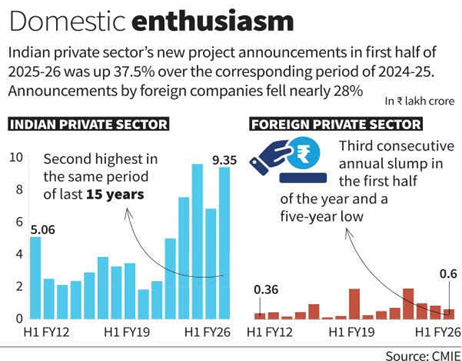
  • Data from the Centre for Monitoring Indian Economy (CMIE) shows that the private sector announced projects estimated at ₹9.95 lakh crore in the April-September 2025 period, up 30.4% over the first half of the previous financial year. Of this, it was the Indian private sector that did the heavy lifting. It announced projects estimated at ₹9.35 lakh crore, 94% of the value of the new project announcements in the first half and up 37.5% over the corresponding period of 2024-25. The value was the second highest in the corresponding period of the past 15 years. The highest was in the first half of 2023-24, when it touched ₹9.54 lakh crore.
  • However, the data also showed that India’s attractiveness as an investment destination for foreign companies might be diminishing. New project announcements by foreign companies fell to about ₹0.6 lakh crore in the April-September 2025 period, down nearly 28% from the corresponding period of last year.
  • This also marks the third consecutive year where foreign announcements have slumped in the first half of the year, and a five-year low for the figure.
  • New project announcements by foreign companies had risen to a peak of ₹1.9 lakh crore in the first six months of 2022-23 before declining subsequently.
  • The slump in new project announcements in India by foreign companies is not in line with global trends. Data from the United Nations Conference on Trade and Development show that global foreign direct investment grew by 11% in 2024 over its level in 2023, which itself was 3% higher than in 2022.
  • New project announcements by governments — both Central and State — slumped to ₹1.51 lakh crore in the first six months of financial year 2025-26, down more than 71% over their level in the corresponding period of the previous year.
  • This level of investment intention was the lowest in at least 15 years, the period for which there is data.
  • India’s first helicopter final assembly line in the private sector will come up at Vemagal in Kolar district of Karnataka. The assembly line will be established by Tata Advanced Systems Ltd. (TASL) to build the Airbus H125 helicopters.
  • According to Airbus and TASL, the “Made in India” H125 helicopter will help develop new civil and para-public market segments, and also meet the Indian armed forces’ requirement for a light multi-role helicopter, especially on the icy heights of the country’s Himalayan frontiers. technologies,” according to Airbus and TASL. The delivery of the first “Made in India” H125 is expected in early 2027.
  • ANRF’s SARAL to simplify scientific research papers

Context: As part of outreach to make scientific research more accessible, the Anusandhan National Research Foundation (ANRF) — India’s newest science funding agency — has developed a tool called SARAL (Simplified and Automated Research Amplification and Learning).

  • This tool, the organisation’s CEO, Shivkumar Kalyanaraman said, would help generate layperson summaries of complex scientific research.
  • This meant using Artificial Intelligence (AI) to extract information from research publications to generate “videos, podcasts, posters and presentation”, he said at a meeting organised earlier this week by the Federation of Indian Chambers of Commerce and Industry. The ANRF would focus on harnessing “deep science and engineering” to create “deep tech products and start-ups”, Mr. Kalyanaraman said.
  • The organisation would be developing an “AI Science and Engineering Open India Stack” that would significantly influence “drug and chemical discovery, aerospace design, climate and weather and advanced materials and design”, he said.

Funds allotted

  • In July, the Union Cabinet approved a ₹1 lakh crore Research Development and Innovation Scheme that intends to provide low interest, long tenure loans to private companies for investment in core research and development.
  • The Foundation’s governing council is expected to play a critical role in evaluating which sectors could receive such funds. The ANRF is envisaged as a single-window clearance mechanism for funding research and development for universities and academic institutions. It is also expected to receive about 70% of its budget from private sources. In function, it has absorbed much of the role the erstwhile Science and Engineering Research Board had played in funding scientific research.
  • Musk is first to hit $500 billion net worth, Forbes list shows
  • Tesla CEO Elon Musk became the first person ever to achieve a net worth of almost $500 billion, propelled by a rebound in the EV firm’s shares and surging valuations of the tech entrepreneur’s other start-ups this year.
  • His net worth stood at $500.1 billion as of 4:15 p.m. E.T., as per Forbes’ billionaires index. His fortunes are tied closely to Tesla, where he held a more than 12.4% stake as of September 15. The stock has risen more than 14% so far this year.
  • PLI scheme for textile sector likelyto be revised

Context: The textile industry is expecting an announcement soon on a revised Production Linked Incentive (PLI) scheme for the sector, with focus on manmade fibre (MMF) textiles.

  • Union Minister for Textiles Giriraj Singh recently posted on X, “From expanding opportunities to smoother implementation, the PLI Scheme is now more dynamic than ever.
  • “With new reforms, the Ministry of Textiles has made it more flexible, industry-friendly and geared towards ease of doing business, which will help in driving growth in MMF & Technical Textiles to the next level.”
  • As per the post, the scheme will include eight new HSN codes for MMF apparel and nine new codes for MMF fabrics. The unit can be set up within an existing firm and the investment criteria is revised to ₹150 crore (part IA) and ₹50 crore (part 2A). Further the incremental turnover needed for sops is 10%.
  • Chairman of Confederation of Indian Textile Industry Ashwin Chandran said in a release the significant lowering of investment thresholds and changes in the turnover-linked sop structure would prove pivotal in fast-tracking the growth of Indian textile and apparel sector.
  • Durai Palanisamy, chairman, Southern India Mills’ Association, said the scheme will attract investments from MSMEs.
  • OpenAI hits $500 billion valuation after share sale to SoftBank, others, sources say

Context: OpenAI, the company behind ChatGPT, has reached a valuation of $500 billion, following a deal in which current and former employees sold roughly $6.6 billion worth of shares, a source familiar with the matter.

  • This represents a bump-up from its current valuation of $300 billion, underscoring OpenAI’s rapid gains in both users and revenue.

Sale to consortium

  • As part of the deal, OpenAI employees sold shares to a consortium of investors including Thrive Capital, SoftBank, Dragoneer Investment Group, Abu Dhabi’s MGX and T. Rowe Price, according to the source, who spoke on the condition of anonymity as they were not authorised to speak to the media.
  • The company had authorized sales of $10-billion-plus worth of stock on the secondary market, the source added. Thrive Capital, SoftBank, Dragoneer, MGX and T. Rowe Price did not respond to Reuters’ requests for comment. The share sale adds to SoftBank’s earlier investment in OpenAI’s $40 billion primary funding round.
  • The company generated around $4.3 billion in revenue in the first half of 2025, about 16% more than it generated all of last year, the Information reported earlier this week. The sale comes at a time when tech giants are competing aggressively for AI talent with lucrative compensation packages. Meta is notably investing billions in Scale AI and poached its 28-year-old CEO, Alexandr Wang, to lead its new super intelligence unit.
  • Indian-made H125 helicopters to roll out from Kolar in 2027

Context: India’s first helicopter final assembly line in the private sector will come up at Vemagal in Kolar district of Karnataka. The assembly line will be established by Tata Advanced Systems Ltd. (TASL) to build the Airbus H125 helicopters.

  • According to Airbus and TASL, the “Made in India” H125 helicopter will help develop new civil and para-public market segments, and also meet the Indian armed forces’ requirement for a light multi-role helicopter, especially on the icy heights of the country’s Himalayan frontiers. technologies,” according to Airbus and TASL. The delivery of the first “Made in India” H125 is expected in early 2027.

Current Affairs: 1st October 2025

7.42 crore voters on Bihar’s final electoral rolls at the end of SIR

EC says physical, digital copies of rolls being shared with parties; electors with complaints can appeal before the District Magistrate and State CEO

Ahead of the Assembly election in Bihar, the Election Commission on Tuesday released the final electoral rolls in the State with nearly 7.42 crore names on the completion of the special intensive revision of the list.

Prior to the revision, the State had 7.89 crore voters as on June 24. When the draft list was released on August 1, there were 7.24 crore names with 65 lakh removed. On the final list, 21.53 lakh names were added and 3.66 lakh removed, a press statement from the commission said.

Chief Election Commissioner Gyanesh Kumar thanked the electors, officials, booth-level agents and leaders of political parties in Bihar for the completion of the special revision in the State after a gap of 22 Years today.

Bihar’s Chief Electoral Officer Vinod Singh Gunjiyal said voters could check their details on voters.eci.gov.in/

download-eroll.

“If any eligible person still wishes to apply for inclusion of their name in the electoral roll, they can submit an application up to 10 days before the last date for filing nominations for election,” Apurva Kumar Singh, Assistant Director, EC, said in the statement.

Mr. Singh said if any person was not satisfied with the decision of the electoral registration officer on entry on the electoral rolls, they may, under Section 24 of the Representation of the People Act, 1950, file a first appeal before the District Magistrate and a second appeal before the CEO.

Mr. Singh said the Chief Electoral Officer (CEO) and district-, constituency-, and block-level election officers had shared, with political parties, the booth-level lists of electors who were reported as deceased, whose enumeration forms were not received, who had permanently migrated, or who could not be traced, with the objective of identifying eligible voters.

The draft electoral rolls were shared with all political parties, while the list of names not included on the draft rolls was displayed by the district election officers and district magistrates, as well as on the website of the Bihar CEO.

He said the SIR exercise was carried out in line with Article 326 of the Constitution. “This large-scale exercise was made successful through the sincere efforts of Chief Electoral Officer Bihar, District Election Officers of all 38 districts, 243 Electoral Registration Officers, 2.976 Assistant Electoral Registration Officers, around 1 lakh Booth Level Officers, lakhs of volunteers and the full involvement of all the 12 major Political Parties, including their district presidents and over 1.6 lakh Booth Level Agents appointed by them,” Mr. Singh said.

Ruling parties welcome SIR-vetted list

Bihar’s ruling parties welcomed the final electoral rolls. “We welcome the final voter list of Bihar after SIR has been completed successfully. This is certainly a step towards strengthening democracy and will increase transparency in elections,” BJP State spokesperson Niraj Kumar said.

Janata Dal(U) MLC and spokesperson Neeraj Kumar slammed the Opposition for questioning the EC’s credibility. “The Opposition parties were raising a finger against the EC with the slogan of ‘Vote chori (vote theft)’ and now the final list has been published in which more than 21 lakh names have been added. In Bihar, the maximum population is of marginalised section and their names have been added. The Opposition is exposed now,” he said.

Opposition Rashtriya Janata Dal spokesperson Chitranjan Gagan said that the party would give its official statement on the completion of SIR after reviewing it with booth-level agents and panchayat representatives.

CM announces more relief for rain-hit farmers

After an aerial survey of flood-hit areas in Kalyana Karnataka, Chief Minister Siddaramaiah on Tuesday announced that the State government would provide an additional ₹8,500 per hectare over and above the Union government’s crop loss compensation under Nationalk Disaster Response Fund norms, across all three crop categories – rainfed, irrigated, and perennial.

After an aerial survey of flood-hit areas in Kalyana Karnataka, Chief Minister Siddaramaiah on Tuesday announced that the State government would provide an additional ₹8,500 per hectare over and above the Union government’s crop loss compensation under NDRF norms, across all three crop categories — rainfed, irrigated, and perennial.

He made the announcement at a media conference in Kalaburagi after an aerial survey of Kalaburagi, Vijayapura, Bidar, and Yadgir districts and chairing a review meeting.

“As per NDRF norms, rainfed, irrigated, and perennial crops are entitled to ₹8,500, ₹17,000, and ₹22,500 per hectare, respectively. The State government will add ₹8,500 across the board, raising compensation to ₹17,000 for rainfed, ₹25,500 for irrigated, and ₹31,000 for perennial crops,” Mr. Siddaramaiah said.

Extent of damage

The Chief Minister said that over 9.6 lakh hectares of crops have been damaged across the State, of which 9.03 lakh hectares were in just eight northern districts of Kalaburagi, Vijayapura, Yadgir, Bidar, Bagalkot, Belagavi, Raichur, and Gadag, accounting for 95% of the State’s total loss.

“As per preliminary estimates, nearly 10 lakh hectares of standing crops have been affected. But we have managed to survey only about 50% so far. With fields still waterlogged and soil too wet, the final figures may go up once the water recedes,” he said.

The flooding has claimed 52 lives and 422 heads of cattle, apart from fully damaging 547 houses. “We have already released compensation for human casualties. Relief for 407 cattle deaths has also been paid. In all, 80 relief centres have been set up, housing more than 10,500 people,” Mr. Siddaramaiah said.

Excess rainfall

Between June 1 and September 29 this year, Karnataka recorded 879 mm of rainfall – 4% above normal. But the surge was much higher in northern districts: Vijayapura 615 mm (+58%), Kalaburagi 768 mm (+34%), Yadgir 659 mm (+29%), and Bidar 750 mm (+16%).

“This year, North Karnataka has seen rainfall levels not witnessed in many years. Coupled with the massive inflow from Maharashtra’s reservoirs, it has created one of the worst flood disasters in recent memory,” he observed.

Stressing the Centre’s role in disaster response, he said his government would submit a memorandum seeking additional funds.

“I will send a delegation to meet the Prime Minister and Union Ministers of Home, Finance and Agriculture to demand more funds for flood relief,” Mr. Siddaramaiah said.

Aerial survey

Earlier in the day, the Chief Minister, accompanied by Ministers M.B. Patil, Krishna Byre Gowda, and Priyank Kharge, undertook the aerial survey of flood-affected areas.

The first round focused on villages in Kalaburagi and Vijayapura, followed by Bidar and Yadgir in the second.

After the aerial inspection, the Chief Minister held a detailed review with elected representatives and senior officers.

He noted that crop losses had occurred in two phases – in August and later in September – and insisted on a single-phase compensation drive.

Five city corporations to have 368 wards, up from 198

As anticipated, the East Corporation, with the lowest population, has the least number of wards at 50, the West Corporation, with the highest population, has the highest number of wards at 111

The State government on Tuesday published a draft of the new wards within the five city corporations in Bengaluru, taking the total number of wards in the city to 368, up from 198.

As anticipated, the East Corporation, with the lowest population, has the least number of wards at 50, the West Corporation, with the highest population, has the highest number of wards at 111. While North and South corporations have 72 wards each, the Central Corporation will have 63 wards, as per the draft notification.

The draft notification gives ward boundaries and prominent areas in the ward, but gives neither a map nor the population and size of the wards.

Ward sizes

While the ward delimitation was carried out based on the 2011 Census, the average ward size as per projected population for 2023 varies in the range of 26,000 in the East Corporation to over 43,000 in the North Corporation.

This ward size is definitely an improvement from the situation under the erstwhile Bruhat Bengaluru Mahanagara Palike (BBMP) where the population of many wards crossed 1 lakh.

But given that the Greater Bengaluru Governance Act, 2024, provides up to 150 wards in each corporation taking the total to 750 in the city, and Deputy Chief Minister and Bengaluru Development Minister D.K. Shivakumar had hinted at 500 wards, many argue there was room to carve out much smaller wards.

There was an excitement over smaller wards, not only in terms of service delivery, but also over its potential to encourage non-traditional political formations to contest and win wards, said N.S. Mukunda of Bengaluru Praja Vedike. “But these ward sizes kill that possibility and further entrench the stranglehold of traditional parties in the city’s politics and governance, for which there will obviously be a bipartisan approval among the traditional parties. This is against the spirit of decentralisation, which Congress claimed to be at the heart of restructuring governance in Bengaluru,” he said.

Outdated on arrival

The guidelines for the Delimitation Commission mandated that each ward should represent around 20,000 residents, with a leeway for 25% variance to ensure balanced representation, as per the 2011 Census, the latest census available, based on which ward delimitation has to be done.

While, as per the 2011 Census, the city’s population was around 85 lakh, it is projected to be 1.44 crore in 2023, which essentially means the new wards are outdated on arrival.

M. Maheshwar Rao, Chief Commissioner, Greater Bengaluru Authority and Chairman of the Ward Delimitation Commission, said that the wards have been carved out based on the 2011 Census within the guidelines issued to the Commission. Citizens can submit their objections to the draft by writing to the Additional Chief Secretary, Urban Development Department by October 15. The final notification of the ward boundaries is expected to be published by November 1.

India got 8% more monsoon rainfall this year, says IMD

India this year received 8% more monsoon rainfall than normal, the fifth-highest since 2001 and the 38th highest since 1901, the India Meteorological Department (IMD) said on Tuesday.

The IMD considers only the rainfall from June 1 to September 30 to calculate monsoon data.

While the southwest monsoon season largely boded well for agriculture by boosting storage in reservoirs, it wreaked havoc in several parts of the country — particularly in North India — leading to loss of life and property.

Seasonal rainfall over northwest India, central India, and south peninsula was 27%, 15% and 10% more than their seasonal averages. However, rainfall in eastern and northeastern India was 80% of what those regions usually get.

The rainfall over northwest India was 74.79 cm, the highest since 2001 and sixth highest since 1901, while that over east and northeast India was 108.9 cm, the second lowest since 1901. Overall, the monsoon rainfall was 93.7 cm.

The monsoon season saw extremely heavy spells in several parts of northern and southern India, thanks to the conjoining of storms that originated in the Mediterranean region, along with the monsoon trough that hovers over the Indian landmass during the monsoon season. When parsed by months, rainfall was 9% more than what is usual in June, 5% more in both July and August, and 15% excess in September.

The southwest monsoon advanced over the south Andaman Sea and Nicobar Islands on May 13, 2025, nearly nine days ahead of the normal schedule. It arrived in Kerala on May 24, ahead of the usual onset date of June 1, and covered the entire country by June 29.

There were seven monsoon depressions, or sub-cyclonic storms that form in the Arabian Sea and the Bay of Bengal, during the season. Of the seven, one intensified into a deep depression. Storms falling in this category last an average of 69 days against a normal of 55, contributing to the extended spells of heavy rain.

Though the monsoon system has not fully withdrawn and will prevail over the next couple of weeks, the IMD does not count that rain in its quota of monsoon rainfall. For October, the agency has forecast ‘above normal’ rain in the country, except for parts of north and northwest India.

While a La Nina is expected to form in the central equatorial Pacific Ocean and it usually means a stronger winter, IMD Director-General M. Mohapatra said this was not always the case.

A forecast for winter (December, January and February) will be available around November, he added.

Centre directs NGOs to seek FCRA renewal 4 months before expiry

The Hindu Bureau New Delhi

The Union Ministry of Home Affairs on Tuesday directed non-governmental organisations (NGOs) to submit applications for renewal of their Foreign Contribution (Regulation) Act (FCRA) registration at least four months before expiry.

FCRA registration, which is mandatory for NGOs and associations to receive foreign funds, is renewed every five years. In a communication, the Ministry noted that several associations had been submitting renewal applications less than 90 days before the expiry of their certificates.

“Such delayed submissions do not allow sufficient time for scrutiny and for obtaining inputs from security agencies,” the Ministry said. It stated that NGOs are “strictly advised to submit their renewal applications well in advance and, in any case, not later than four months before the validity expires.

Maharashtra, Karnataka report most number of farmer suicides

The National Crime Records Bureau (NCRB) has said in its report that 10,786 farmers and agricultural workers committed suicide in 2023. The most number of cases was from Maharashtra (38.5%), followed by Karnataka (22.5%).

The organisations of farmers blamed the Narendra Modi government’s policies for the situation, and said the decision to waive off import duty on cotton would vitiate the situation as most of the suicides were still from the cotton belts of the country.

Of the 10,786 suicides from the farming sector, 4,690 were farmers or cultivators, and 6,096 were agricultural workers. The farm suicides accounted for 6.3% of total suicides (1,71,418 suicides in 2023) in the country.

Out of the 4,690 farmers who committed suicide, 4,553 were male and 137 were female, and out of the 6,096 suicides by farm workers, 5,433 were male and 663 were female.

After Maharashtra and Karnataka, Andhra Pradesh (8.6%), Madhya Pradesh (7.2%), and Tamil Nadu (5.9%) registered the most number of suicides. West Bengal, Bihar, Odisha, Jharkhand, Himachal Pradesh, Arunachal Pradesh, Goa, Manipur, Mizoram, Nagaland, Tripura, Chandigarh, Delhi, and Lakshadweep reported no suicides from the farm belt.

Commenting on the NCRB data, the president of the All India Kisan Sabha, Ashok Dhawale, said more than 10,000 suicides had been reported from the farm sector in 2021, 2022 and 2023, and it showed the systemic crisis that the Modi government could not grasp or combat.

“This crisis is going to aggravate as a large number of farmer suicides take place in the cotton and soybean belt. Maharashtra has turned out to be the graveyard of farmers. The Marathwada and Vidarbha region are cotton and soybean belts. In spite of this, the Union government is bowing to the pressure to sign Free Trade Agreements, and to U.S. President Donald Trump’s tariff terrorism. The government cancelled the 11% import duty on cotton. This means that American cotton is going to come here. Agriculture will be finished by these treaties,” Mr. Dhawale said, adding that the NCRB data could not be trusted.

For those in distress, counselling is available at TeleMANAS-14416

Over 1.73 lakh killed in road accidents in 2023, 1.6% rise: NCRB

More than 1.73 lakh people were killed and 4.47 lakh injured in road accidents across the country in 2023 with nearly 46% of the victims being two-wheeler riders, according to a report of the National Crime Records Bureau (NCRB).

Speeding and careless driving were found to be the two major causes of road accidents.

A total of 4,64,029 road accidents took place in the country in 2023, 17,261 more than in 2022 — with a 1.6% increase in fatalities, from 1,71,100 in 2022 to 1,73,826 in 2023.

The highest number of accidents (20.7% of total) were reported between 6 p.m. and 9 p.m.

Two-wheelers accounted for the highest number of fatal road accidents, causing 79,533 deaths, or 45.8% of total deaths, followed by pedestrians at 27,586 (15.9%) and SUV/car/jeep at 24,776 (14.3%).

Most of the deaths in two-wheeler accidents were reported in Tamil Nadu (11,490) and Uttar Pradesh (8,370). A large number of deaths due to SUV/car/jeep accidents were reported in Uttar Pradesh (19.2% of total ) and a large number of deaths due to trucks/lorries/mini truck accidents were also reported in the State (29.9% of total).

The NCRB said cause-wise analysis of fatal road accidents revealed that 58.6% (1,01,841) and 23.6% (41,035) of fatalities were due to speeding and dangerous/careless driving or overtaking, respectively.

Poor weather conditions, driving under influence of drug/alcohol and animal crossing caused 4,952 deaths.

The highest number of deaths were reported on the National Highways accounting for 34.6%, followed by State Highways at 23.4%.

Crime against children records 9.2% rise in 2023

Press Trust of India New Delhi

A total of 1,77,335 cases of crime against children were registered in 2023, showing an increase of 9.2% over the 2022 figure, according to the latest National Crime Records Bureau (NCRB) report.

The data compiled by the NCRB showed that the crime rate in 2023 stood at 39.9 per 1,00,000 child population in comparison to 36.6 in 2022.

The major crime heads in 2023 were “Kidnapping and abduction of children” (79,884 cases, 45%) and “Protection of Children from Sexual Offences (POCSO) Act” (67,694 cases, 38.2%).

Madhya Pradesh topped the list with 22,393 total cases, followed by Maharashtra (22,390) and Uttar Pradesh (18,852).

Vinay wins trap bronze; Indian pairs make it a 1-2 in mixed air rifle

Vinay Pratap Chandrawat fought his way to the trap bronze, even as the Indian mixed air rifle teams clinched the gold and silver, in the Junior World Cup on Tuesday.

The 20-year-old Vinay first topped the shoot-off when five competed for the last three spots in the final, on being tied at 118 in qualification. In fact, Vinay shot a perfect fifth round of 25 to stay in the reckoning for the final.

After having missed four of the first 15 in the final, Vinay was at his best, as he missed only two hits over the next 25 birds to secure the bronze ahead of compatriot Arjun.

Toni Gudelj of Croatia beat Isaac Hernandez of Spain 44-41 for the gold.

In women’s trap, Sabeera Haris shot 112 and lost the shoot-off for the last berth in the final to Lucy Myers of USA.

In mixed air rifle, Isha Taksale and Himanshu pipped qualification toppers Shambhavi Kshirsagar and Naraen Pranav by 0.2 point for the gold, after the two teams were tied at 15-15. It was the second gold for Himanshu as he had won the individual air rifle event on Monday.

India was on top of the medals table with seven gold, nine silver and seven bronze. Individual Neutral Athletes (AIN) was second with four gold, two silver and four bronze. Italy was third with two gold and two silver, while Croatia and Czechia were joint fourth with a gold medal each. The World Cup will conclude with the junior women’s sports pistol and mixed trap events on Wednesday.

Srihari wins his fifth medal, Rohit claims silver in 50m butterfly

Star Indian swimmer Srihari Nataraj once again stood tall, bagging a bronze in the 100m freestyle to extend his personal haul to five medals at the 11th Asian aquatics championships here on Tuesday.

Also making his mark was Rohit B. Benedicton, who claimed a silver in men’s 50m butterfly and took India’s medal tally to nine.

Smart move

Drawn in lane five, Srihari paced his race smartly.

The Indian swimmer turned third at the 50m mark with China’s Haoyu Wang (49.19) and Qatar’s Ali Tamer Hassan (49.46) ahead of him while Akash Mani (50.45) was close on his heels. In the second lap, Srihari maintained his rhythm to hold off the chasing pack and secure a bronze in 49.96s.

Good season

“The training has been going really well and I have had a good season this year. I was fast in the heats and with the way my training has been going, I thought I’d be faster here.

“But the others swam a brilliant race as well and I’m just glad I got my hand on the wall to be on the podium,” Srihari said after the race.

“The energy is amazing. Usually in swimming, you can’t hear anything while racing, but in the last 50m of the relay on Monday, I don’t know who it was, I could hear people screaming and cheering us the whole time. A great feeling,” he added.

In men’s 50m butterfly, Rohit started well and went on the clinch the silver medal with a time of 23.89, finishing close behind Kazakhstan’s Adilbek Mussin (23.74).

Faltering

Meanwhile, Dhinidhi Desinghu and Shashidhara Rujula booked their places in the women’s 100m freestyle final but could not break through the top half of the field, finishing sixth and eighth respectively.

IISc researchers developnew system to transform seawater into drinking water

This is said to carry out the process in a faster and cost effective manner compared to the existing methods; the desalination unit is low-cost, scalable, and sustainable

Researchers from the Indian Institute of Science (IISc) have developed a new siphon-based thermal desalination system which can transform salty seawater into clean drinking water. This system is said to carry out the process in a faster and cost effective manner compared to the existing methods.

According to the Department of Science and Technology, traditional solar stills, which mimic nature’s water cycle, have long been promoted as simple water purifiers.

Two challenges

However, the department said that this method faces two persistent challenges which are salt buildup, where crusts form on evaporator surfaces resulting in blocking water flow.

The second challenge with this method is scaling limits where wicking materials can only lift water about 10–15 cm, restricting system size and output.

The department said that the IISc team of researchers have addressed both challenges using the principle of siphonage. The siphon-based thermal desalination system developed by the researchers uses a composite siphon which is a fabric wick paired with a grooved metallic surface. The fabric draws salty water from a reservoir, while gravity ensures a smooth, continuous flow. Instead of allowing salt to crystallize, the siphon flushes it away before buildup occurs.

“The water spreads as a thin film across the heated metal surface, evaporates, and then condenses just two millimeters away onto a cooler surface. This ultra-narrow air gap significantly enhances efficiency, producing more than six liters of clean water per square meter per hour under sunlight which is several times higher than conventional solar stills,” the department said.

By stacking multiple evaporator–condenser pairs, the device recycles heat repeatedly, squeezing maximum output from each ray of sunshine.

The department said that the desalination unit is low-cost, scalable, and sustainable, relying only on simple materials such as aluminum and fabric.

The system can run on solar energy or waste heat, making it suitable for off-grid communities, disaster zones, and arid coastal regions. It can also handle extremely salty water (up to 20% salt) without clogging which is a major advance in brine treatment.

The department said that this system could help secure safe drinking water for millions in water-stressed regions.

“From small villages to island nations, the siphon-powered desalination system may finally make the ocean a dependable source of fresh drinking water,” it said.

ADB cuts India’sFY26 growthforecast to 6.5% on U.S. tariff impact

The Asian Development Bank (ADB) has downgraded India’s growth outlook for the current financial year to 6.5% from the 6.7% predicted in April, on account of the impact of the 50% tariffs imposed by the U.S. on imports from India.

The outlook for 2026-27 has also been revised downwards to 6.5% from the earlier prediction of 6.8%.

The ADB, in its Asian Development Outlook September 2025, released on Tuesday, also reduced its growth forecast for developing Asia to 4.8% for the current year 2025 from its forecast in April of 4.9%. Similarly, the forecast for 2026 has been cut to 4.5% from 4.7%.

“The revisions reflect downgrades for India, hit by steep tariff hikes, and Southeast Asia, driven by a worse and more uncertain global environment,” the report said. India faces the steepest tariff hikes among developing Asian economies, prompting a downgrade in its growth outlook.”

The report further said that, despite strong growth in the first quarter of the current financial year, driven by consumption and public investment, the elevated U.S. tariffs, which it said affected about 60% of goods exported to the U.S., will weigh on growth starting in the second half of 2025-26 and in 2026-27.

“Merchandise exports are expected to grow only modestly, constrained by US tariffs on key exports, while exports of services are expected to remain robust and a key driver of growth,” it said. “Investment growth is expected to be lower than previously forecast, with corporate investment still subdued by global trade uncertainty.”

The escalation in tariffs is expected to weigh heavily on key export sectors such as textiles, ready-made garments, jewellery, shrimp, and chemicals, the report noted. On the other hand, however, it noted that consumption demand is expected to grow more than previously expected, aided by lower food prices and cuts to consumption and income taxes.

“The 2025-26 inflation projection for India is revised downward to 3.1%, reflecting subdued global oil prices and a faster-than-expected decline in food prices due to higher agricultural production,” the report said.

However, it added that food prices are expected to normalise in 2026-27, leading to an upward revision of the inflation forecast to 4.2% for that year.

Centre extends RoDTEP export sop plan till March 2026

The Government has extended the Remission of Duties and Taxes on Exported Products (RoDTEP) incentive scheme for exporters until March 31, 2026. Exporters welcomed the move, saying it removes substantial uncertainty and comes when Indian exports are facing significant headwinds.

Started in 2021, the RoDTEP scheme provides refunds to exporters for any embedded duties, taxes, and levies incurred by them not already refunded under other schemes.

The scheme had earlier been available until February 5 this year. In May, following significant lobbying by exporters, the government restored the RoDTEP scheme for exporters done by Advance Authorisation (AA) holders, Export-Oriented Units (EOUs), and units in Special Economic Zones (SEZs).

“The timely extension of RoDTEP has removed the uncertainty that was weighing on the exporting community,” said S.C. Ralhan, president of the Federation of Indian Export Organisations.

NASA’s IMAP will show how solar particles are energised and shield us

IMAP, which was launched on September 24, will map the heliosphere’s boundary, trace energetic particles, and improve space weather forecasting

Space isn’t empty. The sun issues a continuous stream of charged particles called the solar wind, which creates a vast region around our solar system called the heliosphere. This region acts like a protective bubble that shields the planets from cosmic rays and interstellar particles. Yet the structure, dynamics, and boundary of the heliosphere are still poorly understood. Scientists want to know how particles are accelerated in the solar wind and how they interact with the space between stars. Changes in the solar wind and its particles also affect space weather, which can damage satellites, harm astronauts, and disrupt communication systems on earth.

To address these questions, NASA launched the Interstellar Mapping and Acceleration Probe (IMAP) on September 24. Its goal is to map the heliosphere’s boundary, trace energetic particles, and improve space weather forecasting.

IMAP is equipped with 10 scientific instruments, each designed to detect different types of particles or phenomena in space. Some of them are energetic neutral-atom detectors (IMAP-Lo, IMAP-Hi, IMAP-Ultra), which capture neutral atoms that were once charged ions but were changed by acquiring electrons. Other instruments detect charged particles directly, magnetic fields, interstellar dust, and solar-wind structures.

After launch, IMAP will travel to the sun-earth Lagrange point 1 (L1), about 1.6 million km from the earth toward the sun, where gravitational forces balance in a way that allows the spacecraft to remain in a stable orbit with minimal fuel use. Once there, IMAP will continuously observe incoming solar wind and energetic particles from a fixed vantage point. IMAP will also send data in near real-time to help scientists monitor space weather conditions.

Based on mission design and early operations, scientists expect IMAP will produce the most detailed maps yet of the heliosphere’s boundary, revealing how the solar wind collides with the interstellar medium. It will also trace how particles accelerate from the sun, move out, or are energised in the heliosphere. In more specialised research, IMAP-Lo is expected to be able to observe interstellar neutral hydrogen and deuterium, possibly distinguishing primary versus secondary populations of these atoms at the heliopause, which is the outermost layer of the heliosphere.

IMAP data are expected to have profound implications. By revealing the structure and dynamics of the heliosphere, physicists can deepen their understanding of how our solar system is protected against cosmic radiation. That is relevant to understanding the earth’s habitability and that of exoplanets as well. Second, better data on solar wind behaviour will strengthen physicists’ ability to forecast space weather, in turn helping protect satellites, communications networks, power grids, and orbital crews.

For future human exploration beyond the earth, IMAP’s measurements of how particles travel and are accelerated will help plan safer routes and design better shielding for spacecraft.
Current Affairs: 30th Sept 2025

  • Industrial output growth slows to 4% in August

Context: Country’s IIP growth gets pulled down by consumer-related sectors; primary goods sector sees a turnaround with seven-month-high of 5.2%; experts say no effect of GST reforms that came in later

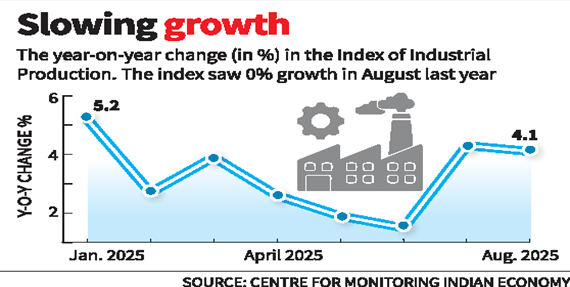
  • Growth in industrial activity in India slowed to 4% in August from its six-month high growth of 4.3% in July.
  • Growth was dragged down by the consumer durables and non-durables sectors, as well as slower growth in manufacturing, capital goods, and infrastructure sectors, government data showed.
  • On the other hand, mining activity, the primary goods sector, and electricity output saw a positive turnaround.
  • Data on the Index of Industrial Production (IIP), released by the Ministry of Statistics and Programme Implementation, showed that growth in the index this August was considerably faster than the 0% seen in August last year.
  • “This data should be read with caution as it captures neither the tariff nor GST effect which have been in the news and affected sentiment in business,” Madan Sabnavis, chief economist at the Bank of Baroda, said. “Tariffs were implemented from August 27 while GST benefits kicked in late September.”
  • The mining and quarrying sector in particular saw a significant turnaround. It grew 6% in August, a 14-month high, snapping a four-month streak of contractions.
  • The second sector to see a robust turnaround was the primary goods sector, which saw growth coming in at a seven-month high of 5.2%. The electricity sector grew at a five-month high of 4.1%.
  • The manufacturing sector, however, slowed to 3.8% in August, down from 6% in July. This was quicker than the 1.2% growth the sector saw in August last year. Similarly, growth in the capital goods sector slowed in August to 4.4% from 6.7% in July. This was, however, quicker than the 0% seen in August last year.
  • The growth in the consumer durables sector slowed to 3.5% in August from 7.3% in July and 5.4% in August last year. The consumer non-durables sector saw activity contracting 6.3%, the worst performance in eight months.
  • More women employed in agriculture, but half of them are unpaid

Context: Global trade trends, technology, and land and labour reforms can help bridge the gap

  • Women-led development has been recognised as a structural game-changer for advancing India’s economic ambitions, yet its full potential remains under-leveraged. Nowhere is harnessing this potential more urgently than in the agriculture sector, the backbone of India’s economy and the largest employer of its women.
  • Despite their growing presence on farms, women’s contributions remain systematically unremunerative. By leveraging recent shifts in trade and technology, India has an unprecedented opportunity to unlock pathways that recognise women as equal partners in agricultural transformation.
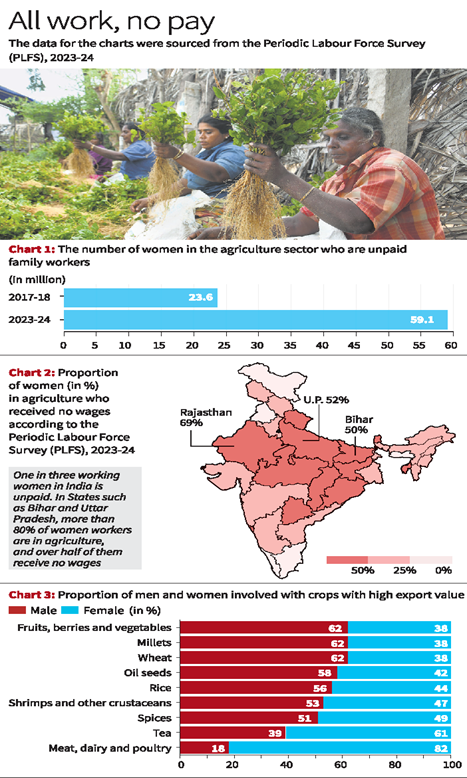
  • In the past decade, structural shifts in the Indian workforce have drawn rural men into higher-paying non-farm jobs, leaving women to replace them to do the agricultural work. As a result, women’s employment in agriculture surged by 135%, and they now account for over 42% of the sector’s workforce. Two out of every three working women are now in agriculture.
  • Yet, this rise has come with diminishing returns. Nearly half of the women in agriculture are unpaid family workers, with their numbers jumping 2.5 times from 23.6 million to 59.1 million in just eight years (Chart 1). As a result, today, one in three working women in India is unpaid. In States such as Bihar and Uttar Pradesh, more than 80% of women workers are in agriculture, and over half of them receive no wages (Map 2).
  • Much of this invisibility stems from systemic inequities. Women are not officially recognised as farmers, own only 13-14% of land holdings, and earn 20-30% less than men for equivalent work. Asset ownership, decision-making power, and access to credit and government support remain male-dominated, trapping women in low-value activities.
  • As a result, women’s greater participation has not translated into higher income for the economy, as agriculture’s share of the national GVA fell from 15.3% in 2017-18 to 14.4% in 2024-25. Therefore, the ‘feminisation of agriculture; has, in a way, reinforced inequities rather than enabling women’s economic empowerment.
  • Global trade trends are opening new windows for women’s economic inclusion in agriculture. The India-U.K. Free Trade Agreement (FTA), for example, is projected to boost Indian agricultural exports by 20% within three years, granting duty-free access to over 95% of agricultural and processed food products. From rice, spices, and dairy to ready-to-eat meals, Indian producers will benefit from premium market access, with safeguards in place for sensitive sectors. Many of these export-oriented value chains employ a significant share of women (Chart 3). If FTA-embedded provisions for women, such as training, credit access, and market linkages, are catalysed, it could enable women’s transition from farm labourers to income-generating entrepreneurs.
  • The greatest opportunity lies in enabling women to move from unpaid, low-value tasks into higher-margin segments such as processing, packaging, branding, and exporting. With global demand rising for organic products and superfoods, India’s value chains for tea, spices, millets and certified organic produce are poised for expansion — sectors where women are already strongly represented. Geographical Indications, branding initiatives, and support for meeting export standards can help women producers shift from subsistence farming toward premium, value-added product markets.
  • Without targeted measures, women risk being excluded from the export-led opportunities emerging in Indian agriculture. Digital innovations can play a decisive role in bridging this gap. Platforms such as e-NAM, mobile-based advisory services, voice-assisted applications, and precision agriculture tools are already connecting women to markets, knowledge systems, and financial services. These solutions help formalise women’s labour while expanding access to schemes, credit, and fair pricing.
  • However, these benefits are contingent on overcoming structural barriers such as low digital literacy, language gaps, and limited access to affordable devices. Tackling these challenges requires collective action by all ecosystem actors — government, private sector, NGOs, self-help groups, and Farmer Producer Organisations (FPOs).
  • Encouragingly, promising models are emerging. AI-enabled solutions such as the government’s BHASHINI platform and Microsoft–AI4Bharat’s Jugalbandi are extending multilingual, voice-first access to government services. L&T Finance’s Digital Sakhi programme has trained rural women in digital and financial literacy across seven States.
  • At the State level, Odisha’s Swayam Sampurna FPOs showcase how technology can position women farmers at the forefront of export competitiveness. The Jhalawari Mahila Kisan Producer Company in Rajasthan leverages digital tools for direct sales and branding. Multi-stakeholder training programs for women farmers in Assam’s tea sector focus on diverse areas. It is important to scale up and emulate these platforms.
  • To transform women’s role in agriculture, land and labour reforms are equally vital. Policies must recognise women as independent farmers by promoting joint or individual land ownership, which in turn strengthens their eligibility for credit, insurance, and institutional support.
  • X to appeal HC judgment upholding Sahyog portal

Context: X, formerly Twitter, said that it would appeal the Karnataka High Court’s decision that rejected its challenge to the Union government’s Sahyog portal.

  • The Sahyog portal was set up last year to allow the police and other authorised government agencies to send takedown notices to social media platforms, a move that X has argued is a broad and illegal censorship regime that would leave it with criminal liability if it did not comply.
  • The company said it was “deeply concerned” by the judgment handed down by the single Bench of judge M. Nagaprasanna, and that it would appeal. It did not indicate whether this appeal would be directed to a larger bench of the Karnataka High Court, or to the Supreme Court.
  • “The Sahyog [portal] enables officers to order content removal based solely on allegations of ‘illegality,’ without judicial review or due process for the speakers, and threatens platforms with criminal liability for non-compliance,” the platform said.
  • “X respects and complies with Indian law, but this order… is inconsistent with the Bombay High Court’s recent ruling that a similar regime was unconstitutional.”
  • X is referring to the Centre’s fact checking unit, which was designed to flag misinformation about the Centre that, once a given post was notified, would strip away the “safe harbour” that a platform would enjoy for continuing to host it; the “intermediary,” X, in this case, would be liable for posts made by users as though it were a publisher. The Sahyog portal, X argues, is similar.
  • Justice Nagaprasanna argued in his ruling that X was not in a position to take umbrage under constitutional guarantees as its parent, X Corp., is a foreign company.
  • Two railway links to offer easy connectivity to Bhutan

Context: Kokrajhar-Gelephu and Banarhat-Samtse lines will run to a total distance of 89 km; they will be developed at a cost of ₹4,033 crore; Railway Minister says project will boost economy, tourism.

  • The Centre announced two rail links with a total distance of 89 km between India and Bhutan — Kokrajhar-Gelephu (Assam) and Banarhat-Samtse (West Bengal) — at a cost of ₹4,033 crore.
  • These two projects are part of the first set of rail connectivity projects between India and Bhutan, Foreign Secretary Vikram Misri announced at a press conference.
  • The memorandum of understanding (MoU) for these projects was signed during Prime Minister Narendra Modi’s visit to Bhutan in March 2024 and a formal agreement was signed here on the occasion of the Bhutanese Foreign Secretary’s visit to New Delhi.
  • “India is the largest trading partner of Bhutan. Most of the EXIM trade of Bhutan is through Indian ports, therefore, it becomes very important to have seamless rail connectivity for the Bhutanese economy to grow, and for the Bhutanese people to have better access to the global network,” Railway Minister Ashwini Vaishnaw said.

For Vande Bharat trains

  • The Minister said the two rail links would provide Bhutan access to 1,50,000 km of the Indian railway network. While the Kokrajhar-Gelephu rail link would be developed over the next four years, the Banarhat-Samtse line would be constructed over a period of three years. The railway lines would be designed for running Vande Bharat trains. The former will have six stations, two viaducts, 29 major bridges, 65 minor bridges, two good sheds, one flyover and 39 underpasses. The latter will include two stations, one major flyover, 24 minor flyovers, and 37 under passes. It will be developed at a cost of ₹577 crore.
  • “This will provide a lot of economic benefits to the people, in terms of tourism, industrial growth, people-to-people movement, and goods movement. Practically, every benefit that railway brings will happen with this,” Mr. Vaishnaw added.
  • The Government of India has pledged ₹10,000 crore in development assistance to Bhutan for its 13th Five-Year Plan running from 2024 to 2029. This funding doubles the support provided during the 12th Plan.
  • Bhutan is also set to benefit from the Jogighopha Inland Waterways Transport Terminal, opened in February. The two nations have also collaborated on five major hydropower projects — Chukha, Tala, Mangdechhu, Kurichhu, and the recently completed Punatsangchhu II.
  • Govt. norms for EV charging infra subsidy

Context: The Centre has issued norms offering up to 100% subsidies for setting up vehicle charging stations, battery swapping and charging stations, targeting high-density cities, satellite towns, and key national and state highways.

  • The guidelines were issued under the ₹10,000- crore PM E-drive scheme for promotion of EVs within which ₹2,000 crores has been apportioned for charging infrastructure.
  • The government is aiming at installing 72,300 EV chargers for cars, two- wheelers, buses and trucks, said Additional Secretary, Ministry of Heavy Industries, Dr. Hanif Qureshi in a LinkedIn post.
  • The post mentioned the government was aiming at a charging grid coverage of at least one charging station in every 3km × 3km grid; on highways, one every 25 km, plus long-range EV chargers every 100 km.
  • The ₹2000 crore subsidy offers support for chargers in government buildings like offices and hospitals, private establishments, including malls and metro stations and other locations as determined by State/ UT governments.
  • “India is ensuring infrastructure leads the way — breaking the adoption bottleneck, boosting consumer confidence, and building a strong public-private ecosystem for clean mobility,” Dr. Qureshi added.
  • State launches Unified Land Acquisition System to ensure transparency and efficiency

Context: The Karnataka government on Monday launched the Unified Land Acquisition System (ULMS) Data Module, aimed at streamlining and digitising the land acquisition process across the State. Officials said the platform will bring greater transparency, efficiency, and accountability in land acquisition proposals and ongoing litigations.

  • Developed by the Centre for Smart Governance under the e-Governance Department, the module has been created with inputs from an expert committee of the Revenue Department, senior officers, Special Land Acquisition Officers (SLAOs), and field officials.

Common platform

  • The system will serve as a common platform for multiple land-acquiring agencies, including Revenue, Irrigation, Urban Development, BDA, BMRDA, Metro, K-Ride, KSHIP, KIADB, KHB, and NHAI. It will provide a consolidated dashboard offering real-time updates on the status of land acquisition proposals.
  • Officials said the module will cover the full life cycle of acquisition — from proposal submission to award, compensation, and rehabilitation — in line with the Right to Fair Compensation and Transparency in Land Acquisition, Rehabilitation and Resettlement Act, 2013.
  • Integration with systems such as Bhoomi, e-Swathu, e-Aasthi, Kaveri 2.0, and Khajane II will ensure that authentic data is sourced directly from respective departments.
  • Revenue Minister Krishna Byre Gowda, who launched the module, said, “With ULMS, Karnataka is setting a new benchmark in citizen-centric governance. The platform ensures transparency for landowners and affected families while providing officials with a robust workflow. It balances the State’s development needs with the rights of citizens.”
  • HC: Charge created earlier will prevail during conflict between GST Act and SARFAESI Act

Context: If there is a conflict between the GST Act and the SARFAESI Act, the priority of the charge must be determined based on the order in which the charges were created, said the Karnataka High Court.

  • “If the charge under the Goods and Services Tax (Tax) Act was created prior to that under the Securitization and Reconstruction of Financial Assets and Enforcement of Security Interest (SARFAESI) Act, 2002, the GST Act will prevail, and vice versa,” the court said while clarifying the position of law when charges were created separately on a same property under these two enactments.
  • Justice Suraj Govindaraj passed the order while allowing a petition filed by Canara Bank while challenging the charge/encumbrance created by the State Commercial Tax Department over an immovable property, which was already mortgaged to the bank, for GST dues. The court declined to accept the Commercial Tax Department’s argument that only the claims under the Insolvency and Bankruptcy Code (IBC) can override those under the GST Act, and that, since the GST Act is subsequent to the SARFAESI Act, the GST Act should prevail in all circumstances of charges.
  • The claim under the GST Act, the court said, is not directly enforceable until the tax authorities have made an assessment and an entry is made on public records, like the encumbrance certificate or property card. What needs to be considered is the date of creation of the charge, the court pointed out.
  • If the charge under the SARFAESI Act was created before the charge under the GST Act, the SARFAESI Act charge would take precedence, the court said while pointing that the charge in the present was created in 2017 by the Bank and the charge over the same immovable property was created by the department only in 2019
  • While directing the department to remove the encumbrance or charge created over the property in question, the court permitted the bank to auction the property to recover dues to it and if any surplus amount remains after dues to the bank, the same should be deposited with the department for adjustment towards GST dues.

Current Affairs: 29th Sept 2025

  • At UNGA week, India signals realignment with the Global South

Context; India stepped up its engagement with the Global South quite visibly during External Affairs Minister S. Jaishankar’s hectic consultations at the United Nation’s 80th high-level week, with strong criticism of Israel’s war on Gaza, U.S.-led trade turmoil, and the lack of UN reform in focus in statements.

  • More than half of his approximately 30 one-on-one bilateral meetings with Foreign Ministers were with countries of the developing nations, while nearly all the multilateral meetings India hosted or Mr. Jaishankar hosted focused on the Global South’s issues, and non-western groupings.
  • The multilateral meetings included the BRICS, IBSA (India-Brazil-South Africa), India-CELAC (South American countries), India-SICA (Central American Integration System), FIPIC (Pacific Island countries), L-69 (developing countries from the Global South) and C-10 (African Union representatives) and the “High-Level Like-Minded countries of the Global South”.
  • Meanwhile, Mr. Jaishankar also met with Australian Foreign Minister Penny Wong and his Japanese counterpart on the sidelines of other groupings, but there was no Quad Foreign Ministers’ meeting, raising questions about whether a date can still be agreed on for the Quad Summit India is due to host this year.

Gaza situation

  • A significant shift at the UNGA week was indicated by India’s position on the Israel war on Gaza. New Delhi, which has been an outlier from other Global South countries thus far and abstained on resolutions calling for a ceasefire, was instead seen backing a number of statements sharply critical of Israel during the UNGA. These included statements by the BRICS Foreign Ministers and the IBSA Trilateral Commission, which said the “Ministers expressed grave concern about the situation in the occupied Palestinian territory and strongly condemned the Israeli attacks against Gaza, which, after almost two years, continue to cause unprecedented suffering to the civilian population of the territory, ravaged by deaths, destruction, forced displacement, and famine”.
  • The statements are much tougher than previous statements that India has agreed to being a part of, indicating a greater alignment with Global South priorities on the issue.
  • Referring to India’s commitment to dealing with the “especially acute” “predicament of the Global South” during India’s statement at the General Debate, Mr. Jaishankar listed a number of issues they faced: from the conflicts in Ukraine and Gaza, to energy and food security, “non-market trade practices”, tariff volatility and uncertain market access.
  • “The resource-stressed ones scrambled to survive, only to hear sanctimonious lectures thereafter,” he said, in a sharp dig at global superpowers for not doing more for the Global South.
  • In its 48-point “priority paper”, the Permanent Mission of India expressed its disappointment over the lack of movement on UN Security Council reform in the previous session.
  • It also stressed maintaining “India’s active engagement as a leading voice of the Global South”, emphasising different areas such as climate finance, development financing, etc, and strengthening coordination with important groups like the Landlocked Developing Countries, Least Developed Countries and Small Island Developing States as well.
  • Astrosat, India’s first space observatory, completes a decade among the stars

Context: India’s first dedicated space astronomy observatory, AstroSat, completed a decade of operations.

  • Ten years ago, on September 28, 2015, the PSLV-C30 (XL) rocket carrying AstroSat lifted off from the Satish Dhawan Space Centre in Sriharikota.
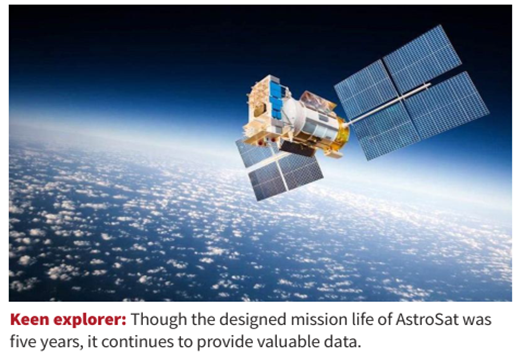
  • Though the designed mission life of AstroSat was five years, it continues to provide valuable data.
  • In the last decade, the multi-wavelength space observatory with five payloads aboard has made major interesting discoveries.
  • Commemorating the milestone in a post on X, the Indian Space Research Organisation said, “On this day 10 years ago, AstroSat, India’s first multi wavelength astronomy observatory was launched by ISRO. From black holes to neutron stars, from the nearest star Proxima Centauri to first time detection of FUV photons from galaxies 9.3 billion light years away, AstroSat enabled groundbreaking insights across the electromagnetic spectrum from UV/Visible to high energy X-rays.

Five payloads

  • AstroSat was designed to observe the universe in the visible, ultraviolet, low and high energy X-ray regions of the electromagnetic spectrum simultaneously with the help of its five payloads.
  • The five payloads are the Ultra Violet Imaging Telescope (UVIT), Large Area X-ray Proportional Counter (LAXPC), Cadmium–Zinc–Telluride Imager (CZTI), Soft X-ray Telescope (SXT), and the Scanning Sky Monitor (SSM).

Collaborative effort

  • Astrosat was realised by the ISRO with the participation of all major astronomy institutions, including the Inter University Centre for Astronomy and Astrophysics, Tata Institute of Fundamental Research, Indian Institute of Astrophysics, and the Raman Research Institute (RRI), some universities of India and two institutions from Canada and the U.K.

Current Affairs: 28th Sept 2025

Guarantees offered financial fillip to women

An independent study has shown several women reporting that the Karnataka government’s five guarantee schemes have helped reduce the financial stress on their families. 

It was found that 91% of respondents used the money received or saved from the guarantees for purchasing food, supplementing the family diet; 84% affirmed that the schemes eased the financial burden of their families

An independent study has shown a large number of women reporting that the Karnataka government’s five guarantee schemes have helped reduce the financial stress on their families.

The mixed-methodology survey, led by independent policy consultant Tara Krishnaswamy, in collaboration with Lokniti-CSDS, Bangalore University, Tumkur University and Indus Action, was conducted over a period of one year. It covered around 6,300 women across 15 districts in the State, 84% of whom affirmed that the schemes eased their families’ financial burden. Around 89% affirmed that it helped their financial upliftment.

“In addition to the ₹2,000 from Gruha Lakshmi, over 90% saved up to ₹1,000 per month due to Gruha Jyoti, and up to ₹1,000 per week from Shakti,” read the report, which also showed that 27% repaid loans using savings from the five guarantees.

Boost to nutrition

According to the study, 91% of respondents use the money received or saved from the guarantees for purchasing food, supplementing the family diet with essentials such as grains, pulses, vegetables, fruits, eggs and meat. Around 95% of the women stated that their families ingested better nutrition and improved diets due to the benefits, while 90% reported increased access to healthcare.

Over 80% of women reported improvements in personal nutrition, own healthcare and personal financial security, and more than 50% respondents engaged in furthering their education.

Scheme-wise highlights

According to the study, Gruha Lakshmi and Shakti schemes have specifically contributed to the empowerment and independence of female beneficiaries.

Highlighting the impact of Shakti scheme, the study found that 19% women found a better-paying job or took up a job due to zero ticket travel offered by the scheme.

“In Bengaluru, it’s even higher; around 34% have secured new or better jobs. They are from low income households and get jobs with marginally high wages, which, without free mobility, is not worth it. But the money they save from the free mobility, combined with the earnings from the job, really help with their financial distress and also boost the economy,” said Ms. Krishnaswamy.

With respect to Gruha Lakshmi, around 95% beneficiaries reported financial upliftment due to the scheme. More than 90% reported improvement in their relationships with their own families and increase in influence on family decisions. Around 92% reported experiencing financial upliftment from Gruha Jyoti scheme as well.

Safety net

“These schemes are a social safety net. The money is not sitting idle somewhere. Whether it is money received through Gruha Lakshmi or any savings that they have because of these schemes, it is all being spent mainly on food, nutrition and health,” remarked Ms. Krishnaswamy.

She noted that Karnataka lags behind peer States of Tamil Nadu and Kerala in terms of health and nutrition indicators. The stunting and wasting of children is over 30% to 35%. The anaemia of women is at 66%.

“You can’t secure your GDP with an underfed and anaemic population. But the money that’s saved through these schemes go back into the economy and boosts the economy. The fact that it is being spent on nutrition and health tells you that there are real unmet needs in core areas,” she added.

Penetration of scheme

When it comes to penetration of the schemes, Bengaluru Urban and Tumakuru districts seem to have done well, with the saturation figures around the median for all schemes.

Bengaluru Rural, on the other hand, shows poor penetration of Anna Bhagya, Shakti and Yuvanidhi schemes.

State records sharp fall in child marriages in 3 years

Karnataka has recorded one of the sharpest declines in child marriages in the country, with cases falling by 55% among girls and 88% among boys over the past three years, according to a new study.

The report, “Tipping Point to Zero: Evidence Towards a Child Marriage Free India”, was released by Just Rights for Children (JRC), a network of over 250 NGOs. It attributes the fall to awareness campaigns, stronger legal deterrence, and community-level interventions that created trust in reporting mechanisms.

Steepest in Assam

At the national level, child marriages dropped by 69% among girls and 72% among boys. Assam registered the steepest fall among girls at 84%, followed by Maharashtra and Bihar (70% each), and Rajasthan (66%). The study, covering 757 villages across five States, was prepared by the Centre for Legal Action and Behaviour Change for Children (C-LAB), an initiative of JRC partner India Child Protection.

Karnataka’s approach

Unlike most other States, Karnataka relied more on helplines (75%) and Child Welfare Committees (53%) than police stations (40%) for reporting cases. This shift, the report noted, shows a “critical link between trust in community-based systems and action against child marriage.”

The State government’s move to empower Panchayat Development Officers (PDOs) to register marriages was described as a “turning point.” Being accessible to villagers, PDOs built awareness and prevented nearly 2,000 child marriages in 2021 alone. Karnataka also became the first State to amend the Prohibition of Child Marriage Act, making even engagements involving minors a punishable offence, the study noted.

Awareness

Awareness campaigns were identified by 92% of respondents as the most effective tool to end child marriage, followed by prosecutions through FIRs and arrests (50%).

Nearly 99% of respondents said they had heard of the Union government’s Bal Vivah Mukt Bharat campaign, mostly through NGOs, schools, and gram panchayats. In Karnataka, all respondents reported taking a pledge against child marriage, while 78% identified NGOs as lead facilitators.

However, despite these gains, challenges remain. Fear of social stigma (79%) and lack of awareness (62%) continue to prevent people from reporting cases. While Census 2011 recorded 4.8 lakh children married before the legal age in Karnataka, only 783 cases were reported between 2019 and 2022.

Ravi Kant, National Convener of JRC, said, “By declaring even engagements in child marriage cases a punishable offence, the government has fortified the child protection ecosystem. Such strict measures are vital to dismantle this centuries-old crime.”

The report recommends stricter enforcement of the law, compulsory marriage registration, and wider dissemination of the Bal Vivah Mukt Bharat portal. It urges designating a National Day Against Child Marriage to mobilise support for a child marriage-free India by 2030.

Kalaloka to be launched at KIA in October to showcase State’s heritage products

Following a delay of over a month, Kalaloka, an aesthetically designed stall that will showcase and sell six products representing Karnataka’s heritage, along with 28 Geographical Indication (GI)-tagged products, is now slated for inauguration at the Kempegowda International Airport’s (KIA) Terminal-2 in October.

While the exact dates are not confirmed, the stall is expected to open after October 15, and Chief Minister Siddaramaiah is likely to preside over the launch, sources told The Hindu.

Delayed by a month

Sources added that the store’s setup was delayed by a month due to pending approval from airport security agencies, but now everything is in place, and it is set to be launched in October.

“Kalaloka is envisioned as a cultural experience that captures the essence of Karnataka. The stall will feature six flagship state-run products alongside 28 GI-tagged items. Among the products to be showcased are Mysore Silk, Mysore Sandal Soap, among other products under Cauvery Handicrafts Emporium. These products will provide travellers with an opportunity to take home a piece of the state’s heritage,” M.B. Patil, Minister for Large and Medium Scale Industries, said.

The products from Cauvery Handicrafts Emporium will include Channapatna toys and dolls, sandalwood and rosewood carvings, Bidriware, Navalgund Dhurries, among others.

In addition to the Terminal-2 outlet, plans are also under way to establish another Kalaloka stall at the international departure lounge of the airport. While tenders are being prepared and cost estimates have been drawn, a formal timeline for this expansion has not been confirmed.

For the Kalaloka stall, Karnataka Soaps and Detergents Limited (KSDL) has also introduced an ultra-luxury soap line under the “Kala Loka – Treasure of Karnataka” label. The Mysore Sandal “Millennium Super Premium Soap”, weighing 150 gm and priced at around ₹3,000, is made from high-quality natural sandalwood oil and features premium packaging.

Additionally, KSDL is conducting trials of a jasmine oil–based soap, made from the rare Mysore Mallige variety, to cater to demand in markets like Europe.

Plans in London

The Karnataka government, through Mysore Sales International Limited (MSIL) and KSDL, is also exploring opportunities in London under the Free Trade Agreement (FTA). Officials are reportedly planning to showcase Karnataka’s heritage goods, particularly KSDL’s premium soaps and MSIL’s textile exports, such as the Mysore Silk portfolio, in boutique retail settings. The officials told The Hindu that discussions are going on, and currently they are looking at various ideas and ways to execute them.

First bullet train section to be completed by 2027

India’s first bullet train project is progressing steadily, with the initial 50-km stretch between Surat and Bilimora in Gujarat set to open in 2027, Railway Minister Ashwini Vaishnaw announced on Saturday. The entire Mumbai–Ahmedabad corridor is expected to be operational by 2029.

Once launched, the high-speed train will cover the 508-km distance between Mumbai and Ahmedabad in just two hours and seven minutes.

“The project is advancing very well. The Surat–Bilimora section will be ready by 2027, the Thane–Ahmedabad stretch by 2028, and the full corridor by 2029,” Mr. Vaishnaw said, after inspecting works at the under-construction Surat station, including track installation and the project’s first turnout (a point where tracks join or separate).

The main line has been designed for speeds up to 320 kmph, with 80 kmph for the loop line. To ensure safety and efficiency, advanced technologies have been deployed. “This is a highly complex train operation, which is why the most modern systems are being used. Special vibration mechanisms and utility cables have been set up to absorb the impact when trains run at 320 kmph. Even the tracks have inbuilt systems to counter vibrations,” the Minister explained.

He added that the tracks featured safety measures to keep trains stable during heavy winds or earthquakes.

Work at the Surat station has entered the final stages, with major construction works complete. Mr. Vaishnaw highlighted the use of new technologies, including roller bearings for track movement and composite sleepers.

“Today, we installed the first turnout at Surat station using innovations being applied in India for the first time,” he said. Calling the bullet train a game-changer, he said the project would link economies of all major cities along the route, similar to the growth in Japan after the Shinkansen’s launch.

He also noted that the BJP has promised to expand the network, with three more corridors planned in the north, one in the east, and one in the south, in addition to the western Mumbai–Ahmedabad line.

UNESCO includes India’s Cold Desert to global biosphere list

India’s Cold Desert Biosphere Reserve has been named among 26 new biosphere reserves across several countries, UNESCO announced on Saturday. With this addition, India now has 13 biospheres listed in UNESCO’s World Network of Biosphere Reserves (WNBR). Spanning about 7,770 sq. km across the dramatic landscapes of Himachal Pradesh’s Lahaul-Spiti district, the Cold Desert Biosphere Reserve was included in the WNBR at the 37th session of UNESCO’s International Coordinating Council of the Man and the Biosphere (MAB) held in Paris, Union Minister for Environment and Forests Bhupender Yadav said in a post on X.

Not just one-horned rhino, Kaziranga Park also harbours a rich variety of insects, spiders

The Kaziranga National Park and Tiger Reserve, the world’s safest address for the one-horned rhino, has revealed a rich community of insects and spiders.

A new rapid survey report documented 283 species of insects and spiders in a woodland habitat of the tiger reserve. It was conducted by entomologists with the Corbett Foundation, along with Kaziranga’s frontline forest personnel.

The report and related information booklets were released on September 26 by Kamakhya Prasad Tasa, the MP representing the Kaziranga Lok Sabha constituency, Khumtai MLA Mrinal Saikia, and Assam’s Principal Chief Conservator of Forest Vinay Gupta.

The study recorded 254 species of insects and 29 species of spiders, which forest officials said was a vital step toward understanding Kaziranga’s “overlooked” biodiversity. They said the findings highlight the urgent need to take insect conservation seriously, especially as climate change threatens to accelerate species loss.

Butterflies and moths accounted for 85 species or 30% of Kaziranga’s insects, while 40 species (14%) of ants, bees, and wasps, and 35 species (12%) of beetles were recorded.

“Conducted through visual estimation with photographs using scientific sampling methods, this landmark survey reveals the park’s often-overlooked micro-faunal richness,” Assam’s Environment, Forest, and Climate Change Minister, Chandra Mohan Patowary, said.

He said the State government was committed to conserving all forms of biodiversity, including the smallest but crucial life forms.

“Worldwide, nearly 40% of insect species are in decline due to habitat loss, deforestation, and climate change. While Kaziranga is celebrated for its megafauna, this study shows that its resilience depends just as much on the small pollinators, soil aerators, and natural pest-controllers that keep the ecosystem functioning,” Sonali Ghosh, the Director of the tiger reserve, said.

Officials underlined the vital ecological role the insects and spiders play, facilitating seed dispersal, helping maintain soil health and regenerate plants, forming the very foundation of the food web that sustains Kaziranga’s iconic wildlife.

“The findings highlight the park’s status as a true hotspot of invertebrate diversity,” Ms Ghosh said.

Kaziranga is better known for its Big Five species — the Indian rhinoceros, Bengal tiger, Asian elephant, wild water buffalo, and eastern swamp deer.

The 1,307.49-sq. km tiger reserve has the most one-horned rhinos on earth, the last estimation recording 2,613 individuals. It also has the third-highest density of tigers (18.65 individuals per 100 sq. km), according to a 2024 report.

PNGRB moots natural gas pipeline from Ennore to Kondapalli

The Petroleum and Natural Gas Regulatory Board has set in motion the process for developing a natural gas pipeline from Ennore LNG Terminal in Tamil Nadu to Kondapalli, Andhra Pradesh.

The facility is being mooted with an eye on meeting the requirement of natural gas in the two States, the regulator said, initiating a suomotu proposal earlier this month. It estimated the length of the proposed pipeline from Ennore – Nellore – Ongole – Guntur – Amravati – Kondapalli to be around 450 kms.

The minimum system capacity, including common carrier capacity, will be 5 MMSCMD, PNGRB said, announcing the commencement of the public consultation process.

Oil India discovers natural gas in Andaman

Press Trust of India 

New Delhi

Oil India Ltd. has discovered natural gas reserves off the Andaman Islands, the state-owned firm said without putting an estimate of the size of the find.

In a statement, OIL said “occurrence of natural gas” was reported in the second exploratory well Vijayapuram-2 drilled in the Offshore Andaman Block AN-OSHP-2018/1, which the company had won under the Open Acreage Licensing Policy. “Further gas isotope studies are being undertaken so as to understand the genesis of the gas,” Oil India said.

BRICS nations criticise protectionism, condemn Israeli strikes against Qatar

The BRICS group of countries, a club of 11 emerging markets, called out protectionism and tariff volatility at a Foreign Ministers meeting on the fringes of the 80th session of the UN General Assembly. The statement comes as countries are navigating the upheaval to global trade following U.S. President Donald Trump’s tariff polices this year — which have seen both higher tariffs and repeated changes to rates.

The BRICS meeting, which was hosted by External Affairs Minister S. Jaishankar, condemned Israel’s attack earlier this month on Qatar as well as expressed “grave concerns” for Palestine after “persistent” Israeli attacks. It also condemned the April terror attacks in Pahalgam.

“As rising protectionism, tariff volatility and non-tariff barriers impact trade flows, BRICS must defend the multilateral trading system,” Mr. Jaishankar said on social media site X on Friday.

The BRICS group has been on the radar of Mr. Trump, who views it as anti-American and a threat to the U.S. dollar. Mr Trump has tariffed some of its other members at high rates such as China as well as Brazil, which currently faces 50% tariffs.

The BRICS statement notes “serious concerns about the rise of unilateral tariff and non-tariff measures which distort trade and are inconsistent with WTO rules”. Countries warned that these could fragment global trade and marginalise the Global South. The statement does not name the U.S. or explicitly point to Mr. Trump’s policies.

On Friday, BRICS countries also “ rejected” climate-related unilateral tariffs such as Carbon Border Adjustment Mechanisms (CBAMs). This has been a concern in trade relationships for instance between India and the EU, which is among the jurisdictions rolling out such a tax. BRICS ministers condemned Israel’s September 9 airstrike on Qatar, which, they said, was a “flagrant violation” of Qatar’s sovereignty and “a grave breach of international law, including the UN Charter”.

On Iran, the joint statement condemned attacks “since June 13, 2025”, including on Iran’s “civilian infrastructure and peaceful nuclear facilities”that are under the safeguard of the International Atomic Energy Agency. Nuclear safety must always be upheld, the countries said. It does not mention Israel or the U.S. explicitly as having conducted the strikes on Iran.

On the Israel-Gaza conflict, the ministers said Israel’s “ persistent” attack on Gaza had caused “ unprecedented suffering to the civilian population of the territory, ravaged by deaths, destruction, and famine”.

The countries called for an immediate ceasefire in the region and they called on Israel to stop its attacks and to withdraw troops. They also condemned the displacement of the Palestinian people and reiterated their support for a two-state solution , recognising a Palestine state, which contains the Gaza Strip and West Bank, with its capital in East Jerusalem.

The statement called for the release of the remaining October 7 hostages . There was, however, no mention of Hamas , which is holding the hostages.

BRICS countries called for more equitable representation at the UN and reform of multilateral organisations, including the UN Security Council (UNSC) and the Bretton Woods institutions. Significantly, BRICS-member China, has not supported India’s bid for a permanent seat on the Security Council.

Current Affairs: 27th Sept 2025

  • Study says astronauts with diabetes can undertake space missions

Context: In a study conducted during the recent Axiom-4 (Ax-4) mission, of which Indian astronaut Group Captain Shubhanshu Shukla was a part, it has been revealed that astronauts with diabetes can undertake space missions.

  • Axiom Space, along with Burjeel Holdings, released the preliminary results of the ‘Suite Ride’ research conducted during the Ax-4 mission.
  • “The research concluded that everyday diabetes tools used by millions on Earth can be used comprehensively to provide end-to-end diabetes monitoring from space to the ground and back to space — a breakthrough in opening the door to future astronauts with diabetes and providing new solutions in remote healthcare,” Axiom Space said.
  • Burjeel Holdings is a healthcare services provider in the UAE, and building on these findings, it also announced its ambition of working towards sending the first astronaut with diabetes to space. Axiom Space and Burjeel Holdings had joined hands to conduct the research during the Ax-4 mission at International Space Station.
  • “Sending up a suite of remote care capabilities, the Suite Ride initiative explored how to manage diabetes in space, marking a meaningful step towards making spaceflight accessible for those with historically disqualifying conditions,” Axiom Space said.
  • It further said the research results found that continuous glucose monitors (CGMs) and insulin pens can operate reliably in the extreme conditions of space.

Inspiring people

  • “Early results suggest that CGM devices can perform with accuracy comparable to Earth-based readings, enabling real-time glucose monitoring of astronauts in microgravity and can communicate readings to the ground.
  • Insulin pens flown on the space station are now undergoing post-flight testing to evaluate the integrity of the formulation,” it said.

Inspiring people

  • “This is about inspiring people everywhere. A diagnosis shouldn’t end your dream of space exploration. Together, we’re advancing the potential to fly the first astronaut with diabetes and to unlock innovation in healthcare,” said Gavin D’Elia, global head of pharma at Axiom Space.
  • The Ax-4 mission was launched on June 25, and during the 20-day mission, the crew comprising Group Captain Shukla and three others completed 320 orbits around the Earth,, covering 8.4 million miles of spaceflight, Axiom Space said. They also performed over 60 research activities and 23 outreach events.
  • NISAR sends first radar images of Earth’s surface

Context: The NASA-ISRO Synthetic Aperture Radar (NISAR) Earth-observing radar satellite has sent the first images of Earth’s surface as the joint mission between NASA and ISRO approaches full science operations later this year.

  • NASA said that the images from the spacecraft, which was launched by ISRO on July 30, display the level of detail with which NISAR scans Earth to provide unique, actionable information to decision-makers in a diverse range of areas, including disaster response, infrastructure monitoring, and agricultural management.
  • “By understanding how our home planet works, we can produce models and analysis of how other planets in our solar system and beyond work as we prepare to send humanity on an epic journey back to the Moon and onward to Mars,” said NASA Associate Administrator Amit Kshatriya.
  • He added that the successful capture of these first images from NISAR is a remarkable example of how partnership and collaboration between two nations, on opposite sides of the world, can achieve great things together for the benefit of all.
  • NASA said that on August 21, the satellite’s L-band synthetic aperture radar (SAR) system, which was provided by NASA’s Jet Propulsion Laboratory in Southern California, captured Mount Desert Island on the Maine coast.
  • “Dark areas represent water, while green areas are forest, and magenta areas are hard or regular surfaces, such as bare ground and buildings. The L-band radar system can resolve objects as small as 15 feet (five metres), enabling the image to display narrow waterways cutting across the island, as well as the islets dotting the waters around it,” NASA said.
  • It added that on August 23, the L-band SAR captured data of a portion of northeastern North Dakota straddling Grand Forks and Walsh counties.
  • The U.S. space agency further said that the images demonstrate how the L-band SAR can discern what type of land cover — low-lying vegetation, trees, and human structures — is present in each area.
  • “This capability is vital both for monitoring the gain and loss of forest and wetland ecosystems, as well as for tracking the progress of crops through growing seasons around the world,” it said.
  • ISRO invites proposals from nation’s scientists

Context: The Indian Space Research Organisation (ISRO) issued an Announcement of Opportunity (AO) inviting scientists within India to analyse archival data from past Venus missions.

  • India’s maiden mission to Venus, Venus Orbiter Mission (VOM) was approved by the Union Cabinet in 2024.

Sun-Venus interaction

  • The mission will involve a spacecraft orbiting Venus to study its surface, atmosphere, and the Sun-Venus interaction.
  • “In order to promote, strengthen and to increase the scientific user community for the VOM, ISRO invites researchers through the AO call for promoting the analysis and modelling of archival data available for the planet Venus,” ISRO said.
  • The space agency said that proposals could be submitted by individuals or a group of scientists and academicians belonging to national institutions, universities, colleges, planetaria and government organisations of India. “Only those having a minimum remaining service of four years before superannuation are eligible to lead the project as Principal Investigators (PI),” the space agency said.

Research areas

  • The research proposals are invited in the following research areas: venusian morphology, topography and sub-surface studies, geological mapping, mineralogy and surface composition of Venus, venusian atmosphere structure, dynamics and composition, venusian Ionosphere and solar wind interaction and modelling of venusian atmospheres and Ionospheres.
  • The space agency said that it expects the project to be completed within three years.
  • On October 1, 2024, ISRO revealed the targeted launch window for the mission.
  • According to the targeted launch window for the VOM, the Earth departure date is scheduled on March 29, 2028, and the arrival date on Venus is July 19, 2028.
  • The space agency had said that the VOM will be launched by the Launch Vehicle Mark-3 (LVM-3).
  • State records highest maternal mortality in 2023; experts call for urgent action

Context: With Karnataka recording the highest maternal mortality ratio (MMR) among southern States during 2021–2023, public health experts and policymakers have called for urgent measures to address the gap.

  • According to the Sample Registration System (SRS) 2023, released this month, Karnataka’s MMR has shot up to 68 deaths per one lakh live births in 2021-23 from 58 in 2020-22, while Andhra Pradesh, Kerala and Tamil Nadu report figures largely in 30s. Telangana’s MMR is 59.
  • The issue was the focus of a day-long conference on “Reducing Maternal Mortality in Karnataka,” organised by the Indian Institute of Public Administration (IIPA), Karnataka Regional Branch, in partnership with R.V. University’s Centre for Global Health and Development, in Bengaluru.
  • Health Minister Dinesh Gundu Rao, in his keynote address, said the State Cabinet had approved a mission to guarantee round-the-clock maternal health services at taluk hospitals and major community health centres. “In this year’s Budget, our Chief Minister has announced a ₹320-crore mission to bring preventable maternal deaths to zero.
  • Our immediate target is to bring MMR down from 68 to 40 within two-and-a-half years, and eventually to 20 to meet global benchmarks,” he said.
  • Medical Education and Skill Development Minister Sharan Prakash R. Patil stressed the need to integrate maternal health priorities into medical training and workforce planning.
  • Calling preventable maternal deaths a “silent crisis,” Ranjini C. Raghavendra, Director of the Centre for Global Health and Development, R.V. University, observed that Karnataka’s achievements were inadequate compared to neighbouring States. “For a State of our intellect and resources, failing to keep pace with our neighbours is a harsh truth. The ₹320-crore mission must be more than an allocation — it must be a guarantee,” she said.
  • B. L. Sujatha Rathod, Director of Medical Education, underlined the need for continuous upgrading of skills to handle high-risk pregnancies.
  • The conference concluded with a call for a State-level maternal mortality acceleration plan, combining immediate lifesaving interventions with long-term investments in infrastructure, workforce and community engagement.
  • In 2019, three Ministries gave nod to Ladakh’s tribal status

Context: Ministries of Home, Tribal Affairs, and Law, and NCST concurred on Sixth Schedule; but in 2022, Centre said the UT administration was ensuring the ‘development’ that tribal status would bring.

  • Weeks after the Union Territory of Ladakh was created in August 2019, three Ministries of the Union government gave a green light to the National Commission for Scheduled Tribes (NCST) to recommend Ladakh’s inclusion as a tribal area under the Sixth Schedule of the Constitution, according to minutes of an NCST meeting held on September 11, 2019.
  • Six years ago, the NCST had taken suo motu cognisance of the demand for the inclusion of Ladakh in the Sixth Schedule. In a meeting on September 11, 2019, it had recommended “after careful consideration” that the “UT of Ladakh be brought under the Sixth Schedule of the Constitution”.

‘No objection’

  • As per the minutes of this 119th meeting of the Commission, the panel had consulted the Ministries of Home, Tribal Affairs, and Law and Justice in a meeting on September 4, 2019, to discuss the issue. In this meeting, the Commission said that after deliberations, the “Ministries were of the opinion that they have no objection in case the Commission recommends for granting Tribal area status to the UT of Ladakh in the Sixth Schedule of the Constitution.”
  • Accordingly, the Commission had recommended the UT’s inclusion in the Sixth Schedule, also noting that before the creation of Ladakh as a UT, the locals had certain agrarian rights and rights over land that restricted people from outside the region from purchasing or acquiring land in Ladakh.
  • In its recommendation, the committee said it felt that Ladakh’s inclusion in the Sixth Schedule would protect these agrarian rights, including rights on land.
  • While the Ministry of Tribal Affairs issued a statement on this recommendation of the Commission at the time, this statement had left out the opinion of the Ministries.
  • The Home Ministry told Parliament in December 2019 that the Ladakh Autonomous Hill Development Council Act, 1997, already provided for the creation of autonomous hill development councils in the Ladakh region, the powers for which are “more or less in line with the Sixth Schedule of the Constitution of India”.

BJP’s poll promise

  • However, the following year, when the Hill Council of Leh went to polls in 2020, the Bharatiya Janata Party had promised constitutional safeguards for the region under the Sixth Schedule in its manifesto.
  • Yet, in December 2022, responding to a Parliamentary panel’s suggestion to explore the possibility of Sixth Schedule status to Ladakh, the Home Ministry had said: “The main objective for inclusion of tribal population under Fifth/Sixth Schedule is to ensure their overall socio-economic development, which, the UT Administration has already been taking care of since its creation. Sufficient funds are being provided to Ladakh to meet its overall developmental requirements.”
  • Modi unveils scheme for women in Bihar, criticises RJD’s reign

Context: 75 lakh women get ₹10,000 each to start business; PM says women bore the brunt of lawlessness and corruption under previous RJD regim.

  • Prime Minister Narendra Modi launched the Mukhyamantri Mahila Rojgar Yojana, a State-funded assistance scheme for women in Bihar.
  • He rolled out the self-employment scheme through videoconferencing from Delhi, and directly transferred 10,000 each into the bank accounts of 75 lakh women in the poll-bound State.
  • Chief Minister and JD(U) leader Nitish Kumar as well as Deputy Chief Minister Samrat Choudhary of the BJP joined the event from Patna.
  • The scheme is meant to help women start their own business. Based on their performance, the government will provide an additional 2 lakh after six months. The assistance can be utilised in areas of their choice, including agriculture, animal husbandry, handicrafts, tailoring, weaving, and other small-scale enterprises.
  • AFSPA extended in parts of Manipur, Arunachal, and Nagaland for six months

Context: The Union Home Ministry extended the Armed Forces (Special Powers) Act in parts of Manipur, Arunachal Pradesh, and Nagaland for six months.

  • In Manipur, the AFSPA has been extended in the whole State, except in jurisdictions of 13 police stations in five valley districts.
  • The excluded police station limits are Imphal, Lamphel, City, Singjamei, Patsoi, Wangoi, Porompat, Heingang, Irilbung, Thoubal, Bishnupur, Nambol, and Kakching.
  • In Nagaland, the AFSPA was extended for six months in nine districts — Dimapur, Niuland, Chumoukedima, Mon, Kiphire, Noklak, Phek, Peren and Meluri — and 21 police station limits of five districts (Kohima, Mokokchung, Longleng, Wokha and Zunheboto), another notification said.
  • Tirap, Changlang and Longding districts in Arunachal Pradesh, and the areas falling within the jurisdiction of Namsai, Mahadevpur and Chowkham police stations in Namsai district, bordering Assam, were declared “disturbed areas” for six months.
  • The 1958 law gives power to the Army and the Central Armed Police Forces deployed in “disturbed areas” to kill anyone acting in contravention of law, arrest and search any premises without a warrant, and protection from prosecution and legal suits without the Union government’s sanction.
  • MiG-21 jets fly into history after 6 decades of service

Context: Defence Minister calls aircraft symbol of India-Russia ties, says its legacy must serve as lesson for upcoming indigenous platforms; highlights its role in 1971 war, Kargil conflict, Operation Sindoor

  • Defence Minister Rajnath Singh on Friday described the MiG-21 as not just an aircraft or a machine but a testament to the deep ties between India and Russia, as the Indian Air Force formally decommissioned the iconic fighter jet at the Chandigarh Air Force Station.
  • “We bid farewell to the Mikoyan-Gurevich MiG-21 from its operational journey. I believe we are closing a chapter that will be written in golden letters not only in the history of the Indian Air Force, but in the history of our entire military aviation,” Mr. Singh said.
  • The last of the MiG-21 jets, belonging to No. 23 Squadron, nicknamed Panthers, were given a grand send-off.
  • Air Chief Marshal A.P. Singh led the final sortie of the MiG-21 Bison with the call sign Badal 3, demonstrating what the Defence Minister called “the credibility of this machine and the respect it holds in the hearts of air warriors”.
  • A ceremonial switch-off of six MiG-21 aircraft in front of the dignitaries marked the culmination of the aircraft’s operational service. The aircraft document Form-700 was handed over to the Chief of the Air Staff by officers and airmen of No. 23 and Commanding Officer of 28 Squadron.
  • The event was attended by former IAF chiefs A.Y. Tipnis, S.P. Tyagi, and B.S. Dhanoa, Group Captain Shubhanshu Shukla and scores of veterans, many of whom had flown the aircraft. Pilots, engineers, technicians, and ground staff who had worked with the MiG-21 also joined the farewell.
  • The Surya Kiran aerobatic team, along with Tejas and Jaguar fighters, performed breathtaking manoeuvres during the ceremony.
  • Mr. Singh highlighted role of MiG-21 in the 1971 war, the Kargil conflict, the Balakot air strike, and Operation Sindoor.
  • On the future of India’s air power, the Defence Minister said the MiG-21’s legacy must serve as “a lesson and a DNA” for upcoming indigenous platforms. “We must consider the success of the LCA-Tejas as the beginning of our next mission, and instil confidence in our upcoming fighter aircraft, the Advanced Medium Combat Aircraft (AMCA),” he said.
  • The decommissioning of the last squadrons has brought down the Air Force’s jet squadron strength to a mere 29 for all practical purposes, the lowest since the 1960s when MiG-21s were inducted.
  • Kodava community confused over how to record religious identity

Context: The Kodava community appears to be in a dilemma over how to record their identity in the ongoing Social and Educational Survey being conducted by the government of Karnataka.

  • At the heart of the debate is whether Kodavas should be registered as followers of the Hindu religion or as adherents of a separate ‘Kodava’ faith.
  • A section of community leaders have been urging Kodavas to declare ‘Kodava’ in the caste, language, and religion columns, while another section has been appealing to people to continue identifying themselves as ‘Hindu’ in religion column.
  • Paradanda Subramani Kaverappa, president of the Akhila Kodava Samaja, maintained that the community should be recorded as ‘Kodava’ across all three categories.
  • “Before the 1941 census, Kodavas were classified as a rare and distinct tribal group. Kodavas do not follow caste divisions, sects, or a formalised religion,” he argued.
  • The small population of Kodavas, which has been shrinking in recent decades, risks losing its unique cultural essence if subsumed within larger communities, he added.
  • Mr. Kaverappa acknowledged that there are differing viewpoints within the community. A recent meeting convened by the Samaja failed to arrive at a consensus.
  • He said that the choice ultimately rests with individuals.
  • “There is no compulsion. Each family can decide for themselves. This survey is only meant to reflect the current social and economic situation of communities to the government,” Mr. Kaverappa said.
  • He clarified that documenting Kodavas under a separate religion would not alter existing practices. “Even if people mention Kodava as their religion, traditional rituals, temple worship, and the influence of Hindu practices will continue as they always have. Our customs have drawn inspiration from Hinduism for generations,” he explained.
  • Mr Kaverappa highlighted concerns among Kodava youth regarding shrinking opportunities. He said recognising Kodava as a distinct category could eventually open doors to benefits, such as reservations.
  • “This survey could also help establish a record for the future, especially when the Central Government carries out its census. We are encouraging people to document their identity as Kodava, but it is entirely voluntary,” he added.

Debate over identity

  • On the other side of the debate, several leaders from the community have been appealing to Kodavas to continue identifying with Hinduism.
  • “Our culture reflects Hindu traditions, be it the worship of Naga and Aiyappa deities in our homes and villages, or the celebration of festivals like Tula Sankramana and Puthari, which follow Hindu customs,” said A. Manu Muthappa, former president of the Napoklu Kodava Samaja.
  • Some Kodava families have been holding discussions in their ainmane (ancestral homes) on how the religion column should be filled in during the survey.
  • Mohan Devaiah, a resident of Ponnampet, said, “I have come across several videos from different clans where meetings were convened, and decisions were taken to either mark Hindu or Kodava under the religion category.”

Recognition of Kodavas

  • The Codava National Council (CNC) has launched a campaign urging Kodavas to declare their identity solely as ‘Kodava’ in all three columns.
  • CNC president Nandineravanda U. Nachappa said, “This is about cultural survival and legal recognition. Only when the government documents us as Kodava across all categories can we preserve our uniqueness.”
  • Karnataka Backward Classes Commission Chairperson Madhusudan Naik has said that there is not much significance for the religion column in the enumeration in the current survey since religion does not come under the purview of the commission. “We will not be evaluating on the basis of religion, and information is being sought under a broader category,” he had said.
  • ‘Give location of usage of Aadhaar to police to trace missing person’

Context: Though the High Court of Karnataka found no fault with the action of the Unique Identification Authority of India (UIDAI) in rejecting the plea of a man for providing Aadhaar data to the police to trace his elder son, missing since 2019, the court directed the authority to issue details of location of use of his Aadhaar from the time of filing of the missing complaint till date to the Hubballi-Dharwad police to probe the case.

  • Justice Suraj Govindaraj issued the direction for sharing only location of use of Aadhaar by the petitioner’s missing son to the police after noticing that certain data of Aadhaar could be disclosed only on the direction given by a High Court as per Section 33(1) of the Aadhaar (Targeted Delivery of Financial and Other Subsidies, Benefits and Services) Act, 2016.
  • The court passed the order on the petition filed by Krishnamurthy, a resident of Hubballi whose son, Vijay K.S, went missing in December 2019 during apprenticeship in a technological servicing company.
  • Making it clear that apart from the location of usage of Aadhaar of the petitioner’s son no other details shall be furnished, the court said the police should not share such details/information with anyone else, apart from that required for the purposes of investigation.

Current Affairs: 26th Sept 2025

  • Centre cancels FCRA licence of activist’s outfit

Context: The Union Home Ministry cancelled the Foreign Contribution (Regulation) Act (FCRA) registration of an organisation founded by climate activist Sonam Wangchuk, citing alleged violations.

  • The CBI is also conducting an inquiry involving another non-profit organisation established by Mr. Wangchuk regarding similar allegations.
  • Day after Leh violence, Home Ministry cancels SECMOL’s FCRA nod; activist calls charges baseless; allegations include accepting foreign funds to study ‘national sovereignty’ and poor accounting.
  • The development comes a day after violence erupted in Leh city of Ladakh, during an ongoing protest demanding Statehood. ”.
  • In 2021-22, SECMOL received ₹4.93 lakh from a Swedish organisation, Framtidsjorden, for “awareness on youth migration, food security, and sovereignty”. The government held that accepting foreign funds for studies involving “national sovereignty” violated FCRA rules.
  • Amendments to be brought to Karnataka Rent Act to rationalise offences, penalties

Context: Aligning with a Central law, the State Cabinet has decided to amend the Karnataka Rent Act, 1999, mainly to decriminalise or rationalise certain offences and penalties.

  • Law and Parliamentary Affairs Minister H.K. Patil said the proposed amendments to the Act are intended to ease giving buildings on rent and it would be a “win-win situation” for both the owner and the tenant, particularly in industrial sheds.
  • Amendments will be made to Sections 24, 25, 53, 54, and 55 of the Act, he said, to ensure compliance on rent payments as well as penalties.
  • The decision comes as Karnataka’s rental market, particularly in Bengaluru, expands rapidly, accompanied by an increase in disputes between landlords and tenants.
  • Among other decisions, the Cabinet has approved ₹16.3 crore for the construction of Karnataka Bhavan-II building at Chanakyapuri in New Delhi.
  • It has approved the Male Mahadeshwara Hill Authority Bill, 2025, for inclusion of a list of persons in the authority to govern M.M. Hills and the temple. A sum of ₹128.74 crore was approved for drainage work in Channapatna in Bengaluru South (formerly Ramanagara) district and ₹95.6 crore for upgradation of the government hospital at Virajpet in Kodagu from 60 beds to 250.
  • To ensure necessary skills during promotions of directors, deputy directors, and secretaries in government departments, it has approved the Karnataka Civil Service Rules, 2025. The new rules make the consideration of necessary skills mandatory during promotions, Mr. Patil said.
  • Cabinet approves skill development policy; 4,432.5 crore needed for seven-year period

Context: The State Cabinet approved the Karnataka State Skill Development Policy 2025-32 with requirement of a whopping ₹4,432.5 crore, during the seven-year period.

  • Its vision is to position Karnataka as a premier hub for skilled workforce and a $1 trillion economy by 2032.
  • The policy envisions “transforming the State into a hub for skill development, fostering an inclusive and future-ready workforce that meets the demands of a rapidly evolving economy.”
  • Its mission is focused on empowering youth and marginalised communities through access to industry-aligned skills, promoting continuous learning, and enhancing collaboration between industry and educational institutions.
  • The comprehensive approach is aligned with the Skill India Mission aimed at bridging regional disparities and supporting sustainable economic growth.
  • The policy objectives are to focus on lifelong learning, reskilling, and upskilling to keep pace with changing technologies and industry needs, and integration of vocational education within schools, higher educational institutions, and universities through credit-based programmes.
  • It laid a strong emphasis on industry collaboration, including apprenticeships, industry-led training, and ITI adoption.
  • It aims to leverage digital technologies and Al-driven tools for training, assessment, and career guidance through a unified digital portal.

Funding need

  • The funding needed for implementing the policy is ₹4,432.5 crore, including ₹1,386 crore from the Asian Development Bank.
  • It has been decided that ₹410 crore would be raised from projects in the PPP model and ₹904 crore from projects already announced in previous State Budgets (ongoing projects with Budget from State or organisations like KKRDB, KMERC, NABARD); ₹807 crore from continuing schemes under the department, funded irrespective of policy provisions; ₹38.5 crore from the Department of Electronics, IT, BT and S&T, and ₹887 crore from the Department of Skill Development.

What CAG report said

  • The Comptroller and Auditor General of India report tabled in the Monsoon Session of the legislature said that only 18% of the trained candidates under the Karnataka Skill Development Corporation secured placements post-training, falling short of the mandated 70%.
  • The Skill Mission was unrealistic in its target during 2017-23, and only 1,15,822 individuals were trained against the target of five lakh youth per year during 2017-2023, the report added.
  • Defence Ministry, HAL ink 62,370-cr. deal for 97 light combat aircraft for IAF

Context: The Defence Ministry signed a contract to buy 97 light combat aircraft, of the Tejas Mark-1A variant, for the Indian Air Force from Hindustan Aeronautics Ltd., in a ₹62,370-crore deal.

  • The order is for 68 fighter jets and 29 twin-seaters, along with associated equipment. Deliveries will begin in 2027-28 and be completed over six years.
  • “The supply of these aircraft by HAL would enhance operational capability of the Indian Air Force to continue their unhindered operations and strengthen defence preparedness of the country,” Defence Minister Rajnath Singh said in a post on X.
  • “This contract reflects the trust and confidence of the Government and the Armed Forces in the indigenously developed aircraft ‘Tejas’, which will be the mainstay of the IAF in the years to come,” he added.
  • With more than 64% indigenous content and 67 new items in comparison to the 2021 contract, this Tejas Mk-1A will feature advanced systems such as the UTTAM AESA Radar, Swayam Raksha Kavach, and indigenous control surface actuators, reinforcing the Aatmanirbhar Bharat initiative to move towards a self-reliant India.
  • The programme is backed by a supply chain of around 105 Indian companies and is expected to generate nearly 11,750 direct and indirect jobs annually during the production period, according to the Ministry
  • under the ‘Buy (India-IDDM)’ category of the Defence Acquisition Procedure 2020, the Tejas Mk-1A is the most advanced variant of the indigenously designed fighter jet and will serve as a powerful platform to meet the IAF’s operational needs, the Ministry added.
  • Rajnath’s Morocco visit marks new chapter in India-Africa defence ties

Context: Defence Minister Rajnath Singh’s maiden visit to Morocco to inaugurate India’s first overseas defence manufacturing facility has marked the beginning of a new chapter in the long-standing friendship between India and Morocco.

  • Mr. Singh and Morocco’s Defence Minister Abdelatif Loudyi jointly inaugurated Tata Advanced Systems Limited’s (TASL) state-of-the-art defence manufacturing facility in Berrechid. The plant will produce India’s indigenously developed Wheeled Armoured Platform (WhAP), making it a significant milestone in India’s growing global defence footprint.
  • Morocco as a gateway to Africa and a potential market for Indian defence equipment. “There is a strong demand in Africa for small arms, bulletproof jackets, armoured vehicles, tanks, and helicopters. This is the right time for India to strengthen its presence in the African defence market by also establishing Maintenance, Repair, and Overhaul (MRO) facilities. Russia has traditionally been the major supplier to the continent, but the Ukraine conflict and subsequent sanctions disrupted its supply chains. Since India has long experience with Russian defence equipment as a major importer, it has a better understanding of maintaining these systems,” the official noted.
  • On India’s defence outreach to African nations, Professor Harsh V. Pant, Vice-President – Studies and Foreign Policy at Observer Research Foundation, said, “India is expanding its defence outreach, particularly focusing on enhancing defence exports. Africa presents good opportunities due to historical links and strategic comfort levels with India.
  • India straddles a unique position in global politics by not being part of either the U.S.-China or Russia-West binaries… Sanctions against Russia may create opportunities for India in the African market due to its neutral stance.”
  • DRDO conducts rail-based launch of Agni-Prime missile

Context: The Defence Research and Development Organisation (DRDO) and the Strategic Forces Command (SFC) successfully test-fired the Intermediate Range Agni-Prime missile from a rail-based mobile launcher, under full operational conditions.

  • The Defence Ministry said the next-generation missile, designed for a range of up to 2,000 km, incorporates advanced features and marks the first launch from a specially developed rail-based system capable of rapid, low-visibility deployment with cross-country mobility.
  • The missile’s trajectory was tracked by multiple ground stations, with the test meeting all mission objectives.
  • India, Russia discuss BRICS grain exchange plan to boost agriculture trade ties

Context: Prime Minister Narendra Modi met Russian Deputy Prime Minister Dmitry Patrushev and discussed plans of creating a common agricultural food exchange that will help in boosting agriculture trade among the BRICS member-countries.

  • Mr. Modi conveyed his greetings to President Vladimir Putin saying he is looking forward to welcoming him for the 23rd India-Russia annual summit to be hosted here later this year.
  • “Happy to meet Russia’s Deputy Prime Minister Dmitry Patrushev at the World Food India 2025. We discussed ways to strengthen our win-win cooperation in agriculture, fertilizers and food processing,” said Mr. Modi after the meeting.
  • The Russian Embassy said the two sides discussed the ongoing work on a Free Trade Agreement between India and the Eurasian Economic Union. “Additionally, the topic of creating a BRICS Grain Exchange was raised — a move that will help boost mutual agricultural trade,” said the Embassy.
  • “Russia highly values its special and privileged partnership with India. India is one of Russia’s key allies in the international arena. Every year, Russian-Indian economic cooperation reaches impressive levels. In 2024, the trade turnover between our two countries reached a historic high,” said Mr. Patrushev.
  • Outward remittances under LRS dips 11% in July to $2,452.93 mn

Context: Outward remittances by resident individuals under the Reserve Bank of India’s (RBI) Liberalised Remittance Scheme (LRS) were almost 11% lower year on year in July at $2,452.93 million on the back of a decline towards travel as well as studies abroad.

  • In the year earlier period, the outward remittances were $2,754.05 million.
  • For 2024-25, the remittances totalled $29,563.12 million.
  • LRS details for July 2025 released on Thursday by RBI showed that of the total $2,452.93 million, the remittance towards travel stood at $1,445.34 million as against $1,662.13 million, while for studies abroad it was $229.25 million ($272.16 million) and under the head gift $223.53 million ($275.26 million).
  • However, during the month the remittance was higher towards purchase of immovable property at $39.48 million ($24.54 million); investment in equity/debt $156.19 million ($120.86 million); and deposit $46.24 million ($41.68 milion).
  • The RBI data showed the monthly outward remittances under LRS for May stood at $2,313.16 million and for June at $2,127.39 million.
  • The Liberalised Remittance Scheme was introduced on February 4, 2004, with a limit of $25,000, which the RBI revised to the present limit of $2,50,000 in phases consistent with prevailing macro and micro economic conditions.
  • RBI makes authentication tougher for digital transactions

Context: The Reserve Bank of India (RBI), to further secure digital payments transactions, has mandated introduction of additional risk-based checks beyond the minimum two-factor authentication by leveraging upon technological advancements.

  • “It shall be ensured that for digital payment transactions, other than card present transactions, at least one of the factors of authentication is dynamically created or proven, i.e., the proof of possession of the factor, being sent as part of the transaction, is unique to that transaction,” the RBI said.
  • The factor of authentication will be such that compromise of one factor would not affect reliability of the other.
  • There can be no justice if Palestine is not freed, says Abbas at UNGA

Context: The Palestinian Authority President reaffirms his commitment to a two-state solution, says Hamas will have no role in governing Gaza once the war is over; at least 17 people were killed in Israeli strikes in the Gaza Strip, including nine children

  • Speaking over video after the United States revoked his visa, the Palestinian leader told world leaders that his people reject the 2023 Hamas attack on Israel and pledged that the militant group would have no role in governing the Gaza Strip after war ends and must hand over its weapons to his administration. Mahmoud Abbas said to his people: “The dawn of freedom will emerge.”
  • Mr. Abbas told the UN General Assembly that Palestinians in Gaza “have been facing a war of genocide, destruction, starvation and displacement” by Israel. His speech came as Israeli Prime Minister Benjamin Netanyahu heads to New York to give his own address in person.
  • In a short but resolute speech, Mr. Abbas lay out his continued vision for a Palestinian state in the West Bank and Gaza alongside Israel.
  • That two-state solution has gained traction after a string of countries – including top U.S. allies — announced recognition of a Palestinian state this past week. But it also appears further than ever from realities on the ground. Mr. Netanyahu’s government has rejected the creation of a Palestinian state.
  • Israeli troops control most of the Gaza Strip. Mr. Netanyahu says Israel will maintain security control over the territory after Hamas is defeated, and he has rejected giving Mr. Abbas’s Palestinian Authority any role in there. Some Ministers in Mr. Netanyahu’s government have pushed for annexing the occupied West Bank, where Mr. Abbas’s authority currently administers small pockets of territory.
  • “There can be no justice if Palestine is not freed,” Mr. Abbas said. He said the Palestinian Authority is “ready to bear full responsibility for governance and security” in Gaza.
  • Meanwhile, at least 17 people were killed in Israeli attacks in the Gaza Strip, according to local health officials. Nine children were among the victims, according to the hospital.

Current Affairs: 25th Sept 2025

  • Leh protest turns deadly; Ministry blames activist

Context: Several people were feared dead and many injured in Leh city in the Union Territory of Ladakh after an ongoing protest demanding the constitutional safeguards of Statehood and tribal status for the region bordering China turned violent.

  • The Ministry said a hunger strike was started by climate activist Sonam Wangchuk on September 10 to press for Statehood and inclusion of Ladakh under the Sixth Schedule (tribal status).
  • It said the Government of India had been actively engaging with the Leh Apex Body (LAB) and the Kargil Democratic Alliance (KDA), and despite a planned meeting on September 26 with the leaders, “a mob guided by Sonam Wangchuk’s provocative statements” caused violence.
  • “The government stands committed to the aspiration of people of Ladakh by providing adequate constitutional safeguards,” the Ministry said.
  • It added that the demands on which Mr. Wangchuk was on hunger strike were an integral part of the discussion of a high-powered committee.
  • The Ministry added that the process of dialogue through the high-powered committee had yielded phenomenal results, such as increasing reservation for Ladakh Scheduled Tribe from 45% to 84%, providing one-third reservation for women in the councils, and declaring Bhoti and Purgi as official languages. The process for recruitment for 1,800 posts had also commenced, the Ministry said.
  • Renowned Kannada novelist S.L. Bhyrappa passes away

Context: Well-known Kannada writer and Saraswati Samman awardee S.L. Bhyrappa, 94.

From Hassan

  • A native of Santheshivara in Channarayapatna taluk of Hassan district, Bhyrappa studied in Hassan and Mysuru districts. He served as a professor of philosophy in various parts of India, including Gujarat and New Delhi, even as he continued to write his novels.
  • Bhyrappa was one of the most widely read writers of Kannada and wrote 25 novels, all of which have seen multiple reprints and translated into several languages.
  • He announced retirement in 2017 after his novel Uttarakanda, a retelling of Ramayana, from Sita’s perspective.
  • His novels Parva, Vamsavriksa and Gruhabhanga are considered classics of Kannada literature. Some of his popular novels were turned into equally popular films and television serials.

Widely read

  • From his first novel Bheemakaya in 1958 to his 25th and last novel Uttarakanda in 2017, after which he announced his retirement, Bhyrappa remained one of the most popular novelists of Kannada. Each of his novels saw multiple editions and the first novel he wrote when he was 27 is still being reprinted.
  • All his novels came to be translated into multiple Indian languages, apart from English. His novels Vamsavriksha, Gruhabhanga, and Parva, a retelling of the Mahabharata, are considered to be classics of Kannada literature.
  • He won the Saraswati Samman award for his novel Mandra in 2010. He was awarded the Padma Bhushan in 2023.

Retelling epics

  • Bhyrappa retold the two epics, the Mahabharata (Parva) and the Ramayana (Uttarakanda), reconstructing them in the social realism mode using the stream of consciousness narrative. In an essay he wrote about researching for Parva, Bhyrappa writes about his travels in North India, visiting the places where the events of the Mahabharata are supposed to have taken place, including the Kurukshetra war.
  • His last novel Uttarakanda, told from the perspective of Sita, was well received even by the progressives and was a sort of a departure from his earlier novels, which faced the criticism that he rarely wrote well-etched women characters. His earlier novel Kavalu (2010) had especially received criticism for being what many termed “anti-feminist.”
  • Bhyrappa often experimented with subjects not much explored in Kannada. For instance, while Yaana was a science fiction novel, set in space, Anchu is a psychological novel, and Mandra was on the theme of music.

Conservative outlook

  • While Bhyrappa remained popular, many critics from the progressive school argued that his novels had a conservative outlook, which was often in collision with various literature movements — Navya, Bandaya and Dalit — which dominated the second half of the 20th century. His fictional works ran parallel to these movements.
  • Some of his novels triggered controversies. For example, Avarana faced criticism for its portrayal of Muslim rulers and conversion.
  • India is mostly with us: Zelenskyy

Context: Saying that India is mostly on Ukraine’s side in its war with Russia, Ukrainian President Volodymyr Zelenskyy has urged Western countries to continue engaging with India.

  • Mr. Zelenskyy is attending the 80th session of the United Nations General Assembly. “I think India is mostly with us,” he said. “We had this question with energy, but I think President [Donald] Trump can manage it,” he added, urging European nations to build a closer relationship with India.

India’s attitude

  • Mr. Zelenskyy said everything had to be done to ensure that the Indians do not withdraw, adding that he was sure India would change its attitude to the Russian energy sector.
  • “With China, it’s more difficult,” he said, adding that it was not in Beijing’s interest to not support Russia.
  • Finnish President Alexander Stubb also expressed similar sentiments. In an interview with Bloomberg TV, Mr. Stubb pushed back against the clubbing together of India, Russia, and China, calling India a “very close ally” of the EU and the U.S., and noting that it was an “emerging superpower”. Mr. Stubb urged western nations to engage closely with India as well.
  • Ukraine could fight and win all of the country back “in its original form” in due course, if Kyiv had help from the North Atlantic Treaty Organization (NATO) and European nations, Mr. Trump had said, ahead of meeting with Mr. Zelenskyy.
  • Apart from imposing a punitive 25% tariff on Indian goods (which already face a 25% ‘reciprocal tariff’) for its oil and arms trade with Russia, Mr. Trump has, in recent days, stepped up the pressure on Europe to end all trade in oil and LNG with Russia.

.

  • IIIT-B develops smart panels to boost 5G and shape 6G networks

Context: Mobile networks often slow down or drop in places where signals cannot reach properly. Instead of building more towers or expensive infrastructure, researchers at the International Institute of Information Technology Bangalore (IIIT-B) have developed Reconfigurable Intelligent Surfaces (RIS) — panels that act like ‘smart walls’ — to redirect or focus signals. This makes networks faster and energy-efficient and is expected to play an important role in upcoming 6G systems while improving existing 5G-advanced networks.

  • One of the biggest advantages of RIS is that it can be easily added to existing 5G-Advanced networks as these panels can be mounted on walls or poles to fix coverage gaps in hotspots, working like a plug-and-play upgrade without major infrastructure changes.
  • For future 6G deployments, RIS can be built directly into the network design, enabling smarter beam management and optimized performance.
  • In both cases, it allows telecom operators to provide better coverage with fewer towers, cutting both costs and energy use.
  • “The RIS built at IIIT-B is designed as a ‘passive’ surface, meaning it consumes very little power while shaping signals. This makes it ideal and attractive for urban India, where operators need affordable solutions to improve coverage without adding heavy energy costs. Researchers are also exploring ‘active’ RIS (which can amplify signals but require power) and hybrid designs that combine the two for more advanced functions,” Prof. Debabrata Das, Director, IIIT-Bangalore.
  • By reflecting and focusing signals, RIS strengthens links in blind spots and extends the range of base stations. This helps operators reduce the number of towers needed without compromising the quality of service.
  • “For everyday users, that means fewer call drops and faster internet speeds, especially in hard-to-reach areas, like crowded city blocks or indoor spaces,” Prof. Das explained.

Drawbacks

  • RIS does face hurdles. In case of fast-moving users, like people in cars, trains, or drones, signals change too quickly, making it hard for the panels to keep up. This can lead to delays or weaker connections. To solve this, researchers are developing predictive beamforming and AI-based mobility tracking that anticipates user movement and adjusts signals automatically.
  • Prof. Das noted that to work effectively, RIS must be coordinated with nearby base stations. This requires updates to existing network protocols and control signalling. IIIT-B researchers are working on building AI-driven systems that automatically adjust the panels in real time, ensuring smooth performance without manual intervention.
  • The institute’s next research directions include developing software-defined RIS with AI-driven control and testing multiple panels working together to further boost performance.
  • The design can also block unwanted signals in certain directions, helping reduce interference.
  • Doddasaggere botanical garden in State sees rise in number of species

Context: A botanical park being developed by the Horticulture Department at Doddasaggere in Tumakuru district, modelled on the Lal Bagh in Bengaluru, has reportedly seen a significant rise in the number of species.

  • As per an Avifauna Survey conducted at the Doddasaggere Botanical Garden, 75 bird species were recorded in March 2025, a significant rise from 35 in 2021.
  • The documented birds include two near-threatened and one vulnerable species, along with five long-distance winter migrants.

Green cover

  • “The Doddasaggere Botanical Garden, planned to be developed on 228 acres, will be the second biggest botanical garden in Karnataka, the first being Lal Bagh in Bengaluru, and the third biggest in India.
  • About 120 acres have been developed so far. In collaboration with IT services company Mphasis and non-profit United Way of Bengaluru, an afforestation drive was taken up on 14 acres within the garden, where 1 lakh saplings of 77 native tree species were planted to recreate a dense dry deciduous forest.
  • The species sighted include Pallid Harrier, Asian Woolly Neck, River Tern, Booted Warbler, Green Sandpiper, Lesser Whitethroat and Tawny Pipit, among others. Over time, the forest cover in the park is expected to sequester approximately 2,100 tonnes of carbondioxide and release around 10,000 tonnes of oxygen annually.
  • Global South must work together, says Jaishankar

Context: India hosts meet of 20 ‘like-minded’ countries on sidelines of UNGA; External Affairs Ministersays multilateralism under attack and international organisations are being rendered ineffective

  • The concept of multilateralism is “under attack”, even as countries of the Global South are seeking more solutions from international organisations such as the United Nations, External Affairs Minister S. Jaishankar has said.
  • He said the state of the world was a cause for concern for all countries, listing a number of “shocks”, including the pandemic, conflicts in Ukraine and Gaza, climate change, and trade uncertainties.
  • He also called for an “urgent resolution of conflicts that are impacting food, fertilizer and energy security”. Twenty countries took part in the meeting hosted by India, including 10 at the Ministerial level.
  • “In face of such proliferation of concerns and multiplicity of risks, it is natural that the Global South would turn to multilateralism for solutions,” Mr. Jaishankar said. “Unfortunately, there too we are presented with a very disappointing prospect. The very concept of multilateralism is under attack. International organisations are being rendered ineffective or starved of resources,” he added.
  • Nine countries from Asia, five from the Americas (South and North, including the Caribbean), and six from Africa took part in the meeting held on the sidelines of the UN General Assembly.
  • Only Sri Lanka, the Maldives, and Mauritius were present from India’s neighbourhood among the group.
  • The meeting was the first of its kind, although officials did not confirm whether India now planned to hold such meetings regularly. India has hosted the “Voice of Global South Summit” in which about 125 countries have been invited for the past three years.
  • It is unclear why the 20 countries present at the UN meeting had been chosen as “like-minded” rather than others, and whether more others had also been invited but declined due to scheduling issues.
  • The countries represented at the meeting included Bahrain, Indonesia, Qatar, Singapore, and Vietnam from Asia; St. Lucia, Trinidad and Tobago, Cuba, and Jamaica from North America; Suriname from South America; and Chad, Ghana, Lesotho, Morocco, Nigeria, and Somalia from Africa.
  • The U.S. has drastically cut its funding for the UN this year and withdrawn from several UN organisations, including the UN Human Rights Council and UNESCO. It has called for a review of other memberships in the UN system.
  • EC launches e-sign feature for addition, deletion, and correction of voter names

Context: The Election Commission (EC) has launched a new e-sign feature on its ECINet portal and app that requires those seeking to register as voters, or applying for deletion and corrections, to verify their identity using their Aadhaar-linked phone numbers.

  • The ECINet, a one-stop platform integrating over 40 of the EC’s earlier mobile and Web applications, went live during the by-elections in five Assembly constituencies in Kerala, Gujarat, Punjab and West Bengal on June 19.
  • Earlier, applicants could submit Forms 6, 7 and 8 meant for addition, deletion, and corrections, respectively, on the Election Commission apps and portal after connecting a phone number with an existing elector photo identity card (EPIC) number, with no verification done of whether the details were those of the specific voter.
  • But now, after an applicant has filled the form, they are taken to an external portal hosted by the Centre for Development of Advanced Computing (CDAC), where he or she is required to enter their Aadhaar number and then generate an “Aadhaar OTP”. The OTP is sent to the phone number linked to that Aadhaar number.
  • The applicant has to then consent to the Aadhaar-based authentication and complete the verification. Only then is he or she redirected to the ECINet portal to submit the form.
  • The new e-sign feature rolled out by the commission assumes importance in view of allegations of fraudulent deletion and addition of names in some constituencies.
  • Simultaneous polls committee meets Montek, Panagariya

Context: The Joint Parliamentary Committee (JPC) reviewing the legislation on simultaneous elections met three economists — Montek Singh Ahluwalia, Arvind Panagariya, and Surjit S. Bhalla — who presented two contrasting views on the issue.

  • Mr. Ahluwalia, former Deputy Chairman of the Planning Commission, rejected the claim that simultaneous elections would lead to economic growth.
  • Mr. Panagariya and Mr. Bhalla, on the other hand, argued in favour of it.
  • A report by the High-Level Committee headed by former President Ram Nath Kovind has said the synchronised election cycle projected a 1.5% increase in GDP.
  • The JPC is headed by Bharatiya Janata Party MP P.P. Chaudhary.
  • Mr. Ahluwalia said the election expenditure would remain unaffected whether polls were held simultaneously or not, sources said. There was no evidence to point at a bump in GDP. There was no hard data backing this claim, Mr. Ahluwalia told the panel. “He argued that economic growth and the election cycle have no clear-cut connection,” a member of the panel said on condition of anonymity.
  • Earlier in the day, speaking in favour of the Constitution (129th Amendment) Bill, 2024, and the Union Territories Laws (Amendment) Bill, 2024, Mr. Panagariya, who chairs the 16th Finance Commission, contended that there was “large academic evidence” that government spending rose before elections, leading to a higher fiscal deficit.
  • Government expenditure in this period moves away from capital expenditure to revenue expenditure, pointing to deterioration in the quality of expenditure, Mr. Panagariya said. To back his points, he said the Finance Commission was impacted by the 2024 Lok Sabha election and the following Assembly elections, resulting in delays in its consultation process. Mr. Panagriya, sources said, contended that not holding elections simultaneously was an impediment to structural reforms.
  • No takers yet for EV localisation scheme

Context: No applications received for the govt.’s ₹4,150 crore investment-linked import concession programme for e-cars to boost local manufacturing

  • Three months after the Centre announced a scheme offering duty concessions on imported electric cars in exchange for commitments to local manufacturing, primarily aimed at wooing Tesla, no automaker has expressed interest.
  • The Ministry of Heavy Industries launched a portal on June 24 for accepting applications under the Scheme for Promotion of Manufacturing of Electric Passenger Cars in India (SPMEPCI). The last day to apply for the scheme is October 21, 2025.
  • Officials said that auto makers were waiting for important foreign trade agreements (FTAs) such as those with the U.S. and European Union to conclude, in case those agreements offered attractive concessions.
  • They cited the FTA with the U.K. as an example, wherein import duties on U.K.-built vehicles, including electric and conventional cars, are cut from over 100% to about 10%, but only for a limited number of vehicles under an annual quota.
  • Finance Minister launchesGST Appellate Tribunal        
  • Justice regarding disputes pertaining to the GST will now not only be fair and fast, but also transparent and accessible to all, Union Finance Minister Nirmala Sitharaman said, launching the GST Appellate Tribunal.
  • The GST Council, during its 56th meeting on September 3, had decided that the GSTAT would be made operational for accepting appeals before the end of September and would begin hearings before December end this year.
  • Qatar enables UPI, Qatar Duty Free becomes first merchant
  • NPCI International Payments Ltd., in partnership with Qatar National Bank, has enabled the acceptance of QR code-based Unified Payments Interface (UPI) across Qatar via point-of-sale terminals for merchants acquired by QNB and powered by NETSTARS’ payment solution.
  • This move will enable Indian travellers to make UPI payments seamlessly at major tourist attractions and Qatar Duty Free outlets, which is the first merchant to go live on UPI, NPCI said.
  • Will AI fix India’s energy demand or will its own needs snowball?

Context: A report estimates that annual global demand for data centre capacity may increase by 19 to 22% from 2023 to 2030, reaching 171 to 219 GW compared to the current demand of 60 GW; this would require building twice the capacity built since 2000 within a quarter of that time frame.

  • As artificial intelligence (AI) and its attendant data demand continue to expand in India and worldwide, a curious dilemma has arisen: will AI help transform energy delivery for the better or will the data centres crucial to its operations impose a new burden on the world’s power grid?
  • In a 2024 report, the International Energy Agency (IEA) highlighted the growing interconnections between energy and AI worldwide. It projected that demand from data centres would more than double by 2030 to around 945 TWh and that AI would be the principal driver. The demand from AI-optimised data centres was projected to more than quadruple by 2030.
  • A McKinsey report has also estimated that the annual global demand for data centre capacity could rise at 19-22% from 2023 to 2030, reaching 171-219 GW, against the total current demand of 60 GW. To avoid a deficit, at least twice as much data centre capacity built since 2000 will have to be in place in less than a quarter of the time.
  • Given AI’s significant hunger for computing power, energy demand is naturally increasing, Anwesha Sen, an assistant programme manager at Takshashila University studying the impact of technology policy and AI on society, said. She is, however, optimistic that it’s “not as drastic when compared to other energy-intensive industries”.
  • Worldwide, data centres consume 1-2% of total power and that’s expected to increase to 3-4% by 2030. To compare, the steel industry consumes around 7% of total power, Ms. Sen said.

Pressure, and potential

  • According to McKinsey, India’s data centre demand is projected to increase from 1.2 GW in 2024 to 4.5 GW by 2030, driven largely by AI and digital adoption across sectors.
  • Mumbai accounts for 41% of the data centre capacity, followed by Chennai (23%) and the National Capital Region (14%).
  • AI-driven data centres in India are projected to consume an additional 40-50 TWh of electricity annually by 2030, according to Raghu Raman, Professor and Dean at the School of Business at Amrita Vishwa Vidyapeetham.
  • The increasing adoption of AI and digital technologies in India is contributing to a significant rise in energy demand, especially in already energy-intensive sectors like real estate, Vimal Nadar, national director of research at the Mumbai-based India office of Colliers, a global investment company, said. India is the third-largest energy consumer worldwide, after China and the U.S., with coal, crude oil, and natural gas comprising the bulk of its energy mix.
  • The energy consumption of data centres is imposing huge pressure on energy systems worldwide, Anish De, global head for Energy, Natural Resources, and Chemicals at KPMG, said, adding: “India will not be any different.”
  • According to Ms. Sen, an equal concern is the correspondingly increasing demand for freshwater required to cool the servers in these data centres.
  • That said, there is scope to press AI to the service of smarter energy management as well.
  • “AI is playing a pivotal role in transforming how energy is delivered, utilised, and managed, both globally and within India,” Mr. Nadar said.
  • On the one hand, AI could help develop energy transition technologies and as well as new materials that mitigate India’s dependence on critical minerals it currently has to import from abroad, Dr. De said by way of example.
  • “It will also aid faster project development. This is already playing out in the main geographies and will propagate to others quickly,” he added. “We will see energy efficiency and resource efficiency gains that will also be substantial, though not enough to offset the demand. AI itself will support the gains in expansion of clean energy.”
  • On the flip side, carbon emissions will also increase. “Despite best efforts it is practically impossible to meet this demand from renewables, both from quality and quantity standpoints,” according to Dr. De.
  • The IEA also noted in its report that AI “could intensify some energy security strains” as “cyberattacks on energy utilities have tripled in the past four years and become more sophisticated because of AI,” even as AI tools are becoming critical for energy companies to defend against such attacks.

Renewables rescue

  • As energy demand intensifies, real estate stakeholders are increasingly prioritising energy efficiency, sustainability, and emission reduction in both new developments and retrofitting of existing assets, Mr. Nadar said.
  • “Concurrently, there is a growing emphasis on renewable energy adoption. Real estate developers are increasingly incorporating rooftop solar solutions and solar-integrated building systems, further reducing the sector’s reliance on conventional energy sources.”
  • The IEA has also said a range of energy sources will be tapped to meet data centres’ rising electricity needs although, according to its report, “renewables and natural gas are set to take the lead due to their cost-competitiveness and availability in key markets.”
  • India and many other countries are taking advantage of AI to enhance energy efficiency and promote sustainable real estate practices, per Mr. Nadar. In India, the Energy Conservation Building Code and the Roadmap of Sustainable and Holistic Approach to National Energy Efficiency scheme aim to integrate AI and data analytics into smart metering, renewable energy management, and sustainable building design.
  • Also within the real-estate sector, AI-driven solutions like smart lighting systems, predictive HVAC optimisation, and automated building controls promise to reduce energy consumption by up to 25%. Green certifications such as GRIHA and LEED further encourage AI-based monitoring of energy and resource usage.
  • Data centres are also adopting AI to optimise cooling systems and server utilisation. As of April 2025, nearly one-fourth of the country’s total data centre capacity in major cities had been green-certified, reflecting an explicit focus on creating sustainable infrastructure. Almost 67% of the Grade A office stock across India’s top seven cities is also green-certified.

‘Need some nudging’

  • Under the National Smart Grid Mission, AI-enabled systems manage demand and integrate renewables, enhancing grid reliability while reducing wastage, according to Raman.
  • The Nxtra (Airtel) Data Centres use AI-powered cooling and predictive analytics to cut energy use, paired with renewable power purchase agreements to run green data centres. BrightNight’s PowerAlpha AI deployed in India to forecast and optimise hybrid solar-wind-battery plants and ensure 24/7 access to renewable energy while minimising grid stress.
  • Tata Power ReNew Power and Hindustan Zinc both use AI for real-time load forecasting, reducing outages and optimising power supply in Mumbai, Dr. Raman added. BESCOM in Karnataka has also started using AI to detect faults and ‘heal’ grid sections and thus mitigate downtime. Similarly, smart meters in Uttar Pradesh have been using AI to detect power theft as well as manage demand-side issues.
  • “A digital energy grid approach aims to build a unified and interoperable power infrastructure, and its potential can be amplified using AI,” Ms. Sen said.
  • She added that companies are also working to develop “sustainable AI” that uses recycled water and has higher power use efficiency.
  • “As the race to build the most capable AI systems has got companies investing in massive data centres, a transition of the energy grid itself to use more sustainable power sources is required and might need some nudging by governments,” Ms. Sen said.
  • How are courts protecting personality rights?

Context: How are Bollywood actors like Aishwarya Rai Bachchan and Abhishek Bachchan flagging the misuse of their voices and likeness through AI-generated content? What are personality rights? Will such injunctions by the judiciary restrict free speech?

  • The Delhi High Court has recently issued a series of orders protecting the personality rights of Bollywood celebrities from unauthorised commercial use.
  • On September 9 and 10, Justice Tejas Karia granted relief to actors Aishwarya Rai Bachchan and Abhishek Bachchan, after they flagged the misuse of their images and voices through AI-generated content and merchandise.
  • A week later, Justice Manmeet P.S. Arora extended similar protections to filmmaker Karan Johar, by barring the unauthorised use of his persona through deepfakes, and other digital manipulation.
  • Actors Amitabh Bachchan, Anil Kapoor, and Jackie Shroff have already secured such protections. These petitions signal a wider push for judicial recognition of personality rights in the digital era.

Are personality rights protected?

  • Personality rights safeguard an individual’s name, likeness, image, voice, signature, and other distinctive traits from unauthorised commercial exploitation.
  • Though not codified in a single statute, personality rights in India are grounded in common law doctrines of privacy, defamation, and publicity rights, and reinforced through judicial precedents.
  • Courts may grant injunctions, award damages, or issue takedown orders to curb misuse in advertisements, merchandise, AI-generated content, or digital platforms.
  • Statutory protection is dispersed across intellectual property laws. The Copyright Act, 1957, grants performers both exclusive rights under Section 38A and moral rights under Section 38B, allowing them to control how their performances are reproduced and to object to any distortion or misuse. The Trade Marks Act, 1999, permits individuals, particularly celebrities, to register distinctive attributes of their persona, such as names, signatures, or even catchphrases, as trademarks.
  • For instance, actors such as Shah Rukh Khan, Priyanka Chopra, Ajay Devgn, and Amitabh Bachchan have registered their names as trademarks. However, the most robust safeguard lies in the common law tort of “passing off” under Section 27 of the Act, which protects the goodwill of an unregistered mark and prevents misrepresentation that could deceive the public or imply false endorsement. This protection is neither automatic nor absolute, as courts generally require clear evidence of reputation and goodwill before granting relief.
  • At the heart of personality rights lies the right to autonomy and privacy rooted in Article 21 of the Constitution. When a celebrity consents to appear in a film, advertisement, or public campaign, they exercise control over their public identity. But when third parties print their image on merchandise or use AI tools to generate deepfakes or chatbots without authorisation, that autonomy is stripped away and the individual’s dignity and agency are compromised.

What have courts ruled so far?

  • The jurisprudence on personality rights in India traces its origins to the seminal 1994 judgment in R. Rajagopal versus State of Tamil Nadu, where a magazine sought to publish the autobiography of Auto Shankar, a death-row convict, recounting details of his private life and alleged links with State officials. The government moved to restrain the publication on grounds of privacy and defamation. The Supreme Court recognised that individuals possess a legitimate interest in controlling the use of their identity, grounding this protection in the constitutional right to privacy. However, it clarified that remedies for privacy violations must follow publication, through actions such as defamation suits, rather than through prior restraint by the state. The court held that personal details may be published without consent if they are already part of the public record.
  • Two decades later, the Madras High Court crystallised the emerging doctrine in a case involving actor Rajinikanth. The lawsuit, filed against the producers of the film Main Hoon Rajnikanth, alleged misuse of the actor’s name, image, and distinctive style of delivering dialogues. The court stressed that infringement does not require proof of falsity, confusion, or deception if the celebrity is readily identifiable, and accordingly upheld the actor’s right to restrain the unauthorised commercial exploitation of his persona.
  • With the advent of AI, courts have had to grapple with novel threats to identity. In 2023, the Delhi High Court granted actor Anil Kapoor wide-ranging protection over his personality rights, restraining 16 online entities from exploiting his name, image, voice, likeness, or his catchphrase “jhakaas,” which he popularised in films. Justice Prathiba Singh clarified that free speech extends to “genuine write-ups, parody, satires and criticism” but cannot be stretched to justify commercial exploitation. She cautioned that when such use “crosses the line and results in tarnishing, blackening or jeopardising the individual’s personality and elements associated with them, it would be illegal.” Referring to morphed images of the actor with other actresses, she said this was “not merely offensive” to him but also to third parties, adding that the court “can’t turn a blind eye to such misuse,” particularly where dilution and tarnishment are actionable torts. Similarly, in May 2024, the Delhi High Court protected the personality and publicity rights of actor Jackie Shroff, restraining e-commerce platforms and AI chatbots from misusing his name, image, voice, and likeness without consent. The court observed that the “unauthorised use of these characteristics for commercial purposes not only infringes upon these rights but also dilutes the brand equity painstakingly built by the plaintiff over the years.”
  • A few months later, the Bombay High Court delivered a significant ruling in favour of singer Arijit Singh, who alleged that Codible Ventures LLP had used AI tools to create artificial recordings of his voice, a practice known as voice cloning. The court reiterated that the singer’s “name, voice, image, likeness, persona and other traits” are protected under his personality rights. Expressing concern over the risks of generative AI, Justice R.I. Chagla observed, “What shocks the conscience of this court is the manner in which celebrities, particularly performers such as the present Plaintiff, are vulnerable to being targeted by unauthorised generative AI content.”

To what extent can such rights curtail free expression?

  • Critics argue that the expansive protection of personality rights could stifle free expression.
  • Article 19(1)(a) of the Constitution guarantees every citizen the right to freedom of speech, which includes the creative freedom to criticise, parody, or satirise public figures. However, Indian courts have repeatedly affirmed that this right is not absolute and must be balanced against an individual’s dignity and autonomy.
  • In DM Entertainment Pvt. Ltd. versus Baby Gift House (2010), the Delhi High Court dealt with a petition filed by a company to which singer Daler Mehndi had assigned his personality rights. The company had alleged that gift shops were selling dolls that were “cheap imitations of, and identical to the likeness” of Mr. Mehndi, amounting to the unauthorised commercial exploitation of his persona. While granting an injunction, Justice S. Ravindra Bhat cautioned that caricatures, lampooning, and parodies would not ordinarily infringe publicity rights. He warned that an “overemphasis on a famous person’s publicity rights” could chill free speech and deprive the public of an entire genre of expression.
  • This principle was reaffirmed more than a decade later in Digital Collectibles PTE Ltd. versus Galactus Funware Technology Pvt. Ltd. (2023), which involved the unauthorised use of sports stars’ likenesses despite exclusive licences held by the plaintiff.
  • The Delhi High Court refused to broaden publicity rights at the expense of free expression, noting that material already in the public domain could not reasonably mislead the public into believing there was an endorsement. Justice Amit Bansal clarified that the use of celebrity names or images for “lampooning, satire, parodies, art, scholarship, music, academics, news and other similar uses” is a legitimate exercise of Article 19(1)(a) and does not amount to infringement of publicity rights.

What are the concerns?

  • Jwalika Balaji, research fellow at the Vidhi Centre for Legal Policy, that a comprehensive legislative framework is the need of the hour to ensure that the enforcement of such rights is not reliant on piecemeal judicial precedents. “In the absence of a regulatory regime, responses remain fragmented and ad hoc. More importantly, there is a fine line between artistic creation and a breach of personality rights. Exceptions must be clearly identified and firmly respected, especially in times when concerns over censorship loom large,” she said.
  • She further pointed out that personality rights are not the exclusive privilege of celebrities, since all individuals enjoy the right to privacy. “Ordinary citizens, especially women, are increasingly targeted through deepfakes and revenge pornography. Laws must be tailor-made to address this disproportionate impact on women,” she said. She noted that in such cases, courts often direct the government to block URLs impersonating an individual or misusing their images without consent. However, she cautioned that tracking every such breach and acting on it remains a herculean task.

Current Affairs: 24th Sept 2025

  • India, China ‘primary funders’ of Russian war: Trump at UNGA

Context: Oft-repeated allegations against India to the floor of the UN General Assembly, U.S. President Donald Trump accused India and China of being “primary funders” of the Russian war in Ukraine.

  • Mr. Trump said he was prepared to impose “very strong tariffs” that would end the purchase of Russian oil but wanted European countries to join in the effort. He said that many NATO countries continued to purchase Russian energy, including gas.
  • Despite accusations against multiple countries and the fact that China imports more Russian energy than India, the U.S. has singled out India by imposing “penalty tariffs” of 25%, effectively doubling the tariffs on Indian goods.
  • “[It is] inexcusable that even NATO countries have not cut off much Russian energy and Russian energy products,” he added.
  • The United Nations General Assembly (UNGA) is the main deliberative and policymaking organ of the UN, comprising all 193 Member States, each with equal voting rights.

Purpose and Functions     

  • The UNGA serves as a unique forum for multilateral discussion on a wide range of international issues, including peace and security, development, human rights, and international law.
  • It is responsible for key decisions regarding the UN budget, the appointment of non-permanent members to the Security Council, and the selection of the UN Secretary-General.
  • The Assembly also adopts resolutions that, while not legally binding, carry significant political weight and reflect the collective will of the international community.

Structure and Sessions             

  • The General Assembly meets annually in regular sessions from September to December, with additional special sessions as needed.
  • Each session is presided over by a President elected from among the Member States.
  • The Assembly’s discussions are organized around agenda items, which lead to the adoption of resolutions on various topics.
  • IAF’s Sarang to take part in festivities

Context: The Sarang Helicopter Display Team of the Indian Air Force (IAF) will be performing in Mysuru as part of the Dasara festivities.

  • The Sarang team, formed in 2003, is the brand ambassador of the IAF.
  • The team has performed over 1,200 shows at more than 386 venues across India and internationally, operating the home grown Advanced Light Helicopter (ALH) Dhruv built by the Hindustan Aeronautics Limited (HAL).
  • Data collection violates right to privacy, petitioner tells court

Context: The linking of caste particulars with Aadhaar, ration cards, electricity RR numbers, mobile numbers, and geo-tagging of households as part of the Social and Educational Survey, being conducted by the State government through the Karnataka State Commission for Backward Classes, violates the fundamental right to privacy under Article 21, it was argued before the High Court of Karnataka.

  • However, the commission informed the court that there is no compulsion on people to disclose information to the enumerators during the survey.
  • “The data collected is stored digitally and can be hacked or leaked, or published without the knowledge of the person concerned and the Government Order reveals that the State intends to geo-tag each household, assign a Unique Household ID, and link caste particulars with Aadhaar numbers, ration cards, mobile numbers, and electricity (RR) connections, all without the backing of any specific legislation,” it was argued.
  • Unlike the Census Act, 1948, which provides for purpose limitation, confidentiality, data retention norms, and penal consequences for misuse, the impugned State process is purely executive, lacking statutory safeguards, it has been contended on behalf of the petitioners while claiming that digitally collected data cannot be reversed.
  • However, the State government has contended that it is “not a caste census”, while terming the claim of the petitioners as “mis-characterisation” of the survey. It was argued that the State government is collecting data only to identify the eligible persons to provide benefits under various schemes and it cannot be denied such a right under a federal system.
  • Meanwhile, the commission’s advocate told the Bench that Aadhaar cards are being used only to identify the persons and the commission is not collecting any data from their Aadhaar.
  • Committee formed to review land revenue (Second Amendment) Bill
  • The Legislative Assembly has constituted a select committee to review the Karnataka Land Revenue (Second Amendment) Bill, 2025, which was taken up for discussion in the recently-concluded Monsoon Session of the legislature.
  • Criminal past alone cannot be a ground to deny bail: SC

Context: A Bench headed by Justice Dipankar Datta sets aside a 2024 Kerala High Court decision, overturning the bail granted to the five ‘RSS workers’ in the murder of SDPI leader K.S. Shan

Criminal antecedents alone cannot be a ground to deny bail, especially in cases in which the accused have suffered long incarceration as undertrials, the Supreme Court held in a judgment restoring the bail of five alleged Rashtriya Swayamsevak Sangh (RSS) workers involved in the murder of Social Democratic Party of India (SDPI) leader K.S. Shan in Kerala in 2021.

  • Andhra Pradesh Assembly passes SC sub-classification Bill

Context: The Andhra Pradesh Assembly has passed a Bill to implement sub-classification among the State’s 59 Scheduled Castes (SCs), aiming to ensure a fairer distribution of reservation benefits in education and public employment.

  • The measure seeks to promote fairness and equitable access to opportunities for all SCs in the State.
  • Currently, SCs are entitled to a 15% reservation in public sector jobs and educational institutions.
  • Under the proposed classification, Group I – Most Backward (12 castes) will receive 6.5%, Group II – Backward (18 castes) will receive 7.5%, and Group III (29 castes) will receive 1%.
  • The newly introduced Bill seeks to replace the Andhra Pradesh Scheduled Castes (Sub-classification) Ordinance, 2025 and formalise these provisions through legislative approval.
  • This move follows the 2024 Supreme Court judgment that upheld the constitutionality of sub-classification within SCs.
  • In response, the State had appointed a one-man commission, led by retired IAS officer Rajiv Ranjan Mishra to recommend sub-classifications among the SCs.
  • Penalty in proportion: Criminal defamation is incompatible with democratic debate

Context: When the Supreme Court of India upheld the validity of criminal defamation in Subramanian Swamy (2016), reasoning that reputation is part of the right to life, it may not have anticipated the difficulties of this position.

  • On September 22, during criminal defamation proceedings against the Foundation for Independent Journalism, Justice M.M. Sundresh of the Court voiced his unease at the growing use of criminal defamation proceedings by private individuals and political actors as an insurance against criticism and as a means of retribution.
  • His observation echoes a broader judicial anxiety expressed in recent proceedings against Rahul Gandhi, Shashi Tharoor and other public figures: that the law is being misused. Criminal defamation proposes imprisonment for speech that injures reputation, a remedy disproportionate to the harm caused.
  • Unlike physical harm, reputational injury can be addressed adequately by monetary damages or injunctions. While protecting dignity may justify strong safeguards, protecting reputation seldom warrants criminal punishment. Since 2016, criminal defamation has become a tool of intimidation.
  • Faced such cases under the Jayalalithaa government, and Mr. Gandhi over remarks about political leaders, with trial courts issuing summons that required the Court’s intervention.
  • The tendency of the lower judiciary to issue summons without weighing the threshold of defamatory speech has aggravated the problem.
  • The law has also become an instrument of propaganda: criminal complainants have weaponised statements taken out of context or distorted in circulation, which the law has compounded by attaching the threat of jail time to contested interpretations.
  • In this way, criminal defamation has fostered opportunistic litigation. For example, Subramanian Swamy versus Sonia Gandhi and Mr. Gandhi (2012-14) entangled rivals in a punishing process rather than seeking timely resolution, while suits filed by Nitin Gadkari and Arun Jaitley against Arvind Kejriwal and AAP leaders kept the Delhi government from performing its duties.
  • For journalists in towns, criminal defamation complaints from local politicians or business interests create the risk of arrest and onerous travel to distant courts, fostering self-censorship.
  • Instead, those genuinely aggrieved can approach civil courts for damages, injunctions or retractions, which address the harm of reputational injury and strike a balance between free expression and protecting reputation.
  • Importantly, civil proceedings also reduce the scope for misuse by the powerful to silence criticism.
  • Many countries, including the U.K., have abolished criminal defamation because such laws are incompatible with democratic debate. It is time for India to follow suit.
  • Right to state: Recognition of Palestine is more than just symbolic

Context: When the state of Israel was declared in Palestine on May 14, 1948, the U.S. recognised it in just 11 minutes. In the years since, most UN members extended recognition to the Jewish nation, which became a UN member in 1949.

  • When the Palestine Liberation Organisation (PLO) declared a state of Palestine in 1988, much of the Global South recognised it, but powerful western nations stayed away with the position that recognition would come only as part of a negotiated two-state settlement.
  • But this week, at the UN General Assembly, the U.K., France, Canada and Australia finally recognised Palestine, which shows their fraying ties with Israel and diminishing faith in a coercion-free diplomatic process leading to a final settlement.
  • For Palestinians, the western recognition could be seen as a diplomatic respite but comes too late — Gaza has been devastated by Israeli forces; Jewish settlements and Israeli checkpoints have mushroomed in the West Bank; and settler violence has displaced thousands of Palestinians over the past two years.
  • Israel’s Prime Minister Benjamin Netanyahu openly declares that there will never be a Palestinian state, and Washington offers Israel unconditional support.
  • Recognition may not have an immediate impact on the ground. Israel’s ruling coalition is incapable of even ending the slaughter in Gaza, let alone discuss a two-state solution.
  • Yet, this wave of recognition is not just a symbolic act. It shows cracks in the post-1948 pro-Israel consensus in the West. The U.K. played a decisive role in the establishment of the state of Israel.
  • France armed it in its early years and helped it build nuclear weapons. These powers bear historical responsibility to find a solution to the problem they were a party to from the beginning. And Palestinians have an internationally recognised right to have their own independent, sovereign state.
  • If Israel does not stop the war in Gaza, which should be the first step, and continues with the settlements in the West Bank, Europe should impose an arms embargo on Tel Aviv. Israel should be warned against annexing the West Bank, which should be treated as a red line.
  • Mr. Netanyahu and his extremist Ministers, though internationally isolated, will not be persuaded. But they will not rule forever. A future Israeli leader could abandon Mr. Netanyahu’s militarism.
  • This forever war and genocidal tag are not helping Israel’s interests either, even though it allows Mr. Netanyahu to cling on to power.
  • The recognition of today should serve as a stepping stone for a Palestinian state tomorrow. That is the best chance for peace for Palestinians, Israelis and West Asia.
  • SC directs Himachal govt. to be clear on its disaster management measures     

Context: The Supreme Court asked the Himachal Pradesh government to come completely clean on its plans for disaster management, its climate change and tourism policies, constructions and industrialisation, details of mega hydroelectric projects, four-lane highways and even the number of trees felled and prosecutions pending district-wise over the years.

  • A Bench led by Justice Vikram Nath, in a suo motu case, quoted the Supreme Court’s observation that “humans, not nature, are responsible for the phenomenon such as continuous landslides, collapsing of houses and buildings, subsidence of roads, etc,” against the backdrop of landslides and flash floods which have wrecked the State during the monsoon season.
  • The court has recorded a series of questions prepared for the State government by its amicus curiae, senior advocate K. Parameshwar, including “whether zoning (if any) is done on the basis of seismic activity/landslides/ green cover/eco- sensitivity”.
  • The court has sought if the State has any ecological sites which prohibit industrialisation/bringing up of mega projects.
  • The Bench has sought details of designated protected areas/reserved forests/wildlife sanctuaries/ national parks and eco-sensitive sites in the State and whether the eco-sensitive zones have been notified across the protected areas.

‘Change in green cover’

  • It has sought details of the total designated forest area in Himachal Pradesh and how much of the forest area has been diverted for non-forest use in the last two decades.
  • Modi to transfer 10,000 each to 75 lakh women in Bihar under job scheme

Context: Prime Minister Narendra Modi will transfer ₹7,500 crore as the first instalment to 75 lakh women under the Mukhya Mantri Mahila Rozgar Yojana in Bihar to help them start businesses of their choice.

  • An official statement from the Bihar Chief Minister’s Office said the Prime Minister would transfer ₹10,000 each to 75 lakh women through direct benefits transfer at a function here.

1.11 crore applications

  • The Rural Development Department, the nodal agency for the scheme, has so far received over 1.11 crore applications from women, while the Urban Development Department will oversee implementation in urban areas.
  • The scheme aims to create employment opportunities, particularly for rural women, thereby ensuring economic empowerment and strengthening Bihar’s economy.
  • Rural Development Secretary Lokesh Kumar Singh has written to all District Magistrates to organise similar programmes at the district, block, cluster-level federation, and village organisation levels, ensuring participation of Jeevika Self-Help Groups.
  • Priority will be given to women from economically weaker sections or those without a permanent source of income. Applicants must be in the 18-60 age group, from nuclear families, and not income tax payees. All Jeevika SHG members are eligible. Unmarried adult women whose parents are no longer alive will also qualify.
  • The State Cabinet, chaired by Chief Minister Nitish Kumar, approved the scheme on August 29. Following a six-month performance review, an additional grant of ₹2 lakh will be given to eligible women entrepreneurs. The initial ₹10,000 assistance will not have to be returned.
  • President lauds women-centric films

Context: At National Film Awards ceremony, Murmu notes recognition of films focusing on women; she calls for adequate representation of women on the jury panels, says films should spread social awareness; receiving Dadasaheb Phalke Award, actor Mohanlal says cinema is the ‘heartbeat of his soul’

  • President Droupadi Murmu presented the prestigious Dadasaheb Phalke Award for 2023 to actor Mohanlal and gave away awards to the other winners at the 71st National Film Awards ceremony.
  • “Cinema is the heartbeat of my soul. Jai Hind,” Mohanlal said after receiving the country’s highest cinema honour.
  • Congratulating all the winners, Ms. Murmu spoke about Mohanlal’s phenomenal contributions, stating that the accomplished actor effortlessly portrayed emotions ranging from the most gentle to the most intense.
  • She noted that good films focusing on women were being made and recognised. “We all see that women, at some level, struggle with patriarchy and prejudiced attitudes.
  • Today, the award-winning films include stories of mothers shaping the moral character of their children, women uniting to challenge social norms…, the stories of courageous women who raise their voices against patriarchal structures,” she said, praising such filmmakers.
  • The President said there should be adequate representation of women on the central and regional panels of the jury.
  • Underscoring the importance of cinema in spreading awareness of, and sensitivity to, social issues, particularly among the youth, Ms. Murmu said cinema should not only be popular but also serve a larger public interest. The President commended everyone involved in the award ceremony for encouraging films that focus on children, especially girls. Six child actors won awards this year.

Notable awards

  • The best male actor award went to Shah Rukh Khan for Jawan and Vikrant Massey for 12th Fail, which was also declared the best feature film.
  • Rani Mukerji got the best female actor award for her role in Mrs. Chatterjee vs Norway.
  • The best direction award was bagged by Sudipto Sen for The Kerala Story (Hindi), which also won in the best cinematography (Prasantanu Mohapatra) category.
  • P.V.N.S. Rohit and Shilpa Rao were adjudged the best male and female singers for the song Premisthunna in Baby (Telugu), which also won for the best screenplay (Sai Rajesh Neelam) along with Parking (Tamil) and Chaleya in Jawan (Hindi).
  • The best debut film award went to Ashish Bende for Aatmapamphlet (Marathi), and the best popular film providing wholesome entertainment to Karan Johar-directorial Rocky Aur Rani Kii Prem Kahaani.
  • Meghna Gulzar’s Sam Bahadur was the best feature film promoting national, social, and environmental values.
  • Sudhakar Reddy Yakkanti-directed Naal 2 (Marathi) was adjudged the best children’s film and Hanu-Man (Telugu) the best film in the animation, visual effects, gaming and comic category.
  • The best male actor in a supporting role award was shared by Vijayaraghavan for Pookkaalam (Malayalam) and Muthupettai Somu Bhaskar for Parking (Tamil). Urvashi won the award for the best female actor in a supporting role for Ullozhukku (Malayalam) along with Janki Bodiwala for Vash (Gujarati).
  • The best child artiste award went to Sukriti Veni Bandreddi for Gandhi Tatha Chettu (Telugu), Kabir Khandare for Gypsy (Marathi), and Treesha Thosar, Shrinivas Pokale and Bhargav Jagtap for Naal 2.
  • The awards for music direction went to G.V. Prakash Kumar in Vaathi (Tamil) and Harshavardhan Rameshwar in Animal (Hindi); and for lyrics to Karsarla Shyam for the song Ooru Palleturu in Balagam (Telugu).
  • Deepak Kingrani won the award for the best dialogue writer for the Hindi film Sirf Ek Bandaa Kaafi Hai. Rongatapu 1982 (Assamese), Deep Fridge (Bengali), Parking (Tamil), Kandeelu (Kannada), Shamchi Aai (Marathi), Puskara (Odia), Godday Godday Chaa (Punjabi), and Bhagavanth Kesari (Telugu) won in the language film categories.
  • India to submit updated carbon-reduction targets by the beginning of COP30 on Nov. 10

Context: India will submit its updated Nationally Determined Contributions (NDCs) around the commencement of the UN Climate Change Conference COP30 in Brazil on November 10, likely with an increased target for energy efficiency improvement, sources in the Environment Ministry indicated.

  • India last updated its NDCs in 2022, when it committed to reduce the emissions intensity of its GDP by 45% of 2005 levels; source half of its electric power capacity from non-fossil fuel sources; and create a carbon sink of at least two billion tonnes by 2030.
  • Emissions intensity of the GDP refers to the amount of carbon emitted per unit of GDP and does not mean a reduction in net emissions. As of December 2023, India reported to the United Nations climate-governing body that the emissions intensity of its GDP had been reduced by 33% between 2005 and 2019. This June, India reported installing at least 50% of its power capacity from non-fossil fuel sources.
  • The updated NDCs, or NDC 3.0 as they are called, is expected to reflect the degree of emissions reductions by 2035. So far, only 30 of the 190-odd countries have submitted their NDCs though it is not uncommon for countries to submit their NDCs just ahead of the annual climate talks.
  • The NDCs are of particular significance this year because Brazil, which assumes the COP presidency in Belém, has stressed that a major effort this year will be to assess what hindered countries from achieving their stated NDCs. All commitments by countries, even if achieved perfectly, cannot stop the globe from heating to an average of 3 degrees Celsius by the century – well short of the Paris Agreement goals.
  • Overall, the ambition to undertake significant emission cuts seems muted.

EU target

  • The European Union has yet to announce a 2035 target, though it has a long-term goal to be “net zero” by 2050.
  • The EU commission this July had proposed an amendment to the EU climate law enabling a 90% cut in emissions compared to 1990 by 2040.
  • Though they were to vote on a target for 2035 last week, France and Germany weighed in to postpone a vote on the matter.
  • The EU is expected to submit its NDCs ahead of COP30 with an indicative 2035 target in a range from 66.25% to 72.5%, compared with the 1990 levels. Australia this month updated its NDCs to say that it “aimed” to cut emissions to 62%-70% of 2005 levels by 2035.
  • The numbers that have been made public so far will feed into a UN ‘synthesis report’ expected next month that will add up these numbers to show how far off the globe is from the Paris Agreement targets.
  • India is also expected to operationalise the India Carbon Market by 2026 — under which 13 major sectors will be given mandatory emission-intensity targets — and can trade their resulting savings,via emission reduction certificates.
  • Private sector growth loses some steam in Sept., PMIs show

Context: India’s private sector growth remained strong in September but cooled from August’s multi-year high as softer demand tempered new orders and failed to translate into faster job creation.

  • HSBC’s flash India Composite Purchasing Managers’ Index (PMI), compiled by S&P Global, fell to 61.9 this month from a final reading of 63.2 in August and below a Reuters poll median forecast of 62.9.
  • However, it was the second-sharpest rate of expansion in just over two years and was comfortably above the 50-mark separating growth from contraction. The moderation was seen across the economy, with both factory output and services growth cooling from last month.
  • ‘Huge scope for Indian tea sector’

Context: India has all the ingredients to become the superpower of the tea industry, according to the Executive Director of the International Tea Committee, James Suranga Perera.

  • Mr. Perera, who spoke recently at the India International Tea Convention in Kochi, that India was the second-largest producer and consumer of tea and the third-largest exporter. Of the total global tea output of 7.074 billion kg and consumption of 6.97 billion kg in 2024, India produced 1.303 billion kg and consumed 1.22 billion kg.

Largest exporter

  • On exports, Kenya, which is the largest exporter of tea, ships almost the entire quantity it produces and China, the second-largest exporter, consumes locally a substantial volume of the tea it produces. Sri Lanka shipped 245 million kg worth $1.4 billion.
  • However, India exported 255 million kg worth almost $800 million. Hence, India should focus on quality to get better realisation and explore newer markets such as South America and Africa, Mr. Perera said.

Per capita consumption

  • On the domestic front, Indian consumers are increasingly willing to pay more for quality. While India’s per capita consumption is 840 gm a year, Turkey’s per capita consumption of 3 kg a year is the highest globally.
  • If the Indian per capita consumption can touch even one kg, it will consume the entire quantity that it produces. “So, the scope is definitely there (for the Indian tea sector),” he said.
  • IPR Gandhinagar proposes roadmap for India’s fusion power plans

Context: Controlled fusion can only happen in extreme conditions, the kind that exists inside stars; there are currently two popular ways to achieve this: inertial confinement and magnetic confinement. India is already invested in the magnetic confinement technique as a member of the ITER project, which is building a reactor in France

  • Researchers at the Institute for Plasma Research (IPR) in Gandhinagar have laid out a roadmap for India to achieve fusion power.
  • They envisage developing India’s first fusion electricity generator, called the Steady-state Superconducting Tokamak-Bharat (SST-Bharat), with a power output 5x the input.
  • According to the team, it will be a fusion-fission hybrid reactor with 100 MW of the total 130 MW provided by fission. The estimated construction cost is ₹25,000 crore.
  • The team ultimately aims to commission a full-scale demonstration reactor by 2060 with an ambitious output-to-input power ratio of 20 and to generate 250 MW.

Fission to fusion

  • “Fusion is the process where two small, light atoms come together to form a bigger, heavier atom. When this happens, a huge amount of energy is released,” Daniel Raju, Dean of academics and student affairs at IPR and lead author of the new study, said.
  • Nuclear fusion is the reason stars exist and produce heat and light.
  • For decades, fission reactors have provided the backbone for nuclear power. Fusion, however, is more attractive than fission because it produces less radioactive waste, eliminating many (but not all) of the costs and headaches of storing hazardous material.
  • Controlled fusion can only happen in extreme physical conditions, the kinds that exist in the belly of a star. There are currently two popular ways to achieve this: inertial confinement and magnetic confinement. Inertial confinement uses powerful lasers to blast a capsule with X-rays to initiate fusion. Magnetic confinement works by recreating some of the conditions inside stars.
  • India is already invested in magnetic confinement as a member of the International Thermonuclear Experimental Reactor (ITER) project, which is building a large reactor in France. In this method, scientists heat plasma to 100 million degrees C, then gently guide the nuclei with magnetic fields until they fuse. To compare, temperatures in the sun’s core reach 15 million degrees C.

Maintaining the plasma

  • The ratio of the output power to the input, called the Q value, determines efficiency.
  • “We need Q to be much greater than 1, meaning the reactor gives us more energy than we use to run it. Right now, the best result has come from the Joint European Torus in the U.K., which got about 0.67, that is, 67% of the energy back,” Raju said.
  • ITER aims to achieve a Q of 10. Future fusion power plants are expected to achieve a value of 20 to be commercially feasible. The doughnut-shaped reactor vessel in which fusion happens is called a tokamak. Its success is measured by how long it can hold the plasma together without dissipating.
  • “The longer we can hold it, the closer we get to continuous and reliable fusion reactions,” Raju said.
  • In February 2025, the WEST tokamak in France maintained plasma for a record 22 minutes. The current state-of-the-art facility in India is the SST-1 tokamak at IPR. According to Raju, “It has managed to produce plasma for about 650 milliseconds, and it is designed to go up to 16 minutes.”
  • SST-1 is a research machine and not meant to generate electricity. SST-Bharat is presented as the next step beyond this experimental base.

Digital twinning

  • To strengthen the new roadmap, the researchers have proposed digital twins — virtual replicas of physical systems that mimic real-time conditions inside a tokamak. This would allow scientists to test new designs and troubleshoot before building them physically. They also suggest machine learning-assisted plasma confinement and programmes to develop radiation-resistant materials. These innovations are still at an early stage, but the roadmap argues they are critical to making progress.
  • Globally, however, timelines remain uncertain. The U.K.’s STEP programme aims for a prototype fusion plant by 2040. Several U.S. private firms claim they will demonstrate grid-connected fusion as early as the 2030s. China’s EAST tokamak has already set records for plasma duration. India’s target of 2060 places it on a longer path — one that may be less competitive but more cautious.
  • Funding and policy are crucial. While the EU and U.S. are investing billions of dollars in fusion R&D and private start-ups, India’s budgets remain modest and almost entirely public-sector driven. The absence of Indian private-sector engagement stands out when compared with the global boom in fusion start-ups. Within India’s wider energy policy, fusion also competes with pressing commitments: net zero by 2070, major expansions in solar and wind, and a long-standing nuclear fission programme.

Rough terrain

  • M.V. Ramana, Simons Chair in Disarmament, Global and Human Security at the University of British Columbia, also struck a note of caution on the prospects for fusion.
  • “Timelines in nuclear fusion are realistic and often not achievable,” Mr. Ramana emphasised.
  • He also pointed out that the economic viability of fusion power is unproven: “The unstated assumption is that electrical power from this process will be affordable at some future date. There is no reason to expect that to be the case.”
  • Raju himself acknowledged the cost challenge: “The economic viability of fusion energy will certainly face a huge challenge while competing with fission and other energy sources due to costs in R&D, construction, and operations.”
  • Even if commercial viability remains elusive, the researchers argued that fusion R&D will produce dividends in other areas, including radiation-hardened materials, superconducting magnets, plasma modelling, and high-temperature engineering. These capabilities have strategic value, potentially upgrading Indian industry and strengthening technological autonomy. Partnerships with ITER and global firms may also spark innovation and bring project management expertise into Indian labs.
  • “Since its [commercial viability hasn’t been demonstrated so far], we are aware that it would be difficult to push it as a potential source of energy in the near future,” Raju said. “Since a lot of private [entities], start-ups, and government bodies across the world are jumping into fusion energy, it makes sense for us to go with optimism and align our domestic fusion programmes with the world.”
  • The mapping of the India-China border

Context: During the Simla Conference, the delegate from the Republic of China categorically maintained that Tibet had no claim to the territories of the tribal belt (corresponding to present day Arunachal Pradesh) on the Assam side of the Himalayan divide, for they were not ethnically Tibetan and were self-governing.

Official Manchu maps

  • During the 267-year Manchu rule (1644-1911), two major maps of the Empire, drawn to scale with coordinate lines, were prepared with the assistance of European Jesuits.
  • The first is Emperor Kang-hsi’s map (1721), depicting the territorial bequest of the Tibet-Assam segment to the then Republic of China (RoC). In the map, Tibet was never conceived as a trans-Himalayan state. Its southern boundary extended only upto the Himalayas, for Tibetans never resided on the southern side of the Himalayan divide.
  • Consequently, non-Tibetan Tawang, south of the Himalayan divide, although Buddhist, was not depicted as Tibetan territory. Corroborative evidence in this regard comes from the RoC delegate’s statement during the Simla Conference (1913-14), in which he categorically maintained that Tibet had no claim to the territories of the tribal belt (corresponding to present day Arunachal Pradesh) on the Assam side of the Himalayan divide, for they were not ethnically Tibetan and were self-governing.
  • Moreover, the RoC delegate did not claim this non-Tibetan tribal-belt on behalf of his country, leaving it to the Indian delegate to include it in Assam as it had already been under its sphere of influence for centuries. The resultant Indo-Tibetan boundary agreement in March 1914, also called the 1914 alignment, was in keeping with Kang-hsi’s map.
  • The second Manchu map that depicts its territorial bequest to the RoC in the eastern Turkestan-Kashmir segment is Emperor Ch’ien-lung’s map (1761), which shows that Eastern Turkestan (a region in the northwestern part of the now People’s Republic of China) was never conceived as a trans-Kunlun territory (mountain range abutting eastern Turkistan).
  • Consequently, the Manchu never claimed the stretch of desolate area south of the Kunlun mountain extending all the way upto the Hindu Kush-Karakoram mountains, lying further south. A proposal was submitted to the Manchu Foreign Office in 1899 suggesting the division of this area on the watershed principle, resulting in the Kashmir-Sinkiang boundary line, which became the 1899 alignment (related to the Aksai Chin region).

Territorial claims to the contrary

  • Apart from the official Manchu maps cited above, there is no subsequent official Manchu map. In 1943, when World War II was at its peak, a tottering RoC felt emboldened enough to set aside the Manchu’s territorial bequest (1721 & 1761 maps), resulting in the emergence of a claim to large tracts of Indian territory. On being questioned on the new map, the RoC’s response was, “The map was but an unprecise draft, to be corrected later on.” A similar map was repeated by the RoC in December 1947, at a vulnerable moment, when a newly independent India’s energies were directed on its military conflict with Pakistan.
  • China retained the same map-making pattern set by its predecessor regime. In a rare moment of candour in Peking in October 1954, Chou En-lai, the then Chinese Premier acknowledged in the presence of the Indian Prime Minister Jawaharlal Nehru, ‘…it is a historical question and we have been mostly printing old maps…At least we do not have any deliberate intentions of changing boundaries as KMT (RoC) had. The whole thing is ridiculous….’.
  • It has been shown that during his talks with Jawaharlal Nehru on the boundary question in New Delhi in April 1960, Chou En-lai had, more or less, conjured up a narrative in support of the Chinese position. He did so by attempting to pick holes in the evidence in support of India’s claim through a clever play of words and assertions, not backed by facts. However, he was cautious in making a reference to evidence of Chinese origin, for he knew that here he could be skating on thin ice.
  • He slowly revealed his tactic to resolve the boundary question: that instead of focusing on maps and documents alone, both sides should agree to the use of a set of principles, enunciated by him, for a resolution. This was a trap, as reasoned by former Foreign Secretary Vijay Gokhale in his book, The Long Game. There appears to be no evidence in the public domain to suggest that Chou En-lai had proposed a territorial swap — where India would concede to the Chinese position in the Aksai Chin region in exchange for Chinese acceptance of India’s claim over Arunachal Pradesh.
  • Instead, the way forward, as agreed to by both parties, was through a package deal that would aim at resolving not only the entire length of the boundary, but also address other pending geopolitical and trade-related matters. To break the impasse, both sides would need to work towards a “…solution which brings no defeat to any side and that it should be reasonable, equitable and friendly…and which is…consistent with dignity and self-respect of both countries.” The broad contours of such a solution could possibly lead to the acceptance of the 1899 and 1914 alignments respectively, with a provision for a territorial swap to meet each other’s security concerns.

Current Affairs: 23rd Sept 2025

Jaishankar, Rubio meet amid trade, visa tensions
Context: External Affairs Minister S. Jaishankar met with U.S. Secretary of State Marco Rubio in an apparent bid by both sides to repair relations ruptured by a number of U.S. actions, including the 50% tariffs on Indian goods and an increase in H-1B visa fees.
  • Talks on the sidelines of the 80th United Nations General Assembly (UNGA) came even as Indian and U.S. trade negotiators prepared for their next round of talks.
  • Mr. Jaishankar and Mr. Rubio: “Our conversation covered a range of bilateral and international issues of current concern. [We] agreed on the importance of sustained engagement to progress on priority areas.
  • During his last visit, Mr. Jaishankar and Mr. Rubio had held the Quad Foreign Minister’s Meeting along with their counterparts from Australia and Japan.
  • No date has yet been announced for the Quad summit, which would bring U.S. President Donald Trump and other Quad leaders to Delhi for the meeting due in November.
  • U.S. President Trump will address the UNGA on Tuesday, while Mr. Jaishankar will address the Assembly on September 27.
  • According to media reports, Mr. Trump is expected to repeat claims on “stopping wars”, including conflicts such as India-Pakistan, Egypt-Ethiopia, Rwanda-Congo, Thailand-Cambodia, Israel-Iran, and Azerbaijan-Armenia.

Children in urban slums are suffering from moderate child food poverty: Study
Context: A recently-published study to estimate “child food poverty” among children aged between 2 and 5 in urban slums found that they lacked adequate nutrition in energy and protein. Most children in urban slums were suffering from moderate child food poverty and had poor feeding practices.
  • Inadequate dietary intake in early childhood can lead to failure of children reaching their growth potential.
  • The study, “A Prospective Observational Study to Determine the Energy and Protein Adequacy in Children Aged Two to Five Years in the Urban Field Practice Area of Bangalore Medical College and Research Institute, Bengaluru, India” was published in Cureus, an open access general medical journal.
  • Rose Treesa Mathew and Jyothi Jadhav from the Bangalore Medical College and Research Institute, Bengaluru, are the main authors.

WHO growth charts

  • The study was conducted among 110 children selected using a simple random sampling method, and data were collected using a pretested, semistructured questionnaire from October 2024 to December 2024.
  • Malnutrition was assessed by plotting appropriate WHO Growth Charts. Child food poverty was measured using the UNICEF and WHO dietary diversity score. Of 110 participants, the adequacy of nutrition in energy and protein was found in 30 participants (27.27%) and 18 participants (16.36%), respectively.
  • The proportion of moderate child food poverty was found to be 71 (64.54%). Unhealthy snacking patterns and poor feeding practices were present. Age, parents’ education, socio-economic status, type of family, and birth order of the child were found to be significantly associated with nutritional adequacy.

Updated evidence

  • “The study was needed because malnutrition and food poverty remain high among pre-school children in India, even with long-standing government nutrition programmes. Previous research suggested very low adequacy of energy and protein intake in this age group, but there was limited recent data from urban slum populations. This study aimed to provide updated evidence on the quality of diets and associated risk factors among young children in Bengaluru’s slums,” she said.
  • “Fewer than 8.69 % met both energy and protein needs. Around two-thirds faced ‘moderate child food poverty,’ meaning their diets lacked diversity.
  • Processed snacks like biscuits and chips were common, while fruits, pulses, and meat were less consumed.
  • Children from poorer households, nuclear families, and with less-educated mothers were more at risk. Food restrictions during illness further worsened nutrition,” she said.
  • She added that the problem is not unique to Bengaluru and similar patterns of inadequate diets and child food poverty are reported across India and in other low-income settings worldwide.

On policymaking

  • What should policymakers take as a lesson from it? “Ensure affordable access to protein-rich and diverse foods, not just calories, use anganwadi and community health workers to deliver nutrition education and support to mothers, counter harmful feeding practices and reduce reliance on ultra-processed snacks, consider taxing ultra-processed and junk foods to reduce their consumption,” she said.
  • She further suggested introducing pictorial warnings or labels on packaged foods—similar to the veg/non-veg pictograms—to help parents easily recognise “junk” foods and make healthier choices, as well as address the socio-economic roots of food poverty through subsidies, school/anganwadi meals, and poverty alleviation.

BBMP’s e-Khata wins National Award 2025
Context: The Bruhat Bengaluru Mahanagara Palike’s (BBMP) e-Khata initiative has been conferred with theNational eGovernance Award 2025 at the 28th National eGovernance Awards held in Visakhapatnam.
  • Recognised for its transformative impact on digitising property records, enhancing transparency, and improving citizen service delivery.

Basic structure: There can be no restriction in a public event on the basis of religion
Context: The Supreme Court of India recently reaffirmed that secularism is a fundamental principle and part of the basic structure of the Constitution of India.
  • While this is a welcome restatement, it is concerning that the Court has to periodically reiterate this foundational aspect of Indian nationhood.
  • The need arose from a misguided petition that sought to communalise a moment of celebration for all Indians.
  • The Karnataka government had invited International Booker Prize-winning Kannada writer Banu Mushtaq, who is Muslim, to inaugurate the Mysuru Dasara festival at the Chamundeshwari Temple.
  • This festival, a State-sponsored cultural event that is not purely religious, serves as an occasion for all communities to come together and share in the joy of the festival.
  • The petition filed in the Court alleged that Ms. Mushtaq’s participation violated Articles 25 and 26 of the Constitution, which guarantee freedom of religion.
  • A Bench of Justices Vikram Nath and Sandeep Mehta rightly dismissed the petition, clarifying that the Dasara festival is a State event, not a private religious ceremony.
  • The Court emphasised that the State cannot discriminate based on religion when organising public events and questioned whether the petitioner had even read the Constitution’s Preamble, which unambiguously promotes equality and secularism.
  • The Karnataka High Court had previously upheld the government’s decision, stating that a person of one faith participating in the events of another does not violate anyone’s constitutional right.
  • The constitutional right to practise and profess religion cannot be interpreted as a right to restrict others from participating in a faith’s practices. Restricting participation in any public gathering based on religion is indefensible in a pluralistic society. Although some places of worship still limit access to certain groups, such practices remain a source of legal and ethical debate.
  • Those who perceive a threat to their religion from someone who is voluntarily and happily joining its festivities are either cynical or cunning.
  • In fact, over many centuries and across different geographies, festivals and pilgrimages have united India’s diverse population, often transcending social barriers.
  • The acceptance of this shared, mixed cultural heritage is a common thread among all Indian political parties, even amid their disagreements. However, a new group of political opportunists is exploiting this harmony by creating communal rifts, turning the logic of coexistence on its head. As the Supreme Court has demonstrated, these individuals need to be held accountable.

Supreme Court judge says it’s high time defamation was decriminalised
Context: The remark mirrors the top court’s anxiety over the rampant use of the criminal defamation law, and reopens the question of whether ‘defamation of any person by a private person can be treated as a crime, for it does not serve public interest’.
  • A Supreme Court judge voiced his exasperation at the increasing use of criminal defamation law by private individuals and political parties to get even, highlighting the need “to decriminalise” slur.
  • “I think time has come to decriminalise this,” Justice M.M. Sundresh remarked
  • Less than a decade ago, the Supreme Court upheld the Constitutional validity of criminal defamation, saying it protected reputation, a part of the fundamental right to life.
  • The top court, in Subramanian Swamy versus Union of India, in 2016, had concluded that the criminal defamation law was a “reasonable restriction” to the right to free speech and expression enshrined in Article 19(1)(a) of the Constitution.
  • Justice Sundresh’s single remark, mirroring the court’s anxiety over the ramped-up use of the criminal defamation law, reopens the question raised in the Subramanian Swamy case as to whether “defamation of any person by a private person can be treated as a ‘crime’, for it does not serve any public interest”.
  • The judge made the oral observation while heading a Bench hearing a petition filed by the Foundation for Independent Journalism, which manages The Wire news website, and a journalist, to quash summons issued to them by a court in a criminal defamation case filed by former Jawarharlal University Professor Amita Singh.
  • Senior advocate Kapil Sibal, for the petitioners, referred to the multiple times the Leader of the Opposition in the Lok Sabha, Rahul Gandhi, had approached the top court to stay summons issued against him by trial courts on the basis of criminal defamation complaints filed by private individuals.
  • In January, the top court stayed criminal defamation proceedings against Mr. Gandhi for his remarks against Union Home Minister Amit Shah.
  • In its March 2025 judgment in the Imran Pratapgarhi case, the Supreme Court had quoted that words or acts claimed to be criminally defamatory “must be judged from the standards of reasonable, strong-minded, firm and courageous men, and not those of weak and vacillating minds, nor of those who scent danger in every hostile point of view”.

Justice Kant flags need for evaluation of judges
Context: The Supreme Court judge Justice Surya Kant highlighted the necessity of putting in place a “performance evaluation” mechanism for judges, with specific parameters and guidelines, to gauge and steer workflow on the Bench.
  • Justice Kant, who is next in line to be the Chief Justice of India, said he was not trying to be a “school principal” but underscored the value of introspection in every institution.
  • The remarks of the judge came while hearing a bail petition in a murder case from Jharkhand.
  • “There are judges who work day in and day out. Their disposal rate is outstanding. Unfortunately, there are judges who cannot deliver for reasons good or bad. We do not know. That depends on the circumstances,” Justice Kant noted.
  • The judge pointed out the disposal rate for criminal appeals were different from bail cases.
  • Disposing one criminal appeal a day after extensive hearing cannot be used as a parameter for deciding on bail pleas. “Judges must know what is the task before them and must deliver. This is the legitimate expectation of the public at large,” Justice Kant said.
  • Justice Kant said every jurist must self-evaluate. Cases cannot be allowed to piled up. He also said that adjournments cannot be a solution. Constant adjournments were demoralising, and even dangerous, he added.

54 vessels are being built for Navy; 10 to join fleet this year
Context: India has set a target of expanding naval strength to over 200 warships and submarines by 2035; exercise to enhance maritime security, build partner capabilities, promote regional cooperation.
  • The Indian Navy is undertaking its largest-ever shipbuilding programme, with 54 vessels currently under various stages of construction in Indian shipyards.
  • The initiative is central to India’s long-term maritime strategy, aimed at safeguarding national interests, and countering regional challenges from China and Pakistan.
  • Positioned as a “first responder” and “preferred security partner” in the Indian Ocean Region (IOR), the Navy is advancing India’s “SAGAR” (Security and Growth for All in the Region) vision.
  • The shipbuilding exercise will strengthen the Navy in enhancing maritime security, build partners’ capabilities, and promote regional cooperation.
  • According to senior officials, several ships are nearing delivery, with a few to be commissioned this year. All 54 vessels are expected to join the fleet by 2030.
  • India has set a target of expanding naval strength to over 200 warships and submarines by 2035, with the possibility of reaching 230 by 2037.
  • The indigenous drive is being powered by the government’s Atmanirbhar Bharat initiative. Each project not only strengthens self-reliance in defence manufacturing, but also generates substantial employment across ancillary industries, an official said.
  • “The Indian Navy has transformed from a ‘Buyer’s Navy’ to a ‘Builder’s Navy’, with significant number of warships under construction in Indian shipyards,” the senior official noted.
  • The Navy is also set to commission up to 10 domestically built warships by December 2025, marking one of the largest single-phase inductions in recent years.

Transition point

  • This year also marks a transition point in India’s naval modernisation. On July 1, the Navy commissioned INS Tamal, a stealth multi-role frigate built in Russia — its last major warship constructed abroad. It was also the eighth Krivak-class frigate inducted over the past two decades.
  • At home, momentum in indigenous shipbuilding continues. The recent delivery of INS Androth, the second in a series of eight Anti-Submarine Warfare Shallow Water Craft (ASW-SWC) being built by Garden Reach Shipbuilders and Engineers (GRSE), Kolkata, underscores the progress. With more than 80% indigenous content, Androth stands as a testament to India’s growing capabilities, said another senior official.
  • The Navy’s expanding shipbuilding programme highlights not just an increase in fleet size, but a strategic leap towards achieving long-term maritime self-reliance.

Number of polluted river sites are showing a slight reduction: CPCB
Context: The number of locations in Indian rivers unfit to bathe saw an incremental dip to 807 in 2023 from 815 in 2022, according to a report by the Central Pollution Control Board (CPCB) made public. There was, however, a reduction in the number of river locations considered “most polluted”.
  • The agency monitors and compiles data in two-year phases on river health — specifically measuring a parameter called biological oxygen demand (BOD) of India’s rivers.
  • BOD is proxy for organic matter dissolved in water with a low number indicating a healthy river.
  • A BOD greater than 3 milligrams per litre indicates rising pollution and is considered unfit for bathing.
  • Two continuous locations exceeding the criterion in a single river is counted as a ‘polluted river stretch’ (PRS).

PRS of rivers

  • In 2023, there were 296 PRS/locations found in 271 rivers. In 2022, there were 311 PRS/locations in 279 rivers.
  • Maharashtra (54) had the highest number of PRS or locations followed by Kerala (31), Madhya Pradesh and Manipur with 18 each, and Karnataka (14). However, Tamil Nadu, Uttar Pradesh and Uttarakhand had the highest number — five — of stretches or locations in ‘Priority 1’.
  • In the 2022 assessment, Gujarat and Uttar Pradesh had the highest number of ‘Priority 1’ river stretches (6), Maharashtra had the highest number of polluted river stretches at 55, followed by Madhya Pradesh (19), Bihar (18), Kerala (18), Karnataka (17), and Uttar Pradesh (17).
  • PRS with a BOD exceeding 30 mg per litre are considered ‘Priority 1’, meaning, the most polluted and thus needing urgent remediation. In the latest assessment, the number of ‘Priority 1’ stretches reduced to 37 from 45 over the 2022 assessment.
  • The CPCB network monitors water quality at 4,736 locations across the country including rivers, lakes, creeks, drains and canals.

‘India’s H-1B visa dependence on a decline in last 6-8 years’
Context: Though most Indian IT firms still have considerable dependence on H-1B visas as percentage to staff base in the U.S., this proportion has been on the decline over last 6-8 years, industry observers said.
  • For instance, 2016 saw 8,473 H-1B visa approvals for the top six tech providers comprising TCS, Infosys, Wipro, HCL Tech, Tech M and LTIMindtree against 43,860 applications while in 2024, these players received 7,105 H1-B visa approvals against 24,269 applications, as per Equirus Securities, a brokerage tracking tech sector.
  • Interestingly, so far in CY2025, these firms received 2,144 H-1B visas against a total of 14,056 applications they put in cumulatively, indicating a huge slide in the number of applications from earlier years. Equirus Securities also observed there was a negative growth (CAGR) both in terms of total visa approvals and the total number of applications they submitted between 2016 and 2024 at -2.2% and -7.1%, respectively.
  • Avinash Vashistha, chairman and CEO, Tholons, a GCC consulting and IT services firm and former chairman and CEO Accenture India, “The new visa fee structure will force both Indian tech providers and U.S counterparts to tweak talent strategies and talent deployment to reduce dependence on H1-B visas.”

Reassess dependence

  • With higher costs and added friction for sponsoring foreign workers, many firms were already reassessing dependence on U.S. visas and leaning more heavily on Global Capability Centres (GCCs) or Dedicated Delivery Centres (DDCs), observed Sachin Alug, CEO, NLB Services, a staffing solutions firm based in Atlanta.
  • Atul Gupta, partner- labour and employment, Trilegal, a full-service law firm, said, “Indian service providers and U.S clients will need to think hard about which roles and positions warrant such a steep investment,” Mr. Gupta further said adding, it was quite likely many positions (jobs) would shift to neighbouring countries in the same or similar time zone (like Canada or Mexico) or come back to India.
  • Therefore, it opened up additional opportunities for Indian tech firms to boost value proposition in handling more core services from India and strengthening GCC capabilities.
  • Prawega Tech Solutions, Founder CEO, Vasishta Haavanur said the $1,00,000 visa regime would only further shrink operating margins of Indian tech firms.
  • Meanwhile, several mid-cap tech firms in India such as Mphasis, Hexaware, Persistent Systems, Cyient, said they have been reducing reliance on H-1B visa in the last couple of years by raising local hiring (in the U.S)and deploying AI. The visa fee hike came up even as Indian IT sector is worried about the possible slapping of tariffs on software exports to U.S.
  • “Well, tariffs on software exports is the only thing that is left now. If that happens, even if it is 10% or 25%, it would mean the death knell for India’s current tech ecosystem,” cautioned B.S Murthy, CEO, Leadership Capital, a CXO advisory firm.

France and other countries prepare to recognise a Palestinian state at UN
Context: More than 140 world leaders to descend on New York for the annual United Nations General Assembly; one world leader who will miss the gathering is Mahmoud Abbas, the Palestinian President whom Washington denied a visa, sparking rebuke.
  • France and other countries prepared to recognise a Palestinian state as the UN’s centerpiece diplomatic week got underway, following a rash of Western governments in symbolically endorsing statehood and sparking Israel’s wrath.
  • Recognition by Britain, Canada, Australia and Portugal on Sunday of a Palestinian state piled pressure on Israel as it intensifies its war in Gaza, which has killed tens of thousands, devastated the enclave and drawn rebukes from allies.
  • President Emmanuel Macron has indicated France will follow suit as he prepares to host a meeting with Saudi Arabia’s Crown Prince Mohamed Bin Salman on the moribund two-state solution — Palestinian and Israeli co-existence.
  • “They want a nation, they want a state, and we should not push them towards Hamas,” Mr. Macron said on Sunday. He also said he would make the release of hostages taken by Hamas during its October 7, 2023, attack on Israel a precondition of opening an embassy to the Palestinian state.
  • Israel’s Foreign Ministry said the recognition moves do not “promote peace, but on the contrary further destabilises the region and undermines the chances of achieving a peaceful solution.”
  • More than 140 world leaders will descend on New York this week for the annual United Nations General Assembly, which will be dominated by the Palestinian question.

Abbas to speak

  • One world leader who will miss the gathering is Mahmoud Abbas, the Palestinian President whom Washington denied a visa, along with his officials. That earned a rebuke from the General Assembly, which will be the focus of world leaders’ speeches and protest walkouts this week. The assembly voted 145 to five to exceptionally allow Mr. Abbas to speak via video link.

‘Russia to stick to nuclear arms limits for one more year’
Context: Russian President Vladimir Putin said on Monday that Moscow will adhere to nuclear arms limits for one more year under the last remaining nuclear pact with the U.S. that expires in February, and he urged Washington to follow suit.
  • Mr. Putin declared that the termination of the 2010 New START would be destabilising and could fuel proliferation of nuclear weapons.
  • “To avoid provoking a further strategic arms race and to ensure an acceptable level of restraint, we believe it is justified to try to maintain the status quo established by the New START Treaty during the current, rather turbulent period,” Mr. Putin said in televised remarks.
  • “Therefore, Russia is prepared to keep adhering to the central quantitative limitations of the New START Treaty for one year after Feb. 5, 2026.” Arms control advocates long have voiced concern about the treaty’s looming expiration and warned that it could fuel a new round of nuclear arms race and increase the risk of a nuclear conflict.