Wed. Jun 24th, 2026

English

Current Affairs: 28th October 2025

  • Cyclone setto cross coast; red alert in 16 A.P. districts

Context: Cyclone Montha is very likely to cross the Andhra Pradesh coast between Machilipatnam and Kalingapatnam around Kakinada evening or night as a severe cyclonic storm with a maximum sustained wind speed of 90-100 kmph gusting to 110 kmph, the India Meteorological Department said on Monday. A red alert has been issued for 16 districts in the State.

  • The cyclonic storm triggered heavy rainfall in three north coastal districts and moderate rainfall in other stations of the State. Visakhapatnam, Srikakulam, and Anakapalli received moderate to heavy rainfall.
  • Stations in the central and south coastal parts of the State received light showers. Chief Minister N. Chandrababu Naidu directed officials to ensure that aid reaches without delay.
  • Rainfall data compiled by the State Directorate of Economics and Statistics showed Jathara in Visakhapatnam district receiving the day’s highest rainfall of 92.25 mm, followed by Madhurawada with 86 mm and Kapuluppada with 85.25 mm.
  • The alerts for SPSR Nellore, Prakasam, Bapatla, Guntur, Krishna, West Godavari, Dr. B.R. Ambedkar Konaseema, Kakinada, Anakapalli, Visakhapatnam and Vizianagaram, the IMD said.
  • Red alerts have been issued for 16 districts and orange alerts for five districts. Except for SPSR Nellore and the eight districts of the Rayalaseema region, all other districts are under red alert as isolated extremely heavy rainfall is likely, with the cyclonic storm likely to intensify into a severe cyclonic storm morning, the IMD added.
  • It said the cyclonic storm over west-central and adjoining southwest Bay of Bengal moved northwestwards at a speed of 13 kmph and remained over the same region at 8.30 p.m.
  • It was positioned at 400 km east-northeast of Chennai in Tamil Nadu, 410 km south-southeast of Kakinada and 460 km south-southeast of Visakhapatnam in Andhra Pradesh and 640 km south-southwest of Gopalpur in Odisha.
  • It is likely to move north-northwestwards and intensify into a severe cyclonic storm by Tuesday morning. Continuing to move further north-northwestwards, it is likely to cross the Andhra Pradesh coast in the evening.
  • Holding a high-level review meeting, Mr. Naidu has directed officials to issue hourly bulletins on Cyclone Montha. He also said Prime Minister Narendra Modi personally enquired about the State’s preparedness and has assured all possible help. Mr. Naidu directed officials to keep 3,211 generators ready across 110 mandals for power backup at 2,707 villages. He instructed that National Disaster Response Force (NDRF) and SDRF teams remain on standby, and that the Fire Services, Electricity, Roads and Buildings, and Panchayat Raj departments stay fully alert.
  • Kakinada braces for cyclone impact

Context: More than 600 boats return to shore; 142 pregnant women relocated to government hospitals; 269 relief camps opened along the stretch between Kakinada and Uppada, 14,500 inmates of welfare hostels sent home as precautionary measure; special teams mobilised to tackle coastal erosion.

  • With the sea churned by Cyclone Montha, the Andhra Pradesh government said that more than 600 boats, including mechanised boats engaged in fishing in the Bay of Bengal, had returned safely to the shore by Monday. As many as 142 pregnant women were shifted to nearby government hospitals as a precautionary measure, it added.
  • As many as 269 relief camps have been opened, with evacuation under way mostly along the stretch between Kakinada and Uppada, which witnessed heavy wind and rains on Monday.
  • As many as 40 boats and 140 swimmers have been deployed for relief operation along the coast, mostly on the Uppada coast. According to sources, more than 14,500 inmates of all the welfare hostels were sent home.

Emergency meet

  • Municipal Administration and Urban Development and Kakinada district in-charge Minister P. Narayana, chairing a meeting on cyclone preparedness, said the Sri Veera Venkata Satyanarayana Swamy Vari Devasthanam in Annavaram, along with the NGO Alluri Sitarama Raju and Akshaya Foundation, would supply 10,000 food packets at the relief camps.
  • “As many as 80 personnel including 50 from the National Disaster Response Force have been deployed along the Kakinada coast,” he said.
  • A team of 100 personnel of the Electricity Department from the Rayalaseema region have arrived for power restoration works in the district, the Minister said.
  • Special teams have been mobilised in Uppada, Kothapalli, Tallarevu, Thondangi, and Kakinada Rural areas in expectation of heavy rain and coastal erosion. The police are guarding the Kakinada-Uppada road which is facing a threat of submergence from sea erosion. Most of the relief camps have been opened between the Kakinada and Uppada coastal belt with essential commodities to meet the requirement for one week, the Minister said.
  • As many as 23 ambulances are ready to tackle emergencies. Medical and health staff at the Pithapuram and Tallarevu primary health centres will be dispatched during relief operations.
  • Kakinada District Collector S. Shan Mohan, Rajya Sabha member Sana Sateesh, Kakinada City MLA Tangella Uday Srinivas, and Special Officer V.R. Krishna Teja were present at the meeting.
  • 10,000 to be evacuated, water release from Godavari canals cut

Context: Nearly 10,000 people are being evacuated in Dr. B.R. Ambedkar Konaseema district, while 126 pregnant women expected to deliver within a fortnight have been shifted to nearby hospitals along the coastline. All of them are under medical care and will remain in government hospitals until Cyclone Montha makes landfall. As many as 120 relief camps have been opened across the district.

  • “By Monday, we aim to evacuate 6,000 people out of the 10,000 likely to be affected along the coastline. Those living in thatched houses are being shifted immediately,” said District Collector R. Mahesh Kumar.
  • On cyclone preparedness, Mr. Mahesh Kumar said hoardings are being removed along 400 km of State highways and 60 km of National Highway no. 216, as heavy winds are expected in the next two days. Farmers have been advised to stay away from fields.
  • At a review meeting, the Collector said the Irrigation Department has been instructed not to release Godavari water into branch canals to prevent inundation of standing paddy crops, with heavy rain expected over the next 48 hours. Two teams each from the NDRF and SDRF have been deployed to respond to emergency calls and assist in relief operations. Irrigation officials have stopped releasing Godavari water into the Western and Central Delta to prevent flooding.
  • Cyclone Montha:IMD issues yellow alert for 11 districts

Context: The India Meteorological Department (IMD), Bengaluru, which has forecast fairly widespread rainfall over Karnataka for the next few days owing to Cyclone Montha, has issued a yellow alert for 11 districts till 28th oct.

  • C.S. Patil, a scientist at IMD Bengaluru, said that Uttara Kannada, Udupi, Dakshina Kannada, Bidar, Kalaburagi, Yadgir, Vijayapura, Bagalkot, Raichur, Koppal, and Gadag are likely to receive heavy rain.
  • IMD synoptic meteorological features stated that Cyclone Montha is likely to move north-northwest wards and intensify into a severe cyclonic storm by Tuesday morning. “Continuing to move further north-northwestwards, it is very likely to cross Andhra Pradesh coast between Machilipatnam and Kalingapatnam around Kakinada on October 28 as a severe cyclonic storm with a maximum sustained wind speed of 90-100 kmph gusting to 110 kmph,”  it stated.
  • Mr. Patil said that the coastal districts are likely to receive extensive rainfall till Wednesday. He added that rainfall in these districts is expected to continue till November 2.
  • He added that on27th oct, the coastal districts received extensive rainfall and many places in south interior and north interior Karnataka received rainfall.
  • SIR 2.0 to begin in 12 States, U.T.s, cover 51 crore voters

Context: EC says exercise will be held in poll-bound Tamil Nadu, West Bengal, Kerala, and Puducherry; Assam, which votes next year, is not on list; Trinamool Congress and DMK have raised concerns.
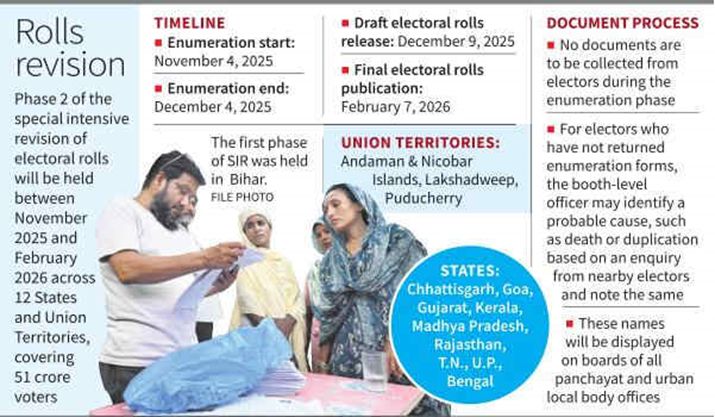
  • The Election Commission kicked off the second phase of the special intensive revision of voter lists in 12 States and Union Territories, including poll-bound Tamil Nadu, West Bengal, Kerala, and Puducherry. The revision will cover 51 crore voters.
  • With the announcement of the second round, the voter lists of the States and Union Territories were set to be frozen. For now, there will be no SIR in Assam, scheduled to go to the polls next year, and a separate order will be issued later.
  • “Under the Citizenship Act, there are separate provisions for citizenship in Assam. Under the supervision of the Supreme Court, the exercise of checking citizenship is about to be completed. The June 24 SIR order was for the entire country. Under such circumstances, this would not have applied to Assam,” Chief Election Commissioner Gyanesh Kumar said at press conference.
  • The exercise will be in focus in West Bengal and Tamil Nadu, where the ruling parties — the Trinamool Congress and DMK — have raised concerns. The SIR will be conducted in Uttar Pradesh, Madhya Pradesh, Rajasthan, Chhattisgarh, Goa, Gujarat, Andaman and Nicobar Islands, and Lakshadweep.
  • The first phase of the SIR was held in Bihar following which more than 68 lakh names were deleted from the electoral rolls.
  • Most States had the last SIR of the voter lists done between 2002 and 2004, and they have nearly completed the mapping of current electors according to the last exercise. Voter mapping involves standardising addresses and correcting discrepancies.
  • In this phase of the SIR, the house-to-house enumeration will take place for a month from November 4 to December 4, and the draft rolls will be published on December 9. Claims and objections can be raised from December 9 to January 8. Notices will be issued, and hearings and verifications will take place between December 9 and January 31. Booth-level officers will be trained, and forms will be printed between October 28 and November 3. The final electoral rolls will be published on February 7, the poll body said.
  • To a question on the demands for putting off the SIR exercise in Kerala where local body elections are scheduled, Mr. Kumar said the poll notification was yet to be issued.
  • On the SIR in West Bengal, where the ruling Trinamool Congress has raised concerns about the exercise, the CEC said the Commission was doing its constitutional duty by carrying out the SIR, and the State government will perform its duties by giving all support and manpower needed.
  • The poll body will give new EPIC cards to all voters as stated during the SIR in Bihar, Mr. Kumar said fresh voter IDs will be given to only those who have any change in their particulars.
  • ‘Black hole activities suppress the birth of new stars around it’

Context:  A new study led by astronomers at the Indian Institute of Astrophysics (IIA) has found that black hole activities suppress the birth of new stars around it. Supermassive black holes at the centres of galaxies are known to drive outflows of gas, and astronomers have long studied how feedback processes from these outflows can in turn determine the evolution of these galaxies.

  • However, a key puzzle has been to understand the relative influence of this gas outflow versus radiation from the central regions on the behaviour and evolution of the host galaxy.
  • The astronomers have uncovered key insights into these powerful forces shaping the universe.
  • The Department of Science and Technology said that the study reveals that both intense radiation from around the black holes as well as the high-speed jets they emit can work together to eject gas from the centres of galaxies, potentially shutting down star formation in their central regions and regulating galactic growth.
  • Using cutting-edge archival data from international astronomical facilities like the Sloan Digital Sky Survey (SDSS) Telescope at optical wavelengths and the Very Large Array (VLA) at radio wavelengths, both located in the United States, the researchers studied over 500 relatively nearby galaxies hosting active galactic nuclei (AGN).
  • “AGN are energetic galaxy centres that emit copious radiation and gas, powered by matter falling onto their supermassive black holes, many millions of times more massive than our Sun,” the department said.
  • “We found that outflows of warm ionized gas are widespread in AGN, and while radiation from the black hole is the main driver, galaxies with radio jets show significantly faster and more energetic outflows,” said Payel Nandi, a Ph.D. student at IIA and the lead author of the study.
  • Their investigation further showed that such outflows, which are high-speed streams of gas pushed out from galactic centres, are more than twice as likely in galaxies detected in radio wavelengths (56%) compared to those without radio emission (25%).
  • “These powerful winds can travel at speeds of up to 2,000 km per second, fast enough to escape the gravitational pull of the galaxy itself,” the department said.
  • Dhruba J. Saikia from the Inter-University Centre for Astronomy and Astrophysics and co-author said that these findings are an important step in understanding the complex inter-relationships between supermassive black holes, radio jets, star formation, and evolution of their host galaxies.
  • Man-animal conflict management task force will be formed: Khandre

Context: The announcement comes in the wake of back-to-back tiger attacks in a span of 10 days in Sargur.

  • Eshwar B. Khandre, Minister for Forests, Ecology and Environment, stated on Monday that a conflict management task force to address human-wildlife conflict will be constituted in the State.
  • While chairing a meeting of the officials in Bandipur, following a tiger attack in which a farmer was killed in Sargur, the Minister said that the task force will be a State-level entity and will comprise local representatives, NGOs and environmental experts.
  • The meeting was a fallout of back-to-back tiger attacks in a span of 10 days in Sargur in which one farmer died while the other victim is under treatment but battling for life in a private hospital in Mysuru. Mr. Khandre said that the task force will take up educational awareness activities and sensitise people living in villages along the forest periphery on preventive measures to be taken to avoid conflict. The task force will visit schools in the forest periphery and sensitise students about wildlife and function as a bridge to promote amity between the Forest Department and the villagers, he said.
  • The Minister directed the officials and the local administration to clamp down with prohibitory orders to prevent people from crowding during combing operations. The urgency for such a measure stems from the fact that the operations are hindered by the crowd which congregates to watch the exercise and courts a danger. On the imperatives of timely communication to the villagers of the presence of wild animals, the Minister said the public should be informed through loudspeakers if elephants or tigers enter residential areas, and information must also be disseminated through social media for greater reach.
  • A command centre will be established for continuous monitoring of the presence of wild animals, and it will be equipped with thermal cameras, drones, and state-of-the-art technology. WhatsApp messages will be forwarded on sighting wild animals close to the villages, the Minister said, calling for its urgent implementation.
  • Mr. Khandre emphasised the need to increase foot patrolling in conflict zones so that precautions could be taken to avoid injury or crop loss. To redress staff shortage and fill vacant posts, the officials were directed to initiate the recruitment process. In addition to it, frontline staff could be outsourced, Mr. Khandre said.
  • The Minister instructed Chief Wildlife Warden P.C. Rai to submit a report within five days on possible measures that could be taken to prevent elephants and tigers from straying out of the forests. The officials were instructed to take up tentacle fencing, solar fencing, and dig elephant-proof trenches where necessary to supplement the rail barricades being installed in areas that are hotspots for human-elephant conflicts.
  • Mr. Khandre said that farmers have attributed the rise in conflict situations to an increase in wildlife safaris and the disturbances being caused in forests and hence he would discuss the issue with officials.
  • India’s maritime global trade to get a boost with proposed Great Nicobar project: Shah

Context: India aims to be among the top five ship-building countries and significantly increase the port-handling capability by building new mega ports, Union Home Minister Amit Shah said in Mumbai on Monday, adding that the proposed Great Nicobar project will boost the country’s maritime global trade multiple times.

  • He was speaking at the inauguration of the fourth edition of the India Maritime Week 2025.
  • The $5-billion Great Nicobar infrastructure project, which will include a power plant, transshipment port and airport, has been criticised by activists and local population, citing environmental concerns and violation of forest rights.
  • He said that the government plans to increase the country’s port handling capacity to 10,000 million tonnes per annum (MTPA) from the present 2,700 MTPA (major and non-major ports combined). India’s maritime strength was due to its strategic location, he said.
  • “Our coastline of over 11,500 km is spread across 13 coastal States. Maritime business contributes to 60 per cent of our GDP [Gross Domestic Product]. Today, over 100 countries are participating in the India Maritime Week. We have 350 speakers, over 500 companies, over one lakh delegates and we expect an investment of ₹10 lakh crore,” he said.
  • Mr. Shah highlighted India’s growing leadership in the Indo-Pacific. “Leveraging its maritime position, democratic stability, and naval capability, India is acting as a bridge between the Indo-Pacific and the Global South, fostering development, security, and environmental progress,” he said.
  • Speaking at the event, Union Minister Nitin Gadkari said India would soon bring down the logistics cost to single digit to nine per cent. “We are still at 16 per cent against China and Europe’s 8 per cent and 12 per cent respectively,” he said.
  • Union Minister for Ports, Shipping and Waterways, Sarbananda Sonowal, said 680 memoranda of understanding (MoUs) worth ₹10 lakh crore were slated to be signed during the India Maritime Week.
  • Justice Surya Kant, part of poll bond, Article 370 verdicts, set to be next CJI

Context: The Chief Justice of India (CJI), B.R. Gavai, recommended Justice Surya Kant, the senior-most judge of the Supreme Court, as his successor to office, and the 53rd Chief Justice of India.

  • The government had in the previous week written to Chief Justice Gavai seeking his recommendation.
  • However, the CJI was on an official visit to Bhutan. Chief Justice Gavai gave his recommendation immediately on his return and met Justice Kant with the recommendation letter on Monday, the first working day of the court after the Deepavali holidays.
  • Chief Justice Gavai is scheduled to retire on November 24.
  • Under the Memorandum of Procedure for the appointment of the Chief Justice of India, and Supreme Court Judges, the Union Law Ministry seeks the recommendation of the outgoing Chief Justice for the next appointment, following which the latter replies to the government.

Key cases

  • Justice Kant has been a part of several impactful decisions of the apex court, including the abrogation of Article 370 of the Constitution which removed the special status to the erstwhile State of Jammu and Kashmir. He was also part of the Bench which held the electoral bonds scheme unconstitutional. He was a member of the Benches which heard the Pegasus spyware case, and the suspension of the sedition law.
  • He was born on February 10, 1962 at Hisar in Haryana. Justice Kant earned his Bachelor’s degree in Law in 1984 from Maharishi Dayanand University, Rohtak. He started his legal practice at the Hisar district court and shifted to Chandigarh in 1985 to practice in the Punjab and Haryana High Court.
  • He was the youngest Advocate-General of Haryana on July 7, 2000, and designated as senior advocate in March 2001. He was elevated as a judge of the Punjab and Haryana High Court on January 9, 2004. Justice Kant was appointed as the Chief Justice of the High Court of Himachal Pradesh in October 2018.
  • He was appointed as a Supreme Court judge on May 24, 2019. He is due to retire on February 9, 2027.
  • India welcomes Gaza peace plan, wishes for early end to Ukraine war: Jaishankar

Context: India recognises that enduring conflicts have the potential to disrupt food security and threaten energy flows, and, therefore, it welcomes the Gaza peace initiative by U.S. President Donald Trump and wishes for an early end to the conflict in Ukraine, External Affairs Minister S. Jaishankar.

  • Speaking at the 20th East Asia Summit in Kuala Lumpur, Mr. Jaishankar spoke in favour of deepening maritime connections in the ASEAN region. “We are also witnessing conflicts that have significant repercussions, near and far. Deep human suffering apart, they undermine food security, threaten energy flows and disrupt trade. India, therefore, welcomes the Gaza peace plan. We also seek an early end to the conflict in Ukraine,” he said.
  • Earlier, Mr. Jaishankar met Secretary of State Marco Rubio as India-U.S. relations continue to remain uneasy after Mr. Trump imposed penalty tariffs on India for buying Russian crude.
  • Mr. Jaishankar, on his part, did not specifically refer to the challenges that India is facing because of Mr. Trump’s campaign to cut down Russian energy exports but pointed at “reliability of supply chains and access to markets” as an area of “growing concerns”. “Energy trade is increasingly constricted, with resulting market distortions. Principles are applied selectively and what is preached is not necessarily practised,” he said, supporting “adjustments” and “resilient solutions”.
  • “Multipolarity is not just here to stay but to grow. All these warrant serious global conversations,” he said. He expressed India’s commitment to enhancing maritime cooperation in the ASEAN region.
  • NDRF teams on the ground, schools closed in Odisha

Context: The Odisha government on Monday deployed disaster response forces and shut down schools in eight districts, which are likely to be impacted by Cyclone Montha. “We have deployed 24 teams of Odisha Disaster Rapid Action Force and five units of National Disaster Response Force mostly in southern Odisha districts.

  • As southern Odisha districts are likely to receive heavy rain under the atmospheric system, we have remained alert,” said Suresh Pujari, State Revenue and Disaster Management Minister. The schools and anganwadi centres have been shut down for two days— keeping the potential heavy rain in mind.
  • CIC appointments in ‘two or three’ weeks, Centre tells top court

Context: The Centre informed the Supreme Court on Monday that vacancies in the Central Information Commission (CIC), which has no Chief Information Commissioner and is down to just two Information Commissioners out of a total sanctioned strength of 10, will be filled in “two or three” weeks.

  • Appearing before a Bench headed by Justice Surya Kant, Additional Solicitor-General K.M. Nataraj said the shortlisted names of candidates had been forwarded to the high-profile selection committee of the Prime Minister, the Leader of the Opposition, and a nominee of the government.
  • However, petitioners, represented by advocate Prashant Bhushan, countered that there was a complete information blackout on the appointment process to the Central Information Commission, and “names are air-dropped without any transparency”.
  • Mr. Bhushan, appearing for Anjali Bhardwaj, Commodore Lokesh Batra (retd.) and Amrita Johri, said it was an irony that the appointments to the very apex body under the Right to Information (RTI) Act were shrouded in opacity while pendency was touching 30,000.
  • He said even the Chief Information Commissioner had retired. Nothing had been done since the last order of the Supreme Court 10 months ago, directing the government to fill the vacancies. He said the government was applying the slow-choke to RTI.
  • “The best way to kill the RTI is to not make any appointments… If they do make appointments, they select persons out of the blue. Names are just air-dropped. There is no information on who is being appointed,” Mr. Bhushan, along with advocates Rahul Gupta and Cheryl D’souza, submitted.
  • Mr. Nataraj said the petitioners could not decide the suitability of the candidates, and their eligibility was decided by the RTI Act.
  • He said the petitioners ought to wait till the appointments were actually made before complaining.
  • Is the Dogri language losing resonance in India?

Context:  Is the Dogri language declining at the same rate across rural and urban landscapes in the Jammu region?

Human society is rapidly moving towards the extinction of its linguistic heritage. According to one report by UNESCO, India has topped the list of countries with the maximum number of dialects on the verge of extinction. According to D.G Rao, former Director of the Central Institute of Languages, India has lost over 220 languages in the last 50 years.

Is Dogri in decline?

  • In recent years, growing concern has emerged over the gradual decline of the Dogri language in the Jammu region. Globalisation, migration, and the pursuit of economic opportunity often encourage speakers to prioritise widely used languages, while regional ones fade into disuse.
  • Political choices and a lack of active interest among native speakers further deepen this crisis. Against this backdrop, Dogri finds itself at a crossroads. Although the J&K Official Languages Bill, 2020 gave it the long-overdue recognition as one of the Union Territory’s five official languages, its status on paper has not translated into meaningful presence on the ground. Unlike other regional languages that have secured space in school curricula or administrative use, Dogri remains largely absent from formal education.

Why is Dogri not being spoken?

  • The decline of Dogri in the Jammu region can be looked at through three critical lenses — government policy, generational perspectives, and the rural-urban divide.
  • One of the central reasons for the decline of Dogri lies in the absence of sustained government support.
  • Unlike Urdu, Kashmiri, and Hindi, Dogri had to wait until 2003 for constitutional recognition. This long delay meant that by the time Dogri gained official status, it had already fallen behind in terms of institutional backing and visibility.
  • A survey conducted by the authors further underscores this policy gap. The research employed a random sampling method, selecting households at intervals of three to four units to ensure representativeness. The sample was distributed across 20 different locations in the Jammu region; 130 people filled the survey form completely.
  • Nearly half of the respondents (48%) from the Jammu region believe that the government has failed to provide adequate policy support for Dogri. Another 43.2% felt that the language offers little relevance for employment prospects or career advancement.
  • Additionally, the survey revealed a stark generational divide in Dogri proficiency. The oldest respondents, those aged 60 and above, displayed the strongest connection to the language, with full proficiency in speaking and an intermediate score in reading and writing.
  • However, among respondents aged 41-60, writing proficiency dropped sharply to just 0.25%, reflecting the gradual erosion of literacy in the language. Respondents under 20 years of age show 0% proficiency in reading and writing Dogri.
  • The survey also revealed a striking contrast between rural and urban populations in terms of Dogri language usage. Approximately 56% of respondents from rural areas actively speak Dogri, with around 15% demonstrating the ability to write it. In contrast, among urban respondents, only 45% reported speaking Dogri, and only 4% had any proficiency in writing it.

What is the way ahead?

  • To address India’s linguistic crisis, two challenges must be addressed. First is technical — with the 2021 Census on hold, one lacks updated data on how many languages are endangered, and where urgent intervention is needed. Without this knowledge, both awareness and policy remain adrift. Secondly, one must shed the mindset that equates English alone with progress. The decolonisation of linguistics is the larger task at hand.

ಪ್ರಚಲಿತ ವಿದ್ಯಮಾನಗಳು: 26 & 27 ನೇ ಅಕ್ಟೋಬರ್ 2025

  • ಮನೆ ಕೆಲಸದವರಕಲ್ಯಾಣಮಸೂದೆ

ಸಂದರ್ಭ: ಬೆಳಗಾವಿ ಅಧಿವೇಶನದಲ್ಲಿ ಮಂಡನೆಗೆ ಸಿದ್ಧತೆ l ವಿಶೇಷ ಮಂಡಳಿ, ನಿಧಿ ಸ್ಥಾಪನೆ: ಮನೆ ಕೆಲಸದವರಿಗೆ ಕನಿಷ್ಠ ವೇತನ, ವಾರಕ್ಕೆ 48 ಗಂಟೆ ದುಡಿಮೆ, .ಟಿ , ವಾರಕ್ಕೊಂದು ರಜೆ, ವಿಶ್ರಾಂತಿ, ವಾರ್ಷಿಕ ರಜೆ ಇತ್ಯಾದಿ ಸೌಲಭ್ಯಗಳನ್ನು ಒಳಗೊಂಡ ಸಾಮಾಜಿಕ ಭದ್ರತೆ ಮತ್ತು ಕಲ್ಯಾಣ ಉದ್ದೇಶದಕರ್ನಾಟಕ ಗೃಹ ಕಾರ್ಮಿಕರ (ಸಾಮಾಜಿಕ ಭದ್ರತೆ ಮತ್ತು ಕಲ್ಯಾಣ) ಮಸೂದೆ 2025’ ಅನ್ನು ಬೆಳಗಾವಿ ಅಧಿವೇಶನದಲ್ಲಿ ಮಂಡಿಸಲು ಸರ್ಕಾರ ಸಿದ್ಧತೆ ನಡೆಸಿದೆ.

  • ಉದ್ದೇಶಿತ ಮಸೂದೆಯು ರಾಜ್ಯದಲ್ಲಿ ಅಧಿಸೂಚಿತವಾಗಿರುವ ಎಲ್ಲ ನಗರ ಪಾಲಿಕೆಗಳಿಗೆ ಅನ್ವಯ ಆಗಲಿದ್ದು, ಮಸೂದೆಯ ಕರಡನ್ನು ಸಿದ್ಧಪಡಿಸಲಾಗಿದೆ.
  • ಮನೆ ಕೆಲಸದವರ ಕಲ್ಯಾಣಕ್ಕಾಗಿ ವಿಶೇಷ ಮಂಡಳಿ ಮತ್ತು ನಿಧಿ ಸ್ಥಾಪಿಸುವ ಬಗ್ಗೆಯೂ ಮಸೂದೆಯಲ್ಲಿ ಪ್ರಸ್ತಾವವಿದೆ. ಕಲ್ಯಾಣ ನಿಧಿಗೆ ಮನೆ ಕೆಲಸದವರು, ಉದ್ಯೋಗದಾತರು, ಮನೆ ಕೆಲಸದವರನ್ನು ಪೂರೈಸುವ ಏಜೆನ್ಸಿಗಳು ನೀಡುವ ಅಥವಾ ಪಡೆಯುವ ಸಂಭಾವನೆಯ ಶೇ 5ರಷ್ಟು ಸೆಸ್ಪಾವತಿಸಬೇಕಾಗುತ್ತದೆ ಎಂಬ ಅಂಶ ಮಸೂದೆಯಲ್ಲಿದೆ.
  • ಅಲ್ಲದೆ, ಮನೆ ಕೆಲಸದವರ ಸುರಕ್ಷತೆ ನಿಯಮಗಳ ಅಡಿ ಸಂಗ್ರಹಿಸಲಾಗುವ ಎಲ್ಲ ದಂಡಗಳು, ಕೇಂದ್ರ ಅಥವಾ ರಾಜ್ಯ ಸರ್ಕಾರ ನೀಡಿದ ಅನುದಾನಗಳು, ಮಂಡಳಿ ಮಾಡಿದ ಬ್ಯಾಂಕ್‌ ಹೂಡಿಕೆ ಗಳಿಂದ ಗಳಿಸಿದ ಬಡ್ಡಿ ಆದಾಯಗಳು, ಮನೆ ಕೆಲಸದವರ, ಉದ್ಯೋಗದಾತರ ನೋಂದಣಿಯ ಶುಲ್ಕವೂ ಈ ಕಲ್ಯಾಣ ನಿಧಿಗೆ ಜಮೆ ಆಗಲಿದೆ.
  • ಮನೆ ಕೆಲಸದವರ ಹಕ್ಕುಗಳನ್ನು ರಕ್ಷಿಸಲು ಮತ್ತು ಅವರಿಗೆ ಸಾಮಾಜಿಕ ಭದ್ರತೆ ಒದಗಿಸಲು ರೂಪಿಸಿರುವ ಈ ಕರಡು ಮಸೂದೆಯು ಲಿಖಿತ ಒಪ್ಪಂದ, ಕಡ್ಡಾಯ ನೋಂದಣಿ, ಕನಿಷ್ಠ ವೇತನ, ನಿಗದಿತ ಕೆಲಸದ ಸಮಯ, ವಾರದ ರಜೆ, ಹೆರಿಗೆ ರಜೆ ಸೇರಿದಂತೆ ಅನೇಕ ಸೌಲಭ್ಯಗಳನ್ನು ಕರಡು ಮಸೂದೆಯಲ್ಲಿ ಪ್ರಸ್ತಾಪಿಸಲಾಗಿದೆ.
  • ನೋಂದಣಿ: ಮಸೂದೆಯ ಪ್ರಕಾರ, ಉದ್ಯೋಗದಾತರು, ಸೇವಾ ಪೂರೈಕೆ ದಾರರು ಹಾಗೂ ರಾಜ್ಯದ ಒಳಗೆ ಮನೆ ಕೆಲಸ ಮಾಡುವ ಎಲ್ಲರೂ ನೋಂದಣಿ ಮಾಡಿಕೊಳ್ಳಬೇಕು.
  • ಡಿಜಿಟಲ್ ಪೋರ್ಟಲ್‌ ಮೂಲಕವೇ ನೋಂದಣಿ ಮಾಡಲು ಅವಕಾಶ ಕಲ್ಪಿಸಲಾಗುವುದು. ನೋಂದಣಿ ಮಾಡಿ ಕೊಳ್ಳದೆ ಮನೆ ಕೆಲಸದವರನ್ನು ನೇಮಕ ಮಾಡಿಕೊಳ್ಳುವಂತಿಲ್ಲ. ನೋಂದಣಿ ಮಾಡಿಕೊಂಡರೂ ಕಾಲ ಕಾಲಕ್ಕೆ ನವೀಕರಿಸದಿದ್ದರೆ ಉದ್ಯೋಗದಾತರಿಗೆ ಆರಂಭಿಕ ಹಂತದಲ್ಲಿ ದಂಡ, ಆ ನಂತರ ಸೆರೆವಾಸ ವಿಧಿಸಲು ಮಸೂದೆಯಲ್ಲಿ ಪ್ರಸ್ತಾವಿಸಲಾಗಿದೆ. ಗೃಹ ಕಾರ್ಮಿಕ ಸುರಕ್ಷತಾ ನಿಯಮಗಳನ್ನು ಉಲ್ಲಂಘಿಸಿದರೆ ದಂಡ ಮತ್ತು ಶಿಕ್ಷೆಗಳಿರಲಿವೆ.

ವಾಗ್ದಾನ ಉಳಿಸಿಕೊಳ್ಳಲಿ

  • ‘ಕರ್ನಾಟಕ ಗೃಹ ಕಾರ್ಮಿಕರ ಸಾಮಾಜಿಕ ಭದ್ರತೆ ಮತ್ತು ಕಲ್ಯಾಣ ಮಸೂದೆ’ಯ ಬಗ್ಗೆ ಮನೆ ಕೆಲಸದವರ ಸಂಘಟನೆಗಳ ಒಕ್ಕೂಟದೊಂದಿಗೆ ಕಾರ್ಮಿಕ ಸಚಿವ ಸಂತೋಷ್‌ ಲಾಡ್‌ ಚರ್ಚೆ ನಡೆಸಿದ್ದರು. ಮನೆ ಕೆಲಸದವರಿಗೆ ಸಾಮಾಜಿಕ ಭದ್ರತೆ ಒದಗಿಸಲು ಅಗತ್ಯವಾದ ವೆಚ್ಚವನ್ನು ಕಾರ್ಮಿಕರು ಮತ್ತು ಮಾಲೀಕರಿಂದ ಭರಿಸುವ ಪ್ರಸ್ತಾವ ಕೈಬಿಡುವುದಾಗಿ ಅವರು ಭರವಸೆ ನೀಡಿದ್ದರು. ಸಚಿವರು ಮಸೂದೆಯನ್ನು ಅಂಗೀಕರಿಸುವಾಗ ಈ ವಾಗ್ದಾನವನ್ನು ಉಳಿಸಿಕೊಳ್ಳಬೇಕು ಎಂದು ಒಕ್ಕೂಟದ ಸಂಚಾಲಕಿ ಜಬೀನಾಖಾನಂ ಆಗ್ರಹಿಸಿದ್ದಾರೆ.

ಕಲ್ಯಾಣಕ್ಕಾಗಿ ಏನೇನು?

lಮನೆ ಕೆಲಸದವರ ಚಿಕಿತ್ಸಾ ವೆಚ್ಚ  lಮಕ್ಕಳ ವಿದ್ಯಾಭ್ಯಾಸದ ವೆಚ್ಚ

lಅಪಘಾತ ಸಂಭವಿಸಿದರೆ ಪರಿಹಾರ lಇಬ್ಬರು ಮಕ್ಕಳಿಗೆ ಸೀಮಿತಗೊಳಿಸಿ ವೇತನ ಸಹಿತ ಮಾತೃತ್ವ ರಜೆ

lಮರಣ ಹೊಂದಿದರೆ ಅಂತ್ಯಕ್ರಿಯೆಗೆ ಸಹಾಯಧನ lನಿವೃತ್ತಿ ಹೊಂದಿದರೆ ಪಿಂಚಣಿಗೆ ಅವಕಾಶ

lಲೈಂಗಿಕ ಶೋಷಣೆ, ಕಳ್ಳಸಾಗಣೆಗೆ ತಡೆ lಜಾತಿ, ಲಿಂಗ, ವರ್ಗ, ಜನಾಂಗ, ಧರ್ಮ, ಪ್ರದೇಶದ ಆಧಾರದಲ್ಲಿ ತಾರತಮ್ಯಕ್ಕೆ ತಡೆ

lಪ್ರತಿ ನೋಂದಾಯಿತ ಘಟಕಕ್ಕೆ ವಿಶಿಷ್ಟ ಗುರುತಿನ ಸಂಖ್ಯೆ

ದೇಶದಲ್ಲಿಯೇ ಮೊದಲು

  • ದೇಶದಲ್ಲಿಯೇ ಮೊದಲ ಬಾರಿಗೆ ಮನೆ ಕೆಲಸದವರಿಗೆ ಸಾಮಾಜಿಕ ಭದ್ರತೆ ಒದಗಿಸಲು ರಾಜ್ಯ ಸರ್ಕಾರವು ಮುಂದಾಗಿದೆ. ಅದಕ್ಕಾಗಿ ಕರಡು ಮಸೂದೆ ತಯಾರಿಸಿ, ರಾಜ್ಯಪತ್ರದಲ್ಲಿ ಪ್ರಕಟಿಸಲಾಗಿದೆ ಎಂದು ಕಾರ್ಮಿಕ ಇಲಾಖೆಯ ಹೆಚ್ಚುವರಿ ಆಯುಕ್ತ ಮಂಜುನಾಥ್‌ ಜಿ. ಮಾಹಿತಿ ನೀಡಿದ್ದಾರೆ.
  • ಮನೆ ಕೆಲಸದವರ ಕುಂದು ಕೊರತೆಗಳನ್ನು ಪರಿಹರಿಸುವುದಕ್ಕಾಗಿ ರಾಜ್ಯಮಟ್ಟ ದಲ್ಲಿ ಸಲಹಾ ಮಂಡಳಿ, ಜಿಲ್ಲಾ ಮಟ್ಟದ ಕುಂದುಕೊರತೆ ಪರಿಹಾರ ಸಮಿತಿ ರಚನೆ ಆಗಲಿದೆ ಎಂದು ತಿಳಿಸಿದ್ದಾರೆ.
  • ಎಸ್ಐಆರ್‌: ಇಂದು ವೇಳಾಪಟ್ಟಿ ಘೋಷಣೆ?

ಸಂದರ್ಭ: ದೇಶದಾದ್ಯಂತ ಮತದಾರರ ಪಟ್ಟಿಯ ವಿಶೇಷ ಸಮಗ್ರ ಪರಿಷ್ಕರಣೆ (ಎಸ್ಐಆರ್) ಕೈಗೊಳ್ಳಲು  ಕೇಂದ್ರ ಚುನಾವಣಾ ಆಯೋಗ ಸಜ್ಜಾಗಿದ್ದುವೇಳಾಪಟ್ಟಿ ಘೋಷಿಸುವ ಸಾಧ್ಯತೆ ಇದೆ.

  • ಹಲವು ಹಂತಗಳಲ್ಲಿ ಪರಿಷ್ಕರಣೆಗೆ ಚಿಂತನೆ ನಡೆದಿದೆ. ಚುನಾವಣೆ ಸಮೀಪಿಸುತ್ತಿರುವ ರಾಜ್ಯಗಳಲ್ಲಿ ಮೊದಲ ಹಂತದ ಎಸ್‌ಐಆರ್‌ ನಡೆಯಬಹುದು.
  • ಚುನಾವಣೆ ಸಮೀಪಿಸುತ್ತಿರುವ ಕೇರಳ, ತಮಿಳುನಾಡು, ಪುದುಚೇರಿ, ಪಶ್ಚಿಮ ಬಂಗಾಳದಲ್ಲಿ ಮೊದಲ ಹಂತದ ಎಸ್‌ಐಆರ್ ನಡೆಯುವ ಮುನ್ಸೂಚನೆ ಇದೆ. ಜತೆಗೆ, ಕೇಂದ್ರಾಡಳಿತ ಪ್ರದೇಶಗಳು ಸೇರಿದಂತೆ 10–15 ರಾಜ್ಯಗಳಲ್ಲಿ ಸಮಗ್ರ ಪರಿಷ್ಕರಣೆ ನಡೆಯಲಿದೆ. ಬಹುತೇಕ ರಾಜ್ಯಗಳಲ್ಲಿ 2002 ಮತ್ತು 2004 ನಡುವೆ ಎಸ್ಐಆರ್ನಡೆದಿತ್ತು.
  • ಗ್ರಾ.ಪಂ.ಗೆ ಅನುಮೋದನೆ ಅಧಿಕಾರ

ಸಂದರ್ಭ: ಬಡಾವಣೆ ಅಭಿವೃದ್ಧಿಗೆ ನಿಯಮ ರೂಪಿಸಿದ ಗ್ರಾಮೀಣಾಭಿವೃದ್ಧಿ ಇಲಾಖೆ: ಗ್ರಾಮ ಪಂಚಾಯಿತಿ ವ್ಯಾಪ್ತಿಯಲ್ಲಿ ಸ್ಥಳೀಯ ಯೋಜನಾ ಪ್ರದೇಶ ಹೊರತುಪಡಿಸಿದ ಜಾಗಗಳಲ್ಲಿ ಬಡಾವಣೆ ಅಭಿವೃದ್ಧಿಗೆ ನಿಯಮ ಗಳನ್ನು ರೂಪಿಸಿ ಗ್ರಾಮೀಣಾಭಿವೃದ್ಧಿ ಮತ್ತು ಪಂಚಾಯತ್ ರಾಜ್ಇಲಾಖೆಯು ಸುತ್ತೋಲೆ ಹೊರಡಿಸಿದೆ.

  • ಗ್ರಾಮ ಪಂಚಾಯಿತಿಯ ಸ್ಥಳೀಯ ಯೋಜನಾ ಪ್ರದೇಶದ ಹೊರಗೆ ಇರುವ ಹಾಗೂ ಭೂಪರಿವರ್ತನೆಗೆ ಒಳಗಾದ ಜಮೀನುಗಳಿಗೆ ಮಾತ್ರ ಈ ನಿಯಮ ಅನ್ವಯವಾಗುತ್ತದೆ. ಪೂರ್ವಾನು ಮೋದನೆ ಪಡೆದ ಈ ಬಡಾವಣೆಗಳಲ್ಲಿನ ನಿವೇಶನಗಳಿಗೆ ಗ್ರಾಮ ಪಂಚಾಯಿತಿಯೇ ಖಾತೆ ಮಾಡಿಕೊಡಲಿದೆ. ಭೂಪರಿವರ್ತನೆ ಇಲ್ಲದೆ ಅಭಿವೃದ್ಧಿ ಪಡಿಸಲಾದ ಬಡಾವಣೆಗಳಿಗೆ ಇದು ಅನ್ವಯವಾಗುವುದಿಲ್ಲ.
  • ಬಡಾವಣೆ ಅಭಿವೃದ್ಧಿ ಪಡಿಸುವುದಕ್ಕೂ ಮುನ್ನ ಸಂಬಂಧಿತ, ಪರಿವರ್ತಿತ ಜಮೀನಿನ ಮಾಲೀಕ ಬಡಾವಣೆಯ ವಿನ್ಯಾಸವನ್ನು ರಚಿಸ ಬೇಕು. ಬಡಾವಣೆಯಲ್ಲಿ ಇರಲಿರುವ ಸಾರ್ವಜನಿಕ ರಸ್ತೆಗಳು, ಉದ್ಯಾನ, ಚರಂಡಿ, ಒಳಚರಂಡಿ, ನೀರಿನ ಕೊಳವೆ ಮಾರ್ಗ, ತ್ಯಾಜ್ಯ ನೀರು ಸಂಸ್ಕರಣ ಘಟಕ, ವಿದ್ಯುತ್ ಜಾಲಗಳಿಗೆ ಸಂಬಂಧಿತ ಇಲಾಖೆ ಅಥವಾ ಪ್ರಾಧಿಕಾರಗಳಿಂದ ನಿರಾಕ್ಷೇಪಣಾ ಪತ್ರ ಪಡೆಯಬೇಕು ಎಂದು ಸುತ್ತೋಲೆಯಲ್ಲಿ ಸೂಚಿಸಿದೆ.
  • ಈ ಎಲ್ಲ ದಾಖಲೆಗಳನ್ನು ಒಳಗೊಂಡ ಅರ್ಜಿಯನ್ನು ಗ್ರಾಮ ಪಂಚಾಯಿತಿಗೆ ಸಲ್ಲಿಸಿ, ಬಡಾವಣೆ ಅಭಿವೃದ್ಧಿ ಪಡಿಸಲು ಅನುಮತಿ ಪಡೆಯಬೇಕು. ಹೀಗೆ ಅಭಿವೃದ್ಧಿ ಪಡಿಸಲಾದ ಬಡಾವಣೆ ಯಲ್ಲಿನ ಸಾರ್ವಜನಿಕ ರಸ್ತೆಗಳು, ಉದ್ಯಾನ, ಚರಂಡಿ– ಒಳಚರಂಡಿ ವ್ಯವಸ್ಥೆ, ತ್ಯಾಜ್ಯ ನೀರು ಸಂಸ್ಕರಣಾ ಘಟಕಗಳು, ಸಾರ್ವಜನಿಕ ಬಳಕೆಯ ಪ್ರದೇಶಗಳನ್ನು ಹಕ್ಕು ಪರಿತ್ಯಾಜನಾ ಪತ್ರದ ಮೂಲಕ ಗ್ರಾಮ ಪಂಚಾಯಿತಿಗೆ ಬಿಟ್ಟು ಕೊಡಬೇಕು. ಹೀಗೆ ಬಿಟ್ಟು ಕೊಟ್ಟ ನಂತರ ಅವುಗಳ ನಿರ್ವಹಣೆಯ ಹೊಣೆಗಾರಿಕೆಯು ಸಂಬಂಧಿತ ಗ್ರಾಮ ಪಂಚಾಯಿತಿಯದ್ದಾಗಿರಲಿದೆ ಎಂದಿದೆ.
  • ಇನ್ನು ಬಡಾವಣೆಯ ಮೂಲೆ ನಿವೇಶನಗಳು, ನಾಗರಿಕ ಬಳಕೆ (ಸಿ.ಎ) ನಿವೇಶನಗಳು ಮತ್ತು ಮಧ್ಯಂತರ ನಿವೇಶನಗಳನ್ನು ಅಡಮಾನ ಒಪ್ಪಂದದ ಅಡಿಯಲ್ಲಿ ಗ್ರಾಮ ಪಂಚಾಯಿತಿಗೆ ಒಪ್ಪಿಸಬೇಕು. ನಿಗದಿತ ಅವಧಿಯಲ್ಲಿ ಬಡಾವಣೆಯನ್ನು ಅಭಿವೃದ್ಧಿ ಪಡಿಸಿದರೆ, ಅಡಮಾನ ಒಪ್ಪಂದವನ್ನು ರದ್ದುಪಡಿಸಬೇಕು ಮತ್ತು ನಿವೇಶನ ಗಳನ್ನು ಬಡಾವಣೆ ಅಭಿವೃದ್ಧಿದಾರರಿಗೆ ಹಿಂತಿರುಗಿಸಬೇಕು ಎಂದು ಸೂಚಿಸಿದೆ.
  • ಅಭಿವೃದ್ಧಿ ಪಡಿಸಲಾದ ಬಡಾವಣೆ ಯಲ್ಲಿರುವ ಮೂಲಭೂತ ಸೌಕರ್ಯಗಳು ಯಾವುದೇ ದೋಷದಿಂದ ಕೂಡಿಲ್ಲ ಎಂಬುದನ್ನು ಖಚಿತಪಡಿಸಿಕೊಳ್ಳುವ ಉದ್ದೇಶದಿಂದ, ಅಭಿವೃದ್ಧಿದಾರರು ಗ್ರಾಮ ಪಂಚಾಯಿತಿಗೆ ಖಾತರಿ ಒದಗಿಸ ಬೇಕು. ಮೂಲ ಸೌಕರ್ಯ ಅಭಿವೃದ್ಧಿಗೆ ತಗುಲಿರುವ ಒಟ್ಟು ವೆಚ್ಚದ ಶೇ 10ರಷ್ಟನ್ನು ಬ್ಯಾಂಕ್ ಭದ್ರತೆ ರೂಪದಲ್ಲಿ, ಒಂದು ವರ್ಷಕ್ಕೆ ಗ್ರಾಮ ಪಂಚಾಯಿತಿ ಎಂಜಿನಿಯ ರಿಂಗ್‌ ಇಲಾಖೆಯಲ್ಲಿ ಇರಿಸಬೇಕು. ಒಂದು ವರ್ಷದ ನಂತರ ಅದನ್ನು ವಾಪಸ್‌ ಪಡೆಯಬಹುದಾಗಿದೆ ಎಂದು ತಿಳಿಸಿದೆ.

ಸುತ್ತೋಲೆಯ ಪ್ರಮುಖ ಅಂಶಗಳು

lಮೂಲಭೂತ ಸೌಕರ್ಯ ಅಭಿವೃದ್ಧಿಗೆ ಸಂಬಂಧಿತ ಇಲಾಖೆ/ಪ್ರಾಧಿಕಾರ ಗಳಿಂದ ವಿನ್ಯಾಸ ಅನುಮೋದನೆ ಪಡೆದ ನಂತರವಷ್ಟೇ ಗ್ರಾಮ ಪಂಚಾಯಿತಿಗೆ ಅರ್ಜಿ ಸಲ್ಲಿಸಲು ಅವಕಾಶ

lಗ್ರಾಮೀಣಾಭಿವೃದ್ಧಿ ಇಲಾಖೆ, ಜಲ ಸಂಪನ್ಮೂಲ ಇಲಾಖೆ, ಎಸ್ಕಾಂಗಳಿಂದ ನಿರಾಕ್ಷೇಪಣಾ ಪತ್ರ ಪಡೆಯುವುದು ಕಡ್ಡಾಯ

lಮೂಲಭೂತ ಸೌಕರ್ಯಗಳ ಅಭಿವೃದ್ಧಿ ವೇಳೆ ಸಂಬಂಧಿತ ಇಲಾಖೆ/ಪ್ರಾಧಿಕಾರ/ವಿಭಾಗಗಳಿಗೆ ಒಟ್ಟು ವೆಚ್ಚದ ಶೇ5 ರಿಂದ ಶೇ10 ರವರೆಗೆ ಮೇಲ್ವಿಚಾರಣಾ ಶುಲ್ಕ ಪಾವತಿಸಬೇಕು

lಬಡಾವಣೆಗಳಲ್ಲಿನ ರಸ್ತೆ, ಉದ್ಯಾನ, ಸಾರ್ವಜನಿಕ ಬಳಕೆ ಪ್ರದೇಶ, ನಾಗರಿಕ ಬಳಕೆ ನಿವೇಶನಗಳನ್ನು ಗ್ರಾಮ ಪಂಚಾಯಿತಿಗೆ ಬಿಟ್ಟುಕೊಡುವುದು ಕಡ್ಡಾಯ

  • ಗುಡ್ಡೆಹಳ್ಳಿ: ದೈತ್ಯ ಪತಂಗ ಪತ್ತೆ

ಸಂದರ್ಭ: ಇಲ್ಲಿನ ಗುಡ್ಡೆಹಳ್ಳಿ ಗ್ರಾಮದಲ್ಲಿ 24 ಸೆಂ.ಮೀ ಅಗಲದ ರೆಕ್ಕೆ ಹೊಂದಿದ್ದ ದೈತ್ಯ ಪತಂಗ (ಅಟ್ಲಾಸ್ ಮೋತ್) ಕಂಡುಬಂದಿದೆ. ಹವ್ಯಾಸಿ ಛಾಯಾಗ್ರಾಹಕ ರವಿ ಗೌಡಾ ಎಂಬುವವರು ದೈತ್ಯ ಪತಂಗದ ಚಿತ್ರ ಸೆರೆಹಿಡಿದ್ದಾರೆ. 

  • ‘ಕರಾವಳಿ ಭಾಗದ ಕಾಡುಗಳಲ್ಲಿ ದೈತ್ಯ ಪತಂಗ ಕಾಣಿಸಿಕೊಳ್ಳುತ್ತದೆ. ಪ್ರಪಂಚದಲ್ಲಿ ದೊಡ್ಡ ಗಾತ್ರದಲ್ಲಿರುವ ಪತಂಗಗಳ ಪೈಕಿ ಇದೂ ಒಂದು. ಕೆಲ ನಿರ್ದಿಷ್ಟ ಮರಗಳ ಎಲೆಗಳ ಮೇಲೆ ಮಾತ್ರ ಮೊಟ್ಟೆ ಇಡುತ್ತವೆ. ಹೆಣ್ಣು ಪತಂಗ ಮೊಟ್ಟೆ ಇಟ್ಟು ನಂತರ ಸಾಯುತ್ತದೆ’ ಎಂದು ಕೀಟ ತಜ್ಞರು ಮಾಹಿತಿ ನೀಡಿದ್ದಾರೆ.
  • ‘2026: ಕಡಲ ಸಹಕಾರ ವರ್ಷ ಘೋಷಣೆ

ಸಂದರ್ಭ: ಆಸಿಯಾನ್ಭಾರತ ಪಾಲುದಾರಿಕೆ: ಹಿಂದೂಮಹಾಸಾಗರಪೆಸಿಫಿಕ್ ಪ್ರದೇಶದ ವಿದ್ಯಮಾನಗಳಿಗೆ ಸಂಬಂಧಿಸಿ ಆಸಿಯಾನ್ಪ್ರಮುಖ ಪಾತ್ರವಹಿಸಬೇಕು ಎಂಬ ವಿಚಾರವನ್ನು ಭಾರತ ಯಾವಾಗಲೂ ಬೆಂಬಲಿಸುತ್ತಾ ಬಂದಿದೆನರೇಂದ್ರ ಮೋದಿ, ಪ್ರಧಾನಿ.

  • ಆಸಿಯಾನ್‌ ಮತ್ತು ಭಾರತ ನಡುವಿನ ಸಮಗ್ರ ಪಾಲುದಾರಿಕೆಯು ಜಾಗತಿಕ ಸ್ಥಿರತೆ ಹಾಗೂ ಅಭಿವೃದ್ಧಿಗೆ ಪ್ರಬಲ ಅಡಿಪಾಯ ವಾಗಲಿದೆ. ಹೀಗಾಗಿ 2026 ಅನ್ನು ‘ಆಸಿಯಾನ್‌–ಭಾರತ ಕಡಲ ಸಹಕಾರ ವರ್ಷ’ ಎಂಬುದಾಗಿ ಘೋಷಿಸ ಲಾಗುವುದು ಎಂದು ಪ್ರಧಾನಿ ನರೇಂದ್ರ ಮೋದಿ ಹೇಳಿದ್ದಾರೆ.
  • ಸಾಗರ ಸುರಕ್ಷತೆ ಹಾಗೂ ‘ನೀಲಿ ಆರ್ಥಿಕತೆ’ ಕ್ಷೇತ್ರಕ್ಕೆ ಸಂಬಂಧಿಸಿ ಆಸಿಯಾನ್‌ ಸದಸ್ಯ ರಾಷ್ಟ್ರಗಳ ನಡುವೆ ಸಹಕಾರ ಕೂಡ ಹೆಚ್ಚುತ್ತಿದೆ. ಈ ಎಲ್ಲ ಕಾರಣಗಳಿಂದ ಈ ಘೋಷಣೆ ಮಾಡಲಾಗುತ್ತದೆ ಎಂದು ವಿವರಿಸಿದರು. ಮಲೇಷ್ಯಾದ ಕ್ವಾಲಾಲಂ ಪುರದಲ್ಲಿ ಆರಂಭವಾದ ಮೂರು ದಿನಗಳ ಆಸಿಯಾನ್‌ ಶೃಂಗಸಭೆಯನ್ನು ವರ್ಚುವಲ್‌ ಮೂಲಕ ಉದ್ದೇಶಿಸಿ ಅವರು ಮಾತನಾಡಿದರು.
  • ‘ವಿಶ್ವದ ಹಲವೆಡೆ ಈಗ ಅನಿಶ್ಚಿತ ಸ್ಥಿತಿ ಇದೆ. ಈ ಪರಿಸ್ಥಿತಿಯಲ್ಲಿಯೂ ಭಾರತ ಮತ್ತು ಆಸಿಯಾನ್‌ ನಡುವಿನ ಪಾಲುದಾರಿಕೆಯಲ್ಲಿ ಗಮನಾರ್ಹ ಪ್ರಗತಿ ಸಾಧಿಸಲಾಗಿದೆ’ ಎಂದರು.
  • ‘ಶಿಕ್ಷಣ, ಪ್ರವಾಸ, ವಿಜ್ಞಾನ ಮತ್ತು ತಂತ್ರಜ್ಞಾನ, ಆರೋಗ್ಯ, ಹಸಿರು ಇಂಧನ, ಸೈಬರ್‌ ಭದ್ರತೆ ಸೇರಿದಂತೆ ಪ್ರಮುಖ ಕ್ಷೇತ್ರಗಳಲ್ಲಿ ಆಸಿಯಾನ್‌ ಸದಸ್ಯ ರಾಷ್ಟ್ರಗಳ ಮಧ್ಯೆ ಸಹಕಾರ ಹೆಚ್ಚುತ್ತಿದೆ. ಸದಸ್ಯ ರಾಷ್ಟ್ರಗಳ ಜನರ ನಡುವಿನ ಸಂಬಂಧ ಬಲಪಡಿಸುವುದು, ಸಾಂಸ್ಕೃತಿಕ ಪರಂಪರೆ ಸಂರಕ್ಷಣೆ ಕಾರ್ಯವನ್ನು ಮುಂದುವರಿಸಲಾಗುವುದು’ ಎಂದು ಮೋದಿ ಹೇಳಿದರು.
  • ಭಾರತದ ಕಾಫಿ ವಿಶ್ವ ಪ್ರಸಿದ್ಧ

ಸಂದರ್ಭ: ಮನದ ಮಾತಿನಲ್ಲಿ ಕರ್ನಾಟಕದ ಕಾಫಿ ಉಲ್ಲೇಖಿಸಿದ ಪ್ರಧಾನಿ: ‘ಕರ್ನಾಟಕ ಸೇರಿದಂತೆ ದೇಶದ ವಿವಿಧ ರಾಜ್ಯಗಳಲ್ಲಿ ಬೆಳೆಯುವ ಕಾಫಿ ವಿಶ್ವದಲ್ಲಿ ಪ್ರಸಿದ್ಧವಾಗುತ್ತಿದೆ’ ಎಂದು ಪ್ರಧಾನಿ ನರೇಂದ್ರ ಮೋದಿ ಅವರು ಹೇಳಿದ್ದಾರೆ.

  • ಮನದ ಮಾತು 127ನೇ ಆವೃತ್ತಿಯಲ್ಲಿ ಮಾತನಾಡಿದ ಅವರು, ‘ಕರ್ನಾಟಕ, ತಮಿಳುನಾಡು ಮತ್ತು ಕೇರಳದಲ್ಲಿ ಬೆಳೆಯುತ್ತಿರುವ ಕಾಫಿ ಹೆಚ್ಚು ಜನಪ್ರಿಯತೆ ಪಡೆಯುತ್ತಿದೆ. ಇದು ಭಾರತದ ಕಾಫಿಯನ್ನು ಜಗತ್ತಿನಾದ್ಯಂತ ಗುರುತಿಸುವಂತೆ ಮಾಡಿದೆ. ಇತ್ತೀಚೆಗೆ ಈಶಾನ್ಯ ಭಾರತದಲ್ಲೂ ಕಾಫಿ ಬೆಳೆಯಲಾಗುತ್ತಿದೆ’ ಎಂದು ಹೇಳಿದ್ದಾರೆ.
  • ಕರ್ನಾಟಕದ ಚಿಕ್ಕಮಗಳೂರು, ಕೊಡಗು ಮತ್ತು ಹಾಸನ, ತಮಿಳುನಾಡಿನ ಪುಲ್ನಿ,  ಶೆವರಾಯ್, ನೀಲಗಿರಿ ಮತ್ತು ಅಣ್ಣಾಮಲೈ, ಕೇರಳದ ವಯನಾಡ್, ತಿರುವಾಂಕೂರು ಮತ್ತು ಮಲಬಾರ್‌ನಲ್ಲಿ ಕಾಫಿ ಬೆಳೆಯಲಾಗುತ್ತಿದೆ ಎಂದಿದ್ದಾರೆ.
  • ಒಡಿಶಾದ ಕೊರಾ ಪುಟ್‌ ಕಾಫಿಯೂ ಜನಪ್ರಿಯತೆ ಪಡೆಯುತ್ತಿದೆ. ದೇಶದ ವಿವಿಧೆಡೆ ಬೆಳೆಯುವ ಕಾಫಿಯ ವೈವಿಧ್ಯ ನಿಜಕ್ಕೂ ಗಮನಾರ್ಹ ಎಂದು ಅವರು ಹೇಳಿದ್ದಾರೆ.
  • ಕೆಲವರು, ಕಾಫಿ ಕೃಷಿ ಮೇಲಿನ ಒಲವಿನ ಕಾರಣದಿಂದಾಗಿ ಖಾಸಗಿ ಕಂಪನಿಗಳಲ್ಲಿನ ತಮ್ಮ ಲಾಭದಾಯಕ ಉದ್ಯೋಗ ತೊರೆದು ಕಾಫಿ ಕೃಷಿಗೆ ಮುಂದಾಗಿ, ಯಶಸ್ವಿಯಾಗುತ್ತಿದ್ದಾರೆ. ಕಾಫಿ ಬೆಳೆಯಿಂದ ಹಲವಾರು ಮಹಿಳೆಯರ ಜೀವನವೂ ಹಸನಾಗಿದೆ ಎಂದು ಅವರು ಹೇಳಿದ್ದಾರೆ.
  • ದೇಶದ ಒಟ್ಟು ಕಾಫಿ ಉತ್ಪಾದನೆಯಲ್ಲಿ ಕರ್ನಾಟಕದ ಪಾಲು ಶೇ 70ರಷ್ಟಿದೆ. ನಂತರದ ಸ್ಥಾನದಲ್ಲಿ ಕೇರಳ ಮತ್ತು ತಮಿಳುನಾಡು ಇವೆ.
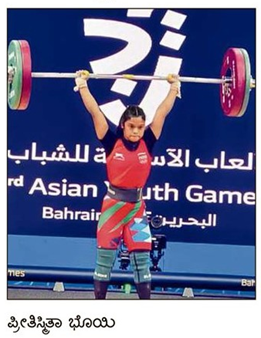
  • ಪ್ರೀತಿಸ್ಮಿತಾ ವಿಶ್ವದಾಖಲೆ

ಸಂದರ್ಭ: ಭಾರತದ 16 ವರ್ಷ ವಯಸ್ಸಿನ ವೇಟ್‌ಲಿಫ್ಟರ್‌ ಪ್ರೀತಿಸ್ಮಿತಾ ಭೊಯಿ ಅವರು ಏಷ್ಯನ್ ಯೂತ್ ಗೇಮ್ಸ್‌ನಲ್ಲಿ 158 ಕೆ.ಜಿ. ಭಾರ (66 ಕೆ.ಜಿ. + 92 ಕೆ.ಜಿ.) ಎತ್ತಿ ಚಿನ್ನ ಗೆದ್ದರಲ್ಲದೇ, ಆ ಹಾದಿಯಲ್ಲಿ ಕ್ಲೀನ್ ಆ್ಯಂಡ್‌ ಜರ್ಕ್‌ ವಿಭಾಗದಲ್ಲಿ ನೂತನ ವಿಶ್ವ ದಾಖಲೆಯನ್ನು ಸ್ಥಾಪಿಸಿದರು.

  • 44 ಕೆ.ಜಿ.ಯೊಳಗಿನ ಬಾಲಕಿಯರ ವಿಭಾಗದಲ್ಲಿ ಪ್ರೀತಿಸ್ಮಿತಾ ಅವರು ಸ್ನಾಚ್‌ನಲ್ಲಿ 66 ಕೆ.ಜಿ. ಮತ್ತು ಕ್ಲೀನ್ ಮತ್ತು ಜರ್ಕ್‌ನಲ್ಲಿ 92 ಕೆ.ಜಿ. ಎತ್ತಿದರು. ಮೊದಲೆರಡು ಯತ್ನಗಳಲ್ಲಿ ಕ್ರಮವಾಗಿ 87 ಕೆ.ಜಿ. ಹಾಗೂ 90 ಕೆ.ಜಿ. ಭಾರ ಎತ್ತಿದ್ದ ಅವರು ಮೂರನೇ ಯತ್ನದಲ್ಲಿ ಈ ಸಾಧನೆ ಮಾಡಿದರು.
  • 60 ಕೆ.ಜಿ.ಯೊಳಗಿನ ಬಾಲಕರ ಸ್ಪರ್ಧೆಯಲ್ಲಿ ಮಹಾರಾಜನ್‌ ಆರುಮುಗಪಾಂಡ್ಯನ್‌ ಅವರು ಒಟ್ಟು 256 ಕೆ.ಜಿ. (114 ಕೆ.ಜಿ. + 142 ಕೆ.ಜಿ.) ಭಾರ ಎತ್ತಿ, ಬೆಳ್ಳಿ ಪದಕಕ್ಕೆ ಕೊರಳೊಡ್ಡಿದರು.
  • ಚೀನಾದ ಶೆನ್‌ ಷುವಾನ್ಫಾ (261 ಕೆ.ಜಿ.) ಸ್ವರ್ಣದ ಪದಕ ತಮ್ಮದಾಗಿಸಿಕೊಂಡರು.

Current Affairs: 26th & 27th October 2025

  • Andhra Pradesh bracesfor cyclone as IMD issueshigh alert for 23 districts

Context: Andhra Pradesh Chief Minister N. Chandrababu Naidu on Sunday put the entire administrative machinery on high alert as the India Meteorological Department issued red and orange alerts for 23 of the 26 districts in the State in view of Cyclone Montha.

  • The IMD said the deep depression over southeast Bay of Bengal was likely to intensify into a cyclonic storm.Thereafter, it was likely to intensify into a severe cyclonic storm and was very likely to cross the Andhra Pradesh coast between Machilipatnam and Kalinga- patnam around Kakinada in the evening or night.
  • While crossing, the severe cyclonic storm could have a maximum wind speed of 90-100 kmph gusting to 110 kmph, it said.
  • According to the IMD bulletin, the deep depression lay about 780 km southeast of Kakinada and 790 km south-southeast of Visakhapatnam.
  • The Regional Meteorological Centre, Chennai, forecast light to moderate rain in a few places over the Tamil Nadu, Puducherry and Karaikal regions.
  • Heavy rain is likely to occur in isolated places in Chennai, Tiruvallur, Chengalpattu, Kancheepuram, Ranipet, Vellore, Villupuram, Kallakurichi, Cuddalore, Mayiladuthurai and Tiruvannamalai districts and Puducherry.
  • Cyclone alert has been issued for Andhra Pradesh, Yanam and adjoining South Odisha coasts so that officials could begin taking precautionary measures.
  • Red alert, which indicates a possibility of extremely heavy rainfall, has been sounded for seven districts of Andhra Pradesh — SPSR Nellore, Prakasam, Bapatla, Krishna, West Godavari, Dr. B.R. Ambedkar Konaseema and Kakinada.
  • The IMD has warned that the sea condition may be ‘very rough’ along and off the Andhra Pradesh and Yanam coasts. It would further worsen, becoming ‘very rough’ to ‘high’.
  • Montha is the third severe cyclonic storm after Asani in 2022 and Michaung in 2023 to cross the Andhra Pradesh coast.
  • During a teleconference with senior officials, Mr. Naidu reviewed the preparedness of all the departments. He instructed the officials to ensure there was no disruption to power supply, telecom connectivity, or drinking water systems.
  • Mr. Naidu urged officials of all departments to ensure there was no loss of life or property. “Alerts should be sent through SMS, social media, IVRS [Interactive Voice Response] calls, and WhatsApp. Ensure that information from the village level reaches the State control room in real time,” the Chief Minister said.
  • Mr. Naidu said State and national disaster response teams have already been deployed in the coastal districts, and that predictive models and real-time data were being used for accurate analysis.
  • Cyclone Montha: Widespread rainfall forecast till Oct. 30

Context: The India Meteorological Department (IMD), Bengaluru, has forecast fairly widespread rainfall over Karnataka for the next four days owing to Cyclone Montha.

  • “Fairly widespread rainfall is expected over Karnataka from October 27 to 30 because of the anticipated cyclone,” IMD, Bengaluru, director.
  • The IMD said that a depression over east-central Arabian Sea moved nearly south-westwards with a speed of 13 kmph during the past six hours and lay centered at 8.30 a.m .on Sunday over the same region, about 970 km west to northwest of Mangaluru.
  • For coastal Karnataka on October 27, the IMD has forecast heavy to very heavy rain and thundershowers with sustained winds at one or two places over Udupi and Uttara Kannada districts and heavy rain and thundershowers with sustained winds at one or two places over Dakshina Kannada district.
  • For north interior Karnataka, it has forecast heavy rain and thundershowers with gusty winds at one or two places over Belagavi and Dharwad districts and light to moderate rain and thundershowers at many places over Bagalkot, Bidar, Gadag, Haveri, Kalaburagi, Koppal, Raichur, Vijayapura, and Yadgir districts.
  • For south-interior Karnataka, IMD has forecast heavy rain and thundershowers with gusty winds at one or two places over Shivamogga, Chikkamagaluru, and Hassan districts.
  • “Light to moderate rain and thundershowers are likely to occur at a few places over Ballari, Bengaluru (Rural), Bengaluru (Urban), Chamarajanagar, Chickballapur, Chitradurga, Davanagere, Kodagu, Kolar, Mandya, Mysuru, Bengaluru South, Tumakuru and Vijayanagara districts,” IMD said.
  • For Bengaluru city and the neighbourhood the forecast for the next 36 hours is generally cloudy skies with light to moderate rain. It added that the maximum and the minimum temperatures are very likely to be around 27°C and 20°C respectively.
  • India-ASEAN ties making steady progress, says PM

Context: Modi says strong partnership is emerging as robust foundation for global stability, development; he announces further deepening of cooperation in the domain of maritime security in 2026.

  • India-ASEAN strategic partnership has continued to prosper despite the prevailing “era of uncertainties”, Prime Minister Narendra Modi.
  • Delivering his opening remarks virtually at the 22nd ASEAN-India summit being held in the Malaysian capital of Kuala Lumpur, Mr. Modi described ASEAN as a “cultural partner” of India, and announced further deepening of India-ASEAN cooperation in the domain of maritime security in 2026.
  • “Even in this era of uncertainties, India-ASEAN comprehensive strategic partnership has continued to make steady progress. And this strong partnership of ours is emerging as a robust foundation for global stability and development,” the Prime Minister said in his remarks that were telecast to the summit.

‘Shared values’

  • Mr. Modi welcomed Timor-Leste as the newest member of ASEAN, and said India and ASEAN together represented nearly one-fourth of the global population and the two sides were connected by “historical ties and shared values”.
  • “The 21st century is our century, the century of India and ASEAN,” he said.
  • Malaysian Prime Minister Anwar Ibrahim, who co-chaired the ASEAN-India summit, said India-ASEAN relationship was rooted in the “values of friendship, trust, and shared interests”.
  • “Among the issues and matters discussed were efforts to finalise the ASEAN-India Trade in Goods Agreement (AITIGA) and the implementation of the ASEAN-India Plan of Action 2026-2030 to strengthen cooperation in trade, investment, education, food security and technological development,” Mr. Ibrahim said.
  • He appreciated close ties between India and the ASEAN region in the fields of education, economy, and culture. Mr. Modi said the AITIGA could “unleash the full economic potential” of India-ASEAN relationship.
  • Mr. Modi said India and the ASEAN member-states in Southeast Asia were “companions in the Global South”, and promised that India would work with the ASEAN countries to advance digital inclusion, food security, and resilient supply chains “amid global challenges”.
  • The Prime Minister referred to India’s active participation in humanitarian assistance and disaster relief activities in the ASEAN region, and said that to deepen maritime relation between the two sides, 2026 would be declared “ASEAN-India Year of Maritime Cooperation”.
  • Mr. Modi mentioned the danger posed by terrorism and reminded the need for unity in fighting terror. “At the same time, we are steadily advancing our cooperation in education, tourism, science and technology, health, green energy, and cybersecurity,” he said, highlighting the “shared cultural heritage” and “people-to-people” ties between India and the ASEAN member-states.
  • While addressing the heads of governments of the ASEAN region, Mr. Modi conveyed his condolences to the Royal Family and the people of Thailand on the passing of the Queen Mother.
  • The ASEAN summit began with the arrival of heads of the member-countries as well as President Donald Trump of the United States.
  • U.S. seeks stronger ties with Pakistan, but not at India’s expense, says Rubio

Context:  The U.S. sees an opportunity to expand its strategic relationship with Pakistan but it will not be at the expense of its historic and important ties with India, U.S. Secretary of State Marco Rubio has said.

  • Ahead of his meeting with External Affairs Minister S. Jaishankar in Kuala Lumpur on Monday, Mr. Rubio, referring to India’s energy ties with Russia, said New Delhi has already expressed a desire to diversify its procurement of crude oil.
  • The U.S. Secretary of State was interacting with journalists ahead of his trip to Malaysia for the ASEAN summit.
  • Mr. Rubio, to a question on the U.S. ties with Pakistan, said New Delhi is “concerned for obvious reasons” and that Washington’s relationship with Islamabad will not be at the expense of the ties with New Delhi.
  • “But, I think they (India) have to understand we have to have relations with a lot of different countries. We see an opportunity to expand our strategic relationship with Pakistan,” he said.
  • “I think the Indians are very mature when it comes to diplomacy and things of that nature. Look, they have some relationships with countries that we don’t have relationships with. So, it’s part of a mature, pragmatic foreign policy,” he said.
  • “I don’t think anything we’re doing with Pakistan comes at the expense of our relationship or friendship with India, which is deep, historic, and important,” Mr. Rubio added.
  • The U.S.-Pakistan ties have witnessed an upswing in the last six months, especially after President Donald Trump’s meeting with Pakistan Army chief Field Marshal Asim Munir following the military conflict between India and Pakistan in May.

India-Russia oil trade

  • To another question on if India will be willing to really shove off its purchases of Russian oil for a trade deal with the U.S., Mr. Rubio said New Delhi has already expressed an interest in diversifying its oil portfolio.
  • U.K. interested in e-Courts project; team to visit India next week

Context: The United Kingdom has evinced interest in the e-Courts project that seeks to digitise entire court records, and a delegation from that country would be in the national capital next week to interact with top Union Law Ministry officials.

  • The ambitious e-Courts project is currently in its third phase with an aim to upgrade the digital infrastructure of subordinate judiciary across the country.
  • Officials said a delegation from the United Kingdom will visit the Department of Justice here on November 6 and interact with top officials and members of the e-committee of the Supreme Court.
  • The e-committee is the governing body charged with overseeing the e-Courts Project conceptualised under the “National Policy and Action Plan for Implementation of Information and Communication Technology (ICT) in the Indian Judiciary-2005”.
  • Under the ongoing phase three of the project, a total of 3,108 crore documents will be digitised.
  • As part of Phase-III, the system will be migrated to cloud technology, and the cost estimated for providing 25 petabytes (according to existing requirement) of cloud storage is ₹1,205.20 crore.
  • The project also seeks to establish and expand the scope of virtual courts for the hearing of cases by creating a robust digital infrastructure. A sum of ₹413.08 crore is the cost estimate for the establishment of 1,150 virtual courts.
  • Phase three of the project was cleared by the Union Cabinet in September 2023.
  • Japan seeks Indian workers but people-to-people ties lag

Context: Japan, with one-third of its population over the age of 65, requires a workforce, academics for research, and a market for its goods, while India, with 65% of its 1.4 billion population under 35, faces rising pressure to create opportunities for its youth.

  • Since 1981, when Suzuki Motor Corporation set up a factory in India to manufacture the Maruti car, the Japanese company has been a byword for bilateral ties, Kenichi Ayukawa, executive vice-president and chief global marketing officer, who headed Maruti Suzuki operations in India from 2013 to 2022, says.
  • Suzuki was among the first to bring Japanese engineers to India to streamline processes and train Indian workers to build the car. With both New Delhi and Tokyo seeking solutions to Japan’s ageing population and India’s burgeoning youth population, the company is now reversing that trend.
  • “Suzuki is now trying to invite a lot of Indians to Japan, training them and helping them develop technology in Japan,” Mr. Ayukawa said, accompanied by Indian scholar and Suzuki executive Chandrali Sarkar. Ms. Sarkar first came to Japan to study at Keio University and has been working on India operations at Suzuki’s Hamamatsu headquarters, about 250 km from Tokyo, since 2022. She noted that while some hesitation among Indians stems from limited Japanese language skills, the broader challenge is unfamiliarity with Japan.
  • “Japan should know more about India and vice versa. Especially the next generation needs to connect, and we need more Indian students, engineers, professionals to come to Japan,” said Kenji Hiramatsu, Chairman of the Institute for International Strategy at The Japan Research Institute (JRI), and Japan’s Ambassador to India from 2015 to 2019. “It is important that we change the mindset of Indian youth that Japan is a special partner for India,” he added, noting that the current number of Indians studying in Japan is far below its potential.

Japan opens doors

  • According to a parliamentary response from the Indian Ministry of Education last year, Japan ranks 34th among countries where Indian students pursue higher education. Only about 1,500 Indian students are currently registered in Japan, a small fraction of more than 3.3 lakh foreign students in the country.
  • Employment figures are similarly modest: about 54,000 Indians work in Japan, one-fourth of the 2.3 lakh Nepali citizens among a total of 23 lakh foreign workers.
  • To address this shortfall, Japan is preparing to open its doors to thousands like Ms. Sarkar under an “Action Plan” launched by Prime Minister Narendra Modi and former Japanese Prime Minister Shigeru Ishiba in August. The plan aims to facilitate five lakh workforce exchanges over the next five years, including the movement of 50,000 skilled personnel from India to Japan.
  • Officials in the Cabinet Secretariat and the Ministry of Foreign Affairs point to the “perfect complementarity” between the two countries. Japan, with one-third of its population over the age of 65, requires a workforce, academics for research, and a market for its goods. India, with 65% of its 1.4 billion population under 35, faces rising pressure to create opportunities for its youth amid stricter immigration policies in the U.S., Canada, and Europe, and Chinese restrictions on high-tech and semiconductor exports.
  • Despite decades of growing government-to-government and business-to-business ties, the officials said, people-to-people connections between India and Japan continue to lag.
  • Satellite for armed forces to be launched next week

Context: The Indian Space Research Organisation (ISRO) will launch military communications satellite CMS-03 on November 2 from the Satish Dhawan Space Centre in Sriharikota.

  • The CMS-03 communication satellite, also known as GSAT-7R, will be launched by the Launch Vehicle Mark 3 (LVM3).

Heavy satellite

  • “CMS-03 is a multi-band communication satellite that will provide services over a wide oceanic region including the Indian landmass. CMS-03, weighing about 4,400 kg, will be the heaviest communication satellite to be launched to Geosynchronous Transfer Orbit (GTO) from Indian soil,” the ISRO said.
  • The launch vehicle has been fully assembled and integrated with the spacecraft, and has been moved to the launch pad on Sunday for further pre-launch operations, it added.
  • The launch of CMS-03 will be the first by the LVM3 rocket in over two years. The last time the rocket was deployed was in July 2023 to launch the historic Chandrayaan-3 mission from Sriharikota.
  • Prepare for Janjatiya Gaurav Divas in November, Centre tells States

Context: In the run-up to the fifth Janjatiya Gaurav Divas on November 15, which will mark the end of tribal icon Birsa Munda’s 150th birth anniversary, the Union government has written to the States, including poll-bound Bihar, and Union Territories, saying they “must organise” commemorative events at the State and district levels from November 1 to 15.

  • In a letter sent to the Principal Secretaries of Tribal Welfare Departments in the States and Union Territories last week, the Tribal Affairs Ministry said that since November 15 marked the end of Birsa’s 150th birth anniversary year, “all the States/UTs must participate in celebrating” the occasion.
  • “However, States where the model code of conduct is in force are being requested to celebrate the Diwas adhering to the MCC.”
  • The letter asked the States and Union Territories to “actively participate” in “inauguration or benefit disbursal targeting tribal populations, launch of tribal-focused schemes, capacity building” and highlighting government schemes such as PM-JANMAN, Dharti Aba Janjatiya Gram Utkarsh Abhiyan, and Adi Karmayogi Abhiyan.
  • The letter said that for the national-level event at this year’s Janjatiya Gaurav Divas, Prime Minister Narendra Modi is expected, and participation has been requested of 25 States and Union Territories, excluding Bihar.
  • In the suggested activities annexed with the Tribal Affairs Ministry’s letter, the government has recommended the display of “Tribal Village Vision 2030” documents prepared under the Adi Karmayogi scheme, interactions of State VVIPs with PM-JANMAN beneficiaries, and painting exhibition of artworks by students of Eklavya school for tribal students. The list also recommends events like Adi Haats for products made by Van Dhan Vikas Kendras, self-help groups, and tribal artisans.
  • The government has also suggested that the States and Union Territories hold campaigns for saturation of individual entitlements and contests in schools, colleges, to celebrate tribal heritage, in addition to arranging health awareness campaigns through Mobile Medical Units.
  • Piyush Goyal to visit Brussels today as India-EU trade talks intensify

Context: Union Commerce and Industry Minister Piyush Goyal will visit Brussels on October 27 and 28 to hold high-level discussions with his counterpart in the European Union (EU) to provide “strategic direction and political impetus” to the ongoing negotiations on a free trade agreement between India and the European Union.

  • At the same time, a delegation of the European Parliament Trade Committee will be in New Delhi from October 27 to 29 to enhance “mutual understanding amid intensive trade negotiations between the EU and India”.
  • According to the Ministry of Commerce and Industry, Mr. Goyal’s visit to Brussels and meeting with Maroš Šefčovič, Executive Vice-President and European Commissioner for Trade of the European Union, comes at a “crucial stage” in the negotiations.

‘Will cover key areas’

  • “Building on the momentum generated by the 14th round of negotiations held earlier this month, the Minister’s visit aims to provide strategic direction and political impetus to the talks,” the Ministry said in a release.
  • “Discussions are expected to cover key areas of the proposed FTA, including market access, non-tariff measures, and regulatory cooperation,” the release added. “The visit will also serve to review progress achieved so far and to identify areas requiring further convergence.”
  • Mr. Goyal will hold a bilateral meeting with Mr. Šefčovič, which will be followed by a working dinner.
  • This will not be considered a formal round of negotiations, but a continuation of discussions.
  • While discussions were ongoing between India and the EU, the next formal round of negotiations had not yet been finalised as the issues holding up the deal required continuous communication rather than waiting for a formal round.
  • These issues included market access, regulatory cooperation and agricultural sensitivities.
  • The delegation of the Trade Committee will include seven members of the European Parliament, according to a press release issued by the European Parliament.
  • “The main objective of this visit is to contribute to increasing our mutual understanding amid intensive trade negotiations between the EU and India,” the co-heads of delegation Cristina Maestre and Brando Benifei said in a joint statement. “The mission is timely taking place just a few months ahead of the deadline to conclude negotiations for a Free Trade Agreement by the end of 2025.”
  • During their visit to India, the delegation will meet a variety of stakeholders.
  • Hanle protects its dark skies and builds a future on stargazing

Context: With the motto ‘come for the mountains, stay for the stars,’ the Hanle Dark Sky Reserve is showing how the Himalayan skies are being preserved today and will be carried forward for future generations, with thousands of new visitors also lending a helping hand to the local economy.

  • Astronomy is the oldest of the sciences. The sky is a free resource, and those who live away from city lights are fortunate to enjoy it for their passion, imagination, and even livelihoods.
  • That’s the story of Hanle, a small Himalayan village that hosts one of the darkest skies in the world. Its Bortle-1 skies — the highest clarity rating on a nine-point scale — seem to say astronomy is for everyone.
  • Located in Ladakh, Hanle is now protected as India’s first dark sky reserve. It’s managed as part of a memorandum of understanding between the Indian Institute of Astrophysics (IIA) in Bengaluru, the Union Territory of Ladakh, and the Ladakh Hill Development Council in Leh. Once a region of nomadic people, Hanle is now emerging as a stargazing destination.
  • A dark sky reserve is a designated area with an exceptionally clear sky, and maintained that way by minimising light pollution. The Hanle Dark Sky Reserve, a unique government-funded and science-driven sustainable development initiative, is located within the Changthang Wildlife Sanctuary, surrounding the Indian Astronomical Observatory, a research facility operated by IIA.
  • The Observatory hosts two optical telescopes, the Himalayan Chandra Telescope and the GROWTH India Telescope (with IIT Bombay), and two Cherenkov telescopes — the High Altitude Gamma-Ray Telescope Array (with the Tata Institute of Fundamental Research) and the Major Atmospheric Cherenkov Experiment (with the Bhabha Atomic Research Centre).
  • “Countless clear sky nights, fewer atmospheric particles that absorb the celestial objects’ light, and low light pollution make Hanle an ideal location for astronomical observations,” Dorje Angchuk, the engineer-in-charge of the Observatory, said.
  • To minimise light pollution at the reserve, the IIA has distributed lamp shades, blackout curtains, and bulbs of warm tones to all homes and infrastructure in the village, Mr. Angchuk said. In support of astrotourism, IIA scientists have trained 25 local youth, 18 of whom are women, as “Astronomy Ambassadors.” These ambassadors are equipped with telescopes and taught basic astronomy concepts. The night-sky tours they lead for visitors help them with a part-time income.
  • Why has IUCN red-flagged the Western Ghats?

Context: The expansive Western Ghats and two national parks in India — Assam’s Manas national park and West Bengal’s Sundarbans national park — have been categorised as being of “significant concern” in the International Union for Conservation of Nature’s (IUCN) list of natural World Heritage sites across Asia.

Why did the IUCN state?

  • The IUCN’s World Heritage Outlook 4 report released earlier this month attributes four threats to the loss of habitats and species in South Asia: climate change, tourism activities, invasive alien species, and roads. The report categorises the natural sites as “good”, “good with some concerns”, “significant concern”, and “critical”. The report uses four cycles of conservation assessments undertaken since 2014.
  • “Each of these categories not only shows the potential for a site to preserve its values and underlying attributes but also indicates the urgency of measures that need to be taken to improve the conservation outlook and ensure the long-term conservation of all sites,” says the report. The IUCN assessment of over 200 natural and mixed World Heritage sites “offers the most in-depth analyses of threats facing natural World Heritage around the world and their protection and management status,” says Grethel Aguilar, IUCN director general, in the introduction to the report.
  • The report points out that the percentage of sites with “a positive conservation outlook has, for the first time, decreased significantly.”

Do we have ‘good’ protected areas?

  • Protected areas in South Asia are being usurped rapidly, obliterating natural habitats. Of the 228 sites assessed since 2014, some 63% of sites had a positive outlook in 2014, 2017 and 2020, however, ‘the IUCN World Heritage Outlook 4 shows that in 2025 only 57% of these sites have a positive conservation outlook.”
  • The threats are also shapeshifting, “it is …notable that roads and railroads are now among the top five greatest threats to natural World Heritage in Asia, while in 2020 this was not the case.” The other threats include: forest fires, hunting, roadkill, waste disposal, encroachment, illegal logging etc.
  • Of the 32 Asian sites categorised as “good with some concerns,” four happen to be in India — The Great Himalayan National Park Conservation Area, Kaziranga National Park, Keoladeo National Park, and Nanda Devi and Valley of Flowers National Parks. Khangchendzonga National Park in Sikkim has been rated “good” in its conservation outlook, valuing “attributes [that] are currently in good condition and likely to be maintained for the foreseeable future, provided that current conservation measures are maintained.”
  • The Western Ghats, a mosaic of forests and grasslands, are older than the Himalayas and have an exceptionally high level of biological diversity and endemism, habitat to some 325 globally threatened (listed in IUCN’s Red List) flora, fauna, bird, amphibian, reptile and fish species, according to UNESCO. This includes the Nilgiri tahr, a stocky, agile goat found nowhere else in the world.

What makes the Ghats vulnerable?

  • The Western Ghats are highly endangered not least by hundreds of hydropower projects such as the proposed ₹5,843 crore Sillahalla Pumped Storage Hydroelectric project in the Nilgiris, which involves constructing dams across River Sillahalla and River Kundah, with an aim to generate 1,000 MW of power for Tamil Nadu’s plains.
  • Moreover, tourism is creating problems of garbage, often consumed by wild animals such as elephants and exacerbating conflict. Plantations are replacing natural ecosystems. And climate change has forced fauna to adapt by redistributing themselves from fast-warming lower altitudes to higher reaches, such as in the case of the Nilgiri flycatcher and the black and orange flycatcher. Exotic species are colonising natural forests, such as eucalyptus and acacia (both originally from Australia), which were introduced here during the colonial era. As for the Sundarbans mangroves where tigers swim, salinity, heavy metal contamination, and unsustainable resource extraction threatens the ecosystem. Sea level rise and frequent storm surges reduce mangrove biodiversity, says the report.

Is there hope yet?

  • Outside India, seven sites in China have been proclaimed “best protected and managed protected areas,” including the Badain Jaran Desert-Towers of Sand and Lake, Chengjiang Fossil Site, and Mount Huangshan.
  • The Natural World Heritage sites make up less than 1% of the Earth’s surface, but nurture more than 20% of mapped global species richness. “This includes over 75,000 species of plants, and over 30,000 species of mammals, birds, fishes, reptiles and amphibians,” says the report.

This report is timely. “The world has agreed to halt biodiversity loss through the Kunming-Montreal Global Biodiversity Framework, and the UNESCO World Heritage Convention is uniquely placed to meet these challenges by bridging the gap between nature and culture, and protecting places with extraordinary biodiversity, functional habitats and high ecosystem integrity,” says the report. “This report is more than a health check. It is a guide for action,” says Ms. Aguilar.

Current Affairs: 25th October 2025

  • Imminent need to overhaul Karnataka Cooperative Societies Act: High Court

Context: Observing that “numerous incongruities pervade the Karnataka Cooperative Societies (KCS) Act, 1959 and the KCS Rules, 1960”, the High Court of Karnataka has said that there is an imminent need to overhaul this law, which has become “a patchwork of a series of piecemeal amendments over the decades and no longer suited to the modern socio-economic environment”.

  • Pointing out that disputes relating to membership, disqualification, voter eligibility, appointment of administrators, and surcharge proceedings have time and again required judicial intervention in a large number of litigations to harmonise contradictory provisions of the KCS Act and the Rules, the court said recurring litigation indicated a systemic defect in the legislative framework itself. Justice Suraj Govindaraj made these observations while dealing with voter list and other issues related to holding elections to a multi-purpose primary rural agricultural cooperative society, Idagundi in Yellapur taluk of Uttara Kannada district.
  • “The courts have attempted to apply the principle of harmonious construction in resolving the issues under this law, but where reconciliation itself becomes impossible, legislative reform is the only viable solution,” the court said.
  • “It is therefore my considered opinion that a comprehensive overhaul of the statute is urgently required. Much like The Income-Tax Act, 1961 is being replaced by the Income-Tax Act, 2025… on account of the I-T Act, 1961 having been amended over 65 times in six decades had become overly complex,” observed Justice Govindaraj.
  • As the new I-T law, which largely retains existing tax principles, aims to simplify the text and remove redundant provisions to reduce litigation and make compliance easier for taxpayers, a new, consolidated KCS Act for Karnataka is required to replace the current legislation, the court emphasised.
  • “Just as the Companies Act was comprehensively revamped to address contemporary requirements, a modernised co-operative law must be framed to ensure efficiency, transparency, and alignment with constitutional principles of cooperative autonomy. Without such reform, cooperatives will remain entangled in unproductive litigation, stifling their true purpose of empowering members economically and socially,” the court observed.

Many areas of conflict

  • The areas of conflict in the KCS Act and the Rules are manifold, like membership rights and disqualification, preparation of voter lists, conduct of elections, appointment of administrators, jurisdictional overlaps, surcharge proceedings, and audit obligations, the court said while pointing out that many provisions have been rendered otiose by technological and socio-economic changes. The court also requested the Karnataka State Law Commission to look into the issue and take appropriate action.
  • PM SHRI signing a tactical decision: Minister

Context: Minister for General Education V. Sivankutty described Kerala’s decision to sign up for the Centrally sponsored PM School for Rising India (PM SHRI) scheme as a “tactical” move designed to overcome denial of school education funds to the State by the Union government.

  • At a press conference held to explain the State government’s position in the wake of strident opposition from coalition partner Communist Party of India (CPI) and others, Mr. Sivankutty said Kerala would continue its fight against the Union government policies of implementing Rashtriya Swayamsevak Sangh’s (RSS) agenda through education. However, the government was not ready to give up on funds for Samagra Shiksha and other projects, especially when the State was facing financial constraints, he said.
  • The Minister said the State had lost ₹188.58 crore in the 2023-24 financial year and ₹513.54 crore in 2024-25. It was due ₹456.01 crore this financial year. This totalled ₹1,158.13 crore.
  • The PM SHRI scheme would wind up by March 2027, he said. By signing the Memorandum of Understanding (MoU) for PM SHRI, the State would get the arrears due to Samagra Shiksha Kerala and two years of PM SHRI funds, which together came to 1,476.13 crore.
  • Responding to criticism that by signing up for PM SHRI the State had accepted the National Education Policy (NEP), 2020, the Minister said the argument was purely technical.
  • The Union government had declared in October 2022 that the objective of Samagra Shiksha was to help implement the NEP, he said. Even when the State had received Central funds till 2023, it had implemented schemes in keeping with the State’s interests. There would be no change in that position, he said.

CPI opposition

  • The Communist Party of India (CPI) State secretariat on Friday expressed its “profound disquiet” over the government inking the MoU for the PM SHRI keeping the Left Democratic Front (LDF) and the Cabinet “in the dark.”
  • Baker’s yeast has the resilience to withstand Martian environment, find researchers

Context: Researchers from the Department of Biochemistry, Indian Institute of Science (IISc) and collaborators at the Physical Research Laboratory (PRL), Ahmedabad, have found that Baker’s yeast (Saccharomyces cerevisiae) has the resilience to withstand harsh conditions found in the Martian environment.

  • Baker’s yeast (Saccharomyces cerevisiae) is an indispensable ingredient in making bread, beer, and biotechnology products. IISc said that this organism holds clues to how life could survive in extraterrestrial conditions and the findings underscore how baker’s yeast could serve as an excellent model for India’s efforts in astrobiology research.
  • It said that the team exposed yeast cells to high-intensity shock waves — similar to those produced by meteorite impacts on Mars — and perchlorate salts, which are toxic chemicals found in Martian soil.
  • Using a High-Intensity Shock Tube for Astrochemistry (HISTA) in Bhalamurugan Sivaraman’s lab at PRL, they simulated shock waves reaching Mach 5.6 intensity. The team also treated yeast cells with 100 mM sodium perchlorate either in isolation or in combination with the shockwaves.
  • “One of the biggest hurdles was setting up the HISTA tube to expose live yeast cells to shock waves — something that has not been attempted before — and then recovering yeast with minimum contamination for downstream experiments,” said lead author Riya Dhage.
  • IISc said that the yeast cells survived when treated with shock waves and perchlorate, although the cells’ growth slowed down.

Key to resilience

  • “The likely key to their resilience lies in their ability to produce ribonucleoprotein (RNP) condensates — tiny, membrane-less structures that help protect and reorganise mRNA when the cells are under stress. Shock waves triggered the assembly of two types of RNPs called stress granules and P-bodies, while perchlorate exposure led to the generation of P-bodies alone. Yeast mutants that were unable to form these structures were far less likely to survive,” IISc said.
  • It added that the results show how RNP condensates may act as biomarkers for cellular stress under extraterrestrial conditions.
  • “What makes this work unique is the integration of shock-wave physics and chemical biology with molecular-cell biology to probe how life might cope with such Mars-like stressors,” said Ms. Dhage.
  • “We hope that this study will galvanise efforts to have yeast on board in future space explorations,” said Purusharth I. Rajyaguru, Associate Professor, Department of Biochemistry.
  • Trouble in ‘soy State’

Context: Madhya Pradesh is India’s largest soybean producer, but young farmers are losing interest in farming, facing key issues such as improper implementation of minimum support price, seed quality, input cost and the possibility of the import of soybean and soybean meal from the United States.

  • The oilseed was quite new to farmers in this area even though others in the State had been sowing it as far back as the late 1970s and early 1980s.

The reasons are many:

  • Issues that ranged from climate change to the import-export policies of the Union Government. “The yield is very low.
  • The price is also almost a ₹1,000 less used to be 15 years ago.
  • Do not have any other alternative crops here as maize, a popular alternate crop, is what the nilgai likes.” The nilgai (Boselaphus tragocamelus) is an antelope species which farmers consider to be a nuisance as it destroys crops.
  • Import of soybean from the United States: “The government is already importing soybean oil and other edible oils. But if soybean is imported from the U.S.,crisis will deepen. The government should set its import-export policy right.

The MSP issue

  • There is another issue that he and other farmer leaders are engaged with, which is proper implementation of the minimum support price (MSP) and procurement by the government in local markets.
  • In the ongoing kharif season, the government had announced 5,328 as the MSP for a quintal of soybean. But in the Chhawani grain market of Indore, farmers have been selling their produce for as low as 3,000 per quintal.
  •  “The government had promised MSP, but we are not getting even half the MSP after the harvest.
  • Soybean cultivation gives huge losses. Both the Centre and State governments claim that they have doubled the income of farmers.
  • The Union Government, in a statement on October 6, 2025, had said that the country’s overall oilseed sowing area, during the 2025 kharif season, had decreased by 10.62 lakh hectares compared to the previous year. The decrease in soybean alone was 9.1 lakh hectares. Madhya Pradesh is India’s largest soybean producer — over 40% — harvesting about 52 lakh metric tonnes (LMT) from about 53 lakh hectares.
  • Farmers are not recovering even the input cost which is the reason for the decrease in cultivation.
  • Earlier used to cultivate coarse cereals, millets and pulses earlier but switched to soybean based on what the government presented to them — soybean cultivation was linked to ensuring self-reliance in edible oil requirements and in meeting the protein needs of a huge population dependent on vegetarian food.
  • “Now the prices of millets and pulses have increased and the prices of soybean have come down. We should not have shifted to soybean”.

The threat of imports

  • The Executive Director of the Soybean Processors Association of India (SOPA), D.N. Pathak, has seen both the growth and the crisis in the soybean sector. He believes that any shortage in its cultivation will have a direct impact on protein availability as soybean in India is not an oilseed crop. Pathak said, “Only 18% or 19% of the soybean is used to make oil. It is basically a protein crop.” He said SOPA has been requesting the government to ensure that farmers get the correct price. “Productivity is low. It has been low for the last 30 to 40 years. It has not improved. A lot needs to be done to improve productivity. The industry should also work there. The government should certainly make efforts,” he said.
  • Pathak said that talk about the import of soybean was being floated by an import lobby with vested interests.
  • A trained professional in electronics, Pathak joined SOPA in 1994, as he had a deep interest in agriculture. It comes as no surprise as his family of farmers is from Uttar Pradesh. “We need about 7 million tonnes to 8 million tonnes of soybean meal,” he says. “This means that we must crush about 100 lakh tonnes of soybean, which is our production now. If we grow more, we export. But we cannot compete because our MSP is so high. So, if somebody were to bring soybean from the U.S., what will happen to this soybean which our farmers grow? Or is there a suggestion that we should not grow soybean? U.S. soybean is roughly $380 a tonne. Our soybean is $620 per tonne. So should we bring U.S. soybean at $380?”

The advent of soybean in the State

  • In the 1980s, Madhya Pradesh first tried black soybean. The present variety, which is yellow soybean, reached farms by the first decade of 2000.
  • Earlier, cooperative societies used to procure soybean till the end of the 1990s and production was good too.
  • Losses: The biggest issue was the seeds. Low quality seeds resulted in a decrease in production and companies began to queue up offering fertilizers and pesticides to enhance production. But this did not work. Rather than it being from lab to land, seeds are coming from market to land,” he said.
  • “Cultivation is down and yield is less. Traders are also worried about the future of soybean. The Bhavantar scheme is not helping farmers. Unless soybean meal is exported, it will be difficult to survive. If U.S. soybean comes here, it will be a double blow,” he said. Kailash said some farmers are keeping soybean for three to four years expecting that the prices will improve as export picks up. According to SOPA, on an average, India exports about two million tonnes of soybean meal; in this season, it could go down by 1.8 million tonnes. SOPA states that the reason for lack of demand for Indian soybean is its higher price.
  • The Chhawani market is one of the biggest soybean markets in India. During the season, traders handle about 2,000 tonnes to 2,500 tonnes of soybean a month. Said Kailash, “Traders of this market brought yellow soybean and provided it to farmers for cultivation after the 1990s. The best time was between 1995 to 2015 when we used to get 6,000 tonnes per month.”
  • Varun, a former secretary of the market, nodded in agreement. According to him, traders in the market deal with buyers from across the country. “We have a membership of about 1,500 traders. There are a lot of workers too in this market. The fluctuations in the soybean market have impacted traders. They are losing revenue. Such fluctuations are basically from the policies of the government. The import policy of the government is a problem. If the government allows imports of soybean, it will be a major problem.”

A reposing of faith in soybean

  • In another part of Indore, despite the sentiment and arguments expressed from the ground, the scientific community has not lost hope in soybean and its future. The Director of the Indian Council of Agriculture Research (ICAR)’s Indian Institute of Soybean Research, Kunwar Harendra Singh said: “From only 30,000 hectares during the 1970s, the country has now more than 12 million hectares under soybean cultivation. You will not see any other crop having expanded in such a way. So this is the big achievement as far as this crop is concerned.”
  • He said that the present decrease in the area of sowing is primarily due to a decline in prices. “The government has been increasing the MSP, but the market rates were declining very fast. And then, other options like maize are in demand,” he said. “This is the only plant based group which has 40% protein… This needs the attention of the government and also different industries to create the awareness on how to use this good quality protein,” he added, pointing to the need for more research on the use of soybean as a human food.
  • “The crop basically belongs to China, and in India earlier, only a few States such as Himachal Pradesh, Uttarakhand and some of the northeastern States used to cultivate it. “More than 90% of soya is being used for cattle feed. We do not have value-added products. We can make different nutritional powders from this. But the industry has to come forward for that.”
  • Gyan Bharatam Missionto ink pact with institutes

Context: It is a flagship initiative of Culture Ministry for identifying, digitising, preserving, and promoting India’s manuscripts; the institutes will be categorised as cluster centres and independent centres.

  • The Gyan Bharatam Mission on manuscripts, under the Union Culture Ministry, will sign Memorandums of Understanding with around 20 institutes across the country for conservation, upkeep, and digitisation of manuscripts.
  • While the 20 institutes will sign the MoUs on Saturday, 30 more will do so over the next few days, a senior official of the Union Culture Ministry. Some of these institutes are Asiatic Society Kolkata, University of Kashmir, Srinagar, Hindi Sahitya Sammelan, Prayagraj, and Government Oriental Manuscript Library, Chennai.
  • Gyan Bharatam is a flagship initiative of the Ministry of Culture for identifying, documenting, conserving, digitising, preserving, and promoting India’s vast manuscript heritage.
  • It was announced during the Union Budget this year.
  • The mission’s mandate is to preserve and establish a dedicated digital platform — known as the National Digital Repository (NDR) — to share India’s manuscript heritage worldwide.
  • The institutions set to sign MoUs have been categorised into cluster centres and independent centres.
  • In the case of a cluster centre, the institution shall be responsible for executing all manuscript-related activities of its own centre, as well as those of its designated cluster partner centres, which shall not exceed 20. In the case of the independent centres, the institution shall be responsible for executing all manuscript-related activities pertaining solely to its own collection.
  • Gyan Bharatam shall provide the overarching framework, guidance, monitoring, and support for the execution of activities under this partnership. In addition, it shall also provide funding, necessary equipment, and budgetary allocations to the designated Centres, subject to approval of work plans, milestones, and quality verification.
  • The various activities to be provided by the institutes with GB’s support have been categorised into survey and cataloguing, conservation and capacity building, technology and digitisation, linguistics and translation, research, publication, and outreach.
  • The centres have also been asked to constitute a dedicated Gyan Bharatam Cell experienced in each vertical, in the spirit of voluntary service, to represent the Centre with sincerity, while also serving as a vital channel of communication to foster collaboration and ensure smooth coordination.

Funds in instalments

  • As far as finances are concerned,funds shall be released in phased instalments in accordance with the implementation schedule and milestones outlined in the approved work plan.
  • The first instalment (70%) shall be disbursed upon the annual budget, the second (30%) instalment shall be released only upon submission of progress reports, detailed financial report, submission of utilisation certificates (UCs) and other important documents.
  • Manipur Nagas declare restrictions ahead of Muivah’s visit to Senapati

Context: The Nagas in Manipur have declared a ‘Genna’ in honour of National Socialist Council of Nagalim (NSCN) leader Thuingaleng Muivah ahead of his visit to the State’s Senapati on October 29.

  • Genna, in Naga culture and traditions, refers to restrictions to ensure maximum participation when a national holiday or an important day for the community is observed.
  • The NSCN is also referred to as the Isak-Muivah faction of the National Socialist Council of Nagaland, or NSCN (I-M).
  • The United Naga Council (UNC), the apex Naga organisation in Manipur, issued a statement on Friday, declaring ‘Genna’ in Senapati “on the occasion of the civic reception in honour” of Mr. Muivah, the Ato Kilonser or “Prime Minister” of the “government” run by the NSCN (I-M). The UNC referred to Senapati as Tahamzam, a Naga name.
  • Senapati, the headquarters of the Naga-majority district with the same name, is about 60 km north of Manipur’s capital, Imphal.
  • The UNC said the ‘Genna’ requires all educational institutions and shops in Senapati to remain closed on the day of Mr. Muivah’s visit.
  • The council also asked all community members to abstain from all other forms of economic and commercial activities, participate in community gatherings and programmes to celebrate the occasion.
  • EC warns parties against misuse of AI-generated content during elections

Context: Ahead of the upcoming Bihar Assembly election, the Election Commission on Friday issued an advisory to all political parties on responsible use and disclosure of synthetically generated information and AI-generated content during election.

  • In a letter to the heads of all political parties, the poll body said that it had been brought to its notice that “the misuse of hyper-realistic synthetically generated information, including depicting political leaders making electorally sensitive messages, is contaminating the level-playing field in the electoral arena, disrupting fair and equal conditions for all political participants, which is a sine qua non for preserving the integrity of the political campaigning during elections”.
  • “The use of technology for creating, generating, modifying and altering information and publishing and transmitting synthetically generated information is a deep threat and challenge because of its ability to masquerade as truth and unwittingly trap political stakeholders into incorrect conclusions and therefore, ECI finds it particularly imperative to ensure that transparency and accountability are maintained to preserve electoral integrity and voter trust,” the letter said.

Previous guidelines

  • The EC had issued detailed guidelines in May last year just before the general elections regarding responsible and ethical use of social media platforms, and an advisory, dated January 16, 2025, specifically addressing concerns around labelling of synthetic and AI-generated content used by political parties for election campaigning. The poll body asked political parties, candidates, and campaign representatives to ensure that any AI- generated or AI-altered image, audio, or video used or disseminated for campaigning purposes shall bear a clear, prominent, and legible label such as “AI-Generated”.
  • RBI may limit banks’ market exposure

Context: The regulator has proposed that the total direct exposure to capital markets and acquisition financing be capped at 20% of their tier-1 capital. India’s central bank proposed limits to banks’ lending against stocks, bonds in capital markets, and for corporate acquisitions to ensure that lenders keep such businesses in check.

  • The Reserve Bank of India (RBI) issued a draft circular proposing that banks’ total direct exposure to capital markets and acquisition financing be capped at 20% of their tier-1 capital, weeks after it said it would ease restrictions on funding mergers and acquisitions.
  • Earlier this month, the regulator allowed banks to fund acquisitions and raised the cap on loans for buying shares at initial public offerings, as part of a raft of measures to boost bank lending in the world’s fifth-largest economy.
  • It had also permitted unfettered bank lending against listed debt securities, and raised the limit for lending against equity shares from ₹2 million to ₹20 million.
  • The RBI proposed that banks’ aggregate capital market exposure, including direct as well as indirect exposure through funds and guarantees, among others, should not exceed40% of their tier 1 capital, and the exposure towards acquisition finance shall not exceed 10%. Tier 1 capital, the highest-quality capital of a bank, includes equity, retained earnings, and certain instruments that can absorb losses.
  • The changes allow domestic banks to lend for acquisitions by Indian corporates, a segment so far cornered by foreign lenders and credit funds.
  • In its proposed rules for acquisition finance, the RBI said that banks may finance a maximum of 70% of the deal value, with at least 30% to be funded by the acquiring company.
  • It said that commercial banks can offer acquisition finance only to listed entities that have a satisfactory net worth and been profitable for the last three years, adding that the loan should be fully secured by the shares of the target company.

NBFCs’ risk-weight

  • Separately, it proposed revised risk-weight guidelines for non-banking financial companies’ infrastructure loans, a move that could lower capital requirements for lenders financing established projects.
  • Advertising veteran Piyush Pandey passes away at 70

Context: The former chief creative officer, worldwide, and executive chairman of Ogilvy India was known to break Western influence on Indian advertising by popularising Hindi in ad films and taglines that caught the fancy of the masses.

  • He was credited with blockbuster campaigns such as the Fevicol bus ad, the fish catch ad for Fevikwik, Pug and Zoozoos campaigns for Vodafone, Har Ghar Kuch Kehta Hay campaign for Asian Paints, Kuch Khass Hay for Cadbury, Chal Meri Luna for Kinetic and the Abki Baar Modi Sarkar ad campaign for the BJP to name a few.
  • Born in Jaipur in 1955, Mr. Pandey did his schooling in the city and moved to New Delhi, where he did his post graduation at St. Stephen’s College.
  • Japan’s new PM commits to higher defence spend, ties with India, Quad

Context: Takaichi said she ‘looks forward’ to promoting the Japan-India Strategic and Global Partnership; ‘in order to promotethe main pillar of Tokyo’s diplomacy, a Free and Open Indo-Pacific, India is a crucial partner,’ says an Assistant Minister.

  • In a dramatic announcement three days after she was sworn in, Japanese Prime Minister Sanae Takaichi said her government will ensure that Japan’s defence spending would increase to 2% of its GDP by March 2026, two years ahead of schedule, even as she pledged support for “security partnerships” like the Quad, which includes India. Ms. Takaichi, who said the government’s first priority is to tackle inflation and boost fiscal spending, was addressing the Japanese Parliament, or Diet, in an inaugural speech about her agenda in office.
  • Ms. Takaichi, the country’s first woman Prime Minister, also responded to Prime Minister Narendra Modi’s congratulatory message on her appointment, saying she “looks forward” to promoting the Japan-India Special Strategic and Global Partnership.
  • “The free, open, and stable international order with which we have become familiar is being significantly shaken by historical shifts in the balance of power and intensifying geopolitical competition,” Ms. Takaichi said, citing Russia, China and North Korea as “serious concerns” and promising to deepen Japan’s “multilateral security consultations” involving the U.S., South Korea, the Philippines, Australia, and the Quad.
  • Toshihiro Kitamura said India was a “unique” country for its leadership of the Global South, and that Ms. Takaichi was committed to following former PM Shinzo Abe’s lead on the Indo-Pacific.

Crucial partner

  • “In order to promote the main pillar of the Japanese diplomacy, a Free and Open Indo-Pacific, India is a crucial partner. Prime Minister Takaichi is fully committed to promote further cooperation with India,” Mr. Kitamura said.
  • In the parliament speech, Ms. Takaichi also ordered a review of Japan’s National Security, Strategic and Defence plans that included the commitment on raising defence expenditure.
  • Japan’s GDP last year was about $4 trillion (591 trillion Yen), and according to the National Security Strategy documents issued in 2022, defence spending was due to reach 11 trillion Yen, or 2%, only by the end of the financial year in 2027. The announcement on defence spending and the Indo-Pacific is significant as it comes a day before Ms. Takaichi leaves for Malaysia where she will meet with counterparts from ASEAN countries on October 26, and then will return to prepare for U.S. President Donald Trump’s three-day visit to Japan beginning October 27.
  • Ms. Takaichi promised to elevate the Japan-U.S. relationship to “even greater heights”. It remains to be seen whether Ms. Takaichi will also raise the Quad and scheduling the Summit due to be held in India later this year, which has been stalled due to India-U.S. tensions on trade issues.
  • Ms. Takaichi called Japan’s population decline its “biggest problem”, and struck a sharp note on immigration, suggesting controls on foreign nationals working in the country, including restrictions on land acquisition by them.
  • Ms. Takaichi gave the parliament address after appointing her Cabinet, which includes several faces familiar to New Delhi. Foreign Minister Toshimitsu Motegi was a minister in the Shinzo Abe cabinet (2017-19), while Internal Minister Yoshimasa Hayashi was the Foreign Minister (2021-23), under former PM Fumio Kishida, and travelled to Delhi for the G20 and Quad Foreign Minister’s meeting. Meanwhile, 44-year-old Defence Minister Shinjiro Koizumi is the son of former Japanese PM Junichiro Koizumi, who travelled to India in 2005 to reset ties, set off strategic talks and launched the practice of annual summits with PM Manmohan Singh.
  • India opposed to any move that may affect truce in Gaza

Context: A day after the Israeli Knesset passed a preliminary Bill on annexation of the West Bank, India reiterated that it opposes any “unilateral” moves that has the potential to dismantle the peace initiative of U.S. President Donald Trump.

  • Speaking at the UN Security Council’s Quarterly Open Debate convened by Russia, India’s Permanent Representative at the United Nations P. Harish said India’s position is based on its assessment of the “overall Palestinian question” and emphasised that food and other requirements “must flow into Gaza in an unimpeded manner”.
  • “The landmark initiative of the United States has generated diplomatic momentum towards peace and all parties must adhere to their obligations in this regard. We also remain firmly opposed to any unilateral moves by parties concerned. Now is the time for all parties to support ongoing peace efforts, rather than to derail them,” said Mr. Harish.
  • The remarks came soon after the Knesset approved a Bill to apply Israeli sovereignty in the West Bank. The Bill titled “Application of Israeli Sovereignty in Judea and Samaria, 2025” was initiated by Member of Knesset Avi Maoz and was passed by a narrow margin. It was sent to the Knesset’s Foreign Affairs and Defense Committee for discussion before being submitted for further votes.

Palestinian question

  • Mr. Harish did not refer to the Knesset’s move but reminded that India’s position is “firmly rooted in its consistent stance on the developments since October 7, 2023 as well as the overall Palestinian question.”
  • “India has clearly condemned terrorism; stressed there must be an end to destruction, despair and suffering of civilians and sought the immediate release of all hostages; held that humanitarian assistance, particularly, food, fuel and other necessities must flow into Gaza in an unimpeded manner,” said Mr. Harish who described President Trump’s peace initiative as an “enabler and catalyst in this regard”.
  • He said that India supports “inalienable rights of the Palestinian people to self-determination, national independence and sovereignty” and that the two-state solution is the “only pragmatic path”.
  • Mr. Harish highlighted India’s recognition of Palestine in 1988 when India began advocating certain important elements of its policy for the Israel-Palestinian conflict — “a sovereign, independent, viable State of Palestine, living side by side in peace and security with Israel, within secure and recognised borders”.
  • The Indian envoy said that the Palestinian people require support from the international community to “rebuild” their lives. He said peace in Palestine has regional implications and India seeks lasting peace in the region. He further reminded the Israeli and Palestinian stakeholders to “honour their respective commitments”.

Current Affairs: 24th October 2025

U.S. sanctions Russian oil majors; Indian refiners poised to cut buy

Context: Rosneft and Lukoil hit with sanctions for ‘funding Kremlin’s war machine’, pushing global oil prices up 3%; Trump saysIndia will cut down imports to ‘almost nothing’ by year-end; Indian firms are ‘recalibrating’ to align with govt. guidelines.

  • U.S. President Donald Trump hit Russia’s two biggest oil companies with sanctions in his latest policy shift on Moscow’s war in Ukraine, prompting global oil prices to rise by 3%.
  • Mr. Trump also reiterated his claim that India has agreed to “stop” buying oil from Russia and would bring its oil purchases down to “almost nothing” by the end of the year, and said he would persuade China to do the same. India and China are the two biggest buyers of Russian oil.
  • Indian refiners — including Reliance, the top Indian buyer of Russian crude — are poised to sharply curtail imports of Russian oil to comply with the new U.S. sanctions, industry sources said.

‘Funding war’

  • The U.S. sanctions target oil giants Rosneft and Lukoil, which between them account for more than 5% of global oil output. The U.S. Treasury has given companies until November 21 to wind down their transactions with the Russian oil producers.
  • “Given [Russian] President [Vladimir] Putin’s refusal to end this senseless war, Treasury is sanctioning Russia’s two largest oil companies that fund the Kremlin’s war machine,” U.S. Treasury Secretary Scott Bessent said in a statement. “We encourage our allies to join us in and adhere to these sanctions.”
  • Oil and gas revenue, currently down 21% year-on-year, accounts for a quarter of Russia’s budget and is the most important source of funding for its war in Ukraine, now in its fourth year.
  • Mr. Trump expressed confidence regarding India’s response to the sanctions. “India, as you know, has told me they are going to stop [buying Russian oil]… It’s a process. You can’t just stop… By the end of the year, they’ll be down to almost nothing, almost 40% of the oil. India, they’ve been great. Spoke to Prime Minister [Narendra] Modi yesterday. They’ve been absolutely great,” the U.S. President told reporters at the White House on Wednesday.
  • Reliance Industries, which operates the world’s biggest refining complex at Jamnagar in Gujarat, has a long-term deal to buy nearly 500,000 barrels per day of crude from Rosneft and also buys Russian oil from intermediaries. It now plans to reduce or cease imports of Russian oil, including halting purchases under its deal with Rosneft, people familiar with the matter said.

‘Recalibration on’

  • “Recalibration of Russian oil imports is ongoing and Reliance will be fully aligned to GOI [Government of India] guidelines,” a Reliance spokesman said in response to a query on whether the company plans to cut its crude imports from Russia.
  • Nayara Energy, another private Indian refiner whose biggest shareholder is Rosneft, also buys oil from the Russian state company, but did not respond to a request for comment on the sanctions.
  • State-owned oil refineries, including Indian Oil Corporation, Bharat Petroleum and Hindustan Petroleum, are reviewing their Russian oil trade documents to ensure no supply will be coming directly from Rosneft and Lukoil, though trade sources said their purchases are typically made through intermediaries.
  • “There will be a massive cut. We don’t anticipate it will go to zero immediately as there will be some barrels coming into the market” via intermediaries, a refinery source said.
  • The U.S. sanctions came after Mr. Trump cancelled a planned summit with Mr. Putin in Budapest, saying that it would not achieve the outcome he wanted. Russian Foreign Ministry spokeswoman Maria Zakharova shrugged off the likely impact of the sanctions, saying Moscow had developed a “strong immunity” to such restrictions. Moscow’s main revenue source comes from taxing output, not exports, which is likely to soften the immediate impact of the sanctions on state finances.
  • Ukrainian President Volodymyr Zelenskyy thanked the U.S. for the new sanctions, saying they were “very important” but that more pressure would be needed to get Moscow to agree to a ceasefire.

Pan-India SIR to cover more than 10 States in first phase

Context: The Election Commission (EC) is all set to announce the schedule for a country-wide roll-out of the Special Intensive Revision (SIR) of electoral rolls at a press conference in the next few days.

  • The first phase of the process will be implemented in more than 10 States and one Union Territory, including election-bound Assam, Tamil Nadu, Puducherry, Kerala, and West Bengal.
  • The EC took stock of the preparedness of all States and Union Territories for the pan-India SIR, at the two-day conference of Chief Electoral Officers (CEO) that concluded here on Thursday.

Schedule soon

  • The full commission will now discuss the matter and take a call on the schedule, which would be announced soon.
  • The process is expected to be rolled out in two phases, beginning with Assam, Tamil Nadu, Puducherry, Kerala, and West Bengal, where Assembly elections are due in 2026.
  • Those States where local body polls are scheduled to be held and are likely to experience harsh weather conditions during the winter will be tackled in later phases.
  • The sources said the commission heard the points raised by the CEOs of all States at the conference and while it responded to general queries and held a presentation on the SIR, no concrete decisions were announced at the meeting. It was stated that a decision would be communicated to all CEOs after the meeting of the Election Commission members.
  • The commission assessed the progress made on the directions previously issued to the CEOs to map the current electors with the electors as per the last SIR in the States and Union Territories, according to an official statement by the poll body.
  • The statement said the commission also interacted one-to-one with the CEOs of poll-bound States/Union Territory of Assam, Tamil Nadu, Puducherry, Kerala, and West Bengal.
  • The two-day conference was held as a follow-up to the SIR preparedness conference held on September 10, during which all the States/U.T.s gave detailed presentations on the number of electors, qualifying date of last SIR, and the electoral rolls in their respective States/U.T.s as per the last completed SIR.
  • The SIR process has been challenged in the Supreme Court. The court, while not questioning the EC mandate to conduct the SIR, had asked the poll body to include Aadhaar as the 12th document to prove identity.

Union govt. asks CJI to recommenda successor

Context: The Centre has, in a letter to Chief Justice of India B.R. Gavai, sought his recommendation for naming his successor. The CJI is currently on a four-day visit to Bhutan. His office said he would come back and send his recommendation to the government.

  • As per seniority norms, Justice Surya Kant is the next in line to become the 53rd CJI. Chief Justice Gavai is scheduled to retire on November 24.
  • Under the Memorandum of Procedure for appointment of the CJI and Supreme Court Judges, the Law Ministry seeks the recommendation of the outgoing CJI on the next appointment. The letter from the government kickstarts the appointment process for the next CJI.
  • Justice Kant became the youngest Advocate-General of Haryana on July 7, 2000, and was designated a senior advocate in March 2001.
  • He was elevated as a judge of the Punjab and Haryana High Court on January 9, 2004 and was appointed the Chief Justice of the High Court of Himachal Pradesh in October, 2018.
  • He was appointed as a Supreme Court judge on May 24, 2019. He is due to retire on February 9, 2027.

Modi to participate in ASEAN meet virtually, drops Malaysia travel plan

Context: Prime Minister Narendra Modi will not travel to Malaysia to attend the 47th ASEAN summit on October 26, but will participate in it virtually. This was announced by him in a social media post.

  • The annual summit of the Association of Southeast Asian Nations (ASEAN), a 10-nation grouping, and associated meetings will be held from October 26 to 28 in Kuala Lumpur.
  • The Ministry of External Affairs (MEA) has not provided any reason for Mr. Modi’s decision, though Malaysian Prime Minister Anwar Ibrahim said that Mr. Modi had cited the “ongoing Deepavali celebrations” as the reason for the change in plans.

Jaishankar goes instead

  • The Ministry announced that External Affairs Minister S. Jaishankar would represent Mr. Modi and lead the Indian delegation at the summit on October 27.
  • “Had a warm conversation with my dear friend, Prime Minister Anwar Ibrahim of Malaysia. Congratulated him on Malaysia’s ASEAN Chairmanship and conveyed best wishes for the success of upcoming summits. Look forward to joining the ASEAN-India Summit virtually, and to further deepening of the ASEAN-India Comprehensive Strategic Partnership,” Mr. Modi said.
  • In a statement posted on X, Mr. Ibrahim said he had discussed the details of the summit with Mr. Modi. “…I respect his decision and extended my greetings for a happy Deepavali to him and the people of India.”
  • The summit will draw a host of dignitaries, including U.S. President Donald Trump. It was expected that the venue would be a meeting opportunity for Mr. Modi and Mr. Trump, especially as the India-U.S. relations remain uneasy after Mr. Trump imposed punitive tariff on India because of India’s purchase of Russian crude oil.
  • Mr. Trump and Mr. Modi exchanged greetings on Deepavali on Tuesday as the India-U.S. negotiations for a trade pact continue. The two sides, however, gave differing takes of the conversation with Mr. Trump telling a group of prominent Indian-Americans and Indian Embassy officials in the White House that the call focused on trade deal, purchase of Russian oil and “no war with Pakistan”, and the Indian sources maintaining that Pakistan was not discussed during the call.
  • Officials had earlier given mixed signals about Mr. Modi’s travel plans for Kuala Lumpur saying that the Bihar election campaign requires the Prime Minister’s attention. Earlier, Mr. Trump had invited Mr. Modi to the Sharm-el-Sheikh peace summit for ceasefire in the Gaza Strip but India was represented at the event by Kirti Vardhan Singh, Minister of State for External Affairs.
  • Since the U.S.’s imposition of 50% punitive tariff on India on August 7, Mr. Modi and Mr. Trump have spoken on multiple occasions, but have not met despite meeting opportunities. The official-level conversation has also become difficult as Mr. Trump continues to insist that he mediated an end to the May 2025 conflict between India and Pakistan, a claim that Indian officials have refused to confirm.

India, Bhutan review border management and security

Context: India and Bhutan reviewed border management and security in a meeting held at Thimphu from October 16-17, a statement by the Union Home Ministry.

  • The Ministry said the two countries had reviewed bilateral security cooperation and border management issues, including mobile signal spillover, future road map for integrated check posts, maintenance of boundary pillars, and cross-border movement.
  • Discussions covered capacity building for Bhutan’s police. The delegations expressed satisfaction at the constructive discussions and reiterated their resolve to work together for a secure border, the Ministry said.
  • This was the 14th India-Bhutan Border Management and Security meeting. The last meeting was held in 2019. The Indian delegation was led by Rajendra Kumar, Secretary, Department of Border Management, Home Ministry, while the Bhutanese side was headed by Sonam Wangyel, Secretary, Ministry of Home Affairs.

Tri-services to get systems, platforms for ₹79,000 cr.

Context: The acquisitions are designed to enhance lethality, mobility and intelligence-gathering capabilities across the services; Defence Acquisition Council, chaired by Rajnath, approves the proposals.

  • The Defence Acquisition Council (DAC), chaired by Defence Minister Rajnath Singh, on Thursday approved a series of capital acquisition proposals worth around ₹79,000 crore aimed at strengthening the operational capabilities of the Army, Navy and Air Force.
  • The Defence Ministry said the approvals granted during a meeting at South Block would cover a wide spectrum of platforms and systems designed to enhance lethality, mobility, and intelligence-gathering capabilities across the Services.
  • For the Army, the DAC accorded Acceptance of Necessity (AoN) for the procurement of the Nag missile system (tracked) Mk-II (NAMIS), ground-based mobile ELINT System (GBMES), and high-mobility vehicles (HMVs) with material handling cranes.
  • The NAMIS (Tracked) will bolster the Army’s ability to destroy enemy armoured vehicles, bunkers, and other fortified positions, while the GBMES will provide round-the-clock electronic intelligence on enemy emitters. The induction of HMVs is expected to significantly enhance logistic support in challenging terrains.
  • For the Navy, the AoN was granted for the acquisition of landing platform docks (LPDs), 30 mm naval surface guns, advanced light weight torpedoes (ALWTs), electro-optical infrared search-and-track systems, and smart ammunition for 76 mm super rapid gun mounts.
  • The LPDs will augment the Navy’s amphibious warfare capabilities and enable it to undertake joint operations with the Army and Air Force. They will also enhance India’s capacity to conduct peacekeeping, humanitarian assistance, and disaster relief (HADR) missions. The indigenously developed ALWT by the DRDO’s Naval Science and Technological Laboratory is capable of engaging conventional, nuclear, and midget submarines.
  • For the Indian Air Force, the AoN was accorded for the collaborative long-range target saturation/destruction system (CLRTS/DS) and other related systems. The CLRTS/DS features autonomous take-off and landing, navigation, target detection and payload delivery capabilities, aimed at augmenting the IAF’s long-range precision engagement capacity.
  • The approvals reflect the government’s continuing emphasis on modernisation, self-reliance and indigenisation under the ‘Aatmanirbhar Bharat’ initiative, officials said.

‘90% of Gaganyaan development work done’

Context: Indian Space Research Organisation (ISRO) Chairman V. Narayanan said that about 90% of the development work on the Gaganyaan mission had been completed.

  • “The Gaganyaan mission is going on very well. A lot of technological development has to take place. Number one, the rocket has to be human-rated, the life support system, the crew escape system and of course, human-centric products. I can say today that approximately 90% of the development work has been completed,” Mr. Narayanan said.

3 uncrewed missions

  • He added that the crewed mission to launch the Indian astronauts into space would take place in 2027 and prior to that, ISRO would undertake three uncrewed missions.
  • “Three uncrewed missions have to be accomplished, the first uncrewed mission with the humanoid Vyomitra is expected to take flight by the end of this year. We want to accomplish the crewed mission by 2027,” he said.

‘UPI leads in payment volume, RTGS value; debit card deals dip’

Context: In the half year ended June 2025, payment transaction volume was 12,549 crore, amounting to 1,572 lakh crore, according to a RBI report.

  • In terms of volume, payment transactions grew from 3,248 crore in Calendar Year (CY) 2019 to 20,849 crore in CY 2024 and in terms of value from ₹1,775 lakh crore to ₹2,830 lakh crore during this period, according to Payment Systems Report, a bi-annual publication released by the Reserve Bank of India (RBI).
  • In the half year (HY) ended June, transaction volume was 12,549 crore, amounting to ₹1,572 lakh crore. Almost all of the growth in payments was attributable to digital payment transactions.
  • “In CY19, digital payments accounted for approximately 96.7% of the total payment transactions by volume and 95.5% by value,” as per the report.
  • By CY24, these figures had risen to 99.7% in terms of volume and 97.5% in terms of value.
  • The volume of UPI transactions has increased significantly from 1,079 crore transactions in CY19 to 17,221 crore transactions in CY24. The total value of transactions grew from ₹18.4 lakh crore in CY19 to ₹246.8 lakh crore in CY24.
  • In H1 of CY25, the volume of UPI transactions stood at 10,637 crore amounting to ₹143.3 lakh crore in value.
  • During the period CY19 to CY24, NEFT transactions more than tripled in terms of volume, from 262.2 crore to 926.8 crore. However, during the same period, in terms of value, they grew from ₹232.9 lakh crore to ₹432.8 lakh crore.
  • In H1 of CY25, NEFT already processed 490.5 crore transactions, worth ₹237 lakh crore, indicating sustained growth and widespread adoption.

RTGS surges

  • Large value payment system RTGS transactions volume grew from 14.8 crore in CY19 to 29.5 crore in CY24, while transaction value rose from ₹1,388.7 lakh crore to ₹1,938.2 lakh crore during this period.
  • In CY25, by H1 alone, RTGS recorded 16.1 crore transactions amounting to ₹1,079.2 lakh crore, indicating sustained growth and usage.

Debit cards dip

  • Transactions in debit cards witnessed a decline since 2019, both in volume and value. In volume terms, debit card transactions declined from 495.32 crore in CY19 to 173.80 crore in CY24, while in value terms, they declined from ₹6.83 lakh crore to ₹5.15 lakh crore during this period.
  • In H1 2025, debit cards recorded 69.09 crore transactions valued at ₹2.22 lakh crore. While Prepaid Payment Instrument (PPI) transaction volume rose from 516.2 crore in CY19 to 698.9 crore in CY24, transaction value remained almost at the same level of ₹2.23 lakh crore during this period. During H1 of 2025, PPIs recorded transaction volume of 404.7 crore and value of ₹1.23 lakh crore.

India’s Russian crude imports in October remain ‘robust’: Kpler

Context: India’s imports of Russian crude oil remain ‘robust’, tracking at approximately 1.8 million barrels per day at present, provisionally up by 2,50,000 barrels per day from September, maritime data and analytics provider Kpler mentioned in a blogpost.

  • The blogpost added Russian barrels remained the ‘largest single source of crude for India accounting for about 34% of the overall share and entailed ‘compelling discounts’ which were ‘too significant for refiners to ignore’.
  • Thus, it sought to infer U.S. President Donald Trump’s remarks initially made on October 15 suggesting India would reduce Russian crude imports, are “likely pressure tactics linked to trade negotiations.” India’s Russian oilpurchases have been the single major point of contention in the talks for a favourable U.S. trade deal.

‘Cutting imports costly’

  • With Moscow accounting for 30-35% of the Indian basket off late, the blog held, “substitution would require rapid scaling from multiple suppliers at higher costs.”
  • Kpler also observed though there has been a stronger push for diversification, Russian contracts are typically signed 6-10 weeks before arrival. “Rewiring all that takes time.”

‘Ethanol tender order may hit 350 makers’

Context: Ethanol producers have raised concerns on the recent ethanol tender order for the 2025-2026 ethanol supply year that reportedly favours new entrants in deficit zones.

  • The published allocations indicate at least 350 distilleries are deprived of adequate procurement orders from Oil Marketing Companies (OMCs). Many of the units were set up on an understanding with the OMCs or were part of earlier policy steps, as per the Grain Ethanol Manufacturrers Association (GEMA).
  • GEMA said in a release that according to the “Allocation Methodology and Criteria” in the tender document, “The zones where the offers from the distilleries located in the zone are less than the requirement of the zone, this has been considered as deficit zone. For these zones, offers from vendors shall be considered in full for allocation.”
  • The policy, which appears to support local sourcing in deficit areas, ignores surplus capacity promoted by the OMCs in neighbouring States. The allocation method bypasses distilleries established with understandings such as long-term off-take pacts and expression of interest.

Current Affairs: 19th,20th & 22nd October 2025

Traffic police introduce e-accident report feature on its ASTraM app

Context: In a move to make accident reporting faster and hassle-free, the Bengaluru City Traffic Police have introduced the E-Accident Report feature on the BTP ASTraM App.

  • This new feature enables motorists to digitally report minor accidents and instantly receive an acknowledgement faster to help them get insurance and damage claims, eliminating the need for in-person visits to traffic police stations.
  • The initiative reflects BTP’s commitment to citizen-first, tech-driven policing for a smarter Bengaluru, Home Minister G Parameshwara, said while receiving 50 bikes from Honda India Foundation for the traffic police to be used as traffic patrolling.
  • “There are around 150 to 200 acknowledgement for minor accidents sought across the city everyday. The E-accident report will help reduce stress with no station visit or police to visit the spot through few simple steps,” a police official said.
  • Once getting into the e-accident option, people can select the ‘report my accident’ option, enter the date and time, drop a pin on the map, and a short note about the issue, click the picture of the damaged vehicle to submit, and receive the official acknowledgement. This report has a unique ID and passkey with a QR code and a short link that will enable the insurance companies to check the authenticity of the report. This option is applicable only for minor accidents, and for the injuries and serious accidents, the app will guide people to call 112 to report.
  • “There will not be any station visit or wait for the police to visit the spot for minor cases thus reduce valuable time, said a police officer adding that this will help faster claim process and less paper work. The time tab and Geo tag report will also improve accuracy and reduce stress for the people,” the official added.

Every inch of Pak. within the reach of BrahMos: Rajnath
Context: Minister commissions first batch of BrahMos missiles in Lucknow, says its strike capabilities make it one of the most-advanced missile systems; India’s role as a defence exporter has been growing Defence Minister Rajnath Singh said that the BrahMos missiles were a symbol of India’s growing indigenous strength in defence manufacturing and every inch of Pakistan was within their reach.

  • Mr. Singh and Uttar Pradesh Chief Minister Yogi Adityanath commissioned the first batch of BrahMos missiles made at the Lucknow unit of BrahMos Aerospace Ltd.
  • “It is a matter of immense joy for me that the state-of-the-art BrahMos booster building is being inaugurated in Lucknow. The delivery of missiles on Dhanteras signals a landmark in the country’s self-reliance in defence, while also generating economic growth and employment,” he said.
  • Hailing the Lucknow facility, inaugurated in May 2025 at a cost of ₹380 crore and spread over 200 acres, the Minister said it would produce approximately 100 missiles annually for the Army, Navy, and Air Force, generating a turnover of ₹3,000 crore and ₹500 crore in GST revenue.
  • “The speed and efficiency of this achievement have set a history, and will strengthen the reliability of Lucknow and Uttar Pradesh. Alongside BrahMos credibility, Lucknow’s identity has been further reinforced,” he said. Emphasising the missile’s supersonic speed, accuracy, and long-range strike capability with conventional warheads, Mr. Singh said these made the BrahMos one of the world’s most-advanced missile systems.
  • “During Operation Sindoor, the missile has proven its technological superiority and strengthened India’s defence credibility globally,” he said. He highlighted India’s growing role in defence exports and said the latest contracts value roughly ₹4,000 crore with countries, including the Philippines, signalling India’s emergence as a global defence partner.
  • Mr. Adityanath said ‘Atmanirbhar Bharat’ is now a “reality taking shape” and India now stands “confidently on the global stage for its defence production capabilities”. “Today, India is attracting global attention as the fourth-largest economy. Even in the defence sector, the vision that Prime Minister Narendra Modi had 11 years ago is now taking shape under the leadership of Defence Minister Rajnath Singh,” he said.

At IMO, 57 nations vote for delaying framework for caon-free shipping
Context: Vote on implementation of the framework aimed at moving shipping industry away from fossil fuel has been postponed for a year amid U.S. President’s ‘outrage’; Trump administration had issued threats against countries that had supported it

Pressured by the United States, member countries of the International Maritime Organization (IMO) postponed a vote on a strategic plan to move the shipping industry away from the use of fossil fuel and become “net-zero” by 2050.

In April, a sub-committee of the IMO approved a framework to bring in a new fuel standard for ships and a global pricing mechanism for carbon emissions. It was decided then that countries would formally vote in a meeting in October to bring these measures into force beginning 2027.

At that time, 63 countries voted ‘yes’ (including the 27 European Union members, Brazil, China, India, Canada, the U.K., Korea and Japan) and 16, including the United States, against it.

U.S. threats

While countries such as Saudi Arabia and Russia have been opposed to the framework, the United States administration since then continues to issue explicit threats against countries that had supported the framework.

Ahead of the vote in London on Friday, U.S. President Donald Trump posted on Truth Social: “I am outraged that the International Maritime Organization is voting in London this week to pass a global Carbon Tax. The United States will NOT stand for this Global Green New Scam Tax on Shipping, and will not adhere to it in any way, shape, or form. We will not tolerate increased prices on American Consumers OR, the creation of a Green New Scam Bureaucracy to spend YOUR money on their Green dreams. Stand with the United States, and vote NO in London tomorrow!”

When proceedings began on October 14, deliberations reportedly became fractious. Ultimately, Singapore brought in a proposal to delay a decision for a year. Saudi Arabia proposed a vote. This resulted in 57 countries voting in favour of delay; 49 against it; and 21 not voting.

The Hindu could not confirm which way India voted.

“We regret that IMO members followed Singapore’s initial proposal to delay the adoption of the framework by 12 months, which Saudi Arabia called to a vote. This is unacceptable given the urgency we face in light of accelerating climate change,” Ralph Regenvanu, Minister for Climate Change, Republic of Vanuatu, who was present at the meeting, said in a statement.

“The IMO’s failure to adopt the framework this week marks a failure of this United Nations agency to act decisively on climate change. This makes the road to Bélem and beyond more difficult. But we know that we have international law on our side and will continue to fight for our people and the planet,” he added.

Shipping emissions

The 2023 IMO GHG (greenhouse gas) Strategy — the umbrella framework — envisages, in particular, a minimum 40% reduction in carbon intensity of international shipping (to reduce CO2 emissions per transport work) by 2030.

Women form 49% of total hospital admissions with Ayushman Bharat
Women account for 49% of total hospital admissions under the government’s flagship health insurance scheme, the Ayushman Bharat-Pradhan Mantri Jan Arogya Yojana (AB-PMJAY), according to the annual report for 2024-25 of the National Health Authority. This signals improved access to institutional healthcare for women, the report said.

Haemodialysis was the most availed treatment (14%), followed by multiple packages (7%); treatment for acute febrile illness (4%); acute gastroenteritis, and cataract and related procedures (3%).

The AB-PMJAY, launched in 2018, is among the largest health insurance schemes in the world, aiming to provide a health cover of ₹5 lakh for a family every year. Recently, Odisha and Delhi were onboarded for the scheme’s implementation.

Except West Bengal, 35 States and Union Territories are now under the AB-PMJAY umbrella.

As of March 31, the AB-PMJAY covers 15.14 crore eligible families, with an additional 8.57 crore families under State-specific schemes, the report added.

“So far, over 9.19 crore hospital admissions have been facilitated under AB-PMJAY, with treatment worth ₹1,29,386 crore completed and 31,005 hospitals empanelled, ensuring nationwide accessibility — 55% public, and 45% private,’’ the report said.

It added that under the nationwide Ayushman card saturation drives, over 40.45 crore cards had been issued, covering 14.69 crore families.

The Aapke Dwar Ayushman (ADA 3.0) initiative achieved outreach through technology-led, community-based, self-registration campaigns, empowering citizens at the grassroots.

To further facilitate inclusivity, the 2023 interim Budget announced the inclusion of 37 lakh families of frontline workers, including Accredited Social Health Activists (ASHAs), Anganwadi workers, and Anganwadi helpers, into the AB-PMJAY.

In October 2024, the scheme included all citizens aged 70 and above, irrespective of income or socio-economic status.

The most ancient Indian wolf is set to be a new species
A discreet, charismatic denizen of scrubland and grasslands, the Indian wolf (Canis lupus pallipes), whose population has dwindled to just around 3,000 individuals in India and Pakistan, is likely to be classified as a new species by the International Union for Conservation of Nature (IUCN).

The Indian wolf was first placed within the umbrella genus of the grey wolf that roamed swathes of Asia. However, it has the oldest living lineage of the world’s wolves.

The canine has also been listed as “vulnerable”, bringing it much-needed attention as well as incentives to protect it and conserve its rapidly shrinking habitat.

This animal faces many threats, Y.V. Jhala, former dean of the Wildlife Institute of India and now a senior scientist of the Indian National Science Academy, explained. They are poisoned for preying on livestock, their natural prey base is vastly depleted in its fragile habitat, and the semi-arid areas they inhabit are destroyed by highways and renewable energy projects, Dr. Jhala told The Hindu.

“A den site I studied in Kutch is now engulfed by the Adani Solar Farm.”

The wolf’s persecution is curious, as they aren’t known to attack humans. “There have been two recent spates of wolf-human conflict, one in 1996 and the other last year in Bahraich district [in Uttar Pradesh],” Dr. Jhala said.

According to reports, since September, six people, including four children, were killed and 30 others were injured in wolf attacks in Bahraich. Meanwhile, almost the entire pack was shot to death.

“There has been a call for over two decades to have it be declared a distinct species,” Abi Vanak, director of the Centre for Policy Design at the Ashoka Trust for Research in Ecology, Bengaluru, told The Hindu.

‘Best models’

“The Indian wolf is already under Schedule 1 of the Wildlife Protection Act. The wolf, like the bustards and other denizens of the open natural ecosystems, do not need strict protected areas. Rather they serve as the best models for co-existence, and this is what needs to be incentivised. With the downgrading of the wolf to ‘vulnerable’ (I don’t call it upgrading), hopefully more international attention and funds can flow towards its conservation, and the protection of its habitats.”

Going forward, Dr. Jhala said, it’s important to acknowledge the IUCN assessment by developing a national policy and management plan for the unique, ancient Indian wolf.

Microbial link between arsenic in soil, lower rice yield uncovered
New research reveals that rice paddy microbes, and not soil arsenic levels alone, dictate arsenic toxicity and crop losses; managing microbial balance may thus be key to protecting the yield and its safety
Research published in Proceedings of the National Academy of Sciences recently has warned that the type of microbes in rice paddies can determine whether arsenic, a notorious carcinogen and plant toxin, builds up in rice grains and triggers drastic crop losses.

The study has identified an important balance between arsenic-methylating bacteria, which convert inorganic arsenic into the toxic organic forms, versus demethylating archaea, which can undo this process. Where the methylating bacteria dominate, rice plants absorb the compound dimethylarsinic acid (DMA) and its more toxic derivative, dimethylated monothioarsenate (DMMTA). These compounds pose health risks to humans as well as induce straighthead disease.

“Straighthead needs to be considered as a physiological disorder rather than a disease in the absence of any infectious agent,” rice pathologist Sridhar Ranganathan, who wasn’t involved in the study, said.

“The symptoms are erect panicles with unfilled grains, often remaining green. Due to empty grains affecting the weight of the panicles, the ear-bearing tillers don’t droop down and remain green and upright, as can be seen with unaffected healthy plants bearing normally filled matured grains in which the plants droop down showing symptoms of initiation of senescence of the leaves and the grains.”

While long dismissed as a local agronomic issue, straighthead disease is now recognised as a global threat. In parts of the US and China, farmers have reported significant outbreaks, often in newly established or rotated paddies. West Bengal in India and Bangladesh have also previously reported straighthead disease.

The condition can result in up to 70% yield losses in severely affected areas. It occurs even when the total arsenic level in the soil is relatively low because the real problem is arsenic speciation, i.e. the chemical form arsenic takes in the soil and plant. The new study has found that the microbial communities that dominate in the paddies determine this speciation. The research team, led by Peng Wang at Nanjing Agricultural University in China, analysed rice paddies of different ages in China, unearthing a surprising pattern. Soils younger than 700 years were dominated by arsenic-methylating bacteria, so the rice grown there accumulated more DMA and DMMTA and the fields were more prone to straighthead disease outbreaks. Soils older than 700 years had more demethylating archaea, which broke down DMA and reduced the compounds’ buildup.

The researchers combined these field data with controlled soil incubation tests, genetic analyses, and a global survey of 801 paddy soil microbiomes. Eventually, they identified 11 methylating microbes and six demethylating archaea whose abundance could accurately predict arsenic risk.

In the paper, the team also reported that newly cultivated paddy regions like the U.S., southern Europe, and northeast China showed high ratios of methylating to demethylating microbes, rendering them particularly vulnerable to straighthead outbreaks. Ancient rice-growing regions had stronger demethylating communities instead. When the ratio of methylating to demethylating microbes exceeded 1.5, the risk of straighthead disease was found to rise sharply.

India is the world’s second-largest producer and consumer of rice. While much of the farming occurs in old, legacy paddies with relatively balanced microbial communities, several States have had new or reclaimed paddy fields established in the last few decades. These fields may be at greater risk, per the new study.

Experts said the research also intersects with climate change. Higher temperatures and altered flooding regimes are expected to increase the soils’ arsenic content (whether from natural sources or anthropogenic), and could tip the microbial balance towards the more harmful varieties. For a country where rice contributes nearly 40% of the population’s caloric intake, the crop’s safety and productivity are crucial.

Dr. Ranganathan said that even if the crop can’t be saved in a single cropping season, agronomic interventions can mitigate risks. According to the research paper, draining the rice fields midseason can ‘suppress’ the methylating microbes by reintroducing oxygen into the soils. Silicon fertilisation has also been known to reduce rice plants’ arsenic uptake. He also said crop rotation strategies can be adjusted to avoid destabilising microbial communities.

At the policy level, the findings highlight the need to monitor arsenic speciation, and not just total arsenic levels, as part of food safety regulations. Current standards, including those of the UN Food and Agriculture Organisation’s ‘Codex Alimentarius’, focus on inorganic arsenic, leaving gaps around methylated species like DMMTA.

20th October

  • In Doha, Pakistan and Afghanistan agree on ceasefire

Context: Both sides decide to establish mechanisms for lasting peace, stability, a statement said after talks between Defence Ministers of the two nations.

  • Pakistan and Afghanistan have agreed to an immediate ceasefire and setting up of “mechanisms” to ensure lasting peace after days of violent clashes along the border that left several soldiers, civilians, and terrorists dead on both sides.
  • The breakthrough came following negotiations between Pakistan’s Defence Minister Khawaja Asif and Afghanistan’s Acting Defence Minister Mullah Yaqoob in Doha, facilitated by Qatar and Turkiye, according to a statement issued by Qatar’s Foreign Ministry.
  • “During the negotiation, both sides agreed to an immediate ceasefire and establishment of mechanisms to consolidate lasting peace and stability between the two countries,” the statement read.
  • The two neighbours also agreed to hold “follow-up meetings” in the coming days to ensure the “implementation” and “sustainability” of the truce “in a reliable and sustainable manner” to achieve security and stability in both countries, it said. The development comes amid heightened tensions along the Pakistan-Afghanistan border, triggered by cross-border clashes after alleged Pakistani air strikes near Kabul last week.

‘Verifiable action’

  • The Doha talks began on Saturday with Pakistan urging the Afghan Taliban authorities to take “verifiable action” against the Tehreek-i-Taliban Pakistan (TTP), which Islamabad accuses of launching cross-border terrorist attacks from Afghan soil.
  • The Foreign Office, in a statement, said Pakistan had stressed the need for the Afghan authorities to honour their “commitments to the international community” and to address Islamabad’s “legitimate security concerns” by taking verifiable action against terrorist entities. “Pakistan appreciates the mediation efforts of Qatar and hopes these discussions contribute to peace and stability in the region,” it said.
  • Relations between Pakistan and Afghanistan have remained strained since 2023.
  • Islamabad has been repeatedly raising concerns over the use of Afghan soil by militants carrying out cross-border attacks.
  • The situation further deteriorated following repeated terrorist attacks by TTP, including one in the restive Khyber Pakhtunkhwa’s Orakzai district recently, which claimed the lives of 11 military personnel, including a Lieutenant-Colonel and a Major.
  • The Foreign Office announced that a temporary ceasefire had been agreed with Afghanistan for the next 48 hours amid the recent border hostilities. Later on Friday, the ceasefire was extended.
  • However, hours after Islamabad and Kabul extended their two-day ceasefire, Pakistan launched fresh air strikes targeting terrorist hideouts in Afghanistan late.
  • Three Afghan cricketers were among several people killed in the strikes, which followed a terror attack at a military installation in North Waziristan, claimed by TTP.
  • Following the incident, the Afghanistan Cricket Board withdrew from participating in the upcoming Tri-Nation T20I Series involving Pakistan, scheduled to be played in late November.
  • Army chief Field Marshal Syed Asim Munir warned Afghanistan to choose between “peace and chaos” as it asked Kabul to take firm and immediate action against terrorists using Afghan soil to launch attacks inside Pakistan.
  • GRAP Stage 2 curbs kick in as Delhi’s air turns ‘very poor’

Context: The Commission for Air Quality Management (CAQM) has invoked Stage II of the Graded Response Action Plan (GRAP) across Delhi-NCR as the city’s air quality slipped into the “very poor” category, with the AQI crossing the 300 mark.

  • The move came after the Sub-Committee on GRAP reviewed the worsening pollution levels and forecasts by the India Meteorological Department and the Indian Institute of Tropical Meteorology, which warned of further deterioration in the coming days.
  • “The AQI of Delhi has shown an increasing trend since morning and has been recorded as 296 at 4 p.m. and 302 at 7 p.m.,” the CAQM said, directing authorities to implement all Stage II measures with immediate effect, in addition to Stage I actions already in force.
  • The panel also asked all implementing agencies to keep strict vigilance, particularly on dust mitigation and to ensure compliance with targeted timelines laid down under the comprehensive policy to curb air pollution in NCR.
  • Under Stage II of GRAP, several curbs and intensified actions include daily mechanical or vacuum sweeping and water sprinkling on identified roads, preferably before peak traffic hours, to control dust.
  • Construction and demolition sites face intensified inspections to ensure strict enforcement of dust control measures.
  • To promote cleaner mobility, the GRAP Stage II mandates augmentation of public transport services through additional CNG and electric buses and increased frequency of metro services, along with differential fare rates to encourage off-peak travel.
  • PM to face Quad, BRICS leaders at ASEAN meet next week

Context: India’s balancing act between the Quad and BRICS will come to the fore at the upcoming Association of Southeast Asian Nations (ASEAN) summit in Kuala Lumpur from October 26 to 28, where Prime Minister Narendra Modi is expected to attend the East Asia Summit (EAS) along with U.S. President Donald Trump and Chinese Premier Li Qiang.

  • Leaders or representatives of China, Russia, Japan, India, Australia, and New Zealand are expected at the EAS, while Brazil President Lula da Silva and South African President Cyril Ramaphosa will attend as observers at the ASEAN-related summits.
  • This means Mr. Modi, if he does travel to Kuala Lumpur this week, will have the chance to meet all counterparts from the Quad and key founder members of BRICS as well, as India prepares to host both summits next year.
  • While the External Affairs Ministry has not so far confirmed Mr. Modi’s participation, Malaysian Foreign Minister Mohamad Hasan announced last week that Mr. Modi would attend the ASEAN-related summits, including the EAS, and government officials said Mr. Modi was “likely” to attend.
  • India was meant to be the host of the Quad Summit this year, but with India-U.S. tensions overshadowing the past few months, officials have indicated the Quad Summit could be held in 2026. India will also take over as chair of the BRICS, and host the summit of the 11-nation grouping of emerging economies in 2026. India is the only common factor between the two groupings often antithetical to each other, as one includes the U.S. and its allies, while the other includes Russia and China. In addition, Mr. Trump’s trade tariffs, threats against India for buying Russian oil, sanctions on Iran (a new BRICS member), and threats to slap 100% tariffs on the BRICS members that he accuses of backing a common currency to counter the U.S. dollar, have added to the strain.
  • “The downward trend in global economic growth, uncertainty in investment flows and interest rates, unilateral measures and supply chain disruptions have come to define the current international economic landscape,” Sudhakar Dalela, Secretary (Economic Relations), External Affairs Ministry, told a conference organised by the Chintan Research Foundation in Delhi last week. “India’s BRICS chairship comes at a time when the world is navigating through multiple challenges, particularly affecting the Global South countries,” he said, describing India’s plans to host the summit in the 20th year of BRICS.
  • Meanwhile, Indian and American officials working on setting up the meeting between Mr. Modi and Mr. Trump on the sidelines of the ASEAN summit, have also been discussing scheduling the Quad summit, but no date has emerged thus far, a number of diplomatic sources said. If the U.S.-India-Australia-Japan summit cannot be held this year, as is looking more likely, it will be the second year in a row that India-U.S. tensions would have derailed New Delhi’s plans.
  • Mr. Modi had invited Quad leaders to a summit in January 2024, timed with Republic Day, but the invitation was declined by then-U.S. President Joe Biden amid a strain over the Pannun case. Mr. Biden subsequently hosted the Quad Summit in September 2024 in the U.S.
  • At a closed-door session on the Quad in Delhi this week, organised by the Jindal Global University, experts said Mr. Trump’s ‘America first’ doctrine now posed a “test to Quad resilience”.
  • As a result, while Mr. Modi’s visit to Kuala Lumpur is planned primarily for ASEAN-related meetings with South East Asian leaders, including the review of the ASEAN-India Trade in Goods Agreement (AITIGA), his schedule may also be crowded with discussions on the way forward on the two important groupings India will host in the upcoming months — the Quad and BRICS.
  • Chandrayaan-2 makes first-ever observations on lunar exosphere: ISRO

Context: The CHACE-2 payload aboard the spacecraft’s orbiter showed an increase in total pressure of dayside lunar exosphere when impacted by the sun’s coronal mass ejection, says space agency.

  • The lunar orbiter of India’s second moon mission, Chandrayaan-2, has made the first-ever observation of the effects of the sun’s coronal mass ejection (CME) on the moon.
  • The Chandra’s Atmospheric Composition Explorer-2 (CHACE-2) payload onboard the orbiter had made the observation.
  • The Indian Space Research Organisation (ISRO) said that the observations from CHACE-2 showed an increase in the total pressure of the dayside lunar exosphere (very thin atmosphere) when the CME impacted the moon.
  • “The total number density (number of neutral atoms or molecules present in an environment per unit volume) derived from these observations showed an increase by more than an order of magnitude. This increase is consistent with earlier theoretical models, which predicted such an effect, but CHACE-2 onboard Chandrayaan-2 has observed such an effect for the first time,” the ISRO said.

Rare occurrence

  • The space agency added that the opportunity to directly observe the effects of the CME on the moon came on a rare occurrence, on May 10, 2024, when a series of CMEs were hurled by the sun. “This increased quantity of solar coronal mass that impacted on the moon enhanced the process of knocking off the atoms from the lunar surface, thereby liberating them to the lunar exosphere, which manifested as the enhancement of the total pressure in the sunlit lunar exosphere,” it added.
  • The space agency said that this observation would provide scientific insight into the understanding of the lunar exosphere and space weather effects on the moon.

Lunar base

  • “Apart from pushing the edge of our scientific understanding about the moon and the lunar space weather, this observation also indicates the challenges of building scientific bases on the Moon. Lunar base architects need to account for such extreme events, which would temporarily alter the lunar environment, before the effects subside,” it said.
  • Launched on July 22, 2019 using the GSLV-MkIII-M1 rocket, Chandrayaan-2 carried eight experiment payloads. However, the Vikram lander, while attempting to make a soft landing on the moon’s surface, lost communication from the lander and the ground stations.
  • 146 species recorded in Kaziranga bird survey

Context: The Kaziranga National Park and Tiger Reserve recorded 146 species in the latest bird survey, Assam’s wildlife officials said. The survey was conducted across five key locations – Agoratoli, Gamiri, Panbari, and Panpur ranges of the national park and the adjoining Laokhowa Wildlife Sanctuary.

  • The surveyors recorded 1,919 avian individuals belonging to 146 species. Agoratoli showed the highest diversity with 89 species, followed by Gamiri and Panbari (59 species each), Panpur (55 species), and Laokhowa (37 species).
  • Kaziranga officials said that several important resident and migratory birds were recorded during the survey.

22nd October

  • New H-1B visa fee will not apply for change of status: U.S. govt.

Context: Fee will not apply to existing visa holders granted an amendment, change of status, or extension of stay, says the USCIS guidelines; the cut-off date is set at September 21, and current H-1B visa holders can travel freely to and from the U.S.

  • In a further relaxation of its rules relating to the new $100,000 fee on H-1B visas, the United States government said that the fee will not apply to applications for a change of status or an extension of stay in the U.S.
  • On September 19, U.S. President Donald Trump had signed a proclamation imposing a $100,000 fee on H-1B visas. Hours later, his government clarified that this would be a one-time fee and would only apply to new applications.
  • Guidelines issued by the United States Citizenship and Immigration Services Department reiterated this, saying that the proclamation “does not apply to any previously issued and currently valid H-1B visas, or any petitions submitted prior to 12:01 a.m. eastern daylight time on September 21, 2025”.
  • “The Proclamation also does not apply to a petition filed at or after 12:01 a.m. eastern daylight time on September 21, 2025, that is requesting an amendment, change of status, or extension of stay for an alien inside the United States where the alien is granted such amendment, change, or extension,” the guidelines added.
  • Notably, they also said that the proclamation does not prevent any holder of a current H-1B visa from travelling to and from the U.S.
  • The U.S. Chamber of Commerce had filed a lawsuit last week challenging the $100,000 fee, saying it overrides existing provisions in current laws that apply to the H-1B programme, including provisions of the Immigration and Nationality Act.

Indian interests

  • The H-1B visa, and any related fees, are of particular interest to Indians since they are the largest beneficiaries of this visa programme.
  • While the U.S. government does not share data on the number of H-1B visa holders currently located in the U.S., other sources — such as FWD.us, an immigration and criminal justice reform advocacy body co-founded by Meta chief executive officer Mark Zuckerberg — say that there were 7.3 lakh H-1B visa-holders in the U.S. as of January of this year. Of these, about 70% were Indian citizens.
  • Further, as per data from the USCIS, Tata Consultancy Services had 5,505 H-1B visas approved in 2025 as of the end of June, the second-highest number of H-1B visas granted to any company that year, after Amazon (10,044).
  • Net FDI fell 159% in August: RBI data

Context: Net Foreign Direct Investment (FDI) into India fell 159% in August, with more money leaving the country than entering it, according to official data. This is the second time this financial year that outflows have exceeded inflows.

  • However, the picture is reversed when looked at over a longer time period, with net FDI between April and August 2025 more than 121% higher than in the same five-month period of the previous year.
  • Data released by the Reserve Bank of India shows that the repatriation and disinvestment by foreign firms in India and the investments done abroad by Indian companies — which add up to the total money leaving the country — were higher than the gross amount that was invested into India in August 2025.
  • Gross investments into India stood at $6,049 million in August 2025, 30.6% lower than their level in August last year and 45.5% lower than in July this year.
  • This was the lowest level of gross inflows in this financial year so far.
  • The amount repatriated and disinvested by foreign companies operating in India stood at $4,928 million in August 2025, down 5.4% from the amount in August 2024 but nearly 30% higher than the amount in July 2025.
  • Foreign investments by Indian companies contracted 29.7% in August 2025 to $1,736 million, the lowest in this financial year.
  • Taken together, this meant that net FDI into India — the difference between the gross amount coming in and the total amount going out — stood at -$616 million in August 2025, 159% lower than in August last year. That is, more money left the country in August 2025 than entering it that month.
  • This had happened in May 2025 as well, albeit at a smaller scale, as net FDI had stood at -$5 million during that month.

Longer period, better picture

  • However, the FDI picture looks better when looked at over a longer timeframe.
  • Net FDI in the April-August 2025 period was $10,128 million, more than 121% higher than in the same period last year. This was driven by an 18.2% increase in gross inflows ($43,760 million) entering the country and a 6.1% contraction in repatriation and disinvestment ($21,205 million) leaving India during this period.
  • Foreign investment by Indian companies stood at $12,427 million in the April-August 2025 period, up nearly 26% over the same period of the previous year.
  • Core sector growth slows to three-month low

Context: Growth in activity in the eight core sectors slowed to a three-month low of 3% in September on contraction in the coal, crude oil, natural gas and refinery products, as well as a relatively sharp slowdown in fertilizers.

  • Slowdown driven by 4 fuel-related sectors — coal, crude oil, natural gas, and refinery products; Steel was the only one of the eight core sectors that saw growth quicken in September to 14.1%
  • Growth in activity in the eight core sectors of the economy slowed to a three-month low of 3% in September dragged down by contraction in the coal, crude oil, natural gas and refinery products as well as a relatively sharp slowdown in fertilizers, official data showed.
  • The data in the Index of Eight Core Industries released by the Ministry of Commerce and Industry shows the index’s performance in September was faster than a year earlier but slowest since this June.

Fuel-related sectors

  • The slower growth was driven by fuel-related sectors — coal, crude oil, natural gas and refinery products.
  • The coal sector contracted 1.19% compared with 2.6% growth a year earlier, and a 11.4% growth in August.
  • Crude oil sector contracted 1.25% from a contraction of 3.9% in September last year. Notably, the crude oil sector had grown 2.4% in August, the first month of growth in eight months.
  • The natural gas sector witnessed the largest contraction, of 3.8%, in September. The sector contracted for 15 consecutive months, data showed.
  • Likely due to the side in the crude oil sector, refinery products contracted by 3.6% this September compared with a 5.8% growth a year earlier.

Fertilizers slow down

  • The fertilizer sector saw growth slowing to 1.6% in September compared with 1.9% a year earlier and 4.6% in August 2025. The cement sector, too, saw growth slowing to 5.3% in September from 7.6% a year earlier.
  • Growth in the electricity sector slowed to 2.1% in September, faster than the 0.5% seen in September 2024, but slower than the 4.1% in August this year.
  • The steel sector was the only one of the eight core sectors that saw growth quicken in September to 14.1% from 1.8% in September last year, and 13.6% in August 2025.
  • Deepavali fireworks send Delhi air quality inching to a five-year low

Context: Following Deepavali, pollution in Delhi inched close to a five-year low with average concentrations of particulate matter (PM) 2.5 across several locations crossing 400 microgram per cubic metre (g/m³) — levels not seen since 2021.

  • On Deepavali day, nine cities out of the 293 monitored by the Central Pollution Control Board (CPCB) reported an air quality index (AQI) value of above 300, classed as ‘very poor’ air quality. On the day after Deepavali, Tuesday (for most of the country), this rose to 16 cities, according to data available on the organisation’s website.
  • Nearly all of these cities fell in North India and in the Indo-Gangetic plains. Nationally, Dharuhera in Haryana reported the worst AQI reading of 462.

Violation suspected

  • An analysis of PM 2.5 trends, which was recorded by the CPCB’s automatic air quality sensors, by independent weather-and-climate agency, Climate Trends, showed a sharp spike in particulate matter concentration from 4 p.m. on Deepavali day (October 20) in Delhi.
  • From values of around 150 at 4 p.m., it spiked to nearly 650 by 11 p.m. This coincides with the period during which bursting firecrackers was legally permissible (8 p.m. to 10 p.m.) on Deepavali day, per the reprieve by the Supreme Court.
  • The SC, in its order, had allowed the use of only CSIR-validated ‘green crackers’, which reportedly emit a minimum 30% less smoke than their traditional counterparts. However, the sheer volume of fireworks during the period, anecdotal reports of the unavailability of these firecrackers, and the air quality index of the day following Deepavali, suggest that these norms were violated.
  • A key parameter that determines air quality levels is wind speeds on the festival night, as well as temperatures.
  • When night temperatures are low, smoke and chemical pollutants hover like haze and will not rise to higher reaches of the atmosphere and get flushed out. Temperatures on Deepavali night this year ranged from 23-25 degree Celsius, the warmest in five years but low wind speeds and the quantity of smoke retarded its egress out of the Delhi and the Gangetic plain airshed.
  • “When examined together, PM 2.5 and temperature data reveal a consistent pattern: high emissions from fireworks and low night-time temperatures jointly contribute to elevated PM 2.5 concentrations. The sharp post-Deepavali spikes indicate both sustained emissions and poor atmospheric dispersion,” the Climate Trends report notes.
  • “The Diwali of 2025 was one of the most polluted in recent years. The spike between the nights of the 19th and 20th directly corresponds to the widespread use of firecrackers across Delhi-NCR. Moreover, visuals and ground data confirm that burning so-called ‘green’ crackers made no measurable difference compared to regular ones. It’s now evident that allowing firecrackers during this time of year is simply not sustainable for the NCR region’s already critical air quality,” Palak Balyan, Research Lead, Climate Trends, said in a statement.
  • A perusal of the AQI values on Deepavali and the subsequent day on the CPCB website shows that in 2023, Delhi’s post-Deepavali (November 13) AQI was 358 (very poor) – close to the 351 (very poor) reported at 4 p.m. this year. The five-year record, however, was on November 5 in 2021, when it recorded 462 (‘severe’).
  • Deepavali AQI this year in the city was 345, only topped by Deepavali AQI of 382 on November 4, 2021.
  • The CPCB presents an annual report of air quality and noise-pollution levels nationally on Deepavali night and following day. It is expected later this week. The Environment Ministry didn’t offer any comment or analysis of the Delhi air quality.
  • Indian mission in Kabul gets embassy tag

Context: Days after the visit by Taliban administration’s acting Foreign Minister Amir Khan Muttaqi, India has upgraded its Technical Mission in Afghan capital Kabul to an embassy. A Ministry of External Affairs statement said,“This decision underscores India’s resolve to deepen its bilateral engagement with the Afghan side in all spheres of mutual interest.”

  • Days after the visit by Taliban administration’s acting Foreign Minister Amir Khan Muttaqi, India has upgraded its Technical Mission in Afghan capital Kabul to an embassy. In a statement, the Ministry of External Affairs (MEA) said the upgrading took place with “immediate effect”.
  • “In keeping with the decision announced during the recent visit of the Afghan Foreign Minister to India, the government is restoring the status of the Technical Mission in Kabul to that of Embassy of India in Afghanistan with immediate effect. This decision underscores India’s resolve to deepen its bilateral engagement with the Afghan side in all spheres of mutual interest,” said the MEA in a statement. Official sources said a chargé d’affaires (CDA) would soon be appointed who would steer the embassy till the appointment of an ambassador.
  • Multiple major powers such as Iran, China, Russia, Gulf countries and Central Asian republics have engaged the Taliban but Russia alone has granted recognition to the Taliban as the de jure ruler of Afghanistan. Sources indicated that it may be sometime before India sends a formal ambassador to take charge of the embassy in Kabul.
  • The decision to upgrade the Technical Mission was taken after External Affairs Minister S. Jaishankar met with Mr. Muttaqi on October 10 against the backdrop of intense hostilities that had broken out between Afghanistan and Pakistan along the Durand Line. Subsequently, the two sides have declared a ceasefire through mediation of Qatar. India had shut its embassy in Kabul and withdrew the existing staff in August 2021 when the Taliban overthrew the government of President Ashraf Ghani.
  • London Book of Records defends recognition of Shakti scheme, KSRTC

Context: After a row over the ‘London Book of World Records’ recognition for Karnataka’s Shakti scheme and the Karnataka State Road Transport Corporation (KSRTC), the London Book of Records issued a clarification defending its decision.

  • The London Book of World Records has issued a clarification in response to what it described as “defaming and tarnishing” reports published on social media platforms. On October 16, a social media post by Chief Minister Siddaramaiah celebrating world record recognitions for the State’s Shakti Scheme and the KSRTC kicked off a row after opposition parties alleged that the certifying agency, the London Book of World Records, had been dissolved months earlier in the United Kingdom.
  • Following the backlash, the original post was deleted on October 17. By then, screenshots of the certificates and the X post had already gone viral.
  • In a release, the London Book of World Records stated that social media posts had created confusion regarding its registration and functioning. It clarified that the London Book of Records is a privately registered company under the Companies Act of 2006, with its registered office in England and Wales, and service offices in Pune and Delhi. The company, it said, was initially incorporated under Company No. 15807855 on June 28, 2024, at the Company House in Cardiff.
  • However, the release added that this company was dissolved on July 15, 2025, and subsequently re-registered under a new number (16667234) on August 22, 2025, with the same name and management.
  • “There is no question of anything dubious, suspicious and issues of a dissolved company,” the statement read, while adding that all contact details are available on the official website.
  • The organisation defended its recognition of the KSRTC and Shakti scheme for empowering women.
  • It described the initiative as a “testimony of exemplary achievement,” noting that the recognition was based on public service excellence and jointly certified by international chairman Avinash Sakunde and Ivan Gacina, European Union Head, Republic of ​Croatia.
  • Modi congratulates new Japan PM, says ties vital to promote Indo-Pacific peace

Context: Ties between India and Japan are “vital” for regional and global peace, said Prime Minister Narendra Modi, congratulating Japan’s newly elected Prime Minister Sanae Takaichi.

  • Officials said the two leaders are expected to speak over the telephone in the next few days, and are likely to meet as early as this weekend, on the sidelines of the upcoming Association of South East Asian Nations (ASEAN) Summit and the East Asia Summit (EAS).
  • Mr. Modi is expected to travel for the summits, although the Ministry of External Affairs (MEA) has not made an announcement yet.
  • In a message on social media, Mr. Modi said he looked forward to working closely with Ms. Takaichi to further strengthen the India–Japan ‘Special Strategic and Global Partnership’.
  • “Our deepening ties are vital for peace, stability, and prosperity across the Indo-Pacific and beyond,” Mr. Modi added.

Agreements inked

  • The change in government in Japan comes just weeks after Mr. Modi visited Tokyo to hold the 15th India-Japan summit with then-Prime Minister Shigeru Ishiba on August 29.
  • The two sides had signed a number of agreements including an Economic Security Partnership, including cooperation on building critical mineral industry capacity, and an upgraded Strategic Partnership. Experts say Ms. Takaichi is expected to continue the upward trend in India-Japan ties, and strengthen them further.
  • “Ms. Takaichi is a protegee of former PM Shinzo Abe, whose tenure in office (2012-2020) is seen as the golden period for India-Japan ties,” former Ambassador to Japan Deepa Wadhwa. “As a result, she will likely continue to focus on the Indo-Pacific as Mr. Abe did, and we can expect her to be more proactive about the Quad engagement as well,” Ms. Wadhwa added.
  • FATF may discuss state sponsorship of terrorism; Pakistan entities in focus

Context: The ongoing Financial Action Task Force (FATF) meetings in Paris are expected to deliberate on state sponsorship as a means to fund and support terrorism, including the financing of banned outfits and their proxies operating in Pakistan, said sources in law-enforcement agencies.

  • The FATF week started, and its Plenary will be held from Wednesday to Friday. Representatives of over 200 jurisdictions and observers are attending the meetings.
  • “Over 130 terror entities and individuals based in, or linked to, Pakistan are listed on the United Nations Security Council’s ISIL/Al-Qaeda Sanctions List. The Resistance Force, a proxy of Pakistan-based banned outfit Lashkar-e-Taiba that carried out the gruesome killings in Pahalgam on April 22, has also been designated by the United States as a global terror outfit,” an official said.
  • In June, the FATF issued a statement condemning the Pahalgam terror attack, stating that it could not “occur without money and the means to move funds between terrorist supporters”. In July, it released a report, “Comprehensive update on terrorist financing risks”, which, for the first time, recognised state sponsorship as a longstanding terror-financing threat to global peace and security.
  • State sponsorship includes providing direct funding, logistics, materials, or training.
  • Indian security agencies have gathered inputs showing that the LeT, under the front of Jamaat-ud-Dawa, has raised funds to rebuild its headquarters in Muridke, which was destroyed by the Indian Air Force on May 7.
  • In May, the Pakistani government had announced that it would finance reconstruction of the LeT and Jaish-e-Mohammed facilities. It allocated four crore Pakistani rupees to the LeT for its headquarters Markaz Taiba, while the estimated cost of its complete reconstruction was likely to exceed 15 crore Pakistani rupees. Therefore, according to the agencies, the outfit raised funds on the pretext of “relief for flood victims”.

Current Affairs: 18th October 2025

  • AI-based facial recognition tech to record staff attendance at govt. schools, colleges

Context: FRA has already been implemented as a pilot project for three months in schools and PU colleges in Mandya, Haveri, and Bengaluru South districts

  • The State government has decided to implement the Artificial Intelligence Powered Facial Recognition Attendance (FRA) system to record the accurate attendance of teachers, lecturers, and other staff in government, aided schools and Pre-university colleges in the State.
  • FRA has already been implemented as a pilot project for three months in schools and PU Colleges in Mandya, Haveri, and Bengaluru South Districts, after which steps have been taken to extend it to teachers, lecturers, and staff of all schools and colleges across the State.
  • The government has already developed a separate app to record the attendance of government and aided school children, and has decided to use the same app for the attendance of teachers and lecturers, and other staffs.
  • Through FRA, teachers, lecturers, and staff must check-in and check-out twice a day, once when school starts and after school ends.
  • “The attendance of teachers and lecturers is important for the future of students and quality education. In this context, steps have been taken to implement the ‘AI-Powered Facial Recognition Attendance’ system,” said V. Rashmi Mahesh, Principal Secretary of DSEL.
  • There was a discrepancy between the number of students in the Student Achievement Tracking System (SATS) and the number of students attending classes.
  • Chief Minister Siddaramaiah had announced the implementation of the FRA in the State Budget for 2025-26.
  • Initially, a pilot project was conducted in the Uttara Kannada district, and after its success, steps have been taken to implement the FRA in all schools across the State.
  • Absenteeism of teachers and lecturers is also common in most government schools and PU colleges. There have also been allegations that many teachers and lecturers used to sign the attendance register and then engage in their personal work. Sources said that, this affected the results of SSLC and II PUC students.
  • The School Development and Monitoring State Committee (SDMC) had urged for the FRA for teachers in all government and aided schools.
  • “The mobile app developed by the government for FRA can be easily installed on any smartphone. Steps have already been taken to include the information of all teachers, lecturers and staff in this app. Instead of individual photos of each staff member, photos of all teachers, lecturers and staff of the respective schools and colleges will be taken ​simultaneously and uploaded through the app.
  • Resolution of Palestinian question necessary for IMEC: Egyptian FM

Context: In Delhi for the first India-Egypt Strategic Dialogue, Abdelatty urges India to join the Egyptian Suez Canal Economic Zone; meets Jaishankar, calls on PM Modi; IMEC project, unveiled at the G-20 Summit in 2023, stalled soon after due to Gaza war.

  • Plans for the India-Middle East-Europe-Economic Corridor (IMEC) cannot proceed without some progress on the Palestinian question, Egypt’s Foreign Minister Badr Abdelatty said on Friday, adding that Egypt would be interested to join all such connectivity projects once the situation is “conducive”.
  • Mr. Abdelatty told a group of presspersons that he had discussed the IMEC project with External Affairs Minister S. Jaishankar during the first India-Egypt Strategic Dialogue on Friday, and also proposed that India join the Egyptian Suez Canal Economic Zone (SCZONE), where Russia, China, and a few other countries already have separate industrial complexes.
  • Prime Minister Narendra Modi, who praised Egyptian President Abdel Fattah Al-Sisi for the Gaza Peace Plan signed with U.S. President Donald Trump this week.

Derailed by attacks

  • The IMEC was launched during the G-20 in New Delhi in September 2023 by a number of countries including India, the United Arab Emirates, Saudi Arabia, the U.S., and the European Union, and is meant to be routed via Israel’s Haifa port.
  • The project floundered within a month, however, after the October 7 terror attacks in Israel and the Israeli bombardment of Gaza.
  • While welcoming all connectivity projects “between the east and west”, Mr. Abdelatty said that the aspirations of the Palestinian people for their own State was necessary for peace and security in the region, and it would not be possible to run a cross-regional connectivity project like the IMEC without it.
  • “If we are serious about having final peace and security, a comprehensive deal and the security for Israel and the whole region, the only solution is to respond positively to the legitimate aspirations of the Palestinian people to have their own statehood, to have their own independent state,” Mr. Abdelatty said in response to a question from The Hindu.

Indian industrial zone

  • Turning to bilateral matters, Mr. Abdelatty said that India and Egypt have committed to doubling bilateral trade from the present level of $5 billion, with particular potential in the areas of chemicals, minerals, pharmaceuticals, phosphates, digital technology, artificial intelligence, and renewable energy.
  • “We have a special industrial zone for China and for Russia in the SCZONE and we are encouraging an Indian industrial zone where we would provide all facilitation and incentives to Indian companies,” he said, adding that India would be able to export goods beyond Egypt, with its population of 120 million, to a market of more than “two billion inhabitants” across Africa, South America, Europe, and Arab countries that are connected to Egyptian ports through free trade agreements.
  • Nashik unit open; HAL can roll out 24 Tejas jets a year

Context: Rajnath Singh flags off the first light combat aircraft Mk1A produced at the facility; Minister opens the third production line for the fighter and the second of Hindustan Turbo Trainer-40 aircraft.

  • The production lines of the light combat aircraft Tejas Mk1A and the training aircraft HTT-40 are proof of the synergy among government, industry and academia, Defence Minister Rajnath Singh said here on Friday, asserting that no challenge was too big if faced together.
  • He was speaking after inaugurating the third production line of Tejas Mk1A and the second of the Hindustan Turbo Trainer-40 at the Hindustan Aeronautics Ltd. facility.
  • The Defence Minister flagged off the first LCA Mk1A aircraft produced at the facility, describing it as a symbol of India’s growing self-reliance in defence.
  • Highlighting the transformation of India’s defence sector in the past decade under Prime Minister Narendra Modi’s leadership, Mr. Singh said the country, which once imported 65-70% of its military hardware, now manufactured nearly 65% of it domestically. “Our goal is to increase this to 100% in the near future,” he said.
  • He recalled that when the government under Mr. Modi came to power in 2014, it faced numerous challenges such as limited defence preparedness, import dependence, and a lack of private sector participation.
  • “Earlier, defence production was largely confined to government enterprises. There was insufficient focus on planning, advanced technology, and innovation, which made us dependent on other nations and created strategic vulnerabilities,” he said. “These challenges pushed us to adopt new thinking and reforms. Today, we are manufacturing domestically what we used to import — fighter jets, missiles, engines, and electronic warfare systems.”
  • Mr. Singh reaffirmed the government’s commitment to inducting indigenous technologies into the armed forces and hailed HAL as the backbone of India’s defence manufacturing ecosystem. He commended HAL for supporting the recently decommissioned MiG-21 fleet and its pivotal role during Operation Sindoor.
  • “In our security history, few instances have tested our system as much as Operation Sindoor. HAL provided round-the-clock support to the Indian Air Force, ensuring operational readiness. The Nashik team carried out crucial integration of the BrahMos missile on Su-30 aircraft, which destroyed terrorist hideouts during the operation,” he said.
  • “This proved that India can design, produce, and deploy its own systems effectively,” he added.

HAL plans

  • The first two production lines of the LCA and the first production line of the HTT-40 are in Bengaluru. The company initiated establishment of the third production line to fast-track delivery of Tejas to the IAF. The production line in Nashik has a capacity of eight aircraft a year.
  • The company said that with the third production line, HAL would achieve a total production capacity of 24 aircraft per year for LCA Mk1A.
  • The third Line had resulted in creation of approximately 1,000 jobs, and development of more than 40 industry partners in and around Nashik, including in cities of Maharashtra, Gujarat, and Madhya Pradesh.
  • In two years, the company plans to expand capacity in Nashik up to 10 aircraft a year by way of establishing an additional Assembly Jig Line, Tooling and Pre-installation Check facilities for Line Replaceable Units.
  • Rotavirus vaccine effective against gastroenteritis in children: study

Context: A recent study on the impact of the indigenous rotavirus vaccine in India found marked reductions in rotavirus-based gastroenteritis in sites across the country.

  • Published in the recent edition of The Nature Medicine, the study ‘Impact of the indigenous rotavirus vaccine Rotavac in the Universal Immunization Program in India during 2016–2020’, is an observational, multi-centre analysis by Nayana P. Nair and Samarasimha N. Reddy, on behalf of the collaborators of the rotavirus vaccine effectiveness and impact assessment network.
  • The study looked at 31 hospitals in nine States between 2016 and 2020, to compare proportions and trends before and after the introduction of Rotavac in the Universal Immunisation Programme (UIP).
  • In 2016, India introduced Rotavac, an indigenous oral rotavirus vaccine, administered at 6, 10 and 14 weeks of age, in its UIP. When a vaccine is introduced in the UIP, it is provided free to all eligible beneficiaries.
  • The authors said, “Evaluating its effectiveness under routine programmatic conditions is critical, given the variable performance of rotavirus vaccines in low- and middle-income countries.”
  • They noted, “The effectiveness of the routine use of indigenous Rotavac vaccine in the national immunisation program was 54%. This was reassuringly similar to the efficacy of 54%, reported during the phase 3 vaccine trial.” Further, the effectiveness was sustained in the first two years of life, when the burden of rotavirus is at its greatest.
  • They found that the proportion of paediatric rotavirus hospitalisations also declined substantially.
  • Rotavac was developed as part of a public-private partnership with the Department of Biotechnology, Bharat Biotech, the U.S. National Institutes of Health, the Centers for Disease Control and Prevention, Stanford University, and PATH, with support from the Bill & Melinda Gates Foundation, among others.
  • Gagandeep Kang, Indian virologist and microbiologist who played a key role in Rotavac’s development, stressed the importance of the study in a post on social media. “Rotavirus vaccine effectiveness is similar to efficacy in India! In other words, vaccines work in the real world and not in just controlled clinical trials. [This is] The first data from India from one of the largest- ever rotavirus vaccine effectiveness studies, contributed by collaborators across many States and organisations. It took a really long time to generate the data and publish it, but it was important to conduct this study for the first indigenous oral rotavirus vaccine.”
  • ‘For India, Agentic AI is huge opportunity, potential liability’

Context: For India, where digital public infrastructure and AI-driven innovation are becoming central to economic growth, agentic AI is a massive opportunity as well as a potential liability, said Saugat Sindhu, global head, advisory services, cybersecurity & risk services, Wipro Ltd.

  • However, he added, “Security, privacy, and ethical oversight must evolve as fast as AI itself.”
  • The future of AI in India would be defined by the intelligence of its systems, their strength and responsibility the country takes to deploy and secure them.
  • According to Mr. Sindhu, agentic AI technologies are reshaping productivity, governance, and national security in an era where machines no longer just assist but act.
  • Listing out some of the most critical cyber risks of agentic AI, he said India’s digital economy was booming — from UPI payments to Aadhaar-enabled services. But as AI evolves from passive large language models (LLMs) into autonomous, decision-making agents, the cyber threat landscape is shifting dramatically.

Current Affairs: 16th & 17th October 2025

  • Trade deficit widens 93% in Sept. as services slump

Context:  month. However, the data shows that for the first half of the financial year — April to September 2025, the trade deficit shrank by 2.3%.

  • Data released by the Ministry of Commerce and Industry on Wednesday showed that India’s total exports stood at $67.2 billion in September 2025, up 0.8% over September 2024.
  • Total imports, on the other hand, grew 11.3% to $83.8 billion over the same period.
  • As a result, the trade deficit in September nearly doubled to $16.6 billion, compared to $8.6 billion in September 2024.

Goods exports grow

  • Notably, the relatively poor performance of the export sector was due to lower exports of services and not goods. India’s goods exports grew 6.7% to $36.4 billion in September 2025 despite that being the first full month of 50% tariffs imposed by the U.S. on imports from India.
  • Services, which have so far bolstered India’s export performance, saw exports shrinking 5.5% in September 2025 to $30.8 billion.
  • However, while the data shows that India’s exports to the U.S. are indeed 13.4% higher in the cumulative April-September 2025 period than in the same period last year, they have been declining steadily over the last few months. That is, where India’s exports to the U.S. stood at $8.8 billion in May 2025, they were valued at $5.5 billion in September 2025.
  • “It is heartening to know that in this turbulence, our merchandise exports have kept up,” Commerce Secretary Rajesh Agrawal said in a press briefing. “That means our industry has been resilient and they have been able to withstand the turbulence by retaining their supply chains and business. They might be taking on some of the costs on themselves,” Mr. Agrawal added.
  • He also sought to downplay the increase in the trade deficit in September, saying that international trade does not always follow the same pattern from year to year.
  • “On a cumulative basis, we are still doing better than last year,” Mr. Agrawal said. “That means the part of the exports that are not facing tariffs are growing well, but also the part of the exports that do face the tariffs are also growing. The exports have not come down.”
  • Looking at the first half of the financial year, the data shows that total exports grew 4.45% in the April-September 2025 period to $413.3 billion. Total imports grew at a relatively slower 3.55% to $472.8 billion over the same period. As a result, the trade deficit during the first half of the financial year shrank by 2.3%.
  • Night light data from 2013 and 2023 reveals limited urban growth in Bihar

Context: A comparison of night light data from 2013 and 2023 shows that most Assembly constituencies in Bihar continue to remain predominantly rural. Only a few constituencies have shown significant growth in nighttime luminosity, primarily in Patna, which was already among the more urbanised parts of the State.

  • Nighttime illumination can serve as a useful proxy for gauging human activity and electricity usage in an area. A higher concentration of night lights often reflects not just street or vehicular lighting, but also ongoing economic activities such as construction or roadwork. Together, these patterns of brightness offer a visual measure of urban growth and development.
  • This method is used to classify constituencies in a State as rural, semi-rural, semi-urban, or urban. This approach is adopted due to the absence of up-to-date official data on the subject, and as administrative boundaries vary from political boundaries.
  • Delhi HC seeks responseon vacancies in National Commission for Minorities

Context: The Delhi High Court on Wednesday sought a response from the Union government on long-pending vacancies in the National Commission for Minorities (NCM).

  • A Division Bench of Chief Justice Devendra Kumar Upadhyaya and Justice Tushar Rao Gedela, while hearing a PIL plea filed by Mujahid Nafees, who claimed to be the convener of the Minority Coordination Committee working on the welfare of minorities across India, pointed out that the commission cannot remain headless for so long.
  • Granting time to the Central government’s counsel to obtain instructions in the matter, the court said the petition was raising a very important issue.
  • “Do not wait for the next date of hearing. Please ensure that things start moving,” the court said. The petition stated that the posts of chairperson, vice-chairperson and members of the NCM have been vacant since April, the month Iqbal Singh Lalpura completed his term as chairman.
  • The National Commission for Minorities which works under the Ministry of Minority Affairs and has quasi-judicial powers, should have seven members, including the Chairperson, and the Vice-Chairperson.
  • The National Commission of Minorities Act, 1992 mandates the appointment of one member from each of the six minority communities — Muslim, Christian, Sikh, Buddhist, Parsi, and Jain.
  • “There is a complete and systematic incapacitation of the National Commission for Minorities due to the Centre’s failure to appoint its head and members ,” the plea states.
  • The petition added that the government’s inaction is further aggravated by the fact that it is in direct contravention of the spirit and letter of a prior order from the High Court where it had expressed its dissatisfaction with such delays.
  • China files WTO complaint on India’s EV, battery subsidies

Context: China has filed a complaint against India in the World Trade Organization (WTO) over New Delhi’s subsidies for electric vehicles (EVs) and batteries.

  • Commerce Secretary said that the Ministry will look into the detailed submissions made by China.

Similar applications

  • Confirming the move, an official said that China had also filed similar applications against Turkiye, Canada and the EU.n“They have sought consultations with India,” the official said.
  • Seeking consultation is the first step of the dispute settlement process as per WTO rules.
  • If the consultations requested with India do not result in a satisfactory solution, the EU can request the WTO set up a panel in the case to rule on the issue raised.
  • China is the second-largest trading partner of India. In the last fiscal, India’s exports to China contracted 14.5% to $14.25 billion against $16.66 billion in 2023-24.
  • The imports, however, rose by 11.52% in 2024-25 to $113.45 billion against $101.73 billion in 2023-24.
  • India’s trade deficit with China had widened to $99.2 billion during the year 2024-25.
  • Russia backs AMCA, offers to make Su-57 jets in India

Context: Russia reaffirmed its commitment to deepen defence cooperation with India with its Ambassador Denis Alipov expressing his country’s readiness to support India’s Advanced Medium Combat Aircraft (AMCA) programme through “local production” of the Su-57 fifth-generation fighter jet.

  • The move underscores the long-standing strategic partnership between the two nations, which has evolved far beyond a traditional buyer-seller relationship into one of joint development, co-production, and full technology sharing. He also said that both sides are exploring collaborations in next-generation technologies.
  • The announcement comes amid growing speculation about the future of the India-Russia oil trade, following U.S. President Donald Trump’s claim that India would soon halt such purchases.
  • However, the Ambassador said that “Russian energy remains the most cost-effective option on the global market”.
  • On the defence ties with India, he said: “For over six decades, Russia has been a trusted defence partner and a key contributor to India’s military modernisation, with nearly 70% of India’s defence equipment of Russian origin, and a testament to its effectiveness has (been) demonstrated by Operation Sindoor. The partnership has produced several landmark achievements, most notably the joint production of the BrahMos supersonic cruise missile, which is now being upgraded to a hypersonic version.”
  • Mr. Alipov said that both sides are exploring collaborations in next-generation technologies, including anti-drone systems, advanced radar solutions, and precision strike capabilities.
  • Trump and MEA at odds over Russian oil imports

Context: Trump claims Modi gave commitment to stop buying oil from Russia ‘soon’; Ministry denies the leaders discussed the issue, but says govt. is ‘broad-basing’ and ‘diversifying’ its energy sources.  

  • India and the United States continued to differ publicly over Russian oil as U.S. President Donald Trump said he had been assured by Prime Minister Narendra Modi that India will stop buying oil from Russia, while the Ministry of External Affairs maintained the two leaders had not spoken about the issue.
  • However, the MEA said that India was “broad-basing” and “diversifying” its sources of energy according to market needs, and did not specifically deny the claim that it was reducing its intake.

Bone of contention

  • The subject of Russian oil, which has led to the U.S. imposing penalty tariffs on India, is also believed to be holding up trade talks between the two countries. While the government has consistently denied it would bow to pressure, data analysed by The Hindu showed that oil public sector undertakings have dropped their Russian imports by as much as 45% between June and September this year, even though Russia remains India’s biggest supplier overall.
  • “I am not aware of any conversation yesterday between the two leaders,” MEA spokesperson Randhir Jaiswal told reporters here on Thursday, also clarifying that a call between Mr. Modi and Mr. Trump last Thursday had only dealt with the Gaza peace plan and India-U.S. trade issues.
  • Mr. Trump had said he was confident that India would end its oil imports “soon” but not “immediately”.
  • Farmers of rain-fed areas to get input subsidy of 17,000 per ha

Context: As farmers incurred crop loss on 12.82 lakh hectares on account of excess rainfall during the south-west monsoon in the State, the Karnataka Cabinet has fixed the input subsidy to farmers of rain-fed area crops at 17,000 per hectare, 25,500 per hectare for crops in irrigated land, and 31,000 per hectare for perennial crops.

  • The input subsidy would be given for a maximum of up to two hectares. The input subsidy fixed by the government was higher than the amount fixed under NDRF norms.
  • A sum of ₹1,090 crore would be additional burden to the government, Minister for Law and Parliamentary Affairs Minister after a Cabinet meeting.
  • He said the Cabinet cancelled the necessity of securing occupancy certificates (OC) by owners of residential houses constructed on 1,200 sqft in municipalities. However, the owners must construct houses as per the plan approved by the authorities.

Cricket stadium

  • It has cleared a ₹2,350 crore for construction of a cricket stadium at Suryanagara of Anekal taluk of Bengaluru Rural district. However, the final clearance would be given after obtaining detailed project report, he said. The stadium would be developed on 75 acres.
  • A sum of ₹54.92 crore was approved for purchase of necessary equipment for commencement of a super-speciality 100-bed hospital in Vijayapura. It also approved ₹100 crore each for developing NIMHANS-like hospitals in Kalaburagi and Mysuru medical colleges.
  • The Cabinet approved ₹650 crore for treating sewage in Vrishabhavati River Valley and treated water would be used for filling tanks in Bengaluru Urban and Rural and Chickballapur districts.
  • The Cabinet decided to cancel the necessity of passing the Kannada language test by probationary officers after the recruitment. Since candidates have to pass a 150-mark Kannada language test during the recruitment, it was decided to scrap the test after the recruitment.
  • FSSAI says only WHO-approved products can be labelled as ORS

Context: A Hyderabad-based paediatrician’s long-standing fight against sugar-rich beverages falsely marketed as oral rehydration solutions (ORS) has resulted in a major regulatory change. The Food Safety and Standards Authority of India (FSSAI) has issued an order stating that no food brand may use the term ‘Oral Rehydration Salts’ or ‘ORS’ on its products unless the formulation adheres strictly to the standards recommended by the World Health Organisation.

  • The directive, issued mandates the immediate withdrawal of all previous permissions granted to food business operators for using ‘ORS’ in conjunction with their brand names.
  • Specifically, it rescinds two earlier orders, dated July 14, 2022, and February 2, 2024, that had allowed the use of ‘ORS’ as part of a trademark with a prefix or suffix, provided the label included a disclaimer stating, “The product is not an ORS formula as recommended by WHO.”
  • FSSAI issued a detailed clarification reaffirming that the use of ‘ORS’ in any food product’s name, whether fruit-based, non-carbonated, or ready-to-drink, violates the Food Safety and Standards Act, 2006, and related regulations. The regulator stated that such labelling ‘misleads consumers by way of false, deceptive, ambiguous, and erroneous names or label declarations,’ and therefore contravenes multiple provisions under the Act.
  • This regulatory intervention stems from a persistent legal campaign by paediatrician Sivaranjani Santosh, who began questioning deceptive marketing practices nearly a decade ago.
  • ‘Studying space weather mustbe a major activity for humans’

Context: The PUNCH Space Mission, launched by the National Aeronautics and Space Administration (NASA) earlier this year to observe the ‘young solar wind,’ is “making the invisible, visible,” Craig Edward DeForest, Principal Investigator of the mission, has said.

  • “We are making the solar wind visible,” Dr. DeForest said on Wednesday evening, while giving a public lecture on ‘Imaging Almost Nothing At All…With the PUNCH Space Mission of NASA’ in Thiruvananthapuram. The lecture was jointly organised by the Indian Institute of Space Science and Technology (IIST), the Christ University Nodal Office and the local chapter of the Breakthrough Science Society.
  • PUNCH, short for ‘Polarimeter to Unify the Corona and Heliosphere,’ is attempting to understand the corona (the Sun’s outermost atmosphere) and the solar wind as “a single system,” according to Dr. DeForest, who is also Director of the Department of Solar and Heliospheric Physics, Southwest Research Institute, Boulder, Colorado.
  • Studying and forecasting space weather should be important activities for humans, Dr. DeForest said. He points out that they provide a way to “protect ourselves.” Solar events such as the solar wind and coronal mass ejections can have impacts across the solar system.

Solar maximum

  • The sun is now in a time of solar maximum, a period of high activity. In five years or so it will be much quieter, he said. “We cannot predict when an ejection will happen, but we can predict that ejections will happen over an interval of time,” he said.
  • Google’s new AI finds promising approach for cancer treatment

Context: Opening a portal to a new approach to drug discovery, Google unveiled a family of artificial intelligence tools that proposed a drug combination for detecting cancer that human experts did not know about, which seemed effective in laboratory conditions.

  • This is a rare instance of AI being used in the process of scientific discovery to design practical drug candidates.
  • The Cell2Sentence-Scale 27B (C2S-Scale) is a 27-billion-parameter foundation model designed to understand the language of individual cells. “This announcement marks a milestone for AI in science,” Shekoofeh Azizi and Brian Perozzi, staff scientists at Google DeepMind and Google Research, respectively, said in a blogpost, adding, “C2S-Scale generated a novel hypothesis about cancer cellular behaviour and we have since confirmed its prediction with experimental validation in living cells. This discovery reveals a promising new pathway for developing therapies to fight cancer.”
  • Their research paper, with the scientific details, was made available for public scrutiny at bioRxiv, a repository of pre-prints.
  • The problem that researchers set out to solve was how to detect an emerging tumour when the immune system itself was unaware of it. A strategy was to force such nascent tumours to display immune-triggering signals through a process called antigen presentation.
  • The C2S-Scale 27B model was given a task: find a drug that boosts immune signals only if low levels of interferon are present. Interferons are proteins produced by the body and act as frontline defenders against infections and tumours.
  • This is a situation that exists when a tumour is likely secretly growing while avoiding the body’s natural threat detection system. Small AI, or Large Language Models were unable to learn this. By exposing the 27-billion parameter model to two large data sets — real-world patient samples with tumour-immune interactions plus low-level interferon signalling and cell-line data with no immune context — the scientists trod upon insight.
  • They first simulated the effect of over 4,000 drugs and noted how many of them worked in situations where interferon levels were low even as the tumours grew. Out of the many drug candidates highlighted by the model, a fraction (10%-30%) of drug hits are already known in prior literature, while the remaining drugs were “surprising hits with no prior known link”. The model zeroed in on a chemical drug called silmitasertib that only seemed to boost the immune system when it suspected a tumour.
  • “With more pre-clinical and clinical tests, this discovery may reveal a promising new pathway for developing therapies to fight cancer,” Sundar Pichai, CEO, Google and Alphabet, posted on X on Thursday.
  • Indian iron and steel exporters face the highest CBAM levy

Context: Indian exporters of iron and steel to EU may have to pay about €301 million (approximately 3,000 crore) in Carbon Border Adjustment Mechanism (CBAM) fees, the highest among all countries exporting similar products to the EU, an analysis by European non-profit think-tank Sandberg has found.

  • CBAM is a levy that European importers must pay if they buy products from countries whose production emits more carbon dioxide per tonne than equivalent goods manufactured within the EU.
  • An online calculator developed by Sandberg, made public, estimates that Russia will face the next highest CBAM charges (€240 million), followed by Ukraine (€198 million) and China (€194 million).
  • The analysis further indicates that India’s total CBAM liability, covering exports of aluminium and cement in addition to iron and steel, stands at about €330 million, or roughly 1.05% of the value of all traded goods. However, the study also suggests that Indian exporters could earn higher revenues, estimated at €510 million, if they shift to cleaner technologies, resulting in a net cost reduction of around €180 million.
  • India has consistently opposed the CBAM, with industry bodies describing it as a “non-tariff barrier”.
  • Commerce Minister Piyush Goyal said in July that if the EU implemented the CBAM, India would “retaliate with taxes of its own.”
  • India in active talks for trade pact with U.S., EU, Oman: Goyal

Context: India has implemented a number of free trade agreements with developed nations and is in active dialogue for such pacts with nations including the U.S., Oman, and the EU, Commerce and Industry Minister Piyush Goyal said.

  • India has implemented trade pacts with Australia, the UAE and EFTA bloc. It has also signed an agreement with the U.K.
  • “We have done free trade agreements (FTAs) with many developed countries in the last three years… We are in active dialogue with the U.S., EU, Chile, Peru, New Zealand, and Oman,” the Minister told reporters here.
  • “It clearly shows that India is the favoured and preferred destination both for investment and for bilateral trade,” he added.

Pact with Brazil

  • Mr. Goyal also said with Brazil also, he has discussed expanding preferential trade agreement from its current level so that “we can” in the future penetrate the South American market in a bigger way.
  • The Indian official team is in Washington now to hold trade talks with U.S. counterparts. The team will be there till October 17. In February, leaders of India and the U.S. asked officials to negotiate a Bilateral Trade Agreement. They fixed a deadline to conclude the first tranche of the pact by the fall (October-November) of 2025.

Current Affairs: 15th October 2025

  • Dashboard to keep track of govt. litigation launched

Context: The Department of Legal Affairs, Ministry of Law and Justice, inaugurated the “Live Cases” dashboard under the Legal Information Management and Briefing System (LIMBS), designed to provide real-time data visualisation of court cases and offer an overview of upcoming hearings.

  • Union Minister Arjun Ram Meghwal inaugurated the dashboard, describing it as “a significant step towards enhancing transparency, accountability, and efficiency in government litigation management.”
  • According to official data, the portal currently tracks 7,23,123 live cases from 53 ministries and departments.
  • India to train border security force of Mongolia, says Modi

Context: India will start a new programme to help in capacity building for the border security force of Mongolia, Prime Minister Narendra Modi said.

  • Welcoming visiting Mongolian President Khurelsukh Ukhnaa, Mr. Modi highlighted common Buddhist bonds between Mongolia and India. He announced that holy relics of two of Lord Buddha’s leading disciples would travel to Mongolia next year. He also said that India would start issuing free e-visas for Mongolian citizens.
  • “Our defence and security cooperation is also steadily strengthening. We have launched several new initiatives, from training programmes to the appointment of a Defence Attaché at the Embassy. India will also launch a new capacity-building programme for Mongolia’s border security forces,” Mr. Modi said.
  • Explaining the announcement, senior officials of the Ministry of External Affairs said India and Mongolia already had joint defence exercises, saying, “They are interested and they see a lot of benefits of training with us.”
  • Mr. Modi highlighted common Buddhist links between India and Mongolia and said, “I am happy to announce that next year, the holy relics of two great disciples of Lord Buddha — Sariputra and Maudgalyayana — will be sent from India to Mongolia.”
  • The two sides signed 10 MoUs covering areas such as immigration, cooperation, humanitarian aid, geology and mineral resources, and yoga.
  • Get advertisements pre-certified, EC tells parties ahead of polls

Context: Ahead of the Bihar Assembly election, the Election Commission (EC) on Tuesday directed political parties to get advertisements pre-certified, and asked candidates to inform it about their “authentic” social media accounts while filing nominations.

  • The election will be held in two phases on November 6 and 11, followed by counting of votes on November 14.
  • In a statement, the EC said it had issued orders on October 9, requiring every registered, national and state political party, and every candidate to apply to the Media Certification and Monitoring Committee for pre-certification of all political advertisements on electronic media, including social media, before publication.
  • The statement said such committees had been constituted at the district and State levels for pre-certification of political advertisements under the prescribed guidelines and no political advertisements were to be released to any Internet-based media or websites, including social media websites, by political parties or candidates without pre-certification by the respective committee.
  • These panels shall keep a strict vigilance on suspected cases of paid news in the media and take suitable action.
  • The poll panel said that bulk SMS and audio messages during the 48-hour “silence period”, which starts before the conclusion of voting, is prohibited.
  • “Further, given the penetration of social media in the electoral landscape, candidates have also been instructed to share the details of their authentic social media accounts at the time of filing nomination,” it said.
  • Political parties should also submit a statement of expenditure incurred on campaigning through Internet, including social media websites, to the EC within 75 days of the completion of the election.
  • India calls for swift action on climate measures at Pre-COP

Context: Environment Minister Bhupendra Yadav emphasised the need to “implement” climate measures, in a series of meetings in Brasilia, Brazil, on Monday in the build-up to the 30th edition of the Conference of Parties (COP) in the city of Belem, beginning November 10.

  • “We must now focus on implementing ambitious climate measures and, above all, addressing the most pressing challenge: the urgent lack of resources for developing countries to deliver adaptation and mitigation,” he said. The Minister stressed that the time for continuous reviews without action has passed. “Dialogue is important, but action is imperative.”
  • These meetings called ‘Pre-COP’ meetings are an annual feature ahead of the main meeting and usually involve participation by a small group of senior delegates representing their countries, to iron out differences, find common bridging points to improve the chances of a successful outcome at the COP meeting.
  • Mr. Yadav acknowledged the successful conclusion of the first Global Stock Take (GST), a five-yearly process established by the Paris Agreement to assess the world’s collective progress on climate action.
  • He said that the GST is designed to strengthen ambition by performing three essential roles — enabling Parties (member countries) to evaluate collective progress, identify remaining gaps, and guide enhanced actions both domestically and globally.
  • The Minister also met Mr. Simon Stiell, Executive Secretary, United Nations Framework Convention on Climate Change (UNFCCC).
  • WHO issues product alert on three contaminated oral liquid medicines

Context: The World Health Organization (WHO) has issued a medical product alert on three liquid medicines identified in India as contaminated and reported to it on October 8.

  • They have been identified to be of specific batches of Coldrif, Respifresh TR and ReLife, manufactured by Sresan Pharmaceutical, Rednex Pharmaceuticals, and Shape Pharma, respectively.
  • The UN agency said Indian regulatory authorities had been advised to consider targeted market surveillance, with particular attention to informal and unregulated supply chains where products might circulate undetected.
  • They should carefully evaluate the risks associated with any oral liquid medicines originating from the same manufacturing sites — particularly those produced since December 2024.
  • “The CDSCO [Central Drugs Standard Control Organisation] has informed WHO that none of the contaminated medicines have been exported from India and there is currently no evidence of illegal export,” it said adding that the affected products contained active ingredients commonly used to relieve symptoms of the common cold, flu, or cough.

Substandard product

  • The WHO said the products were considered substandard as they failed to meet quality standards and specifications. On October 8, the CDSCO reported presence of diethylene glycol in at least three oral liquid medicines. Diethylene glycol is toxic to humans when consumed and can prove fatal.
  • “WHO continues to collaborate closely with Indian health authorities to monitor the situation, identify the source of the contamination and mitigate any potential public health risks,” it said.
  • The agency warned that the contaminated products posed significant risks to patients and could cause life-threatening illness.
  • Defence Minister calls for reformed multilateralism upholding global order

Context: Some nations are violating or undermining global rules while others seek to impose their own, Defence Minister Rajnath Singh said, asserting that India stands firm in upholding the international rules-based order even as it pushes for reform of outdated multilateral structures to meet contemporary challenges.

  • Addressing senior military leaders of the United Nations Troop Contributing Countries (UNTCC) at the inaugural session of the Chiefs’ Conclave under way at the Manekshaw Centre in New Delhi from October 14 to 16, and being hosted by India for the first time, the Defence Minister highlighted a “4C formula” — consultation, cooperation, coordination, and capacity-building — as a guiding principle for UN peacekeeping. The approach was essential to tackle emerging challenges, and ensuring sustainable global peace, he said.
  • Urging technologically advanced and financially capable nations to enhance their contributions through troops, logistics, technology, and specialised capacities, the Minister said innovations such as secure communications, surveillance systems, and unmanned platforms could make missions safer and more effective.
  • “Meeting the emerging challenges demands more than bravery; it requires adaptability and innovation on the part of troop-contributing countries,” Mr. Singh said.
  • Mr. Singh leader reaffirmed India’s steadfast support to UN peacekeeping, noting that nearly 2,90,000 Indian personnel had served in over 50 missions across the world, from the Congo and Korea to South Sudan and Lebanon. “India is ready to contribute troops, share expertise, and support reforms that make peacekeeping more effective and accountable,” he said.
  • In his welcome address, Chief of the Army Staff General Upendra Dwivedi highlighted India’s long-standing contributions to UN peacekeeping.
  • Google to invest $15 billionin AI data centre at Vizag

Context: This would be the tech giant’s largest AI hub ever outside the United States; Bharti Airtel, AdaniConneX to help build the ‘gigawatt-scale’ compute capacity data centre.

  • In a yet another boost to Andhra Pradesh’s digital ambitions, tech giant Google announced Tuesday that it would be investing approximately $15 billion over the next five years to develop a ‘gigawatt-scale’ compute capacity data centre focussed on artificial intelligence (AI) in Vishakhapatnam.
  • The MoU was signed in the presence of AP Chief Minister N. Chandrababu Naidu, Union Finance Minister Nirmala Sitharaman, Union IT and Railways Minister Ashwini Vaishnaw, Andhra Pradesh IT Minister Nara Lokesh, and Google Cloud CEO Thomas Kurian, and senior officials. Mr. Kurian informed this would be the largest AI hub the California-based tech company would be building outside the U.S.
  • The tech giant would be partnering with telecom services provider Bharti Airtel and data centre services provider AdaniConneX to help build the data centre. The AI hub would look to provide high-performance and low-latency services that businesses require to scale their AI-powered suites.
  • Additionally, Google’s AI hub investment would also look to create a connectivity hub in Vishakhapatnam seeking to bring multiple international sea cables to land in the Port City. This would be further connected with the tech-giant’s two million miles of existing terrestrial and subsea cables, thus, enhancing connectivity. “We see this hub not just serving India but from India serving Asia and other parts of the world,” Mr. Kurian stated.
  • Welcoming the announcement as “historic”, Mr. Naidu emphasised in a larger context, “AI is key to addressing some of our most pressing challenges, from agriculture and manufacturing to healthcare and finance. It will transform critical sectors, bring far-reaching benefits to our people, enhance governance, empower businesses and improve lives.”
  • Ms. Sitharaman hailed the collaboration as a milestone in India’s digital evolution. “The establishment of an AI Data Centre and subsea cable landing station in Visakhapatnam is a major stride toward our national growth vision,” she said.

‘Explore Andamans’

  • Mr. Vaishnaw suggested that Google explore the Andaman region to lay their undersea subsea cables. “It is a very strategic location, and Singapore today is all choked. Why can’t we make Andaman as the next global hub for data transfer,” he said, assuring the Union Government’s support. He emphasised the region could help reach Southeast Asia, Australia and a “large part of the world which is today looking at totally new capacity”.
  • He sought to know if the facility could be used for developing employment potential and talent to cater to AI services which were emerging as a “major new category of the digital economy”.
  • IMF forecasts India to grow 6.6% in 2025, cuts projection for next year

Context: The International Monetary Fund (IMF), in its October outlook, increased India’s growth projections by 20 basis points to 6.6% for 2025 whilst projecting a decline of the same intensity to 6.2% in 2026.

  • The Washington-headquartered financial institution predicted that global growth would edge upwards by 20 basis points to 3.2% this year, with the outlook for 2026 unchanged at 3.1%.
  • Elaborating the rationale for the upward revision for India, IMF attributed it to a carry-over effect from a “strong” first quarter, which helped New Delhi “more than offset” the impact of U.S. President Donald Trump-induced tariff regime since July.
  • India’s GDP in June-end had peaked to a five-quarter high of 7.8%, driven primarily by sectors such as manufacturing, services and construction.
  • The downward revision for 2026, thus, considers a fading of the momentum from the first quarter.
  • IMF attributed the slowdown in global growth to headwinds from “uncertainty and protectionism”.
  • The IMF, however, stated that the impact of the tariff was “smaller than originally announced [anticipated]”.
  • Saudi Arabia to boost ties with India in textile sector

Context: A high-level Saudi Arabia delegation led by Vice-Minister for Industry and Mineral Resources Khalil ibn Salamah met Union Textiles Secretary Neelam Shami Rao in New Delhi to advance bilateral cooperation in the textile sector.

  • India was the second-largest supplier ($517.5 million) to Saudi’s textile and apparel sector in 2024 capturing 11.2% share of textile and apparel imports.
  • At the meeting, there was mutual recognition of Saudi’s strength in petrochemical-based industries and India’s expanding capabilities in Man-Made Fibre and technical textiles.

Current Affairs: 14th October 2025

  • Gaza declaration inked as Hamas sets hostages free

Context: Trump, leaders of Egypt, Qatar and Turkiye sign document meant to cement the ceasefire; Hamas releases last of the 20 surviving hostages and Israel hands over 1,968 mostly Palestinian prisoners.

  • U.S. President Donald Trump hailed a “tremendous day for the Middle East [West Asia]” as he and regional leaders signed a declaration on Monday meant to cement a ceasefire in Gaza, hours after Israel and Hamas exchanged hostages and prisoners.
  • Mr. Trump sat down at a resort in Sharm el-Sheikh with more than two dozen world leaders to discuss the deal. The U.S. President along with leaders of Egypt, Qatar and Turkiye signed the declaration as guarantors to the Gaza deal.
  • “The document is going to spell out rules and regulations and lots of other things,” Mr. Trump said before signing, repeating twice that “it’s going to hold up.”
  • As part of Mr. Trump’s plan to end the Gaza war, Hamas freed the last 20 surviving hostages it held after two years of captivity in Gaza. In exchange, Israel released 1,968 mostly Palestinian prisoners held in its jails.
  • Under the ceasefire agreement, Hamas is also due to return the bodies of 27 hostages who died or were killed in captivity, as well as the remains of a soldier killed in 2014 during a previous Gaza conflict.
  • Retail inflation eases to 8-year low of 1.54%

Context: Retail inflation fell to a more than eight-year-low of 1.54% in September on falling food and fuel prices, official data showed. This is once again below the Reserve Bank of India’s lower comfort bound of 2%.

  • Inflation, as measured by the Consumer Price Index released by the Ministry of Statistics and Programme Implementation, was last lower in June 2017, when it stood at 1.46%.
  • Inflation had fallen below the RBI’s lower comfort limit in July 2025, before rising marginally to 2.1% in August.
  • The food and beverages grouping saw a contraction of 1.4% in September, compared with a growth of 0.05% in August and 8.4% inflation in September last year. “Looking ahead, food inflation is likely to stay benign supported by a favourable base and good monsoon,” Rajani Sinha, chief economist at CareEdge Ratings, said.
  • “That said, risks remain from the late withdrawal of the monsoon and heavy rain in certain regions, which could risk crop damage.”
  • In addition, Ms. Sinha said that persistently high double-digit inflation in edible oils warrants close monitoring, given weak sowing trends, import dependence, and elevated global edible oil prices.
  • Inflation in the oil and fats category stood at 18.3% in September, the 11th consecutive month of double-digit inflation in the sub-grouping.
  • Inflation in the fuel and light category came in at 1.98% in September, down from 2.3% in August. Save for one month, inflation in this category has been easing since April.
  • “The moderation in food and fuel prices has provided much-needed relief to households and improved purchasing power,” Rajeev Juneja, president of the PHDCCI, said.
  • Inflation in the clothing and footwear category was 2.28% in September, marginally lower than the 2.33% seen in August 2025 and the 2.7% in September last year. This is the fifth consecutive month of slowing inflation in this category.
  • Inflation in the pan, tobacco and other intoxicants category, however, quickened to 2.7% in September from 2.5% in August. Similarly, the housing sector also saw inflation quickening to 4% in September from 3.1% in the previous month.
  • Economists say that the low inflation figures, with the RBI’s Monetary Policy Committee revising downwards its inflation forecast for the year for the fourth time in a row, raises hopes of a rate cut again in December.
  • ‘India’s rare earth elements strategy should align with global shifts’

Context: India’s rare earth elements strategy should align with global supply chain shifts and geopolitical pressures, aiming to reduce dependency on dominant players like China, said Abhishek Bhatia, Managing Director & Partner at Boston Consulting Group (BGC).

Steady growth

  • The country’s rare earth elements market is set to grow steadily, driven mainly by the rising demand for magnets used in green technologies, he said, while elaborating on a ​topic ‘Critical minerals – Global Scenario and ​Strategy for India’, at the Critical Mineral Summit organised by Foundation of Science Innovation and Development at Indian Institute of Science.
  • The rare earth elements market is expected to grow at over 6% CAGR until 2040, with magnet applications growing even faster at 8 to 9% CAGR.
  • According to him, magnets account for just 35% of rare earth element volume but generate over 80% ​of total industry value, highlighting their economic importance. “This growth is fuelled by demand from electric vehicles, offshore wind power, robotics, and consumer electronics, all relying on permanent magnets,”.
  • India invites Carney for AI summit, both sides agree to restart trade talks

Context: India and Canada agree to restore ties against the backdrop of talks held between External Affairs Minister S. Jaishankar and Canadian counterpart Anita Anand; the two countries also begin discussions on SMR nuclear-powered reactors.

  • India and Canada agreed on a series of measures to restore relations, including relaunching the energy dialogue, after talks between External Affairs Minister S. Jaishankar and Canadian Foreign Minister Anita Anand.
  • Sources said the delegations discussed an invitation for Canadian Prime Minister Mark Carney to visit India in February next year for the Artificial Intelligence (AI) Summit. While Mr. Carney has not yet accepted the invitation, a senior official from the Canadian Prime Minister’s Office was present during the meetings, indicating the visit to India was being considered seriously.

Areas of interest    

  • Among the major announcements, both sides agreed to begin at the earliest, their ministerial-level discussions on bilateral trade and investments, besides re-establishing the Canada-India Ministerial Energy Dialogue for cooperation on renewables and critical minerals, relaunching the Joint Science and Technology Cooperation Committee, and encouraging Canadian AI companies and researchers to participate in India’s AI Impact Summit from February 19 to 20, 2026.
  • India and Canada have also begun preliminary talks on SMR (Small Modular Technology) nuclear-powered reactors and other cooperation in civil nuclear energy.
  • The focus on a number of issues that have been put on the back-burner since 2023, when Canada accused Indian “government agents” of being involved in the killing of a Khalistani activist in Canada, was an attempt, said officials on both sides, to not allow the security issues between the two countries to overshadow all other areas of cooperation.

On repair mode

  • Since Mr. Carney and Prime Minister Narendra Modi met in June this year, Delhi and Ottawa have intensified talks on repairing relations, and held security level talks separately when Canadian National Security and Intelligence Advisor Catherine Drouin met with National Security Advisor Ajit Doval in Delhi in September.
  • “Building on the momentum of Prime Minister Carney’s meeting with PM Modi this summer at the G7 Summit, Canada and India are elevating the relationship between our countries, while maintaining our law enforcement and security dialogue and expanding our economic relationship,“ Ms. Anand said in a statement.
  • The officials said that although Mr. Carney and Mr. Modi had agreed during their meeting to restart trade talks for a Comprehensive Economic Partnership Agreement (CEPA), they may now abandon the previous effort, and start from scratch.
  • “Our discussions focused on exploring areas of cooperation in the field of energy, technology, and food security. Also, reiterated India’s readiness to reinvigorate mutually beneficial trade, investment, and economic ties based on trust and respect,” Mr. Goyal posted, without speaking specifically about the CEPA.
  • Number of births declines; deaths rise slightly: report

Context: The Vital Statistics of India, based on the Civil Registration System report for 2023, shows 86.6 lakh deaths were registered that year, recording a marginal increase from the 86.5 lakh in 2022.

  • India registered 2.52 crore births in 2023, around 2.32 lakh fewer than in 2022, the Vital Statistics of India based on the Civil Registration System (CRS) report for the year 2023 shows.
  • The report, compiled by the Registrar-General of India (RGI) and released on Monday, stated that 86.6 lakh deaths were registered in 2023, a marginal increase from 86.5 lakh deaths in 2022.
  • The report shows that there was no major spike in deaths in 2022 and 2023, despite the COVID-19 dashboard maintained by the Health Ministry showing that the total number of pandemic-induced deaths stood at 5,33,665 as on May 5.
  • However, there was a significant rise in deaths in 2021, the second-year of COVID-19 lockdown, which recorded an excess of 21 lakh deaths from the 2020 count.
  • There were 81.2 lakh deaths in 2020 and 102.2 lakh in 2021.
  • The report also said that Jharkhand recorded the lowest sex ratio at birth at 899, followed by Bihar at 900, Telangana at 906, Maharashtra at 909, Gujarat at 910, Haryana at 911 and Mizoram at 911. Since 2020, Bihar has been recording the lowest sex ratio, which is defined as the number of females born per 1,000 males.

Sex ratio count

  • The highest sex ratio was reported by Arunachal Pradesh at 1,085, followed by Nagaland at 1,007, Goa at 973, Ladakh and Tripura at 972, and Kerala at 967.
  • The share of institutional births in total registered births is 74.7 % in 2023. However, the report did not include information from Sikkim. Overall registration of births for the year 2023 stood at 98.4%.

Statewise data

  • The report said that 11 States/Union Territories achieved more than 90% registration of births within the prescribed time limit of 21 days.
  • These States are Gujarat, Puducherry, Chandigarh, Dadra and Nagar Haveli and Daman & Diu, Tamil Nadu, Lakshadweep, Andaman and Nicobar Islands, Haryana, Himachal Pradesh, Goa and Punjab. Five States — Odisha, Mizoram, Maharashtra, Chhattisgarh and Andhra Pradesh — reported 80-90% registration, while in 14 States — Assam, Delhi, Madhya Pradesh, Tripura, Telangana, Kerala, Karnataka, Bihar, Rajasthan, Jammu & Kashmir, Jharkhand, West Bengal, Meghalaya and Uttar Pradesh — the registration stood at 50-80%.
  • Hike in PF pension under consideration of Cabinet: Minister

Context: Union Labour Minister Mansukh Mandaviya told a meeting of the Central Board of Trustees (CBT) of the Employees Provident Fund Organisation (EPFO) here that the Cabinet was actively considering increasing the minimum PF pension.

  • Though the issue was not on the agenda, trade union members in the CBT said during the discussions that the minimum PF pension should be revised from the present ₹1,000 a month. “The Minister did not rule it out and said the Cabinet is actively considering the proposal,” a CBT member after the meeting.
  • The meeting also discussed the issue of delay in distributing higher pension as per the Supreme Court order. Some CBT members argued that the EPFO must withdraw the guidelines framed on the matter, and said that new guidelines should be implemented in tune with the top court order. “The response was not positive,” another member said.
  • The Labour Ministry, in a release, said the meeting took a number of path-breaking decisions, including simplification and liberalisation of the EPF partial withdrawal provisions.
  • “To enhance ease of living of EPF members, CBT decided to simplify the partial withdrawal provisions of EPF Scheme by merging 13 complex provisions into a single, streamlined rule categorised into three types namely, Essential Needs (illness, education, marriage), Housing Needs, and Special Circumstances. Now, members will be able to withdraw up to 100% of the eligible balance in the Provident Fund, including employee and employer share,” the Ministry said.
  • Withdrawal limits have been liberalised — education withdrawals will be allowed up to 10 times and marriage up to five times (from existing limit of a total of three partial withdrawals for marriage and education in all). “Requirement of minimum service has been uniformly reduced to only 12 months for all partial withdrawals,” it added.
  • Uttarakhand eases UCC rules for people from Nepal, Bhutan
  • The Uttarakhand government on Monday approved a crucial amendment to the Uniform Civil Code (UCC), bringing relief to citizens of Nepali and Bhutanese origin who are living in the State and do not have an Aadhaar card as identity proof to register their marriage.
  • Sources stated that the State has allowed people from Nepal, Bhutan and even Tibet to register their marriage using a certificate from the Foreign Registration Officer. The official added that the aim was to give respite to people of Nepal, Bhutan, and Tibet, who share historic and cultural ties with the State.
  • Achieving Centre’s rooftop solar targets to remain a challenge: study

Context: Despite a near four-fold increase in applications between March 2024 and July 2025, only 13.1% of the targeted 1 crore solar rooftop installations, under the PM Surya Ghar Yojana (PMSGY), has been achieved, and just 14.1% of the allocated 65,700 crore in subsidies released till July 2025, a report said.

  • “In this scenario, the FY2027 target [of 1 crore installations] continues to be viewed as a considerable challenge,” said the report on the performance of the scheme, jointly published by the Institute for Energy Economics and Financial Analysis (IEEFA) and JMK Research and Analytics.
  • Reasons included tardy approval processes, which could stretch anywhere from 45 to 120 days, stemming largely from “meter shortages, lack of coordination between consumers, installers, and DISCOMs, and procedural inefficiencies at the utility level,” it noted.
  • The PMSGY is a Centre-led endeavour to encourage more homes to install rooftop solar connections. The government provides capital upfront via loans.
  • As of July 2025, the period until which the report tracked progress, the PMSGY had received 57.9 lakh applications for residential rooftop solar installations. The scheme has facilitated the installation of 4,946 MW of rooftop solar capacity till July 2025 across various States and Union Territories, indicating “robust on-ground execution”, the report said.
  • Subsidy disbursements have crossed ₹9,281 crore ($1.05 billion), benefiting over 16 lakh households. As of July 2025, the 4.9 GW of installations added under the PMSGY accounted for approximately 44.5% of the country’s total residential rooftop capacity.
  • The PM solar scheme only incentivises solar installations, whose component parts are entirely manufactured in India. Called “DCR-compliant modules”, they are on average costlier by 12/watt over imported variants. “These higher prices are making larger residential installations less economically attractive,” the report said.
  • “Establishing clear, time-bound rooftop solar capacity targets at the State level is essential for creating a coherent vision,” said Vibhuti Garg, Director, IEEFA-South Asia, and a contributing author, in a statement.
  • Mokyr, Aghion and Howitt win Nobel economics prize

Context: Winners are professors in U.S., French and British universities; prize worth $1.2 mn highlights work on innovation-driven economic growth.

  • Joel Mokyr, Philippe Aghion and Peter Howitt won the 2025 Nobel economics prize for “having explained innovation-driven economic growth”, the Royal Swedish Academy of Sciences.
  • The prestigious award, formally known as the Sveriges Riksbank Prize in Economic Sciences in Memory of Alfred Nobel, is the final prize to be given out this year and is worth 11 million Swedish Kronor ($1.2 million).
  • “The laureates have taught us that sustained growth cannot be taken for granted,” the prize-awarding body said in a statement. Economic stagnation, not growth, has been the norm for most of human history. Their work shows that we must be aware of, and counteract, threats to continued growth.”
  • Mr. Mokyr is a professor at Northwestern University, in Evanston in the United States, while Mr. Aghion is professor at the College de France and INSEAD, in Paris, and at the London School of Economics and Political Science, in Britain. Mr. Howitt is a professor at Brown University, in Providence in the United States. Mr. Mokyr was awarded half the prize with the other half being shared between Aghion and Howitt.
  • “Joel Mokyr used historical observations to identify the factors necessary for sustained growth based on technological innovations,” John Hassler, member of the Nobel Committee, said.

Creative destruction

  • “Philippe Aghion and Peter Howitt produced a mathematical model of creative destruction, an endless process in which new and better products replace the old.”
  • The awards for medicine, physics, chemistry, peace and literature were announced last week.
  • Those prizes were established in the will of Swedish dynamite inventor and businessman Alfred Nobel and have been handed out since 1901, with a few interruptions mostly due to the world wars.
  • The economics prize was established much later, being given out first in 1969 when it was won by Norway’s Ragnar Frisch and Jan Tinbergen from the Netherlands for work in dynamic economic modelling. Tinbergen’s brother Nikolaas also won a prize, taking home Medicine in 1973.
  • While few economists are household names, relatively well-known winners include former U.S. Federal Reserve chairman Ben Bernanke, and Paul Krugman and Milton Friedman. Last year’s economics award went to U.S.-based academics Simon Johnson, James Robinson and Daron Acemoglu for research that explored the relationship between colonisation and the establishment of public institutions to explain why some countries have been mired in poverty for decades.
  • Snow leopards are the world’s least genetically diverse big cat

Context: A new Stanford-based study explains the implications of this phenomenon for the future of the elusive feline; researchers used whole-genome sequencing data for 37 snow leopards and concluded that the low genetic diversity is likely due to a persistently small population size.

  • The snow leopard, the agile “ghost of the mountains” that inhabits the rugged ranges of 12 Asian countries, including India, has the lowest genetic diversity of any big cat species in the world, even lower than that of the dwindling cheetah.
  • A new study led by researchers at Stanford University, published in Proceedings of the National Academy of Sciences (PNAS) on October 7, explained the implications of this phenomenon.
  • The researchers used whole-genome sequencing data for 37 snow leopards and concluded that the low genetic diversity is, however, “likely due to a persistently small population size throughout their evolutionary history rather than recent inbreeding.”

‘Purging’ of mutations

  • This means that “mutations that could potentially cause health issues in snow leopards have been removed from the population over many generations,” lead author Katie Solari, a research scientist in biology at Stanford, told The Hindu.
  • The PNAS paper added, “We found snow leopards to have the lowest heterozygosity of any big cat species, with heterozygosity for every snow leopard sample included in this study falling lower than that observed in any other big cat.” This included cheetahs, “which have long been considered the archetype of low heterozygosity in big cats.”
  • The good news is that snow leopards, compared to several Panthera species, have a significantly lower highly deleterious homozygous load — genes inherited from the mother and father that have fewer instances of duplicated copies of potentially harmful mutations that are connected with health issues.
  • This, the authors said, suggests effective “purging” of bad mutations during their evolutionary history at small population sizes.
  • “If a negative trait surfaced, those individuals died before reproducing, or their progeny were less successful. This purging, facilitated by historic inbreeding, allowed the snow leopard population to remain relatively healthy even at their small numbers,” an article in the Stanford Report read.
  • In fact, “the inbreeding coefficient of snow leopards is significantly higher than other big cats and was even significantly lower than the Asian leopard and puma, indicating that the lower genetic diversity observed in snow leopards is not explained by higher inbreeding,” per the research paper.
  • The very low genetic diversity and small population sizes mean they may not be able to adapt well to future anthropogenic challenges.

Critical to Asia’s mountains

  • The wild feline indeed faces a long list of threats today: climate change, habitat loss, decreased availability of primary prey (mountain ungulates such as the Siberian ibex), retaliatory killings for livestock predation, and poaching for their skin. All this while climate change in Asia’s high mountains threatens their future. Despite this, snow leopards, which were first listed as ‘endangered,’ were controversially downlisted to ‘vulnerable’ in 2017, as they did not meet certain criteria for population size.
  • There are no more than 4,500 to 7,500 individuals, each critical to the Asian mountain ecosystem “that offers immense ecosystem services — acting as an important source of carbon storage and providing water to almost two billion people.”
  • Hearteningly, however, the international community has worked for decades to establish a sustainable zoo population: in 2008, there were 445 snow leopards across 205 institutions globally, the paper read.
  • The snow leopard, distinguished by an unusually long tail, which acts as a rudder to help it keep its balance as it traverses its rough terrain, happens to be the least genetically studied of all big cat species. There is, however, evidence of continuous habitat connectivity across at least 75 km in Pakistan and around 1,000 km in Mongolia, and the animal is known to cross long distances between mountain ranges, according to the study.

‘Very poorly studied’

  • As for India, a pioneering survey last year estimated that 718 snow leopards exist in the wild: 477 in Ladakh, 124 in Uttarakhand, 51 in Himachal Pradesh, 36 in Arunachal Pradesh, 21 in Sikkim, and nine in Jammu and Kashmir. The Indian snow leopard accounts for 10-15 percent of the global population.
  • “Of the 12 countries with wild snow leopards, India has the highest numbers after China and Mongolia. That makes India one of the most important countries for the conservation of this species,” Kulbhushansingh Suryawanshi, with the India programme of the Snow Leopard Trust at the Nature Conservation Foundation (NCF), Mysore.
  • He added that the genetic diversity of leopards in India “is very poorly studied … We need to sample across the high mountains to understand the genetic diversity of snow leopards in India.”
  • “India’s Project Snow Leopard, dedicated to the conservation of snow leopards, and NGOs such as the NCF, have been working on snow leopard conservation for 27 years. Local community members from snow leopard habitats such as Ladakh, Jammu and Kashmir, Himachal Pradesh, Uttarakhand, Sikkim, and Arunachal are key partners in the conservation of snow leopards,” said Dr. Suryawanshi.
  • But the snow leopard in India is threatened by land use change and climate change, he said.
  • “Almost the entire snow leopard habitat in India is within 50-100 km of the international border. Large-scale infrastructure is changing the face of this region. Climate change-induced warming and floods are impacting the wildlife of this landscape, including the snow leopards, to a large extent.”

Maintaining integrity

  • Dr. Suryawanshi, who is a co-author of the paper, said the main challenge of studying snow leopards is in “getting the samples.” Bureaucratic hurdles in getting permissions to study snow leopards generally slow down research, he said.
  • “In addition, the timelines of funding and permissions often do not match. The Stanford study collaborated with researchers around the world, and only then were they able to put together enough samples to make an assessment of the genetic diversity of snow leopards. We need to collect a similar number of samples from within India to understand the genetic diversity of snow leopards in the country.”
  • On the future fate of snow leopards of the fragile high-elevation landscape of the Himalayas, “we need to treat these landscapes and the people that live here with respect,” said Dr. Suryawanshi. “The effects of rampant large infrastructure projects are clearly visible in the scale of destruction in the recurrent floods that occur every monsoon.”
  • Maintaining the integrity of the snow leopard’s habitat is crucial for the long-term conservation of this charismatic species of the Himalaya, Dr. Suryawanshi added.
  • Arctic seals, birds in new ‘red list’of endangered species: IUCN

Context: Arctic seals and birds are coming under increasing threat, mainly due to climate change and human activity, according to an updated list of endangered species released by the world’s top conservation body.

  • The International Union for Conservation of Nature (IUCN) said habitat loss driven by logging and agricultural expansion is a threat to birds. At the same time, seals were at risk mostly due to global warming and human activities, including maritime traffic.
  • The IUCN said it was changing the status of the hooded seal from vulnerable to endangered while bearded and harp seals are now classified as near threatened.
  • “This timely global update highlights the ever increasing impact human activity is having on nature and the climate and the devastating effects this has,” its director general Grethel Aguilar told reporters at its World Conservation Congress in Abu Dhabi.
  • The IUCN red list now includes “172,620 species of which 48,646 are threatened with extinction,” it said in a statement.
  • Global warming is destroying the natural habitat of animals including seals that live in the cold parts of the world. Maritime traffic, mining and oil extraction, industrial fishing and hunting are among other risks to the species.
  • “Global warming is occurring four times faster in the Arctic than in other regions, which is drastically reducing the extent and duration of sea ice cover,” the IUCN said.
  • “Ice-dependent seals are a key food source for other animals,” it added.
  • They “play a central role in the food web, consuming fish and invertebrates and recycling nutrients” and are one of the “keystone species” of their ecosystem.
  • Kit Kovacs, a scientist at the Norwegian Polar Institute, raised the alarm about the Svalbard archipelago, halfway between Norway and the North Pole.
  • “When I lived on the archipelago, just a couple of decades ago, we had five months of sea ice cover in areas that are now winter ice-free. It is really hard to express just how rapidly the Arctic is changing,” she said.
  • The IUCN said its red list of birds is the fruit of nine years of work by “thousands of experts”.
  • “Overall, 61% of bird species have declining populations — an estimate that has increased from 44 percent in 2016,” the IUCN said.
  • It studied thousands of bird species worldwide and found that “1,256 (or 11.5%) of the 11,185 species assessed are globally threatened”.
  • This year’s update focused on regions where the destruction of tropical forest poses a growing threat to birds. In Madagascar, 14 species were newly classified as near threatened and three others were labelled vulnerable. In West Africa, five more bird species were found to be near threatened in addition to one more in Central America.
  • The report also mentioned a positive development. The green turtle is no longer endangered, it said, citing “decades of sustained conservation action” that saw its population recover by 28% since the 1970s.
  • Nicolas Pilcher, the Executive Director of the Marine Research Foundation, said this success should spur action not complacency.
  • “Just because we have reached this great step in conservation isn’t a reason to sit back and then become complacent,” he said.