Wed. Jun 24th, 2026

English

Solar panels yield far more energy per acre than biofuels

Context: A Poland-sized area is dedicated to liquid biofuels. Is there a more efficient way to generate energy?

Electric vehicles might be promoted as the key technological solution for low-carbon transport today, but they were not always the obvious option. Back in the early 2000s, it was biofuels. Rather than extracting and burning oil, we could grow crops like cereals and sugarcane, and turn them into viable fuels.

  • While we might expect biofuels to be a solution of the past due to the cost-competitiveness and rise of electric cars, the world produces more biofuels than ever. And this rise is expected to continue.
  • In this article, we give a sense of perspective on how much land is used to produce biofuels, and what the potential of that land could be if we used it for other forms of energy. We will focus on what would happen if we used that land for solar panels, and then how many electric vehicles could be powered as a result. We will mostly focus on road transport, as that is where 99% of biofuels are currently used.
  • To be clear: we are not proposing that we should replace all biofuel land with solar panels. There are many ways we could utilise this land, whether for food production, some biofuel production, or rewilding. Maybe some combination of all of the above. But to make informed decisions about how to use our land effectively, we need to get a perspective on the potential of each option. That is what we aim to do here for solar power and electrified transport.

Source and impacts

  • Most of the world’s biofuels come from sugarcane (mostly grown in Brazil), cereal crops such as corn (mostly grown in the United States and the European Union), and oil crops such as soybean and palm oil (which are grown in the U.S., Brazil, and Indonesia). Collectively, these biofuels produce around 4% of the world’s energy demand for transport. While that does push some oil from the energy mix, the climate benefits of biofuels are not always as clear as people might assume.
  • Once we consider the climate impact of growing the food and manufacturing the fuel, the carbon savings relative to petrol can be small for some crops. But more importantly, when the opportunity costs of the land used to grow those crops are taken into account, they might be worse for the climate. That is because agricultural land use is not “free”. If we chose not to use it for agriculture, then it could be rewilded and reforested, which would sequester carbon from the atmosphere.
  • From a climate perspective, freeing up that cropland from biofuels would be one alternative. However, another option is to utilise it for another form of energy, which could offer a much greater climate benefit.
  • A recent analysis from researchers at Cerulogy estimated that biofuels are grown on 61 million hectares of land. But when they split this allocation between land for biofuels and land for animal feed, the land use for biofuels alone was 32 million hectares. There are much higher published figures too. For this article, we are going to assume a net land use of 32 million hectares. This is conservative, and that is deliberate. For context, that is about the size of Germany, Poland, the Philippines, Finland, or Italy.

Solar power equivalent

  • How much solar power could you produce on that land, and how many cars could you run? Could we use those 32 million hectares of land differently to produce even more energy than we currently get from biofuels?
  • The answer is yes. If we put solar panels on that land, we could produce roughly 32,000 terawatt-hours of electricity each year. That is 23 times more than the energy that is currently produced in the form of all liquid biofuels. 32,000 terawatt-hours is a big number. The world generated 31,000 TWh of electricity in 2024. So, these new solar panels would produce enough to meet the world’s current electricity demand.
  • Again, our proposal is not that we should cover all of this land in solar panels, or that it could easily power the world on its own. We don’t account for the fact that we would need energy storage and other options to make sure that power is available where and when it is needed (not just when the sun is shining). We are just trying to get a sense of perspective for how much electricity could be produced by using that land in more efficient ways.
  • These comparisons might seem surprising at first. But they can be explained by the fact that growing crops is a very inefficient process. Plants convert less than 1% of sunlight into biomass through photosynthesis. Even more energy is then lost when we turn those plants into liquid fuels. Crops such as sugarcane tend to perform better than others, like maize, but even they are still inefficient.
  • By comparison, solar panels convert 15% to 20% of sunlight into electricity, with some recent designs achieving as much as 25%. That means replacing crops with solar panels will generate a lot more energy.

Solar versus biofuels

  • Now, you might think that we are comparing very different things here: energy from liquid biofuels meant to decarbonise transport, and solar, which could decarbonise electricity. But with the rise of affordable and high-quality electric vehicles, solar power can be a way to decarbonise transport, too.
  • Run the numbers, and we find that you could power all of the world’s cars and trucks on this solar energy if transport were electrified. Of course, these vehicles would need to be electrified in the first place. This is happening — electric car sales are rising, and electric trucks are now starting to get some attention — but it will take time for most vehicles on the road to be electric. For now, we will imagine that they are.
  • We estimate that the total electricity needed to power all cars and trucks is around 7,000 TWh per year, comprising 3,500 TWh for cars and a similar amount for trucks. You could power all of the world’s cars and trucks on this solar energy if transport were electrified.
  • That is less than one-quarter of the 32,000 TWh that solar panels could produce on biofuel land. Consider those options. The world could meet 3% or 4% of transport demand with biofuels. Or it could meet all road transport demand on just one-quarter of that land. The other three-quarters could be used for other things, such as food production, biofuels for aviation, or it could be left alone to rewild.
  • Land use comes at a cost, so we should think carefully about how to use it well. Our point here is not that we should cover all of our biofuel land in solar panels. What we do want to challenge is how we think and talk about land use. People rightly question the impact of solar or wind farms on landscapes, but rarely consider the land use of existing biofuel crops, which do very little to decarbonise our energy supplies.
State govt. notifies social boycott Act

Context: Karnataka Social Boycott (Prevention, Prohibition and Redressal) Act, 2025, was published in the gazette by the State government on Monday, following assent given by Governor Thaawarchand Gehlot.

  • The Act, which comes into effect, seeks to prohibit social boycott of a person or a group of persons including their family members, and imposes stringent punishment on the offenders.
  • Social boycott has been defined as a gesture or an act, whether oral or written, of any social discrimination.

Namo Venkatesha wins film literary award

Context: Namo Venkatesha, a collection of articles on 20 selected films written by senior journalist Raghunath Cha. Ha. has been selected for the State Annual Film Literary Award for the calendar year 2020.

  • The book was published by Annapoorna Prakashana, Sirigeri, Ballari district. The Department of Information and Public Relations on Monday announced the awards for the calendar years 2020 and 2021 in Bengaluru.
  • The selection committee for the 2020 award was chaired by Hemanth M. Nimbalkar, Commissioner of the Department of Information and Public Relations, with senior journalists Rajashekar Hatagundi and Basavaraj Megalakere as members. For the 2021 calendar year, the film literature award has been conferred on Antarangada Anna, a book on the life of Dr. Rajkumar, authored by writer and film director Prakashraj Mehu.
  • The book was published by Sirigandha Prakashana, Bengaluru.
  • The selection committee for 2021 comprised noted litterateur Chidananda Sali and journalist Sharanu Hullur.

India, Germany agree to shore up defence cooperation

Context: India and Germany will enhance defence trade with an eye on ‘co-production and co-development,’ Prime Minister Narendra Modi, as the two sides signed an agreement to strengthen bilateral defence industrial cooperation.

  • Welcoming German Chancellor Friedrich Merz to India, Mr. Modi said India will launch a ‘consultation mechanism’ on increasing collaboration with Germany in the Indo-Pacific region.
  • In his remarks, Mr. Merz, who is on his first visit to Asia since assuming office in May 2025, said “rough winds” are blowing in world politics and that India and Germany should increase partnership to counter global trends of instability.
  • The list of ‘outcomes’ following the meeting between the two leaders also included several other MoUs and Joint Declarations of Intent covering areas like recruitment of skilled professionals by Germany, sports, and higher education.
  • “The growing cooperation in defence and security is a symbol of our mutual trust and shared vision. I express my heartfelt gratitude to Chancellor Merz for simplifying the processes related to defence trade. We will also work on a roadmap to enhance cooperation between our defence industries, which will open up new opportunities for co-development and co-production,” Mr. Modi said following talks with Mr. Merz.
  • Mr. Modi pointed out that Chancellor Merz’s visit coincided with India and Germany marking 25 years of strategic partnership and 75 years of diplomatic relations. The two teams also discussed multiple regional issues, including the conflicts in Ukraine and the Gaza Strip, with PM Modi reiterating India’s condemnation of terrorism.
  • Chancellor Merz urged India to partner with Germany in strengthening ‘global supply chains’. “Unfortunately, we are seeing a renaissance of protectionism,” said Chancellor Merz, adding that protectionism hurts India-Germany trade ties. The comments from the visiting German leader about the rise in protectionism in global affairs came against the backdrop of a decline in India-U.S. trade relations that have been hit by the imposition of punitive tariffs on India by U.S. President Donald Trump.
  • Chancellor Merz did not talk about President Trump in his formal remarks, but later, talking to reporters, he mentioned that Germany does not impose tariffs on other countries, an indirect reference to the punitive tariffs that the U.S. has imposed on India.
  • “Countries like Germany and India have been focusing on principles of free trade and open markets, and we will continue to focus on these principles in future. We are experiencing that great powers are using supply chains and raw materials as instruments of power. Together we want to oppose this,” said Chancellor Merz, indicating the India-EU Free Trade Agreement could be concluded as early as the end of this month.
  • A Joint statement issued after bilateral talks said that the two leaders have “reiterated their support for the conclusion of the India-EU Free Trade Agreement as a key outcome of the upcoming EU-India Summit, which will facilitate trade flows and inject further momentum into German-India economic relations.”
  • The two sides reiterated their commitment to fight illegal immigration and aimed for full implementation of the provisions of the Migration and Mobility Partnership Agreement (MMPA) that was signed in December 2022. The agreement is aimed at stopping “irregular migration, human trafficking and document and visa fraud”, said the Joint Statement.”
  • It added that a ‘Joint Declaration of Intent’ signed on Monday on the recruitment of healthcare professionals will address Germany’s demand for the sector.

Retail inflation

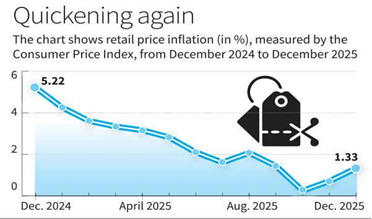
Retail inflation at 3-month high of 1.33% in December

Context: Increased figure still below RBI’s lower comfort level of 2%; data show broad-based decline in price levels across sectors as reason for low figure; core inflation at 28-month high of 4.8%, says expert.

  • India’s retail inflation quickened to a three-month high of 1.33% in December 2025, which is still significantly below the lower comfort level of 2% set by the Reserve Bank of India (RBI), official data released showed.
  • Data on the Consumer Price Index for December 2025, released by the Ministry of Statistics and Programme Implementation, show that the low levels of retail inflation are a result of a broad-based decline in price levels across sectors. The RBI targets an inflation rate of 4%, with a comfort band of 2% above and below that.
  • The food and beverages category saw a contraction of 1.85% in prices in December 2025, a moderation from the contraction of 2.8% seen in November. This is likely due to a high base effect as inflation in this category stood at 7.7% in December last year.
  • “However, inflation was high at over 5% for meat products, oils, and fruits and will continue to exert upward pressure in the coming months,” Madan Sabnavis, chief economist at the Bank of Baroda said.
  • Inflation in the ‘pan, tobacco, and intoxicants’ category remained unchanged at 2.96% in December 2025 as compared to November. The clothing and footwear category saw inflation easing marginally to 1.44% in December 2025 from 1.49% in the previous month. Inflation in this category had been 2.7% in December 2024. The housing sector, too, saw inflation easing to 2.86% in December 2025 from 2.95% in the previous month. The fuel and light category saw inflation ease to 1.97% in December 2025, as compared to 2.3% in November.
  • “Core inflation (CPI excluding food and beverages, fuel and light, and petrol and diesel for vehicles) jumped to a 28-month high of 4.8% in December 2025 from 4.4% in November 2025,” Aditi Nayar, chief economist and head, research & outreach at ICRA Limited said. “However, this was largely led by precious metals; core CPI excluding gold and silver remained unchanged at 2.4% between these months.”

Source: The Hindu

Forest management committees

Context: The Ministry of Tribal Affairs is in talks with the Ministry of Environment, Forests, and Climate Change for funding the management of community forest resources, for which rights have been vested in gram sabhas of tribal communities and other forest-dwellers across the country under the Forest Rights Act (FRA), government officials said.

  • Officials of both Ministries met over it recently, and the Tribal Affairs Ministry is also planning to write to the Environment Ministry formally on this matter, a top official told The Hindu, adding that this was necessary to “correct the perception” that the forest bureaucracy was at odds with the goals of community-led forest resource management.
  • For the last 20 years, the FRA has recognised the historical rights of Scheduled Tribe communities and other forest-dwellers on the forests they have lived in and around and vested these rights in them through FRA titles for specific sets of rights. Under the FRA, gram sabhas are entitled to include community forest resource rights (CFR) over areas “they have been traditionally protecting, regenerating, conserving and managing for sustainable use”.
  • In 2023, the Tribal Affairs Ministry issued guidelines for the management of forests for which CFR rights had already been granted to gram sabhas.
  • These guidelines provided for setting up CFR management committees under the title-holding gram sabhas, mandating that conservation and management plans be drawn up by the communities before the Forest Department is called in to align them with the Environment Ministry’s working plan codes. The Union government is now looking to rope in the Environment Ministry to fund the CFR management committees that are being set up under the FRA.
  • One senior official said, “The CFRM committees will need resources and help in functioning. They will need the funds to hire officials, prepare plans, and even train their own community’s people in running the day-to-day operations. The idea is to get funding help from the Environment Ministry for this as well.”
  • A meeting at the level of Secretaries of both Ministries was held over the last month. “If needed, safeguards can be built in to ensure that the planning of forest conservation and management remains community-led and is not necessarily taken over by the forest department,” one of the officials said.

Public Sector Enterprises privatisation (Disinvestment)

The Confederation of Indian Industry (CII) has suggested an accelerated four-pronged strategy to unlock value from the disinvestment of public sector enterprises (PSEs), calling for a demand-driven approach in selecting units for privatisation, and following a predictable road map.

  • In its proposals for the Union Budget 2026-27, the industry lobby urged the Union government to mobilise resources through a calibrated approach to privatisation focusing on sectors where private participation can enhance efficiency, technology infusion, and global competitiveness, to sustain capital expenditure and address developmental priorities amid global economic uncertainties.
  • The CII called upon the Centre to announce a rolling three-year privatisation pipeline, outlining which enterprises are likely to be taken up for privatisation during this period while recognising that full privatisation of all non-strategic PSEs is a complex and time-consuming process. It argued that this visibility would encourage deeper investor engagement and more realistic valuation and price discovery, which would contribute towards expediting the privatisation process.

Releasing value

  • “Government could reduce its stake in listed PSEs in a phased manner to 51% initially, allowing it to remain the single largest shareholder while releasing significant value into the market. Over time, this stake could be brought down further to between 33% and 26%,” the CII stated in its proposal.
  • Reducing the government’s stake to 51% in 78 listed PSEs could unlock close to ₹10 lakh crore, according to its analysis.
  • “A calibrated reduction of the government’s stake in listed PSEs to 51% and even lower is a pragmatic step that balances strategic control with value creation. Unlocking nearly ₹10 lakh crore of productive capital would provide vital resources to accelerate physical and social infrastructure development and support fiscal consolidation,” CII Director-General Chandrajit Banerjee said.

PSLV-C62/EOS-N1 Mission

Context: The vehicle, carrying an earth observation satellite and 15 ‘co-passengers’ developed by Indian and overseas customers, is set to lift off at 10.17 a.m today; it is the 105th launch from Sriharikota.

  • The 22.5-hour countdown to the launch of the Polar Satellite Launch Vehicle (PSLV), carrying an earth observation satellite and 15 co-passenger satellites, commenced at the Satish Dhawan Space Centre in Sriharikota on Sunday.
  • The Indian Space Research Organisation (ISRO) is scheduled to launch the PSLV-C62/EOS-N1 Mission at 10.17 a.m. on Monday from the first launch pad of the Satish Dhawan Space Centre. This will be the 105th launch from Sriharikota. It will also be the 64th flight of the Polar Satellite Launch Vehicle and the fifth mission of the PSLV-DL variant.
  • The 15 co-passenger satellites have been developed by start-ups and academic institutions from India and abroad. The EOS-N1 satellite is said to have been built for strategic purposes.
  • “It is a commercial mission of NewSpace India Limited (NSIL). EOS-N1 and 14 co-passenger satellites will be injected into a Sun Synchronous Orbit and KID Capsule into a re-entry trajectory,” the ISRO said.
  • It added that after the injection of EOS-N1 and 14 satellites, the PS4 stage will be re-started to de-boost and enter a re-entry trajectory, followed by KID Capsule separation. “Both PS4 stage and KID Capsule will re-enter into Earth’s Atmosphere and impact will be in the South Pacific Ocean,” the ISRO said.
  • The 15 co-passengers are:  Theos-2 earth observation satellite built jointly by Thailand and the U.K.;  CGUSAT by Dhruva Space (India); DSUSAT by Dhruva Space; MOI-1 by Dhruva Space and Takeme2Space (India); LACHIT by Dhruva Space and and Don Bosco University (India); Thybolt-3 by Dhruva Space; Munal by Nepal university Antharkshya Pratishtan (Nepal) and MEA, GoI; KID Capsule by Orbital Paradigm (Spain) and RIDE! (France); Edusat by AlltoSpace (Brazil); Uaisat by AlltoSpace; Galaxy Explorer by AlltoSpace; Orbital Temple by AlltoSpace; Aldebaran-1 by AlltoSpace; Sanskarsat by Laxman Gyanpith (India); and AyulSat by OrbitAid (India).

UN Secretary-General’s Award 2025: Major Swathi Shantha Kumar from Bangalore has won it

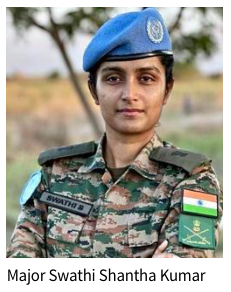
Context: An Indian Army officer from Bengaluru, Major Swathi Shantha Kumar, has won the UN Secretary-General’s Award 2025 for her project Equal Partners, Lasting Peace.

  • Major Swathi is currently serving on an United Nations Mission in South Sudan (UNMISS) and her efforts are said to have significantly enhanced gender parity through the effective deployment and integration of the Indian Engagement team, thereby strengthening grassroot level engagement across the area of responsibility.
  • Under her initiative and command, the team successfully conducted short- and long-distance patrols, integrated reverie patrols, and dynamic air patrols to far-flung counties of the host nation. These operations contributed substantially to creating a conducive and secure environment for more than 5,000 women, enabling meaningful participation and community confidence-building.
  • Major Swathi is an officer in the Corps of Electronics and Mechanical Engineers (EME). Her father, R. Shantha Kumar, said that she did her schooling in Bengaluru and graduated from the New Horizon College of Engineering following which she was commissioned in the Indian Army.
  • “We are very proud that our daughter is serving the nation in uniform, but like any other parent I am worried about her as she has to serve in very harsh terrains and conditions. This award is a recognition for her hard work and discipline which makes me a very happy and proud father,” Mr. Kumar said.
  • He added that Major Swathi has been in South Sudan for nearly 15 months and is expected to return to India early next month following which she will be posted in Secunderabad.
  • United Nations Secretary-General Antonio Guterres recently announced and honored the winners of the Secretary General’s Award 2025.
  • In his address Mr. Guterres said that the Mission has further strengthened the gender-inclusive approach by the UNMISS.
  • This prestigious award recognises initiatives that advance gender parity and promote gender-responsive peacekeeping in alignment with the UN mandate.
  • The team was shortlisted from nominations received across all UN peacekeeping missions and UN agencies worldwide and emerged as the winner in the Gender Category, securing the highest number of votes among four finalists through a UN-wide voting process involving the UN personnel globally.

The United Nations Mission in South Sudan (UNMISS) is the UN’s peacekeeping mission established in 2011 to support the world’s youngest nation. Its mandate—recently extended until 30 April 2026—focuses on protecting civilians, monitoring human rights, supporting peace processes, and facilitating humanitarian aid.

🌍 United Nations Mission in South Sudan (UNMISS) – Complete Overview
🏛️ Background
Established: July 2011, following South Sudan’s independence.

Mandate Authority: UN Security Council Resolution 1996 (2011).

Current Mandate: Extended by Resolution 2779 (May 2025) until 30 April 2026.

Headquarters: Juba, South Sudan.

Personnel: Thousands of uniformed (military, police) and civilian staff from multiple UN member states.

🎯 Core Mandate & Objectives

Focus AreaKey ActionsImpact & Goal
Protection of Civilians (POC)Deploying peacekeepers to prevent physical violence; protecting women, children, and displaced persons; using force as a last resort.To ensure the physical safety of non-combatants and vulnerable groups in conflict zones.
Human Rights MonitoringDocumenting and reporting violations; supporting accountability for war crimes; advocating for the rule of law.To prevent future atrocities and ensure that perpetrators are held responsible.
Support to Peace ProcessesFacilitating dialogue between warring parties; monitoring ceasefires; assisting in the implementation of peace agreements.To transition a country from active conflict toward a stable, long-term political settlement.
Humanitarian AssistanceSecuring aid corridors; providing logistics for food/medical delivery; ensuring safe access for NGOs.To mitigate the immediate human suffering caused by war and displacement.
Capacity BuildingTraining local police and judiciaries; supporting election organization; strengthening national security institutions.To empower the host nation to maintain its own security and governance independently.

📌 Recent Developments (2025–26)
Mandate Renewal: Security Council extended UNMISS until April 2026 amid rising instability.

Inclusive Spaces: UNMISS has worked to release recruited children, build peace, and protect vulnerable groups.

Infrastructure Support: Repairs and constructions to connect communities and mitigate climate change effects.

Justice Initiatives: Promoting accountability and strengthening local justice systems

✨ Significance
UNMISS is critical for stabilizing South Sudan, protecting civilians, and supporting peacebuilding.

Its presence reassures international partners and provides a framework for humanitarian aid delivery.

The mission also highlights the UN’s role in conflict prevention and post-conflict state-building.

India’s Contribution to UNMISS
India has been one of the largest and most consistent contributors to UN peacekeeping missions worldwide, and its role in UNMISS is particularly significant.

Troop Contributions
India has deployed over 2,000 personnel to UNMISS, including:

Infantry battalions for civilian protection and area security.

Engineering units for infrastructure development (roads, bridges, shelters).

Medical contingents providing healthcare to both UN staff and local civilians.

Indian peacekeepers are stationed in key regions like Juba, Bor, Malakal, and Bentiu, often in volatile conflict zones.

✨ Significance of India’s Role
Reinforces India’s image as a responsible global peacekeeper.

Strengthens India–Africa relations through humanitarian goodwill.

Demonstrates India’s commitment to the UN Charter and global stability.

Builds trust among local communities, where Indian peacekeepers are often praised for their approachability and compassion.

Central Ground Water Board: Andhra Pradesh is facing widespread contamination of groundwater

The Central Ground Water Board (CGWB) has stated in its Annual Ground Water Quality Report, 2025 that Andhra Pradesh is one of the States facing widespread contamination of groundwater as per the BIS standards.

  • However, the report notes that the monsoon had shown some improvement in water quality, particularly in the areas affected by high electrical conductivity (EC) and fluoride.
  • “Elevated uranium concentrations exceeding 30 parts per billion (ppb) were detected sporadically in Andhra Pradesh and four other States,” the report mentioned. High incidence of residual sodium carbonate beyond permissible limits was also recorded in Andhra Pradesh (26.87% of the samples analysed).
  • The groundwater quality alerts issued by the CGWB during June 2024-–March 2025 highlighted the high incidence of nitrate, iron, fluoride, chromium, cobalt, manganese, nickel, zinc, arsenic, selenium, cadmium, lead, and uranium, with notable concerns in Andhra Pradesh and eight other States. Andhra Pradesh and some other States were found to be facing seawater intrusion in coastal aquifers, which was attributed to high levels of electrical conductivity.

Uranium hotspots

  • Sixteen villages in Sri Sathya Sai district, and three in Tirupati district were found to have uranium levels exceeding 30 ppb.
  • Five villages were identified as arsenic hotspots, where the concentration of the heavy metal exceeded 10 ppb. Fluoride contamination above 1.50 mg/l in areas, especially hard rock aquifers in Andhra Pradesh, where over-extraction enhances the mobilisation of fluoride-bearing minerals was one of the major findings.