Wed. Jun 24th, 2026

English

Equality in society has to start in school, says Supreme Court

Context: The Supreme Court, in a judgment on Tuesday, said that equality in society had to start in school, where the child of a multi-millionaire or a Supreme Court judge had to sit shoulder-to-shoulder with a child of an autorickshaw driver or a street vendor.

  • A Bench headed by Justice P.S. Narasimha elaborated that the obligation of the government under the Right to Education Act (RTE) to ensure that neighbourhood schools admit children belonging to weaker and disadvantaged sections has an “extraordinary capacity to transform the social structure of our society”.
  • “The statutory design [of the RTE Act] is normatively ambitious. It envisages elementary education for all children, across the spectrum of class, caste, gender and economic position, in a shared institutional space. It makes it possible, normatively and structurally, for the child of a multimillionaire or even of a judge of the Supreme Court of India to sit in the same classroom and at the same bench as the child of an autorickshaw driver or a street vendor,” Justice Narasimha, who authored the judgment, wrote.
  • The top court’s judgment rose from the bitter experience of the petitioner, Dinesh Biwaji Ashtikar, who was quietly snubbed off when he had approached a neighbourhood school to admit his children for free and compulsory elementary education in 2016.
  • “It is his case that, even though information through RTI indicated that seats were available, the neighbourhood school did not respond,” Justice Narasimha narrated.
  • The judge observed that educating “young India” and achieving “equality of status” demanded an earnest implementation of the constitutional right under Article 21A to free and compulsory education, followed by the statutory mandate of the 2009 Act.

‘National mission’

  • “Ensuring admission of such students must be a national mission and an obligation of the appropriate government and the local authority. Equally, courts, be it constitutional or civil, must walk that extra mile to provide easy access and efficient relief to parents who complain of denial of the right,” the Supreme Court declared.

Treat inclusion of disabled persons as an advantage: SC

Context: The Supreme Court urged corporates and investors to consider the inclusion of persons with disabilities not just as a mere “compliance issue” but also as a “strategic advantage” that would enhance their business performance, resilience, and social impact.

  • The judgment, co-authored by a Bench of Justices J.B. Pardiwala and K.V. Viswanathan, is the second in two months with which the Supreme Court is stepping in to highlight that business corporations not only do lead a profit-only existence but also have a constitutional duty to contribute to the society and environment.
  • The Bench exercised the court’s extraordinary constitutional powers under Article 142 to direct Coal India Limited to give Sujata Bora, who has multiple disabilities, a supernumerary post with a separate desk and specially-designed computer at its North Eastern Coalfields office in Assam.

Source: The Hindu

SC differs on sanction to try public servants

Context: The Supreme Court delivered a split verdict on the legality of a provision in an anti-corruption law which mandates prior sanction before prosecuting public servants.

  • Justice B.V. Nagarathna concluded that Section 17A of the Prevention of Corruption Act, 1988, was plainly unconstitutional, while Justice K.V. Viswanathan, the puisne judge on the Division Bench, said that sanction must be decided by an independent authority such as the Lok Pal or the Lok Ayukta.

Policy paralysis

  • Justice Viswanathan said the mere possibility of abuse of an otherwise valid provision cannot be a ground for declaring it unconstitutional. He compared striking down Section 17A to “throwing the baby out with the bathwater”.
  • “If honest public servants are not given a basic assurance that decisions taken by them will not be subjected to frivolous complaints, it is the nation that will suffer. Public servants will resort to a play-it-safe syndrome, and that will result in policy paralysis. The panacea of striking down will turn out to be worse than the disease,” Justice Viswanathan wrote in his opinion.
  • He directed that an independent inquiry of the facts of a corruption complaint would be ideal before a grant of sanction.
  • The case will now be referred to the Chief Justice of India to be placed before a Bench of three judges.
  • “A fine balance has to be maintained between the need to protect a public servant against mala fide prosecution on the one hand and the object of upholding the probity in public life by prosecuting the public servant against whom prima facie material in support of allegation of corruption exists, on the other,” Justice Viswanathan observed in his opinion.
  • He said the Lokpal had the authority to conduct an inquiry into even an allegation of corruption made against the Prime Minister of the country.
  • “If Section 17A is invalidated on the ground that prior approval should not exist at all, the immediate consequence would be that any complaint alleging corruption in official decision-making could straightaway result in a police inquiry or investigation,” Justice Viswanthan reasoned.

Source: The Hindu

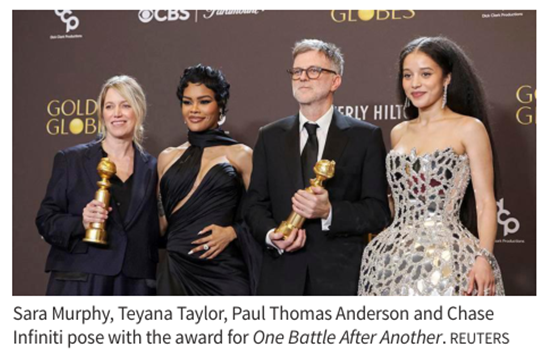
Hamnet and One Battle After Another reign supreme at 83rd Golden Globes

Context: Paul Thomas Anderson’s ragtag revolutionary saga One Battle After Another took top honours at Sunday’s 83rd Golden Globes in the comedy category, while Chloe Zhao’s Shakespeare drama Hamnet pulled off an upset over Sinners to win best film, drama. Hamnet star Jessie Buckley won best female actor.

  • One Battle After Another won best film, comedy, supporting female actor for Teyana Taylor, best director and best screenplay for Mr. Anderson Sinners won for best score and cinematic and box-office achievement .
  • Timothee Chalamet won his first Golden Globe for Marty Supreme.
  • The Globes held in California began with a pointedly political opening from host Nikki Glaser.
  • “Yes, the Golden Globes, without a doubt the most important thing happening in the world right now,” she said.
  • Winners included Rose Byrne for best female actor in a comedy or musical in If I Had Legs I’d Kick You, and Wagner Moura, the Brazilian star of The Secret Agent, for best male actor in a drama. Kleber Mendonça Filho’s period political thriller also won best international film. Supporting actor front-runner Stellan Skarsgard won for the Norwegian family drama Sentimental Value. It was the first major Hollywood movie award for the 74-year-old veteran actor.

Solar industry’s wish list for Union Budget

Context: As India’s solar energy capacity continues to accelerate, the domestic industry is seeking an enhanced production-linked incentive scheme, second instalment of PM-Kusum and viability gap funding to accelerate potential for energy storage, in the upcoming Union Budget.

  • Subrahmanyam Pulipaka, CEO at the industry body National Solar Energy Federation of India, told The Hindu, “The sector has grown big today, we are no more a sub-sector of the power sector. We are the second-largest generator in terms of installed capacity, therefore, our aspirations have increased in the same proportion.”

PLI for ingots

  • Mr. Pulipaka sought the government instituting a production-linked incentive (PLI) or a similar scheme, for manufacturing ingots. They are among the raw materials used for making solar cells.
  • “These are all capital-intensive parts,” he stated.
  • Separately, Prafulla Pathak, Solar Energy Society of India (SESI) also insisted on good financial allocation for the industry to help push overall indigenous production.

PNGRB, DVGW ink MoU to advance hydrogen integration

  • India’s Petroleum and Natural Gas Regulatory Board (PNGRB) and its German counterpart DVGW inked a memorandum of understanding (MoU) to establish a cooperative framework for integrating hydrogen into the country’s natural gas infrastructure.
  • Among other things, the MoU would seek to facilitate knowledge sharing relating to safety methodologies. It would also seek to facilitate technical visits and anonymised data sharing.

Modi, Merz launch annualkite festival in Ahmedabad

Context: PM and German Chancellor get grand welcome with music and dance performances; the leaders visit exhibit reflecting Ahmedabad’s architectural heritage, watch demonstrations on kite-making.

  • Prime Minister Narendra Modi on Monday inaugurated the International Kite Festival, 2026 on the Sabarmati riverfront in Ahmedabad, with German Chancellor Friedrich Merz attending as the chief guest. The two leaders launched the festival by flying kites.
  • Chief Minister Bhupendra Patel and Deputy Chief Minister Harsh Sanghavi were present, along with members of the State Cabinet, MLAs, municipal corporation office-bearers, and senior State government officials.
  • Mr. Modi and Mr. Merz were welcomed with music and dance performances. Cultural presentations included Gujarati folk dance Beda Raas, Kuchipudi, Bharatanatyam, and Mallakhamb.
  • The two leaders visited an exhibit reflecting the architectural heritage of Ahmedabad’s pols and havelis (traditional houses and grand residences).
  • As part of a heritage walkway, a kite museum and a photo wall have been set up. The dignitaries were briefed on kites from different Indian States, made using various materials and techniques. They observed demonstrations by artisans on kite-making.
  • The festival on the Sabarmati riverfront draws inspiration from kite-flying celebrations held across Gujarat annually ahead of Uttarayan, also known as Makar Sankranti, which falls this year.
  • It celebrates the sun’s northward journey and the transition towards summer. The festival is being organised by Gujarat Tourism.
  • A musical ensemble by 108 artists from Gujarat and Rajasthan featuring instruments such as sitar, sarangi, violin, mandolin, harmonium, flute, dholak, tabla, and mridang will perform.
  • The performance included Vande Mataram, Vaishnav Jan, and German compositions. Folk singer Kinjal Dave will perform and illuminated kites will light up the night sky.
  • This year, the festival boasts 135 international kite-flyers representing 50 countries and 65 kite-flyers from 13 Indian States. In addition, 871 kite-flyers from 16 districts of Gujarat are participating.
  • The countries are Algeria, Argentina, Australia, Belarus, Belgium, Brazil, Bulgaria, Cambodia, Canada, Chile, China, Colombia, Costa Rica, Denmark, Egypt, France, Germany, Greece, Guatemala, Hungary, Indonesia, Ireland, Israel, Italy, Japan, South Korea, Lebanon, Lithuania, Malaysia, Mauritius, Mexico, New Zealand, the Philippines, Poland, Portugal, Russia, Singapore, Slovakia, South Africa, Spain, Sri Lanka, Sweden, Thailand, Turkmenistan, Ukraine, the U.K., the United States, Vietnam, Slovenia, Bahrain, Nepal, Turkey, and Jordan.
  • To introduce visitors to Gujarati cuisine and handicrafts, 25 handicraft stalls and 15 food stalls have been set up at the venue.

DRDO carries out flight test of anti-tank guided missile

  • The Defence Research and Development Organisation (DRDO) on Sunday successfully flight-tested the indigenously developed third-generation fire-and-forget man portable anti-tank guided missile (MPATGM) with top-attack capability against a moving target in the K.K. Ranges in Ahilya Nagar, Maharashtra.
  • The Defence Ministry said the flight test was conducted by the DRDO’s Defence Research & Development Laboratory (DRDL), Hyderabad, and it marked a significant milestone towards the induction of the advanced anti-tank weapon system into the Indian Army.
  • It incorporates cutting-edge indigenous technologies, including an imaging infrared (IIR) homing seeker.

Pax Silica: India to be invited to join U.S-led initiative Pax Silica, says envoy

Context: India was not included in the original launch of the arrangement for cooperation on semiconductors, critical minerals, AI; Gor ‘takes charge’ of U.S. Embassy with music and fanfare, says both countries continue to actively engage over trade deal.

  • India will be invited to join “Pax Silica”, the U.S.-led eight-nation arrangement to cooperate on semiconductors, critical minerals, and artificial intelligence, next month, incoming U.S. Ambassador Sergio Gor announced on Monday. He added that both countries hoped to make progress on long-delayed trade negotiations soon.
  • Mr. Gor, who is yet to present his credentials to President Droupadi Murmu, projected a positive outlook for India-U.S. ties after months of tensions over trade, tariffs, and India’s import of Russian oil.
  • “The United States and India are bound not just by shared interests, but by relationship anchored at the highest levels,” Mr. Gor said in an unprecedented “arrival speech”, delivered with much fanfare from the steps of the U.S. Embassy on Shantipath in Delhi.
  • “Real friends can disagree but always resolve their differences in the end,” he added. He said the two sides “continue to actively engage” over the trade deal that had been initially launched nearly a year ago when Prime Minister Narendra Modi visited Washington. Subsequently, the deal lost momentum as the U.S. imposed 50% tariffs on Indian goods, and has seen six official rounds of negotiations and three visits to the U.S. by Commerce Minister Piyush Goyal.
  • “Remember, India is the world’s largest nation, so it’s not an easy task to get this across the finish line, but we are determined to get there,” he said.
  • India was not included in the original launch of “Pax Silica” in Washington in December, though fellow Quad members Japan and Australia, I2U2 countries, Israel and the UAE, and others including South Korea, Singapore, the U.K., and the Netherlands were invited.

Trump’s visit

  • Mr. Gor said he hoped U.S. President Donald Trump would visit India “soon, hopefully in the next year or two”. Mr. Trump was expected to visit India last year to attend the Quad Summit, and India is hoping to host the summit this year.

Unconventional arrival

  • The Ambassador’s statement, made to hundreds of U.S. Embassy staffers in Delhi and Indian media, was unconventional as Mr. Gor is expected to present his credentials later this week.
  • According to diplomatic protocol, Ambassadors are expected to make public appearances only after the credentials are presented. Mr. Gor arrived at the Embassy with his Ambassadorial convoy, including a special armoured car with red and blue blinking lights.
  • As he alighted, the Embassy officials who had gathered there more than two hours before, along with the press, greeted him with loud applause, and as he walked up the steps, a special playlist of songs, reportedly chosen by Mr. Gor, that included the 1960s soul song Hold on, I’m Coming and Mr. Trump’s favourite YMCA were played over loudspeakers.
  • The ceremony, which included dozens of media outlets, was telecast live — a break from the past. His predecessor, Biden-appointee Eric Garcetti, had arrived to take up his assignment in a colourful autorickshaw in April 2023, but without the media or the large welcoming assembly.
  • Mr. Gor begins with his tasks cut out, given spiralling ties between New Delhi and Washington, particularly over a number of statements, including Mr. Trump’s repeated claim that he mediated the India-Pakistan conflict in May 2025, which the government has strenuously denied.
  • Last week, the External Affairs Ministry rejected a claim by U.S. Commerce Secretary Howard Lutnick that the trade deal had fallen through as Prime Minister Narendra Modi had not called Mr. Trump to finalise it, pointing out that the two leaders had spoken eight times during the year.
  • Mr. Gor said that India-U.S. trade negotiators would hold another call.
  • In addition, the government has been uncomfortable with the U.S. President’s contention that Mr. Modi had promised to cut India’s imports of Russian oil “to make him happy”, stressing that any decisions are led by market conditions.

Special envoy

  • Mr. Gor, who has also been appointed Mr. Trump’s Special Envoy for South and Central Asia, has taken a few months to arrive, after being named for the post in August 2024, and confirmed by the U.S. Senate in October.
  • Alongside bilateral issues, his travels in the region, particularly to Pakistan and Bangladesh, will be watched most closely in New Delhi.