Wed. Jun 24th, 2026

English

Sinners makes Oscar history with record 16 nominations

Context: Vampire period horror film Sinners, directed by Ryan Coogler, smashed the all-time Oscars record with 16 nominations, the Academy announced. The tally included a best actor nomination for Michael B. Jordan.

One Battle After Another came in second with 13 nods including best picture, best actor for Leonardo DiCaprio and best director for Paul Thomas Anderson.

Guillermo del Toro’s monster epic Frankenstein, Timothee Chalamet-led ping-pong drama Marty Supreme and Norwegian arthouse favourite Sentimental Value each bagged nine nominations. Period drama Hamnet secured eight nods including best actress for Jessie Buckley.

  • Mr. DiCaprio, Mr. Chalamet and Mr. Jordan will battle for the best actor Oscar, along with Ethan Hawke for Broadway period drama Blue Moon and Wagner Moura from Brazilian political thriller The Secret Agent. For best actress, Ms. Buckley will compete with Emma Stone in conspiracy theorist drama Bugonia, Renate Reinsve in Sentimental Value, Kate Hudson in music biopic Song Sung Blue, and Rose Byrne in indie hit If I Had Legs I’d Kick You.
  • Persian-language Palme d’Or winner It Was Just An Accident, Spain’s hippie odyssey Sirat and heart-wrenching Palestinian docudrama The Voice of Hind Rajab will compete for best international film.
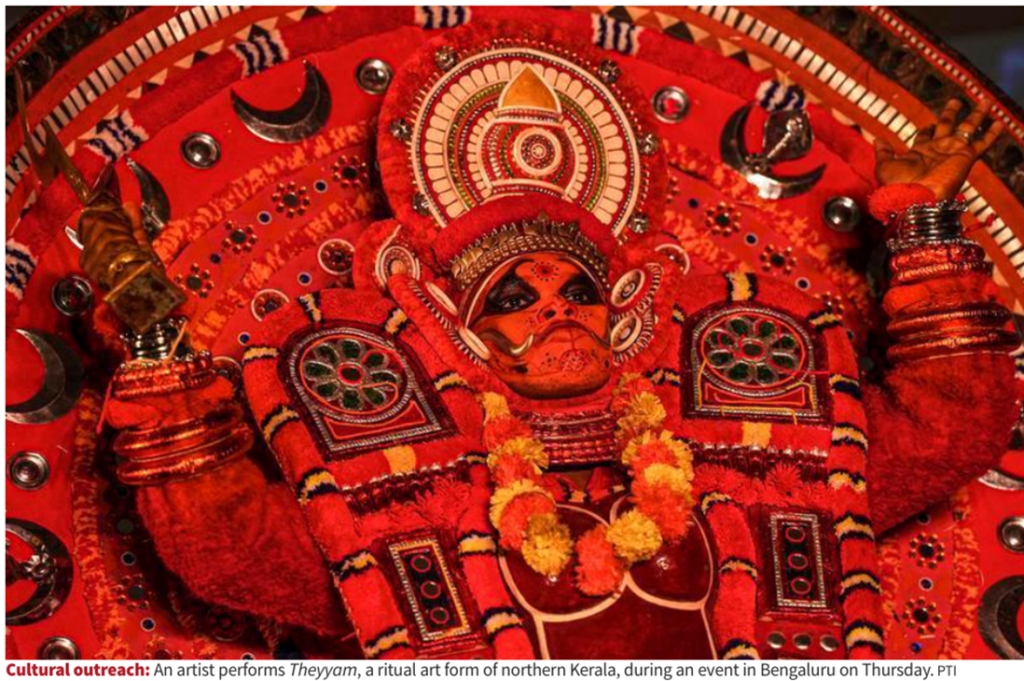

Theyyam, a ritual art form of northern Kerala

Context: Theyyam is a ritualistic art form practiced in the northern districts of Kerala, especially Kannur and Kasaragod. It is a sacred performance tradition in which the performer is believed to embody a deity or ancestral spirit during the ritual.

Key Features

  • Religious–ritual nature: Performed in kavus (sacred groves) and temples.
  • Transformation of the performer: Elaborate make-up, face painting, towering headgear, and costumes symbolize the deity.
  • Trance and possession: The performer enters a trance state, during which devotees seek blessings and oracles.
  • Social dimension: Many Theyyam deities represent folk heroes, ancestors, and oppressed communities, reflecting social justice themes.

Music and Performance

  • Accompanied by traditional percussion like chenda and elathalam.
  • Includes ritual dances, songs, and fire rituals.

Cultural Significance

  • Preserves folk beliefs, oral traditions, and local history.
  • Represents the syncretic culture of Kerala, blending religion, art, and social memory.

Small Industries Development Bank of India (SIDBI)-Equity infusion

Cabinet okays 5,000 crore equity infusion into SIDBI

Context: The Union Cabinet approved an equity infusion of 5,000 crore into the Small Industries Development Bank of India (SIDBI) to expand the credit available to micro, small and medium enterprises (MSMEs).

  • The infusion will be made by the Department of Financial Services (DFS) in three tranches. Of the total amount, ₹3,000 crore will be infused in 2025-26 at a book value of ₹568.65 as on March 31, 2025, and ₹1,000 crore each in 2026-27 and 2027-28 at the book value prevailing at the end of the respective previous financial year.
  • “After the capital infusion, the number of MSMEs to be provided financial assistance is expected to increase from 76.26 lakh at the end of financial year 2025 to 102 lakh (approximately 25.74 lakh new MSME beneficiaries will be added) by the end of financial year 2027-28,” the government said.
  • According to official data, as of September 30, 2025, about 6.9 crore MSMEs registered with the government employed 30.16 crore people. This worked out to an average employment generation of 4.37 persons per enterprise, it said. Based on this average, the addition of new MSME beneficiaries is estimated to generate employment for about 1.12 crore people by 2027-28.
  • The additional capital infusion would be necessary to help SIDBI maintain a strong capital to risk-weighted assets ratio (CRAR), as its risk-weighted assets are expected to grow with increased lending to MSMEs. “A healthy CRAR, well above the mandated level, is a key to protecting credit ratings,” the release said. “SIDBI will benefit from an infusion of additional share capital by maintaining a healthy CRAR. This infusion of additional capital would enable SIDBI to generate resources at fair interest rates, thereby increasing the flow of credit to MSMEs at competitive costs.”

Mozambican rights activist to get Indira Gandhi Peace Prize

Context: Mozambican rights activist and humanitarian Graca Machel has been selected for the Indira Gandhi Prize for Peace, Disarmament and Development for 2025, the Indira Gandhi Memorial Trust announced.

  • The decision was taken by an international jury chaired by former National Security Adviser Shivshankar Menon.
  • Ms. Machel was chosen for her “path-breaking work” in the fields of education, health and nutrition, economic empowerment and humanitarian action, carried out under difficult circumstances, the Trust said in a statement.
  • The award carries a cash prize of ₹1 crore along with a citation and a trophy.
  • Describing her as a distinguished African stateswoman and human rights advocate, the trust said Ms. Machel’s life’s work has been rooted in the struggle for self-determination and the protection of vulnerable communities.

‘Freebies’ different from public welfare investment, says SC

Context: The Supreme Court drew a clear line between state functionaries splurging public money on irrational freebies and “investing” in welfare schemes for the marginalised sections.

  • “Distribution of state largesse to individuals at a large scale is different from investing state largesse in public welfare schemes. That distinction should be kept in mind,” Chief Justice Surya Kant observed orally.
  • The Supreme Court asked why there was no “dedicated diversion of revenue surplus for developmental purposes which would further the constitutional ideal of inclusivity through free medical care and education for the poor and those not in the creamy layer of the society. The state has a commitment towards this end”.

State’s obligation

  • The Chief Justice said launching welfare schemes was an obligation the state had to achieve under the Directive Principles of State Policy in the Constitution.
  • The oral observations from the Bench, including Justice Joymalya Bagchi, was in response to an oral mentioning made by advocate Ashwini Kumar Upadhyay for early listing of a batch of petitions seeking a judicial declaration that irrational freebies offered by political parties to lure voters during poll time should be considered a “corrupt practice”.
  • Mr. Upadhyay said when the petition was filed, the nation was in debt of ₹1.5 lakh crore, which had since increased to ₹2.5 lakh crore. Every Indian was in debt, and yet the state continued to rain freebies before elections, he submitted.
  • “This is a very, very important matter,” Chief Justice Kant reacted, agreeing to list it early for hearing.

‘Parasitic existence’

  • In January last year, a top court Bench headed by Justice (now retired) B.R. Gavai had asked whether untrammelled freebies lull the poor into a parasitic existence, depriving them of any initiative to find work, join the mainstream and contribute to national development.

Reservation in private institutions under Article 15(5)

Context: The Congress said that any regulator for higher education must be mandated to oversee the implementation of Article 15(5) of the Constitution, which empowers the state to provide reservation for the Scheduled Castes (SCs), Scheduled Tribes (STs), and Other Backward Classes (OBCs) in private educational institutions.

  • Referring to the Viksit Bharat Shiksha Adhishthan Bill, 2025, which seeks to establish a single regulator for higher education and was introduced in the Lok Sabha on December 15, 2025, before being referred to a Joint Parliamentary Committee, Congress general secretary (communications) said such a body must have a clear mandate to ensure the implementation of Article 15(5).
  • “Any such regulator should be mandated to oversee the implementation of Article 15(5) of the Constitution, which came into effect exactly 20 years ago today,”.

Full implementation

  • He urged the Centre to fully implement Article 15(5) on the 20th anniversary of its enactment through the 93rd Constitutional Amendment by the Manmohan Singh-led UPA government.
  • Calling it a historic moment, He said the amendment enabled the introduction of a 27% reservation for OBC students in Centrally funded higher education institutions (HEIs), including the IITs, IIMs, Central Universities, and NITs. “Since then, lakhs of students from the OBC communities have availed of this reservation, bringing economic and social mobility to millions,” he said.
  • Article 15(5) also permits the government to mandate reservation for SC, ST and OBC students in private higher education institutions, he said, noting that its validity was upheld by the Supreme Court in the Pramati Educational and Cultural Trust vs Union of India judgment on May 6, 2014.

Source: The Hindu

Electronics City Industrial Township Authority is a ‘public authority’, rules commission

Context: The Karnataka State Information Commission has brought the Electronics City Industrial Township Authority (ELCITA) under the purview of the Right to Information Act by declaring it as a “public authority,” and has asked the authority to furnish information within a timeframe in future.

  • Stating that though ELCITA does not have an elected body, the commission has said that it has been set up by the government and had all the powers of a local body, including collection of tax. It had been set up under the Karnataka Municipalities Act, and was acting like a town municipality by being responsible for management, finances and development issues.
  • The commission has also ordered the ELCITA to appoint assistant public information officer and first appeal authority.
  • The recent order by Information Commissioner Rudranna Harthikote came on an appeal by Ganesh Kumar M., who said that the ELCITA was formed through a government gazette without which it cannot exist and questioned the tax collection power if it was a private entity. He had sought details about development works and the tendering process.
  • In its defence, the authority cited Supreme Court order in the Thalappalam Cooperative Bank v/s Kerala government and two cases settled by the Madras High Court and argued that it does not fall under the ambit of being a “public authority.”
  • However, the commission noted that Electronics City was developed by the Karnataka government-owned KEONICS in 1970 to promote electronic industries that was later transferred to Electronics City Industrial Association for managing the area in 1997.
  • The ELCITA was formed in 2013 under Karnataka Municipalities Act 1964 to manage public services such as roads, water supply and cleanliness. Of the total tax collected, which is a responsibility of the government, by the authority, 30% is shared with three village panchayats, it noted.
  • Mr. Harthikote has pointed out that any authority formed through a law passed by Parliament or the State legislature or the government order comes under the RTI Act as “public authority” and hence ELCITA also comes under the ambit of the RTI Act.
  • While any authority that secures financial aid directly or indirectly becomes a “public authority”, the ELCITA also has government nominees in its management. The order also cites a Madras High Court case in which Tiruppur Area Development Board was declared as “public authority” and brought under the purview of RTI Act. Similarly, the Noida Authority has been declared as a “public authority.”

Source: The Hindu

IMF upgrades India’s growth projection for current financial year from 6.6% to 7.3%

Context: The International Monetary Fund (IMF) has revised upwards its estimate of India’s Gross Domestic Product (GDP) growth in the current financial year 2025-26 to 7.3% from its earlier prediction of 6.6%.

  • This upward revision, the IMF said in its January 2026 World Economic Outlook update released on Monday, was primarily a reflection of stronger-than-expected growth in the third quarter, and “strong momentum” in the fourth quarter of the financial year.
  • “In India, growth is revised upward by 0.7 percentage point to 7.3% for 2025 [FY 2025-26], reflecting the better-than-expected outturn in the third quarter of the year and strong momentum in the fourth quarter,” the report said. “Growth is projected to moderate to 6.4% in 2026 and 2027 as cyclical and temporary factors wane,” it added.

Slower figure

  • The IMF’s prediction of 7.3% growth for 2025-26 is just marginally slower than the 7.4% the Union government predicted for the same period.
  • For the global economy, the report projects growth to remain “resilient” at 3.3% in calendar year 2026 and at 3.2% in 2027, largely the same as the 3.3% estimated for 2025.
  • These forecasts entail a small upward revision for 2026 and no change for 2027 as compared with the predictions made in the October 2025 World Economic Outlook. “This steady performance on the surface results from the balancing of divergent forces,” the report said.

Turbulent times

  • “Headwinds from shifting trade policies are offset by tailwinds from surging investment related to technology, including artificial intelligence (AI), more so in North America and Asia than in other regions, as well as fiscal and monetary support, broadly accommodative financial conditions, and adaptability of the private sector.”
  • On the inflation front, the report predicted that inflation in India is expected to go back to near-target levels after a decline in 2025 driven by subdued food prices. The Reserve Bank of India’s target for inflation is 4%.

Include digital currency link on BRICS agenda: RBI to govt.

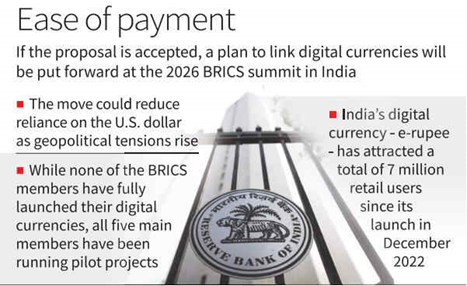
Context: The Reserve Bank of India (RBI) has recommended to the Centre that a proposal connecting the central bank digital currencies (CBDCs) of BRICS countries be included on the agenda for the 2026 summit of the grouping, two sources have said.

  • The proposal seeks to make cross-border payments easier, in a move that could reduce reliance on the U.S. dollar as geopolitical tensions rise. The RBI’s recommendation builds on a 2025 declaration at the BRICS summit in Brazil, which pushed for interoperability between members’ payment systems to make cross-border transactions more efficient.
  • The RBI has publicly expressed interest in linking India’s digital rupee with other nations’ CBDCs to expedite cross-border transactions and bolster its currency’s global usage. It has, however, said its efforts to promote the rupee’s global use are not aimed at promoting de-dollarisation.
  • India will host the next BRICS summit later this year. If the RBI’s recommendation is accepted, a proposal to link the digital currencies of BRICS members would be put forward for the first time. The BRICS includes Brazil, Russia, India, China, and South Africa, among others. The initiative could irritate the U.S., which has warned against any moves to bypass the dollar. U.S. President Donald Trump has previously said the BRICS alliance is “anti-American” and he threatened to impose tariffs on its members.
  • While none of the BRICS members have fully launched their digital currencies, all five main members have been running pilot projects.
  • India’s digital currency — the e-rupee — has attracted a total of 7 million retail users since its launch in December 2022, while China has pledged to boost the international use of the digital yuan.
  • The RBI has encouraged the adoption of the e-rupee by enabling offline payments, providing programmability for government subsidy transfers and by allowing fintech firms to offer digital currency wallets.
  • The RBI and the central bank of Brazil did not respond to emails seeking comment. The People’s Bank of China said it had no information to share on the subject in response to a request for comment; the South African and Russian central banks declined to comment.
  • For the BRICS digital currency linkages to be successful, elements like interoperable technology, governance rules and ways to settle imbalanced trade volumes would be among the discussion topics, one of the sources said.
  • The source cautioned that hesitation among members to adopt technological platforms from other countries could delay work on the proposal and concrete progress would require consensus on tech and regulation.
  • One idea that is being explored to manage potential trade imbalances is the use of bilateral foreign exchange swap arrangements between central banks, both the sources said.
  • Previous attempts by Russia and Indian government to conduct more trade in their local currencies hit roadblocks.
  • Russia accumulated large balances of the Indian rupee for which it found limited use, prompting India’s central bank to permit the investment of such balances in local bonds.
  • Weekly or monthly settlements for transactions are being proposed to be made via the swaps, the second source said.

Human + AI will define the future of work by 2027: study

  • Human + AI will define the future of work and nearly all HR leaders (97%) anticipate that by 2027, the nature of work will be shaped by humans working alongside AI rather than engaging with it only intermittently, showed a Nasscom-Indeed study.
  • As per the study, this trend signalled a shift from AI being a supplementary tool to becoming an integral part of everyday roles, workflows and decision-making processes.