Wed. Jun 24th, 2026

English

Karnataka Hate Speech and Hate Crimes (Prevention) Bill

Context: Chief Minister Siddaramaiah said that Governor Thaawarchand Gehlot has not returned the Karnataka Hate Speech and Hate Crimes (Prevention) Bill. The Governor has neither rejected nor approved the Bill, he said.

  • Chief Minister Siddaramaiah said that Governor Thaawarchand Gehlot has not returned the Karnataka Hate Speech and Hate Crimes (Prevention) Bill.
  • The Governor has neither rejected nor approved the Bill, he said.
  • Speaking to presspersons before leaving for Bengaluru after winding up his programmes scheduled in Mangaluru on Saturday evening, Mr. Siddaramaiah said that the Governor will receive an explanation about the Bill if he seeks one.

📌 Governor’s Role under Article 200
The Constitution of India (Article 200) outlines the Governor’s powers when a Bill is presented for assent:

Assent: The Governor may approve the Bill, making it law.

Withhold Assent: The Governor may reject the Bill.

Return for Reconsideration: Except in the case of Money Bills, the Governor can return the Bill to the Legislature for reconsideration. If the Legislature passes it again, the Governor must give assent.

Reserve for President’s Consideration: The Governor may reserve the Bill for the President, especially if it conflicts with national interests or constitutional provisions.

👉 In the current case, the Governor has not exercised any of these options, leaving the Bill pending. This creates a constitutional limbo, where the Legislature has passed the Bill but it has not yet become law.

⚖️ About the Karnataka Hate Speech and Hate Crimes (Prevention) Bill
🎯 Objective
To prevent, regulate, and penalize hate speech and hate crimes in Karnataka.

To safeguard constitutional values of equality, fraternity, and secularism.

To provide a legal framework for law enforcement to act against individuals or groups inciting violence or discrimination.

📜 Key Provisions (as reported)
Definition of Hate Speech & Hate Crimes:

Hate speech includes verbal, written, or symbolic communication that promotes hatred, violence, or discrimination against communities.

Hate crimes include acts of violence motivated by prejudice against caste, religion, language, gender, or ethnicity.

Punishments:

Prescribes fines and imprisonment for offenders.

Enhanced penalties for repeat offenders or organized groups.

Law Enforcement Empowerment:

Police and investigating agencies are given authority to register cases, investigate, and prosecute offenders.

Special provisions for fast‑track trials in severe cases.

Community Safeguards:

Protection of vulnerable groups from targeted hate campaigns.

Mechanisms to monitor online hate speech and digital platforms.

🌍 Significance
Curbing Communal Tensions: Provides a legal deterrent against inflammatory speeches and hate‑driven violence.

Safeguarding Constitutional Values: Reinforces Articles 14 (Equality), 15 (Non‑discrimination), 19 (Reasonable restrictions on free speech), and 21 (Right to life and dignity).

Strengthening Law Enforcement: Gives police and judiciary clearer powers to act against hate‑based offences.

Public Confidence: Builds trust among minority and vulnerable communities that the State is committed to protecting them.

⚖️ Constitutional Balance
The Bill raises important questions about freedom of speech (Article 19(1)(a)) versus reasonable restrictions (Article 19(2)).

The Governor’s delay in assent highlights the checks and balances between Legislature and Executive.

If reserved for the President, the Bill will undergo Union‑level scrutiny, ensuring national consistency in hate speech laws.

✨ Conclusion
The Karnataka Hate Speech and Hate Crimes (Prevention) Bill is a progressive attempt to legally address hate speech and hate‑driven violence, but its implementation depends on the Governor’s assent under Article 200. By defining hate speech, prescribing punishments, and empowering law enforcement, the Bill seeks to curb communal tensions and uphold constitutional values. However, the Governor’s inaction has left the Bill in a constitutional limbo, making its future uncertain until assent or reservation is decided.
Malayalam Bhasha Bill 2025 & Karnataka

Context: A day after Kerala Chief Minister Pinarayi Vijayan sought to allay fears of Kannada linguistic minority in Kerala about the Malayalam Bhasha Bill 2025, the Karnataka Border Area Development Authority (KBADA) has said that the Bill should explicitly exempt linguistic minority areas (parts of Kasaragod district) in the mandatory Malayalam first language clause — allowing Kannada to remain the first language, and also remove the inherent contradictions in the Bill.

  • While Mr. Vijayan pointed out provisions in Clause 7 of the Bill to allay fears of the Kannada-speaking population, the authority pointed out contradictions in the provisions that was also leading to confusion.
  • The assessment of the Karnataka government was that under the proposed legislation, those studying in Kannada medium would also need to study Malayalam as a compulsory subject/first language, affecting those who are unfamiliar with that language.

Academic performance

  • It could affect the academic performance adversely and Kannada’s primacy would also get eroded over time. It may disrupt existing set-ups where Kannada was the first language, sources aware of the assessment said.
  • This comes amidst concerns aired by Karnataka Chief Minister Siddaramaiah over the adverse effects of the Bill on the Kannada-speaking population in Kerala.
  • The sources said that the Kerala government through the Bill should accelerate declaration of specific taluks in Kasaragod district as minority areas under the Bill and secure full benefit of Clause 7 in it that provided for bilingual signboards and teachers’ appointments in Kannada, among others.
  • The authority chairman Somanna Bevinamarad is learnt to have echoed similar sentiments.
  • An estimate puts the Kannada-speaking people in Kasargod to be more than 70% of the population.

Contradictions

  • According to Prakash Matthihalli, secretary of the authority, despite protections in Clause 7 (special provisions regarding linguistic minorities) in the Bill, there were contradictions and difficulties in implementation.
  • He said that while Clause 6(1) mandated Malayalam as the compulsory first language in all government and aided schools in Kerala up to 10th standard, Clause 7(1) provided for communication of all letters and transactions in local offices in the local language.
  • “However, as per Clause 7(2) students whose mother tongue is any language other than Malayalam may pursue their studies in the languages of their choice that are available in the schools. When the second language English is compulsory in national education curriculum in Kerala, how can a student opt Kannada as first language when Clause 6(1) says Malayalam is mandatory across the State?”
  • Further, Clause 7(3) that spoke of students from other States and foreign countries whose mother tongue was not Malayalam, provided for exemption only in 9th and 10th standards. “Clause 7 should explicitly specify the exemption to linguistic minorities areas.”
  • Mr. Matthihalli said the Karnataka government had no problem with the Bill if the ambiguities in the provisions were cleared and it exempted the Kannada-speaking regions.

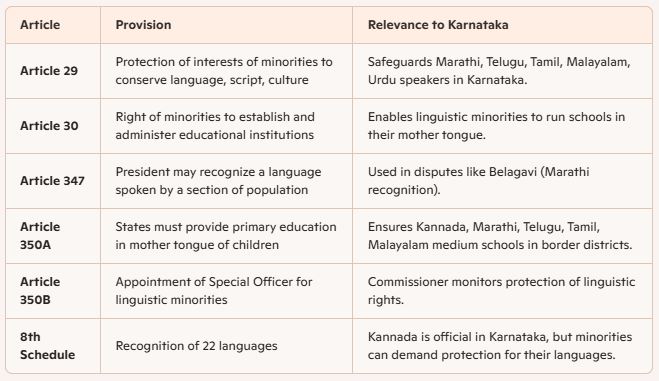
Karnataka’s border districts host significant linguistic minorities such as Marathi speakers in Belagavi, Telugu in Ballari and Raichur, Tamil in Bengaluru and Kolar, Malayalam in Kodagu, and Urdu across urban centers. The Indian Constitution protects these communities under Articles 29 and 30 (cultural and educational rights), Article 347 (recognition of languages), and Article 350A & 350B (instruction in mother tongue and linguistic minority commissioner).

🗣️ Linguistic Minorities in Karnataka
📍 Border Districts & Communities

District(s)Linguistic MinorityNotes & Context
Belagavi, Bidar, Kalaburagi (Gulbarga)MarathiDeep historical ties with the Maratha Empire and Maharashtra; Belagavi is a major focal point of a long-standing border dispute.
Ballari, Raichur, KoppalTeluguDriven by geographical proximity to Andhra Pradesh and Telangana; strong cultural and trade links.
Bengaluru Urban, Kolar, ChamarajanagarTamilSignificant population due to historical migration (e.g., KGF workers) and border proximity to Tamil Nadu.
Kodagu, Dakshina KannadaMalayalamCommon in areas bordering Kerala. Kasaragod (Kerala) also has a reciprocal Kannada minority, leading to ongoing language right discussions.
Urban centers (Bengaluru, Mysuru, Kalaburagi)UrduA significant minority, particularly in cities with Deccan Sultanate history. In some taluks, Urdu speakers exceed 15% of the population.
Northern Karnataka (Vijayapura, Bidar)Hindi / LambaniOften includes migrant traders and workers; also includes the Lambani (Banjara) community, which is sometimes classified under Hindi in census data.
Coastal Karnataka (Udupi, Dakshina Kannada)Tulu & KonkaniWhile native to Karnataka, these are distinct linguistic minorities with their own unique scripts and cultural academies.

📜 Constitutional Provisions for Linguistic Minorities

⚖️ Current Issues
Belagavi Dispute: Maharashtra claims Marathi-speaking areas; Karnataka asserts Kannada primacy.

Kasaragod Issue: Kerala’s Malayalam Bhasha Bill 2025 raised fears of marginalization of Kannada minorities in Kasaragod.

Education Rights: Linguistic minorities demand mother-tongue instruction in border schools.

Kathputli: pulling strings in Jaipur’s puppet colony

In this Jaipur corner, nearly 250 families carry forward one of Rajasthan’s oldest folk art forms, Kathputli; these artisans sew bright costumesonto small wooden puppets that are used by travelling performers who narrate tales of Rajput kings, warriors, folk heroes, and moral stories
In a maze of narrow lanes in the ‘Pink City’ of Jaipur lies Kathputli Nagar, a place where stories are not written but carved, stitched, and brought to life with strings. Inside cramped homes stacked close together, men and women sit on the floor, shaping small wooden faces, painting bold eyes, and sewing vibrant costumes. Nearly 250 families live here, many of them have been preserving the craft for generations. What begins in their modest homes eventually finds its way to bustling markets, cultural fairs, and stages across the world.

These puppets, known as Kathputlis, are one of Rajasthan’s oldest folk art forms. The name comes from kath (wood) and putli (doll), reflecting their simple yet expressive construction. Historically, Kathputli performances were used by travelling performers to narrate tales of Rajput kings, brave warriors, folk heroes, and moral stories to village audiences. Long before modern forms of entertainment, Kathputlis were a powerful medium of communication.

The design of these Rajasthani puppets mirrors the State’s rich culture. Their colourful attire draw inspiration from royal courts and desert traditions, while their sharp features and exaggerated expressions add drama to every movement. Each puppet represents a character from everyday life or folklore, helping preserve the State’s social and cultural identity.

Puppet shows remain the soul of this tradition. Accompanied by folk music on the dholak and harmonium, puppeteers bring the Kathputlis to life with strings and rhythmic narration. The performances brim with humour, music, and satire, often reflecting social realities alongside legendary tales. From the homes of Kathputli Nagar to bigger stages, Kathputlis continue to carry Rajasthan’s voice across generations.

Source: The Hindu

How will the U.S. exit affect climate action?

Why has U.S. President Donald Trump moved to withdraw the U.S. from the UN Framework Convention on Climate Change and the UN Intergovernmental Panel on Climate Change? What will be the financial impact? What will it mean for international cooperation on climate change?’
U.S. President Donald Trump has signed a presidential memorandum withdrawing from 66 international organisations, such as the UN Framework Convention on Climate Change (FCCC) and the UN Intergovernmental Panel on Climate Change (IPCC).

What does the U.S. exiting the FCCC mean?

Mr. Trump has been calling climate change a hoax. His government is also currently in the process of pulling the U.S. out of the Paris Agreement. On February 4, 2025, he issued an executive order requiring the government “to determine which organisations, conventions, and treaties [to which the U.S. is party] are contrary” to its interests. His decision to exit the FCCC and the IPCC are based on this review.

Pulling out of the FCCC will exclude the U.S. from the core framework that organises almost all multilateral climate diplomacy. For instance, it won’t have to participate in the FCCC reporting system, which records countries’ greenhouse gas emissions and progress towards their commitments, and thus allows nations to monitor their collective efforts and hold each other accountable. Legally, the FCCC provides a way for countries to withdraw should they see fit. The FCCC also says withdrawing from it is treated as withdrawing from any protocol to which the party belongs. This includes the Paris Agreement. In practical terms, this means the U.S. will cease to be a party inside the system that runs the annual Conference of the Parties (COP) negotiations and the processes by which the rules are drafted for transparency, carbon markets, financial architecture, etc. The country will also lose its ability to negotiate from inside the room at COPs even if it can still attend some meetings as an observer. However, it won’t have the legal standing to bargain as a party.

How will climate finance be affected?

The FCCC has established a financial mechanism with operating entities including the Global Environment Facility and the Green Climate Fund, and the COP oversees the arrangements of that mechanism. If the U.S. isn’t a party, it will lose its leverage inside the COP over how that financial architecture evolves while also making it politically easier for a U.S. administration to justify withholding contributions.

Conversely, the exit will also raise the ‘cost of doing climate business’ for U.S. companies. Many private sector enterprises, investors, insurers, and subnational governments currently plan around the expectation that global climate rules will become tighter over time, so the U.S.’s decision to exit the FCCC could signal more policy volatility, in turn increasing risk premiums and leaving U.S. exporters more exposed to foreign climate-related trade measures. For many partner countries climate cooperation has become tied up with broader negotiations on energy security, critical minerals, industrial policy, and development finance. The potential implication here is that countries may now become more unwilling to cut side deals with Washington in adjacent domains because they will have to account for the durability of the U.S.’s commitments.

What does the IPCC do?

The IPCC assesses scientific research on climate change, compiling reports that synthesise the current understanding of climate science, the consequences, and potential strategies policymakers everywhere can implement. Pulling out of the IPCC would weaken the U.S.’s role in owning the shared scientific references climate negotiations rely on. This doesn’t automatically mean “American scientists will no longer be involved in climate reports” but it likely will reduce U.S. involvement. The IPCC reports’ authors are put together by a process in which governments and observer organisations nominate experts and the IPCC Bureau creates teams. If the U.S. stops nominating, an important pipeline for U.S.-based expertise — which is considerable — becomes narrower.

This said, the IPCC explicitly encourages experts who are nominated but not selected to contribute as expert reviewers. This role is open and large in scope and U.S. researchers could still participate if their government steps back. U.S. scientists can also still be nominated via non-government routes, for example, by observer organisations.

What are the global repercussions?

The climate talks run on reciprocity. When a very wealthy country with high emissions decides to quit, it weakens the expectation that other major players will also play by the same shared rules. This in turn can harden poor countries’ positions; these countries already believe their rich counterparts promise more than they deliver. It can also give cover to other reluctant governments to delay or dilute action.

The timing is also unfortunate because the conversation on climate finance has shifted from the older $100 billion goal towards much larger needs and new targets. According to the Organisation for Economic Co-operation and Development, economically developed countries mobilised $115.9 billion in climate finance in 2022, the first time it exceeded $100 billion. However, adaptation finance remains far below the need: the UN Adaptation Gap Report 2025 estimated it to be $310-365 billion per year by 2035 while international public adaptation finance flows were about $26 billion in 2023.

At the COP29 summit in 2024, governments agreed to a new collective quantified goal of at least $300 billion per year by 2035. The U.S. exiting the world’s main climate action bodies makes it harder to make credible deals to reach these numbers because other countries will ask why they should pay more when a major historical emitter is stepping away.

Source: The Hindu

India’s 2025 rice exports surge to near record as curbs lifted

India’s rice exports jumped 19.4% last year to the second-highest on record after New Delhi lifted all export curbs, making shipments more competitive, government and industry officials told Reuters.

An improved flow of rice from the world’s largest exporter of the grain curbed shipments from rivals Thailand and Vietnam and drove prices in Asia to their lowest in nearly a decade, easing costs for poor consumers in Africa and other regions.

Quick rebound

“Indian shipments rebounded quickly after the government lifted export restrictions” in March, said a government official, who asked not to be named as he was not authorised to speak to the media.

As supplies improved with record production, India removed the last of the export curbs imposed in 2022 and 2023.

Exports rose to 21.55 million metric tons from 18.05 million in 2024, near the 2022 record of 22.3 million tons, the official said.

Non-basmati rice shipments jumped 25% to 15.15 million tons, while basmati exports increased 8% to a record 6.4 million tons, he said.

Non-basmati rice shipments rose sharply to Bangladesh, Benin, Cameroon, Ivory Coast and Djibouti, while Iran, the UAE and Britain increased purchases of premium basmati rice during the year, said another government official.

‘Shifting from Russian oil imports will currently not hurt India financially’

Data shows that while the premium paid on oil from the U.S. has remained largelythe same as three years ago, the discount received from Russia has shrunk considerably
The prevailing low global oil prices mean that, if India chooses to shift away from importing Russian oil and switches to more oil from the U.S., the financial impact of this would be limited, according to experts as well an analysis of India’s import data.

An analysis by The Hindu of the volume and value of India’s oil imports show that in November 2025, the latest month for which there is data, India imported oil from Russia at the rate of $482.7 per tonne.

That month, oil imports from the U.S. cost $523.3 per tonne. On average, India paid $498.8 per tonne for its oil imports in November 2025.

In other words, in November 2025, India received an average discount of $16.1 per tonne from Russia, while it bought oil at an average premium of $24.6 per tonne from the U.S.

Declining discount

Data shows that, while the premium paid on oil from the U.S. has remained largely the same as three years ago, the discount received from Russia has shrunk considerably.

Three years earlier, in November 2022, India received a discount of $40.3 a tonne on its oil imports from Russia. The premium paid on American oil stood at $21.2 per tonne.

“India was very keen to keep importing from Russia at a discounted rate while a discount existed,” Vibhuti Garg, Director for South Asia at the Institute for Energy Economics and Financial Analysis, said.

“But that discount has now gone and global oil prices have fallen significantly. They are at about $60 a barrel and could fall further. So, if India does cut down on its Russian oil imports significantly, this won’t currently be damaging fiscally.

However, she added that, if in the future prices go back up to $80-90 a barrel, then the lack of this Russian discount could start pinching the Indian government. A previous report by The Hindu shows how India’s oil imports from Russia touched a six-month high in November 2025.

However, since then, Reliance Industries, one of the biggest oil importers in India, said that it had not received any oil shipments from Russia in the last three weeks of December 2025 and did not expect any in January 2026.

Limited impact

According to Ajay Srivastava, founder of think-tank Global Trade Research Initiative and former Director General of Foreign Trade in the Government of India, the premium paid to the U.S. also reflects the superior quality of the oil supplied by it.

“Until 2023-24, Russian oil was about 20% cheaper than what we could get in the market,” Mr. Srivastava said. “That price differential has evaporated since then. There is also a quality difference between the oil that we get from Russia and the US. Russian oil is largely heavy crude, with a higher sulfur content, which is considered lower quality, while the US crude is lighter and of better quality.” He added that reducing oil imports from Russia would not have any financial impact on India.

“While strategic concerns are different, economically it will not make much of a difference,” Mr. Srivastava said.

Other risks arise

Puneet Kumar, Partner, Energy Sector at EY-Parthenon India said that, with about 35% of India’s oil imports originating in Russia, there is a risk to India from cutting down on Russian oil. But he, too, acknowledged that this risk is currently likely to be offset due to the low global oil prices.

However, he pointed out other factors that could put a strain on India’s finances if they persist.

“These gains would be partially negated by other economic factors, including recent depreciation of the Indian rupee (around 5% this year) and increased logistics cost from U.S.,” Mr. Kumar said.

Aditya-L1 decoded how solar storms impact earth’s magnetic field: ISRO

The Indian Space Research Organisation (ISRO) said its Aditya-L1 solar mission had provided new insights into how a powerful solar storm could impact earth’s magnetic shield.

“The most severe effects occurred during the impact of the turbulent region of the solar storm,” the space agency said in a statement.

In a breakthrough study published in The Astrophysical Journal in December, ISRO scientists and research students analysed a major space weather event that struck earth in October 2024.

The study used observations from Aditya-L1, India’s first solar observatory, along with data from other international space missions to decode the impact of a massive eruption of solar plasma from the sun.

Space weather events

“Space weather refers to conditions in space caused by transient activity on the sun, such as solar plasma eruptions, which can affect satellites, communication and navigation services, and power grid infrastructure on earth,” the statement said.

According to ISRO, the turbulent region of the solar storm “strongly compressed the earth’s magnetic field, pushing it unusually close to the earth and briefly exposing some satellites in geostationary orbit to harsh space conditions.”

The space agency noted that this phenomenon occurs only during severe space weather events.

The study also revealed that during the turbulent phase, currents in the auroral region (high latitudes) super-intensified, a process that could heat the upper atmosphere and lead to enhanced atmospheric escape.

Source: The Hindu

11 potential Blue Flag beaches in Karnataka

The beaches identified as potential Blue Flag candidates are Someshwara, Ullal, and Sasihitlu in Dakshina Kannada; Asare, Kodi Kanyana, Padukere, Kodi Kundapur, and Shiroor in Udupi; and Bailur, Apsarakonda, and Ravidranath Tagore beach in Uttara Kannada.

Five national waterways have been identified for developing river cruise tourism in Karnataka, namely, Kali river, covering 53 km; Sharavati river, covering 29 km; Gurupura river, covering 10 km, Netravathi river, 30 km, and Kabini river, covering 23 km.

Draft Karnataka Beach Shack Policy aims to regulate and promote eco-friendly, sustainable and responsible tourism on the State’s coastline while ensuring local community participation, environment conservation and quality visitor experiences.

Karnataka is making a significant push to transform its 320-km coastline and inland waterways into world-class sustainable tourism destinations. The shift towards Eco-Tourism through the Blue Flag program and localized policies.

🌊 Blue Flag Certification: The Gold Standard for Beaches
The Blue Flag is an international eco-label awarded by the Foundation for Environmental Education (FEE), Denmark. It is one of the world’s most recognized voluntary awards for beaches, marinas, and sustainable boating tourism operators.

1.Criteria for Selection (The 33 Points)
To earn a Blue Flag, a beach must comply with 33 stringent criteria across four main categories:

Environmental Education: Information about the ecosystem and local phenomena must be displayed.

Water Quality: No industrial, waste-related, or sewage-related discharges may affect the beach area.

Environmental Management: The beach must be clean; waste disposal bins and recycling facilities must be available.

Safety and Services: Adequate number of lifeguards, first aid equipment, and safe access (including for the disabled) must be provided.

Blue Flag Beaches in India & Karnataka
As of now, India has 12 Blue Flag certified beaches. Karnataka was one of the first states in India to receive this honor.

table

🚤 National Waterways & River Cruise Tourism
While the coast attracts sun-seekers, the National Waterways (NW) project aims to explore the hinterlands.
table

🏠 The Beach Shack Policy: A Balanced Approach
The draft policy is a game-changer because it moves away from permanent concrete structures to temporary, eco-friendly shacks, similar to the successful model in Goa but with a stricter focus on Karnataka’s culture and environment.

Why is it Important?
Sustainable Economy: Prevents illegal construction on the shoreline.

Local Pride: Licenses are prioritized for local residents, ensuring the profit stays within the community.

Night Tourism: Managed shacks with proper lighting and security allow for safe evening tourism, which is currently lacking in many areas.

🛡️ Importance of these Initiatives
Environmental Protection: Blue Flag standards prevent coastal erosion and pollution.

Global Recognition: International tourists specifically look for “Blue Flag” tags when planning vacations.

Economic Diversification: Reduces the dependency on traditional fishing alone, providing “Green Jobs” to the coastal youth.

🏖️ Potential Blue Flag Candidates in Karnataka

DistrictBeach NameUnique Tourism Potential / Features
Dakshina KannadaSomeshwaraFamous for the “Ullal Rocks” and the historic Someshwara Temple on the shore.
UllalKnown for its scenic coastline and proximity to Mangaluru city.
SasihitluAn emerging hub for International Surfing festivals; located at the confluence of the Shambhavi and Nandini rivers.
UdupiAsareA quiet, pristine stretch ideal for eco-conscious travelers.
Kodi KanyanaLocated near a scenic estuary, perfect for bird watching and backwater views.
PadukereRecently connected by a bridge to Malpe, it offers wide sandy stretches and sunset views.
Kodi KundapurKnown for its lighthouse and the unique “Sea Walk” experience.
ShiroorLocated at the northern tip of Udupi, it offers a serene environment near the Western Ghats.
Uttara KannadaBailurA secluded beach known for its crystal-clear water and white sand.
ApsarakondaUnique for having a waterfall right next to the beach and ancient caves.
Ravindranath TagoreThe main beach of Karwar; famous for water sports and the INS Chapal Warship Museum.

Source: The Hindu

Varanasi ‘Tent City’, inaugurated by PM, violated environmental norms: NGT

Context: The National Green Tribunal (NGT) has said that a ‘Tent City’ established on the Ganga riverbed in Varanasi, Uttar Pradesh, in 2023 was operated in “violation” of environmental laws.

  • Inaugurating the project on January 13, 2023, Prime Minister Narendra Modi had said: “With the Tent City, tourists and devotees coming to Kashi now have an incredible means of accommodation.”
  • “We find that the Tent City by the respondents No. 11 and 12 (two private companies) was set up and operated in violation of the environmental norms and the provisions of the River Ganga (Rejuvenation, Protection and Management) Authorities Order, 2016 for which the environmental compensation has been levied, but not recovered. Therefore, the same is required to be recovered expeditiously,” the NGT said in an order dated January 8.
  • The Principal Bench of the NGT comprising chairperson Prakash Shrivastava and expert member A. Senthil Vel was hearing an application that the Tent City was allegedly polluting the riverbed and river water and causing harm to flora and fauna. The applicant also alleged that the sewage of the Tent City was directly discharged into the river.
  • “The respondents (government authorities) will ensure that in future violating the provisions of River Ganga (Rejuvenation, Protection and Management) Authorities Order, 2016 and the applicable environmental norms, no such Tent City is allowed to be set up on the bank of river Ganga or its tributaries,” the NGT order said.
  • The applicant had also alleged that the Tent City was set up at the place of ‘Kachhua Wildlife Sanctuary’ and this sanctuary was illegally de-notified in 2020. The NGT order said that since the de-notification of a turtle sanctuary, which is related to the Tent City, is pending before the Supreme Court, the green court “does not deem it proper” to go into this issue.
  • In a report submitted to the NGT in October 2023, the National Mission for Clean Ganga (NMCG) noted that “application for the prior-approval for the project development of Tent City has been made after the project has already been implemented in 2022”.

A Tent City is a modern approach to managing mass gatherings and boosting tourism in ecologically sensitive or infrastructure-limited areas. It functions like a “pop-up hotel” or a temporary township.

⛺ What is a Tent City?
At its core, a Tent City is a temporary urban ecosystem. Unlike camping, which is often primitive, a modern Tent City (like the ones in Varanasi or Gujarat) provides “Glamping” (Glamorous Camping) facilities.

🏛️ Background
Prayagraj Kumbh Mela: The world’s largest Tent City is built here, accommodating millions of pilgrims with facilities like food, medical care, and security.

Varanasi (Ganga Riverfront): In 2023, Prime Minister Narendra Modi inaugurated a Tent City to attract tourists. However, the National Green Tribunal (NGT) later ruled that it violated environmental norms.

Gujarat – Statue of Unity: The ‘Tent City Narmada’ offers luxury tent accommodations for visitors near the world’s tallest statue.

🌱 Features and Benefits
Flexibility: It can be dismantled after the event or season, leaving the land for its natural purpose (e.g., riverbanks during monsoon).

Infrastructure on Demand: It provides essential services like electricity, clean water, and waste management in remote areas.

Local Economy: It creates jobs for locals in hospitality, catering, and transport during the peak tourist season.

⚖️ The Conflict: Tourism vs. Environment
The most critical aspect of the Tent City concept is the Environmental Impact, which has led to legal battles with the National Green Tribunal (NGT).

Waste Management: Large numbers of people generate massive amounts of sewage and plastic waste. If not managed, this flows directly into rivers like the Ganga.

Ecological Disturbance: Construction on riverbeds (floodplains) can disturb the breeding grounds of birds and aquatic life.

The NGT Stance: In the Varanasi case, the NGT emphasized that “Sustainable Development” is mandatory. You cannot promote tourism at the cost of the river’s health.

DPDP Act does not ‘dilute’ RTI Act,A-G says in opinion

Context: Attorney-General R. Venkataramani has said in a written opinion that the Digital Personal Data Protection Act, 2023 did not “dilute” the Right to Information Act, 2005, a government source said.

  • Civil society groups and transparency advocates have argued that the Act’s amendment of Section 8(1)(j), turning a partial exemption for government bodies to turn over “personal” information into a total exemption, undermined transparency.
  • However, Mr. Venkataramani said that a different part of the RTI Act, which had not been amended, would allow government bodies to disclose such personal information in response to RTI requests. “Section 8(2) of the RTI Act, 2005 mandates disclosure of exempted information whenever public interest outweighs harm,” the opinion said. Mr. Venkataramani declined to confirm authorship of the opinion.
  • “There is no dilution of accountability and transparency due to [the] DPDP Act. It only provides a legal framework to ensure balance between privacy and transparency, as mandated by the Supreme Court in the Puttaswamy case judgment.”
  • The Centre, which notified the RTI amendment in November 2025, even as other parts of the DPDP Act were given a 12-18 month implementation timeline, has made a similar argument. Section 8(1) of the RTI Act lists out exemptions where “there shall be no obligation to give any citizen” information in response to a request.
  • The earlier language of Section 8(1)(j) exempted from providing “information which relates to personal information the disclosure of which has no relationship to any public activity or interest, or which would cause unwarranted invasion of the privacy of the individual unless the Central Public Information Officer or the State Public Information Officer or the appellate authority, as the case may be, is satisfied that the larger public interest justifies the disclosure of such information,” with a proviso that information that cannot be denied to Parliament cannot be denied to citizens.