Context: The National Intelligence Grid (NATGRID), a secure platform for the police and other investigating agencies to access government and private databases in real-time, has been linked to the National Population Register (NPR), which has the family-wise details of 119 crore residents in India, government officials have said.
The Union Home Ministry has been pushing for the enhanced use of NATGRID by the State police forces and Central law and security agencies for intelligence gathering and speedy investigation of criminal cases through indigenous and secure platforms.
An Organised Crime Network Database was being developed on NATGRID‟s IT platform to facilitate secure data-sharing between the National Investigation Agency (NIA) and the State AntiTerror Squads (ATS), upgraded NATGRID tools, particularly “Gandiva”, are supporting multi-source data collection and analysis.
NATGRID is, on an average, getting nearly 45,000 requests a month. The platform, accessible only to security agencies, became operational last year after being conceptualised in 2009 in the aftermath of the 26/11 Mumbai terror attacks.
The data for NPR, which stores information family wise, were first collected in 2010 with the first phase of the 2011 Census and was last updated in 2015 through doorto-door enumeration. It was to be updated further during the 2021 Census, which has been delayed by the COVID-19 pandemic.
When the Union Cabinet approved the proposal for conducting Census 2027 at a cost of ₹11,718 crore, there was no separate allocation for the NPR. Earlier on July 29, the government informed the Lok Sabha that no decision had been taken to update the NPR during the forthcoming Census exercise.
The NPR is the first step for the creation of a countrywide National Register of Citizens (NRC). “Gandiva”, the details of all family members of a suspect or a person of interest if available in NPR could be accessed through the platform. Gandiva can be used for facial recognition and entity resolution. “If the image of a suspect is available, it can be fed into Gandiva. If any photo identity document such as telecom KYC or vehicle registration or driving licence matches with the photo, Gandiva can provide the details, thereby saving time and resources of an investigator,”.
CM flags off 81 ‘Arogya Sethu’ mobile health units
Context: Chief Minister Siddaramaiah flagged off 81 ‘Arogya Sethu’ Mobile Health Units (MHUs) aimed at delivering primary healthcare services to people living in remote, inaccessible, forest and hilly regions of Karnataka.
Launching the units in front of the grand steps of the Suvarna Vidhana Soudha in Belagavi, the Chief Minister said the initiative was intended to ensure that quality healthcare reaches citizens who have so far remained outside the formal health system.
The mobile units, rolled out under the theme “Healthcare at the remotest village”, will provide doorstep healthcare services in hard-to-reach areas, including 32 Scheduled Caste and Scheduled Tribe (SC/ST)-reserved constituencies. Of the total 81 units, 49 are being implemented under the National Health Mission (NHM), while 32 are funded through the State government’s Scheduled Caste Sub-Plan and Tribal Sub-Plan (SCSP/TSP) allocations.
Health Minister Dinesh Gundu Rao said each mobile health unit will be staffed with an MBBS doctor, a nurse and a laboratory technician. The services offered will include outpatient consultations, basic diagnostic tests using rapid diagnostic kits, free medicines, referral services and community health monitoring. The units will also support the implementation of national and State health programmes in remote regions, the Minister said.
The MHUs will be implemented at the district level with decentralised monitoring and supervision, enabling flexibility based on local needs and geographical conditions.
Officials said the units would also be deployed during medical emergencies and disasters.
As per the operational plan, each unit will conduct medical camps in two to three villages a day on fixed schedules, with prior intimation to residents. The vehicles have been procured on an outsourcing basis, while human resources will be engaged on a contractual basis.
Officials said the operational cost has been pegged at ₹1.92 lakh per unit per month, with an annual expenditure of ₹1,686.24 lakh for all 81 units. Of the total, 41 vehicles have been allotted to the North Karnataka region.
Raichur has been allotted the highest number of mobile health units (eight), followed by Uttara Kannada (six), Kalaburagi and Dakshina Kannada (five each). Belagavi, Chamarajanagar, Kodagu, Mysuru, Udupi and Vijayanagara districts have been allotted four units each.
Hate speech Bill passed in Council after oversix hours of debate
Context: After over six hours of debate, an adjournment and protest by the BJP in the Well of the House, The Karnataka Hate Speech and Hate Crimes (Prevention) Bill, 2025, was passed by the Karnataka Legislative Council.
Dr. Parameshwara quoted the Supreme Court observation in Vishal Tiwari vs Union of India and others, which said, “Hate speech cannot be tolerated as it leads to loss of dignity and self-worth of the targeted group members, contributes to disharmony amongst groups, and erodes tolerance and open-mindedness.” The Minister also placed some data on increasing cases of hate speech before the House emphasising the need for a new law.
Govinda Rao panel report on regional imbalances will be implemented: CM
Context: Stating that the government was committed to removing regional imbalances through development, Chief Minister Siddaramaiah declared that it would implement the report of M. Govinda Rao High Power Committee for Reddressal of Regional Imbalances which is expected to be submitted in January, 2026.
Debate on issues
“Whatever may be the requirement of funds, we will implement the committee’s recommendations fully,” the Chief Minister told the Legislative Assembly while replying to a debate on issues related to development of North Karnataka.
The government would take measures to focus on taluks that would be identified by the Govinda Rao committee as backward, the Chief Minister said.
Backward taluks
He pointed out that earlier measures had been taken to provide funds to the tune of ₹31,000 crore over the period of eight years to 114 taluks that had been identified as most backward, more backward and backward taluks in the State.
However, the Govinda Rao committee had been formed later to know if regional imbalances still prevailed and the measures to be taken to tackle them, he noted.
The disparities in terms of development were clearly visible with about 10 districts of the total 31 in Karnataka, particularly those from the northern region, having a per capita income of less than ₹2 lakh as against the State’s average per capita income of ₹3,39,813, Mr. Siddaramaiah noted.
Guarantee schemes
He termed the guarantee schemes too as tools for removing regional imbalances. As much as 43.63% per cent of the funds meant for guarantee schemes had been spent in North Karnataka region, he pointed out.
Of the total population of 6.95 crore in the State, North Karnataka accounted for 2.96 crore (42%). Geographically, the northern region accounted for 14 districts of the total 31 districts in the State and 97 Assembly constituencies of the total 224 in the State, he explained.
Citing lack of dairy development in North Karnataka as one of the reasons for its backwardness, particularly in rural areas, he pointed out that as against the State’s milk production of over one crore litres a day, the northern milk unions accounted for just 10 lakh litres a day.
Accusing the Centre of indulging in non-cooperation with the State, he alleged that the Centre had failed to keep its promise of providing assistance of ₹5,300 crore to Upper Bhadra Project as listed in its Budget a few years ago.
Similarly, it had put a stumbling block in the path of development of North Karnataka by not notifying the award of Krishna Water Disputes Tribunal-2 and by not providing clearances to the Mahadayi drinking water project, he alleged.
The Centre was yet to provide the State’s share of ₹13,000 crore towards Jal Jeevan Mission and ₹3,000 crore towards peripheral ring road in Bengaluru, he said, and reiterated that Karnataka had suffered a loss of ₹ 1.5 lakh crore in the last five years in terms of devolution of funds, grants and its share of Central taxes though it contributed a tax amount of ₹4.5 lakh crore a year.
He agreed to bring out a White Paper on the status of promises made for the development of North Karnataka.
ISRO’s launch of U.S. satellite scheduled on December 24
Context: The Indian Space Research Organisation (ISRO) will launch the 6,500 kg BlueBird communications satellite on December 24 from Sriharikota.
The national space agency announced that the communication satellite developed by the U.S.-based AST SpaceMobile will be launched as part of the LVM3-M6 mission.
“The launch of LVM3-M6 is scheduled on 24 December 2025 at 8.54 am IST from the Second Launch Pad of the Satish Dhawan Space Centre,” it said. The satellite was initially scheduled to be launched on December 15, but was postponed.
Centre plans portal to provide all forest rights services online
Context: The Union government is developing a national web portal to try and take the entire process of forest rights recognition and management online, senior officials told.
According to a presentation prepared by the Tribal Affairs Ministry, this new portal is proposed to act as a single window for all Forest Rights Act (FRA) processes, which include filing and processing of claims (from the Gram Sabhas’ Forest Rights Committee to State-Level Monitoring Committees), issuing digital title deeds, storing legacy data on titles granted, and mapping potential forest areas over which FRA rights could be claimed in the future in the form of an FRA Atlas.
The Ministry’s pitch came at a national consultative workshop organised by the National Tribal Research Institute in New Delhi on Friday on the challenges in implementing the 2006 Scheduled Tribes and Other Traditional Forest Dwellers (Recognition of Forest Rights) Act, popularly known as the Forest Rights Act or FRA, meant to recognise generationally held and exercised rights of STs and other forest dwellers on forest land across the country.
The law recognises various rights of forest dwellers on these lands, such as individual, community, the right to use resources, habitation, etc.
On the sidelines of the workshop, senior officials said this portal would be part of the overarching FRA road map, which the Ministry was working to finalise by the first half of 2026. One of them said this was part of the government’s larger plans to use FRA records to identify beneficiaries for the saturation of existing government welfare schemes.
Beta version
A beta version of the portal has been developed, and it is being called TARANG for the time being, an official said.
At the workshop, while Tribal Affairs Minister Jual Oram stressed how FRA rights were “fundamental” to ensuring sustainable livelihoods, Tribal Affairs Secretary Ranjana Chopra spoke of the need to geotag all recognised types of forest rights and called for solutions on livelihood promotion and digitising records.
Officials from various States where recognition of forest rights has been high are likely to be invited for a demonstration of the portal in January, according to government officials.
Child trafficking a deeply disturbing reality, says SC
Context: SC judgment emphasises that courts must not disbelieve the testimony of a trafficked child just because of minor inconsistencies in her evidence; says she must be treated as an injured witness.
The Supreme Court, in a judgment, observed that child trafficking and commercial sexual exploitation of children by organised cartels is a “deeply disturbing reality” in India which continues to flourish despite protective laws.
The court said child trafficking networks have a complex and layered structure which operate at various levels of recruiting, transporting, harbouring, and exploiting minor victims.
The judgment, which laid down guidelines for appreciating evidence in child trafficking cases, said courts must not disbelieve the testimony of a trafficked child just because of minor inconsistencies in her evidence.
“Such organised crime activities operate as apparently independent verticals whose insidious intersections are conveniently veiled through subterfuge and deception to hoodwink innocent victims,” a Bench of Justices Manoj Misra and Joymalya Bagchi said.
A victim’s sole testimony must suffice if her version appeared to be credible and convincing. A trafficked child must not be treated as an accomplice by the courts. “Her deposition is to be given due regard and credence as that of an injured witness,” the court directed.
Justice Bagchi, who authored the judgment, termed child trafficking and sexual exploitation as an offence that struck at the very foundations of dignity and bodily integrity.
The judgment concerned a minor who was forcibly pushed into illicit sexual intercourse by a gang of traffickers in Bengaluru. Her persistent refusal to consent had led her to be confined in a rental apartment, until she was rescued by the police in November 2010.
The top court, while upholding the conviction of the gang members under the Immoral Traffic (Prevention) Act, said the case laid bare the “moral and material abandonment” of a child whom the state was constitutionally obliged to protect from harm’s way.
Justice Bagchi said courts must not discard a trafficked victim’s version as improbable or “against ordinary human conduct” solely on the ground of her failure to promptly protest against the “ostensibly innocuous yet ominous agenda of the trafficker”.
“Diffused and apparently disjoint manner in which the crime verticals operate in areas of recruitment, transportation, harbouring and exploitation make it difficult, if not impossible, for the victim to narrate with precision and clarity the interplay of these processes…,” Justice Bagchi observed.
Recognise vulnerability
In the present case, the victim’s testimony about the topography of the rented apartment was rebutted by two prosecution witnesses, prompting the defence to attempt to discredit her evidence.
The Bench underscored that courts must bear in mind, while examining a victim, her “inherent socio-economic and, at times, cultural vulnerability when the minor belongs to a marginalised or socially and culturally backward community”.
Judicial appreciation of the victim’s evidence must be marked by sensitivity and realism, it said.
WHO meet boosts collaboration on global health: PM
Context: The second WHO Global Summit on Traditional Medicine facilitated dialogues among Health Ministers and representatives of various countries, opening up new avenues for promoting joint research, simplifying regulations, and advancing training and knowledge sharing, Prime Minister Narendra Modi said at the closing ceremony of the summit at Bharat Mandapam.
He said that over the past three days, experts in the field of traditional medicine from across the world engaged in serious and meaningful discussions. “It is India’s privilege and a matter of pride that the WHO Global Centre for Traditional Medicine has been established in Jamnagar,” said the Prime Minister.
Digital technology
He said the summit gave an opportunity to showcase digital health technology, AI-based tools, research innovations, and modern wellness infrastructure, which together showed a new collaboration between tradition and technology.
“When tradition and technology come together, the capacity to make global health more effective increases significantly, and therefore the success of this summit holds great importance from a global perspective,” he said.
He highlighted the launch of the Traditional Medicine Global Library as an international platform aimed at preserving scientific data and policy documents related to traditional medicine in one place.
Emphasising India’s focus on “partnerships of healing” globally, Mr. Modi shared two key collaborations: the establishment of a Centre of Excellence for BIMSTEC countries, covering South and South-East Asia, and a collaboration with Japan aimed at integrating science, traditional practices, and health.
Corporates have fundamental duty to protect the ecosystem, asserts SC
Context: The Supreme Court interpreted ‘corporate social responsibility’ or CSR to inherently include environmental responsibility, holding that the legal person of a corporation has a fundamental duty to protect the environment as a key organ of society.
“The corporate duty must evolve from merely protecting the shareholders to protecting the ecosystem that we all inhabit. Therefore, the corporate definition of ‘social responsibility’ must inherently include ‘environmental responsibility’,” a Bench of Justices P.S. Narasimha and Atul S. Chandurkar held in a judgment.
The judgment was based on petitions highlighting the cause of a near-extinct bird species — the Great Indian Bustard, “one of the heaviest flying birds in the world and a flagship species of the arid and semi-arid grasslands of the Indian subcontinent”, primarily located in and around the Great Thar desert.
The court brought companies under the ambit of Article 51A(g) of the Constitution, which imposes a fundamental duty on every citizen “to protect and improve the natural environment including forests, lakes, rivers and wildlife, and to have compassion for living creatures”.
“Companies cannot assert to be socially responsible while ignoring equal claims of the environment and other beings of the ecosystem…,” Justice Narasimha, who authored the judgment, reasoned.
The court explained that allocation of CSR funds by companies for the protection of the environment cannot be seen as “a voluntary act of charity”, but a fulfilment of a Constitutional obligation.
Shared environment
“The obligation to protect endangered species is paramount… Where corporate activities such as mining, power generation, or infrastructure threaten the habitat of endangered species, the ‘polluter pays’ principle mandates that the company bears the cost of species recovery. CSR funds must, therefore, be directed towards ex-situ and in-situ conservation efforts to prevent extinction,” the court said.
Non-renewable power generators operating near the habitats of the Great Indian Bustard in Rajasthan and Gujarat must always remember that they share the environment with the bird and must undertake their activities as if they were “guests in its abode”, Justice Narasimha said.
The court also upheld an expert committee’s recommendations to revise the priority areas to 14,013 sq. km and 740 sq km for Rajasthan and Gujarat, respectively.
‘Too low an inflationa cause for concern’
Context: Prevailing low inflation will squeeze profit margins, increase real valueof debt and interest rates for private sector, says MPC’s external member.
Although low inflation rate and high growth led the Monetary Policy Committee (MPC) to reduce repo rate by 25 basis points (bps) earlier this month to support growth, the drastic fall in inflation numbers remained a cause for concern, the minutes of the MPC released by the Reserve Bank of India (RBI) indicate.
“The current inflation rate is actually too low, breaching the lower bound in the flexible inflation targeting regime, especially if precious metals like gold are excluded. Besides, too low an inflation rate is not healthy for a developing country like India, suggesting a demand deficit,” external MPC member Nagesh Kumar wrote.
He said inflation not only continued to remain benign, the headline CPI too declined further to 0.3% in October 2025, largely driven by decreasing food prices. “It is in contrast to FY25: Q2, when the growth was slowing, but inflation was at relatively high levels,” he pointed out.
Stating that inflation had continued to undershoot forecasts, external MPC member Saugata Bhattacharya said while the low prints had largely emanated from a small set of components, the broader basket of “underlying” inflation too was likely to undershoot the inflation target for many months.
“In addition, there is little to signal a risk of potential overheating of capacity even if growth momentum were to sustain. Household inflation expectations remain well anchored and have responded to the recent sharp drop in inflation,” he stated.
External member Prof. Ram Singh said in his statement that the prevailing low inflation would squeeze profit margins and increase the real value of debt and interest rates for the private sector.
“Disinflationary expectations running across several quarters can dampen and defer private-sector investment even in the short run. As MSMEs’ businesses operate in highly competitive markets and have limited ability to raise prices through the market power channel but the wages tend to be downward sticky, low inflation is detrimental to their interests as well,” he emphasised.
Deputy Governor Poonam Gupta stated that inflation had been below the 4% target for the last nine months averaging 2.3% and was likely to remain well contained for at least nine more months. “The average inflation for 2025-26 is projected to be 2.0%, down by 60 bps from the October policy.
The most crucial recent development from the perspective of monetary policy has been the faster than anticipated moderation in CPI headline inflation,” she wrote.
“Going ahead, good agricultural production, low food prices and exceptionally benign international commodity price outlook suggest that headline inflation for the full year (2025-26) is likely to be around 2%, half of what was projected at the beginning of the year, RBI Governor Sanjay Malhotra wrote in his statement.
RBI Board approves risk-based deposit insurance for banks
Context: The Central Board of Directors of Reserve Bank of India (RBI) has approved a risk-based deposit insurance framework for banks at its meeting in Hyderabad.
The approval follows the Central Bank’s statement in October, in which it had proposed a risk-based premium model.
Mooted as an alternative to the existing flat rate premium-based deposit insurance scheme, the framework is expected to help banks that are more sound financially to save significantly on the premium paid.
Detailed notification will be issued shortly and the framework will be effective from next financial year, RBI had then said.
China requests WTO consultations with India over ICT tariffs
Context: China filed a petition with the World Trade Organisation (WTO), requesting consultations with India over New Delhi’s tariffs on information and communication technology (ICT) products and solar sector subsidies.
A statement issued by the spokesman of the Ministry of Commerce here said India’s measures allegedly violate multiple WTO obligations, including the principle of national treatment, and constitute import substitution subsidies explicitly prohibited under WTO rules.
‘Unfair advantages’
“They grant unfair competitive advantages to India’s domestic industries while undermining China’s interests,” the statement said. It urged India to honour its WTO commitments and promptly adjust these measures.
This is the second petition filed by China at the WTO against India this year.
UN rights chief calls for an end to revenge attacks in Bangladesh
Context: Soon after the return of the mortal remains of Sharif Osman Hadi, the upcoming leader of Inquilab Mancha, UN Human Rights chief Volker Turk has called for a “transparent investigation” into the killing and urged “everyone to refrain from violence”.
“Retaliation and revenge will only deepen divisions and undermine the rights of all. I urge the authorities to conduct a prompt, impartial, thorough and transparent investigation into the attack that led to Hadi’s death, and to ensure due process and accountability for those responsible,” Mr. Turk said.
Chief Adviser to the interim government Mohammad Yunus announced that funeral prayers for Hadi would be held at 2 p.m. at the South Plaza of the National Parliament of Bangladesh in Dhaka.
Context: The Legislative Assembly, on December 18, passed the Bill on preventing hate speech and hate crimes, while members of the Opposition were on a protest over a Minister’s remark on members from coastal Karnataka.
The Assembly took up the Karnataka Hate Speech and Hate Crimes (Prevention) Bill for discussion after Home Minister introduced it and briefed the members about its features.
Dr. Parameshwara sought the support of the House for the Bill, while the Opposition was staging a protest. Members of the BJP were in for a surprise as the Bill was passed, without they being able to join the discussion. The Speaker adjourned the House for lunch, declaring that the Bill had been passed.
India signs trade pact with Oman for duty-free exports
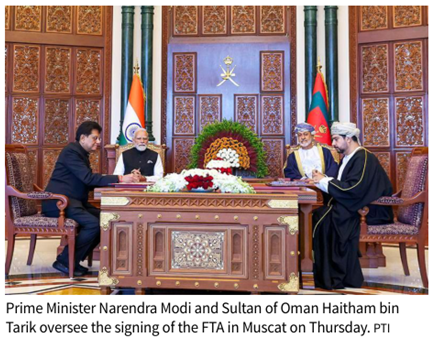
Context: India and Oman signed a Comprehensive Economic Partnership Agreement (CEPA) on Thursday, under which Oman will provide India duty-free access to 98.08% of its tariff lines, covering 99.38% of India’s exports to Oman.
India, on the other hand, has offered liberalised tariffs on 77.79% of its total tariff lines, covering 94.81% of what India imports from Oman. Apart from tariff removal on merchandise exports, the deal also includes several concessions that are expected to benefit India’s service sector, including in terms of mobility of workers.
The deal was signed in Muscat by Commerce and Industry Minister Piyush Goyal and Oman’s Minister of Commerce, Industry and Investment Promotion, Qais bin Mohammed Al Yousef, in the presence of Prime Minister Narendra Modi and Sultan Haitham bin Tarik.
India exported $4.06 billion worth of merchandise to Oman in 2024-25, which made up 0.93% of India’s total exports that financial year. It imported $6.5 billion worth of goods from Oman, comprising 0.91% of India’s total imports.
“The CEPA will infuse the India-Oman partnership in the 21st Century with renewed faith and energy,” Mr. Modi said earlier in the day while speaking at the India-Oman Business Forum. “This is a blueprint for our future. It will give our trade new vigour and new trust for investments and will open the doors of new opportunities in every sector.”
This is the first bilateral agreement that Oman has signed with any country since it signed a deal with the U.S. in 2006. It is also the second deal India has signed with a country in the Gulf Cooperation Council (GCC), the first being with the United Arab Emirates in February 2022.
Mr. Goyal had also pointed out that a trade deal with Oman also serves as a gateway for India to the GCC region, eastern Europe, central Asia, and to Africa.
Benefit to labour-intensive sectors
The Prime Minister added that the CEPA will create new opportunities for growth, employment and innovation for the youth of both countries.
Taking to X soon after the signing of the deal, Mr. Goyal said that the deal would “significantly benefit” labour-intensive sectors, generating employment and strengthening Micro, Small & Medium Enterprises (MSMEs), artisans, and women-led enterprises.
CAG recommends to State govt. to ensure Escoms reduce AT&C losses
Context: The Comptroller and Auditor-General of India which audited the Integrated Power Development Scheme (IPDS) in Karnataka has recommended that the State government ensure that the Electricity Supply Companies (Escoms) reduce the Aggregate Technical and Commercial (AT&C) losses as per the trajectory fixed by the Union Ministry of Power (MoP).
Subsidy
The CAG has also recommended ensuring timely release of subsidy for irrigation pumpsets as per metered consumption.
The CAG found that while the approved cost (including PMA charges of ₹6.87 crore) of the IPDS was ₹1,378.44 crore and the awarded cost was ₹1,721.19 crore., the Escoms incurred the actual expenditure of ₹ 1,489.33 crore (as of March 2023), i.e., Escoms incurred excess expenditure of ₹ 110.89 crore than the sanctioned cost in implementing the scheme, which included additional expenditure to the extent of ₹ 38.52 crore due to non-procurement of materials at Central Procurement Prices discovered by MoP.
It also pointed out that non-compliance of various requirements for securing additional grants resulted in loss of opportunity to receive additional grant of 15% of the project.
Better billing
At the same time, CAG acknowledged that the billing efficiency of Hescoms had generally improved during the scheme period contribution to reduction in billing losses.
The CAG found that while in August 2015, in-principle approval to DPRs of all five Escoms valued at ₹1,138.75 crore was granted and works were to be awarded within six months and completed within 24 months, Escoms took took 11 to 27 months to award works, leading to significant delays.
In the report it is mentioned that the Escoms awarded contracts in violation of KTPP Act and Rules by providing less time for submission of tenders, ranging from 15 days to 54 days against the stipulated minimum time of 60 days and by awarding works at high tender premiums exceeding the estimated cost by 5% to 34%.
CAG audit also recommended that the State government may ensure that Escoms may devise a suitable mechanism to issue tenders in time, to take up works without delay and to ensure completion of works in time to achieve the envisaged objectives.
Further Escoms may follow time frames as per KTPP Act and Rules to ensure adequate competition and to allow market discovery for most economical rates.
The Escoms may ensure that comprehensive feasibility surveys were conducted before project execution and may include conditions of standard bid documents in invitation to bids and ensure adherence to the same while executing works, the report said.
Bill adopted in Assembly to impose punishment for social boycott
Context: The Legislative Assembly adopted the Karnataka Social Boycott (Prevention, Prohibition and Redressal) Bill 2025 that seeks to prevent the evil practices of imposing social boycott, social discrimination and social disabilities at various levels by caste or community panchayats or by its members.
Any person who imposes or causes to impose or practises any social boycott on any member of his community, will on conviction, be punished with imprisonment, which may extend to three years, or with fine which may extend to ₹1 lakh, or with both, according to the provisions of the Bill.
The Bill, which was piloted by Social Welfare Minister H.C. Mahadevappa, also seeks to appoint a social boycott prohibition officer.
The House also adopted the Karnataka Private Medical Establishments (Amendment) Bill, 2025, which seeks to replace an Ordinance.
The Bill seeks to include the term “mental health establishment” within the definition of “private medical establishment” and nominate one member from the Indian Medical Association and one member representing the Association of Registered Medical Establishments or Ayush Medical Practitioners as member of Registration and Grievances Redressal Authority.
Assembly passes internal reservation Bill amid debate on Alemari and EWS quota
Context: Amid demand to increase the reservation for Scheduled Castes (SCs) to accommodate the interests of 59 Alemari (nomadic) communities, the Karnataka Legislative Assembly unanimously passed.
The Karnataka Scheduled Castes (Sub-Classification) Bill, 2025, that provides legislation cover to internal reservation in 17 % reservation for 101 Scheduled Castes.
The government was under pressure from the Dalit Left groups to legislate the internal reservation matrix.
Social Welfare Minister H.C. Mahadevappa, who moved the Bill, said, “Internal reservation was a promise made during the 2023 Assembly elections and we have kept it.”
Legislative cover
The Bill seeks to provide legislative cover to the GO that apportioned 17% reservation. Of this, 6% reservation has been provided to 16 castes in Category A (Dalit Left), 6% to 19 castes in Category B (Dalit Right) and 5% to 63 castes, including 59 Alemari castes in Category C (Lambani, Korama, Koracha and Bhovi).
During the discussion on the Bill, Deputy Leader of Opposition Arvind Bellad said that Alemari communities could not compete with other castes and inequality would continue. The Chief Minister’s Economic Adviser Basavaraj Rayaraddi suggested that the State could explore possibility of increasing the total reservation for SCs to 18% to include 1% reservation to Alemari communities.
India and the Netherlands reaffirm defence ties
Context: Defence Minister Rajnath Singh met the Foreign Minister of the Netherlands, David van Weel, in New Delhi, reaffirming the steadily expanding defence partnership between the two nations.
During the meeting, they held wide-ranging discussions on bilateral security and defence cooperation, including priority areas for the co-development and co-production of defence equipment, the Ministry of Defence stated.
The two countries reiterated their commitment to strengthening military-to-military engagement, and developing defence cooperation as a key pillar of the India-Netherlands Strategic Partnership.
The talks also underscored the shared commitment of India and the Netherlands to a free and rules-based Indo-Pacific region. Emphasising the need for closer defence ties, the Ministers highlighted the importance of connecting the defence industries of both countries, particularly in niche and emerging technologies.
Retired judges don’t want to sit as junior ad hoc judges: CJI
Context: Chief Justice of India Surya Kant revealed that retired High Court judges are reluctant to return to the Bench as ad hoc judges to clear the massive pendency of criminal cases for a simple reason: they are “embarrassed” to sit as junior judges alongside younger colleagues.
The High Courts across the country are burdened by mounting arrears, particularly in criminal cases.
Data from the National Judicial Data Grid shows that 18,98,833 criminal cases are pending in the 25 High Courts.
Of these, 68.27% or 12,96,374 cases have been pending for over a year. Against a sanctioned strength of 1,122 judges, there are 298 vacancies in the High Courts as of December 15.
Based on SC verdict
Alarmed by the backlog, the Supreme Court in a judgment in January activated Article 224A of the Constitution, allowing the Chief Justices of the High Courts to appoint retired former judges as ad hoc judges to clear criminal appeals.
However, the response from the High Courts has been lukewarm, with several courts not sending names to the Supreme Court for appointment as ad hoc judges.
“In my travels to the various High Courts, I spoke to the Chief Justices. They said there were many former judges who were keen and willing to return to the Bench and work… But they feel very embarrassed to sit as a junior judge with a serving judge on Division Benches,” Chief Justice Kant told Attorney-General R. Venkataramani during a special hearing. He pointed out that most criminal appeals were pending before Division Benches or two-judge Benches in the High Courts.
The Chief Justice, accompanied by Justices Joymalya Bagchi and Vipul M. Pancholi, noted that a large number of cases were pending in the Allahabad, Punjab and Haryana, and Patna High Courts.
The Chief Justice said the problem existed from the other end as well. “The serving judges would ask why they should sit with a retired person heading the Bench… Can we persuade a sitting judge to be a Bench partner with a retired judge heading the Bench?” he said.
Amicus curiae and senior advocate K. Parameshwar referred to an April 2021 judgment on the appointment of ad hoc judges.
LS passes rural jobs Bill amid protests
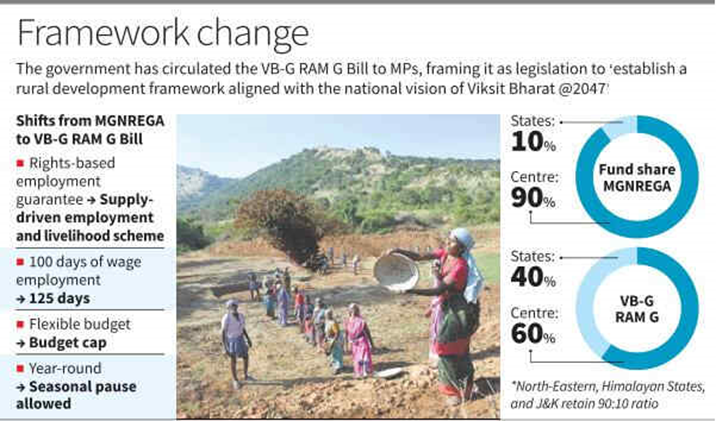
Context: The Lok Sabha passed the Viksit Bharat Guarantee for Rozgar and Ajeevika Mission (Gramin) (VB-G RAM G) Bill, replacing the 20-year-old Mahatma Gandhi National Rural Employment Guarantee Act (MGNREGA), amid loud protests from Opposition MPs who stormed the well of the House, tore copies of the Bill, and raised slogans.
Responding to the debate in the Lower House, Rural Development Minister Shivraj Singh Chouhan said the MGNREGA was riddled with “problems” and “corruption was rampant”. He also accused State governments of “misusing” funds.
“Funds were not allotted as expected. As per the Act, 60% of the funds were to be spent on labour and 40% on material. But only 26% was spent on material and funds were siphoned off,” he said.
Sculptor Ram Sutar passes away at 100
Ram V. Sutar, the legendary sculptor whose creations, including the Statue of Unity, defined the country’s public art landscape, was instrumental in giving Indian memorial sculpture global recognition.
Among his vast body of work are statues of Mahatma Gandhi at the Parliament complex, and Dr B.R. Ambedkar.
Rajya Sabha passes Bill to allow private firms in nuclear sector
Context: Amendments to SHANTI Bill and proposal to send it to a panel, moved by Opposition MPs, defeated in a voice vote; Jairam Ramesh warns against relaxation of any liability norms while Jitendra Singh says there will be no compromise with safety.
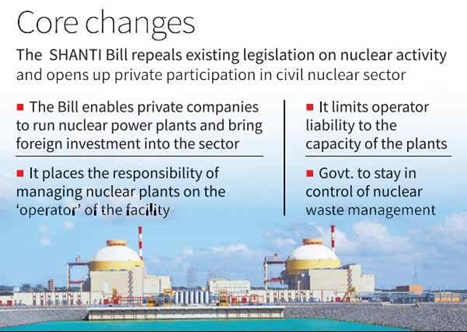
With the Rajya Sabha also clearing the Sustainable Harnessing and Advancement of Nuclear Energy for Transforming India (SHANTI) Bill on Thursday, the Union government said the Bill seeks to reduce the dependence on fossil fuels and increase the capacity of India’s atomic energy sector.
Senior Congress MP Jairam Ramesh, who initiated a debate, claimed that the Bill was brought with the intention of increasing the contribution of private companies in the nuclear sector. Mr. Ramesh warned the Centre against any relaxation in liability norms and cited the example of France, where all nuclear reactors are under government control.
The amendments to the Bill and the proposal to send the Bill to a Select Committee, moved by Opposition MPs, were defeated in a voice vote.
Countering the Opposition charges, Minister of State for Department of Atomic Energy Jitendra Singh said that nuclear power is a reliable source of energy, unlike other renewable energy options. He said there will be no compromise with safety. Mr. Singh said there has been no report of any radiation-related hazards to the public from any Indian reactors.
Mr. Ramesh said, “The Narendra Modi government has the habit of ignoring the milestones achieved by past governments.” He said the BJP opposed the nuclear deal between India and America in 2008. “The BJP had then said that there is not much future in nuclear energy. It is because of the nuclear deal that happened in 2008 that now the BJP can think of such a Bill,” he said.
“Our country has the capacity — we have installed plants of 220 megawatts and 540 megawatts. Utilise that capacity. Similarly, the government had brought farm laws to benefit the private sector, which had to be withdrawn. This Bill should not be vendor-driven. We are self-reliant in the matter of nuclear power. So, promote indigenous technology,” Mr. Ramesh said. He said the private sector will bring capital, not technology.
‘Will shape sector’
Harsh Vardhan Shringla, MP, said the country stands at a decisive juncture in its energy journey and the SHANTI Bill will shape the civil nuclear sector for generations, ending fragmented governance and creating an investment-ready framework. “This is not privatisation; this is partnership with accountability,” he said.
Trinamool Congress MP Sagarika Ghose said the Bill is fundamentally dangerous. “This Bill brings neither Shanti nor security… we are not debating whether India should pursue nuclear energy, India has always pursued nuclear energy responsibly for decades…” she said.
DMK MP P. Wilson said the Bill was a “nuclear bomb which threatens the country’s peace and security”. “There is nothing peaceful, nothing sustainable, nothing transformative about this legislation. On the contrary, it is a reckless, dangerous and deeply flawed attempt to privatise one of the most sensitive and high-risk sectors of a nation — the nuclear energy sector,” he said.
SC considers passive euthanasia for 31-year-old
Context: The Supreme Court asked to meet the parents of a 31-year-old man lying in a comatose condition for 13 years while contemplating their plea for passive euthanasia by withdrawing artificial life support for him.
“It is a very sad report. We cannot keep this boy in this stage,” Justice J.B. Pardiwala, accompanied by Justice K.V. Viswanathan, addressed the family’s counsel, advocate Rashmi Nandakumar, and Additional Solicitor-General Aishwarya Bhati.
The court’s comment came after perusing the report of a secondary medical board, headed by an AIIMS team of doctors, containing 31-year-old Harish Rana’s medical history.
‘900 million people will have diabetes by 2050, strong steps needed to slow progression’
Context: In its projections for 2050, the 11th edition of the International Diabetes Federation’s Diabetes Atlas has calculated that from around 500 million people living with diabetes in 2024, the number will grow to nearly 900 million people between the ages of 20 and 79.
Publishing the key results as an article in the peer-reviewed journal Lancet Diabetes Endocrinal 2025, the authors, who are scientists collaborating accross the world, pointed out that in 2024, that figure was 11.11% of the population and just over 580 million adults.
As per their projections, diabetes will affect 12.96% of the population — over 850 million people — in 2050.
In the paper, Irini Genitsaridi and other researchers say, “As the diabetes epidemic has continued unchecked since the turn of the millenium, stronger efforts are needed to slow down progression.” A total of 210 countries and five territories were included in the study.
In 2024, more people with diabetes were living in urban areas (400 million) than in rural areas (189 million). The authors state that this trend would continue with the projection for 2050 for urban centres (655 million), but in rural areas, it is likely to remain almost the same (198 million) in 2050.
Ramachandran, one of the authors of the paper, from the India Diabetes Research Foundation, says “one of the unique features of this year’s Atlas, is the table listing the top 10 countries of the world with diabetes load. China is right at the top of the table with about 148 million people with diabetes, and India comes up second on the table, with nearly 90 million. The United States comes third, and Pakistan, fourth.
In 2050, while China and India will maintain their top positions on the table, it is projected that Pakistan will climb to the third slot.
FinMin unveils new logofor Regional Rural Banks
The Finance Ministry unveiled a new logo for Regional Rural Banks (RRBs) to signify a single and unified brand identity.
On the principle of ‘One State One RRB’, the Department of Financial Services, Ministry of Finance, has consolidated 26 Regional Rural Banks (RRBs) across 11 States/Union Territories, effective from May 1, 2025.
The reform marks a crucial step toward building stronger and more efficient RRBs.
FM tables Securities Market Code Bill 2025 in Lok Sabha
Context: The Bill, which seeks to unify three laws governing the securities market, has been referred to the Standing Committee on Finance for review.
Finance Minister Nirmala Sitharaman tabled the Securities Market Code Bill 2025 in the Lok Sabha.
The Bill, which seeks to unify three laws governing securities market, was referred to the Standing Committee on Finance for review.
The Bill proposes to consolidate the Securities Contracts (Regulation) Act, 1956, Securities and Exchange Board of India (SEBI) Act, 1992, and the Depositories Act, 1996.
The move was announced in the Union Budget in 2021-22 and the Bill has now been tabled to rationalise and consolidate the existing provisions, and provides a modern regulatory framework for investor protection and capital mobilisation at scale, according to the statement of objectives in the Bill.
As per the Bill, the government proposes to increase the number of members in SEBI to 15 from the current nine, including the Chairperson.
This will include the Chairperson, two officers appointed by the Central Government and one from the RBI as ex-officio members, and 11 others, of whom at least five will be whole-time members. Currently there are three whole-time members.
In another significant change, Union Government also proposed to decriminalise violations of “minor, procedural and technical nature” into civil penalties to “facilitate the ease of doing business and to reduce the compliance burden.”
Civil penalties
The Bill, if enacted in its current form, would bring “unlawful gains or losses” under civil penalties and limit punishments only to cases of market abuse such as insider trading or trading while in possession of material or non-public information.
Further, in the case of contravention of any rules or provisions of the code, no inspection can be done if eight years had passed from the date of contravention. The Bill also mandates that the members of the board disclose any direct or indirect interests before making a decision to eliminate conflict of interest.
“These changes appear to be made in keeping with extant requirements balancing faster adjudication processes with the need for better deterrence,” said Paras Parekh, Partner at CMS INDUSLAW.
Even as the Bill was being introduced, DMK MP Arun Nehru and Congress’ Manish Tewari opposed it saying it gave excessive powers to a single body, which was against the principle of the separation of powers.
Responding to this, Ms. Sitharaman said that since the government was referring it to the standing committee, such details could be discussed by the panel.
Exporters to gain on near duty-free access to Oman, says FIEO
Context: The India–Oman Comprehensive Economic Partnership Agreement (CEPA) would strengthen India’s export competitiveness across goods and services, enhance professional mobility, and support inclusive and employment-led growth, The Federation of Indian Export Organisations (FIEO) said in its initial comment after signing of the deal.
“The CEPA secures unprecedented market access for Indian exports, with zero-duty access on 98.08% of Oman’s tariff lines, covering 99.38% of India’s exports by value,” said S. C. Ralhan, President, FIEO.
“This will significantly enhance the competitiveness of Indian goods and benefit key labour-intensive sectors such as textiles and apparel, leather and footwear, gems and jewellery and sports goods.”
LS passes nuclear energy Bill allowing privatisation
Context: Congress protests SHANTI Bill which removes clause holding equipment supplier responsible for failure, questions its timing and interest shown by a ‘conglomerate house’; Centre defends the Bill.
The Lok Sabha passed the Sustainable Harnessing and Advancement of Nuclear Energy for Transforming India (SHANTI) Bill, 2025, despite demands by several Opposition parliamentarians for referring the legislation to a parliamentary panel.
The Bill, which aims at incentivising private sector participation, both Indian and foreign, into nuclear power production, now moves to the Rajya Sabha for discussion.
Congress MP Manish Tewari, who opened discussions on the Bill following introductory remarks by Science Minister Jitendra Singh, sought to know if it was a “coincidence” that a legislation enabling private sector participation in the nuclear sector coincided with interest expressed by the “conglomerate house… Adani” in November to enter the nuclear sector.
Mr. Singh, amidst uproar in the House following this, retorted that the Bill had nothing to do with any specific company and such an aspersion “brought disrepute to the House.”
Mr. Tewari also burrowed into what is perhaps the most significant element of the Bill: the removal of a clause in the existing Civil Liability for Nuclear Damage Act, 2010, that allows the operator of a nuclear power plant to claim recourse from suppliers if their equipment was found being responsible in case of an accident.
In 2008, the Bharatiya Janata Party (BJP) had moved a no-confidence motion against the Manmohan Singh government for, among other things, the absence of such a clause. Later, this was also a reason for the lack of foreign participation in India’s nuclear sector despite the U.S.-India nuclear deal that granted India a waiver from Nuclear Suppliers Group sanction as it opened foreign companies to potentially unlimited liability.
“I now see that there is no reference to suppliers… god forbid if there is an accident… shouldn’t a foreign supplier be liable?” Mr. Tewari questioned.
‘Times have changed’
Mr. Singh acknowledged that the BJP had voiced opposition in the past and said that the existence of the clause “had caused reservations in collaborators” but the scenario today was different from 2010. “Times have changed… technology has changed. We are now into small modular reactors which didn’t exist as a technology at that time. There will now be reactors – following the just announced Nuclear Mission – that will give power in dense areas. The risk of catastrophe has now changed. This Bill is coming in because the scenario has changed,” he said.
Aditya Yadav of the Samajwadi Party accused the government of bringing in the Bill by “sacrificing the old laws… that kept public interest first” because the government faced with a “dollar that has crossed ₹90” and “unable to attract foreign investment” was “desperately trying to throw a red carpet to American companies” under pressure from the “prevailing Trump tariffs”.
Supriya Sule, MP from the Nationalist Congress Party (Sharad Pawar), asked how it was possible to cap the liability of plant operators at ₹3,000 crore. “How can you put a cap on that… how have you calculated this magic number?” she asked.
11 Bills passed in Council
Context: The Karnataka Legislative Council passed 11 Bills that were earlier passed by the Karnataka Legislative Assembly.
They were Chandraguthi Shree RenukambaKshetra Development Authority Bill, 2025; The Karnataka Rent (Amendment) Bill 2025; Shree Chamundeshwari Kshetra Development Authority (Amendment) Bill 2025; the Karnataka Hindu Religious Institutions and Charitable Endowments (Amendment) Bill 2025; Karnataka Cine and Cultural Activists (Welfare) (Amendment) Bill 2025; Malnad Area Development Board (Amendment) Bill 2025; Karnataka Land Revenue (Amendment) Bill 2025; Bayaluseeme Development Board (Amendment) Bill 2025; Sri Malai Mahadeswaraswamy Kshethra Development Authority (Amendment) 2025: Karnataka Labour Welfare Fund (Amendment) 2025, and the Karnataka State Universities (Amendment) Bill 2025.
Bill on sub-classification of SCs for reservation tabled in Assembly
Context: The Karnataka Scheduled Castes (Sub-classification) Bill, 2025, that seeks to provide legality to the government orders related to sub-classification of the 101 Scheduled Castes with a reservation share of 17% was tabled in the Legislative Assembly.
The one-man commission led by retired Justice H.N. Nagamohan Das had submitted its report to the government on August 4 this year with specific recommendations on sub-classification of Scheduled Castes among various sub-groups of SCs.
The government approved the recommendations of the commission with some modifications to implement the sub-classification among the SCs for ensuring a fair and equitable distribution of reservation benefits, and accordingly sub-categorised 101 Scheduled Castes with a share of 17% of reservation.
As per the Bill, Category-A, which has 16 castes, and Category-B, with 19 castes, will get reservation of 6% each, while Category-C, comprising 63 castes, will get reservation of 5%. Similarly, the Bill has three non-categorised Scheduled Castes – Adi Andhra, Adi Dravida and Adi Karnataka – that are eligible to opt for reservation under Category-A or Category-B, based on caste certificates.
The Karnataka State Commission for the Scheduled Castes and the Scheduled Tribes (Amendment) Bill, 2025, too was tabled in the Assembly on Wednesday.
The Bill seeks to nominate a person belonging to the ST and a woman as the members of the Karnataka State Commission for the Scheduled Castes and the Scheduled Tribes. It also seeks to empower the Karnataka State Commission for the SC and ST to make necessary modifications in the reservation percentage of sub-classification to the members of SCs on the receipt of new data or information from the government.
Other Bills
The Assembly also adopted six Bills, including the Bengaluru Metropolitan Land Transport Authority (Amendment) Bill, 2025, and Drugs and Cosmetics (Karnataka Amendment) Bill, 2025.
CAG highlights inadequate preparedness in State’s disaster management
Context: The report of the Comptroller and Auditor General (CAG) of India has highlighted the vulnerabilities, inadequate preparedness in disaster management system of Karnataka, amid increasing natural disasters.
Analysing the efforts from 2017-18 to 2022-23 in managing calamities and risk reduction, the report pointed out that although Karnataka State Disaster Management Authority (KSDMA) was established in 2008, the State Disaster Management Policy was published after 12 years, only in 2020.
It said that the State Emergency Operation Centre was under-equipped in terms of human resources and infrastructure, which affected its functioning. The Disaster Response Force Units had huge vacancies — ranging from 67% to 96% — of the sanctioned strength resulting in the units facing difficulties in carrying out duties and rescue operations.
Defective TWSs
KSNMDC had installed Telemetric Rain Guages (TRGs) and Telemetric Weather Stations (TWSs) in a phased manner between 2009 and 2015, but as of December 2023, it was found that 43% of TRGs and 52% of TWSs were defective, the report said.
It has also pointed out that the funds released by the State were not calamity-specific, complicating monitoring of NDRF/SDRF grants. The CAG has found misappropriation of ₹18.59 lakh at Chintamani in Chikkaballapura district, unutilised funds of ₹7.69 crore in Fire Emergency Department, and taluks of Haveri district spending ₹1.81 crore out of SDRF for reasons not related to natural calamities/disasters.
The CAG has pointed out that although the State Action Plan for Flood Risk was established in 2021, it lacked preparation for flood management in critical sectors. It found that 49 out of the 100 Water Level Sensors installed in Bengaluru remained non-functional as on December 2023. The State has not established a legal framework for flood infrastructure.
On the compensation front also, CAG has found discrepancies. It has said that compensation for damages was inconsistent and the verification processes were inadequate. It also found that there were 22,496 cases of house damage reconstruction pending despite ₹213.94 crore disbursed.
The CAG has recommended revamping Emergency Operation Centre and enhancing training for officials, among other things.
Funds meant for welfare of mining areas spent violating guidelines: CAG report
Context: The Comptroller and Auditor General (CAG) of India has taken note of irregular expenditure of funds under the Pradhan Mantri Khanij Kshetra Kalyan Yojana (PMKKKY), violating the guidelines.
The CAG has audited the money spent towards the welfare of areas affected by the mining, utilising funds collected by the District Mineral Foundation Trusts (DMFTs), between 2015 and 2023.
The trusts collected ₹4,003.51 crore during the period and incurred an expenditure of ₹1,826.46 crore.
The CAG report was tabled in the Legislative Assembly in Belagavi on Wednesday.
The CAG, in its findings, noted that the Deputy Commissioner of Ballari utilised ₹68 lakh to purchase 12 vehicles, utilising the DMFT fund in 2021, violating the guidelines. Similarly, the report noted that ₹1.26 crore was spent towards the salary of Home Guards and the improvement of roads in the Deputy Commissioner’s office premises in Ballari between 2020 and 2023.
When the CAG sought reply for the expenditure, in violation of the guidelines, the State government maintained that it was spent as per the approval of the Finance Department. However, the CAG reported that the government’s response was not acceptable.
“The reply was not acceptable as the Finance Department has no powers to sanction expenditure as per the DMFT rules,” the report stated.
FDI inflow grows
Karnataka has recorded a remarkable year on year growth of 149.3 % in FDI equity inflows in the first quarter of 2025-2026 compared to 2024-2025. In the first quarter this fiscal, the FDI equity inflows to Karnataka reached $5.6 billion out if $ 18.6 billion received by the country.
In 2024-2025, State received $ 6.6 billion, representing 13.2 % of the nation’s total FDI equity inflows.
GST rate rationalisation to further hit revenues
Context: The State estimates the revenue shortfall of ₹9,000 crore in addition to the revenue loss of about ₹9,500 crore due to non -merger of cess.
Karnataka, which estimated a revenue deficit of ₹19,262 crore at the commencement of 2025-26 financial year, is now expecting the deficit to further increase following the GST rate rationalisation and non-realisation of tax on mines.
The revenue deficit — primarily caused by the five guarantee schemes — in 2025-26 budget had come down to 0.63% from 0.96% of the 2024-2025 budget. Considering the growth rate, the government was estimated to overcome revenue deficit by 2027-28.
The Mid Year Assessment of Medium Term Fiscal Plan (MTFP) 2025-2029 tabled in the Winter Session of the Legislature here, estimates an expected lower revenue collections compared to the estimated targets — potentially increasing the revenue deficit in the current financial year. Due to GST rate rationalisation, the State estimates the revenue shortfall of ₹9,000 crore in addition to the revenue loss of about ₹9,500 crore due to non-merger of Cess.
The 2025-26 budget estimated a revenue expenditure of about ₹3.11 lakh crore against the estimated revenue receipts of about ₹2.92 lakh crore in the total budget size of ₹4.09 lakh crore. The first half of this fiscal, the State, however, has recorded a revenue surplus of ₹68 crore with revenue expenditure of ₹1,28,924 crore against revenue receipts of ₹1,28,987 crore. By the end of September, total spending was 36.4%. The capital expenditure increased by 32.3% in the first half of 2025-2026 over 2024-2025. The Union Finance Ministry has projected the State’s GSDP to be around ₹30.91 lakh crores for 2025-2026.
The assessment noted that the increase in committed expenditure, including the State’s spending on guarantees and various welfare schemes, has increased the revenue expenditure, and the GST rationalisation has further constrained the State’s fiscal position.
Stating that the GST rate rationalisation will have significant impact on the State’s finances, it said any reduction in SGST or other own tax revenue for States directly reduces fiscal capacity, potentially forcing them to either borrow more or cut essential services. The cessation of GST compensation mechanism has left States fully responsible for any revenue shortfall when the compensation period ended in 2022. State’s GST to GSDP ratio fell sharply from 3.5 % in 2020 to 2.4 % in 2024. The GST revenue as percentage of GSDP has still not surpassed the levels recorded in the pre -GST era, it noted.
SC order on mines
The assessment also noted the negative IGST settlement of ₹2,074 crore in April, 2025, that has moderated the overall revenue growth during the first half of the current fiscal year. While Karnataka expected a tax revenue of ₹3,000 crore from mines after it enacted the Karnataka Mineral Rights and Mineral Bearing Lands Tax bill, 2024, following Supreme Court direction, the Bill is still pending Presidential assent, it said.
Meanwhile, the non -tax revenue has increased to ₹9,827 crore in the first six months of 2025-26 from ₹6,624 crore in the corresponding period last year. The own tax revenue has also increased from ₹84,945 crore in 2024-25 to ₹ 90,981 crore in 2025-26. The assessment noted that the revenue collections had shown a 7.7% increase over the corresponding period last year.
Centre’s aid falls
However, the grant in aid from the Centre has decreased by 38.2 % in 2025-2026 from ₹8,309 crore in first half of last year to ₹5,139 crore received in the first six months of this fiscal. The assessment noted that the transfers from the Centre have shown no growth.
Navy commissions second MH-60R copter squadron, the ‘Ospreys’, at INS Hansa
Context: INAS 335, the Ospreys, the second Indian Naval Air Squadron to operate MH-60R helicopters, was commissioned at INS Hansa, Goa. The ceremony was presided over by Admiral Dinesh K. Tripathi, Chief of the Naval Staff (CNS), marking another major milestone in the modernisation of Indian naval aviation.
The commissioning follows the induction of the first MH-60R helicopter squadron at Kochi, Kerala, in March 2024. With the induction of the versatile, multi-role MH-60R helicopter on the western seaboard as the first operational squadron, the Navy has significantly enhanced its rotary wing combat and surveillance capabilities.
Addressing the gathering, Admiral Tripathi said the commissioning assumes special significance as 2025 marks 75 years since the Government of India approved the formation of the Fleet Air Arm, a historic decision that gave wings to naval aviation.
Recalling earlier capability additions at INS Hansa, the CNS noted that the Navy had commissioned its second P-8I maritime patrol aircraft squadron at the same airbase in 2022. Complementing the P-8I fleet, the Navy is going ahead with the acquisition of 15 MQ-9B Sea Guardian remotely piloted aircraft.
Uttarakhand Governor returns UCC, religious conversion Bills
Context: In a setback to the Pushkar Singh Dhami-led Uttarakhand government, Governor Lt. Gen. Gurmit Singh (retd.) has returned the amendment Bills related to the Uniform Civil Code (UCC) and the State’s Freedom of Religion and Prohibition of Unlawful Conversion Act, citing technical flaws.
Sources in the government confirmed that the Governor’s office has returned the Bills.
“Apart from some grammatical and technical errors, the Governor has also raised issues with the punishment term for a couple of offences in the new legislations,” an official involved in the drafting of the Bills told The Hindu.
He added that since the Bills have now come back from the Governor’s office, they will have to be redrafted, removing the mistakes pointed out and addressing other technical glitches. “The government then will be left with two options, either pass the amendments by bringing an ordinance or get them passed again in the State Assembly and send them again for the Governor’s consideration,” the official added.
Although the State government has claimed that the Governor’s office returned the Bills due to minor faults, the Congress termed the move a tactic to keep the issues alive in public memory ahead of the Assembly elections due in 2027.
“If they were just minor flaws, the Governor’s office could have unofficially sent them back for corrections. …it is just a tactic of the government to recall the Bills and once again pass them in the Assembly sometime around the elections which are due in early 2027 because the BJP has already used all its divisive tactics to win elections and now they are left with nothing new,” Uttarakhand Congress vice-president Suryakant Dhasmana said.
Suggest measures to prevent attacks on judges: SC to Centre
Context: The Supreme Court asked the Centre and the Supreme Court Bar Association (SCBA) to suggest measures to prevent a repeat of incidents such as the one in October when a lawyer threw an object at the then Chief Justice of India’s Bench.
On October 6, advocate Rakesh Kishore hurled an object at a Bench led by then Chief Justice of India B.R. Gavai and shouted slogans before he was escorted out of the court room.
The SCBA, represented by senior advocate Vikas Singh, has sought contempt action against Mr. Kishore.
However, the Bench led by the current Chief Justice of India, Justice Surya Kant, had steered the trajectory of the petition away from the contempt jurisdiction to framing guidelines to prevent such incidents from happening in the future. On Wednesday, the court impleaded the Centre, represented by the Solicitor General Tushar Mehta, in the case.
Besides, preventive measures, the Bench directed the lawyers’ body and the Centre to propose protocol that has to be followed by “everyone” in “publicising, reporting” such incidents.
The SCBA has contended that Mr. Kishore’s act was “contempt on the face of the court”.
Prasar Bharati drafts policy to monetise television, OTT content
Context: Prasar Bharati, the government-owned national broadcaster, has uploaded a draft Content Syndication Policy, 2025 on its website for public consultation.
The policy seeks to promote cultural outreach and monetise content, while also upholding its public service mandate, Minister of State for Information and Broadcasting L. Murugan said in the Lok Sabha.
A structured industry consultation had been carried out with key stakeholders across the media ecosystem, including OTT (Over-The-Top) platforms, linear TV broadcasters, radio networks, telecom carriers, IPTV (Internet Protocol Television) operators, and content aggregators, Mr. Murugan said in response to questions by T.M. Selvaganapathi, Salem MP.
The policy aims to monetise content produced by Doordarshan and Akashvani; archived national and regional content; digital-first content published on Prasar Bharati’s OTT platform; and live coverage of government events, festivals, and sports, among others.
It calls for “strategic collaborations” with domestic and international platforms to expand the reach of Prasar Bharati’s content, and strengthen India’s cultural presence globally.
RS passes Bill for 100% FDI in insurance sector
Context: During debate, Opposition says Bill should be sent to a Select Committee of Parliament givenits far-reaching impact; House passes Repealing and Amending Bill that annuls 71 obsolete laws.
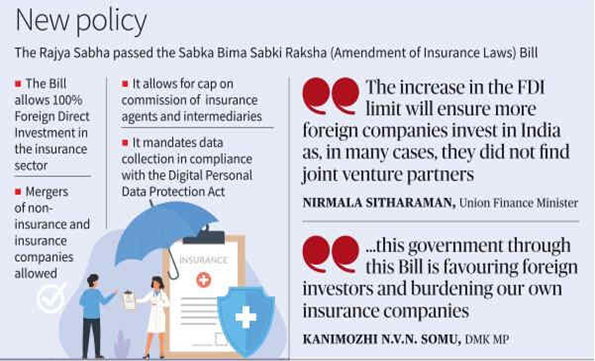
A day after the Lok Sabha passed the Sabka Bima Sabki Raksha (Amendment of Insurance Laws) Bill, the Rajya Sabha passed the legislation which allows 100% foreign direct investment in the insurance sector.
The Upper House also cleared the Repealing and Amending Bill that repeals 71 obsolete laws. The Bill was also passed by the Lok Sabha.
The structure of insurance regulation is very clearly laid out in the Bill, and the premium collected from Indians by foreign insurance companies will be kept in the country, Union Finance Minister Nirmala Sitharaman said, replying to a debate on the Bill. Private sector insurance companies were participating in all welfare schemes of the Union government, and the Bill would ensure that foreign companies would also participate in social sector-related activities and government schemes, Ms. Sitharaman said. “We are not giving them any room to get away from that responsibility,” she said.
The increase in the FDI limit to 100% would ensure more foreign companies invest in India as, in many cases, they did not find joint venture partners for various reasons, she said. With more companies, the competition would increase, and premiums should drop, she said.
Earlier, during the debate, the Opposition demanded that the Bill be sent to a Select Committee of Parliament given the far-reaching impact it has on the insurance sector.
‘Threat to data privacy’
Initiating the debate, senior Congress MP Shaktisinh Gohil said the Bill posed a threat to data privacy as foreign companies would demand PAN and Aadhaar of their customers, which may lead to digital frauds. The Centre should learn from the experience of privatising the civil aviation sector, Mr. Gohil said. He demanded that the Bill be sent to a Select Committee.
Questioning the use of both Hindi and English in the name of the Bill, Saket Gokhale of the All India Trinamool Congress said the Bill opened the door to profit extraction by foreign companies.
A market share of $600 billion would go to foreign investors once the Bill was implemented, Kanimozhi N.V.N. Somu of the Dravida Munnetra Kazhagam said. “This is daylight robbery. The government should not squander opportunities to promote and strengthen its own PSUs (public sector undertakings), but this government through this Bill is favouring foreign investors and burdening our own insurance companies,” Ms. Kanimozhi said.
The Rajya Sabha passed the Repealing and Amending Bill. The Bill would remove 71 outdated laws, correcting errors that had crept in during the law-making process, and removing discriminatory aspects of certain laws, Union Law Minister Arjun Ram Meghwal said.
“We give priority to ease of living along with ease of doing business,” he said. “These reforms are a step towards liberation from a colonial mindset,” he added. It seeks to repeal Acts, including the Indian Tramways Act, 1886; the Levy Sugar Price Equalisation Fund Act, 1976; the Bharat Petroleum Corporation Limited (Determination of Conditions of Service of Employees) Act, 1988; the General Clauses Act, 1897; the Code of Civil Procedure, 1908; and the Indian Succession Act, 1925.
Context: Holding simultaneous elections to legislatures at the State and Union levels will be a “positive step” from an economic standpoint, according to Harvard economist Gita Gopinath, a former Chief Economist and First Deputy Managing Director at the International Monetary Fund (IMF). However, she cautioned that the implementation of the proposed reform will require careful planning to address logistical complexities, according to sources.
Ms. Gopinath was briefing the Parliamentary Joint Committee reviewing the Constitution (One Hundred and Twenty-Ninth Amendment) Bill, 2024, which aims to introduce simultaneous elections. The panel also met Sanjeev Sanyal, a member of the Economic Advisory Council to the Prime Minister, who backed simultaneous elections.
‘Could spur investment’
In a written submission to the panel, Ms. Gopinath reportedly said that synchronising the Lok Sabha and Assembly elections could reduce prolonged periods of policy uncertainty and spur economic activity.
“International research shows that pre-election uncertainty slows investment. In India, this is compounded by the Model Code of Conduct, which freezes new projects during staggered polls,” she noted. States that hold simultaneous elections had recorded stronger post-election growth, she said.
The economist argued that fewer election cycles could shift public spending towards long-term infrastructure projects. Synchronisation, she said, could help governments prioritise infrastructure, boosting growth prospects.
Uncertain cost impact
Noting that the synchronised elections could generate efficiency and gains, she warned that international experience, notably Indonesia’s 2024 election, underscored the risks of fully simultaneous polls. “Indonesia faced record spending, heavy logistical pressures and unusually high staffing needs, prompting its Constitutional Court to partially separate elections from 2029,” she said.
While India’s administrative strengths may mitigate some challenges, the net cost impact remains uncertain.
Arguing on similar lines, Mr. Sanyal said that simultaneous elections would reduce expenditure, adding that is not the primary reason to bring in this reform.
The staggered elections impose “significant economic costs due to repeated disruptions in policy continuity”, he said.
He said that synchronised polls could enhance governmental stability, thereby strengthening long-term decision-making and policy planning.
Vaishnaw says anti-collision system installed on 2,00O km of rail network
Context: Union Railway Minister Ashwini Vaishnaw informed the Lok Sabha that the indigenous anti-collision Kavach safety system had been fully commissioned on over 2,000 km of the rail network.
In a reply during Question Hour, Mr. Vaishnaw said that Kavach was a highly complex Automatic Train Protection (ATP) system comprising five major components. It required continuous laying of optical fibre cable (OFC) along tracks and the installation of telecom towers.
The Minister said the Railways had so far laid 7,129 km of OFC, installed 860 telecom towers, connected 767 stations to data centres, deployed track-side equipment along 3,413 km, and equipped 4,154 locomotives with the system. “Complete commissioning has crossed 2,000 km,” he said, adding that the pace of work was “very fast”.
The Minister said around 40,000 technicians and operators had been trained, underlining that Kavach was a “totally new and very complex” system.
On rail accidents
Responding to a supplementary by DMK MP Kalanidhi Veeraswamy on rail accidents, Mr. Vaishnaw said consequential accidents had fallen by nearly 90% — from 135 in 2014 to 11 now.
In response to another supplementary question, he said redeveloping railway stations without disrupting train services was a “complex task”.
He noted that several countries suspended rail operations for three to four years during station redevelopment. “In India, where 7.5 crore passengers travel by train, this is simply not possible,” Mr. Vaishnaw said.
He said stations were being upgraded under the Amrit Bharat Station Scheme, which adopts a long-term, phased approach based on master plans.
ICG Ship Sarthak makes first port call at Iran’s Chabahar
Context: The Indian Coast Guard (ICG) Ship Sarthak, an offshore patrol vessel, entered the Chabahar port in Iran on December 16 for a four-day visit till December 19.
According to the Defence Ministry, the port call, marking the first-ever visit of an Indian Coast Guard ship to Chabahar, underscored India’s growing maritime engagement in the region and its ability to support secure supply lines to Afghanistan and Central Asia.
The visit is aligned with India’s SAGAR and MAHASAGAR vision of fostering secure and inclusive maritime engagements. ICG Ship Sarthak will engage in a range of professional and community-oriented activities.
Indian Army leaves for Desert Cyclone-II military exercise
Context: An Indian Army contingent has departed for the United Arab Emirates (UAE) to participate in the second edition of the India–UAE Joint Military Exercise DESERT CYCLONE–II, scheduled to be held at Abu Dhabi from December 18 to 30.
According to the Defence Ministry, the Indian contingent comprised 45 personnel, primarily drawn from a battalion of the Mechanised Infantry Regiment.
The UAE Land Forces will be represented by a contingent of similar strength from the 53 Mechanised Infantry Battalion.
Aim of the exercise is to enhance interoperability and further strengthen defence cooperation between the Indian Army and the UAE Land Forces.
SEBI reviews decades’ old brokerage norms
Context: Decides to cut maximum expense ratio by up to 15 bps; cap on brokerage segment cut to 6 bps for cash market, 2 bps on derivative transactions.
The Securities and Exchange Board of India (SEBI) on Wednesday revised the total expense ratio charged by mutual funds (MFs), reviewed the two-decade-old brokerage regulations, and proposed to discuss public comments on the high-level committee (HLC) regarding its report on conflict of interest.
The markets regulator, in its board meeting, also announced measures for simplification of IPO documents for the benefit of investors, and allowed credit rating agencies (CRAs) to carry out ratings for unlisted debt instruments.
SEBI decided to cut the maximum expense ratio charged on investors by up to 15 basis points as part of a comprehensive review of the MF regulations.
The changes have been applied on slabs determined by the assets under management of the mutual funds.
According to the new regulations, expense ratio will now be called ‘Base Expense Ratio’ (BER), which will exclude stamp duty, GST, and STT among other levies. The total exchange ratio will be a sum of BER, brokerage, regulatory levies and statutory levies.
The cap on brokerage segment has now been cut to 6 bps for cash market and 2 bps on derivative transactions. In the consultation paper on MF regulations, the regulator proposed that the cash market brokerage may be capped at 2 bps and derivatives at 1 bps. One bps is one hundredth of a percentage.
In line with the proposals, the additional exit load of 5 bps, usually charged in the event of a premature redemption, has been completely done away with. “It was very clearly brought to our notice that the sell side research is a bundled cost. We were trying to propose that they can unbundle it and can pay brokerage at a lower level and pay for research separately, [but] that business model is not available today,” SEBI Chairperson Tuhin Kanta Pandey said while addressing a press conference.
He added that attempts to unbundle sell side research cost and brokerage charges were not successful in Europe and the U.K.
Sell side research are brokerage reports that are given by securities brokerage companies. Brokerage includes cost for research and the brokerage commission.
The mutual fund regulation reviews also included simplification of old rules, reorganisation of roles and responsibilities of AMCs, and reorganisation of provisions related to the prudential investment limits and valuation of securities.
SEBI also revamped the stock brokers regulations to simplify language, updating contemporary changes among other changes. Both mutual fund and brokerage regulations were more than two decades’ old.
The regulator also simplified norms for public issue by doing away with the need for an offer document summary and instead replaced it with the abridged prospectus. The document will be made available to the investor in the form of a QR code.
SEBI also said that it had reviewed the high level committee report on conflict of interest.
India, Oman to sign free trade pact today: Goyal
Context: Confirming India and Oman will be signing a Free Trade Agreement (FTA), Commerce Minister Piyush Goyal said the FTA offers “immense opportunities” in a number of sectors, including textiles, footwear, automobiles, gems and jewellery, renewable energy, and auto components.
Speaking at the India-Oman Business Forum in Muscat, Mr. Goyal added India stood to gain in terms of the access Oman provides to markets such as the GCC, eastern Europe, central Asia, and Africa.
India and Oman began talks on a Comprehensive Economic Partnership Agreement (CEPA) in 2023. Mr. Goyal said he and his Omani counterpart would sign the FTA in the presence of Prime Minister Narendra Modi and Sultan Haitham bin Tarik.
“The sky is the limit in terms of potential, particularly with Oman opening the doors as a gateway to the Gulf Cooperation Council region, eastern Europe, central Asia, and to Africa,” said Mr. Goyal.
He added there were four broad areas in which the two countries can collaborate with each other.
Energy transition
“One is in the energy transition that both are committed to, whether it’s renewable sources of energy, battery storage, green hydrogen, that whole ecosystem can open up between Oman and India,” he said.
The second area was infrastructure, multi-modal logistics and export warehouses.
“Another area would be food security. We can help Oman ensure food security,” he said, adding “there was a lot of potential in this area.”
The fourth area, which India and Oman could work together, was to develop startup ecosystems.
“The startups can engage with each other, build bridges, work on deep tech or smarter ways to work on logistics software services, artificial intelligence, there is tremendous potential to leverage this area as a hub,” Mr. Goyal said.
Karntaka Legislative Assembly adopts Bill to add members to GBA
Context: The Assembly adopted the Greater Bengaluru Governance (Second Amendment) Bill, 2025, to include elected representatives as members of the GBA.
The Legislative Assembly adopted the Greater Bengaluru Governance (Second Amendment) Bill, 2025, that seeks to include members of the Lok Sabha, the Rajya Sabha, the Legislative Assembly, and the Legislative Council as members of the Greater Bengaluru Authority (GBA) if they come under its jurisdiction.
Names of some of the elected representatives, including Rajya Sabha MP Sudha Murthy and Chickballapur MP K. Sudhakar, had been left out from the GBA as its members, though they came under the GBA jurisdiction. The proposed amendment would provide for adding their names.
Ex-officio members
It is also aimed at including Chief Secretary, Additional Chief Secretary to Urban Development Department, and Additional Chief Secretary/Principal Secretary to Finance Department as ex-officio members of the GBA.
The Bill also provides for inclusion of ACS to Urban Development Department as a member of the Executive Committee of the GBA.
It also provides for re-division of wards in respect to newly incorporated local areas to be carried out within a specified period.
No provision for appointing nominated members to the GBA. “There are 369 members in the GBA. If the government adds one nominated person for every 20,000 population, there would be another 369 members. This would create confusion.”
Karnataka tops National Energy Conservation Awards 2025
Karnataka Renewable Energy Development Limited (KREDL) has won the National Energy Conservation Awards 2025 under the State Energy Efficiency Performance Award (SDA Group-1) category, The second place was taken by Maharashtra.
President Droupadi Murmu presented the award in New Delhi on December 14 during the National Energy Conservation Day celebrations.
Vishwas Gowda wins gold
Powerlifter Vishwas Gowda P. won three gold medals in the 90 kg category at the WRPF World Championship 2025, held in Moscow, Russia, from December 4 to 7.
According to the Pratham International Group of Institutions, Vishwas topped the podium in Full Powerlifting, Bench Press and Push Pull events, bringing international recognition to Indian powerlifting with his dominant showing at the prestigious championship.
Forest Minister attributes human-animal conflict to increase in animal population
Context: Forest Minister Eshwar Khandre attributed the increase in the human-animal conflict in recent years to the increase in animal population.
After the Wildlife Protection Act, 1972, came into effect, the hunting of animals was stopped. Gradually the number of animals increased.
Karnataka stands first in the country considering the elephant population (6,395) and second in terms of tiger population. As per the tiger census conducted in 2022, the tiger population was 563 in the State.
“But, when analysed again after the recent incidents of human-tiger conflicts, we understood that the number has gone up to 600 in the State.
In the year 1972, the number of tigers in Bandipur was only 12. During our last census the number was 150 and now it has gone to 200,”. The Bandipur National Park is spread over 1,000 sq. km.
“I had asked the officers to study the carrying capacity of the park. According to an estimation, a tiger needs an area of 11 to 12 sq. km. Going by the land available, the park could accommodate around 100 to 110 tigers.
But the current population is around 200, initiating territorial fights among them. We have also studied the population of mammals like deer that tigers require to survive. There is no shortage of such animals,” he said.
The Minister said every year on an average 40-50 human deaths are reported in human-animal conflicts.
Assembly adopts 12 Bills, including Land Revenue Bill
Context: Karnataka Land Revenue (Second Amendment) Bill, 2025, seeks to remove anomalies in classification and maintenance of land records in Kodagu district.
The Karnataka Legislative Assembly adopted 12 Bills, including the Karnataka Land Revenue (Second Amendment) Bill, 2025, which seeks to remove anomalies in the classification and maintenance of land records in Kodagu district, and the Karnataka Rent (Amendment) Bill.
Piloting the Karnataka Land Revenue (Second Amendment) Bill, Revenue Minister Krishna Byre Gowda noted that Kodagu had continued to operate its own traditional system of records even after 1964 when the Karnataka Land Revenue Act had come into effect.
Under this pre-Independence system, those who served the British in their army had been appointed as agents (Pattedars) to collect revenue on behalf of the British regime. However, the problem started in 2000 when Karnataka moved towards of digitisation of land documents through the Bhoomi project, as there was no parity between the records under the Bhoomi and the land records in Kodagu, he noted.
However, the then Deputy Commissioners of Kodagu had continued with the old system by issuing notifications at their level which created in additional columns in RTC that had entries for pattedars. This triggered legal issues over ownership of land as there was a need to clarify whether the land owner had absolute ownership or if it belonged to pattedars.
Hence, the government was now amending this legislation to provide for empowering tahsildars of Kodagu district to hold hearings and make necessary corrections in the land records to bring them in conformity with present system.
The Karnataka Rent (Amendment) Bill would seek to achieve the principle of “Minimum Government Maximum Governance” by decriminalisation of minor offences and rationalisation of monetary penalties as envisaged in the Jan Vishwas (Amendment of Provisions) Act 2023 (Central Act 18 of 2023).
The Malnad Area Development Board (Amendment) Bill, The Bayaluseeme Development Board (Amendment) Bill, Shree Chamundeshwari Kshetra Development Authority and Certain Other Laws (Amendment) Bill, The Chandraguthi Shree Renukamba Kshetra Development Authority Bill, and Sri Malai Mahadeshwaraswamy Kshetra Development Authority (Amendment) Bill were also adopted by the Assembly.
Study affirms Kerala’s rich butterfly diversity in the Western Ghats region
Context: Kerala hosts the highest butterfly diversity among all Indian States along the Western Ghats, with 328 species documented, including 41 species endemic to the Western Ghats, according to a new monograph published in ENTOMON, an open access quarterly journal by the Association for Advancement of Entomology.
The researchers of the study ‘The Butterflies (Lepidoptera, Rhopalocera) of Kerala: Status and Distribution’ have reported that the Western Ghats support 337 butterfly species and Kerala accounts for nearly the entire diversity. The butterfly fauna of the State spans six families, led by Nymphalidae (97 species), Lycaenidae (96 species), and Hesperiidae (82 species), followed by Papilionidae, Pieridae and Riodinidae.
The study, undertaken by a team of researchers led by Kalesh Sadasivan, has also documented 36 migratory butterfly species to highlight the State’s role as a key corridor for seasonal butterfly movements. Notably, 22 species recorded from Kerala are included in the IUCN Red List, though most fall under the ‘Least Concern’ category, while two are listed as ‘Near Threatened.’
The monograph highlights that 70 butterfly species found in Kerala are protected under the Wildlife (Protection) Act, 1972. Of these, only four have the highest level of protection under Schedule I.
One of the most significant contributions of the work is the extensive larval host plant checklist which documents over 1,800 feeding records, including over 350 new field observations. Covering nearly 800 plant species, the list represents one of the largest region-specific compilations in India.
With PM in Jordan, Jaishankar in Israel, India reiterates its position on West Asian conflicts
Context: With Prime Minister Narendra Modi in Amman calling for an India-Jordan collaboration for the reconstruction of war-ravaged Syria, and External Affairs Minister S. Jaishankar in Tel Aviv expressing India’s support for the Trump peace plan for Gaza, India reiterated its willingness to play an important role in the fast-evolving scenario in West Asia.
Speaking at the India-Jordan Business Forum, Mr. Modi said King Abdullah II had shared his vision of developing railways and “next-generation infrastructure” in Jordan. “During our meeting yesterday, His Majesty also highlighted the infrastructure reconstruction needs in Syria. Indian and Jordanian companies can collaborate to address these requirements together,” he said.
Mr. Modi — who was in Jordan earlier during for his ongoing three-nation tour covering Jordan, Ethiopia and Oman — met with King Abdullah II and expressed mutual determination to fight “terrorism, extremism and radicalisation”. The two dignitaries also discussed regional conflicts. “Prime Minister reaffirmed India’s support for efforts being made to achieve durable peace in the region,” the External Affairs Ministry said.
A day after Mr. Modi reached Jordan, Mr. Jaishankar landed in the Israeli capital Tel Aviv where he was welcomed by the Foreign Minister Gideon Saar. Mr. Jaishankar condemned the terror attack in Bondi beach of Sydney, Australia, and said, “Where India and Israel are concerned, we are both countries who have a policy of zero tolerance towards terrorism.”
“I also would like to listen to you about the regional situation. I want to say that India supports the Gaza peace plan (given by President Trump) and hopes that it will lead to a lasting and durable solution,” he said.
Mr. Jaishankar’s visit has attracted attention as in its backdrop, the Israeli Knesset passed a law to stop the activities of the UN Relief and Works Agency for Palestine refugees that India has historically assisted.
PM honoured with Ethiopia’s highest award
Context: Prime Minister Narendra Modi was conferred with Ethiopia’s highest award ‘The Great Honour Nishan of Ethiopia’ by his Ethiopian counterpart Abiy Ahmed Ali.
The award was to honour Mr. Modi’s role in strengthening India-Ethiopia ties, the Ministry of External Affairs said.
India and Ethiopia also elevated their ties to a strategic partnership, after the leaders discussed issues of bilateral interest.
Govt. introduces Bill to replace MGNREGA amid loud protests
Context: A new Bill — referred to as VB-G RAM G — was introduced in Parliament, proposing major changes to the Mahatma Gandhi National Rural Employment Guarantee Act (MGNREGA) framework. The Bill triggered strong protests from Opposition parties, leading to MPs marching from the Lok Sabha chamber to Mahatma Gandhi’s statue within the Parliament premises, demanding that the Bill be referred to a parliamentary committee for detailed scrutiny.
Government’s Position
Bill aims to:
Fully develop villages
Establish balance between agriculture and labour
Align rural governance with Gandhian philosophy
Described the Bill as being in the spirit of “Ram Rajya”, suggesting moral governance, self-reliant villages, and social harmony.
Constitutional and Policy Issues Involved
Article 21 (Right to life with dignity): Employment security is linked to livelihood.
Directive Principles of State Policy:
Article 38 – social justice
Article 39 – right to livelihood
Federalism: Reduced funding and centralisation weaken State autonomy.
Decentralisation: Gram Panchayats’ role may be undermined.
Significance of MGNREGA
World’s largest rights-based employment programme
Provides:
Guaranteed 100 days of wage employment
Social security during agrarian distress
Acts as:
Automatic stabiliser during economic downturns
Tool for poverty alleviation and asset creation
Conclusion
The controversy around the VB-G RAM G Bill reflects a broader debate on:
Rights-based welfare vs budget-controlled schemes
Centralisation vs decentralisation
Symbolic invocation of Gandhian ideals vs constitutional guarantees
While the government presents the Bill as aligned with Gandhian philosophy and rural development goals, the Opposition views it as a dilution of MGNREGA’s core principles, potentially harming rural livelihoods, federal balance, and constitutional values.
‘Conscious’ decision to separate funding from regulator, say officials on higher education Bill
Context: The Union government’s decision to take away funding powers from the regulatory authority and create separate regulatory, accreditation, and standards councils for higher education institutions under the proposed Viksit Bharat Shiksha Adhishthan Bill, 2025, was a ‘conscious’ move in keeping with the National Education Policy, 2020 suggestion to minimise conflicts of interest.
They said that this is why the Bill has segregated the three roles of regulation, accreditation, and standards-setting. However, the officials said the grant-disbursal function currently being exercised by the University Grants Commission (UGC) is proposed to be performed by the Ministry of Education.
Without providing details, Education Ministry officials said that under the proposed law, the mechanism that will be used to disburse grants to Central universities “will be similar to or better than the existing mechanisms”. They added that institutional performance on regulatory compliance will continue to be a “major factor” in deciding the quantum of funds to be distributed, but not the only one, citing the need for a “holistic view” while giving grants.
The VBSA Bill, introduced in the Lok Sabha on Monday amid objections from the Opposition, proposes an overhaul of India’s higher education regulatory framework, replacing the UGC, the All India Council for Technical Education (AICTE), and the National Council for Teacher Education (NCTE), with a single apex commission — the VBSA, which will coordinate between a regulatory, an accreditation, and a standards councils, operating “autonomously”. Most notably, it takes away grant-disbursal power from the regulatory authority, a power that UGC exercises in the current system.
A coalition of teachers’ and students’ associations and unions from across the country have raised objections, among others, about the proposition to take away funding power from the regulatory authority, noting that leaving it in the direct control of the Education Ministry would risk grants being subject to “political influence”.
Education Ministry officials explained that even though the NEP 2020 had suggested a separate Council for disbursing grants that the UGC currently disburses to Central universities, “it was a conscious decision that this is not going to be possible” because of the multiplicity of “sources and funnels” through which higher education institutes across the country receive funding.
As soon as the government introduced the Bill in the Lok Sabha on Monday, it proposed that the Bill be sent for deliberation to a 31-member joint committee of Parliament.
Officials said the government hopes to engage in an intense discussion over the Bill’s provisions and is encouraging suggestions to be submitted to the panel.
Rajya Sabha clears additional funds for fertilizer subsidy
The Rajya Sabha, cleared the first batch of Supplementary Demands for Grants that authorises the Union government to additionally spend ₹41,455 crore in 2025-26. This includes over ₹ 18,000 crore towards fertilizer subsidy.
The gross additional expenditure in the Supplementary Demands for Grants is ₹1.32 lakh crore, in which ₹90,812.17 crore is savings by various Ministries.
The Supplementary Demands for Grants also has allocation of ₹9,500 crore to the Petroleum Ministry to compensate oil marketing companies for under-recoveries and ₹1,304 crore for additional expenditure by the Department of Higher Education.
Rashtrapati Bhavan displays portraits of all 21 Param Vir Chakra awardees
Context: Portraits of all 21 Param Vir Chakra awardees are now on display at the Rashtrapati Bhavan, replacing the previously displayed portraits of 96 British Aide-de-Camps (ADCs).
The Param Vir Chakra is India’s highest military honour, awarded for displaying the most exceptional acts of valour, courage, and self-sacrifice during war.
The initiative aims to honour the memory of soldiers who had laid down their lives in the service of the nation. President Droupadi Murmu inaugurated the ‘Param Vir Dirgha’ at the Rashtrapati Bhavan, on the occasion of Vijay Divas.
“The move will assist in educating visitors about our national heroes who displayed dauntless resolve and unconquerable spirit in defending our nation. The initiative to display portraits of Indian national heroes marks a step toward shedding the colonial mindset and embracing, with pride, the richness of India’s culture, heritage, and timeless traditions,’’ a release issued by the Rashtrapati Bhavan said.
The government had been working to restore pride in India’s “sanatan values”, with prominent changes including the renaming of the Rajpath to Kartavya Path, a senior Central government official said.
Similarly, the Indian Navy’s ensign has shed the Saint George’s Cross, adopting instead a design featuring the National Flag and a Navy blue-gold octagon dedicated to Chhatrapati Shivaji Maharaj. The 2022 Republic Day Beating Retreat ceremony, part of the ‘Azadi ka Amrit Mahotsav’, embraced Indian instruments, including the sitar, santoor, and tabla.
Decolonial renaming
Across India, including on the Andaman and Nicobar Islands, colonial nomenclature has been replaced, the official said.
In 2018, Ross Island was renamed Netaji Subhash Chandra Bose Dweep, Neil Island became Shaheed Dweep, and Havelock Island was renamed Swaraj Dweep.
In 2024, the capital of the Union Territory, Port Blair, was renamed Sri Vijaya Puram, and 21 islands were named after Param Vir Chakra awardees. The Rashtrapati Bhavan’s Mughal Garden was renamed Amrit Udyan.
“Through various initiatives, the Centre is dismantling colonial legacies,’’ the official said.
Indian Army receives final batch of Apache helicopters
Context: The Indian Army received the final batch of three AH-64E Apache attack helicopters, completing its six-unit fleet at the 451 Army Aviation Squadron based in Jodhpur, Rajasthan. The helicopters landed at the Air Force Station, Hindon, in Ghaziabad before being inducted into the service.
The Apaches were contracted in February 2020 under a $600-million deal with the United States. The first batch of three helicopters was delivered earlier this year, and the arrival of the final batch will ensure full operationalisation of the Army’s dedicated Apache squadron.
The six advanced attack helicopters will be stationed at Jodhpur. The squadron was raised in March last year to cater specifically to operational requirements on the western front.
The deliveries come against the backdrop of a telephonic conversation between Defence Minister Rajnath Singh and U.S. Defence Secretary Pete Hegseth in July this year, during which both sides reviewed ongoing and upcoming initiatives to strengthen bilateral defence cooperation.
During the talks, the United States had assured India of delivering the first batch of three Apaches within two weeks and the remaining three by November this year. The first batch was delivered after a delay of nearly 15 months from the original delivery schedule of May 2024, primarily due to global supply chain disruptions.
The AH-64E Apache is regarded as the world’s most advanced multi-role combat helicopter.
Rupee breaches 91 level, turns weakest Asian currency in ’25
Context: With India’s growth strong and inflation contained, policymakers may be ‘comfortable’ allowing some depreciation, currency experts opined.
The rupee breached one more psychological mark by depreciating beyond 91 to 91.14 on the spot market against the U.S. dollar during intraday trade, making it one of the weakest major currencies globally this year and the weakest in Asia in 2025.
But it gained a bit during the day to close at 90.93 as compared with it’s previous close of 90.78, down nearly 16 paise, a fresh all time low.
Anindya Banerjee, Head Currency and Commodity Research, Kotak Securities, said the pressure on the currency is being driven by three key factors: sentiment, capital flows, and the global macro backdrop.
“The uncertainty around the pending India-U.S. trade deal and the broader trade-war environment is weighing on markets. From a flows perspective, foreign portfolio investors have pulled out close to $2.7 billion in the first two weeks of December alone, already among the largest monthly outflows this year, with the month still unfinished,” he said.
He said globally rising U.S. bond yields and expectations of a Bank of Japan rate hike have triggered an unwinding of the yen carry trade.
“This has led to risk aversion across equities, credit, crypto, and some commodities, adding speculative pressure on emerging-market currencies, including the rupee,” he added. Stating that the rupee may head towards 92, he said, RBI’s relatively limited intervention so far appeared deliberate.
“With India’s growth strong and inflation contained, policymakers may be comfortable allowing some currency depreciation, especially in a global trade-war environment where a weaker currency can support export competitiveness,” he said.
“And on a day when the rupee has reached 91, I think it is important to also flag that we have been expecting [it] for a while, but not wide depreciation. And there are strategic and tactical decisions involved in the rupee,” said Neelkanth Mishra, Chief Economist of Axis Bank, Head of Global Research at Axis Capital, and part time member at the Prime Minister’s Economic Advisory Council (PMEAC).
“I think the RBI is letting the currency move around a bit. It’s not a bad idea. We will have to see at what level they [would say] in the three-to-six-month basis, more than this volatility is not allowed. I think the mistake was in pegging it [rupee to $] at 83. Those past sins are still haunting us,” he emphasised.
In a note, Finrex Treasury Advisors said the rupee made a new lifetime low as dollar buying continued with news that U.S. President Donald Trump had not agreed to the new proposals as he wanted agri and its products to be included in the proposal which India had not agreed to.
Lok Sabha passesBill on 100%FDI in insurance
Context: The Bill also empowers IRDAI to disgorge wrongful gains from insurers and intermediaries.
The Lok Sabha passed an all important Bill that proposes to raise foreign direct investment (FDI) in insurance sector from 74% to 100% besides a clutch of other amendments to insurance laws amid protests from the opposition.
Finance Minister Nirmala Sitharaman, in her reply to the discussion, said allowing 100% FDI would pave the way for further capital infusion, better technology as well as better insurance products. It would ease the process for global companies to foray into the Indian insurance market without domestic partners, she said, adding forming a joint venture is a mammoth task.
All Indian laws will apply to the companies. They will be regulated like other insurance entities, she said, seeking to allay apprehensions around changes the Bill is proposing to the Insurance Act, 1938; the Life Insurance Corporation Act, 1956; and the Insurance Regulatory and Development Authority Act, 1999.
The FDI limit for insurance companies was raised from 26% to 49% in 2015 and from 49% to 74% in 2021. On the amendment reducing net owned fund requirement for foreign reinsurance branches from ₹5,000 crore to ₹1,000 crore, she said the move would invite more reinsurers to the country for creating greater risk capacities and create level playing field for FRBs in domestic tariff area as opposed to IFSC.
Stating that government’s priority is to strengthen the public sector insurance companies, she said ₹17,450 crore was infused in three public sector general insurance companies to strengthen their capital base. Listing of LIC, GIC Re and New India Assurance was also a step in the direction of boosting public insurers.
The Bill also empowers insurance regulator IRDAI to disgorge wrongful gains from insurers and intermediaries. As part of proposal to rationalise penalties to be imposed by IRDAI, the maximum limit of penalty on insurance intermediaries like in the case of insurers is to be increased from ₹1 crore to ₹10 crore to “act as a deterrent and encourage legal and regulatory compliance.”
Terming the Bill a landmark reform, General Insurance Council Chairman and Bajaj General Insurance MD and CEO Tapan Singhel said by strengthening policyholder protection, improving transparency and empowering the regulator, the Bill builds trust at the core of the insurance system.
Sugar production shows an increase
Context: Sugar production from October 1, 2025 to December 15 saw a 28% increase compared with the same period in 2024.
As per Indian Sugar and Bioenergy Manufacturers Association, sugar production touched 78.25 lakh tonne in the first 75 days of the current sugar marketing season as against 61.28 lakh tonne last year.
Sugar production is up in Uttar Pradesh, Maharashtra, and Karnataka. However, the current ex-mill sugar price has fallen to ₹3,600 to ₹3,660 a quintal in Maharashtra.
The prices have dropped in all the major sugar producing States, the ISMA said. Meanwhile, ISMA Director General Deepak Ballani told The Hindu it was suggested the Centre raise ethanol blending from the present 20%, to 22% and thereafter to 25% in a ‘phased manner.’
B. Sairam named chief of Coal India
State-owned miner Coal India appointed B. Sairam as their new chairman and managing director.
He would succeed Sanoj Kumar Jha, also the Additional Secretary at the Ministry of Coal, who held interim charge of the State-owned miner following the superannuation of P. M. Prasad October-end.
Prior to his latest appointment at the Maharatna, Mr. Sairam served as the CMD of Northern Coalfield Ltd.
He also served as the director (technical) at Coal India’s subsidiary Central Coalfield Ltd.
Coal output rises
Meanwhile, overall coal production in India rose 2.06% in November when assessed with the comparable period last year, although it fell slightly short of the stipulated target for the month, according to provisional data from the Coal Ministry.
Power generated in November declined about 5.8% compared with the previous month, owing to moderate climatic conditions reducing demand for appliances.
Production in November this year stood at 92.68 million tonne (MT) compared with 90.81 MT in the same period last year.
A butterfly is the face of COP17 to be held next year in YerevanThe Erivan Anomalous Blue inhabits calcareous grasslands in Armenia, but the host plant of the species is still not known : DTE
Armenia has unveiled the logo for the 17th Conference of the Parties (COP17) to the Convention on Biological Diversity. At its centre is Polyommatus eriwanensis, a blue butterfly found only in and around Yerevan. The emblem appears alongside the slogan “Taking action for nature”, signalling the conference’s focus on moving from commitments to implementation. COP17, scheduled for October 2026, will host the first global review of how countries are implementing the Kunming Montreal Global Biodiversity Framework. The framework has 23 targets, from protecting habitats to reforming subsidies that harm biodiversity. The logo uses 23 blended colours, reflecting the idea that progress on one target depends on action across all. The Erivan Anomalous Blue is more than a visual element. Endemic species like this are highly sensitive to environmental changes. Their populations respond quickly to habitat loss, climate shifts, and changes in plant availability. Scientists often use butterflies as indicators of ecosystem health. By featuring this species, Armenia links global biodiversity goals to a local, tangible example. The species inhabits calcareous grasslands in Armenia but the host plant of the species is still not known. The species is not included in the Global and European Red Lists.“Armenia’s vision for COP17 is a beautiful one. It aims to inspire us all to see that transformation is possible, that nature is worth protecting, that implementation is happening and that we all have an important and active role to play,” said Astrid Schomaker, the Executive Secretary of the Convention on Biological Diversity, at the unveiling event held on the sidelines of the seventh session of the United Nations Environment Assembly that concluded recently in Kenya.
The choice builds on a precedent from COP16 in Colombia. That conference featured the Inirida flower, endemic to the Guaviare region. It highlighted a unique ecological zone and showed that conference logos can reflect specific ecosystems while addressing international conservation priorities. Earlier COP logos have included animals, plants, landscapes, and symbolic forms. Some reflected the host country’s environments; others represented broader environmental ideas. Over time, logos have shifted from generic nature to imagery and habitats with ecological or political relevance. Together, they show how biodiversity discussions have matured: from awareness raising to accountability. The COP17 butterfly represents this evolution. It reminds participants that biodiversity targets are not abstract numbers. Implementation depends on governments, civil society, local authorities, and communities. The survival of small, local species reflects the success of global frameworks. By choosing a species that exists close to people’s daily lives, the logo also illustrates the connection between human activity and ecosystem health. Conservation depends on action at all levels. The butterfly presence highlights that every effort, large or small, contributes to the wider goal of protecting biodiversity.
Context: According to the Karnataka State Disaster Risk Reduction (KSDRR) Road Map 2025-30, which provides a vulnerability profile of the State, 80% of the State’s geographical area is prone to drought, 22% is prone to moderate earthquake and 24% prone to cyclones, heavy winds, etc.
With this in the backdrop, Karnataka, which incurred a cumulative loss of over ₹1.22 lakh crore due to natural disasters between 2015 and 2021, has prepared a roadmap and set 2030 as the time frame to cut such losses by 75%.
The KSDMA has prepared the road map. for a “disaster-resilient Karnataka’’ to reduce mortalities, economic loss and casualties.
Natural disasters: With ₹1.22-lakh crore losses, State sets timeline for mitigationKarnataka State Disaster Management Authority has prepared the road map for a ‘disaster-resilient Karnataka’ to reduce mortalities, economic loss and casualties1 of 2R.
Karnataka, which incurred a cumulative loss of over ₹1.22 lakh crore due to natural disasters between 2015 and 2021, has prepared a roadmap and set 2030 as the time frame to cut such losses by 75%.
The Karnataka State Disaster Management Authority (KSDMA) has prepared the road map for a “disaster-resilient Karnataka’’ to reduce mortalities, economic loss and casualties.
Vulnerability profile
The preparation of the Karnataka State Disaster Risk Reduction (KSDRR) Road Map 2025-30 entailed drawing up a vulnerability profile, as per which 80% of the State’s geographical area is prone to drought, 22% is prone to moderate earthquake and 24% of the geographical area in the State is prone to cyclones, heavy winds, etc,. Human-induced disasters like road and industrial accidents too are considered for risk assessment and disaster mitigation.
The KSDRR report, released recently, has set short, medium and long-term plans and stipulates 2029-30 as the year by which the economic loss, infrastructure damage, human and animal mortality and casualties, were to be reduced by 75% of the baseline established in 2026.
The study, which went into the preparation of the KSDRR Road Map, points out that not only does the State experience disasters of various types and intensities but estimates that nearly 61.10 million people are at risk.
There is hardly any economic sector which has not been affected by the frequent occurrence of natural disasters but the brunt of it is borne by agriculture.
While the cumulative loss across various sectors has been pegged at over ₹1.22 lakh crore, the loss between 2015 and 2021 in agriculture was pegged at ₹1.02 lakh crore. The crops over 1.84 lakh hectares were lost, while the loss in horticulture was pegged at ₹10,102.81 crore.
Road infra damages
Afte agriculture, it is the damage to roads which was the highest and affected 1.12 lakh km of roads during the assessment period and the loss incurred was pegged at ₹17,296 crore.
A study of drought-affected districts indicated that between 2001 and 2022, Kalaburagi, Gadag, Davangere, Belagavi were afflicted by drought 14 times, while a majority of the remaining districts reported drought on at least 13 occasions.
Climate change impact
The report was also a pointer to the extremities of nature and the impact of climate change in many districts in recent decades, as prolonged spells of drought were followed by severe floods. This included the districts of Raichur, Ballari, Kalaburgi, Yadgir, Bidar, etc,.
The socio-economic impact of natural disasters on various departments — from agriculture to education and tourism — has been studied in detail and broad action plans suggested for mitigation.
Timeline for targets
The road map proposes a department-wise action plan for effective and timely response and better recovery in case of any natural or man-made disaster. It stipulates that by 2026, all departments, districts and gram panchayats should prepare disaster management plans with baseline data of the year 2025-26.
During 2027-28, the State will collaborate with various stakeholders for technology transfer, knowledge management, etc. for risk reduction.
La Niña, cold dry air from Siberia contributed to the winter chill
Context: Several districts in north interior Karnataka and Bengaluru experienced a steep drop in temperatures in the past week between December 8 and 14. What contributed to this? An India Meteorological Department (IMD) and a Bangalore Professor have decoded this.
They have cited an interplay between global La Niña conditions, synoptic advection from the Siberian High and local radiative physics for this phenomenon.
Kamsali Nagaraja, Professor at the Department of Physics, Bangalore University, and IMD Scientist Chanabasanagouda S. Patil said that to understand why a region geographically closer to the Equator experienced such biting cold, one must look thousands of kilometres away to the Pacific Ocean, where the 2025 winter unfolded under the shadow of La Niña.
The duo said that this global atmospheric phenomenon, characterised by cooler-than-average sea surface temperatures, acted as a conductor for the planetary weather orchestra.
Why harsher
It strengthened the trade winds and modified global circulation patterns, effectively loading the dice for a harsher winter over the Indian subcontinent.
While La Niña set the stage, the primary actor was the Siberian High, a massive, semi-permanent collection of cold, dry air that accumulates over northern Asia. Typically blocked by the Himalayas, a specific pressure configuration this December unlocked the gates, allowing this continental air to escape its usual boundaries, the duo said.
They added that a perfect synoptic storm facilitated this southward migration of cold air, which resulted in Vijayapura district and Bidar district recording 7 °C and 7.4 °C with a departure of nearly 8°C from the normal. Besides, Bengaluru, which is usually insulated by its urban heat, saw airport temperatures drop to 12.9 °C.
Prof. Nagaraja and Mr. Patil said that the winds, however, only brought the cold air to Karnataka. They said that the extreme severity of the freeze was dictated by the microscopic physics of the boundary layer, specifically a process known as “nocturnal radiative cooling”.
‘Open window’ effect
The atmosphere during this week was exceptionally dry, particularly at the mid-tropospheric level, effectively stripping the earth of its natural blanket. Water vapour and clouds usually trap heat radiating from the ground, but with clear skies and arid air, the earth lost its warmth directly to space at a rapid rate after sunset. This “open window” effect caused the mercury to crash by 15 degrees or more from day to night, turning pleasant afternoons into biting nights, Prof. Nagaraja and Mr. Patil said.
Govt. yet to procure sanitary pads under Shuchi scheme
Context: With four months left for the academic year to end, tenders to procure these sanitary napkins are still under way; the scheme, which was discontinued in 2020 during the pandemic, was resumed in 2024, following a High Court order1 of 2 Under Shuchi scheme, the government distributes 12 Shuchi Kits, each with 10 sanitary napkins, per year for a student.
There are only four months left for the completion of the academic year 2025-26. But the State government is yet to supply Shuchi kits (sanitary napkin kits) to adolescent girls aged 10 to 18 in government and aided schools, colleges and hostels under the menstrual hygiene programme, Shuchi. Tenders to procure these sanitary napkins are still under way.
The scheme, that was discontinued in 2020 during the pandemic, was resumed in January 2024, following a High Court order. Sanitary napkins were procured in 2024-25 without tenders after availing an exemption under Section 4G of the Karnataka Transparency in Public Procurements (KTPP) Act, 1999.
However, this year, the government has called tenders for procurement leading to a delay.
Responding to a question raised by Congress MLC Madhu G. Madegowda in the ongoing legislature session, Minister for Health and Family Welfare Dinesh Gundu Rao said that the Cabinet had approved the distribution of sanitary pads under the Shuchi programme for the year 2025-26, and a tender had been called by Karnataka State Medical Supplies Corporation Limited (KSMSCL) for the procurement process.
Under the Shuchi scheme, the State government distributes 12 Shuchi Kits, each with 10 sanitary napkins, per year per student. The State government has identified 19,64,507 beneficiaries for the year 2025-26, and the scheme is expected to cost ₹71.83 crore this year.
Turn to NGOs
With the State government not supplying sanitary pads to schools and colleges, many institutions have turned to non-governmental organisations (NGOs) to fill the gaps.
A headmaster of a government school in Laggere, Bengaluru, said that their school had over 150 adolescent girls, and the Shuchi kits provided by the Department of Health and Family Welfare in July were over. “A local donor purchased enough sanitary pads for all the girls in our school for a month. We have approached another NGO for pads next month,” he said.
The government has identified 19,64,507 beneficiaries for 2025-26
Kerala Governor says there is judicial overreach in Vice-Chancellor selection
Context: Kerala Governor Rajendra Vishwanath Arlekar openly criticised the Supreme Court over its intervention in the appointment of Vice-Chancellors (V-Cs) in Digital University Kerala (DUK) and APJ Abdul Kalam Technological University (KTU).
The Governor deplored the tendency of one institution usurping the role of another in a democracy. He said the power to amend the Constitution was vested with Parliament and legislatures, and the courts were there to “interpret the Constitution and not to amend it”.
Referring to the dispute over Vice-Chancellor appointments, he said the authority to do so rested with the Chancellor as laid down in University Grants Commission regulations.
“Kannur University verdict honours the right of the Chancellor to select the Vice-Chancellors. But after some time, the very same provisions are being ignored by the Supreme Court and its judges,” he said. He questioned the court’s decision to appoint search committees for selecting the Vice-Chancellors.
He said such actions amounted to judicial overreach. “Taking [away] the tasks of every institution and doing them themselves [by the courts] is not correct,” he said, while reiterating that the courts must only ensure that the law was followed and that each institution must function within its domain.
Indian Navy to commission second MH-60R helicopter squadron in Goa
Context: The Navy had commissioned its first squadron of the multi-role MH-60R helicopters on March 6 last year at Kochi.
The Indian Navy will commission its second MH-60R helicopter squadron, INAS 335 (Ospreys), on December 17 at INS Hansa in Goa, in the presence of the Chief of the Naval Staff, Admiral Dinesh K. Tripathi.
The event will mark a significant milestone in the Navy’s ongoing drive towards modernisation and capability enhancement.
The Indian Navy said that equipped with advanced weapons, sensors, and a state-of-the-art avionics suite, the MH-60R is a versatile multi-role platform capable of effectively addressing both conventional and asymmetric threats. The helicopter has been fully integrated with fleet operations and has already demonstrated its operational effectiveness on several occasions.
The commissioning of INAS 335 will provide a major boost to the Indian Navy’s integral aviation capabilities, significantly enhancing its operational readiness. The induction of the MH-60R will further strengthen India’s blue-water capabilities by extending the Navy’s operational reach and enabling sustained naval operations .
Deployment of the Seahawk helicopters in the Indian Ocean Region will reinforce the Indian Navy’s maritime presence and deter potential threats.
The Indian Navy had commissioned its first squadron of the multi-role MH-60R helicopters on March 6 last year at Kochi, marking the beginning of a new chapter in its maritime aviation capability.
Bill for overhaul of higher education regulatory framework likely soon
Context: In its new Viksit Bharat Shiksha Adhishthan Bill, 2025, set to be introduced in Parliament this Winter Session, the Union government has proposed an “overhaul of the regulatory framework” of higher education in India by establishing a 12-member Viksit Bharat Shiksha Adhishthan (VBSA) umbrella commission, under which separate regulatory (viniyaman), accreditation (gunvatta), and standards (manak) councils will operate.
This Bill, listed in the Lok Sabha bulletin for the Winter Session, seeks to subsume the functions of the University Grants Commission (UGC), the All India Council for Technical Education, and the National Council for Teachers’ Education.
It further proposes that the UGC’s grants-disbursal function be performed “through mechanisms devised by the Ministry of Education”.
Citing its pursuit of the National Education Policy, 2020, the government, in the Statement of Objects and Reasons, said the Bill would “enable and empower universities and other higher educational institutions to achieve excellence in teaching, learning, research and innovation, as an outcome of better co-ordination and determination of standards in institutions for higher education or research and scientific and technical institutions”.
In this Bill, the government has provided for the creation of the Viksit Bharat Shiksha Adhishthan (VBSA), which will consist of 12 members. The Viksit Bharat Viniyaman Parishad (regulatory), the Viksit Bharat Gunvatta Parishad (accreditation), and the Viksit Bharat Manak Parishad (standards) will operate under this, with up to 14 members each.
The law is proposed to be applicable to all Central and State universities, colleges, and higher education institutions, including those for technical education, teacher education, architects’ education, institutions of national importance, and institutes of eminence. It has exempted professional programmes in disciplines such as medicine, dentistry, law, pharmacology, nursing, and veterinary sciences.
Foreign universities
While the Bill gives the Accreditation Council a mandate to develop an “outcome-based institutional accreditation framework”, it has mandated the Regulatory Council to set standards for Centre-approved foreign universities to operate in India, “facilitate high-performing universities” to set up campuses abroad, and develop a “coherent policy to prevent commercialisation of higher education”, among others.
With new Bill, demand-led job scheme set to turn supply-driven
Context: Viksit Bharat — Guarantee For Rozgar And Ajeevika Mission (Gramin) Bill proposes to increase guaranteed workdaysfrom 100 to 125, but raises the financial burden on States and dismantles the demand-driven structure of the MGNREGA.
MGNREGA is now Viksit Bharat — Guarantee For Rozgar And Ajeevika Mission (Gramin)
The Union government is set to introduce the Viksit Bharat — Guarantee For Rozgar and Ajeevika Mission (Gramin) Bill to replace the Mahatma Gandhi National Rural Employment Guarantee Act (MGNREGA), 2005 in the Lok Sabha. The move will mark a shift from a “demand-driven framework” to a “supply-driven scheme”.
Under the new system, allocations will be capped at a fixed budget determined by the Union government based on “parameters” not yet specified. Employment will be provided only in rural areas notified by the Centre.
While the VB-G RAM G Bill increases the number of guaranteed workdays from 100 to 125, it significantly raises the financial burden on States from the current 10% share to 40% of total expenditure. The government circulated the Bill among MPs on Monday, framing it as legislation to “establish a rural development framework aligned with the national vision of Viksit Bharat @2047”.
Under the MGNREGA, the Union government was responsible for 100% of the labour wages and 75% of the material wages.
New Bill set to shift job scheme to supply-driven
Context: In practice, this translated to a 90:10 cost share between the Centre and the States. However, Section 22(2) of the Bill says “the fund-sharing pattern between the Union government and the State governments shall be 90:10 for the north-eastern States, Himalayan States/Union Territories (Uttarakhand, Himachal Pradesh, and Jammu and Kashmir), and 60:40 for all other States and Union Territories with legislature”.
While this increases the financial burden on States, the new Bill gives the Centre greater control over where and how the scheme will be implemented. Section 4(5) says: “The Central government shall determine the State-wise normative allocation for each financial year, based on objective parameters as may be prescribed by the Central government.” The MGNREGA was demand-based and allowed flexibility to increase the budget based on need.
The Centre will not only set the budget for each State but also decide where it will be spent. Section 5(1) empowers the Union government to “notify rural areas in a State” where the scheme will be implemented.
The new Bill allows for pausing the programme during peak agricultural seasons to “facilitate availability of labour”. Technological interventions introduced under the MGNREGA — such as mobile app-based attendance, Aadhaar-based payment systems, and geotagging of worksites — are now codified into law.
Nikhil Dey, a founder member of Mazdoor Kisan Shakti Sangathan (MKSS) and one of the architects of the MGNREGA, criticised the move, calling it a retreat from the rights-based framework enjoyed for two decades.
Trade deficit falls to $6.6 bn. in Nov. due to merchandise export growth
Context: India’s trade deficit plummeted by more than 61% in November to $6.6 billion, due to strong growth in merchandise exports and a fall in merchandise imports. Notably, India’s exports to the U.S. in November 2025 were higher than in October 2025, as well as in November last year.
Export & Import
Data released by the Ministry of Commerce and Industry showed that total exports grew 15.5% to $74 billion in November, while total imports slid 0.6% to $80.6 billion. The further disaggregated data showed that merchandise exports grew 19.4% to $38.1 billion in November. Merchandise exports had fallen 11.8% in October.
“In terms of merchandise exports, November 2025 has seen the highest exports out of any November in the last 10 years,” Commerce Secretary Rajesh Agrawal said. “The November data takes care of the worries that arose after the October data.”
The data show that India’s exports to the U.S. grew 22.6% to $6.98 billion in November compared to November 2024. This was also 10.7% higher than in October 2024.
“…the November data shows our trade relations with the U.S. are going on well, and this is a positive sign,” he said.
Merchandise imports fell 1.9% to $62.7 billion in November. These were 17.6% lower than in October, when they had surged due to gold imports. Gold imports fell nearly 60% to $4 billion in November compared to November 2024 and by nearly 73% compared to October.
Govt. to send VBSA Bill to JPC
Context: The Union government on Monday proposed that the new Viksit Bharat Shiksha Adhishthan (VBSA) Bill, 2025, which seeks to overhaul the higher education regulatory framework by replacing the University Grants Commission (UGC), be sent to a Joint Parliamentary Committee with members from both Houses.
Union Education Minister Dharmendra Pradhan afternoon tabled the Bill even as MPs from across Opposition parties opposed it.
Opposition MPs from Kerala and Tamil Nadu objected to the nomenclature of the legislation, arguing that by choosing to name the Bill and the new authorities proposed in it in Hindi, the Union government was “imposing Hindi” on non-Hindi-speaking States.
After hearing the objections to the introduction of the Bill – which will subsume the functions of the UGC, the All India Council for Technical Education, and the National Council for Teacher Education – Mr. Pradhan moved to introduce the Bill amid uproar. Following this, Parliamentary Affairs Minister Kiren Rijiju rose and said the government had decided to propose that this Bill be sent to a joint committee constituted by the Speaker.
Mr. Rijiju said that in the meeting of the Lok Sabha’s Business Advisory Committee, “Many members have requested that this is an extensive Bill and we need further deliberation on it.”
The Coordination Committee Against HECI (VBSA) held a press conference in New Delhi, insisting that the Bill was a “revived” version of the 2018 Higher Education Commission of India Bill, which had received thousands of adverse reactions and was subsequently put on hold. The committee, a coalition of over 30 teacher and student associations and unions, argued that this Bill was a “structural shift to dismantle public-funded higher education in India”.
Government holds back Bill seeking amendment to Anti Cow Slaughter Act
Context: The State government is learnt to have decided to drop its earlier plan to bring the Karnataka Prevention of Slaughter and Preservation of Cattle (Amendment) Bill, 2025, before the ongoing legislature session in Belagavi.
The Bill that seeks to provide for release of vehicles seized during the illegal transportation of cattle for slaughtering on submission of “indemnity bond” instead of “Bank guarantee”, that is equivalent of the value of vehicle as prescribed in the Act, will not come up before the ongoing winter session, according to sources in the government.
The government had desisted from tabling it, though it had been mentioned in the Legislative Assembly’s agenda last week among other Bills that were to be tabled in the House. The Bill had been cleared by the State Cabinet for bringing up before the winter session, at the Cabinet meeting held in Bengaluru on December 12.
Sources in the government said that the decision to put the Bill on hold had been taken as the government did not want any controversy to erupt at this point of time.
It is learnt that a section of the ruling party MLAs have expressed a view that the Bill, though aimed at helping poor vehicle owners who earn their livelihood by operating on a hire basis, may provide a handle to the Opposition to launch an attack at the government on communal lines.
Protests had been staged by Hindutva organisations against the proposed Bill in some parts of the State soon after the Cabinet gave clearance to bring it up before the winter session.
The government had earlier stated that it was planning to bring such an amendment to substitute the word “indemnity bond” in the place of “bank guarantee” in the Act in tune with the Karnataka High Court’s order dated October 27, 2022. It had directed the authorities to release the vehicle seized in connection with illegal transportation of cattle on production of “indemnity bond”.
Sources in the government said that though the Bill sought to provide for “only a very minor amendment”, it was decided that it would not be taken up now as it could turn controversial.
The Karnataka Prevention of Slaughter and Preservation of Cattle Act, 2020, had been notified by the then BJP government in February, 2021. The legislation prescribes a ban on slaughtering of all cattle, including cow, calf, and bull. It seeks to ban the slaughter of buffalo if the animals are below 13 years of age.
‘Wasps can playa big role in controlling pests’
Context: Wasps have a great potential to be beneficial insects and can play a larger ecological role in controlling pests, said Raghavendra Gadagkar, professor and National Science Chair, Centre for Ecological Sciences, IISc.
Delivering the T.N. Ananthakrishnan Birth Centenary Lecture on “You are how much you eat: Caste and nutrition in the Indian paper wasp, Ropalidia marginata”, Dr. Gadagkar said that for a long time the focus on beneficial insects has been bees and that nobody really looked at the wasps.
“But in recent years, it has been recorded that wasps are excellent predators of pests and they are being used now for pest control. In the last five to 10 years people have woken up to the possibilities of wasps playing a larger ecological role especially in terms of pest control,” Dr. Gadagkar said.
He added that nutrition is the key and that wasps which eat more become egg-layers, and well-fed larvae develop into adults who feed more and become egg layers.
“Wasps who feed more develop ovaries early. Behaviourally dominant and well- fed wasps tend to leave their natal nets to find new nests either alone or jointly. They prepare for this future by altering their behaviour both on and off the nest,” he added.
S.N. Puri, former Vice-Chancellor, MPKV, Rahuri & Central Agricultural University, Imphal, emphasised the importance of research on technologies used in natural farming and standardisation of drone application for delivering various biocontrol agents.
J.P. Singh, Plant Protection Adviser, Government of India, briefed about the National Pest Surveillance Scheme and stressed the importance of pest scouting for deciding the right dose and use of pesticides.
State orders immediate solar connectivity for government hospitals
Context: The Karnataka Power Transmission Corporation Ltd. (KPTCL) has directed all electricity supply companies (Escoms) to immediately provide connectivity to solar rooftop systems installed in government hospitals, after it was found that several facilities had been denied integration due to long-pending dues.
In a communication to the Managing Directors of Bescom, Hescom, Mescom, Gescom, and Chamundeshwari Electricity Supply Corporation (CESC), the KPTCL noted that hospitals, given their essential and uninterrupted public service role, cannot be deprived of solar power on account of financial arrears.
The government has taken a serious view of the delays, the letter said, and instructed all field officers to facilitate immediate connection and ensure compliance without further lapse.
Units in 3,600 places
The directive comes as the Health Department accelerated efforts to bring down electricity expenditure through large-scale solar adoption.
Karnataka has emerged as the first State in the country to install solar power units in 3,600 government health centres within a year, achieving 80% to 85% savings in electricity bills, according to officials.
The installations are supported through CSR funds under the Saura Swasthya scheme, implemented in partnership with the SELCO Foundation. The initiative aims to ensure uninterrupted power supply across rural health institutions, benefiting more than three crore people.
Since its launch in November 2024, solar units have been installed in around 3,000 centres, with over 1,150 facilities fully solarised. Work is under way in nearly 1,300 sub-centres, and the department expects to reach 3,700 installations by the year-end.
By 2026, Karnataka plans to solarise 5,000 health facilities, including 2,877 sub-centres, 1,971 Primary Health Centres (PHCs), 28 Urban PHCs, 12 Community Health Centres and 112 taluk hospitals.
The sub-centres are equipped with 0.25 kW to 1 kW rooftop units, PHCs with 4kW to 5 kW systems, and taluk hospitals with capacities of up to 10 kW.
Reduction in bills
The ₹120-crore project has already generated power savings of more than three megawatts and reduced electricity bills by up to 70% in covered facilities. Monthly savings are expected to touch ₹50 lakh, amounting to over ₹100 crore over a decade, by reducing reliance on grid power and diesel generators.
Minister for Health Dinesh Gundu Rao told The Hindu that the project would help strengthen healthcare delivery in rural pockets. “Saura Swasthya will not only ensure uninterrupted healthcare services but also lead to immense savings in electricity bills, which can be utilised to improve hospital infrastructure and patient care,” he said.
Beyond installation, the SELCO Foundation is working on a long-term system sustainability through strengthened operation and maintenance (O&M). Remote Monitoring Systems enable real-time tracking, while a dedicated Saura e-Mitra mobile app allows health staff to raise service requests.
Of the 626 complaints logged so far, 314 have been resolved, and more than 2,000 personnel have been trained in maintenance.
The State has also set up India’s first Solar O&M Learning Centre for health institutions in Raichur, aimed at building local technical capacity. “The initiative is lowering electricity costs, reducing CO2 emissions, and strengthening uninterrupted healthcare delivery for last-mile communities,” said SELCO Foundation director Huda Jaffer.
Raj Kumar Goyal takes oath as CIC; 8 more sworn in
Context: President Droupadi Murmu on Monday administered the oath of office to former Indian Administrative Service (IAS) officer Raj Kumar Goyal as the Chief Information Commissioner of the Central Information Commission. Mr. Goyal took charge and administered the oath of office to eight new Information Commissioners in the presence of two incumbent Information Commissioners, Anandi Ramalingam and Vinod Kumar Tiwari
The new appointees are Surendra Singh Meena, Ashutosh Chaturvedi, Swagat Das, Sudha Rani Relangi, P.R. Ramesh, Khushwant Singh Sethi, Jaya Varma Sinha, and Sanjeev Kumar Jindal. The Central Information Commission, set up under the RTI Act with up to 10 members, now has a full panel for the first time in nine years.
PM Modi arrives in Jordan, says his visit will boost bilateral linkages
Context: Prime Minister Narendra Modi said that his visit to Jordan will boost bilateral linkages between the two nations. He was speaking after arriving in Amman on the first leg of his three-nation trip aimed at further strengthening ties.
In a special gesture emblematic of the close ties between the two countries, Mr. Modi was warmly received by Jordanian Prime Minister Jafar Hassan at the airport and accorded a ceremonial welcome.
“Landed in Amman. Thankful to Mr. Jafar Hassan, Prime Minister of the Hashemite Kingdom of Jordan, for the warm welcome at the airport,” Mr. Modi said in a post on social media.
“I am sure this visit will boost bilateral linkages between our nations,” he added. This full-fledged bilateral visit to Jordan is taking place after 37 years, coinciding with the 75th anniversary of the establishment of diplomatic relations between the two countries.
Jordan is the first leg of Modi’s four-day, three-nation tour, which will also take him to Ethiopia and Oman.
“It is an honour to welcome Prime Minister @narendramodi of the Republic of India to Jordan today, as a valued guest, in a visit that reflects seventy-five years of close and enduring relations,” the Jordanian Prime Minister said in a post on social media.
“We look forward to broader horizons of cooperation between our two countries, particularly in the economic, investment, and technological fields,” he added.
Modi will meet King Abdullah II ibn Al Hussein for a one-on-one talk followed by a delegation-level meeting. On Tuesday, the Prime Minister and the King would address an India-Jordan business event, which will be attended by leading businessmen from both countries.
The Prime Minister, along with the Crown Prince, is scheduled to visit Petra, the historic city that shares ancient trade linkages with India, subject to weather conditions.
According to the Ministry of External Affairs, this is Prime Minister Modi’s first full-fledged bilateral visit to Jordan.
Modi had transited through Jordan in February 2018, while on his way to Palestine.
India and Jordan share strong economic ties, with New Delhi being Amman’s third-largest trading partner.
SHANTI Bill to allow private sector to make, run nuclear power plants
Context: The Centre introduced in the Lok Sabha on Monday the SHANTI Bill that aims to incentivise private sector participation, both Indian and foreign, into nuclear power production. It does this by replacing India’s existing laws — the Atomic Energy Act, 1962, and the Civil Liability for Nuclear Damage (CLND) Act, 2010, — with the Sustainable Harnessing and Advancement of Nuclear energy for Transforming India (SHANTI) Bill, 2025.
The latter creates an atomic energy regulatory structure that is answerable to Parliament, removes the Nuclear Power Corporation of India’s monopoly over operating nuclear plants, and restricts the instances under which nuclear power plant operators can claim compensation from suppliers of equipment in case of an accident.
Simultaneously, it also buffers operators by introducing limits on the extent of their liability, in case of violating the laws under the Act, based on the size of the plants they operate, and limits the maximum penalty on them to ₹1 crore even in the case of a “severe breach”.
“The Bill proposes a revised and pragmatic civil liability framework for nuclear damage, confers statutory status on the Atomic Energy Regulatory Board (AERB), and strengthens mechanisms related to safety, security, safeguards, quality assurance and emergency preparedness,” a statement by the Union Ministry of Science and Technology said. Jitendra Singh, Minister of State for Science and Technology, introduced the Bill.
Privatising the nuclear power sector, which currently makes up 1.5% of India’s installed power capacity, and 3% of the electricity produced, has been on the government’s agenda in recent years to boost clean energy production, improve grid stability, and move towards its 2070 net-zero (zero net-carbon emissions) targets.
This includes scaling-up installed nuclear power to 100 GW, up from the current 8.8 GW, by 2047; a ₹20,000 crore mission launched in the Union Budget this year to develop ‘small modular reactors’; and a slew of customised 220 MW pressurised heavy water reactors.
“The Bill gives hope for large-scale innovation in nuclear technology through amendments in patent laws, aligns with global liability conventions, and proposes the expansion of nuclear energy projects through private sector participation. Any explanation regarding the CNLD Act of 2010 seemed inadequate to foreign and domestic suppliers and vendors,” M.P. Ram Mohan, Professor, Indian Institute of Management, Ahmedabad.
SIR process is based on Constitutional framework: Centre
Context: Citing precedence, Law Minister says EC’s revision took place earlier too under various governments; Opposition continues criticism over exercise.
The Union government on Monday defended the special intensive revision (SIR) of electoral rolls, and said the guiding principle for the exercise was universal adult franchise.
During a discussion on electoral reforms in the Rajya Sabha, the Opposition continued to attack the Centre over the SIR.
Congress leader Digvijaya Singh said elections were not being held in a transparent manner as the BJP wanted to establish a ‘fascist state’ without elections. Former Prime Minister H.D. Deve Gowda said the Opposition would continue to get defeated in elections if it tarnished the image of the Election Commission every time.
Senior Congress MP Randeep Singh Surjewala demanded that the Chief Justice of India continue to be a part of the committee to select the Chief Election Commissioner and Election Commissioners.
Participating in the debate, Law Minister Arjun Ram Meghwal said the SIR was based on the constitutional framework created by B.R. Ambedkar. Quoting Dr. Ambedkar, he said the revision of the voters’ list was based on the principle of ‘one person, one vote’, which was a major pillar of election reforms.
“Our Constitution and electoral process is based on this principle. So, when under SIR, the same is being undertaken to take out people who are not eligible from voter lists, why are they [Opposition parties] opposing it?” the Minister asked, and cited precedence that SIR took place under various governments earlier.
Mr. Gowda said every party had lost elections, but never mocked any Prime Minister or public institution. “India is a very big country… Remember my friends, please, by using the words ‘vote chori’ (theft) you are going to suffer in the coming days,” he added. Mr. Surjewala said the SIR was a ‘selective ideological removal’ and added that Dr. Ambedkar had wanted the EC not to be under the executive and that right to vote should be a fundamental right.
Mr. Digvijaya Singh demanded removal of the ceiling on electoral expenses to ensure transparency in the election process.
Unemployment rate dips to 4.7% in November: PLFS
Context: The unemployment rate (UR) among people aged 15 years and above declined to 4.7% in November, the lowest level since April, when it stood at 5.1%, according to the Periodic Labour Force Survey (PLFS) report for November released.
The PLFS, conducted by the National Statistical Office (NSO) of the Ministry of Statistics & Programme Implementation (MoSPI), stated that the overall Labour Force Participation Rate (LFPR) increased to 55.8% in November, the highest level recorded since April.
According to a MoSPI statement based on the PLFS report, the rise in LFPR was primarily driven by rural areas, where it increased to 58.6% in November from 58% in April.
On a month-on-month basis, the rural LFPR rose from 57.8% in October, while the urban LFPR decreased marginally from 50.5% to 50.4%.
Overall, the female LFPR showed a steady rise from June 2025 to November 2025, the MoSPI said.
“It increased from 32% to 35.1% during this period, driven mainly by higher labour force participation in rural areas, while urban female LFPR remained relatively stable. Rural female LFPR recorded a consistent upward movement, rising from 35.2% in June 2025 to 39.7% in November 2025,” it added.
The Worker Population Ratio (WPR) for persons aged 15 years and above in rural areas increased from 55.4% in April 2025 to 56.3% in November 2025, while the overall WPR rose from 52.8% to 53.2%.
“Urban WPR remained largely stable. Notably, rural female WPR improved from 36.8% in April 2025 to 38.4% in November 2025, driving the rise in overall female WPR from 32.5% to 33.4% over this period,” the Centre said.
The NSO surveyed 3,73,229 people for the PLFS. 2,13,337 from rural and 1,59,892 from urban areas were surveyed in this round.
INR depreciates to anotherall time low of ₹90.78 a dollar
Context: The Indian rupee depreciated to a new low of ₹90.78 a dollar amid continuous foreign investment outflows and elongated period of uncertainty around tariffs.
The rupee opened at ₹90.5 and depreciated to ₹90.79, before settling at a new all-time low of ₹90.78 against the U.S. dollar. Foreign institutional investors (FIIs) had sold Indian equities worth ₹17,821 crore between December 1 and December 15 alone.
Thermal power requirement projected to grow to 307 GW
Context: The projected thermal power requirement is expected to grow to 307 gigawatts (GW) by 2035, Union Minister for Commerce Piyush Goyal said in response to a question.
Speaking to reporters he said progress was being constantly made to meet the energy requirement of the country. He informed that in the previous fiscal 7.2 GW-worth capacity was commissioned.
India, Mexico in talks to mitigate tariff hike impact, says Agrawal
Context: Commerce secretary says the proposed 50% tariffs would impact $2 bn worth of exports, moots preferential trade pact for quick resolution.
India and Mexico are discussing ways to mitigate the impact of Mexico’s proposed tariff increases on countries it does not have a free trade agreement with, which includes India, Commerce Secretary Rajesh Agrawal.
A quick way to resolve the issue would be through a Preferential Trade Agreement, he said, adding that the proposed tariffs would impact about $2 billion worth of exports from India to Mexico.
The Mexican government had on December 3 re-submitted to its Parliament a previous proposal to hike tariffs to 50% on imports from countries which it had accorded Most Favoured Nation (MFN) status and had not signed a trade agreement with.
“Tariffs have been increased on a most-favoured nation basis, within the World Trade Organization framework,” Mr. Agrawal said at a press briefing on Monday.
“When MFN tariffs are increased, it impacts non-Free Trade Agreement and non-Bilateral Trade Agreement partners. That is how it will impact India as well.”
He added that due to the tariffs being on an MFN basis and within the legal framework of the World Trade Organization (WTO), India would not have recourse at the WTO to challenge the decision. However, it is engaging bilaterally with Mexico to find a way forward.
“According to the initial proposal that was supposed to come into effect from August 2026, the impact on Indian exports would have been $3.8 billion,” Mr. Agrawal said.
“Subsequently, we have been engaged with them and we flagged that, though this was within their legal rights to raise these tariffs, it would not be good for trade. The final plan they have come out with will have an impact of $2 billion on India exports.” The tariffs are expected to impact India’s automobile, two-wheelers, auto parts, textiles, iron and steel, plastics, and leather and footwear exports to Mexico.
“The Embassy of India raised immediate concerns with Mexico’s Ministry of Economy on September 30, which clarified that the measure is not directed against India and reaffirmed its commitment to the bilateral relationship,” Mr. Agrawal said.
He added that, from what “he has heard”, Mexico’s move is primarily aimed at reducing imports from China.
“The only fast way forward is to get into a Preferential Trade Agreement, because a Free Trade Agreement would take a lot of time.”
India-U.S. ‘very close’ to finalising initial framework deal
Context: India and the U.S. are “very close” to finalising an initial trade agreement on reciprocal tariffs, Commerce Secretary Rajesh Agrawal said, although he declined from specifying a deadline for it.
On the negotiations with the European Union, Mr. Agrawal said both sides are at the final stage where all that is left are the topics where the two sides have differences, which are gradually being resolved.
“On the India-U.S. trade deal, we have done six formal rounds of negotiations where we have discussed both the full-fledged Bilateral Trade Agreement for which we signed the Terms of Reference in March and also an interim framework deal that can address the reciprocal tariffs,” Mr. Agrawal said at a press conference. “We are very close on at least the framework deal which we feel can be done in a short period of time, but I would not like to put a time period to it,” he added.
In the case of the negotiations with the European Union on a Free Trade Agreement, the Commerce Secretary said that the two sides are consistently narrowing down their differences.
“What happens when you reach the closure of a deal, there are a set of differences on the table where we are not able to agree,” Mr. Agrawal said. “Every meeting helps us reduce those differences. Every day our teams are engaged on some issue or the other.”
“I will not say there will be formal rounds from now, but there will continue to be physical and virtual meetings to take this forward towards conclusion,” he explained.
On the negotiations with the Eurasian Economic Union (EAEU), which includes Russia, Mr. Agrawal said that talks are still in an early stage but that the next round of negotiations are proposed to be in February 2026.
“With New Zealand, we did the fourth round in November 2025, which was a formal round,” he said. “After that some physical meetings have taken place as well as virtual.”
“On the India-Chile FTA, the fourth round happened in early December and we are progressing well there,” he said
Lawmakers set to debate 100% FDI in insurance proposal
Context: India’s proposal to permit 100% foreign direct investment (FDI) in insurance that figured in Budget FY26 announcements is set to be debated by lawmakers as the Bill mooting this and a clutch of a few other amendments to key insurance laws was circulated to Members of Parliament.
The aggregate holdings of equity shares by foreign investors, including portfolio investors, in an Indian insurance company may extend up to 100% of the paid-up equity capital.
The investment will be subject to “such conditions and such manner as may be prescribed,” per the Sabka Bima Sabki Raksha (Amendment of Insurance Laws) Bill, 2025, seeking to raise the FDI limit from 74%.
The move is aimed at accelerating the growth in the insurance sector, according to the Bill to amend the Insurance Act, 1938; the Life Insurance Corporation Act, 1956; and the Insurance Regulatory and Development Authority Act, 1999.