Context: As the scale of economic loss escalates, disaster risk finance has moved to the forefront of policy.
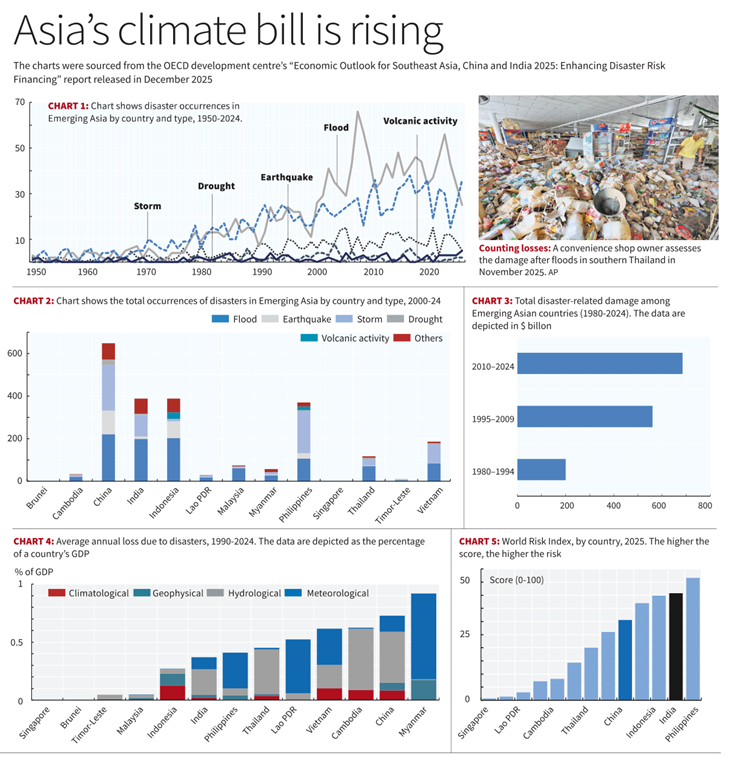
Emerging Asian economies that comprise India, China, and the ASEAN-11, face an escalating threat from natural disasters that are growing in both frequency and intensity (Chart 1).
Over the past decade, the region has had an average of 100 disasters annually, impacting approximately 80 million people.
The nature of these threats varies by geography: while floods and storms are the primary drivers of risk in India, tropical cyclones frequently batter the Philippines and Vietnam.
Meanwhile, China and Indonesia contend with significantly higher seismic risks (Chart 2).
The human and economic toll of this vulnerability has been punctuated by several landmark catastrophes.
As the scale of economic loss escalates (Chart 3), disaster risk finance has moved to the forefront of regional policy. To design an effective response, governments must first establish a data-driven foundation.
From 1990 to 2024, India sustained average annual disaster-related losses equivalent to 0.4% of GDP (Chart 4). The composition of these losses is geographically distinct. India’s vulnerability is primarily hydrological (non-storm-related floods and landslides), whereas Myanmar’s losses are predominantly meteorological (extreme temperatures and cyclonic storms).
The regional risk framework also includes climatological factors (drought and wildfire), and geophysical hazards (seismic activity and volcanic eruptions) too. Among the Asian economies analysed, India ranks second only to the Philippines in the World Risk Index (Chart 5). The index calculates risk as the geometric mean of exposure (population burden) and vulnerability (a combination of structural susceptibility, coping capacity, and long-term adaptation).
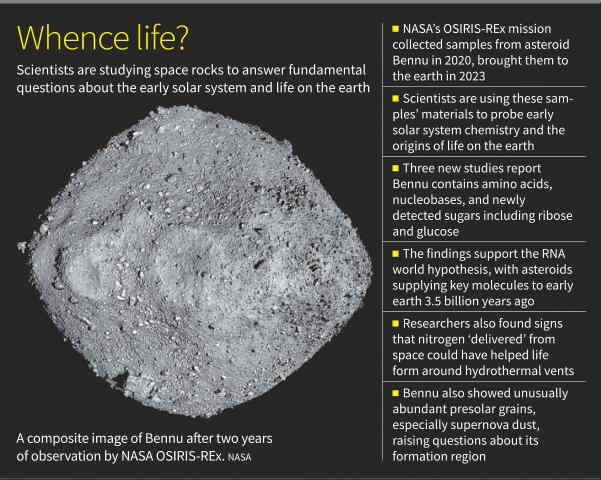
OSIRIS-REx samples from Bennu show the asteroid carries ribose, glucose, amino acids, nucleobases; discovery includes nitrogen-rich polymers, presolar grains of supernova origin, raising questions about how earth acquired life’s ingredients
In 2020, a spacecraft more than 3 lakh km away on a small asteroid called Bennu collected samples of its surface. The craft, part of NASA’s OSIRIS REx mission, then launched itself towards the earth, dropping off the canister of samples in September 2023. Since then, scientists in the US and Japan have been studying pieces of Bennu to answer fundamental questions about the formation of the early solar system and life on the earth.
On December 2, three teams published papers reporting Bennu contains sugar and other important molecules required to form RNA, and is also surprisingly abundant in supernova dust from a time before the sun formed.
When the solar system was forming from the cloud of dust and gas swirling around the sun, several smaller rocks were pushed around as well, and often clumped together. Bennu’s larger parent asteroid formed in this way around the same time as the sun, 4.6 billion years ago, somewhere beyond Saturn. When Jupiter migrated to its present orbit, the parent was kicked into the asteroid belt, where it collided with other rocks. Over millennia, fragments from the parent gave rise to Bennu, which today orbits the sun between the earth and Mars.
In a Nature Geoscience paper, scientists led by Tohoku University in Japan reported finding ribose, the sugar molecule present in RNA, and glucose, the sugar molecule required for metabolism, on Bennu. Together with previous findings of amino acids and all the five nucleobases found in DNA and RNA, the entire inventory of molecules scientists believe are needed for life have now been confirmed on Bennu.
“For 5-C to convert to 6-C sugar, the optimal mix of environmental conditions such as very little but liquid brine, the right pH, and extremely low temperatures are required, which the asteroid possessed at formation,” Kuljeet Kaur Marhas, professor and head of the Planetary Labs Analysis Section at the Physical Research Laboratory, Ahmedabad, who works with samples of the asteroid Itokawa, said.
The findings strengthen the ‘RNA world’ hypothesis: that early life used RNA as a source of genetic information and for catalytic functions, before DNA and proteins evolved. According to the study, the abundance of asteroids like Bennu in the inner solar system would have provided sugars and amino acids, leading to the formation of life on the earth more than 3.5 billion years ago.
Chemical reactions
Scientists have also reported evidence of chemical reactions between ices forming polymer molecules before the ices melted. In a Nature Astronomy paper, a second team from NASA thus explained the discovery of polymers of nitrogen- and oxygen-rich materials on Bennu. This material, called carbamate, would have been soft and gummy when it formed, hardening since. Scientists haven’t found this material in extraterrestrial samples before.
At the time Bennu’s parent formed, volatile compound ices like frozen ammonia, known to accumulate on asteroids’ primordial surfaces, could have been heated by random radioactive decay. This would have liquefied the ices, which seeped into rocky pores and deposited the salts and minerals dissolved in them there. Bennu could have ‘inherited’ a piece of this.
Dust and gas in the early presolar system were formed from other exploding stars. By analysing the dust, astronomers hope to find clues about the elements that made up its counterpart in the early solar system, which could help understand how planets formed.
In a third paper also published in Nature Astronomy, a different NASA team showed the presolar grains on Bennu had indeed been disturbed and moved around by moving liquids on the asteroid’s surface. The concentration of presolar grains was at least 6x higher than in other similar asteroid and meteorite samples.
The team also reported signs the grains had been singed by heat released when the great mass of dust collapsed to form our sun.
Studies of the grains revealed they originated from various types of stars and supernovae. Of these, the concentrations of grains of supernovae-origin were the highest, indicating it was present in abundant quantities in the part of space where Bennu’s parent formed.
“Why exactly there is an abundance of supernova-origin presolar grains is the biggest question, as Bennu is just like plenty of other asteroids in its neighbourhood,” Dr. Marhas, who also reviewed the presolar grains paper, said.
“Will we find similar concentrations if we sample previously studied asteroids in different locations or is there something specific that makes the ordinary-seeming Bennu extremely special?”
The Transport Ministry has proposed assigning Aadhaar-like unique identification numbers to EV batteries to ensure their end-to-end traceability and efficient recycling.
The proposed framework will make it mandatory for battery producers or importers to assign a 21-character Battery Pack Aadhaar Number (BPAN) to batteries, as per draft guidelines from the Ministry. They will also have to upload the relevant Battery Pack Dynamic data on the official portal of BPAN.
Bharatanatyam exponent Urmila Satyanarayanan was presented the Nritya Kalanidhi award at the 19th Dance Festival inaugurated at the Music Academy in the city.
Presenting the award, Takahashi Muneo, Consul- General, Consulate General of Japan in Chennai, said the honour recognised not only her artistic excellence but also her lifelong commitment to the preservation and propagation of Bharatanatyam.
Drawing parallels between Indian and Japanese dance traditions, he said classical Japanese forms such as Noh, Kabuki and Nihon Buyo emphasised controlled movement and discipline — aspects that resonate strongly with Indian classical dances. Both traditions, he said, share a deep respect for heritage and the teacher-disciple lineage.
Mr. Muneo said many Japanese students had travelled to India to learn Bharatanatyam, while several renowned Indian dancers had taught and performed in Japan, serving as a powerful example of how culture can connect nations.
Accepting the award, Ms. Satyanarayanan expressed gratitude to her teachers, students and the Music Academy. Recalling that her arangetram was at the Music Academy, she said receiving the award from the renowned institution was a milestone in the life of a dancer.
Earlier, N. Murali, president of the Music Academy and Director of The Hindu Group of Publications, said the award to Ms. Satyanarayanan came at an important stage in her artistic journey — 50 years after her arangetram and 30 years since she founded the dance school ‘Natya Sankalpa’. She is known for her improvisation and innovation, with several acclaimed thematic presentations and dance dramas to her credit, he said.
Scientists from the Indian Institute of Astrophysics (IIA) have unveiled an intriguing secret behind the dusty veil of a young star named T. Chamaeleontis (T. Cha), quietly forming planets about 350 light years from Earth when part of its circumstellar inner wall collapsed partially.
According to the Department of Science and Technology, this can help rewrite our understanding of how planetary systems evolve.
T Chamaeleontisan (T. Cha) is surrounded by a planet-forming disk called circumstellar disk that contains a wide gap- likely carved out by a newborn planet. “Normally, the dense inner regions of such disks act like a protective wall or veil blocking much of the star’s ultraviolet light from reaching the colder, outer regions. That shielding makes Poly Atomic Hrydrocarbons (PAHs), flat, honeycomb-shaped molecules (Benzene rings) made of carbon and hydrogen thought to be among the earliest precursors of life’s chemistry, especially hard to detect around low-mass, Sun-like stars,” the department said.
While these molecules are common in interstellar clouds, detecting them in the disks of low-mass, Sun-like stars has been challenging due to the low amount of ultra violet light produced by them.
The IIA scientists used archival spectroscopic data from NASA’s James Webb Space Telescope (JWST) Mid Infrared Instrument (MIRI) to study polycyclic aromatic hydrocarbons (PAHs) in the spectrum of this star.
The ultra-sensitive JWST telescope, almost by accident, caught the moment in 2022 when that veil thinned- and an ancient kind of chemistry lit up in space.
The material from the disk of the star suddenly plunged onto the star in a burst of accretion, thinning or partially collapsing that inner wall. As this happened ultraviolet radiation suddenly streamed outward, illuminating parts of the disk that were once in shadow. This helped shed light on the survival and variation of complex hydrocarbon molecules in the planet-forming disk around a young, Sun-like star.
“JWST’s MIRI has now revealed them clearly in T. Cha and this is one of the lowest mass stars with PAH detection in their circumstellar disk,” said Arun Roy, a post-doctoral fellow at the IIA.
T. Cha was observed by the JWST in 2022, when the inner wall had partially collapsed allowing ultraviolet photons to flood the outer disk.
“This sudden illumination excited the PAHs in the disk, making them glow strongly in the JWST’s detectors. It was like a curtain lifting, revealing chemistry that had been hidden for years,” Mr. Roy added.
Context; The Government introduced two new components in the Export Promotion Mission (EPM) aimed at easing and reducing the cost of the credit-access process for exporters.
This comes days after the Ministry of Commerce and Industry notified guidelines for a market access scheme under the EPM. With announcement, three of the 11 schemes under the EPM have been operationalised.
The two schemes would entail an outlay of ₹5,181 crore over six years until 2030-31. The two schemes were under the Niryat Protsahan category, which is meant to lower the cost of credit for exporters.
Interest Subvention for Pre- and Post-Shipment Export Credit scheme will reduce the cost of export finance and “strengthens MSME liquidity, improve competitiveness and supports India’s integration into global value chains, while ensuring fiscal prudence and compliance,” the Ministry of Commerce said in its announcement.
Interest subvention
“Eligible MSME exporters can avail interest subvention on rupee export credit (pre- and post-shipment) extended by scheduled banks, in accordance with RBI Master Directions,” it added.
The second sub-scheme — Collateral Support for Export Credit — is aimed at giving MSME exporters the ability to access bank credit even with limited collateral or third-party guarantees.
The scheme would be implemented through the Credit Guarantee Fund Trust for Micro and Small Enterprises (CGTMSE) on a pilot basis and be applicable to export-linked working capital loans.
MSME exporters exporting notified tariff lines will be eligible for the collateral support.
Micro & small exporters would be eligible for up to 85% guarantee, while medium exporters would be capped at a 65% guarantee.
India’s Export Promotion Mission now includes two new credit-linked schemes to ease MSME access to export finance, with ₹5,181 crore allocated until 2030–31. 🚀 Export Promotion Mission (EPM): Credit-Linked Schemes Overview The Government of India has expanded the Export Promotion Mission (EPM) by operationalizing two new schemes under the Niryat Protsahan category. These are designed to reduce the cost and complexity of accessing export credit, especially for MSME exporters.
📌 Key Highlights Total Outlay: ₹5,181 crore over 6 years (2025–2031)
Schemes Operationalized: 3 out of 11 under EPM
Focus: MSME liquidity, competitiveness, and global integration
Feature
Interest Subvention for Pre & Post-Shipment Credit
Collateral Support for Export Credit
Primary Purpose
To reduce the cost of export financing by lowering interest rates.
To provide credit access to those who have limited assets for collateral.
CGTMSE (Credit Guarantee Fund Trust for Micro and Small Enterprises).
Nature of Phase
Ongoing policy support.
Launched on a Pilot Basis.
💡 Strategic Impact Liquidity Boost: Easier access to working capital for MSMEs
Competitiveness: Lower financing costs improve pricing and delivery capabilities
Inclusivity: Supports exporters from non-traditional districts and sectors
Compliance & Prudence: Aligned with RBI Master Directions and fiscal safeguards
🌍 Export Scenario Context India’s exports have faced global headwinds due to supply chain disruptions and trade protectionism. The EPM aims to:
Consolidate fragmented schemes into a digitally enabled framework
Promote labour-intensive and MSME sectors
Enhance market access through targeted support
According to the PIB framework, the full EPM has a total outlay of ₹25,060 crore and includes components like Niryat Disha (market readiness) and Niryat Protsahan (financial support).
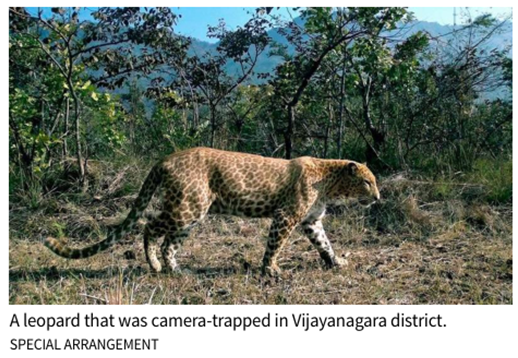
Context: An ultra-rare leopard colour morph has been documented for the first time in Karnataka, in Vijayanagara district, by wildlife scientist Sanjay Gubbi and his team from the Holématthi Nature Foundation (HNF).
Sandalwood hues
Unlike most leopards that possess tawny coats with black rosettes, this exceptionally rare colour morph exhibits a pale reddish-pink coat, similar to the colour of sandalwood, with light-brown rosettes.
“Only a handful of such leopards have been documented so far across the globe. Internationally, leopards of this colour morph are referred to as Strawberry leopards. But to honour Karnataka’s cultural heritage, we want to name it sandalwood leopard,” Mr. Gubbi said.
Karnataka is one of the largest sandalwood producers in India.
Ultra-rare condition
The leopard, documented by Mr. Gubbi’s team through camera trapping, is a female, estimated to be around six or seven years old.
The unusual colouration is believed to result from a genetic condition involving either an excess of red pigmentation or a deficiency of dark pigmentation.
In India, only a single such individual has been documented prior to this, in the Ranakpur region of Rajasthan in November 2021. Globally a few have been recorded in South Africa and single one in Tanzania.
According to Mr. Gubbi, molecular analysis using DNA samples is required to determine the exact genetic mechanism that has led to the unusual colouration in the Vijayanagara individual.
“This leopard is consistent with conditions such as hypomelanism or erythrism, both of which are naturally occurring genetic traits identified in wild mammals. The current assessment is based on photographic evidence and visual characteristics…Until genetic evidence is available, it is scientifically appropriate to describe this animal as a rare colour morph rather than assign a specific genetic condition,” he said.
Camera trapping was conducted as part of HNF’s ongoing efforts to estimate leopard populations and identify key landscapes for large mammal conservation in the Kalyana-Karnataka region.
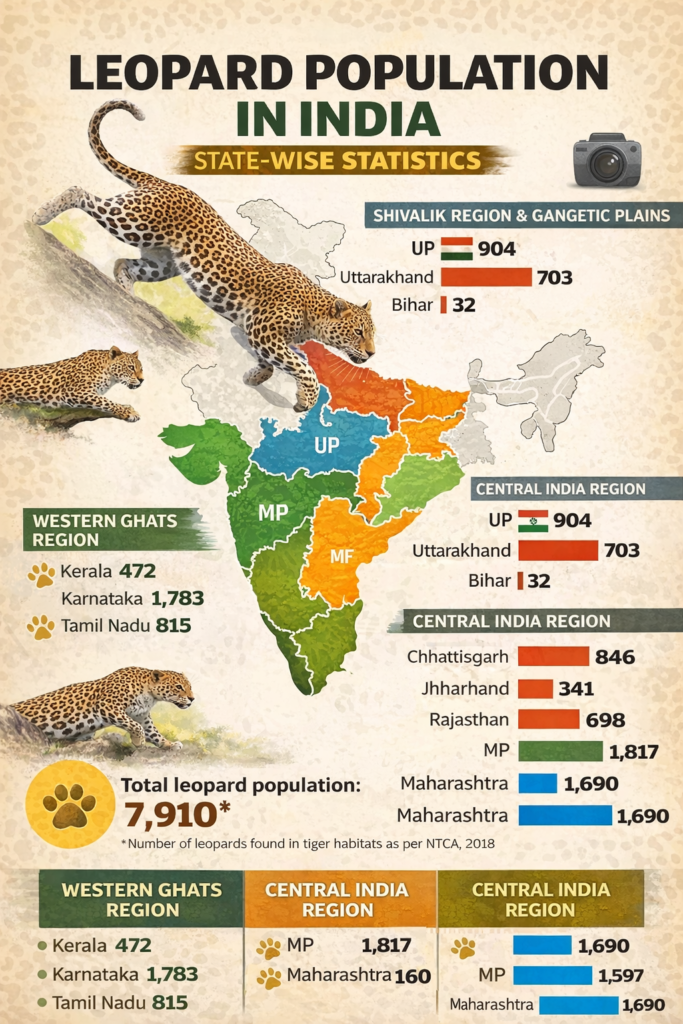
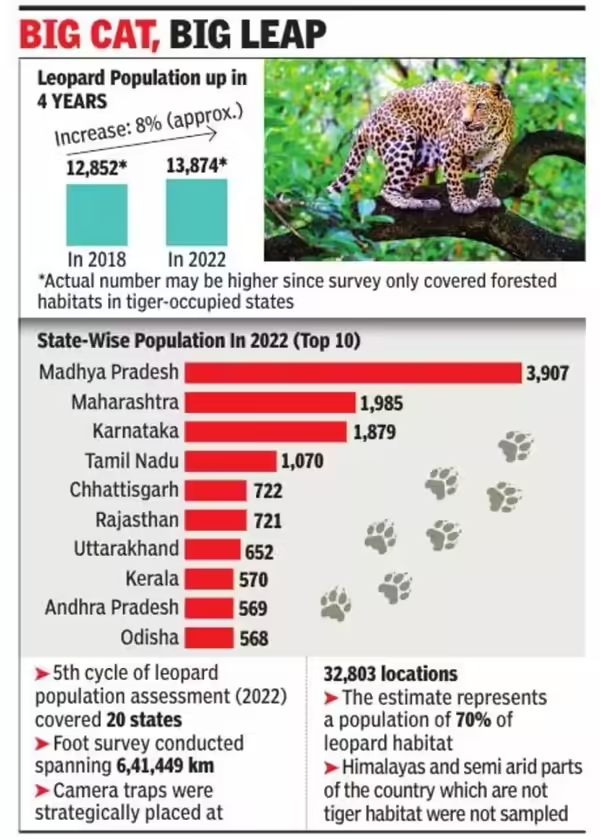
“This region remains understudied from a wildlife conservation perspective yet holds significant potential for conserving arid-zone species such as the Indian grey wolf, striped hyena, and Bengal fox,” said a statement from the foundation. The HNF’s research indicates that Karnataka supports around 2,500 leopards.
Context: Prime Minister Narendra Modi will flag off the first Vande Bharat sleeper train later this month. It will ply between Guwahati and Kolkata.
The 16-coach train, with a capacity of 823 passengers, has a design speed of upto 180 kmph. It has 11 three-tier and four two-tier AC coaches, and a first-class AC coach.
The third-AC fare will be ₹2,300, second AC ₹3,000, and first AC ₹3,600.
The train boasts ergonomically designed berths with improved cushioning, automatic doors, and enhanced ride comfort with superior suspension and noise reduction.
Safety measures include Kavach, an indigenously developed, high-tech automatic train protection system designed to prevent collision, advanced controls, and safety systems inside the driver’s cabin.
There will be CCTV cameras on all coaches, and specially designed seats for passengers with disabilities, he said.
The districts that will benefit from this service include Kamrup Metropolitan and Bongaigaon in Assam and Coochbehar, Jalpaiguri, Maldah, Murshidabad, Purba Bardhaman, Hooghly, and Howrah in West Bengal.
Assamese cuisine will be served aboard when the train originates from Guwahati and Bengali cuisine on its return journey.
Bullet train
The Minister also announced that the country’s first bullet train would be ready in August 2027, and the route would be opened in a phased manner. The first section to open will be from Surat to Bilimora, followed by Vapi to Surat, Vapi to Ahmedabad, Thane to Ahmedabad, and finally Mumbai to Ahmedabad.
The 508-km Mumbai-Ahmedabad high-speed rail corridor has been steadily progressing, with significant work completed on viaducts, bridges, tunnels, and stations. The corridor will see speeds of up to 320 kmph and is set to reduce travel time between Mumbai and Ahmedabad to two hours.
Violin maestro R.K. Shriramkumar has been conferred the prestigious Sangita Kalanidhi award for the year 2025 by The Music Academy, Chennai — one of the highest honours in Carnatic classical music.
About the Award The Sangita Kalanidhi is regarded as the highest recognition in Carnatic music, given annually to an outstanding musician in recognition of lifetime achievement and contribution to the art. The awardee typically presides over the Music Academy’s annual conference and concert series held during Chennai’s famous December Music Season.
About R.K. Shriramkumar R.K. Shriramkumar is a renowned Carnatic violinist from the celebrated Rudrapatnam lineage of musicians in Karnataka. He has accompanied generations of legendary vocalists and musicians, including Semmangudi Srinivasa Iyer, M.S. Subbulakshmi, D.K. Pattammal, and contemporary stars like T.M. Krishna, Bombay Jayashri, and others.
His deep musical scholarship and expertise — particularly in the compositions and musicological work of Subbarama Dikshitar and Muthuswami Dikshitar’s tradition — have greatly contributed to his selection.
Significance of the 2025 Award Shriramkumar’s selection coincides with the 250th birth anniversary of the composer Muthuswami Dikshitar, adding special cultural significance to the honour this year.
Context: Finance Ministry announces end of GST compensation cess; beed is in 18% slab, other tobacco products in 40% bracket as govt. bids to ‘ensure that real cigarette prices rise faster than incomes’.
The Union Finance Ministry issued a series of notifications that will give effect to the new taxation regime for tobacco products from February 1 2026.
The Central Excise (Amendment) Act, 2025, passed recently, specifies new rates of excise duty on tobacco products.
Excise duty on cigarette
The Ministry also notified that provisions of the Health Security se National Security Act, 2025, which intends to levy a cess on pan masala units, will come into force from February 1.
Under the Goods and Services Tax (GST) regime, the excise duty on cigarettes had so far been rendered a nominal amount of a “fraction of a paisa” per cigarette stick, and the GST compensation cess rate on tobacco products had not been increased since it was implemented in July 2017.
“For India, affordability has either stagnated or increased in the past decade, meaning cigarettes have not become more expensive relative to consumers’ purchasing power,” the note said. “This is contrary to global public health guidance, which emphasises annual increases in specific excise duties to ensure that real cigarette prices rise faster than incomes.”
At the same time, the Ministry notified February 1 as the date from which the GST compensation cess would cease to exist. The cess was originally introduced for a period of five years to compensate States for any loss arising out of the implementation of GST.
Tax slabs
The Finance Ministry also notified the new GST rates for tobacco products. Beedis have been moved to the 18% category from the now-defunct 28% slab. All other tobacco products have been moved to the 40% slab. These new rates will be effective from February 1.
The GST compensation cess was to end in 2022. However, due to the COVID-19 pandemic, the cess collections were not enough to compensate the States and so the Centre borrowed money to compensate them.Hence, it was extended until 2026, with the proceeds being used to repay the loan.
With the impending end of the loan, the Centre on September 22, 2025, removed the incidence of the cess on most items except tobacco items. From February 1, 2026, the cess will no longer apply on these items either, effectively ending it.
Finally, the Ministry introduced a new valuation mechanism for tobacco products such as chewing tobacco, filter khaini, jarda, scented tobacco, and gutkha, whereby the GST value would be determined based on the retail sale price declared on the package.
Regarding the Health Security se National Security Act, 2025, the Ministry justified the inclusion of the national security aspect by saying that conventional tax revenues cannot always guarantee funding for national security functions, and so a dedicated cess is needed for the purpose.
“General tax revenues are subject to competing developmental priorities and cannot always guarantee sustained long-term funding for core national security functions,” the FAQ note said.
“A dedicated purpose-specific cess enables the Union to create a non-lapsable, predictable financial stream that supports multi-year security preparedness, technological upgradation, capacity creation, and advanced equipment procurement — without increasing the tax burden on the general population or raising broad-based rates such as GST.”
Brief on Central Excise (Amendment) Act, 2025:
What is it?
The Central Excise (Amendment) Act, 2025 is a law passed by Parliament in December 2025 to amend the Central Excise Act, 1944 by revising excise duty rates on tobacco and tobacco-related products. The amendment was introduced to ensure that tax incidence on tobacco products remains protected even after the cessation of GST compensation cess.
Key Features of the Amendment
Higher Excise Duties on Tobacco Products
The Act increases central excise duty on various tobacco products:
Cigarettes, cigars, hookah, chewing tobacco, zarda and scented tobacco products are covered under the revised structure.
Excise duty on cigarettes is raised from the earlier ₹200–₹735 per 1,000 sticks to ₹2,700–₹11,000 per 1,000 sticks (depending on category).
Chewing tobacco duty increased from 25% → 100%.
Hookah tobacco duty increased from 25% → 40%.
Smoking mixtures (for pipes/cigarettes) duty increased from 60% → 325%.
The objective is to protect total tax incidence after GST compensation cess ends, and also to discourage tobacco consumption for public health reasons.