KAS Current Affairs
Preliminary Examination
Paper-I: Current Events of National and International Importance
Paper-II: Current Events of State Importance and Important Government Schemes and Programs
Main Examination
Paper-I: Essays
Essay – 1: Topic of International/National Importance
Essay-2: Topic of State importance/Local Importance
Paper-II: General Studies 1
Centre to amend the Foreign Contribution (Regulation) Act
Context: The Union government is likely to amend the Foreign Contribution (Regulation) Act in the ongoing session of Parliament session. One of the key changes proposed is the appointment of a “designated authority” to take over, manage or dispose of assets created out of foreign funds by an NGO or association, which has had its FCRA registration suspended, cancelled, or not renewed.
- Another proposed amendment is expanding the definition of “key functionary” of an NGO beyond an “office bearer/director” to include directors; partners; trustees; the karta (head) of a Hindu Undivided Family; office-bearers or members of the governing body or managing committee of a society, trust, trade union or association; and any other person who has control over or responsibility for the management or affairs of such an organisation.
- The amendment also proposes to make key functionaries liable for offences under the FCRA.
- Registration under the FCRA is mandatory for an NGO to receive foreign funds. Till now, the 2010 parent Act only had the provision to regulate the flow of foreign funds, and not the statutory framework to manage the assets created out of such funds.
- The Foreign Contribution (Regulation) Amendment Bill, 2026 also proposes to amend Section 43 of the parent Act, which will require any law enforcement agency or State government to seek prior approval of the Central government for initiation of investigation into FCRA-related complaints.
- The Statement of Objects and Reasons of the Bill circulated by Home Minister Amit Shah said that, at present, around 16,000 associations are registered under the FCRA and they receive around ₹22,000 crore annually.
- The Bill proposes to reduce the maximum imprisonment for FCRA offences from five years to one year. It also proposes fixed timelines for the utilisation of foreign funds received under the “prior permission” category, unlike the open-ended provision under the 2010 Act.
Net FDI negative for fifth straight month
Context: Net FDI into India contracted for the fifth consecutive month in January 2026, with outflows exceeding inflows by nearly $1.4 billion, a three-month high. The data shows this was because inflows into India fell nearly 7% while the amount repatriated out of the country nearly doubled.
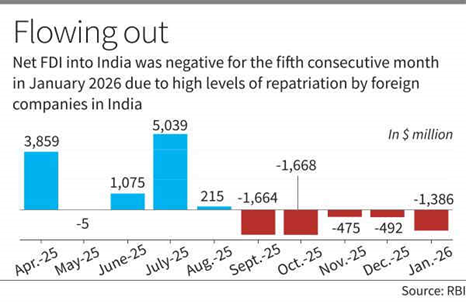
- According to data released by the Reserve Bank of India on Monday as part of its monthly bulletin, the total amount of money entering India as direct investment, or gross FDI, stood at about $5.7 billion in January 2026.
- This was 7% lower than in January last year, and only two-thirds of the amount that came in December 2025. The RBI, however, looked at a longer time period to draw some positive conclusions.
- “During April 2025 – January 2026, gross FDI inflows remained strong, higher than the corresponding period a year ago,” the central bank noted in its report. “Sector-wise, manufacturing received the highest share of equity inflows, followed by computer services, electricity and other energy, and financial services — these sectors together accounted for over 60% of total inflows.”
- With regard to outflows, the outward FDI by Indian companies increased by 5.4% in January 2026 to $2.1 billion. This was, however, nearly 30% lower than the outward FDI in December 2025.
- “Around 75% of the outward FDI flows were directed to the U.S., Singapore, the UK, and the UAE during the [April 2025 – January 2026] period,” the RBI said. Repatriation and disinvestment by foreign companies doing business in India, on the other hand, increased by 97.3% to $4.9 billion in January 2026. But this was nearly 18% lower than the amount in December 2025.
- As a result, net FDI stood at about -$1.4 billion, the lowest since October 2025.
- The central bank noted that portfolio investments again flowed out more than they flowed in in March this year.
Centre restores RoDTEP benefits for exporters
Context: The government has restored the complete benefits provided to exporters under the Remission of Duties and Taxes on Exported Products (RoDTEP) scheme. In a notification it said the rates and values applicable 22 this year and were reduced by 50% are now being restored to earlier levels from February 23 to March 31.
- According to GTRI, while the DGFT decision is welcome, the initial reduction is hard to justify as RoDTEP is not a subsidy.
Paper-III: General Studies 2
Centre signals early delimitation, women’s quota for 2029 polls
Context: The Union government has indicated that it will bring an amendment Bill proposing a delimitation exercise based on the 2011 Census to ensure the implementation of the Women’s Reservation Act, 2023, ahead of the 2029 Lok Sabha election.
- Under the proposed amendments, the number of Lok Sabha seats will increase from 543 to 816, with 273 seats, 33%, reserved for women. The amendments could be brought in the ongoing Budget Session or in a Special Session called for the purpose.
States’ concern
- Though the draft of the amendments are yet to be circulated, that care would be taken so that the existing proportion of seats will be maintained for all States, amid concerns that States that had showed success in population control programmes would lose out on representation vis a vis more populous States. Southern States had in particular expressed this concern. Overall, each State is likely to see a 50% rise in seats, but the pro rata basis would be maintained.
- As per Article 82 of the Constitution, the next delimitation exercise was to be done based on the first Census after 2026, but these amendments could mean that the 2011 Census data will be applied and the remaking of constituencies can proceed without the current Census exercise being concluded. The proposals may include the expansion of State Assemblies as well.
- The Act originally passed in September 2023 envisaged the conduct of the Decadal Census, followed by delimitation of seats. The 2021 Decadal Census, which got delayed because of COVID, beginning next month. As per the current timelines, implementation of the Act could be pushed beyond 2030. However, by bringing in fresh amendments, the government is now seeking to bring forward the implementation of the Act.
- “The amendments will require a two-thirds majority of both Houses.
- The Women’s Reservation Act, 2023, known as the Constitution (106th Amendment) Act, 2023, mandates a 33% reservation for women in the Lok Sabha and State Assemblies.
Kolar water table has risen to 50-100 ft. under K.C. Valley project, says IISc
Context: The groundwater level in parts of Kolar has risen significantly under the K.C. Valley project, with water now available at depths of just 50 to 100 ft. compared to nearly 1,800 ft. earlier, said the Indian Institute of Science (IISc), adding that sustained monitoring since 2019 has found no adverse impact on water quality, public health, soil, crops, or livestock.
The K.C. Valley Project (Koramangala–Challaghatta Valley Project) is Karnataka’s flagship initiative to recharge groundwater in the parched districts of Kolar and Chikkaballapur by pumping treated wastewater from Bengaluru’s sewage treatment plants into local lakes. It has raised water tables significantly, but concerns remain about untreated sewage inflows and water quality.
- IISc officials said the project has significantly improved groundwater availability across Kolar and surrounding districts, with 144 lakes being replenished and wells in the region also showing increased water level.
- They said groundwater is being treated through a five-stage purification process, resulting in clean water that is free from odour and colour. Multiple rounds of research conducted by the IISc have found no traces of harmful metal elements in the water.
- The officials also noted that there had been no impact on human or animal health.
- “Crops such as fenugreek, cucumber, beetroot, tomato, and other flowering plants are being cultivated successfully, while soil quality has improved across the region,” the institute said, dismissing allegations of excessive nitrogen content in the soil, stating that there is no difference in soil quality between irrigated and non-irrigated ones.
- The institute said there is also an increase in bird populations and healthy aquatic life in lakes. IISc said surveys conducted three times among residents revealed no complaints, with many reporting improved access to water and better living conditions. Farmers’ livelihood had improved, and officials pointed out to increase in milk production. They also pointed out that instances of kidney stones among residents have reduced attributing it to acess to cleaner water.
- While presenting the findings, IISc officials said several organisations have recommended that the K.C. Valley model be replicated across the country. However, concerns were raised during the meeting over the discharge of untreated sewage into lakes, particularly in parts of Chickballapur, where city sewage is reportedly being let directly into waterbodies.
| Aspect | Details |
| What | A lift irrigation and lake rejuvenation project that pumps secondary treated wastewater from Bengaluru’s sewage treatment plants (STPs) into ~122 rain-fed tanks in Kolar and Chikkaballapur districts. |
| Why | • To address acute groundwater depletion in Kolar & Chikkaballapur. • To provide sustainable irrigation support. • To recharge aquifers and revive lakes in drought-prone regions. |
| How | • Wastewater from 5 Bengaluru STPs is treated and pumped ~60 km. • Water is released into lakes, where it percolates into the groundwater table. • Implemented at a cost of ₹1,342 crore. • Managed by the Karnataka Minor Irrigation Department with IISc monitoring. |
| Where | • Origin: Koramangala–Challaghatta Valley, Bengaluru. • Destination: 122 lakes in Kolar (Dakshina Pinakini & Palar river sub-catchments) and extended to Chikkaballapur. |
| Impact (Positive) | • Water table rise: IISc reports groundwater rose by 50–100 ft in many wells. • Lake revival: 144 lakes replenished. • Agriculture: Farmers report significantly improved irrigation availability. • Health & crops: IISc studies clarified no adverse impact on crops or livestock. |
| Challenges (Negative) | • Untreated sewage inflow: Reports of municipal sewage mixing into lakes, reducing project credibility. • Water quality concerns: Farmers demand tertiary treatment for safer long-term use. • Frothing incidents: Lakshmisagara lake showed froth, raising environmental alarms. |
| Status (2026) | • Project is fully operational but remains under heavy public and scientific scrutiny. • Farmers in Chikkaballapur have staged protests demanding higher-quality treated water. • Ministers (Krishna Byre Gowda, NS Boseraju) have issued warnings to municipal bodies against operational lapses. |
| Planned Outcomes | • Long-term groundwater recharge. • Sustainable irrigation for drought-prone districts. • Reduction in dependence on deep borewells. • Potential global model for other water-scarce urban-rural corridors. |
Significance of the Project
Environmental: Effectively reuses urban wastewater, significantly reducing the pressure on finite freshwater sources.
Agricultural: Acts as a lifeline for farmers in semi-arid districts, supporting dairy and crop production.
Social: Revives traditional lake ecosystems and strengthens rural water security, preventing migration.
Policy: Demonstrates Karnataka’s innovative and aggressive approach to integrated water management.
‘U.S.-led Pax Silica
- The U.S.-led initiative is aimed at building resilient supply chains for critical minerals and Artificial Intelligence (AI) technologies. India joined the coalition in February 2026, during the AI Impact summit held in New Delhi.
Lok Sabha sends Corporate Law Amendment Bill 2026 to JPC
Context: The government introduced the Corporate Laws (Amendment) Bill, 2026 in the Lok Sabha following which the House adopted a motion to send the proposed legislation to a Joint Parliamentary Committee (JPC) for detailed examination.
- The JPC will comprise members from both Houses of Parliament for detailed analysis and recommendations, Union Finance Minister Nirmala Sitharaman said while proposing the motion for JPC reference. The motion was adopted by a voice vote.
- The Bill seeks further amendments to the Limited Liability Partnership Act, 2008 and the Companies Act, 2013 to facilitate ease of doing business and address the gaps identified by the Company Law Committee in its 2022 report.
- The proposed amendments are expected to rationalise penalties, shift several minor procedural lapses from criminal liability to monetary penalties, and streamline regulatory processes to promote ease of doing business.
- The FM said the Bill was aimed at promoting ease of doing business and ease of living for corporates by decriminalising more provisions.
‘Diluting provisions’
- When the Bill was introduced in Lok Sabha, Opposition members Manish Tewari (Congress), Saugata Roy (Trinamool Congress) and T. Sumathy (DMK) opposed the same claiming the legislation sought to dilute the provisions of law under which companies mandatorily had to pay 2% of profit towards corporate social responsibility (CSR).
- The FM refuted the claim and said that the Bill had been introduced after two years of deliberations and the apprehensions of the members were unfounded as the proposed legislation sought to amend only the criteria for net profit, not the entire clause related to CSR.
- Mr. Tewari also said since a Parliamentary Standing Committee on Corporate Affairs was already in place, the Bill must be sent there rather than setting up new JPC.
- Home Minister Amit Shah, intervening, said none of the Opposition members talked about referring the Bill to a panel and now, when the FM has herself sought it, they were arguing as to which panel the Bill should be sent.
- Greater cooperation needed between India and Russia, says Jaishankar
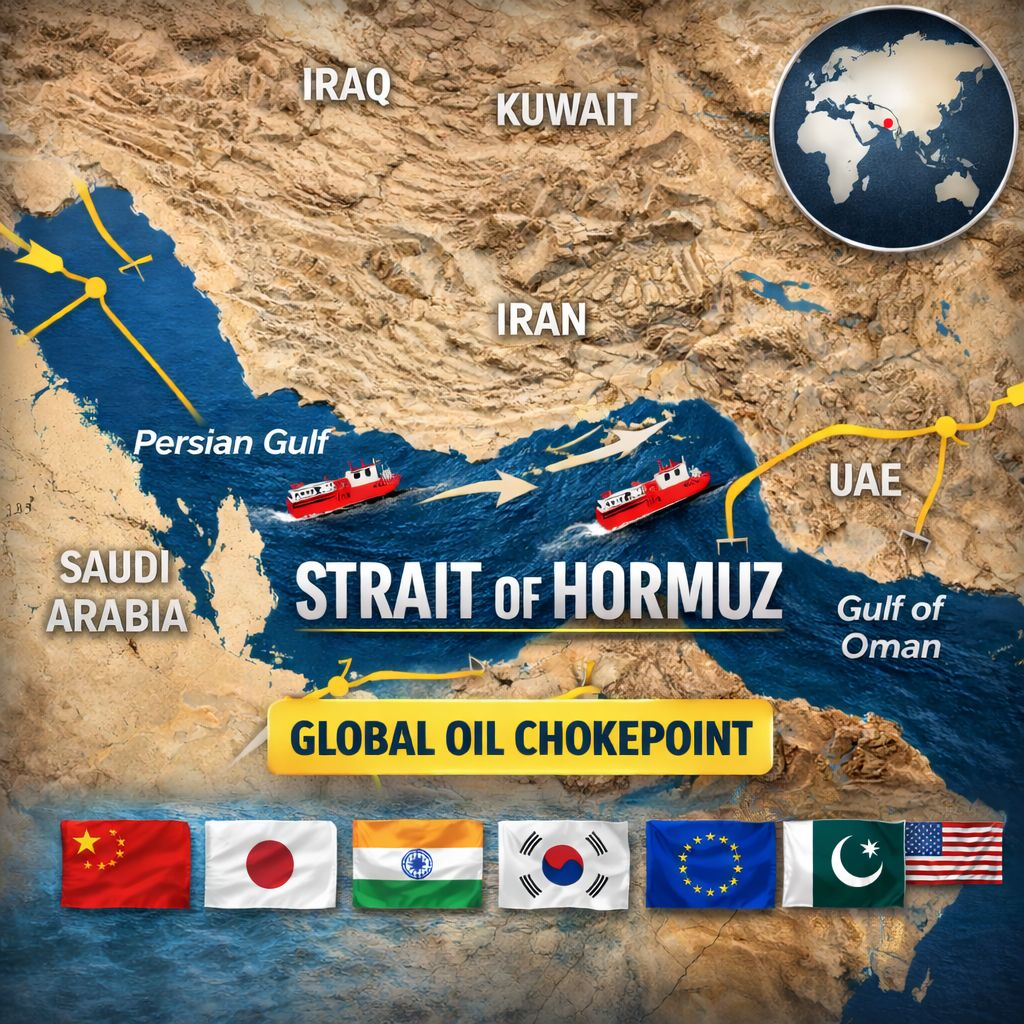
Context: Against the backdrop of the war in West Asia, External Affairs Minister S. Jaishankar, said the “evolving multipolar order” calls for “greater cooperation” between India and Russia both bilaterally as well as multilaterally through groupings such as BRICS, SCO, G-20, and the United Nations.
In the context of the 2026 geopolitical landscape, this dialogue underscores India’s mastery of Strategic Autonomy—maintaining a deep, functional bond with Moscow while navigating a world fractured by conflicts in West Asia and Eurasia.
India-Russia Bilateral Agenda (2026)
| Dimension | Analytical Insight |
| Geopolitical Context | The relationship is being recalibrated against the “acute crisis in the Persian Gulf” (US-Israel-Iran tensions). India is positioning itself as a stabilizing force that uses its BRICS Chairmanship to promote a “Humanity First” approach. |
| Economic Sovereignty | A breakthrough in De-dollarization: 96% of bilateral trade is now conducted in national currencies (Rupee-Ruble). This insulates the partnership from Western-led financial sanctions and streamlines commerce. |
| Multipolarity & Groups | India and Russia are leveraging BRICS, SCO, and G-20 to challenge unipolarity. Russia’s explicit support for India’s 2026 BRICS Chairmanship signals a unified front in the “Global South” discourse. |
| Strategic Pillars | Civil Nuclear Energy remains the bedrock, with the Kudankulam project serving as a “stellar example.” Additionally, the push for the Eurasian Economic Union (EAEU) FTA suggests a shift toward deeper regional economic integration. |
| New Frontiers | Post-Putin’s Dec 2025 visit, the focus has expanded beyond defense to skilled professional mobility, food safety, and maritime cooperation, diversifying the relationship to be more resilient. |
Key Strategic Takeaways:
- The “Strategic Autonomy” Litmus Test
By engaging deeply with Russia amidst the West Asian war, India is signaling to the global community that its foreign policy is dictated by its own national interests. Lavrov’s praise for India’s “strategic autonomy” suggests that Russia views India not just as a buyer, but as an independent pole in the Evolving Multipolar Order. - Economic Decoupling from the West
The transition of nearly all trade (96%) to national currencies is a massive shift. It reduces transaction costs and creates a closed-loop economic system that is “sanction-proof,” ensuring that essential supplies like fertilizers, oil, and nuclear tech remain uninterrupted regardless of global political pressure. - BRICS 2026: “Humanity First”
Under India’s leadership, BRICS is moving toward a people-centric agenda. This softens the “anti-West” image often associated with the bloc, instead focusing on shared global challenges like food security and health, where Russian resources and Indian manufacturing/human capital create a perfect synergy. - Connectivity & Energy Security
The mention of Maritime Cooperation and the EAEU FTA points toward the operationalization of the International North-South Transport Corridor (INSTC) and the Chennai-Vladivostok Maritime Route. This ensures India has a stable, alternate supply chain for energy and minerals from the Russian Far East.
Summary
The India-Russia Annual Summit 2026 is set to be a milestone. While the West focuses on containment strategies, India is focusing on “Inclusive Multipolarity.” By bridging the gap between its ties with the West and its “special” bond with Russia, India is effectively acting as the diplomatic “hinge” of the 21st century.
This dialogue is a classic example of Realpolitik. India is balancing its “Global Strategic Partnership” with the US against its “Privileged” partnership with Russia to maximize its influence in the Persian Gulf and Eurasia.
Paper-IV: General Studies 3
Karnataka accounted for 9% of India’s ransomware cases in 2025-26: Report
Context: Nearly 9% of the total ransomware cases in India in 2025–26 were from Karnataka, according to the Centre of Excellence for Cybersecurity – Karnataka (CySecK) annual compendium report released.
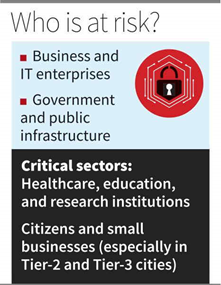
- The report also stated that 4.3% of the total malware detections were from Karnataka.
- Bengaluru, too, witnessed cyberattacks that were four times higher than the previous year, according to the report.
Vulnerable sectors
- Among the most vulnerable sectors for cyberattacks are government departments, education, and healthcare, which, according to the report, collectively witnessed more than 6.8 million malware detections in Karnataka.
- CySecK is a flagship initiative by the State government through the Department of Electronics, IT, and BT, established in 2019 to drive cybersecurity innovation, research, and ecosystem development across Karnataka.
- CySecK held its annual cybersecurity conference on March 17.
- The report, published as part of the conference, outlines the State’s cybersecurity landscape, key risks, and strategic priorities to strengthen digital resilience.
Major attacks
- The report also details major cybersecurity incidents in the State.
- The most significant was the Kaveri 2.0 Distributed Denial-of-Service (DDoS) attack in February 2025, which led to service disruption and an estimated ₹47.75 crore in daily revenue loss.
- DDoS attacks are launched to slow down or crash websites, servers, or networks, making them unavailable to genuine users.
- The second major incident was a ransomware attack on a private hospital that led to encrypted medical records and disruption in patient care. There were also telecom API data breaches, highlighting third-party security risks.
- “As digital adoption accelerates across governance, education, healthcare, finance, and industry, the state’s exposure to cyber risks has increased significantly,” the report noted.
- It also underscored that the growing reliance on digital infrastructure has widened the cyberattack surface across sectors and regions, including cloud platforms, digital payments, connected systems, and data-driven services.
Ignored area
- A senior police officer explained that in the backdrop of technological advancement, cybercrimes are widely discussed and reported, but cybersecurity is less talked about.
- However, Karnataka notified its cybersecurity policy as early as 2024, adopting a dual approach: strengthening government cybersecurity while fostering a robust public cybersecurity ecosystem.
- Aligning with the objectives of the policy, the Karnataka government has launched several initiatives, including CySecK. A major stride has been made by bringing cybersecurity under the Cyber Command Unit.
- CySecK plays this role by working across academia, government, industry, and startups to strengthen Karnataka’s overall cybersecurity readiness.
Draft policy on ‘Responsible Digital Use Among Students’ sets goals for parents, schools
Context: It recommends that schools include digital well-being and social media literacy in the curriculum.
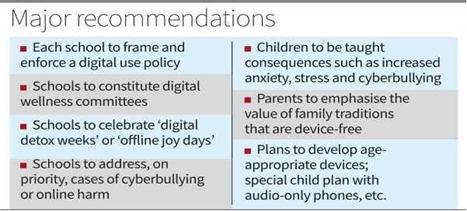
- The draft policy for “Responsible Digital Use Among Students”, released by the Department of Health and Family Welfare, has recommended that parents set structured routines with clear screen-time rules and prioritise privacy, safety, and open conversation with children on digital well-being.
- It recommended that schools incorporate digital well-being and social media literacy in their curriculum, besides implementing special programmes for digital detox and identifying early mental health red flags.
- The policy has been drafted in collaboration with the Karnataka State Mental Health Authority, NIMHANS, and the School Education Department, based on deliberations with stakeholders. It further recommended a set of “preventive, promotive, and responsive strategies for all schools to implement”. “Parents should facilitate more peer interactions and conversations without screens, invite friends over for offline play, promote role play, group reading, or drama at home, and model face-to-face communication,” the draft said.
- The government announced it would bring in a policy to restrict social media use among children below 16. The draft policy aims “to create a safe, balanced, and psychologically healthy digital environment for students”.
- “Parents should define screen time limits (as per age), mandatory screen-free time during meals, sleep hours, and study periods, tech curfew all screens off 1 hour before bedtime,” it recommended for parents, advocating marking digital free zones like bedroom, dining table, kitchen, bathroom, and motorised vehicle where no family members use technology. “Decide upon digital fasting time where no family members use any device,” said the draft.
- On the responsibility of schools, the draft policy states, “Schools must incorporate digital well-being and social media literacy within the life skills, value education, and ICT (Information and Communication Technology) curriculum. Age-appropriate lessons on responsible digital behaviour, privacy, online safety, and screen-time balance should be taught regularly.”
Centre launches AI skilling drive with Google, YouTube
Context: Part of initiatives unveiled by Ashwini Vaishnaw to boost creative economy; a citizen creator platform, and in-built satellite tuners in television sets for access to DD Free Dish launched.
- Union Minister Ashwini Vaishnaw on Monday unveiled three new initiatives aimed at strengthening India’s media, broadcasting, and digital sector and promoting the “orange economy”, or the creative economy.
- The creative economy includes industries where economic value is generated primarily from creativity, culture, technology, and intellectual property.
- The three initiatives are named the National AI Skilling Initiative in partnership with Google and YouTube through the Indian Institute of Creative Technologies (IICT); MyWAVES, a citizen creator platform on WAVES OTT; and the rollout of advanced Electronic Programme Guide and in-built satellite tuners in television sets for enhancing access to DD Free Dish services.
- Key media and entertainment industry representatives, the head of YouTube India along with senior Ministry officials took part in the event.
- Underscoring Prime Minister Narendra Modi’s vision of democratising technology, Mr. Vaishnaw said the initiatives will make technology more affordable and accessible. He said that with in-built satellite tuners and an advanced programme guide, citizens can now access content easily without additional equipment.
- He described MyWAVES as a powerful platform for content creators, enabling them to create, upload, and share content.
- Referring to the Union Budget announcements, he underlined the government’s commitment to promoting the “orange economy” and supporting the creative sector.
- The Union Minister said under the National AI Skilling Initiative, being implemented with the support of YouTube, about 15,000 youth will be trained without levying any fee.
- He spoke about the “Creators’ Corner” scheme and urged content creators to actively use Doordarshan and platforms such as MyWAVES to showcase India’s rich culture and regional diversity.
- Speaking about the partnership’s impact, YouTube India managing director Gunjan Soni said: “We believe that AI has the potential to open up remarkable opportunities for India’s dynamic creative economy. Through our collaboration with the Ministry of Information & Broadcasting and IICT, we aim to equip creators and professionals with the skills required to master the tools of the future, leverage AI to tell more compelling stories… expand their reach to new audiences, and play a role in shaping the future of media.”
- The AI skilling programme will be conducted in two phases — Phase I from March 23 to June 30 2026, and Phase II from July to December 2026.
- The first phase will focus on foundational AI learning at scale through Google Career Certificates and Google Cloud Generative AI learning paths. Participants will undergo courses such as AI Essentials, Prompting Essentials, Introduction to Generative AI, and Generative AI Leader Path.
- The second phase will involve advanced, project-based specialisation for the creative industry. The curriculum will include modules on the art of storytelling, YouTube best practices, and advanced training using AI tools such as Gemini 3 and Vertex AI.
Paper-V: General Studies 4
Sources: The Hindu