- T.N. urges CWMA against permitting projects not recognised by CWDT
Context: The Tamil Nadu government on Monday urged the Cauvery Water Management Authority (CWMA) to initiate appropriate steps against Karnataka, which has been consistently facilitating cultivation by implementing projects that have not been recognized by the final verdict of the Cauvery Water Disputes Tribunal (CWDT), as well as by the judgment of the Supreme Court (SC).
- An official release issued by the Tamil Nadu government said Secretary of the Water Resources Department, J. Jayakanthan, and Chairman of the Cauvery Technical Cell, R. Subramanian, represented Tamil Nadu in the 46th meeting of the CWMA chaired by Chairman S.K. Haldar and made the submission.
- Tamil Nadu also urged the CWMA to get information about these projects, it said.
- Officials representing Tamil Nadu also requested the CWMA to ensure that Biligundlu received 7.35 tmc of water due for December, in view of the storage and considerable inflow into reservoirs in Karnataka.
- They informed that the storage in Mettur dam was 87.55 on December 8 and that inflow was 4,282 cusecs and the outflow was 2,986 cusecs for drinking water and industrial purposes.
- The CWMA was also informed that the crops have been affected due to the heavy rains received in districts in the Cauvery delta region last month and due to cyclone Ditwah in the first week of December.
- Officials were involved in ascertaining the actual loss incurred by farmers.
- ‘Provide assurances’ that Indians won’t be targeted ‘selectively’: MEA to China
Context: Reaffirming India’s territorial integrity and sovereignty, the Ministry of External Affairs on Monday urged Chinese authorities to “provide assurances” that Indian citizens will not be targeted “selectively” while they “travel” or “transit” through China.
- The remarks from the Official Spokesperson of the Ministry, Randhir Jaiswal, came approximately a fortnight after an Indian citizen was detained at the Shanghai International Airport, where Chinese authorities refused to recognise her Indian passport as she hailed from Arunachal Pradesh.
- In addition, the Ministry advised Indian nationals to exercise “due discretion” while transiting through China.
- “We expect the Chinese authorities to provide assurances that Indian citizens transiting through Chinese airports will not be selectively targeted, arbitrarily detained or harassed and that regulations governing international air travel would be respected by the Chinese side,” said Mr. Jaiswal. “The MEA would advise Indian nationals to exercise due discretion while travelling to or transiting through China.”
- Official sources said that Monday’s statement which came during a weekly press briefing indicated that New Delhi is displeased by China’s repeated assertions over Arunachal Pradesh. An official source said Monday’s statement was aimed at reminding China of India’s “firm” position on Arunachal Pradesh, which includes the ancient Buddhist region of Tawang as well as vast segments of the Eastern Himalayas.
- The possibility of harassment of Indian nationals in Chinese airports had grown after Pema Thongdok of Arunachal Pradesh announced on social media on November 23 that she was detained at Shanghai airport for “over 18 hours”.
- Putin’s India visit: Chinaseeks stronger trilateral ties
Context: China reacted positively to Russian President Vladimir Putin’s visit to India, framing the three countries as an important part of the Global South and said sound trilateral ties are conducive to regional and global peace and stability, besides their own national interests.
- “China, Russia and India are emerging economies and important members of the Global South,” Chinese Foreign Ministry spokesperson Guo Jiakun told a media briefing in Beijing, reacting for the first time to Mr. Putin’s high-profile visit to New Delhi last week and his interactions with Prime Minister Narendra Modi.
- Mr. Guo said that the three countries maintaining sound relations are not only in line with their own interests but also conducive to regional and global peace. Mr. Putin’s visit was watched closely, considering Beijing’s close and strong ties with Moscow.
- RS clears Bill to impose cess on pan masala units
Context: The Rajya Sabha passed the Health Security se National Security Cess Bill after a debate, where Opposition members argued that the Bill is an encroachment upon the rights of States.
- In her reply to the debate, Union Finance Minister Nirmala Sitharaman said cess as the percentage of the gross tax revenue during the erstwhile United Progressive Alliance regime was 7% and in 2025-26, it was 6.1%. “Far lower cess is being collected now than what was collected under the UPA,” she said, countering the charges that the revenues collected by the Centre as cess were not divided with the States.
‘Clarify on allocation’
- The Bill seeks to impose a cess on manufacturing units of tobacco product pan masala, which will be used to augment expenditure on national security and public health. During the debate, the Opposition asked the government to clarify how allocation will be made to States and Union Territories from the cess as health is a State subject.
- AAP member Ashok Kumar Mittal said the share of cess had increased in the revenue collection of the Central government. “This is causing so much loss to States. The August 25 report of the Comptroller and Auditor-General says the Central government has failed to transfer ₹3.69 lakh crore worth of cess collection to intended reserve,” he said, and added that Section 21 of the Bill provided that any court would take cognisance of a crime only when the commissioner of that department permitted it.
- Trinamool Congress member Saket Gokhale and CPI(M) member John Brittas too expressed similar concerns. DMK member Kanimozhi N.V.N. Somu said Tamil Nadu would never allow the State’s rights, revenues or autonomy to slowly get chipped away under the guise of reforms.
- India ramps up humanitarian aid for cyclone-hit Sri Lanka
Context: As part of the ongoing Operation Sagar Bandhu, launched to provide urgent search and rescue and humanitarian assistance & disaster relief (HADR) to Sri Lanka, the Indian Navy has deployed four additional ships — INS Gharial, LCU 54, LCU 51 and LCU 57 — to deliver relief material to regions affected by Cyclone Ditwah.
- Earlier, INS Vikrant, INS Udaygiri and INS Sukanya had extended critical support, including relief supplies and heli-borne search and rescue operations. According to the Indian Navy, the three LCUs reached Colombo in the morning of December 7. INS Gharial was slated to arrive at Trincomalee on Monday to continue the humanitarian mission.
- ‘Fire count gives a skewed picture of stubble burning’
Context: A research outfiit, iForest, studied multiple satellite datasets that said while government claims over a 90% reduction in Punjab and Haryana, burnt-area measurements show only a 30% decline.
- The use of ‘fire counts,’ — satellite-derived estimates of active fires — to gauge the extent of stubble burning in Punjab and Haryana may be misleading.
- The Environment Ministry has repeatedly claimed that fire counts in Punjab and Haryana fell by 92% and 90% respectively since 2021, citing this as evidence of a sharp decline in stubble burning and proof of the effectiveness of measures in the two states.
- However, when data from a different satellite were used to compute another parameter called ‘burnt area’ — the actual land area affected by fire — the reduction was more gradual, around 30%, falling from about 31,500 sq. km in 2022 to 19,700 sq. km in 2025 (as of November 25), says a study by iForest, a research outfit, that analysed data from multiple satellites used to track stubble burning in Punjab and Haryana.
- “The government should stop using fire counts as a proxy for gauging a decline or increase in stubble burning,” said iForest CEO Chandra Bhushan, adding, “The smoke that is detected by satellite sensors offers better representation of the land burned. Small fires are often missed by satellites.”
- Currently, all of India’s official estimates rely on data provided by the Consortium for Research on Agroecosystem Monitoring and Modelling from Space (CREAMS) of the Indian Agricultural Research Institute (IARI) and are built on NASA’s Moderate Resolution Imaging Spectroradiometer (MODIS) on the Terra and Aqua satellites and the Visible Infrared Imaging Radiometer Suite (VIIRS) on the Suomi-NPP satellites.
- These satellites orbit earth’s poles and observe India only at fixed times of the day, from 10.30 a.m. to 1.30 p.m. Their sensors are only able to capture active fires and unable to compute the actual number of fires over, say, a 24-hour period.
- “These monitoring gaps have far-reaching implications. Fires missed by polar-satellite sensors lead to underestimated emissions, mischaracterised aerosol and particulate-matter loads, and incorrect simulations of air-quality dynamics across India,” a press statement from iForest noted.
- To arrive at their burnt area estimates, iForest used data from the Multi-Spectral Instrument of the Sentinel satellite. Though also a polar-orbiting satellite, passing over India only about once in five days and whose data is available only with a lag of eight to 15 days, it is the only one of its kind able to calculate ‘burnt area’ at a resolution of 100m by 100m.
- Another set of satellite data used in the analysis was the Meteosat 8 and 9, with the sensors Spinning Enhanced Visible and Infrared Imager (SEVIRI). Unlike the other satellites, this one is ‘geostationary,’ meaning it continuously looks at the same spot and can, thus, provide data every 15 minutes.
- “While it might not provide accurate information on fire counts, this satellite data clearly showed that since 2022, most of the fires were concentrated in the evenings – outside the detection time of the polar satellites. Which means that the true number of fires in the state has been undercounted,” said Mr Bhushan.
- 7 states contribute more to total taxes than their sharefrom devolutions
Context: Seven States contribute a higher share in total tax collections in the country than their share in what they get back from the Centre as devolution, an analysis of data shared by the government in Parliament shows.
- Data shared by the Ministry of Finance to the Rajya Sabha showed that Uttar Pradesh accounted for 4.6% of the total tax collected in the country between 2020-21 and 2024-25, but received 15.8% of taxes shared by the Centre during this period.
- That while U.P. had the highest positive difference, where the share in devolution exceeded the share in taxes collected, Maharashtra had the biggest negative difference, where the share in taxes collected exceeded the share in devolution. Maharashtra contributed 36.1% of total revenue but received 6.65% of the Centre’s tax devolution in the period 2020-21 and 2024-25.
- The other States with negative differences include Karnataka, whose share in total taxes collected exceeded its share in devolutions by 8.8 percentage points, Haryana (4.3 pps), Gujarat (3.5 pps), Tamil Nadu (2.95 pps), Telangana (1.4 pps) and Goa (0.04 pps). On the other hand, Bihar’s share in devolution exceeded its contribution to total taxes by 8 pps, Madhya Pradesh’s by 5.5 pps, and Rajasthan by 3.55 pps.
- ‘Crypto transactions crossed ₹51,000 cr.in 2024-25 in India’
Context: The value of cryptocurrency transactions in India crossed ₹51,000 crore in 2024-25, up 41% over the previous year, an analysis of data shared with Parliament showed.
- The data, shared by the Ministry of Finance in reply to a question in the Rajya Sabha, showed that the government collected ₹511.8 crore as Tax Deducted at Source (TDS) on crypto transactions in 2024-25. As the rate of TCS is 1% on every transaction, this means the value of total transactions that year stood at ₹51,180 crore.
- Under the Finance Act 2022, the government had introduced a provision in the Income Tax Act 1961, which has been retained in the I-T Act 2025, mandating a 1% TDS on any transfer of Virtual Digital Assets (VDAs) or cryptocurrencies. The government had collected TCS worth ₹221.3 crore in 2022-23 and ₹362.7 crore in 2023-24, implying transactions worth ₹22,130 crore and ₹36,270 crore were conducted in those two years, respectively.
- What is the India Post’s DHRUVA framework?
- What will be the use cases of the Digital Hub for Reference and Unique Virtual Address (DHRUVA)?
- The Department of Posts in May proposed a framework called Digital Hub for Reference and Unique Virtual Address, or DHRUVA, which would allow for the standardisation and sharing of physical addresses through “labels” that resemble email addresses. DHRUVA will also help with “effective governance, inclusive service delivery, and enhanced user experience,” the postal department said. The government has put out a draft amendment to the Post Office Act, 2023 to enable DHRUVA. This follows the release of DIGIPIN, a 10-digit alphanumeric pin code based on location coordinates.
- What is DHRUVA?
- DHRUVA is being proposed as a Digital Public Infrastructure (DPI) along the lines of Aadhaar and UPI. The service would allow a range of players — from logistics players like India Post to e-commerce and gig platforms like Amazon and Uber — to receive a “label” instead of users having to fill out an address. The label would then be authorised by the end user, which would then allow the platform in question to receive both the “descriptive” address, and the “geo-coded” DIGIPIN.
- DIGIPIN is an open-sourced location pin system, which India Post developed in-house. Every 12 square metre block in India has its own unique DIGIPIN. India Post hopes that, at least within the postal network, it can be useful in rural areas where precise descriptive addresses may not always be available (or possible), and would help mail delivery personnel with a precise location as a fallback, in addition to the PIN code.
- DHRUVA’s ecosystem envisions entities like Address Service Providers who would generate a proxy address or label (like amit@dhruva); Address Validation Agencies who would be able to authenticate addresses; Address Information Agents who would act as intermediaries where users would be able to manage consent for providing their addresses; and a governance entity, along the lines of the National Payments Corporation of India, that would oversee the whole framework.
- How will DHRUVA be used?
- India Post said that a key use case would be consent-based data sharing, where people tokenising their addresses (like UPI addresses tokenise bank accounts) can “regulate when their address information can be accessed, and the duration for which it can be accessed through a consent framework.” Another useful feature will be updating addresses, allowing users to shift routine deliveries seamlessly when they move houses.
- DHRUVA would thus allow users to share their addresses with digital platforms, public and private. The Department said that this would also help users with “service discovery,” by allowing intermediaries to show what doorstep services are available at their location. Since the architecture of such a framework would require data collection, Dvara Research, a non-profit policy research group focusing on issues like financial inclusion, said that a draft law would be needed to authorise it.
- Will it help urban governance?
- Beni Chugh, who leads Dvara’s Future of Finance Initiative, argued that it was unclear if the system would be helpful in enabling urban governance, as the addresses it envisioned were linked to people, and not independently surveyed structures. “The current design relies on collecting personal information along the addresses, which, makes it necessary to have a consent-based mechanism for address sharing,” Ms. Chugh pointed out.
- “However, if citizens consented not to share addresses or generate address codes, it could result in incomplete datasets of built infrastructure or population. This could reduce the effectiveness of this DPI for urban planning and governance mechanisms. In most parts of the world, digitisation of addresses does not include personal information which preempts the need for users’ consent and allows for richer datasets.”
- Citizenship under CAA only if claims verified: SC
Context: Act provides rights to persecuted religious minorities, but their claims must clear official review, says court after petitioner flags panic among refugees from neighbouring nations after SIR began.
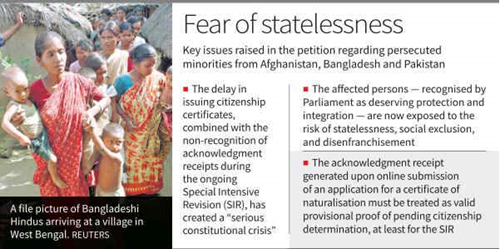
- The Supreme Court said conferment of rights associated with Indian citizenship to people claiming to be religious minorities who fled persecution from Pakistan, Afghanistan, and Bangladesh and protected under the Citizenship (Amendment) Act, would be wholly dependent on whether their claims turn out to be true.
- The court said that though the Citizenship (Amendment) Act, 2019, had introduced changes in favour of granting “enforceable rights” to persecuted religious minorities from these countries, every such claim would have to be enquired into and verified by the authorities.
- The oral observations from a Bench of Chief Justice of India Surya Kant and Justice Joymalya Bagchi came on a petition filed by an NGO, Aatmadeep.
- The NGO submitted that these groups, especially those who had fled Bangladesh and were living in West Bengal, were petrified that the ongoing special intensive revision (SIR) of electoral rolls would render them stateless.
- Chief Justice Kant said the conferment of Indian citizenship was not a given for CAA applicants. They should fulfil certain conditions, and in due course, could apply for inclusion in the voters’ list, the Chief Justice said.
- The court, however, issued notice to the Election Commission and the Centre, seeking a response. It posted the case for hearing next week.
- The NGO, in its petition filed through advocate Anish Roy, submitted that the proviso to Section 2(1)(b) of the Citizenship (Amendment) Act (CAA) exempted religious minorities from Afghanistan, Bangladesh, and Pakistan who entered India on or before December 31, 2014, from being considered “illegal migrants”. These communities were Hindus, Sikhs, Buddhists, Jains, Parsis, and Christians. Section 6B of the CAA allows these persons to apply for grant of certificate of registration or certificate of naturalisation. The NGO argued that those who apply for naturalisation should not be deprived of citizens’ rights and privileges.
- However, the petition said the authorities had delayed the issuance of the citizenship certificates. This, coupled with the non-recognition of acknowledgment receipts during the ongoing special intensive revision (SIR), has created a serious constitutional crisis.
- “The affected persons, already recognised by Parliament as persecuted minorities of Afghanistan, Bangladesh and Pakistan who entered India deserving protection and integration, are now exposed to the risk of statelessness, social exclusion and disenfranchisement,” the petition alleged.
- Chief Justice Kant said “You are claiming that you are entitled by virtue of these amended provisions in the CAA to become citizens of this country. But you have not been conferred citizenship so far… The amended provisions might have conferred some enforceable rights in your favour to seek citizenship, but each and every statutory requirement has to be determined, like, do you belong to any minority in that country; were you resident of the country of which minority were permitted to come to India; and in what capacity have you come to India.
- The CJI said if the government has made a law, there would be a mechanism that would follow to implement the law.
- State drafts law on menstrual leave
Context: Even as the High Court is set to hear arguments on behalf of the State on Wednesday on its November 20 notification on menstrual leave, the State government has readied a Bill to give legislative teeth to the provisions.
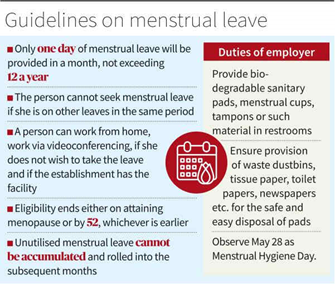
- In what is the first-ever such legislation, the State government has drafted the Karnataka Women Well Being Leave Bill, 2025. It provides menstrual leave not only for working women in the formal sector, but also for female students in educational institutions, transgenders, ASHAs, anganwadi, and midday meal personnel, and those working in mines. The Bill is expected to be introduced in the ongoing legislature session.
- Bill expands the scope of those eligible for leave, but also proposes setting up a Karnataka Women Well Being Authority
- In the first-ever such legislation proposed in the country, the Karnataka government has readied the Karnataka Women Well Being Leave Bill, 2025, which provides menstrual leave not only for working women in the formal sector but also for female students in educational institutions, transgenders, ASHAs, anganwadi, and midday meal personnel, and those working in mines.
Age criteria
- An earlier Government Order had covered the private sector, and last week the government brought its workers under its ambit. Instead of 18 as a minimum age criteria prescribed earlier, the Bill does not propose any lower minimum age limit, but the upper age limit has been capped at 52 or till menopause.
- While the working women will get one day leave per month, the menstrual leave for students will be upto two days in a month and consequently 2% relaxation in the attendance for menstrual issues in educational institutions.
WFH facility
- If the employee does not chose to avail of the leave, she will be entitled for work from home if the facility is available. Not mandating a doctor’s certificate, the leave can be availed through a request on e-mail.
- The proposed Bill is likely to be cleared in the Cabinet on Thursday, following which it will be introduced in the legislature, sources said. This will be the most comprehensive legislation proposed so far in the country.
- When asked if the Bill was in response to the ongoing case in the Karnataka High Court, sources said that the government was working on the Bill for some time now.
- Among other things, the Bill proposes setting up Karnataka Women Well Being Authority, which will be headed by the chairperson of the Karnataka State Commission for Women to redress grievances arising out of complaints.
- Labour officer in the district will be the enforcement officer.
Penalty clause
- A penalty of upto ₹5,000 for each contravention of the provision has been proposed for those who deny menstrual leave, ill treat or discriminate against menstruating women.
- Trump mulls tariffs on rice from India
Context: Days before a U.S. team of negotiators is to visit India to discuss tariffs, U.S. President Donald Trump has hinted at imposing further tariffs on India, this time on rice, to prevent it from “dumping” rice in the U.S.
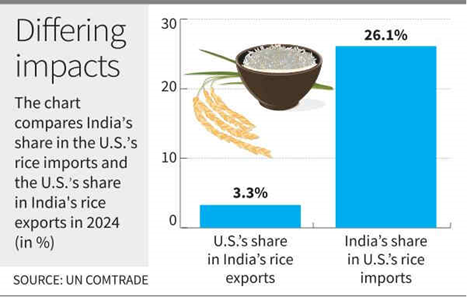
- However, an analysis of trade data between the two countries shows that such tariffs would hurt the U.S. far more than India since only about 3% of India’s rice exports go to the U.S., whereas Indian rice makes up more than one-fourth of the quantity imported into the U.S.
- In other words, for rice, the U.S. is not a major export destination for India, but India is a major import source for the U.S.
- A U.S. team of negotiators led by Deputy U.S. Trade Representative Rick Switzer would be in New Delhi on December 10-12 to discuss tariffs. The U.S. has currently imposed a total of 50% tariffs on imports from India.
- Mr. Trump made his rice tariff comments during a White House meeting in which he unveiled a $12 billion package to support American farmers.
- At a meeting in the White House, when a farmers’ representative complained that India, Thailand and other countries were “dumping” rice in the U.S., Mr. Trump asked the U.S. Secretary of the Treasury Scott Bessent: “Why is India allowed to do that? They have to pay tariffs. Do they have an exemption on rice?” Later, he said the issue can be solved “so quickly with tariffs” on these countries that are “illegally shipping” into the U.S.
- According to data with the Ministry of Commerce and Industry, India exported rice worth $391.74 million to the U.S. in 2023-24, which makes up about 3.1% of India’s total rice shipments. India exports rice to 179 other countries.
- On the other hand, according to data from the World Integrated Trade Solutions website, India accounted for about 26% of the $1.6 billion worth of rice the U.S. imported in 2024.
- “President Trump’s threat to impose new tariffs on Indian rice looks driven more by domestic politics than by trade logic,” Ajay Srivastava, former Director General of Foreign Trade, said.
- Aditya-L1 joins global effort revealing why the 2024 solar storm behaved unusually
Context: India’s first solar observatory Aditya-L1, along with six U.S. satellites, in a major breakthrough, has revealed why the May 2024 solar storm also known as Gannon’s storm behaved so unusually.
- In May 2024, the earth faced the strongest solar storm in more than two decades, which disturbed Earth’s environment severely.
- The solar storm is composed of a series of giant explosions on the Sun, called coronal mass ejections (CMEs). CMEs are like massive bubbles of hot gas and magnetic energy thrown out from the Sun into space. When these bubbles hit Earth, they can shake our planet’s magnetic shield and cause serious trouble for satellites, communication systems, GPS, and even power grids.
- According to the Indian Space Research Organisation (ISRO), during the May 2024 solar storm, the Sun’s magnetic fields, which are like twisted ropes inside a solar storm, were breaking and rejoining within the storm.
- “Usually, a CME carries a twisted “magnetic rope” that interacts with Earth’s magnetic shield as it approaches Earth. But this time, two CMEs collided in space and squeezed each other so firmly that the magnetic field lines inside one of them snapped and rejoined in new ways, a process called magnetic reconnection,” ISRO said. It added that this sudden reversal of the magnetic field made the storm’s impact stronger than expected.
- “At the heart of this discovery is India’s first solar observatory, Aditya-L1, which joined forces with six U.S. satellites (NASA’s Wind, ACE, THEMIS-C, STEREO-A, MMS, and NASA-NOAA joint mission DSCOVR),” the ISRO said.
- “Thanks to precise magnetic field measurements from India’s Aditya-L1 mission, scientists were able to map this reconnection region. They found that the area where the CME’s magnetic field was tearing and reconnecting was enormous — about 1.3 million km across, i.e., nearly 100 times the size of Earth. It was the first time such a giant magnetic breakup and rejoining had ever been seen inside a CME,” it added.
- This discovery is expected to enhance the understanding of how solar storms evolve as they travel from the Sun to Earth.
- ‘India has to move from service provider to a product nation’
Context: India’s maiden full-fledged summit on supercomputing kicks-off in Yelahanka, featuring advanced computer technologies by 175 firms.
- India has a huge need to move from a service provider to a product nation, taking advantage of emerging technologies, including quantum computing, high performance computing and artificial intelligence, said Ashwini Vaishnaw, Minister for Railways, Information and Broadcasting, and Electronics & Information Technology.
- The Minister was addressing online supercomputing experts and entrepreneurs and policy makers gathered from across India and overseas at the inaugural ceremony of the maiden edition of Supercomputing India 2025 (SCI 2025) held at the Manipal Institute of Technology (MIT), Yelahanka.
- Speaking on the occasion, Jitin Prasada, Minister of State for Electronics & Information Technology, highlighted that the government has various mission mode programmes which have been initiated as part of moving towards a product nation.
- Responding to a query on why quantum computing has suddenly received so much hype, Thomas Zacharia, senior vice president, technology partnership at AMD, on the sidelines of the conference, told The Hindu that this technology has been demonstrated as useful in specific cases, and increasingly becoming relevant in recent years.
- “So the excitement is that, while it has been a promise, today quantum computing can be utilised be for very specific and important applications that cannot be done in any other way, which is why it’s exciting,” he explained.
- However, he agreed every technology has a hype cycle, but what we’re talking about here is that quantum computers have very good systems for quantum mechanical systems. So a certain class of problems can be effectively solved using quantum computers. And today, if we have demonstrated with a sufficient number of cubits that we can get real life solutions to where it is applicable, Mr. Zacharia explained.
- SCI 2025 is India’s first comprehensive conference on high-performance computing, artificial intelligence and quantum computing, organised by the Centre for Development of Advanced Computing (C-DAC) under the aegis of the National Supercomputing Mission (NSM) and joined by global collaborators.
- 57,000 cybercrime cases registered in State in last three years: Parameshwara
Context: Karnataka has witnessed over 57,000 cybercrime cases in the last three years, accounting for financial fraud to the tune of ₹5,473 crore, according to Home Minister G. Parameshwara.
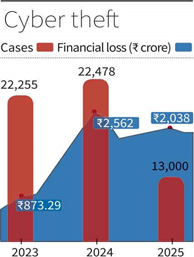
In numbers
- Replying to BJP member Cement Manju during Question Hour in the Assembly, he said 22,255 cybercrime cases had been filed in 2023 in Karnataka amounting to financial fraud of ₹873.29 crore. In 2024, the number of registered cybercrime cases stood at 22,478, accounting for financial fraud of ₹2,562 crore. So far, in 2025, these cases have stood at 13,000 with a financial fraud of ₹2,038 crore.
- So far, it had been possible to recover only ₹627 crore in these cases of cybercrime, he said, while pointing out that more than 10,700 cases had been solved so far.
- The statistics provided by the Minister shows that Bengaluru city tops the list of cities in terms of cybercrimes in 2025 by accounting for 9,326 cases. Among the districts, Bengaluru Urban district accounted for 384 cases, followed by Vijayapura (340), Tumakuru (243), Ramanagara district (192), Udupi district (171), Mysuru city (166) and Mysuru district (56).
- Listing the efforts by the State government to curb cybercrimes, the Minister said Karnataka had created a cyber vertical led by a DGP like the CID and Prisons Department for the first time in the country. As many as 43 cyber police stations had been set up crack down against cybercrime, he said.
Online betting
- Dr. Parameshwara said that incidents of online betting had increased both within the country and abroad. He said the State government had tried to bring changes to the existing legislation to ban online betting.
- But the Online India Gaming Federation had got a stay from the courts against such changes. The State had now approached the Supreme Court and the case had been listed for December 19, he said. Though the Centre too had brought in a legislation to curb online betting, that legislation too had been stayed, he said.
- Govt. togive ₹5 lakh each to 23 kambalas
Context: The State government has decided to support kambala (slush track buffalo race) by providing financial assistance of ₹5 lakh each to 23 kambala events a year in Dakshina Kannada and Udupi districts.
- Announcing this in the Assembly while replying to Congress member Ashok Kumar Rai during Question Hour, Law Minister H.K. Patil said a sum of ₹5 lakh would be given to each of the kambala events.
- Earlier, the Minister said financial grant had been earmarked for 10 kambala events and that the government was considering increasing it to 20 events. However, all the members from the coastal region, cutting across party affiliations, urged the government to increase it to 23 kambalas, as that would encourage tourism and traditional sport in coastal region. The Minister finally agreed to their demand.
- Ensure free content access for LLMs, says working paper
Context: It says data crawlers for training artificial intelligence models should not be restricted; instead a copyright society should be set up to collect royalties for members and non-members of body.

- A government working paper released on Monday suggested that AI large language models (LLMs) such as ChatGPT should, by default, have access to content freely available online, and that publishers should not have an opt-out mechanism for such content.
- Instead, a copyright society-like non-profit should be set up to collect royalties for both members and non-members of that body.
- The working paper, authored by a committee formed by the Department for Promotion of Industry and Internal Trade (DPIIT), is not final, and is accepting public comments for 30 days. The document is one of the main indicators of how the Indian government is thinking of balancing copyright holders’ fears that AI systems will regurgitate content they invested in without remuneration, and the interests of LLM developers who have routinely consumed massive amounts of data online to train their models.
- Nasscom, which was represented in the DPIIT’s committee, dissented, arguing that forced royalties would amount to a “tax on innovation”, and said that “mining” or scraping the Web for data must be allowed for freely available content without paywalls, and that both “crawlable” and access-restricted content providers should have options to “reserve” their content from being mined for LLM development.
Opt-out not feasible
- The committee rejected Nasscom’s dissent, arguing that small content creators may not have the means to actually enforce such opt-outs.
- The Digital News Publishers Association, which represents traditional news media outlets with a digital presence, including The Hindu, has sued ChatGPT maker OpenAI in the Delhi High Court for copyright infringement. OpenAI denies the allegations. The working paper argues that it may not be prudent to await the outcome of this and other similar litigation.
- The recommendations, if put in place through a law, will eliminate any allegations of improper access to data, by blessing all access, provided a fee is paid. This model is similar to the “compulsory licensing” framework in place for radio stations in India, which are empowered to play music without negotiating rights for them, as long as a statutorily prescribed fee is paid to the rights holders.
- This balancing may face pushback from AI developers and content creators; the former may argue against anything that increases development costs as few AI firms are even profitable at the moment, leaving little appetite to share revenues. Content creators may resist a flat fee if they feel their inputs are more valuable in training a model than those of other royalty recipients.
- A payout to the copyright society set up for distributing AI riches to content creators, will be distributed by considering factors such as Web traffic and social indicators, like how respectable a publisher is. Any decision can be taken to the the court, the working group says.
- SC asks Centre togive nationwide dataon missing children
Context: The Supreme Court directed the Union government to furnish six years of nationwide data on missing children and to appoint a dedicated officer in the Union Home Ministry to ensure effective coordination with the States and Union Territories in compiling such information.
- A Bench of Justices B.V. Nagarathna and R. Mahadevan was hearing a public interest litigation petition filed by the non-profit organisation Guria Swayam Sevi Sansthan, which highlighted the rising number of children who remain untraced across several States.
- The court had earlier directed all States and Union Territories to depute dedicated officers to oversee cases of missing children and to ensure that such details are promptly uploaded on the Mission Vatsalya portal administered by the Women and Child Development Ministry.
- Appearing for the Centre, Additional Solicitor-General Aishwarya Bhati informed the Bench that all States and Union Territories had appointed such officers and uploaded their particulars on the portal. She noted, however, that the effective dissemination of information and coordinated use of the platform remained essential to securing meaningful outcomes.
- The Bench observed that the Home Ministry itself had not nominated a dedicated officer to oversee cases of missing children, despite being the central coordinating agency. It accordingly directed the Ministry to appoint such an officer within two weeks and to upload the officer’s details on the Mission Vatsalya portal.
- “We find that the Ministry of Home Affairs of the Union of India has not appointed a dedicated nodal officer for cases of missing children for the purpose of Mission Vatsalya, and hence an officer may be nominated as a dedicated nodal officer, whose details may also be uploaded on the Mission Vatsalya portal,” the court ordered.
- ‘Rise in global useof Aadhaar-like ID systems dangerous’
Context: Fifty-four civil society groups and over 200 individual signatories have put out an open letter pushing back against the expanding use of Aadhaar-like digital identity systems in countries other than India.
- The two-page letter was signed by organisations such as Internet Freedom Foundation; the Mazdoor Kisan Shakti Sangathan; JNU Students Union; Safai Karmachari Andolan; and People’s Union for Civil Liberties (PUCL). It was also endorsed by individuals such as former Amnesty International India chair Aakar Patel, activist Jean Drèze, and constitutional law scholar Gautam Bhatia.
- The Centre has promoted digital identity systems such as Aadhaar around the world as a key plank of digital public infrastructure, a concept that India is promoting with both policy support and open source tools, such as those provided by the Modular Open Source Identity Platform (MOSIP). MOSIP, which was largely developed by the IIIT Bengaluru, does not use the same technology as Aadhaar.
- Some countries engaged with MOSIP at various degrees include Morocco, the Philippines, Sri Lanka, Ethiopia, and Uganda.
- Cyclone impact sparks fresh calls in Sri Lanka to recast IMF agreement
Context: As Sri Lanka reels from Cyclone Ditwah’s devastation, calls to revisit the ongoing International Monetary Fund (IMF) programme, which critics say imposes punishing austerity, are growing louder.
- At least 638 people died — 191 remain missing — and millions were affected by torrential rains, unprecedented flooding, and multiple landslides that battered Sri Lanka late November. The climate disaster, one of the worst the country has witnessed, has dealt a sharp blow to the island’s tentative recovery, three years after it declared bankruptcy amid a financial meltdown.
- Last week, Opposition Leader Sajith Premadasa urged the Anura Kumara Dissanayake government to renegotiate the IMF deal in the wake of the climate catastrophe, calling for immediate talks with the Fund to suspend or amend conditions that aggravate the people’s hardships.
- A UNDP study in 2022–23 found that the crushing economic crisis in 2022 had left over half of the island’s population “multidimensionally vulnerable”. Although Sri Lanka has since achieved relative fiscal stability, the condition of the country’s poor — hit hardest by IMF-prescribed spending cuts — has worsened.
- In the wake of the recent natural disaster, over 70 civil society groups and activists across Sri Lanka have called for renegotiation of the IMF deal, debt, and climate justice. “While a majority of people are reeling under austerity measures, including regressive tax hikes, subsidy cuts, and inadequate social security measures, the Government of Sri Lanka has become a prisoner of the ongoing Extended Fund Facility programme of the IMF,” said their statement, issued on December 8, 2025.
‘Urgent revision’
- “The IMF controlling government spending not only restricts the ability of the government to respond to the ongoing humanitarian crisis, but severely impedes investment in infrastructure, recuperating livelihoods, and adapting to further climate change impacts,” they contended, demanding an “urgent revision” of Sri Lanka’s debt restructuring agreement, a “massive” debt reduction, a halt on subsidy removals, and an immediate standstill on current and future debt servicing for the country’s recovery.
- In 2026, the government must service debt totalling over $2 billion, while it tries to lift the country out of the deluge, whose full impact is yet to be ascertained. Some development experts have observed that recovery might prove harder than after the Indian Ocean tsunami of 2004.
- Recognising the challenge, President Dissanayake told Newsweek magazine in an interview published on December 8: “Initial estimates indicate that the damage may well be beyond any natural disaster that our island has endured. So we will have to service debt while simultaneously rebuilding from climate disasters. This is why debt sustainability frameworks for climate-vulnerable countries must change.”
- Weighing in on Sri Lanka’s predicament, former President of the Maldives Mohamed Nasheed recently noted that the climate calamity makes it “impossible” for Sri Lanka to stay aligned with the IMF programme. “When Sri Lanka faced its financial crisis in 2022, the IMF approved a four-year Extended Fund Facility after months of negotiation. Yet the Debt Sustainability Analysis (DSA) failed to account for climate shocks,” he said in a social media post, as the cyclone’s impact began unfolding.
- Not just Sri Lanka, but several climate-vulnerable, debt-distressed countries are in a similar plight. The Climate Vulnerable Forum — an international alliance of over 70 highly climate-vulnerable countries — has long called for reforming the DSA to properly value resilience investments and natural capital, and for a reformed G20 Common Framework that includes automatic debt standstills in response to climate shocks, said Mr. Nasheed, who is also the Secretary-General of the Forum.
Emergency financing
- However, there are no signs yet that the Sri Lankan government may veer away from the IMF programme. In fact, the government has sought a $200 million Rapid Financing Instrument from the Fund. An IMF spokesman confirmed that Sri Lanka’s request for emergency financing will take precedence over the scheduled fifth review of the ongoing Extended Fund Facility (EFF).
- Meanwhile, activists have demanded that the government urgently prioritise equitable relief, focusing on economically and socially marginalised communities most affected by the disaster. “The highest [number of] casualties were reported from Badulla, Kandy, Kegalle, Matale, and Nuwara Eliya districts — areas especially prone to landslides and home to already marginalised and vulnerable working-class tea plantation workers,” the Feminist Collective for Economic Justice, a network of feminist activists across Sri Lanka, said in a statement. Demanding universal social protection schemes, the Collective called for urgent negotiations with the IMF and other creditors “to cancel debt repayment and reverse austerity policies in this crisis context.”
Source: The Hindu