- With only 26% deaths having certified cause, Karnataka keen to enhance rate
Context: Following concerns that only 26.73% of registered deaths in Karnataka currently have medically certified causes — a major gap affecting disease surveillance and health planning — the State Health Department has issued a set of directives to improve the coverage and quality of Medical Certification of Cause of Death (MCCD) reporting in the State.
- In a circular issued by Harsh Gupta, Principal Secretary, Health and Family Welfare, the department noted that reliable cause-specific mortality data is critical. The MCCD system, mandated under the Registration of Births and Deaths (RBD) Act, 1969 (as amended in 2023), is intended to provide cause-specific mortality data at the State and national level.
- Mr. Gupta told The Hindu that the recent amendment to the Karnataka Registration of Births and Deaths Rules, 2024, effective from January 16, 2025, has made it mandatory for all government and private health facilities to issue a certificate of the cause of death in Form 4 for hospital deaths and Form 4A for deaths occurring at home or other locations.
Through e-JanMa
- All registered hospitals — public and private — must issue medical cause of death certificates in Form 4 for hospital deaths and submit them electronically through e-JanMa to the local registrar, while also providing a copy to the next of kin.
- For deaths occurring outside medical institutions — homes, transit, prisons, old-age homes and similar facilities — attending doctors must issue Form 4A for free.
- Hospitals are also required to report monthly death counts and submit “nil reports” where no deaths occur.
- Local registrars must ensure that every reported death (Form 2) is accompanied by a cause-of-death certificate.
- For non-hospital deaths, priority for issuing the certificate is assigned to the doctor who treated the deceased during the final illness, any doctor familiar with the patient’s medical history or government medical officers (PHCs, CHCs, taluk and district hospitals).
- In medico-legal cases, the certifying doctor must provide the cause of death following an inquest or autopsy. Deaths must be reported and certified within 21 days across rural and urban areas. Private hospitals must report deaths occurring under their care to the respective registrar.
- To ensure compliance and improve data quality, each district will establish a review and monitoring committee headed by the District Health Officer, with experts from clinical and public health departments. The committee will meet monthly to review samples of certificates, support local registrars and hospitals, and organise training.
- Post pandemic, new families get on the ‘silk road’ in Karnataka
Context: After a dip during the pandemic years, over 13,000 new families have taken up sericulture in Karnataka over the past five years, contributing a 43% rise in cocoon production and a nearly 20% jump in raw silk output.
- Several factors including support from the government, better cocoon prices and better availability of high-quality chawki (carefully reared young silkworms essential for good yields) have helped the industry regain momentum and expanded mulberry cultivation to 1.18 lakh hectares in 2024–25, the largest area under sericulture in 15 years.
- Farmers also believe that demand for Karnataka silk has strengthened after the Centre banned China silk, which earlier dominated the market because of its lower cost. “The price of silk is around ₹7,000 to ₹7,500 a kg now, and in the coming months it may touch ₹9,000. During COVID, it had fallen below ₹2,000,” M. Pemme Kumar, a sericulturist said.
- “Karnataka’s traditional silk belts- Ramanagara and Sidlaghatta which are known for producing some of India’s best cocoons- had witnessed farmers gradually exit sericulture, moving to horticulture over the past decade, largely due to volatile prices and competition from cheaper imported silk. The ban on China silk has brought some stability back to the market,” Bhupat Rajan, another grower said.
- Officials from the Central Silk Board, however, believe that Chinese imports were not the primary reason for the earlier price crash, noting that the price of Chinese silk remains around ₹5,000 a kg.
- The growers pointed out that government support has revived the industry significantly. “The State government raised the incentive for bivoltine cocoon producers from ₹10 to ₹30 a kg in the 2024–25 Budget. This attracted many growers,” Shantamma Nagaraju, a sericulturist said.
Reelers in decline
- While demand has strengthened and prices have recovered from the pandemic lows, the sector continues to grapple with a shrinking number of reelers, a link in the value chain whose decline has itself contributed to the higher price of raw silk in recent years, the growers said.
- While the State government had announced an annual subsidy of ₹12 crore for raw silk reelers through the Karnataka Minority Development Corporation during last year’s Budget, many, specifically younger generations, are no longer entering into reeling because of low and irregular incomes, demanding working conditions and lack of mechanisation.
- “Reeling, a labour-intensive process of extracting fine silk fibre from cocoons, is struggling to survive as this altogether lacks machinery and relies on skill, precision and hours of manual labour to produce high-grade yarn,” a grower said.
- State revises maize procurement norms; raises cap to 50 quintals per farmer
Context: Following protests by maize growers over procurement limits, the State government on Sunday revised its order on Minimum Support Price (MSP) operations, increasing the maximum quantity that can be purchased from each farmer to 50 quintals.
- A corrigendum issued in this regard stated that the earlier cap of 20 quintals per farmer has now been enhanced. Procurement would be based on landholding data available on the FRUITS platform, with up to 12 quintals per acre allowed and a ceiling of 50 quintals per farmer at the support price of ₹2,400 per quintal. The order states that priority will be accorded to procurement through Primary Agricultural Credit Societies located near distilleries.
- The decision comes after maize growers staged demonstrations alleging “unfair treatment” in procurement operations and demanded wider coverage under the MSP window.
- The government had recently permitted poultry feed manufacturers to directly buy maize from growers. In a separate order issued on December 4, the government had allowed poultry feed producers to procure maize directly from farmers at MSP rates for the 2025–26 kharif marketing season. The move is expected to ensure better price realisation, reduce intermediary involvement, and expand marketing channels for growers.
- The decision followed a meeting chaired by Chief Minister Siddaramaiah where industry representatives were urged to source an estimated five lakh tonnes of maize.
- The Karnataka Poultry Farmers and Breeders’ Association has committed to initially procure 5,000 tonnes with a 20% advance payment.
- Procurement will adhere to MSP quality specifications with a maximum moisture content of 12% for poultry feed suitability. The government said the latest measure would run parallel with procurement by the Karnataka State Co-operative Marketing Federation, which supplies maize to distilleries.
- The evolution of pension reforms in India
Context: There has been a gradual but decisive shift from a welfare-based social assistance to a more participatory inclusion framework.
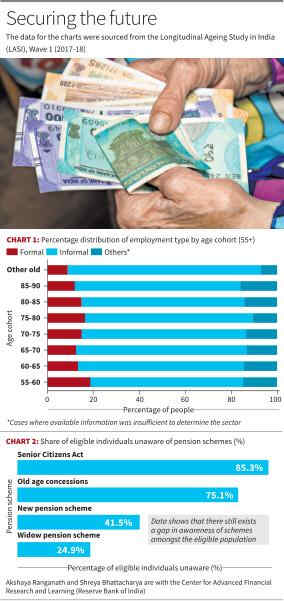
- India’s rapidly ageing population is emerging as a pivotal pension challenge. Today, over 153 million Indians are aged over 60. This is projected to double to 347 million by 2050. While a small section of older Indians has benefited from the rise of formal sector retirement, more than 88% of today’s senior citizens continue to work, in the sprawling informal economy, without access to pensions or reliable social security rather than retiring (Chart 1). We revisit the evolution of pension schemes for financial inclusivity of the Indian informal sector.
- The Indira Gandhi National Old Age Pension Scheme (IGNOAPS) is a social assistance programme launched in 1995 for persons aged over 65, living below the poverty line (BPL). Subsequent changes expanded scheme eligibility and strengthened financial support, leading to a significant rise in enrolment. It is a first among national-level efforts taken to provide a direct, regular source of income to the older population in the unorganised and economically vulnerable section of society. Similarly, formal sector government employees were covered under the government-sponsored Old Pension Scheme (OPS).
- Research finds that unlike social benefit schemes, contributory pension schemes in developing countries encourage household formal savings behaviour. Announced in Budget 2015-16, the Atal Pension Yojana (APY) is a contributory pension scheme for individuals aged 18-40, where periodic contributions are made to a pension account. At retirement, the accumulated amount, including returns, is disbursed, with the government guaranteeing a minimum pension if returns fall short. Taking into consideration the seasonal nature of informal sector income, especially agriculture, the APY allows for not just monthly but also quarterly and half-yearly instalments.
- For the formal sector, OPS was replaced by the contributory-model New Pension Scheme (NPS) in 2004. The NPS also has a corporate sector model which extends to all corporate sector employees with a savings account. Recently, the NPS 2.0 was launched allowing total allotment to 100% equity and a flexible multiple scheme framework (MSF) — an attractive change for younger high-risk, high-reward-type investors. The APY and NPS models form a comprehensive long-term financial security framework that ensures inclusion in the formal financial system, despite the sectoral divide.
- The Labour Codes introduced a uniform definition of ‘wages’, requiring that basic pay make up at least 50% of total earnings. This closes a long-standing loophole that allowed employers to shrink basic pay by inflating allowances. With pension, gratuity, and social security benefits now calculated on a higher base, workers stand to gain stronger financial protection.
- The progression of pension schemes in India reflects a hierarchical pattern in which each stage builds on the needs identified before it. Through an equity and social-welfare lens, the government first introduced IGNOAPS and OPS to meet the basic needs of older adults. Having secured social protection, the focus shifted to more sophisticated goals such as financial inclusion and savings and investment behaviour through the NPS and the NPS 2.0. To bridge sectoral divide, similar behavioural nudges were extended to informal-sector workers via the APY.
- Many of these schemes are explicitly targeted at BPL individuals, and are therefore designed to extend coverage to informal-sector workers who lack access to formal retirement provisions. However, there still exists a gap in awareness of schemes amongst the eligible population. Our findings from the Longitudinal Ageing Survey of India (LASI) show that as of 2017-18, 42% of individuals aged over 55 were still unaware of NPS and its eligibility criteria and requirements (Chart 2).
- To tackle limited awareness and fragmented access to welfare programs, the e-SHRAM portal was launched as a national database for informal sector workers. Through this, workers can register and obtain information about social security schemes for which they are eligible. Our analysis of the LASI data shows that over age 55, about 75.6% of women and 68% of men work in this sector.
- While this is a significant step towards integrating the informal workforce into the country’s formal social protection system, realising e-SHRAM’s full potential depends on overcoming challenges related to registration, awareness, and effective disbursement of benefits. For instance, registration requires Aadhaar to phone number linkage and a savings bank account, which is susceptible to errors of exclusion. Moreover, according to the Comprehensive Annual Modular Survey of India (2022-23), 63% of the elderly population do not know how to use the Internet. This risks leaving the most economically vulnerable among them behind.
- The evolution of pension schemes in India has seen a gradual but decisive shift from a welfare-based social assistance to a more participatory inclusion framework. While the challenges of unawareness still remain, initiatives such as e-SHRAM signal a data-driven approach to policy targeted at the older age population. The trajectory of these continuing revisions and initiatives will pave the way for inclusive policies and dignify the contributions of the elderly in their later years of life.
- U.S. official begins five-day India visit to advance strategic partnership
Context: A day after Russian President Vladimir Putin’s visit to India, the U.S. Under Secretary of State for Political Affairs, Allison Hooker, started her five-day visit on Sunday. The visit will cover New Delhi and Bengaluru and include meetings between Ms. Hooker and senior Indian officials, including Foreign Secretary Vikram Misri.
- “Under Secretary Hooker’s visit will focus on advancing the U.S.-India strategic partnership, deepening economic and commercial ties, including increasing American exports, and fostering collaboration in emerging technologies, including artificial intelligence and space exploration,” said the Department of State in an announcement.
- During her stay in New Delhi, Under Secretary Hooker will participate in the Foreign Office Consultations with Foreign Secretary Misri. Her discussion will include regional security, economic cooperation and “shared priorities” in the Indo-Pacific, said the official announcement.
- Ms. Hooker took charge as the Under Secretary of state earlier this year and ever since has held a number of meetings with officials from the region. India was supposed to host the Quad summit in 2025, but the summit meeting has not been scheduled so far, and there is no official information about it.
- In Bengaluru, Ms. Hooker will visit the Indian Space Research Organisation and meet leading figures from India’s space, energy and technology sectors with the goal to “promote innovation in U.S.-India research partnership and explore opportunities for expanded cooperation,” the official announcement said.
- The Foreign Office Consultation comes against the backdrop of the continuation of the penalty tariffs by the U.S. on India. Latest reports suggest that India has made a considerable reduction in the purchase of Russian energy, though relations with Russia remain on track, with Prime Minister Narendra Modi on December 5 describing the bilateral relationship as important as the “Pole Star” (Dhruva Tara).
- ‘It is essential to nurture inheritance and pass it on to future generations’
Context: The world is indeed becoming “more multi-polar”, which makes a compelling case for “deeper multilateralism”, and collectively, prosperity can only come through mutual respect and understanding, External Affairs Minister S. Jaishankar said.
- In his address at the opening ceremony of a key UNESCO meeting on Safeguarding of Intangible Cultural Heritage (ICH) at the Red Fort complex here, he also told delegates from various countries that in the “shared quest for progress and prosperity”, it is essential to nurture inheritance, build on it and pass it on to the future generations.
- The 20th session of the Intergovernmental Committee for the Safeguarding of Intangible Cultural Heritage will take place at the Red Fort from December 8 to 13.
- Mr. Jaishankar underlined that India, besides being home to many UNESCO World Heritage Sites, has itself undertaken many preservation and conservation projects across the world. A key dimension of that engagement is preservation of intangible heritage.
- “The world is a fundamentally pluralistic landscape, a landscape whose richness lies in its diversity and intricacy. Far from being flat, it has a vast range of specificities and characteristics,” he said. “What humankind has generated over the centuries will only be fully appreciated when that heritage is carefully nurtured,” he said.
- He emphasised that challenges in that context arise when efforts are made to “dominate, to sideline, to dismiss or even to erode”.
- But as “decolonisation” took place and the world began returning to its “natural diversity”, political and economic rebalancing started to unfold, Mr. Jaishankar said.
- “Voices across geographies that were suppressed found expression again. But that process will remain incomplete until there is also cultural rebalancing,” he added.
- Cheetah cub from Kuno run over by vehicle in Gwalior
- A cheetah cub died on Sunday in Madhya Pradesh’s Gwalior district after being hit by a vehicle on the Agra-Mumbai National Highway (NH-46), making it the second death of a big cat at the Kuno National Park (KNP) in just two days.
- Two 20-month-old Indian-born male cubs, offspring of the South African female cheetah named Gamini, had ventured out of Kuno’s boundaries, and were being tracked by a cheetah tracking team and local forest staff, when one of them was hit by a speeding vehicle. The incident took place around 6.30 a.m. when the two cubs were crossing the NH-46 near Ghatigaon in Gwalior.
- Rajnath unveils border infrastructure projects
Context: Minister inaugurates 125 BRO projects across Ladakh, J&K and seven States, describes them as a testament to the government’s commitment to border infrastructure under vision of Viksit Bharat.
- Defence Minister Rajnath Singh on Sunday inaugurated 125 strategically vital infrastructure projects of the Border Roads Organisation (BRO) from Ladakh, the highest number ever dedicated to the nation in one event.
- The Defence Ministry said the projects, worth around ₹5,000 crore, span the Union Territories of Ladakh and Jammu and Kashmir and seven States — Arunachal Pradesh, Sikkim, Himachal Pradesh, Uttarakhand, Rajasthan, West Bengal, and Mizoram. The initiatives comprise 28 roads, 93 bridges, and four other key assets, marking the largest value inauguration in the BRO’s history.
- Addressing the ceremony held on the Darbuk Shyok Daulat Beg Oldie Road at the Shyok Tunnel site, Mr. Singh described the projects as a testament to the government’s commitment to border infrastructure under the vision of Viksit Bharat.
- The 920-metre Shyok Tunnel, a major highlight, is engineered to provide all-weather connectivity to one of the world’s most challenging terrains. He said the tunnel would significantly improve mobility, security and rapid deployment capabilities during extreme winters, when the region experiences avalanches and heavy snowfall.
- Mr. Singh also virtually inaugurated the Galwan War Memorial, built to honour the courage and sacrifice of Indian soldiers. Emphasising the multi-dimensional value of robust border connectivity, he said such infrastructure strengthened national security, enhanced logistics movement, boosted tourism, and generated employment while reinforcing people’s faith in development.
- Referring to Operation Sindoor, the Minister credited strong connectivity for enabling the armed forces to conduct the operation with precision and coordination. He praised the synergy between the forces, civil administration and border residents, describing it as the “unique identity” of the nation.
- Mr. Singh also highlighted the BRO’s humanitarian work in Uttarakhand, Sikkim and Jammu and Kashmir, and acknowledged its technological advancements, including indigenous Class 70 modular bridges developed under Aatmanirbhar Bharat.
- Citing a record BRO expenditure of ₹16,690 crore in FY 2024 25 and an enhanced outlay for FY 2025 26, he reiterated the government’s commitment to strengthening border infrastructure and achieving self-reliance in defence manufacturing.
- In the past two years, 356 BRO projects have been dedicated to the nation, underlining the organisation’s capability across diverse terrains.
- National intelligence grid gains traction as Central agencies, police scour for information
Context: The National Intelligence Grid (NATGRID), a platform for the police and investigating agencies to securely access government and private databases in real time, is getting around 45,000 requests a month, government officials told.
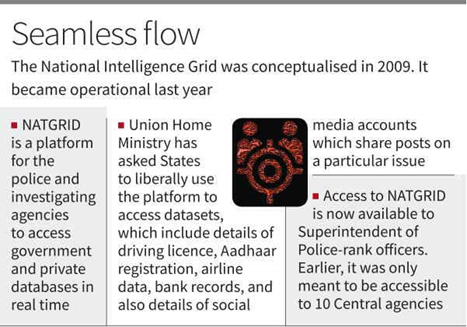
- The platform, accessible only to security agencies, became operational last year after first being conceptualised in 2009 in the aftermath of the 26/11 Mumbai terror attacks.
- At the recent conference of Directors-General of Police, chaired by Prime Minister Narendra Modi in Raipur, the law enforcement agencies, including State police, were asked to scale up the use of NATGRID in all investigations.
- The Union Home Ministry has asked States to liberally use the platform to access datasets, which include details of driving licence, Aadhaar registration, airline data, bank records, and also details of social media accounts which share posts on a particular issue.
- Access to NATGRID is now available to Superintendent of Police-rank officers. Earlier, it was only meant to be accessible to 10 Central agencies, such as the Intelligence Bureau, Research and Analysis Wing, National Investigation Agency, Enforcement Directorate, Financial Intelligence Unit, Narcotics Control Bureau, and the Directorate of Revenue Intelligence.
- Several State police officials told that they faced certain hurdles while accessing the information on the platform.
Time consuming
- An official said that logging on the portal required a lot of time, while another official said they had to wait longer to get the desired information, even though the platform is supposed to provide real-time data.
- The platform, which had been in the works for over a decade and was first envisaged under Congress leader P. Chidambaram, received a fresh momentum under Home Minister Amit Shah in 2019. Under Mr. Shah, the differences between various security agencies were ironed out, and the application was made accessible to even the State police.
- The government is taking several steps to enhance security and maintain the sanctity of data in the wake of repeated cyberattack attempts on critical infrastructure in the country, official sources said.
- In 2024, India witnessed over 20.41 lakh cybersecurity-related incidents, the highest number of incidents since 2020.
- “Instead of security agencies seeking data from multiple sources, NATGRID provides the information on a single platform. The confidentiality of the user is maintained, and the registration of a first information report (FIR) is not necessary. Information can be secured to join the dots during an investigation or to develop intelligence,” said another government official.
- Top agricultural research body urges varsities to startcourses in natural farming
Context: Indian Council of Agricultural Research (ICAR) Director-General M.L. Jat has written to the Vice-Chancellors of all State and Central agriculture universities, as well as universities with agriculture departments, urging them to launch undergraduate and postgraduate courses and research programmes in natural farming.
- Though natural farming was already offered as an elective subject in various institutions and four universities had dedicated courses on the subject, it is the first time that the ICAR has urged all affiliated colleges and State government institutions to introduce courses on the topic.
- In the letter, Dr. Jat said natural farming had emerged as a subject of national importance, aligned with India’s strategic priorities for sustainable agriculture and farmer welfare. He said the B.Sc. (Hons.) agriculture – natural farming programme, developed as per the Sixth Deans’ Committee recommendations and National Education Policy (NEP) 2020 guidelines, has already been finalised, approved, and circulated to all agricultural universities. “Some universities have successfully initiated this programme from the academic year 2023-24, marking a transformative milestone in agricultural higher education. I hope remaining universities will introduce this course by next academic year,” he said.
- On strengthening postgraduate education and advanced research on the subject, he said that given the expanding national demand for chemical-free food systems, resilient agro-ecosystems, soil health restoration, and low-emission farming, it was imperative that the State agricultural universities, deemed universities, and Central agricultural universities develop PG programmes in natural farming and allied domains.