- Assembly nod for hate speech Bill
Context: The Legislative Assembly, on December 18, passed the Bill on preventing hate speech and hate crimes, while members of the Opposition were on a protest over a Minister’s remark on members from coastal Karnataka.
- The Assembly took up the Karnataka Hate Speech and Hate Crimes (Prevention) Bill for discussion after Home Minister introduced it and briefed the members about its features.
- Dr. Parameshwara sought the support of the House for the Bill, while the Opposition was staging a protest. Members of the BJP were in for a surprise as the Bill was passed, without they being able to join the discussion. The Speaker adjourned the House for lunch, declaring that the Bill had been passed.
- India signs trade pact with Oman for duty-free exports
Context: India and Oman signed a Comprehensive Economic Partnership Agreement (CEPA) on Thursday, under which Oman will provide India duty-free access to 98.08% of its tariff lines, covering 99.38% of India’s exports to Oman.
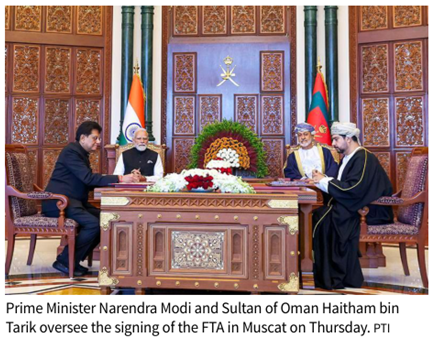
- India, on the other hand, has offered liberalised tariffs on 77.79% of its total tariff lines, covering 94.81% of what India imports from Oman. Apart from tariff removal on merchandise exports, the deal also includes several concessions that are expected to benefit India’s service sector, including in terms of mobility of workers.
- The deal was signed in Muscat by Commerce and Industry Minister Piyush Goyal and Oman’s Minister of Commerce, Industry and Investment Promotion, Qais bin Mohammed Al Yousef, in the presence of Prime Minister Narendra Modi and Sultan Haitham bin Tarik.
- India exported $4.06 billion worth of merchandise to Oman in 2024-25, which made up 0.93% of India’s total exports that financial year. It imported $6.5 billion worth of goods from Oman, comprising 0.91% of India’s total imports.
- “The CEPA will infuse the India-Oman partnership in the 21st Century with renewed faith and energy,” Mr. Modi said earlier in the day while speaking at the India-Oman Business Forum. “This is a blueprint for our future. It will give our trade new vigour and new trust for investments and will open the doors of new opportunities in every sector.”
- This is the first bilateral agreement that Oman has signed with any country since it signed a deal with the U.S. in 2006. It is also the second deal India has signed with a country in the Gulf Cooperation Council (GCC), the first being with the United Arab Emirates in February 2022.
- Mr. Goyal had also pointed out that a trade deal with Oman also serves as a gateway for India to the GCC region, eastern Europe, central Asia, and to Africa.
Benefit to labour-intensive sectors
- The Prime Minister added that the CEPA will create new opportunities for growth, employment and innovation for the youth of both countries.
- Taking to X soon after the signing of the deal, Mr. Goyal said that the deal would “significantly benefit” labour-intensive sectors, generating employment and strengthening Micro, Small & Medium Enterprises (MSMEs), artisans, and women-led enterprises.
- CAG recommends to State govt. to ensure Escoms reduce AT&C losses
Context: The Comptroller and Auditor-General of India which audited the Integrated Power Development Scheme (IPDS) in Karnataka has recommended that the State government ensure that the Electricity Supply Companies (Escoms) reduce the Aggregate Technical and Commercial (AT&C) losses as per the trajectory fixed by the Union Ministry of Power (MoP).
Subsidy
- The CAG has also recommended ensuring timely release of subsidy for irrigation pumpsets as per metered consumption.
- The CAG found that while the approved cost (including PMA charges of ₹6.87 crore) of the IPDS was ₹1,378.44 crore and the awarded cost was ₹1,721.19 crore., the Escoms incurred the actual expenditure of ₹ 1,489.33 crore (as of March 2023), i.e., Escoms incurred excess expenditure of ₹ 110.89 crore than the sanctioned cost in implementing the scheme, which included additional expenditure to the extent of ₹ 38.52 crore due to non-procurement of materials at Central Procurement Prices discovered by MoP.
- It also pointed out that non-compliance of various requirements for securing additional grants resulted in loss of opportunity to receive additional grant of 15% of the project.
Better billing
- At the same time, CAG acknowledged that the billing efficiency of Hescoms had generally improved during the scheme period contribution to reduction in billing losses.
- The CAG found that while in August 2015, in-principle approval to DPRs of all five Escoms valued at ₹1,138.75 crore was granted and works were to be awarded within six months and completed within 24 months, Escoms took took 11 to 27 months to award works, leading to significant delays.
- In the report it is mentioned that the Escoms awarded contracts in violation of KTPP Act and Rules by providing less time for submission of tenders, ranging from 15 days to 54 days against the stipulated minimum time of 60 days and by awarding works at high tender premiums exceeding the estimated cost by 5% to 34%.
- CAG audit also recommended that the State government may ensure that Escoms may devise a suitable mechanism to issue tenders in time, to take up works without delay and to ensure completion of works in time to achieve the envisaged objectives.
- Further Escoms may follow time frames as per KTPP Act and Rules to ensure adequate competition and to allow market discovery for most economical rates.
- The Escoms may ensure that comprehensive feasibility surveys were conducted before project execution and may include conditions of standard bid documents in invitation to bids and ensure adherence to the same while executing works, the report said.
- Bill adopted in Assembly to impose punishment for social boycott
Context: The Legislative Assembly adopted the Karnataka Social Boycott (Prevention, Prohibition and Redressal) Bill 2025 that seeks to prevent the evil practices of imposing social boycott, social discrimination and social disabilities at various levels by caste or community panchayats or by its members.
- Any person who imposes or causes to impose or practises any social boycott on any member of his community, will on conviction, be punished with imprisonment, which may extend to three years, or with fine which may extend to ₹1 lakh, or with both, according to the provisions of the Bill.
- The Bill, which was piloted by Social Welfare Minister H.C. Mahadevappa, also seeks to appoint a social boycott prohibition officer.
- The House also adopted the Karnataka Private Medical Establishments (Amendment) Bill, 2025, which seeks to replace an Ordinance.
- The Bill seeks to include the term “mental health establishment” within the definition of “private medical establishment” and nominate one member from the Indian Medical Association and one member representing the Association of Registered Medical Establishments or Ayush Medical Practitioners as member of Registration and Grievances Redressal Authority.
- Assembly passes internal reservation Bill amid debate on Alemari and EWS quota
Context: Amid demand to increase the reservation for Scheduled Castes (SCs) to accommodate the interests of 59 Alemari (nomadic) communities, the Karnataka Legislative Assembly unanimously passed.
- The Karnataka Scheduled Castes (Sub-Classification) Bill, 2025, that provides legislation cover to internal reservation in 17 % reservation for 101 Scheduled Castes.
- The government was under pressure from the Dalit Left groups to legislate the internal reservation matrix.
- Social Welfare Minister H.C. Mahadevappa, who moved the Bill, said, “Internal reservation was a promise made during the 2023 Assembly elections and we have kept it.”
Legislative cover
- The Bill seeks to provide legislative cover to the GO that apportioned 17% reservation. Of this, 6% reservation has been provided to 16 castes in Category A (Dalit Left), 6% to 19 castes in Category B (Dalit Right) and 5% to 63 castes, including 59 Alemari castes in Category C (Lambani, Korama, Koracha and Bhovi).
- During the discussion on the Bill, Deputy Leader of Opposition Arvind Bellad said that Alemari communities could not compete with other castes and inequality would continue. The Chief Minister’s Economic Adviser Basavaraj Rayaraddi suggested that the State could explore possibility of increasing the total reservation for SCs to 18% to include 1% reservation to Alemari communities.
- India and the Netherlands reaffirm defence ties
Context: Defence Minister Rajnath Singh met the Foreign Minister of the Netherlands, David van Weel, in New Delhi, reaffirming the steadily expanding defence partnership between the two nations.
- During the meeting, they held wide-ranging discussions on bilateral security and defence cooperation, including priority areas for the co-development and co-production of defence equipment, the Ministry of Defence stated.
- The two countries reiterated their commitment to strengthening military-to-military engagement, and developing defence cooperation as a key pillar of the India-Netherlands Strategic Partnership.
- The talks also underscored the shared commitment of India and the Netherlands to a free and rules-based Indo-Pacific region. Emphasising the need for closer defence ties, the Ministers highlighted the importance of connecting the defence industries of both countries, particularly in niche and emerging technologies.
- Retired judges don’t want to sit as junior ad hoc judges: CJI
Context: Chief Justice of India Surya Kant revealed that retired High Court judges are reluctant to return to the Bench as ad hoc judges to clear the massive pendency of criminal cases for a simple reason: they are “embarrassed” to sit as junior judges alongside younger colleagues.
- The High Courts across the country are burdened by mounting arrears, particularly in criminal cases.
- Data from the National Judicial Data Grid shows that 18,98,833 criminal cases are pending in the 25 High Courts.
- Of these, 68.27% or 12,96,374 cases have been pending for over a year. Against a sanctioned strength of 1,122 judges, there are 298 vacancies in the High Courts as of December 15.
Based on SC verdict
- Alarmed by the backlog, the Supreme Court in a judgment in January activated Article 224A of the Constitution, allowing the Chief Justices of the High Courts to appoint retired former judges as ad hoc judges to clear criminal appeals.
- However, the response from the High Courts has been lukewarm, with several courts not sending names to the Supreme Court for appointment as ad hoc judges.
- “In my travels to the various High Courts, I spoke to the Chief Justices. They said there were many former judges who were keen and willing to return to the Bench and work… But they feel very embarrassed to sit as a junior judge with a serving judge on Division Benches,” Chief Justice Kant told Attorney-General R. Venkataramani during a special hearing. He pointed out that most criminal appeals were pending before Division Benches or two-judge Benches in the High Courts.
- The Chief Justice, accompanied by Justices Joymalya Bagchi and Vipul M. Pancholi, noted that a large number of cases were pending in the Allahabad, Punjab and Haryana, and Patna High Courts.
- The Chief Justice said the problem existed from the other end as well. “The serving judges would ask why they should sit with a retired person heading the Bench… Can we persuade a sitting judge to be a Bench partner with a retired judge heading the Bench?” he said.
- Amicus curiae and senior advocate K. Parameshwar referred to an April 2021 judgment on the appointment of ad hoc judges.
- LS passes rural jobs Bill amid protests
Context: The Lok Sabha passed the Viksit Bharat Guarantee for Rozgar and Ajeevika Mission (Gramin) (VB-G RAM G) Bill, replacing the 20-year-old Mahatma Gandhi National Rural Employment Guarantee Act (MGNREGA), amid loud protests from Opposition MPs who stormed the well of the House, tore copies of the Bill, and raised slogans.
- Responding to the debate in the Lower House, Rural Development Minister Shivraj Singh Chouhan said the MGNREGA was riddled with “problems” and “corruption was rampant”. He also accused State governments of “misusing” funds.
- “Funds were not allotted as expected. As per the Act, 60% of the funds were to be spent on labour and 40% on material. But only 26% was spent on material and funds were siphoned off,” he said.
- Sculptor Ram Sutar passes away at 100
- Ram V. Sutar, the legendary sculptor whose creations, including the Statue of Unity, defined the country’s public art landscape, was instrumental in giving Indian memorial sculpture global recognition.
- Among his vast body of work are statues of Mahatma Gandhi at the Parliament complex, and Dr B.R. Ambedkar.
- Rajya Sabha passes Bill to allow private firms in nuclear sector
Context: Amendments to SHANTI Bill and proposal to send it to a panel, moved by Opposition MPs, defeated in a voice vote; Jairam Ramesh warns against relaxation of any liability norms while Jitendra Singh says there will be no compromise with safety.
- With the Rajya Sabha also clearing the Sustainable Harnessing and Advancement of Nuclear Energy for Transforming India (SHANTI) Bill on Thursday, the Union government said the Bill seeks to reduce the dependence on fossil fuels and increase the capacity of India’s atomic energy sector.
- Senior Congress MP Jairam Ramesh, who initiated a debate, claimed that the Bill was brought with the intention of increasing the contribution of private companies in the nuclear sector. Mr. Ramesh warned the Centre against any relaxation in liability norms and cited the example of France, where all nuclear reactors are under government control.
- The amendments to the Bill and the proposal to send the Bill to a Select Committee, moved by Opposition MPs, were defeated in a voice vote.
- Countering the Opposition charges, Minister of State for Department of Atomic Energy Jitendra Singh said that nuclear power is a reliable source of energy, unlike other renewable energy options. He said there will be no compromise with safety. Mr. Singh said there has been no report of any radiation-related hazards to the public from any Indian reactors.
- Mr. Ramesh said, “The Narendra Modi government has the habit of ignoring the milestones achieved by past governments.” He said the BJP opposed the nuclear deal between India and America in 2008. “The BJP had then said that there is not much future in nuclear energy. It is because of the nuclear deal that happened in 2008 that now the BJP can think of such a Bill,” he said.
- “Our country has the capacity — we have installed plants of 220 megawatts and 540 megawatts. Utilise that capacity. Similarly, the government had brought farm laws to benefit the private sector, which had to be withdrawn. This Bill should not be vendor-driven. We are self-reliant in the matter of nuclear power. So, promote indigenous technology,” Mr. Ramesh said. He said the private sector will bring capital, not technology.
‘Will shape sector’
- Harsh Vardhan Shringla, MP, said the country stands at a decisive juncture in its energy journey and the SHANTI Bill will shape the civil nuclear sector for generations, ending fragmented governance and creating an investment-ready framework. “This is not privatisation; this is partnership with accountability,” he said.
- Trinamool Congress MP Sagarika Ghose said the Bill is fundamentally dangerous. “This Bill brings neither Shanti nor security… we are not debating whether India should pursue nuclear energy, India has always pursued nuclear energy responsibly for decades…” she said.
- DMK MP P. Wilson said the Bill was a “nuclear bomb which threatens the country’s peace and security”. “There is nothing peaceful, nothing sustainable, nothing transformative about this legislation. On the contrary, it is a reckless, dangerous and deeply flawed attempt to privatise one of the most sensitive and high-risk sectors of a nation — the nuclear energy sector,” he said.
- SC considers passive euthanasia for 31-year-old
Context: The Supreme Court asked to meet the parents of a 31-year-old man lying in a comatose condition for 13 years while contemplating their plea for passive euthanasia by withdrawing artificial life support for him.
- “It is a very sad report. We cannot keep this boy in this stage,” Justice J.B. Pardiwala, accompanied by Justice K.V. Viswanathan, addressed the family’s counsel, advocate Rashmi Nandakumar, and Additional Solicitor-General Aishwarya Bhati.
- The court’s comment came after perusing the report of a secondary medical board, headed by an AIIMS team of doctors, containing 31-year-old Harish Rana’s medical history.
- ‘900 million people will have diabetes by 2050, strong steps needed to slow progression’
Context: In its projections for 2050, the 11th edition of the International Diabetes Federation’s Diabetes Atlas has calculated that from around 500 million people living with diabetes in 2024, the number will grow to nearly 900 million people between the ages of 20 and 79.
- Publishing the key results as an article in the peer-reviewed journal Lancet Diabetes Endocrinal 2025, the authors, who are scientists collaborating accross the world, pointed out that in 2024, that figure was 11.11% of the population and just over 580 million adults.
- As per their projections, diabetes will affect 12.96% of the population — over 850 million people — in 2050.
- In the paper, Irini Genitsaridi and other researchers say, “As the diabetes epidemic has continued unchecked since the turn of the millenium, stronger efforts are needed to slow down progression.” A total of 210 countries and five territories were included in the study.
- In 2024, more people with diabetes were living in urban areas (400 million) than in rural areas (189 million). The authors state that this trend would continue with the projection for 2050 for urban centres (655 million), but in rural areas, it is likely to remain almost the same (198 million) in 2050.
- Ramachandran, one of the authors of the paper, from the India Diabetes Research Foundation, says “one of the unique features of this year’s Atlas, is the table listing the top 10 countries of the world with diabetes load. China is right at the top of the table with about 148 million people with diabetes, and India comes up second on the table, with nearly 90 million. The United States comes third, and Pakistan, fourth.
- In 2050, while China and India will maintain their top positions on the table, it is projected that Pakistan will climb to the third slot.
- FinMin unveils new logofor Regional Rural Banks
- The Finance Ministry unveiled a new logo for Regional Rural Banks (RRBs) to signify a single and unified brand identity.

- On the principle of ‘One State One RRB’, the Department of Financial Services, Ministry of Finance, has consolidated 26 Regional Rural Banks (RRBs) across 11 States/Union Territories, effective from May 1, 2025.
- The reform marks a crucial step toward building stronger and more efficient RRBs.
- FM tables Securities Market Code Bill 2025 in Lok Sabha
Context: The Bill, which seeks to unify three laws governing the securities market, has been referred to the Standing Committee on Finance for review.
- Finance Minister Nirmala Sitharaman tabled the Securities Market Code Bill 2025 in the Lok Sabha.
- The Bill, which seeks to unify three laws governing securities market, was referred to the Standing Committee on Finance for review.
- The Bill proposes to consolidate the Securities Contracts (Regulation) Act, 1956, Securities and Exchange Board of India (SEBI) Act, 1992, and the Depositories Act, 1996.
- The move was announced in the Union Budget in 2021-22 and the Bill has now been tabled to rationalise and consolidate the existing provisions, and provides a modern regulatory framework for investor protection and capital mobilisation at scale, according to the statement of objectives in the Bill.
- As per the Bill, the government proposes to increase the number of members in SEBI to 15 from the current nine, including the Chairperson.
- This will include the Chairperson, two officers appointed by the Central Government and one from the RBI as ex-officio members, and 11 others, of whom at least five will be whole-time members. Currently there are three whole-time members.
- In another significant change, Union Government also proposed to decriminalise violations of “minor, procedural and technical nature” into civil penalties to “facilitate the ease of doing business and to reduce the compliance burden.”
Civil penalties
- The Bill, if enacted in its current form, would bring “unlawful gains or losses” under civil penalties and limit punishments only to cases of market abuse such as insider trading or trading while in possession of material or non-public information.
- Further, in the case of contravention of any rules or provisions of the code, no inspection can be done if eight years had passed from the date of contravention. The Bill also mandates that the members of the board disclose any direct or indirect interests before making a decision to eliminate conflict of interest.
- “These changes appear to be made in keeping with extant requirements balancing faster adjudication processes with the need for better deterrence,” said Paras Parekh, Partner at CMS INDUSLAW.
- Even as the Bill was being introduced, DMK MP Arun Nehru and Congress’ Manish Tewari opposed it saying it gave excessive powers to a single body, which was against the principle of the separation of powers.
- Responding to this, Ms. Sitharaman said that since the government was referring it to the standing committee, such details could be discussed by the panel.
- Exporters to gain on near duty-free access to Oman, says FIEO
Context: The India–Oman Comprehensive Economic Partnership Agreement (CEPA) would strengthen India’s export competitiveness across goods and services, enhance professional mobility, and support inclusive and employment-led growth, The Federation of Indian Export Organisations (FIEO) said in its initial comment after signing of the deal.
- “The CEPA secures unprecedented market access for Indian exports, with zero-duty access on 98.08% of Oman’s tariff lines, covering 99.38% of India’s exports by value,” said S. C. Ralhan, President, FIEO.
- “This will significantly enhance the competitiveness of Indian goods and benefit key labour-intensive sectors such as textiles and apparel, leather and footwear, gems and jewellery and sports goods.”