- Retail inflation moves up marginally to 0.7% in Nov.
Context: Inflation has slowed in seven of the first eight months of the financial year; decline in food prices offsets marginal acceleration in fuel inflation; prices in housing segment stay virtually unchanged.
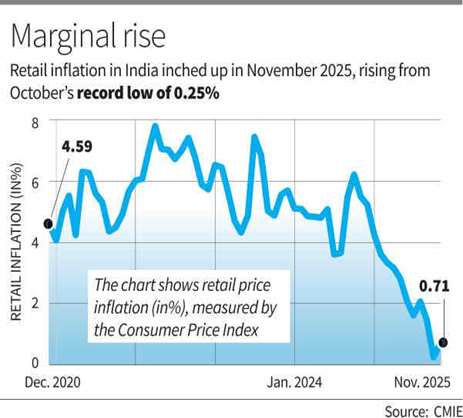
- Retail inflation in India quickened marginally to 0.7% in November 2025, up from the historic low of 0.25% in October 2025, with a continued contraction in food prices offsetting a marginal acceleration in fuel inflation. November’s inflation rate is the second-lowest ever recorded in the current series of the Consumer Price Index (CPI).
- Inflation as measured by the CPI, for which the latest data were released by the Ministry of Statistics and Programme Implementation on Friday, has slowed in seven of the first eight months of this financial year.
- The food and beverages category saw prices contract by 2.8% in November 2025, as compared to a high base of 8.2% in November of last year, and a contraction of 3.7% in October 2025.
- “The factors driving inflation downwards have been the same: base effect and decline in prices of vegetables and pulses,” Madan Sabnavis, chief economist at the Bank of Baroda said. “In particular, potatoes, onions and tomatoes have witnessed a decline, leading to food inflation falling by 3.9%. In the food basket, edible oils witnessed sharp increases though the topline number was down to 7.9%. Mustard and coconut oil were the main drivers of inflation here.”
- This contraction in food prices offset the impact of a quickening in fuel inflation to 2.3% in November 2025, compared to 2% in October, and a contraction of 1.8% in November of last year. Inflation in the pan, tobacco, and intoxicants category quickened marginally in November 2025 to 3% from 2.9% in October.
- The clothing and footwear category, on the other hand, saw inflation ease marginally to 1.5% from 1.7%.
- Inflation in the housing category remained virtually unchanged at 2.95% in November 2025 as compared to 2.96% in October.
- AI Centre of Excellence for Healthcare established at IISc
Context: The Translational AI for Networked Universal Healthcare (TANUH) Foundation has been established at the Indian Institute of Science (IISc) in Bengaluru as a dedicated AI Centre of Excellence in Healthcare to advance AI-driven healthcare innovation at scale in the country.
- This has been established in line with the government of India’s vision of ‘Make AI in India and Make AI Work for India’, and the Ministry of Education has set up four Centres of Excellence in Artificial Intelligence (AI-CoEs), each hosted by a premier academic institution in India, including IISc.
- The institute stated that the TANUH AI-CoE is a Section 8 not-for-profit company that focuses on developing and deploying scalable AI solutions for the effective management of non-communicable diseases (NCDs) at the point of care. The centre operates as a multidisciplinary hub, bringing together clinicians, data scientists, and AI researchers.
- Nine faculty members from IISc, spanning digital health, machine learning, and public health, anchor the centre’s research programmes. TANUH’s core team, comprising executives, engineers, programme managers, and research staff, with significant industry experience, enables the translation of health-AI technologies from the lab to the population scale.
- TANUH’s goal is to design and deploy tools for early detection, risk prediction, monitoring and personalised solutions across high-burden conditions such as oral cancer, breast cancer, retinal diseases, diabetes, and mental health. The tools will help frontline health workers, improve primary and hospital care, and include human decision-making to make sure the care is safe and effective. The solutions are designed to be used directly where patients are treated, follow responsible AI standards, and are created and tested together with doctors and researchers.
- About 31% of SCSP/TSP funds used for guarantee schemes since 2023
Context: Minister defends move stating Section 7(C) of the SCSP/TSP Act allows utilisation of the funds in tune with SC/ST population.
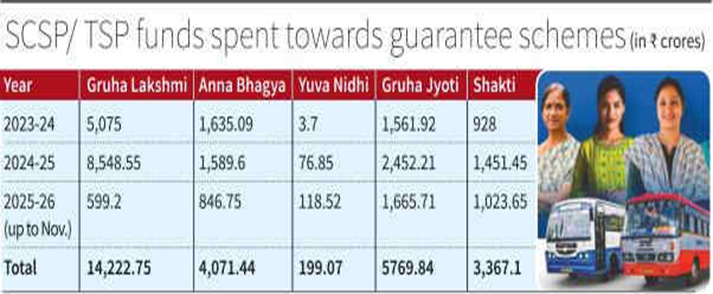
- The State government has used a significant share of the amount earmarked for the Scheduled Castes Sub Plan (SCSP) and Tribal Sub Plan (TSP) towards implementing the five guarantee schemes of the Congress government since 2023.
- According to statistics shared by Social Welfare Minister H.C. Mahadevappa, in response to a question by Hemalatha Nayak in the Legislative Council in Belagavi on Friday, of the total amount spent towards SCSP and TSP, as much as 31%, has been utilised for the guarantee schemes.
- The total amount for SCSP and TSP for the year 2023-24 was ₹35,221.8 crore, and of that, ₹34,369.85 crore was released, and finally, ₹34,245.76 crore was spent. In the year 2024-24, the total amount spent for SCSP and TSP was ₹38,717.74 crore. In the current year, up to November 2025, the government had spent ₹14,938.19 crore towards the SCSP and TSP.
- Since the Congress party came to power in 2023, the government has spent a total of ₹87,901.69 crore for SCSP and TSP. This amount includes ₹27,630.2 crore spent towards the guarantee schemes.
- The Minister, in his reply, defended the utilisation of SCSP/TSP funds for the guarantee schemes, stating that Section 7(C) of the SCSP/TSP Act allows utilisation of the funds in tune with the population of SC and ST.
- He stated that the amount utilised for guarantee schemes reached the beneficiaries of the SC and ST communities.
Bus travellers
- Interestingly, he stated that his department had sought information from the Transport Department about the number of SC and ST women who had benefited from the Shakti scheme, under which women passengers could travel free in KSRTC buses. Ms. Nayak, the MLC, wondered how the Transport Department could share the information of the SC/ST passengers, as they do not collect the caste details while issuing tickets.
- Leader of Opposition Chalavadi Narayanaswamy appealed to Chairman Basavaraj Horatti to allot suitable time for a detailed discussion on the issue.
- Civil society group flags concerns over Karnataka hate speech Bill
Context: A civil society organisation has urged the Karnataka government to subject the proposed Karnataka Hate Speech and Hate Crimes (Prevention) Bill, 2025, to wider public consultation before it is tabled in the Legislative Council. It has already been tabled in the Assembly.
- While welcoming the intent behind the legislation, Campaign Against Hate Speech, the organisation, said the Bill in its present form raises several concerns that warrant careful review.
- In a representation to the government, the group said the Bill marks an important acknowledgement of the harm hate speech and hate crimes inflict on constitutional values of fraternity and dignity. Stating that such acts disproportionately target women, minority and queer communities, they cautioned that the current version risks being ineffective and may leave scope for misuse.
- A key concern is the Bill’s definition of “hate crime”, which is limited to communication of hate speech. “This creates a false equivalence between speech and physical acts of violence, and fails to recognise offences such as mob lynching, punitive demolitions and social or economic boycotts. The Bill also provides no standalone punishment for hate speech, and relies on an emotion-based definition — an approach that has already led to weak enforcement under existing criminal laws,” the memorandum stated.
- The range of punishment for hate crimes was questioned for its lack of clarity, especially since the offence is non-bailable and cognisable. Sections granting broad “preventive” powers to the Executive Magistrate and police were flagged as potentially enabling arbitrary action, as the law does not define the scope of such powers or the due process requirements.
- Another point of concern, the group said, is the provision allowing a designated officer to block or remove online content construed as hate crime material even before trial.
- Emphasising that the Bill has far-reaching implications, the organisation cited the Supreme Court’s emphasis on meaningful public consultation and referred to the Centre’s 2014 Pre-Legislative Consultation Policy.
- Census 2027 to cost ₹11,718 crore, no separate budget earmarked for NPR
Context: The Union Cabinet on Friday approved the proposal for conducting Census of India 2027 at a cost of ₹11,718.24 crore, a government statement said.
- Unlike 2019, the statement does not mention a separate budgetary allocation for updating the National Population Register (NPR), which is the first step for the creation of a countrywide National Register of Citizens (NRC).
- In 2019, the Union Cabinet chaired by Prime Minister Narendra Modi approved ₹3,941.35 crore for updating the NPR and ₹8,754.23 crore for conducting the Census of India 2021, which could not be conducted due to the COVID-19 pandemic.
- NPR, which was first collected in 2010 and updated in 2015 and already has a database of 119 crore residents, was to be updated with the first phase of Census in 2020. On July 29, the government informed the Lok Sabha that no decision has been taken to update the NPR during the forthcoming Census exercise.
- Union Home Minister Amit Shah posted on X, “The outcome of the Census 2027 will serve as the new compass for development, mirroring India’s latest population data with more accuracy. The precision in data will accelerate Modi Ji’s vision of delivering the benefits of good governance and development to citizens of every demographic denomination, making the slogan of ‘Sabka Saath, Sabka Vikas’ a grand reality of New India in the Amrit Kaal.”
- The government’s statement on Friday said that the “largest administrative and statistical exercise in the world” will ensure that data are provided to Ministries in a “clean, machine-readable and actionable format” as part of the “Census-as-a-Service (CaaS)” initiative.
- This will be the first digital Census and the first to enumerate caste in independent India. “The current endeavour would be to make available the coming Census data at the shortest possible time across the country. Efforts will also be made to disseminate Census results with more customised visualisation tools,” the statement said.
- The government said that a nearly 18,600-strong technical workforce will be engaged for about 550 days at the local level.
- “The enumerators, generally government teachers and appointed by the State governments, will be doing the field work of Census in addition to their regular duties,” it said.
- Data will be collected using mobile applications and a dedicated portal, namely Census Management and Monitoring System, has been developed for monitoring the Census process in real time.
- Framework to fight fake news has been made strong: Minister
Context: The government has strengthened the framework to combat fake news and deepfakes across media platforms, Union Minister for Information and Broadcasting Ashwini Vaishnaw said in the Rajya Sabha.
- In response to the questions asked by Mohammed Nadimul Haque (Trinamool Congress), the Union Minister said free speech is protected under Article 19(1) of the Constitution.
- “The government is cognisant of the increasing instances of fake, false, misleading information, and AI-generated deepfakes across media platforms, which can adversely impact democratic processes and public order,” said the reply.
Statutory framework
- A broad statutory and institutional framework already exists to address fake news across various media platforms, the Minister said.
- TV channels follow the Programme Code under the Cable Television Networks (Regulation) Act, which prohibits content that is obscene, defamatory, deliberately false, or that contains suggestive innuendos and half-truths.
- The rules framed under the Act establish a three-tier grievance redressal mechanism to address violations.
- For the print media, Norms of Journalistic Conduct issued by the Press Council of India restrain the publication of fake, defamatory, or misleading news. It can inquire into alleged violations of the norms, examine complaints, and issue warnings.
- There is Code of Ethics under Information Technology Rules 2021 for publishers of news and current affairs on digital media.
- The Fact Check Unit (FCU) has been set up under the Press Information Bureau to check fake news related to the government.
- Govt. likely to rename MGNREGS to ‘Pujya Bapu Gramin Rozgar Yojana’
Context: The government is likely to introduce a Bill in the ongoing Winter session of Parliament amending the Mahatma Gandhi National Rural Employment Guarantee Act (MGNREGA), changing the name of the flagship rural employment scheme to “Pujya Bapu Gramin Rozgar Yojana”.
- According to senior government functionaries, the amended Bill was cleared by the Union Cabinet in its meeting.
- There was no official announcement on the proposal at the Cabinet briefing addressed by Union Minister Ashwini Vaishnaw.
- The original Bill passed by Parliament on August 25, 2005, was called the “National Rural Employment Guarantee Act”. The suffix “Mahatma Gandhi” was added in 2009.
- The flagship scheme guarantees up to 100 days of wage employment in every financial year to every household whose adult members volunteer to do unskilled manual work. The sources also indicated that the government plans to increase this to 125 days.
- As per a written answer by the Minister of State for Rural Development Kamlesh Paswan on Friday in the Rajya Sabha, the average number of days of employment per household during the past five years comes to 50.35 days. He also noted that the scheme was a “fallback option when no better employment opportunity is available”.
- In 2022, the government had appointed a panel headed by former Union Rural Development Secretary Amarjeet Sinha to review the scheme, especially the inter-State variations, and lower expenditure under the scheme in States with higher poverty rates.
- The amended Bill is likely to take into account the panel’s recommendation, introducing exclusionary clauses based on economic indices of a State.
- The government is also likely to tweak the scheme’s funding pattern.
- RS resolution seeks free, compulsory early childhood care
Context: The Rajya Sabha discussed a private member’s resolution moved by nominated member Sudha Murty urging the Union government to consider steps to amend the Constitution to introduce a new Article 21B guaranteeing free and compulsory early childhood care and education (ECCE), including nutrition, health services, and pre-primary learning, for all children between three and six years of age.
- The resolution also sought universal access to quality ECCE through strengthened Anganwadi services and asked the government to focus on ECCE for its central role in securing strong foundations for lifelong learning and development.
- “Children are our future. They are the rising Sun. Their early education should benefit their life. Hence I request through you sir, to our government to consider amending our Constitution to give fundamental right to education from three to 14 years,” Ms. Murty said.
- UNEA adopts India’s proposal on wildfire management
Context: India’s push for a stronger global system to manage and prevent wildfires — centred on early-warning mechanisms and improved risk assessments — was formally adopted at the United Nations Environment Assembly (UNEA-7) in Nairobi, the Environment Ministry said in a statement.
- India’s resolution, titled “Strengthening the Global Management of Wildfires,” calls for a shift from reactive firefighting to proactive prevention. Officials said these measures are essential to address what India called the “cascading ecological, economic and social impacts” of today’s fires.
- ‘Cover doctors deputed for COVID-19 duty under PMGKY’
Context: The Supreme Court observed that the nation must not forget the unwavering sacrifice and heroism of doctors and health workers during the pandemic days while holding that the Pradhan Mantri Garib Kalyan Yojna (PMGKY) insurance package benefits would apply to public and private medical professionals drafted into COVID-19 duties, only to lose their lives in service.
- The Indian Medical Association’s COVID-19 registry records 748 doctors’ deaths in the first wave and hundreds more in subsequent waves.
- The PMGKY package offered a comprehensive personal accident cover of ₹50 lakh for 90 days to a total of around 22.12 lakh public healthcare providers, including community health workers, who were in direct contact and care of COVID-19 patients.
- The verdict came in a petition filed on the death of a doctor who ran a private clinic in Maharashtra. Dr. B.S. Surgade’s wife claimed his services were requisitioned by the government to keep his clinic open during the pandemic. She said he had fatally contracted the virus from his patients.
- ‘PF contributions on wages beyond ₹15,000 voluntary’
Context: The Union Labour and Employment Ministry has clarified that contributions by employers and employees to the Provident Fund in excess of the statutory monthly wage ceiling of ₹15,000 are voluntary, after the Code on Social Security and three other codes came into force on November 21.
- The Code on Social Security replaces the Employees’ Provident Funds and Miscellaneous Provisions Act, 1952 and eight other laws. Similarly, 20 separate laws are subsumed into the other three codes — Code on Wages; Industrial Relations Code, and the Occupational Safety, Health and Working Conditions Code.
- In a post on social media platform X on Wednesday, the Ministry made it clear that “there is no legal requirement” for the contributions made over and above the wage ceiling. “In case the employer and the employee agree, they can voluntarily contribute on wages more than the statutory limit of ₹15,000.”
- It emphasised that there would be no reduction in take-home pay in the light of enforcement of the four codes. The Ministry gave an illustration to substantiate its position.
- Since September 2014, the present limit has been in force. It was against this backdrop that early this month, Kerala MPs Benny Behanan and Dean Kuriakose raised a question in the Lok Sabha whether the ceiling would be increased to ₹30,000.
- Union Labour Minister Mansukh Mandaviya replied that “raising the wage ceiling for coverage under EPFO [Employees’ Provident Fund Organisation] is done based on extensive stakeholders’ consultations, including trade unions and industry associations, as the same will have impact on the take-home salary of employees and on the hiring cost for employers.”
- Centre increases minimum support price for copra
- The Cabinet Committee on Economic Affairs (CCEA), here on Friday, decided to increase the Minimum Support Price (MSP) for copra for the 2026 market season.
- The MSP for fair average quality of milling copra has been fixed at ₹12,027 per quintal and for ball copra at ₹12,500 per quintal.
- The new rate is an increase of ₹445 per quintal for milling copra and ₹400 per quintal for ball copra over the previous season.
- India offers ‘final’ deal to U.S., but tariff removal is focus
Context: Offers ‘immediate’ removal of tariffs on import of items like walnutsand apples, but prioritises removal of 25% tariffs linked to Russian oil.
- India has offered the U.S. a revised “final” deal, but its priority now is the removal of the additional 25% tariffs linked to Russian oil, two different sources have confirmed .
- As per the latest submission, India has offered to “immediately” remove tariffs on the import of items like walnuts, almonds, apples, and industrial goods. However, these would be part of a larger Bilateral Trade Agreement, while India right now is focussing on the removal of the 25% tariffs. A U.S. team led by Deputy U.S. Trade Representative Rick Switzer was in New Delhi for two days until December 12.
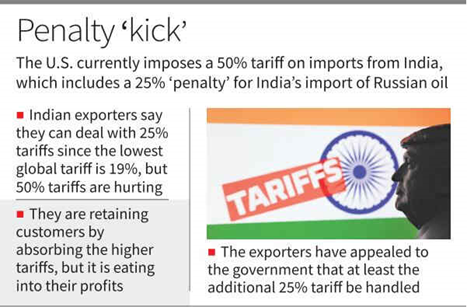
- The U.S. currently imposes a 50% tariff on imports from India, including a 25% reciprocal tariff and a 25% ‘penalty’ for India’s import of Russian oil.
- “India has offered the U.S. team a revised deal,” an official in the Government of India aware of the latest developments in the trade deal told The Hindu on the condition of anonymity given the sensitivity of the issue. “This is the final offer that India can make.”
- “The focus now is on removing the 25% Russian oil tariffs,” the official explained. “Indian exporters have told the government that they can deal with 25% tariffs since the lowest global tariff is 19%, but 50% tariffs are hurting.” Two days ago, U.S. Trade Representative Jamieson Greer, while testifying before the U.S. Senate Appropriations Committee, said that India was a “tough nut to crack”, but that the offers it has made to the U.S. were the “best we’ve ever received as a country”.
- According to a second official, Indian exporters are currently retaining customers by absorbing the higher tariffs as they feel that this is cheaper and easier than losing customers and then trying to reacquire them later. But this is eating into their profits.
- “They have appealed very sincerely to the government that at least the additional 25% tariff be handled and so the government is pushing for that,” the second official said.
- The latest version of India’s offer to the U.S. includes an offer to “immediately” remove tariffs on the import of tree nuts such as almonds and walnuts, apples, industrial goods, and items such as luxury motorcycles in return for the U.S. removing the additional 25% tariff.
- “The two teams of negotiators have broadly done what they can, the ball is in Trump’s court to accept the deal or not,” the second official said.
- This is confirmed by the fact that Commerce Minister Piyush Goyal on Thursday told reporters in Mumbai that Mr. Switzer’s visit was not “centred around negotiations”.
- A previous analysis of government trade data by The Hindu found that India has been cutting back on its Russian oil imports well before the U.S. imposed its penalty tariffs in August.
- ‘Nuclear, insurance opened up’
- India’s Cabinet approved sweeping changes to atomic energy laws and fully opened insurance sector to foreign investors, two government sources said, in a bid to attract billions of dollars in these two critical sectors.
- India, which plans to expand nuclear power capacity 12-fold by 2047, is relaxing rules to end a decades-old State monopoly and overcome a stringent liability provision to allow private participation and attract foreign technology. In insurance, the government proposed removing the 74% cap on foreign ownership of Indian insurers.
- Union Cabinet allows export of coal
Context: Paving the way for further coal exports, the Union Cabinet approved a policy allowing coal acquired through auctioning to be utilised for any industrial use and export.
- The current policy allows coal to be used only for cement, steel, sponge, iron and aluminium, etc. via auctions.
- Effectively, the Policy for Auction of Coal Linkage for Seamless, Efficient and Transparent Utilisation of coal (CoalSETU) would now allow guaranteed supply deals (coal linkages) obtained via auctions to be used for captive consumption, export, or any other purpose (including coal washing), except for resale in India. Those securing coal linkages would be allowed to use it via the window among subsidiaries or group firms.
- In FY25, India produced 1.05 billion tonne of coal.
- Technical textile missionlikely to be extended
Context: The National Technical Textiles Mission (NTTM) introduced by the Ministry of Textiles in 2020 with ₹1,480 crore in total funding, ending in March 2026 will likely be extended by two years.
- An official said with almost 50% of the funds used so far, the Mission is expected to be extended by two years. The Mission has four components — research, innovation and development; market development, export promotion and education and training.
- India frees up business visas for Chinese professionals in major step to boost ties
Context: India has cut red tape to speed business visas for Chinese professionals, two officials said, a major step to boost ties between the Asian giants and end chronic delays that cost output worth billions of dollars because of scarce technicians.
- As Prime Minister Narendra Modi cautiously rekindles ties with Beijing in the face of punishing U.S. tariffs, the officials said New Delhi dropped a layer of bureaucratic scrutiny and shortened visa approval times to less than a month.
- India had blocked virtually all Chinese visits after the nuclear-armed neighbours clashed on their Himalayan frontier in mid-2020, widening its vetting of business visas beyond the home and foreign ministries.
- Following the news, China’s Foreign Ministry said it had noticed “positive action” from India to facilitate people-to-people exchanges in the common interest. “China is willing to maintain communication and consultation with India to continuously enhance the level of facilitation of exchanges,” Ministry spokesperson Guo Jiakun added.
- The removal of red tape comes after Mr. Modi visited China this year for the first time in seven years.