- Panel on prison security fifth in decade
Context: Most of the recommendations of previous four committees have not been implemented; Hitendra Committee, the latest, was formed.
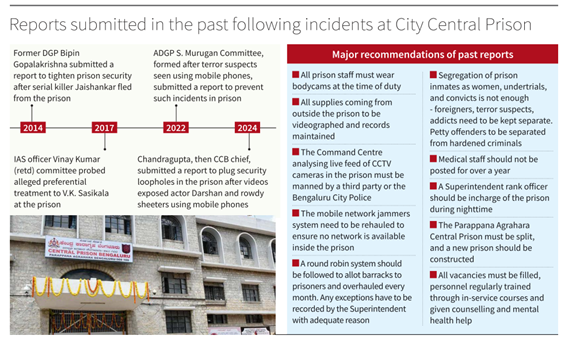
- In just over a decade, the Karnataka government has formed five committees to recommend measures to tighten security at the Parappana Agrahara Central Prison- four under the Congress regime and one under the Bharatiya Janata Party (BJP) regime.
- The latest was formed, led by R. Hitendra, Additional Director General of Police (Law and Order). Just like the previous four times, this committee was also formed in response to a recent expose of inmates at the prison having access to television, mobile phones, and alcohol, even as most of the recommendations made by the previous four committees are gathering dust.
- “The State government has been indulging in a knee-jerk reaction every time there is an expose of inmates accessing some banned items. Most of these committees have only bought time and created an impression that action was being taken, without addressing basic issues in the prison like overcrowding, large vacancies, removing subjectivity from processes in the prison, which most of these reports have flagged,” said a senior official, who did not wish to be named.
‘Fence eating the crop’
- “The problem at the prison is mostly a case of collusion of officers, fence eating the crop. Suspensions of lower rank officers won’t help. In bad cases, officers need to be sternly dealt with, including dismissals from service, to instill discipline in the rest. We need to send prison staff for regular in-service training, which is a rarity now,” a senior officer said.
- However, he said that the persistent problems of overcrowding at the Parappana Agrahara Central Prison and large-scale vacancies, nearly 40%, which are the fundamental issues, remain unaddressed. Splitting the jail and building a new jail was an absolute necessity, another officer said.
- One of the major recommendations of all the four committees has been to work towards removing subjectivity from various processes in the prison.
- For instance, two reports have recommended that the number of CCTV cameras in the prison should not only be increased, but the command centre analysing this live feed must be manned by a third party agency and not the Department of Prisons and Correctional Services. In fact, one report has suggested that the feed from the prison’s command centre be linked to the Bengaluru City Police’s Command Centre for a live review. Home Minister G. Parameshwara on Monday ordered such a Command Centre to be set up in the prison in the next two weeks, but there was no clarity on who would monitor the live feed and raise alarms over violations.
Use of bodycams
- One of the committee reports has recommended that all prison personnel – from a sentry to the jail superintendent – must mandatorily be made to wear bodycams, but it has not been implemented yet.
- The reports have recommended that any supply of food or other material coming from outside should be thoroughly checked, videographed, and then only sent in. This was also not being followed thoroughly, sources said.
- This was often the channel for contraband to enter the prison, the sources said. At least two committee reports have recommended that separation of inmates is a must.
Allocation of barracks
- Moreover, subjectivity needs to be removed in even allotment of barracks. A round robin system should be followed to allot barracks and every month the system needs to be overhauled again, one of the reports recommends.
- One of the reports said that medical officers should not be posted at the prison for over a year.
- Most of the illegal activities happen during night time, and no senior prison staff are usually present. A recent report has recommended that a superintendent rank officer should be on duty in the prison during night time so that there is accountability.
- CM inaugurates Kalaloka store at KIA
Context: The Kalaloka store, which will showcase and sell Karnataka’s traditional and GI-certified products to both domestic and international travellers at the Kempegowda International Airport (KIA), was inaugurated by Chief Minister Siddaramaiah.
- The Kalaloka store, which has been aesthetically designed to reflect the State’s culture and heritage, has been set up by the Department of Industries at the Terminal 2.
- “This is a moment of joy in the industrial map of Karnataka. The KIA ranks third in the country in terms of passenger traffic.
- The Kalaloka store has been established to give visitors an immediate glimpse of Karnataka’s pride and cultural essence as soon as they arrive. Through this initiative, our State’s distinguished products will receive global recognition, branding, and market reach,” the Chief Minister said.
- Minister for Large and Medium Industries M.B. Patil said that the Kalaloka store, located near Terminal 2, features Karnataka’s traditional products such as Mysore Sandal Soap, sandalwood oil, incense sticks, Mysuru Silk, Channapatna toys, LIDKAR leather goods, aromatic coffee powders and beverages, handloom products, Ilkal sarees, Lambani garments, sandalwood artefacts, Bidriware, and Mysore-style paintings.
- “In total, 45 GI-certified products from Karnataka will be showcased and sold here,” he said.
- ISRO conducts crucial safety tests on main parachutes for Gaganyaan crew
Context: The Indian Space Research Organisation (ISRO) recently conducted an important test on main parachutes for the Gaganyaan Crew Module.
- The test was conducted at the Babina Field Firing Range (BFFR) in Uttar Pradesh’s Jhansi on November 3 as part of the ongoing series of Integrated Main Parachute Airdrop Tests (IMAT) for the qualification of parachute system for Gaganyaan mission.
- For the Gaganyaan Crew Module, the parachute system comprises a total of 10 parachutes of four types. The descent sequence begins with two apex cover separation parachutes that remove the protective cover of the parachute compartment, followed by two drogue parachutes that stabilise and decelerate the module.
- “Upon release of the drogues, three pilot parachutes are deployed to extract three main parachutes, which further slow down the Crew Module to ensure a safe touchdown. The system is designed with redundancy — two of the three main parachutes are sufficient to achieve a safe landing,” the space agency said.
- The main parachutes of the Gaganyaan mission deploy through a step-by-step process known as reefed inflation. “In this process, the parachute first opens partially, which is called reefing, and then fully opens after a predetermined period of time, known as disreefing.
- This process is carried out using a pyro device,” it added. In the recent test, ISRO demonstrated one of the extreme scenarios — delay in the disreefing between the two main parachutes successfully, thereby validating the system for its maximum design conditions.
- The test evaluated the system’s structural integrity and load distribution under asymmetric disreefing conditions, which is one of the most critical load scenarios expected during actual mission descent.
- A simulated mass equivalent to the Crew Module was dropped from an altitude of 2.5 km using the Indian Air Force’s IL-76 aircraft. The parachute system deployed as planned and the sequence was executed flawlessly, and the test article achieved a stable descent and soft landing, validating the robustness of the parachute design.
- State ranks fourth in country in terms of adoption numbers
Context: Maharashtra tops the list; despite growing interest, Karnataka faces a shortage of adoptable children.
- Karnataka ranks fourth in the country in terms of adoption numbers, following Maharashtra, Tamil Nadu, and West Bengal, according to data shared by officials from the Directorate of Child Protection.
- While 306 children were adopted in 2024–25, and 190 so far in 2025–26, officials said the State faces a shortage of legally adoptable children despite a steady rise in the number of prospective parents.
- Data showed that Maharashtra recorded the highest number of adoptions in 2024–25 at around 800, followed by Tamil Nadu (600), West Bengal (315), and Karnataka (306). From 2020–21 up to October 2025–26, Karnataka has facilitated 1,540 adoptions, including 1,385 in-country and 155 inter-country, through 45 specialised adoption agencies — 21 government-run and 24 privately managed.
Year-wise
- Karnataka recorded 256 adoptions in 2020–21, including 223 in-country and 33 inter-country adoptions. The number rose to 281 in 2021–22, with 239 domestic and 42 inter-country adoptions.
- In 2022–23, the State saw a dip with 223 adoptions — 188 in-country and 35 inter-country — but the trend picked up in 2023–24, when 284 children were adopted, including 263 within India and 21 abroad.
- The highest number of adoptions in recent years was recorded in 2024–25, with 306 children finding families — 293 in-country and 13 inter-country. In the ongoing financial year 2025–26, up to October, 190 children have been adopted so far, including 179 in-country and 11 inter-country adoptions.
- Arundathi T.S., Deputy Director (State Adoption Resource Agency – SARA), Directorate of Child Protection, that 2,271 registered prospective adoptive parents are waiting for adoption as of November 11, 2025. “However, only 79 children are currently available for adoption. Of these, 55 are children with special needs and 29 are normal,” she said.
- “Many children who are otherwise eligible (orphans, abandoned or surrendered) cannot be placed for adoption because their legal guardians are unwilling to give consent. When we approach them for consent, they refuse stating that they will take them away once they turn 18,” she said.
- The official attributed the low availability of adoptable children to successful efforts to trace families. “When infants below two are abandoned, efforts are made to trace parents within two months, while for older children the tracing period extends to four months,” she said.
- Children surrendered by parents are given a 60-day window for reclamation, after which the adoption process can proceed. A majority of these cases involve unwed mothers and teenage pregnancies, including those registered under the POCSO Act, she pointed out.
- The adoption process has become more transparent and accountable after being brought online under Mission Vatsalya. Aadhaar enrolment is being done for children entering the adoption system to ensure identification and safety, the official said.
Bengaluru Urban
- In Bengaluru Urban district, which has six recognised adoption agencies, 283 children have been adopted in the last five years — 265 within India and 18 inter-country. This year alone, 36 children have been legally adopted.
- The District Child Protection Unit (East Division), established in June 2022, oversees two agencies — Shishu Mandir and St. Michael Home. Since its inception, 142 children have been adopted under its jurisdiction, including seven inter-country adoptions. Two inter-country adoptions from St. Michael Home are currently under process, officials said.
- Don’t use COP30 to change Paris deal ‘architecture’: India
Context: Country says the parties ‘must remain committed to and guided by equity’; it urges the Brazil COP Presidency to make a special call to the Parties to submit their National Adaptation Plan.
COP 30
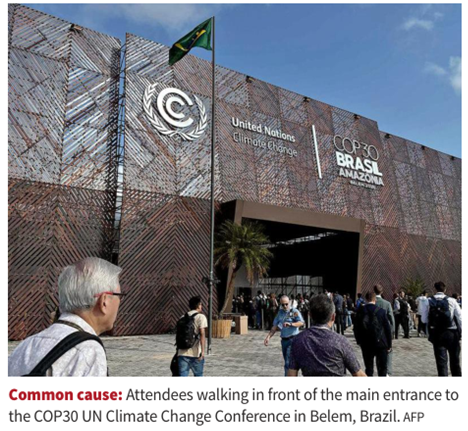
- India made its opening statement at COP30 in Belem, Brazil, underlining that the climate conference ought to be stressing “adaptation”, and the 10th anniversary of the Paris Agreement, signed in 2015, should not be used to “change the architecture” of that consensus.
- This “architecture” refers to the agreed-upon principle of “common but differentiated responsibilities (CBDR)”, which means that all countries must do their bit to curb fossil fuel emissions but without compromising on national economic-development priorities.
Dwindling finance
- With the withdrawal of the United States from the Paris Agreement and developed countries agreeing to mobilise only $300 billion — and not the demanded $1.35 trillion annually — by 2035 as “climate finance” (to cope with unfolding climate disasters as well as move away from fossil fuels), developing countries, including India, saw this as a reneging on agreed commitments.
- “We must remain committed to and guided by equity and common but differentiated responsibilities. The cornerstone principles of the Convention and its Paris Agreement signed all of us to the CBDR in Brazil back in 1992. We must reaffirm our strongest commitment to the principles here, not attempt to sideline and ignore them,” India delegation member Suman Chandra said as part of a collective of Like-Minded Developing Countries (LMDC).
- “Over the next two weeks, we must stay true to the cause and advance adaptation, which is among the most important issues for us. The [Brazil COP] Presidency must make a special call to the Parties to submit their National Adaptation Plan in line with national priorities and progress,” she added.
- The LMDC is a large collective that represents nearly half of the world’s population, and consists of China, India, Pakistan, Indonesia, Bangladesh, Cuba, Egypt and several others.
- India is yet to submit its National Adaptation Plan and the updated Nationally Determined Contribution, which specifies steps to curb fossil fuel emission by 2035, to the United Nations.
- “We are not here to point fingers, but the facts speak for themselves. We cannot simply bypass the roadblocks and the impediments to implementation,” Ms. Chandra added.
- “Developed countries need to reach net zero much earlier than projected. They should invest significantly more in negative emission technologies,” Tanmay Kumar, Secretary, Environment Ministry and part of the India delegation, said on behalf of a joint statement by another grouping called BASIC (Brazil India China South Africa).
- The LMDC had pushed for including a discussion on the responsibility of developed countries on the COP30 agenda but in the larger spirit of “consensus” was moved to a separate negotiating track by COP30 President André Corrêa do Lago.
- SC judge: imported ideas may not save endangered species
Context: Supreme Court judge Justice P.S. Narasimha said many environmental law principles imported from the West such as “inter-generational equity” are anthropocentric and would hardly be of any assistance in protecting an endangered species from extinction.
Great Indian Bustard
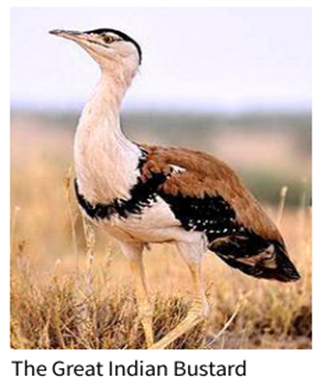
- Justice Narasimha made these oral observations while hearing a petition filed by M.K. Ranjitsinh on the conservation of the dying species of the Great Indian Bustard, which is being bred in captivity, and the Lesser Florican.
- Senior advocate Shyam Divan, appearing for the petitioner, said there were 70 bustards in captivity and 150 in the wild. Lesser Floricans number 70.
- “That is all… Captive breeding may be successful with the Great Indian Bustard, but it is not showing success with the Lesser Florican. Extinction is not an option for these two species,” he said.
‘Biblical roots’
- Justice Narasimha said principles such as inter-generational equity had “Biblical” roots, with humans at the top.
- The judge referred to how, 13 years ago, a amicus curiae in the red sanders conservation case, had urged the Supreme Court to consider the “intrinsic worth” of an endangered species rather than its “instrumental value to human beings”.
- He criticised principles such as inter-generational equity which “pre-supposes the higher needs of human beings and lays down that exploitation of natural resources must be equitably distributed between the present and future generation”. The judge said the court, in its judgment in the red sanders case, had accepted his submissions on the need to take an ecocentric approach, which “obliges every citizen to have compassion for all living creatures”, in biodiversity law.
- Net direct tax collections grow 7% as refunds fall sharply
Context: Net direct tax collections grew by 7% in this financial year up to November 10, largely driven by a significant contraction in the refunds paid out by the Income Tax Department during this period, official data shows.
- The direct tax collections data, released by the Income Tax Department on Tuesday, shows that gross collections grew 2.15% to ₹15.35 lakh crore in this financial year up to November 11.
- Within this, gross corporate tax collections grew 4.6% to ₹ 6.9 lakh crore. Gross non-corporate tax — which includes personal income tax — grew 0.5% during this period to ₹ 8.1 lakh crore.
- “The data shows that, remarkably, non-corporate tax collections have kept pace in spite of the very significant rate cut last year,” Rohinton Sidhwa, Partner at Deloitte India said.
- “This is a very good sign showing stronger growth of income levels.” Total refunds were 17.7% lower this year than in the corresponding period of last year.
- According to Mr. Sidhwa, the fact that refunds have fallen significantly could either mean that cash paying tax payers are no longer in the tax net or that the government has “consciously throttled back” on refunds.
- As a result of the drop in refunds, net collections grew 7% to ₹12.9 lakh crore in this financial year up to November 11.