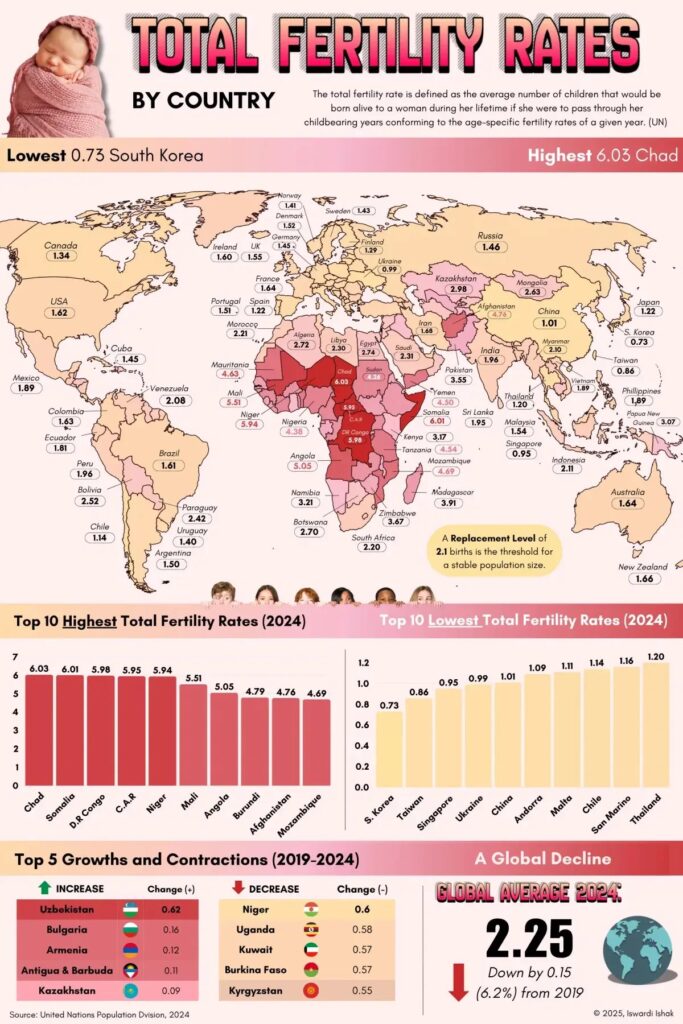
Africa has the highest fertility, and parts of East Asia see some of the lowest birth rates.Developed countries are almost all below replacement level (2.1 births per woman), with one notable exception: Israel.Fertility rates are dropping across the world.Between 2019 and 2024, there were only 12 countries that saw fertility rates grow—meanwhile rates declined or stayed the same in 185 countries.Total fertility rate is defined as the average number of children that would be born alive to a woman during her lifetime if she were to pass through her childbearing years conforming to the age-specific fertility rates of a given year.The eight highest ranking countries in terms of fertility are all found in Africa, with the top three being Chad (6.03), Somalia (6.01), and the DRC (5.98). Even so, these countries have seen meaningful five-year drops in their rates, averaging around a 0.4 decrease in births per woman.At the bottom of the rankings, we have four Asian jurisdictions: Taiwan (0.86), South Korea (0.73), Hong Kong (0.73), and Macau (0.68).Mapped: Every Country by Total Fertility RatePublished 17 hours ago on December 22, 2025By Iswardi Ishak green checkmark icon Featured
Fertility rates are falling almost universally; however, there are a handful of outliers that have seen rates increase slightly in the last five years.As a general rule: Africa has the highest fertility, and parts of East Asia see some of the lowest birth rates.Developed countries are almost all below replacement level (2.1 births per woman), with one notable exception: Israel.Fertility rates are dropping across the world.Between 2019 and 2024, there were only 12 countries that saw fertility rates grow—meanwhile rates declined or stayed the same in 185 countries.This map visualization by Idwardi Ishak uses data from the United Nations to show the total fertility rate for countries and other notable jurisdictions globally.
Total fertility rate is defined as the average number of children that would be born alive to a woman during her lifetime if she were to pass through her childbearing years conforming to the age-specific fertility rates of a given year.Total Fertility Rate Data by CountryThe below table shows the total fertility rate for each jurisdiction using data from 2019 and 2024, while also highlighting the five-year change between the years.
The eight highest ranking countries in terms of fertility are all found in Africa, with the top three being Chad (6.03), Somalia (6.01), and the DRC (5.98). Even so, these countries have seen meaningful five-year drops in their rates, averaging around a 0.4 decrease in births per woman.At the bottom of the rankings, we have four Asian jurisdictions: Taiwan (0.86), South Korea (0.73), Hong Kong (0.73), and Macau (0.68).Where Fertility is Falling the FastestFertility is falling fastest in a mix of very different regions, highlighting how universal the shift has become.Some of the sharpest declines since 2019 are in Africa, including Niger and Uganda, where fertility remains high but is dropping rapidly as urbanization and education expand.East Asia continues to see steep declines from already low levels, with China, South Korea, Hong Kong, and Macau pushing deeper into ultra-low fertility. Meanwhile, parts of the Middle East (such as Kuwait) and Eastern Europe (including Lithuania) have also seen rapid drops, driven by economic pressure, delayed family formation, and migration.The Developed World: One Big OutlierIn the developed countries, almost all places are now well below the replacement rate threshold.That said, Israel remains as the one big outlier. In 2024, the country had a fertility rate of 2.79 children per woman.This is largely because having children is strongly supported both culturally and institutionally in Israel, across income and education levels. Further, high fertility is reinforced by generous family policies, widespread childcare support, and strong social norms, including large families among religious communities.Source: https://www.visualcapitalist.com/cp/mapped-countries-by-fertility-rate/