Context: A day after Kerala Chief Minister Pinarayi Vijayan sought to allay fears of Kannada linguistic minority in Kerala about the Malayalam Bhasha Bill 2025, the Karnataka Border Area Development Authority (KBADA) has said that the Bill should explicitly exempt linguistic minority areas (parts of Kasaragod district) in the mandatory Malayalam first language clause — allowing Kannada to remain the first language, and also remove the inherent contradictions in the Bill.
- While Mr. Vijayan pointed out provisions in Clause 7 of the Bill to allay fears of the Kannada-speaking population, the authority pointed out contradictions in the provisions that was also leading to confusion.
- The assessment of the Karnataka government was that under the proposed legislation, those studying in Kannada medium would also need to study Malayalam as a compulsory subject/first language, affecting those who are unfamiliar with that language.
Academic performance
- It could affect the academic performance adversely and Kannada’s primacy would also get eroded over time. It may disrupt existing set-ups where Kannada was the first language, sources aware of the assessment said.
- This comes amidst concerns aired by Karnataka Chief Minister Siddaramaiah over the adverse effects of the Bill on the Kannada-speaking population in Kerala.
- The sources said that the Kerala government through the Bill should accelerate declaration of specific taluks in Kasaragod district as minority areas under the Bill and secure full benefit of Clause 7 in it that provided for bilingual signboards and teachers’ appointments in Kannada, among others.
- The authority chairman Somanna Bevinamarad is learnt to have echoed similar sentiments.
- An estimate puts the Kannada-speaking people in Kasargod to be more than 70% of the population.
Contradictions
- According to Prakash Matthihalli, secretary of the authority, despite protections in Clause 7 (special provisions regarding linguistic minorities) in the Bill, there were contradictions and difficulties in implementation.
- He said that while Clause 6(1) mandated Malayalam as the compulsory first language in all government and aided schools in Kerala up to 10th standard, Clause 7(1) provided for communication of all letters and transactions in local offices in the local language.
- “However, as per Clause 7(2) students whose mother tongue is any language other than Malayalam may pursue their studies in the languages of their choice that are available in the schools. When the second language English is compulsory in national education curriculum in Kerala, how can a student opt Kannada as first language when Clause 6(1) says Malayalam is mandatory across the State?”
- Further, Clause 7(3) that spoke of students from other States and foreign countries whose mother tongue was not Malayalam, provided for exemption only in 9th and 10th standards. “Clause 7 should explicitly specify the exemption to linguistic minorities areas.”
- Mr. Matthihalli said the Karnataka government had no problem with the Bill if the ambiguities in the provisions were cleared and it exempted the Kannada-speaking regions.
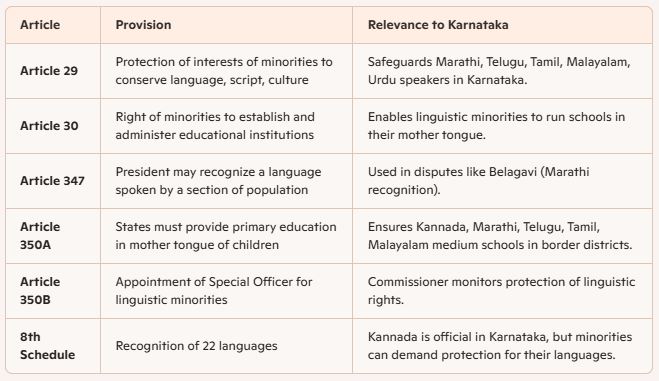
Karnataka’s border districts host significant linguistic minorities such as Marathi speakers in Belagavi, Telugu in Ballari and Raichur, Tamil in Bengaluru and Kolar, Malayalam in Kodagu, and Urdu across urban centers. The Indian Constitution protects these communities under Articles 29 and 30 (cultural and educational rights), Article 347 (recognition of languages), and Article 350A & 350B (instruction in mother tongue and linguistic minority commissioner).
🗣️ Linguistic Minorities in Karnataka
📍 Border Districts & Communities
| District(s) | Linguistic Minority | Notes & Context |
| Belagavi, Bidar, Kalaburagi (Gulbarga) | Marathi | Deep historical ties with the Maratha Empire and Maharashtra; Belagavi is a major focal point of a long-standing border dispute. |
| Ballari, Raichur, Koppal | Telugu | Driven by geographical proximity to Andhra Pradesh and Telangana; strong cultural and trade links. |
| Bengaluru Urban, Kolar, Chamarajanagar | Tamil | Significant population due to historical migration (e.g., KGF workers) and border proximity to Tamil Nadu. |
| Kodagu, Dakshina Kannada | Malayalam | Common in areas bordering Kerala. Kasaragod (Kerala) also has a reciprocal Kannada minority, leading to ongoing language right discussions. |
| Urban centers (Bengaluru, Mysuru, Kalaburagi) | Urdu | A significant minority, particularly in cities with Deccan Sultanate history. In some taluks, Urdu speakers exceed 15% of the population. |
| Northern Karnataka (Vijayapura, Bidar) | Hindi / Lambani | Often includes migrant traders and workers; also includes the Lambani (Banjara) community, which is sometimes classified under Hindi in census data. |
| Coastal Karnataka (Udupi, Dakshina Kannada) | Tulu & Konkani | While native to Karnataka, these are distinct linguistic minorities with their own unique scripts and cultural academies. |
📜 Constitutional Provisions for Linguistic Minorities
⚖️ Current Issues
Belagavi Dispute: Maharashtra claims Marathi-speaking areas; Karnataka asserts Kannada primacy.
Kasaragod Issue: Kerala’s Malayalam Bhasha Bill 2025 raised fears of marginalization of Kannada minorities in Kasaragod.
Education Rights: Linguistic minorities demand mother-tongue instruction in border schools.