Current Events of National and International Importance
₹9,072 cr. for three railway projects for various States
Context: The Cabinet Committee on Economic Affairs, chaired by Prime Minister Narendra Modi, approved three multi-tracking railway projects at a cost of ₹9,072 crore.
- The projects include the construction of a second line on the Gondia (Maharashtra)-Jabalpur (Madhya Pradesh) section and the addition of third and fourth lines between Punarakh and Kiul in Bihar, and between Gamharia and Chandil in Jharkhand.
- Spanning a total length of 307 km, the three projects are aimed at decongesting these busy sections. The proposed works are expected to enhance connectivity to nearly 5,407 villages, and improve rail connectivity to several prominent tourist destinations, including Kachnar Shiv Temple, Kanha National Park (Balaghat), and Pench National Park, among others.
- According to the Ministry of Road Transport and Highways, the projects are being undertaken under the PM-Gati Shakti National Master Plan and aims to enhance multi-modal connectivity and logistics efficiency through integrated planning.
Current Events of State Importance and Important Government Schemes and Programs
Asha Kirana initiative reaches 1.4 cr. people across Karnataka
Context: 393 permanent vision centres have been established across district hospitals, taluk hospitals, and community health centres as part of the initiative to strengthen institutional services.
- The State Health Department’s flagship eye-care initiative, Asha Kirana, redesigned with the objective of eliminating preventable visual impairment, has facilitated free eye screenings for 1.4 crore people through ASHA workers since its launch in July 2025.
393 vision centres
- To tackle preventable blindness, the Health Department expanded and restructured the Asha Kirana programme under the National Programme for Control of Blindness and Visual Impairment (NPCBVI).
- As part of this initiative to strengthen institutional services, 393 permanent Asha Kirana vision centres have been established across district hospitals, taluk hospitals, and community health centres.
Cataract surgeries
- Launched simultaneously on July 3, 2025, the centres provide comprehensive eye-care services, including vision screening, free distribution of spectacles, free cataract surgeries, and eye donation and collection services.
- While 1.4 crore people have been screened in these centres so far, over 2.91 lakh people have been provided free spectacles. A total of 4,19,972 cataract surgeries have been performed till January 2026, of which 58,582 were conducted in government hospitals and 3,61,390 in private hospitals, according to data.
- Aimed at increasing awareness and access to eye health services, particularly targeting cataracts and uncorrected refractive errors — the two major causes of vision impairment in the country — the programme was earlier carried out through doorstep screenings by ASHA workers and field staff from the department on a campaign mode. However, under the redesigned programme, people can visit the vision centres in public health facilities at their convenience and get screened for eye problems. This ensures continuous and accessible services.
WHO recognition
- Health Minister: The initiative has emerged as a source of hope for economically disadvantaged individuals who have lost vision due to various health conditions.
- “The World Health Organisation (WHO) has commended the programme, granting it global recognition. The WHO has also expressed interest in documenting the Asha Kirana model to examine the possibility of replicating the comprehensive eye-care framework in other States and countries,”.
Paper-I: Essays
Essay – 1:
Mobile Usage Regulation: Is It an Individual Responsibility or Does It Require Government Intervention? Discuss.
Essay – 2:
Guarantee Schemes: Instruments of Social Justice or Sources of Fiscal Stress?
Paper-II: General Studies 1
Paper-III: General Studies 2
Now, khata changes for farmlands can be done through mobile phones
Context: The Karnataka government launched an auto-mutation system that facilitates farmland owners to effect changes in khatas from their mobiles without visiting Revenue offices.
- Though this method was in force since 2024, it was confined to only instances where there was no need to issue notices. The new initiative would now allow changes in all instances to be made to khatas online.
- Aapplications under this facility could be made through the Bhoomi portal. There will be a notice period of seven days for general cases, during which objections could be filed by anyone through this portal. The khata would be changed automatically on the eight day if no objections were filed.
- However, the notice period would stretch for 15 days for cases that seek changes in khata owing to reasons other than registration. Even in these cases, the change would be automatically effected on the 16th day if there are no objections.
Union Cabinet nod for ‘Kerala’ to become ‘Keralam’
Context: The Kerala Assembly passed a resolution seeking name change on June 2024. The Union Cabinet approved the Kerala government’s proposal to change the State’s name from ‘Kerala’ to ‘Keralam’, the name used in the Malayalam language.
- The President will now refer the Kerala (Alteration of Name) Bill, 2026, to the Kerala Legislative Assembly to express its views, under the proviso to Article 3 of the Constitution of India.
- Once these views are received, the Union government will take further action to obtain the President’s recommendation to introduce the name change legislation in Parliament.
- The decision was taken at a Cabinet meeting chaired by Prime Minister Narendra Modi at its first gathering at Seva Teerth, the new complex housing the Prime Minister’s Office.
- The move comes almost two years after the Kerala Assembly passed a resolution seeking the name change.
- The resolution, dated June 24, 2024, said: “The name of our State is ‘Keralam’ in Malayalam Language. States were formed on the basis of language on the 1st day of November, 1956. The Kerala Piravi Day is also on the 1st day of November. Since the time of national independence struggle, there has been a strong demand for the formation of United Kerala for the people speaking Malayalam language.
- But in the First Schedule to the Constitution the name of our State is recorded as ‘Kerala’. This Assembly unanimously appeal to the Central Government to take urgent steps as per Article 3 of the Constitution for modifying the name as ‘Keralam’.”
- The matter was considered in the Ministry of Home Affairs and, with the approval of Minister Amit Shah, the draft note was circulated to the Department of Legal Affairs and the Legislative Department of the Ministry of Law and Justice, for their comments. These departments concurred with the proposal to change the name.
Paper-IV: General Studies 3
Govt. to roll out free HPV vaccination programme
Context: The Union Health Ministry is set to launch a nation-wide Human Papillomavirus (HPV) vaccination programme targeting girls aged 14.
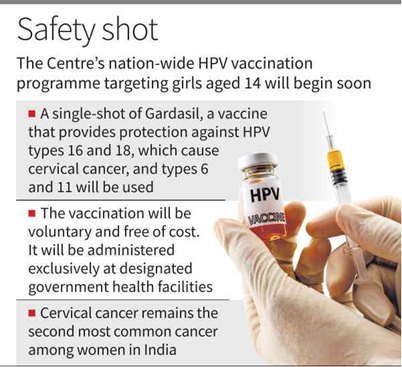
- The vaccination will be voluntary and free of cost, ensuring equitable access across socio-economic groups.
- India will use Gardasil, a quadrivalent HPV vaccine, for protection from HPV types 16 and 18, which cause cervical cancer, and types 6 and 11.
- “Global and Indian scientific evidence confirms that a single dose provides robust and durable protection when administered to girls in the recommended age group,” a senior Health Ministry official said.
- “The nation-wide programme will target girls aged 14 years, an age at which the HPV vaccine offers maximum preventive benefit, well before potential exposure to the virus,” the official said.
- To ensure uninterrupted availability and quality, India has secured HPV vaccine supplies through a transparent, globally supported procurement mechanism.
- “Under India’s partnership with Gavi, the Vaccine Alliance, Gardasil vaccines, which are approved by India’s drug regulator and widely used internationally, have been made available for the national programme. The procurement follows stringent quality and cold chain standards, enabling the government to provide the vaccine free of cost to eligible girls across all States and Union Territories,’’ the official said.
- HPV vaccination under the national programme will be conducted exclusively at designated government health facilities, including the Ayushman Arogya Mandirs (Primary Health Centres), Community Health Centres, Sub-District and District Hospitals, and Government Medical Colleges.
- Each vaccination session will be carried out in the presence of trained medical officers, supported by skilled healthcare teams, and equipped for post-vaccination observation and management of any rare adverse events.
- Cervical cancer remains the second most common cancer among women in India, with nearly 80,000 new cases reported annually.
Paper-V: General Studies 4
Ethics Case Study – Factory Issue in Koppal District
Background:
In a village of Koppal district, the establishment of a new industrial factory has triggered significant public opposition. The government argues that the project will generate employment opportunities and promote regional economic development. However, local farmers and residents fear that the factory may cause environmental pollution, damage agricultural land, deplete water resources, and lead to health problems.
While the protests initially began peacefully, there are signs of rising tension and potential law-and-order concerns. As a district-level administrative officer, you are responsible for handling the situation. You must balance the need for industrial development with environmental protection, livelihood security, and public peace.
Ethical Issues Involved
1.Economic development vs Environmental protection
2.Job creation vs Protection of health and agriculture
3.Public interest vs Private corporate profit
4.Legal compliance vs Political and economic pressure
5.Transparency vs Administrative expediency
Stakeholders
Local farmers and villagers
The company establishing the factory
State government
District administration and police
Pollution Control Board
Environmental activists and civil society groups
Future job seekers
Options Available
Option 1:
Grant immediate approval for the factory to begin operations.
Option 2:
Temporarily halt the project and order a re-evaluation of the Environmental Impact Assessment (EIA).
Option 3:
Initiate dialogue with all stakeholders and attempt a negotiated solution with safeguards and compensatory measures.
Sources: The Hindu