Current Events of National and International Importance
India amends tax treaty with France, cuts dividend tax
- India has revised its three-decade-old tax treaty with France, which will help major French firms save millions of dollars in dividend levies, while it also broadens New Delhi’s powers to tax certain transactions, the finance ministry said.
- French firms holding at least 10% in an Indian entity will now pay a 5% tax on dividends, down from 10% earlier.
- For minority French shareholdings of under 10% in Indian companies, however, dividend tax will rise from 10% to 15%.reuters
RODTEP rates cut
- The Directorate General of Foreign Trade has amended the Remission of Duties and Taxes on Exported Products Scheme so that the rate applicable for all products shall be limited to 50% of existing rates and, where applicable, 50% of the notified value caps, with immediate effect.
Current Events of State Importance and Important Government Schemes and Programs
Centre allocates ₹2,245.30 croreto Karnataka under SwachhBharat Mission-Urban 2.0
Context: The Union government has allocated ₹2,245.30 crore to Karnataka under the Swachh Bharat Mission-Urban (SBM-U) 2.0, with ₹83.53 crore ready to be released once the State submits a detailed action plan.
- The information was given by the Ministry of Housing and Urban Affairs in response to an issue raised in the Lok Sabha by MP for Bengaluru Central P.C. Mohan.
- According to the Ministry, out of the total ₹2,245.30 crore allocation, ₹709.30 crore has been earmarked for solid waste management. So far, projects worth ₹625.77 crore have been approved, and the State government has claimed ₹87.82 crore.
- An additional ₹83.53 crore will be released after the State prepares and submits a detailed action plan, gets it cleared by the State Level Technical Committee, and sends it to the Ministry for approval. Once approved, the funds must be transferred by the State government to urban local bodies for implementation.
- For Bengaluru alone, projects worth ₹512.68 crore have already been cleared, of which the Centre’s share is ₹128.16 crore. These projects include material recovery facilities with a combined capacity of 1,226.11 tonnes per day to sort and process waste, waste-to-energy plants capable of handling 460 tonnes per day, and sanitary landfills with a capacity of 800 tonnes per day.
- Plans also include transfer stations that can manage 6,081.74 tonnes per day, remediation of 100.49 lakh tonnes of legacy waste, and the procurement of 24 mechanical road sweepers.
- Mr. Mohan said substantial funds have already been allocated and approvals granted by the Centre, and that timely submission of the action plan by the State would ensure release of the remaining funds and speed up the development of modern waste management infrastructure in Bengaluru.
Paper-I: Essays
Essay-1: Topic of International/National Importance
“Technology becomes humane only when access becomes universal.”
Essay-2: Topic of State importance/Local Importance
Paper-II: General Studies 1
President unveils bustof Rajaji, hails move toshed ‘colonial mindset’
Context: President Droupadi Murmu unveiled the bust of C. Rajagopalachari at the Rashtrapati Bhavan, hailing it as a step towards “shedding the vestiges of colonial mindset”.
- The bust of Rajaji, the only Indian Governor-General of Independent India, has been installed at the Grand Open Staircase near Ashok Mandap and replaces that of Edwin Lutyens, the British architect who designed New Delhi.
- “This initiative is part of a series of steps being taken towards shedding the vestiges of the colonial mindset and embracing, with pride, the richness of India’s culture, heritage, timeless traditions and honouring those who served Bharat Mata with their extraordinary contributions,” said a statement from the Rashtrapati Bhavan.
- Ms. Murmu visited the venue of Rajaji Utsav that will be open to the public from February 24 to March 1. Speaking on the occasion, she said that when Rajaji arrived at the Government House (now known as Rashtrapati Bhavan), he placed portraits of Ramakrishna Paramahamsa and Mahatma Gandhi in his room.
- “Rajaji sent a clear message that while India was formally still a dominion, Swaraj had been fully established in the hearts of Indians. Thus, Rajaji set an inspiring example of mental decolonisation. His ideals are reflected in the national campaign adopted by the people of India to take pride in India’s heritage… Indian consciousness and connection with all Indians, especially the weaker sections, are reflected in Rajaji’s thoughts and actions,’’ she said.
- The President said that while India moved towards “Viksit Bharat”, icons such as Rajaji would inspire people with their ideas and ideals. She called for promoting the spirit of enterprise to fulfil his dreams.
‘State contributes one-fifth to India’s bioeconomy’
Context: Karnataka’s bioeconomy, a $39 billion enterprise, contributes over one-fifth to the national bioeconomy and over 10% to the Gross State Domestic Product as of 2025, said a newly launched report.
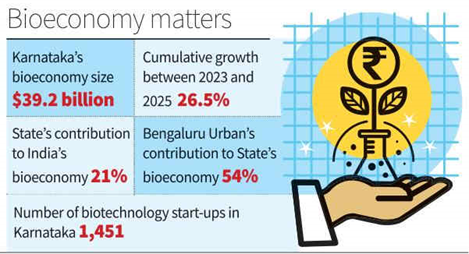
- Between 2023 and 2025, the State’s bioeconomy expanded from $31 billion to $39.2 billion, representing a cumulative rise of 26.5%; Karnataka also saw 218 new biotech start-ups being added in 2025 alone
- Karnataka’s bioeconomy, a $39 billion enterprise, contributes over one-fifth to the national bioeconomy and over 10% to the Gross State Domestic Product (GSDP) as of 2025, observes a newly launched report.
- The Karnataka BioEconomy Report 2025, prepared by the Association of Biotechnology-Led Enterprises (ABLE) for the Karnataka government, was released.
Production-oriented
- Between 2023 and 2025, the State’s bioeconomy expanded from $31 billion to $39.2 billion, representing a cumulative rise of 26.5%.The growth has been attributed to a robust biopharmaceutical base , rapid bioindustrial diversification, and strong bioservices integration.
- “Karnataka’s innovation ecosystem — anchored in research institutions, start-ups, and global R&D centres— has transitioned from being research-heavy to production-oriented and globally competitive,” reads the report, which pins the State’s contribution to India’s bioeconomy at 20.63%.
- According to the report, Karnataka’s bioeconomy accounted for 10.51% of the GSDP in 2025. This is more than twice the share of the biotech sector to India’s GDP (4.57%).
- “This positions biotechnology not merely a scientific discipline but as an economic pillar central to the State’s development model,” notes the report.
Start-up numbers
- Karnataka’s biotech start-up ecosystem continued to grow, with 218 new biotech start-ups being added in 2025 alone, marking the highest annual start-up additions in three years. With this,the cumulative number of biotech start-ups in the State stands at 1,451,up from 1,233 in 2024.
- The State currently holds a 12–13% share of the national biotechnology start-up pool and more than75%of them startups are focused on life sciences and health-tech. Bengaluru accounts for about 54% of the biotech start-ups.
- Mysuru contributes around 8.7% to the bioeconomy of the State, while Belagavi and Dakshina Kannada together account for over 9%.
- On the investment front, between January 2024 and October 2025, Karnataka attracted$1.14 billion across around 40 deals.
Collaboration critical
- “The rapid expansion of biomanufacturing shows a sector moving decisively from research to global-scale production. Continued collaboration between government, industry and academia will be critical to sustaining Karnataka’s leadership in India’s next phase of bio-led growth,” said G.S. Krishnan, honorary president, ABLE.
- Minister for Information Technology, Biotechnology and Rural Development, noted that biotechnology is no longer confined to laboratories, but is now a central driver of economic growth, industrial innovation and societal impact.
- “Our focus is on building a full-spectrum biomanufacturing economy by supporting deep-tech start-ups, strengthening innovation infrastructure, and ensuring that growth reaches beyond Bengaluru,”he said.
Paper-III: General Studies 2
Centre unveils policy to tackle terrorism threats
Context: PRAHAAR states that India faces terrorist threats on all three fronts — water, land and air; the policy adds that capacities have been developed to protect critical sectors of the economy
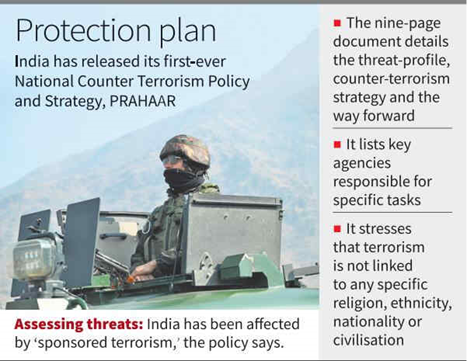
- The Union Home Ministry released the country’s first-ever anti-terror policy, emphasising that other than terror sponsored from across the border, “criminal hackers and nation states continue to target India through cyber-attacks”. The policy — titled PRAHAAR — has been uploaded on the Ministry’s website.
- It states that India faces terrorist threats on all three fronts — water, land and air — and that capacities have been developed to protect critical sectors of the economy, including power, railways, aviation, ports, defence, space and atomic energy, from both state and non-state actors.
- The Hindu first reported on December 23, 2025, that the National Counter Terrorism Policy and Strategy had been finalised and would be released soon.
- The policy underlines that “India does not link terrorism to any specific religion, ethnicity, nationality or civilisation”. However, it notes that India has been affected by “sponsored terrorism” from across the border, with “Jihadi terror outfits as well as their frontal organisations” continuing to plan, coordinate, facilitate and execute terror attacks.
- “India has been on the target of global terrorist groups such as al-Qaeda and IS, which have been trying to incite violence in the country through sleeper cells,” it says, adding that extremists operating from foreign countries have hatched conspiracies to promote terrorism.
- “Their handlers from across the border frequently use the latest technologies, including the use of drones, for facilitating terror-related activities and attacks in Punjab and J&K. Increasingly, terrorist groups are engaging organised criminal networks for logistics and recruitment to execute and facilitate terror strikes in India,” the policy says.
- Union Home Minister Amit Shah had announced on November 7, 2024, that a National Counter Terrorism Policy and Strategy was being drafted to fight terrorism and its ecosystem.
- Following the April 22, 2025, Pahalgam terror incident, the National Investigation Agency (NIA) conducted meetings with anti-terror units of all States and apprised them of the measures aimed at preventing and pre-empting such attacks.
- The policy further states that for propaganda, communication, funding and guiding terror attacks, these terror groups use social media platforms as well as ‘instant messaging applications’ and technological advancements such as encryption, dark web, crypto wallets etc, enabling them to operate anonymously.
- “Disrupting/Intercepting terrorist efforts to access and use CBRNED (Chemical, Biological, Radiological, Nuclear, Explosive, Digital) materials remains a challenge for Counter Terrorism (CT) agencies. The threat of state and non-state actors misusing drones and robotics for lethal purposes remains another area of concern,” it flags.
- As a way forward, the policy suggests that to make appropriate cases against the perpetrators of acts of terrorism, there is a need to associate legal experts at every stage of investigation.
- “Terrorist groups based outside (from abroad) nowadays use the infrastructure, logistics and terrain knowledge of local outfits for launching attacks. National actions, coupled with international and regional cooperation, are key elements in addressing the transnational terrorism challenge,” it emphasises.
- The MHA said Indian intelligence and law enforcement agencies have been continuously working to prevent the recruitment of Indian youth by extremist groups.
- Underscoring the role of community and religious leaders, the policy states that moderate preachers and NGOs are engaged to spread awareness about the adverse consequences and impacts of radicalisation and extremist violence.
- The Ministry said there is a move to establish a uniform anti-terrorism structure across States, as standardisation of processes and procedures would ensure similar and synergistic responses to terror attack.
- It said that the policy aims to criminalise all terrorist acts and deny access to terrorists, their financiers and supporters access to funds, weapons and safe havens.
WhatsApp tells SC it does not share data with Meta
Context: Will fully comply with National Company Law Appellate Tribunal directions on user consent for sharing data with parent company, it says as both challenge imposition of penalty of ₹213.14 crore
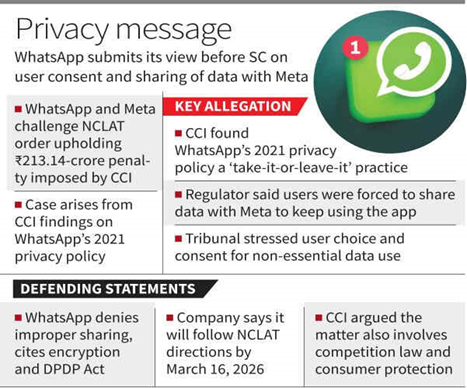
- The instant messaging platform WhatsApp maintained in the Supreme Court on Monday that it was not “quite right” to say the online entity was sharing data with other Meta platforms.
- Appearing before a three-judge Bench headed by Chief Justice of India Surya Kant, senior advocate Kapil Sibal, for WhatsApp and its parent company, Meta, said its technology was very clear and put a premium on privacy. “There is no question of violating the law,” Mr. Sibal submitted.
- He said the Digital Personal Data Protection (DPDP) Act, 2023, comprehensively addressed the privacy concerns raised in the Supreme Court.
- The court was hearing petitions filed by Meta and WhatsApp against a National Company Law Appellate Tribunal (NCLAT) decision to uphold a ₹213.14-crore penalty imposed by the Competition Commission of India (CCI).
- The CCI had found WhatsApp’s “take-it-or-leave-it” approach in its 2021 privacy policy an abuse of its market dominance. It found the prior consent sought from users to share their data with Meta “manufactured”. It had concluded that users were forced to share data for continued access to WhatsApp messaging services.
- In an appeal last year, the NCLAT concluded that the “core principle is to remove exploitation by restoring user choice”.
- “The users can be given choice if users retain the right to decide what data is collected from them, for which purposes, and for how long. We had also stated in our findings that any non-essential collection or cross-use (like advertising etc.) can occur only with the concerned user’s express and revocable consent,” the NCLAT had observed.
- WhatsApp said it would fully comply with the NCLAT directions relating to user consent for sharing data with Meta under its controversial 2021 privacy policy by March 16, 2026. The tribunal had, however, found the CCI’s five-year ban on sharing data for advertisement purposes “redundant”, considering that the user had already been given a choice to opt in or out.
- WhatsApp has filed a comprehensive affidavit explaining its technology of end-to-end encryption, following scathing oral remarks from the Bench in the previous hearing on February 3.
- The Bench had cautioned that it would not permit the platform and Meta to breach the right to privacy of millions of their “silent consumers” in India through the sharing and commercial exploitation of personal data. It had even compared sharing of private data to a “decent way of committing theft”. Though WhatsApp and Meta had protested that users could “opt out” of the data-sharing provision, the court had persisted in its criticism.
- Senior advocate Madhavi Goradia Divan, for CCI, said there was also a competition law concern attached to the case.
- “Data-sharing has many facets. One may be privacy and data protection. But there is another aspect, protecting market and consumer, which stands on a totally different footing,” Ms. Divan submitted.
Paper-IV: General Studies 3
Paper-V: General Studies 4
Ethics Case Study
Background
In Rajamahendravaram city of East Godavari district, Andhra Pradesh, four elderly persons died and eight others fell critically ill after consuming adulterated milk supplied by a local vendor. Medical reports indicate that the victims suffered from acute renal failure and anuria. The same vendor had procured milk from 46 dairy farmers and supplied it to 106 families. The district administration detained the vendor and initiated forensic testing of blood samples, cattle fodder, and milk samples. The State government announced compensation to victims’ families, while allegations of negligence in enforcing food safety norms were raised.
You are the District Collector of East Godavari.
- Ethical Issues Involved?
- Stakeholders?
- Ethical Principles Applied?
- Options Available to You?
Option 1: Limit action to arresting the vendor and completing investigation
Option 2: Combine legal action with immediate health, relief, and surveillance measures
Option 3: Implement long-term structural reforms in food safety governance
Sources: The Hindu