Background: Historical Regional Imbalances
Karnataka has long faced inter-regional developmental disparities, especially between North / Kalyana Karnataka and South & Coastal Karnataka.
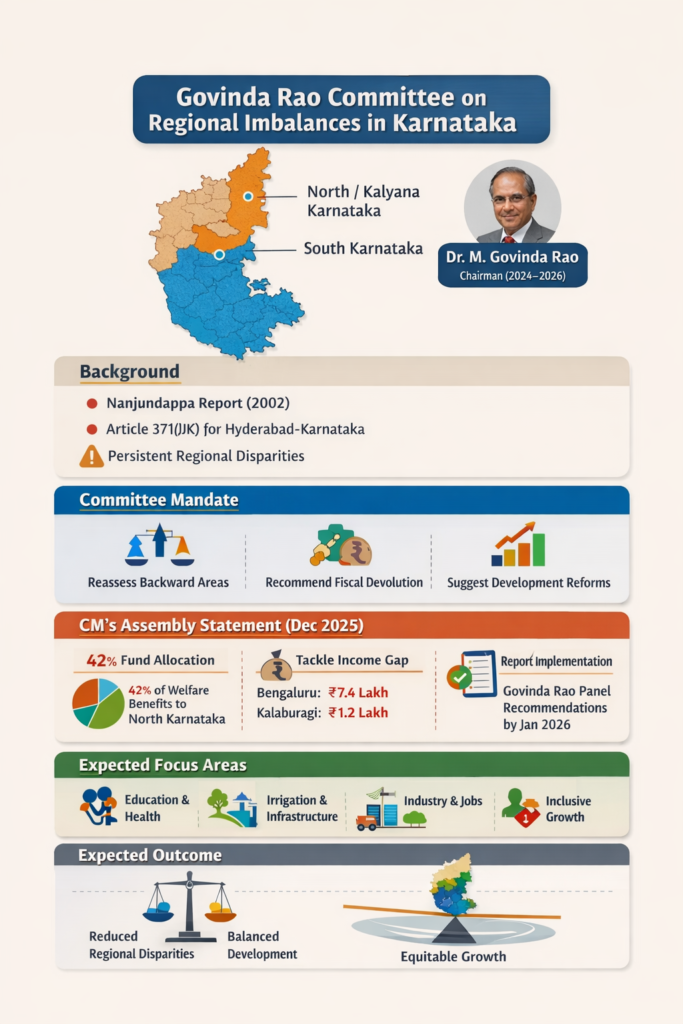
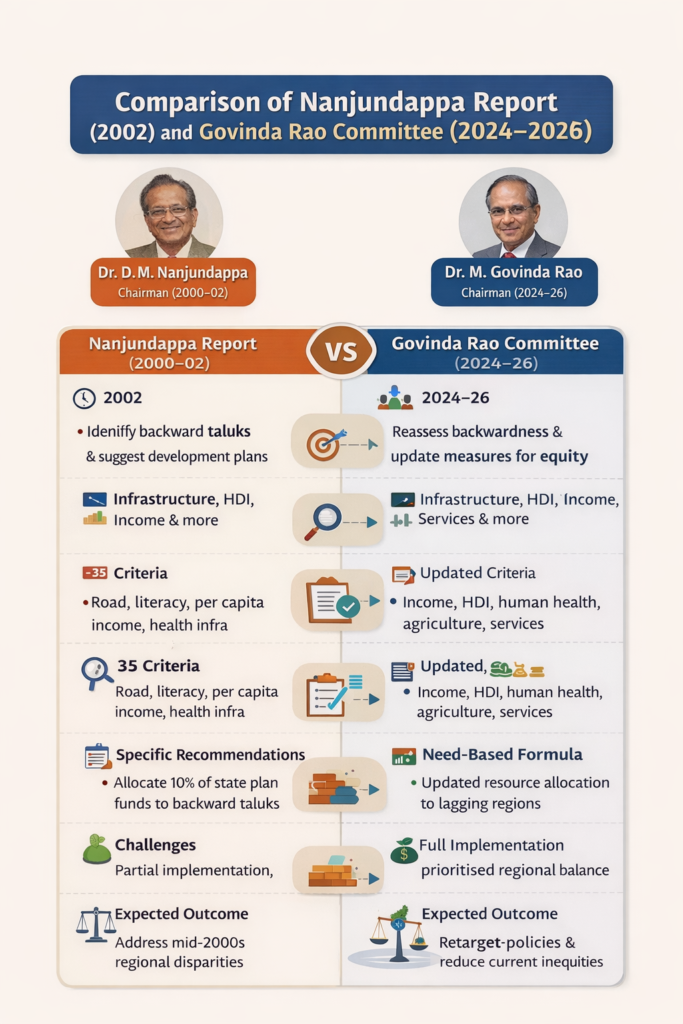
In 2002, the Dr. D.M. Nanjundappa Committee (High Power Committee for Redressal of Regional Imbalances) identified 114 backward taluks, categorised as most backward, very backward, and backward, mostly concentrated in North and Kalyana Karnataka. The committee recommended targeted interventions and large fiscal allocations (about ₹31,000 crore) over eight years to bridge the gap.
Article 371J/K was inserted into the Constitution (Ninety-eighth Amendment Act, 2012) providing special development measures, reservations and a dedicated Regional Development Board to uplift the Hyderabad-Karnataka region.
Despite these efforts, significant disparities in education, healthcare, infrastructure, income and human development indicators persist across regions.
Govinda Rao Committee — Formation & Mandate
To reassess and update Karnataka’s regional imbalance strategy, the Government constituted the Karnataka Regional Imbalance Remediation Committee in March 2024, chaired by Prof. M. Govinda Rao, a noted economist and former Member of the 14th Finance Commission.
Key Mandate
Review the implementation of the Nanjundappa report and existing development indicators.
Revisit and update criteria for identifying backward areas, considering current socio-economic realities (per capita income, education, health, infrastructure, agriculture, industry etc.).
Formulate policy and fiscal recommendations for equitable development across all regions.
Engage stakeholders and government departments for comprehensive assessment.
The committee’s methodology is more comprehensive than earlier efforts, with increased indicators and field consultations in all districts.
Timeline
Originally expected by September 2025, the Govinda Rao committee sought additional time, and the report is now expected by January 2026.
Government’s Recent Statements & Policy Direction
Winter Session 2025: Assembly Response
On 19–20 December 2025, Chief Minister Siddaramaiah, replying to a special debate in the Karnataka Assembly at Belagavi, outlined the government’s approach to regional imbalance, based on findings and anticipated recommendations of the Govinda Rao panel:
Equitable Allocation of Welfare Benefits
The state has about 6.95 crore residents, of whom ≈2.96 crore (42%) are in North Karnataka.
North Karnataka accounts for ≈53% of the state’s geographical area and ≈43% of assembly seats.
CM emphasized that at least 42–43% of government welfare benefits should be allocated to North Karnataka on the basis of its population and area share.
Guarantee Schemes & Funds Spent
Out of Rs 1,06,066 crore spent on state guarantee schemes, Rs 46,277 crore (43.63%) has gone to North Karnataka beneficiaries, aligning with the population share.
Sectors include Gruha Lakshmi, Gruha Jyothi, Anna Bhagya, Shakti, Yuva Nidhi and others.
(Gruha Jyoti is a subsidy scheme providing free electricity up to 200 units, illustrating the nature of flagship welfare programmes.
Income & Development Gap
The Chief Minister noted stark disparities: Bengaluru Urban’s per capita income (~₹7.4 lakh) versus Kalaburagi (~₹1.2 lakh), underlining ongoing inequality within the state.
The government aims to narrow this gap significantly over coming years.
Report Implementation & Additional Measures
CM confirmed that once the Govinda Rao committee report is received, its recommendations will be implemented fully.
Proposals like ₹500 crore for Kittur Karnataka development, establishment of 300 Karnataka Public Schools, and implementation of education sector reforms based on a separate committee led by Prof. Chhaya Devadgaonkar were highlighted.
Political Debate
Opposition parties, notably the BJP, challenged the government’s assertions and demanded further clarity and special package announcements, leading to political contention in the Assembly.
What the Govinda Rao Committee Report Is Expected to Focus On
Based on media previews and statements by the committee:
1. Updated Development Indicators
Revising deprecated indicators from the Nanjundappa framework (e.g., telephone access, post offices) to current metrics covering human development, services, infrastructure and income.
2. Taluk-Level Assessment
Comprehensive evaluation of all 236 taluks to identify those lagging behind.
3. Sectoral Recommendations
Strategies to enhance:
Education and health infrastructure
Agriculture and allied sectors
Industrial and service sector development
Irrigation, connectivity and transportation
Strengthening institutions such as the Kalyana Karnataka Regional Development Board with long-term planning frameworks.
4. Fiscal Formula
Suggesting need-based resource allocation formulas, possibly moving beyond population-only criteria to include development gaps, density, and economic potential.
Significance & Implications
Policy
The Govinda Rao panel’s report is expected to reshape Karnataka’s regional development policy by updating the basis of backwardness and recommending actionable plans to address structural disparities.
Political & Social
Debate around regional imbalance is not merely administrative but politically charged, reflecting demands for equitable development and scrutiny of welfare spending.
Future Direction
Implementation of committee recommendations may influence:
Budgetary priorities
Targeted welfare schemes
Institutional reforms for regional governance
Conclusion
The Govinda Rao Committee represents Karnataka’s latest, evidence-based effort to objectively assess and address long-standing regional imbalances. Its pending report (expected January 2026) will guide policy decisions, resource allocation, and welfare strategies, aiming for a more balanced, inclusive development trajectory across the state.