New York gets its first Mayor-elect of South Asian origin
Context: Zohran Mamdani made history by becoming New York City’s first Muslim and South Asian-origin Mayor-elect, and its youngest since 1917, topping off a stunning grassroots campaign led by the message of affordability and upending a political class dominated by wealthy donors.
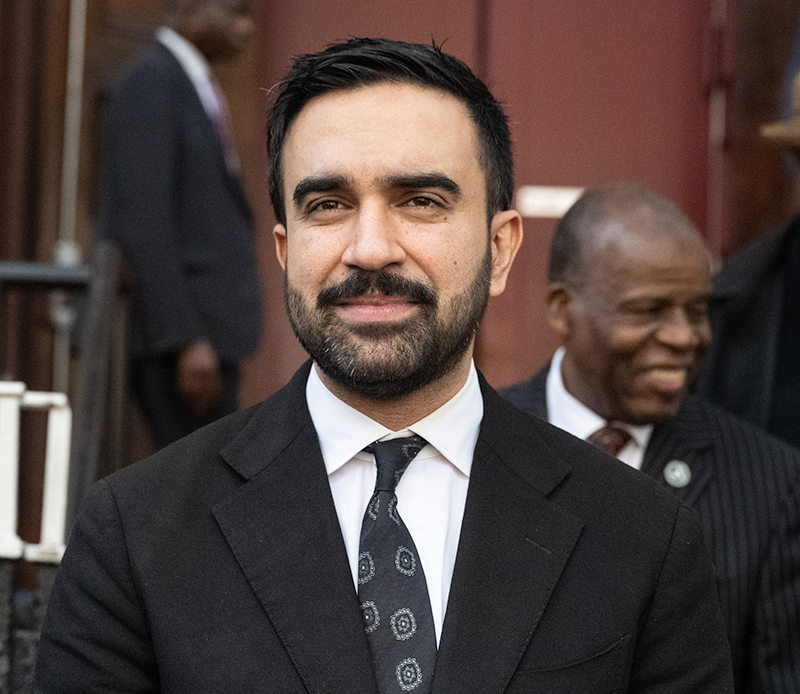
- In his victory speech before a jubilant crowd in Brooklyn, the 34-year-old declared: “We have toppled a political dynasty… tonight, New York has stepped from the old into the new.” Quoting from Jawaharlal Nehru’s “Tryst with Destiny” speech, Mr. Mamdani said: “Standing before you, I remember the words of Jawaharlal Nehru. A moment comes, which comes but rarely in history, when we step out from the old to the new, when an age ends, and when the soul of a nation, long suppressed, finds utterance.”
- He defeated both a Republican challenger, Curtis Sliwa, and former New York Governor Andrew Cuomo, who was backed by a coalition of billionaires who spent millions to block Mr. Mamdani’s rise.
- More than two million New Yorkers voted, the highest turnout for a mayoral contest in more than 50 years, according to the New York Board of Elections.
- Mr. Mamdani won 50.4% of the votes, while Mr. Cuomo, running as independent, won 41.6%. Mr. Sliwa won 7.1%.
About:
QUICK FACTS
Born: 18 October 1991
Famous for: Mamdani is New York City’s first Muslim and South Asian mayor
Political views: He describes himself as a democratic socialist, which has no clear definition but essentially means giving a voice to workers, not corporations
Born in Uganda, Mamdani moved to New York with his family at the age of seven.
He attended the Bronx High School of Science and later earned a degree in Africana Studies from Bowdoin College, where he co-founded the campus chapter of Students for Justice in Palestine.
He became a naturalised American citizen in 2018.
He is of Indian descent. His mother, Mira Nair, is a celebrated film director and his father, Professor Mahmood Mamdani, teaches at Columbia University in New York. Both parents are Harvard alumni.
Mamdani and his wife, Brooklyn-based Syrian artist Rama Duwaji, met on the dating app Hinge.
- Wildlife Board for diverting forest land
Context: The Standing Committee of the State Wildlife Board has recommended forwarding the proposal to divert forest land from the Sharavathi Lion-tailed Macaque Wildlife Sanctuary, to the National Board for Wildlife for approval.
- The Standing Committee of the Board, chaired by Environment Minister Eshwar Khandre, decided to forwared to the National Board for Wildlife the proposal for diversion of 0.976 hectares of forest land
- The Standing Committee of the State Wildlife Board has recommended forwarding the proposal to divert forest land from the Sharavathi Lion-tailed Macaque Wildlife Sanctuary, to the National Board for Wildlife (NBWL) for approval.
- The Standing Committee of the State Wildlife Board, chaired by Environment Minister Eshwar Khandre, which met, decided to recommend the proposal for diversion of 0.976 hectares of forest land.
- A proposal to release forest areas of the Sharavathi Lion-tailed Macaque Wildlife Sanctuary for approval by the Standing Committee of the NBWL was submitted to the State government through the Parivesh portal last September.
Approved
- The committee also approved various road construction and widening proposals linked to the Sharavathi Lion-tailed Macaque Sanctuary, the Ranganathittu Bird Sanctuary Eco-Sensitive Zone, and the Someshwara Wildlife Sanctuary with the condition that project plans ensure that there is no harm to wildlife.
- The Minister directed that while granting approval to any project in forest and wildlife sanctuary areas, proposals should mandatorily include measures to reduce risks and ensure no harm to wildlife.
- On the proposal to establish a leopard conservation reserve in Chittapur, Mr. Khandre directed officials to conduct a field inspection and submit a detailed report.
- Mr. Khandre also directed officials to fix a radio collar on the elephant captured near Kerekatte in Chikkamagaluru district and release it back into the forest. The elephant had reportedly caused the death of two persons in Kerekatte range of Kudremukh Wildlife Division in Sringeri taluk on October 31.
- The Minister instructed the Principal Chief Conservator of Forests to invite former Indian cricket team captain Anil Kumble, who is the ambassador of the Karnataka Forest Department, and for wildlife conservation to attend future meetings of the Department.
- Centre’s governance guidelines for AI call for trust and safety
Context: Advocating a hands-off approach to the regulation of artificial intelligence, the Ministry of Electronics and Information Technology on Wednesday released the India AI Governance Guidelines.
- The document is a significantly changed revision of a framework put out for consultation in January.
- The report was drafted by a panel formed in July and headed by Balaraman Ravindran, the head of the Department of Data Science and Artificial Intelligence at the Indian Institute of Technology, Madras. The broader group that worked on the previous framework was headed by Principal Scientific Adviser Ajay K. Sood.
- The guidelines will “be a cornerstone in developing AI for India, and can be a role model for AI governance globally”, Abhishek Singh, Additional Secretary at the Ministry, said.
- The report emphasises seven principles for AI: trust; people-centricity; “responsible innovation”; equity; accountability; understandability of LLMs; and “safety, resilience and sustainability.” Mr. Ravindran stressed that the governance guidelines seek to signal India’s largely hands-off approach to AI.
- The report has six recommendations also: expand access to AI infrastructure and “leverage the power of digital public infrastructure for scale, impact and inclusion”; build capacity by skilling in AI; “adopt balanced, agile and flexible frameworks” as far as regulating AI is concerned; mitigate risks by looking at “India-specific” factors that need to be addressed; boost accountability in the AI ecosystem by requiring “greater transparency… about how different actors in the AI value chain operate”.
- “We are calling this the AI Governance Guidelines, not AI regulation or anything like that, because we don’t want it to be viewed as something that throttles AI adoption in India,” he said.
- While the previous framework laid emphasis on minimising risks inherent in deploying AI, the current model scales this back to promoting innovation with guardrails. The report also strips away much of the previous work done by NITI Aayog and the Organisation for Economic Cooperation and Development that was foundational to the earlier draft framework’s approach.
- In the long term, the report says, new laws should be drafted based on “emerging risks and capabilities” of AI systems. Responding to reports on the government considering a new AI law, IT Secretary S. Krishnan said that there were no immediate plans, but as and when there would be an urgent need for such legislation, the government would act swiftly.
- The AI guidelines are separate from a draft amendment to the IT Rules, 2021.
- Skilling treated as extracurricular activity: NITI Aayog CEO
Context: Skilling is still treated as an extracurricular activity in India and yet to be treated as part of mainstream education, said B.V.R Subrahmanyam, CEO, NITI Aayog.
- “Skilling is yet to be part of our country’s education system, unfortunately. This is at the root of the problem India is currently facing. Since our curriculum lacks general employability skill training, a majority of our population remains hugely unskilled, doing very low paying jobs or even staying unemployed,’’ he lamented, while delivering the keynote address at Bengaluru Skill Summit, being organised by the Government of Karnataka.
- Addressing a gathering of law/policy makers, educators, industry leaders, and start-ups, he said, India as a whole has to think differently and focus on skilling its people of all ages: young, old, students, women and farmers and others.
- The country’s 50-crore farmers have to be also trained otherwise the magic of agriculture won’t happen again.
- “We are actually putting people in silos and treating skilling as something separate. Actually, skilling has to be an integral part of the education system and skilling has to be thrown open to people of all ages — 20, 30, 40, 50 or 60 years,’’ he suggested.
- India was in a sweet spot, the country was at an important inflection point, with a positive growth trajectory, even geopolitics was also favouring India and the country has to invest in its demographic dividend, Mr. Subrahmanyam insisted adding, “If we don’t, our demographic advantage can be a curse for us. Only a skilled, employable, well-earning workforce having productive-livelihood will power India to become a $30 trillion economy by 2047, with each individual expected to contribute $18,000 (per capita income) to the economy.’’
- According to Mr. Subrahmanyam, the country required integrated academic, skill and vocational training schools and institutes on a large scale. Many have done wrong education and taken up courses and wasted their time, and now they are 35 or 40 years old and think their life is over.
- He suggested a system that would map skill sets, bring people and job roles on a common platform and establish interoperability (communication) between different educational platforms which would eventually help create diverse career roadmaps, define skill sets, identify newer job roles and create huge employment opportunities for a skilled workforce.
- On the impact of artificial intelligence on employment oportunities, Mr. Subrahmanyam added that AI would remove roles and not jobs.
- FATF releases updated asset recovery framework; India played a key role, says ED
Context: The global inter-governmental Financial Action Task Force (FATF) has released the “Asset Recovery Guidance and Best Practices” guidelines, which provide a comprehensive and updated framework to strengthen the global system for asset recovery against financial crimes.
- “The guidance follows up on one of the most significant global reforms to the FATF standards on confiscation and international cooperation in over three decades. It outlines practical measures for policymakers and practitioners to identify, trace, freeze, manage, confiscate, and return assets derived from criminal activity,” the Enforcement Directorate (ED).
- The ED stated that India played a prominent role in the development of both the revised FATF standards and the guidance document.
- “The document contains multiple examples from cases investigated by the ED, which are cited as models of effective asset recovery practice and inter-agency coordination. This recognition reflects the increasing international standing of India and the ED in the global discourse on asset recovery and financial crime enforcement,” it said.
- The new framework expands the definition of asset recovery to cover the entire process from the identification of criminal property to its eventual confiscation and return.
- “For the first time, the FATF has mandated that countries provide for non-conviction-based confiscation, enabling authorities to recover criminal assets even in the absence of a criminal conviction where prosecution is not possible or practical,” the agency said.
- The guidance also promotes the adoption of tools such as extended confiscations and unexplained-wealth orders that require individuals to show the lawful origin of their assets when there is reasonable suspicion of criminal linkage. Greater emphasis has been placed on provisional measures to secure assets at an early stage and prevent their dissipation.
- Sikh relic brought to Patna from Delhi after over 300 years
Context: An important holy relic related to the Sikh faith, the sacred Jore Sahib, the footwear of the 10th Sikh Guru, Shri Guru Gobind Singh Ji Maharaj, and his wife, Mata Sahib Kaur Ji, had an unusual journey of 1,500 kilometres from New Delhi to Patna after a gap of more than 300 years.
- It was established on November 1 at the Takhat Sri Harmandir Ji Patna Sahib.
- The establishment of the reliquary at Patna Sahib, the birthplace of Shri Guru Gobind Singh Ji, is being seen as a major event in the Sikh faith, as the private custodians of the relics have offered them to the larger Sikh congregation.
- The relics were scientifically validated by the Indira Gandhi National Centre for the Arts, and a system for transporting and further preservation of the relics was created. The provenance of the relics were authenticated by the Union Ministry of Culture via carbon dating. Interestingly, the private custodians of the relics are related to the family of the Union Minister for Petroleum and Natural Gas, Hardeep Singh Puri.
- “Our ancestors were in the service of Guru Maharaj with the holy Jore Sahib ‘Charan Suhawa’ more than 300 years ago…,” Mr. Puri said in a post on X at the conclusion of a yatra.
- Stubble-burning area in Punjab 20% lower than last year’s in three major districts: data
Context: While instances of stubble burning in Punjab in October were at a five-year low, the area that was actually set afire in three major districts — Amritsar, Taran Taran and Ferozpur — was likely 20% less than last year’s, according to data sourced by The Hindu from a satellite-imagery firm and a senior official formerly with the Punjab Pollution Control Board.
- However, the first fortnight of November is historically when farm fires in Punjab peak and there may well be a surge in the burnt area.
- The government regularly shares daily data on the fire count but does not disclose burnt area. The link between fire counts and burnt area is significant for an accurate picture on efforts to curb farm fires, which in previous years have contributed as much as 35% of the daily winter pollution load in Delhi.
- Last November,— triggering the Supreme Court to order increased scrutiny — that Punjab’s claims of a reduction in farm fires, by publicising only fire counts caught on satellite, did not capture reality. The area actually burnt in Punjab had increased in 2023 (19.1 lakh hectares) compared to 2022 (15.4 lakh hectares). This was likely due to farmers burning stubble after satellite-passes to avoid detection. In 2024, the burnt area was nearly the same as 2023, at 19.4 lakh hectares.
- This year, satellite imagery of farm fires over Punjab only began emerging around October 10 — almost a month-long delay — due to heavy rain and flooding during most of September, contributing to a delayed harvest. Between October 13 and 28, the three districts were responsible for 515 fire events detected by satellite, about 55% of the 933 such events in the State. During the period, 2.46 lakh hectares were burnt in these districts, according to an analysis shared with by Noida-based Suhora Technologies, a space-analytics company with expertise in using satellite imagery for a variety of applications.
- Krunesh Garg, who had served as the Member Secretary, Punjab Pollution Control Board, until September 2025 and has for years monitored and implemented measures to address stubble burning, told that data with him showed ”the three districts at the same time last year reported 3.15 lakh hectares of burnt area”. “If it is indeed 2.46 lakh hectares, that is a reduction and is certainly a positive sign…it shows that measures implemented in the last five years have started to show results,” he added. He said that Amritsar and Taran Taran belt (north-east Punjab) typically saw fires start early and conclude by October-end. “I believe whatever burning that usually happens in those regions has already concluded,” he noted.
- Couldn’t establish what proportion of cultivated area in the three districts of Amritsar, Taran Taran and Firozpur has been harvested.
- In the week from October 28 to November 4, fire counts have sharply spiked from 993 to 2,839 — nearly three times higher than the cumulative October figure. Still, this is nearly half of the fire count logged at the same time last year and about a fifth of figures from 2023. The spike was attributed to the window for sowing wheat — the rabi crop — fast closing and available till November 15.
- Chinese varsities dominate QS Asia rankings; India slips
Context: China has overtaken India as the most-represented location in the QS World University Rankings: Asia 2026, according to the rankings released this week.
- While India added 132 universities and institutes to the list this year, taking its tally to a record high of 294, China added 259 institutions, bringing its total to 394.
- In the last two editions, India had the highest number of universities and institutes in the rankings, ahead of China. This year, a total of 1,526 universities were ranked, of which 557 are new entries.
Among the top 100
- Seven Indian institutions feature in the top 100, with the Indian Institute of Technology, Delhi, ranked highest at 59, followed by the Indian Institute of Science (IISc), and the IITs in Madras, Bombay, Kharagpur, and Kanpur, along with the University of Delhi.
- China, meanwhile, has 25 universities in the top 100. While India retained the same number of institutes in the top 100 as last year, their rankings declined. The IIT-Delhi slipped from 44 in the 2025 rankings to 59 this year.
- Delhi University fell from 81 to 95, the IISc from 62 to 64, and the IIT Madras from 56 to 70.
- The top 10 positions in the 2026 rankings were dominated by universities from Hong Kong, Singapore, and China.
- ‘Highest’ FPI sell-off signals waning confidence in India
Context: Unless corporate performance improves significantly, foreign investors won’t find India attractive for investments, say experts; tepid corporate profitability has more to do than just stock returns.
- Foreign investors have sold ₹1.5 lakh crore worth of Indian stocks as of November 4, 2025, according to NSDL data. Continued selling will make this the largest sell-off in about 20 years.
- “India benefitted from investors leaving China, but this benefit has run out,” said Mike Coop, Chief Investment Officer, EMEA at Morningstar Investment Management.
- “I think India was like the mirror image of China when the latter collapsed, and people thought it was uninvestable. India boomed and benefited from the reshoring from China to India. We have reached the end of that and probably, that’s not a great starting point for Indian equities. The valuation level has not been positive as it was,” he said.
- “On a PE basis, Indian markets have remained expensive relatively to peers in most years [in the past nine years],” said Dhananjay Sinha, CEO and co-head of Institutional Research at Systematix, an Indian financial services firm. Price to earnings (PE) ratio is a measure used to determine if the price of a stock justifies its earnings to the shareholder. “Currently, Indian stocks are trading 22 times their earnings,” Mr. Sinha said.
- A section of experts though believes that the market is past the stage of expensive valuations and may now be ready for better returns. “Over the last year, returns have been weak in India, whereas returns in many other parts of the world have been much stronger,” Pranjul Bhandari, Chief Economist ASEAN, HSBC, said.
- “Today, we are seeing our relative valuation actually going back to long term average. It’s not looking too rich,” she added.
- “This is because investors have understood that earnings growth can’t be in teens when the nominal gross domestic product (GDP) growth is in single digits. A more realistic expectation may trigger foreign investors to return and an improvement in market returns might be around the corner,” Ms. Bhandari said.
- Despite divergent views, there is consensus among experts that corporate India’s profits must grow at a faster pace. For FPI participation to revive, either corporate earnings growth must quicken to 15-20% or valuations must compress significantly, Mr. Sinha said. “Currently, trailing earnings over the past 4-6 quarters are flattish, while forward expectations for the next two years are only approximately 10-11%; hardly enticing, especially amid visible downside risks,” he added.
FDIs trend lower
- While FPIs are selling, net foreign direct investments (FDI) also trend lower. Total foreign investment, which includes portfolio and direct investment as a share of gross domestic product (GDP), hit a 25-year low in 2024-25, he said. What makes this more concerning is that, FPIs who invest in India based on their conviction in the economy’s long-term growth redeemed for the eighth consecutive week as of October 31, 2025, according to Sunil Jain, V-P of Elara Capital.
- A low-performing corporate sector has consequences beyond just the stock market. “Elusive private capital expenditure and slowing household incomes are inter-linked trends that have curtailed private demand and lending growth. These issues, persisting for years and recently intensifying, have been partly offset by government spending on infrastructure and household transfers. Amid intensifying de-globalisation, India’s structural growth outlook faces considerable risks,” Mr. Sinha reiterated.
- Adding credence to his views, the World Bank, in its World Development Report 2024, highlighted the need for sweeping institutional reforms in the absence of which developing economies like India can run the risk of slowing down before it becomes a high income economy, a phenomenon that economists call “The Middle Income Trap.”
- That being said, conversations about middle income trap happen all over emerging economies in Southeast Asian economies and is not exclusive to India. With policy reforms, India can reduce the risk of structural economic slowdown, Ms. Bhandari asserted.
- Agri tech a ‘big part’ of FTA negotiations with India: McClay
Context: Agricultural technology sharing and methods to increase output are a “big part” of the negotiations between New Zealand and India on a free trade agreement (FTA), New Zealand’s Minister for Trade and Investment Todd McClay.
- India and New Zealand began the fourth round of negotiations towards an FTA on Monday, with the Indian team visiting Auckland until Friday. Commerce Minister Piyush Goyal also visited New Zealand on Wednesday to discuss various issues with Mr. McClay.
- Speaking to reporters in Auckland along with Mr. Goyal, Mr. McClay said that New Zealand had been innovating over the years and working with its farmers to find ways to produce more and to increase its farmers’ incomes.
- “Prime Minister [Christopher] Luxon has directed me in our discussions and negotiations to make sure New Zealand does its part to help Prime Minister [Narendra] Modi meet his commitment to increasing the earnings of Indian farmers by 50% by 2030,” Mr. McClay said.
- “So a lot of the science that we have developed here to help them produce more is available to us in cooperation with India and that’s been a big part of our discussion around the negotiation so far,” he added.
- Negotiations with India regarding agriculture have been tricky as the Indian government has been steadfast in protecting the interests of its farmers.
- This has been a speed bump in negotiations with the U.S., European Union, and even the United Kingdom.
‘Challenges remain’
- “It’s fair to say that on both sides, there are always challenges in a trade negotiation,” Mr. McClay acknowledged.
- “What Minister [Piyush] Goyal and I have agreed is that rather than our negotiators arguing, we will find solutions together. And so far, I think we’ve made great progress.”
- Neither Minister was forthcoming about a deadline by which the deal would be finalised.