- U.S. is doing a trade deal with India, says Trump
Context: U.S. President Donald Trump said Washington is “doing a trade deal with India”, and emphasised that he has “a great relationship” with Prime Minister Narendra Modi, as both sides continue negotiations on a proposed pact.
- “If you look at India and Pakistan… so, I’m doing a trade deal with India and I have great respect and love, as you know, for Prime Minister Modi. We have a great relationship,” Mr. Trump said at the APEC (Asia-Pacific Economic Cooperation) CEO Summit in Gyeongju, South Korea.
- He landed in South Korea from Japan as part of a three-nation tour of Asia.
- Mr. Trump, who did not elaborate on trade talks, reiterated his claim that he used trade to resolve the war between India and Pakistan in May.
‘Under strain’
- The U.S. President’s comment came at a time when the relations between New Delhi and Washington have been reeling under severe strain after Mr. Trump imposed 50% tariffs on India, including an additional 25% levies for its procurement of Russian crude oil.
- FTA talks with EU crossed halfway mark: Piyush Goyal
Context: The negotiations between India and the European Union on a free trade agreement have crossed the halfway mark, with 10 out of 20 chapters of the agreement having been finalised, and several other chapters nearing completion, Union Commerce Minister Piyush Goyal said.
- “We have made significant progress in the three-day discussion between European Commissioner for Trade and Economic Security Maros Sefcovic and his team and our team on several areas,” Mr. Goyal said at a press briefing.
- The Minister has returned from a three-nation tour over the last week or so, having visited Geneva for the 16th session of the United Nations Conference on Trade and Development (UNCTAD), Berlin for the Berlin Global Dialogues, and Brussels to “further our negotiations with the European Union” for an FTA.
- He further said that, on an increasing number of issues, the two teams are moving towards convergence. The team from the EU is set to visit New Delhi next week for the next round of negotiations, and Mr. Sefcovic will visit the capital at the end of November or in December, the Minister said.
- ‘Swiss firms have shown interest in Quantum City’
Context: Swiss companies and key research institutions in the quantum technology sector have responded positively to partnership opportunities in the proposed Quantum City in Bengaluru, said N.S. Boseraju, Minister for Minor Irrigation, Science and Technology.
- The Karnataka government is implementing several programmes aimed at establishing Bengaluru as the “global focal point for the quantum sector”. Following the announcement at the country’s first Quantum Conference, the State government has already allocated land for the Quantum City.
- Discussions concerning the city’s development were held with representatives from leading global quantum research institutions, including ETH Zurich and CERN. The Minister noted that Karnataka, in collaboration with the Indian Institute of Science (IISc), has initiated courses to develop skilled quantum human resources. He emphasised the availability of expert talent and a conducive environment for new research in the State.
- Karnataka participated in the “Swissnex Quantum Summit”, where the delegation provided information on investment opportunities to representatives of major global quantum companies. A demonstration of the proposed Quantum City was also showcased.
- The delegation visited ETH Zurich, the institution famously associated with Albert Einstein’s research. The Minister extended an invitation to world-renowned directors of the ETH Zurich Quantum Center — Andreas Wallraff, Jonathan Home, and Klaus Ensslin — pioneers in superconducting qubits and trapped ion systems research for over 20 years, to attend the upcoming Quantum India Conference.
- During the visit to Zurich Instruments, information was gathered on the manufacture of essential instrumentation required for Quantum Computing development. The Minister announced that this institution has agreed to provide training to research students from Karnataka.
- Kerala puts PM SHRI scheme on hold, sets up review panel
Context: Education Minister Sivankutty will chair the committee; move comes after ruling front ally CPI raises concerns over mandatory inclusion in the scheme to receive Central funds for education.
- Kerala Chief Minister Pinarayi Vijayan announced a seven-member Cabinet subcommittee to study the CPI’s concerns on the PM SHRI scheme.
- The key ruling front ally publicly denounced the signing of MoU by the State government, as the “reactionary” National Education Policy-linked PM SHRI scheme, which the BJP-led Central government had set as an obligatory condition for releasing statutory federal grants estimated at ₹1,446 crore for school education.
- Mr. Vijayan said the government had frozen further procedures concerning the scheme until the panel submitted its report to the government.
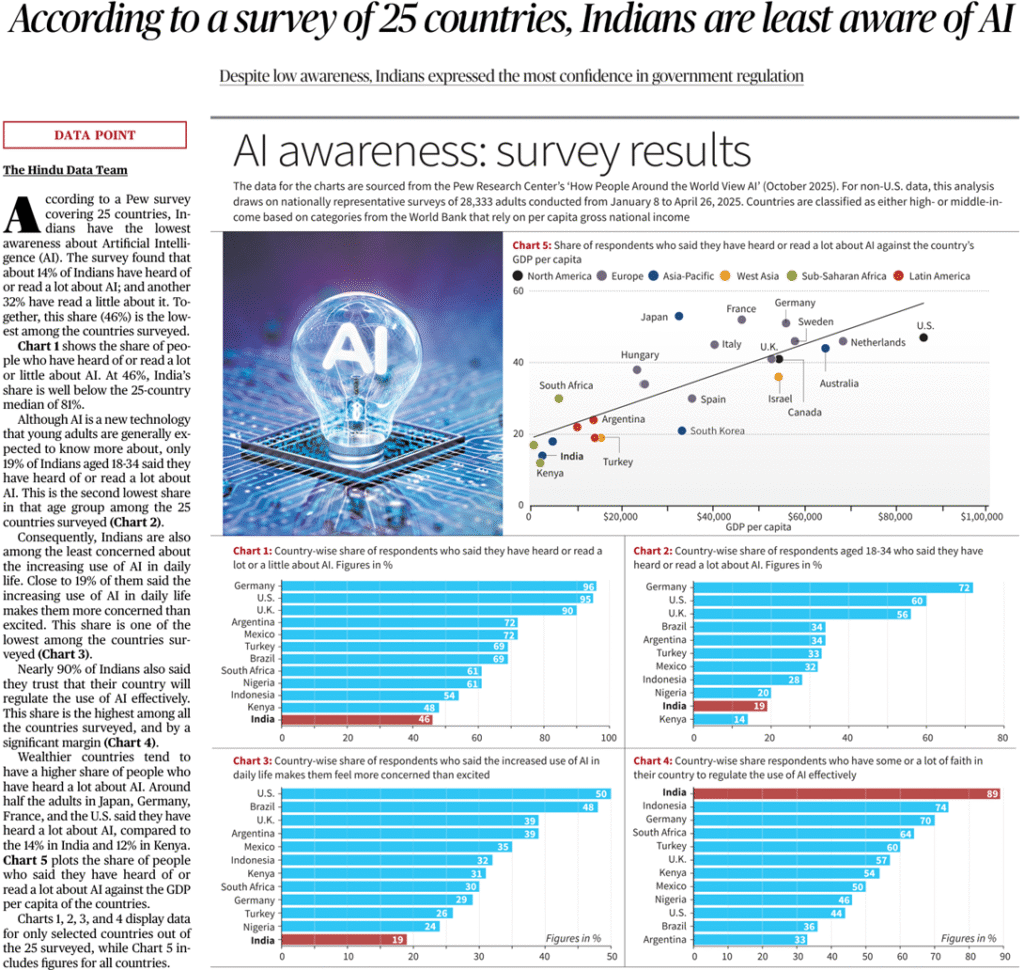
- According to a survey of 25 countries, Indians are least aware of AI
- Indian maritime sector has seen historic progress: Modi
Context: PM launches initiatives worth ₹2.2 lakh crore for shipping and shipbuilding sectors at Maritime Leaders’ Conclave; amid global tensions, India represents autonomy and inclusive growth.
- The progress in India’s maritime domain has been historic and the capability of major ports has doubled, Prime Minister Narendra Modi.
- “Cargo movement has increased 700% in inland areas. Today, India’s ports are considered among the best in the developing world,” he added.
- Mr. Modi was speaking at the Maritime Leaders’ Conclave held at the NESCO Ground to mark ‘India Maritime Week’.
- During the event, Mr. Modi launched initiatives worth ₹2.2 lakh crore for the shipping and shipbuilding sectors, including acquisition of 437 vessels. Several memoranda of understanding (MoUs) for port-led industrialisation, sustainability, and shipbuilding, among others, were signed.
Sign of confidence
- “In 2016, the maiden India Maritime Week was held in Mumbai. Today, it has become a global summit. Eighty-five countries participate in it today. This itself sends a very big message,” Mr. Modi said.
- “The MoUs signed here show the confidence of the world in India’s maritime capabilities.”
- “This [2025] is a crucial year for the country’s maritime capabilities. The Vizhinjam deep water transit hub has been operational. It is a matter of pride for every Indian. Kandla port and the Jawaharlal Nehru Port Trust (JNPT) have shown great capabilities. The JNPT’s handling capability has doubled, making it India’s biggest container port,” he added.
- Modern and futuristic laws have been implemented and old laws scrapped. They strengthen sustainability and enhance digitisation in ports. The safety of our ports has increased and ease of business has improved.”
Logistics performance
- Praising logistics performance of Indian ports, Mr. Modi said, “In the Logistics Performance Index of the World Bank, India had performed better.”
- “Shipbuilding is our top priority too. India is making great strides in shipbuilding,” he said, adding, “New alternatives for finance and easy credit will be offered.”
- “We welcome your ideas, innovation and investment. Public-Private Partnerships [PPP] have been increasing. We are giving incentives to States to attract investment,” he told the attendees at the conclave.
- India, China hold fresh round of talks on border peace
Context: The Indian and Chinese militaries held a fresh round of high-level talks aimed at maintaining peace and security along the Line of Actual Control (LAC) in eastern Ladakh.
- It was the first such interaction between the two militaries after the Special Representatives’ talks in August between National Security Adviser Ajit Doval and Chinese Foreign Minister Wang Yi.
- According to the Ministry of External Affairs (MEA), the 23rd round of India-China Corps Commander-level meeting was held on October 25 at the Chushul-Moldo border meeting point.
- This was the first meeting of the General Level Mechanism in the Western Sector since the 24th round of Special Representatives’ talks held on August 19. The discussions, the Ministry said, were held in a “friendly and cordial atmosphere”.
- The Ministry added that both sides had reviewed the progress since the 22nd round of Corps Commander-level Meeting held in October 2024 and shared the view that peace and tranquillity have been maintained in the border areas. The two sides agreed to continue using existing mechanisms to resolve any issues on the ground and to maintain stability along the LAC.
- The Chinese Ministry of National Defence also confirmed the talks, stating that “the two sides engaged in active and in-depth communication on the management of the western section of the China-India border”.
- The latest round of talks comes amid ongoing efforts by both nations to sustain dialogue and prevent incidents along the contested frontier, where disengagement efforts have been under way since 2020.
- Japan’s new PM calls Modi, discusses Quad, economic and security issues
Context: India and Japan would like to open a “golden chapter” in their ties, said Japan’s Prime Minister Sanae Takaichi, who held her first conversation with Prime Minister Narendra Modi, a week after she took office. The conversation, which lasted about 25 minutes, focused on the Quad, economic and defence cooperation, and the mobility of professionals, both sides said.
- In a post, Mr. Modi said he had discussed their “shared vision for advancing the India-Japan Special Strategic and Global Partnership, indicating India and Japan will move forward with the initiatives and agreements signed during Mr. Modi’s visit to Japan in August. Mr. Modi had then met with Ms. Takaichi’s predecessor Shigeru Ishiba, who subsequently had to resign from office.
- The Japanese Prime Minister’s office said that Ms. Takaichi stated that India and Japan share “fundamental values and strategic interests”.
- “Japan intends to continue to work together toward realizing a Free and Open Indo-Pacific, including through Japan-Australia-India-U.S.,” it said in statement, adding that Japan will continue its cooperation with India on security, economy, investment, innovation, and people-to-people exchanges. In a post responding to Mr. Modi on social media, Ms. Takaichi said that she would like to open a “new golden chapter in the Japan-India Special Strategic and Global Partnership”, along with Mr. Modi.
- The new Japanese Prime Minister has met many of her Asian and Indo-Pacific counterparts already, as she attended the ASEAN summit in Kuala Lumpur last week, that Mr. Modi pulled out of. Ms. Takaichi will be in Gyeongju in South Korea for the Asia Pacific Economic Cooperation Summit.
- When asked about whether she will meet Chinese President Xi Jinping, who will hold a summit with U.S. President Donald Trump morning, Chief Cabinet Secretary Minoru Kihara said that her schedule is still being finalised.
- The conversation between the two Prime Ministers came a day after Mr. Trump’s visit to Japan, when Ms. Takaichi had also referenced the Quad.
- Developing nations need 12 times more funds to fight climate crisis
Context: To adapt to climate change, developing countries will require anywhere from $310-365 billion (at least ₹27 lakh crore) annually by 2035, according to a United Nations analysis. This is nearly 12 times more than the money that currently flows from the developed to the developing world for this purpose.
- The analysis, underlining the huge gap between the demand and supply of funds needed to protect developing nations from climate change impacts, appears in Running on Empty, an annual report on the shortfall released, ahead of the 30th edition of the UN Framework Convention on Climate Change Conference of Parties (COP-30) to be held in Belem, Brazil next month.
- International public adaptation finance flows to developing countries stood at $26 billion (about ₹2.2 lakh crore) in 2023, down from $28 billion the previous year. If these trends continue, a target agreed upon by countries at the COP-26 in Glasgow, to double adaptation finance to $40 billion by 2025 will be “missed”, the report added.
Disappointing target
- Finance is a significant issue in climate negotiations, as developing countries insist that developed countries pay the costs of adaptation (to deal with climate change impacts) and mitigation (to move away from fossil fuels), as well as compensation for losses and damages already occurring. This total bill is collectively called “climate finance”.
- At COP-29 in Baku, Azerbaijan last year, developing countries, which were demanding nearly $1.3 trillion annually by 2035, were disappointed when the developed world agreed to only $300 billion, called the New Collective Quantified Goal (NCQG) on climate finance.
- Tuesday’s UN report underlines this criticism. “…it is far too evident that the financial resources needed to enable adaptation action in developing countries at the scale necessary to meet the growing challenges of current and future climate risks is woefully inadequate. It will take nothing less than a global collective effort to increase climate finance to the levels articulated in the Baku to Belém Roadmap to 1.3 trillion,” it notes.
- The report also raises concerns that whatever money has been made available at present is primarily classified as ‘debt.’ Although 70% of international public adaptation finance was concessional in 2022-23, it is “worrisome” that debt instruments continue to dominate these overall flows, comprising 58% on average in that financial year, the report said.
- SEBI favours ‘simpler’ mutual fund rules
Context: Regulator proposes to do away with old rules, simplify language,and rationalise fee structure; changes aimed at reducing investor costs.
- The Securities and Exchange Board of India (SEBI) has proposed major changes to mutual fund regulations to reduce investor costs and to make them simpler.
- The markets regulator said that the proposals contained provisions to do away with old rules, simplify the language, and rationalise fee structures.
- “Numerous amendments over the last 29 years have contributed to the MF regulations becoming considerably voluminous and complex. Hence, SEBI has undertaken an exercise to comprehensively review the MF regulations,” according to a consultation paper.
- As part of the efforts to make MF schemes cheaper for the investor, SEBI has done away with the additional expense of 0.05% charged by AMCs over exit load. “In 2012, mutual funds were mandated to credit exit load to the scheme and AMCs were allowed to charge 20 bps more as additional expenses to the scheme. A basis point is one-hundredth of a percentage. The said additional charge, was reduced from 20 bps to 5 bps in 2018,” SEBI said.
- “The provision for additional expense of 5 bps allowed to the AMCs to charge the mutual fund schemes, was transitory in nature..with an objective to rationalise cost for unit holder, this expense charged to the scheme has been removed from the draft MF regulations,” SEBI said.
- To lighten the impact of the removal of additional expense on exit load, SEBI proposed that the first two slabs of the expense ratio of open-ended active schemes be revised upwards by 5 bps. It also proposed to exclude all statutory levy like STT, GST, CTT, and stamp duty from the expense ratio limits along with the present permissible expenses for brokerage, exchange and regulatory fees. SEBI also proposed to reduce brokerage charges to 0.02% from 0.12% in cash market and 0.01% from 0.05% in the derivatives market.
- India mulls $12-bn plan to bail out debt-laden State power discoms
Context: India is considering a bailout exceeding ₹1 trillion ($12 billion) for debt-laden state-run power distribution companies.
- To receive the bailout funds, the States will be required to privatise their electric utilities and transfer managerial control or keep control but list them on a stock exchange, according to three government officials and a document outlining the plan prepared by the Union Ministry of Power.
- The plan marks Prime Minister Narendra Modi’s toughest reform push yet to overhaul the chronically inefficient state-run electricity distribution companies, seen as the weakest link in India’s energy chain. The Power Ministry and the Ministry of Finance are discussing the final details of the bailout, with an announcement expected in the February budget, said two government sources.
- Under the proposal, at least 20% of the state’s total power consumption must be met by private companies and the States must assume part of the retailer’s debt, according to the Power Ministry presentation.
- To do so the States can choose to privatise their distribution operations for access to loans to pay off existing debt under two options. First, the States can create a new distribution company, divest 51% of the equity, which will enable them to access a 50-year interest-free loan for the privatised company’s debt, along with access to low-interest federal loans for five years, the presentation showed.
- The second option would let States privatise up to 26% of the equity of an existing State-owned power distribution company in exchange for access to low-interest loans from the federal government for five years, it showed.
- Alternatively, States that do not decide to transfer managerial control through privatisation must list their utilities on a recognised stock exchange within three years.
- States that choose to list would receive low-interest loans from the federal government for infrastructure management, the presentation showed.
- The State power retailers have accumulated losses of ₹7.08 trillion ($80.6 billion) and outstanding debt of ₹7.42 trillion ($84.4 billion) as of March 2024, the documents showed.
- Private companies such as Adani Power, ReliancePower, Tata Power, CESC and Torrent Power are expected to benefit from the reforms as they are likely to gain stakes in the State companies.
- Sugar sector concerned over reduction in ethanol sourcing
Context: The sugar sector is concerned over the cut in ethanol sourcing in the 2025-2026 ethanol supply year.
- The Indian Sugar & Bio-Energy Manufacturers Association (ISMA) said only 289 crore litre ethanol had been allocated from sugar-based feedstock or 28% of the total need. The industry invested almost ₹40,000 crore with a capacity to supply 650 crore litre of ethanol a year. It supplied 330 crore litre last ethanol supply year.
- The sector expects almost 345 lakh tonne sugar output between October 1 and September 30, 2026. Of this, local consumption will be just 284 lakh tonne and sugar diversion for ethanol 34 lakh tonne leading to excess sugar stocks.
- While the Fair and Remunerative Price of sugarcane rose 16.5% to ₹355 a quintal since 2022–23, ethanol procurement prices from sugarcane juice and B-heavy molasses was static at ₹60.73 and ₹65.61 a litre respectively. Ethanol’s cost of production was ₹66.09 a litre from B-heavy molasses and ₹70.70 a litre from cane juice.
- The minimum selling price (MSP) of sugar has been ₹31 a kg since February 2019 with output cost at ₹40.24/kg. The Centre must ensure 50% ethanol is sourced from sugar sector, raise MSP, announce sugar export policy and increase ethanol procurement prices, ISMA said.
- What is China’s complaint against India at WTO?
Context: China has filed a complaint with the World Trade Organization (WTO) against India. It alleges that India is providing subsidies, as part of the Production-Linked Incentive (PLI) scheme, for the development of advanced chemistry cell (ACC) batteries; for boosting the auto sector; and for facilitating the production of Electric Vehicles, in contravention of WTO law.
What is the PLI scheme?
- India launched the PLI scheme in 2020 to give a fillip to Indian manufacturing. This scheme provides financial incentives based on incremental sales to strategic industries; aims to bolster India’s position in global value chains; and integrates medium and small-scale industries into the industrial production process through backward linkages.
- The three specific PLI schemes that China has challenged are — the PLI scheme which aims to incentivise the establishment of giga-scale manufacturing capabilities of ACC batteries in India; the scheme for the auto industry, which seeks to buttress the manufacturing of Advanced Automotive Technology (AAT) products in India, encompassing both vehicles and their components; and third, a scheme to promote EV manufacturing by attracting global EV manufacturers to the country.
What is China’s complaint?
- China alleges that the three PLI schemes provide financial benefits or subsidies to companies operating in India contingent on Domestic Value Addition (DVA). For instance, under the PLI scheme for the auto sector, one of the conditions for eligibility to get financial benefits is that there must be a 50% DVA.
- Likewise, one of the salient features of the PLI scheme for ACC batteries is that the beneficiary must ensure a DVA of 25%. The Chinese argue that the DVA requirements under these PLI schemes incentivise companies to use domestic goods rather than imported goods, discriminating against Chinese goods in the Indian market.
What is the law on subsidies in WTO?
- While providing industrial subsidies to boost domestic industry is a sovereign right of states, WTO law ensures that these subsidies are not provided in a manner that jeopardises the international trade of other countries by ushering in unfair competition.
- Unfair competition may arise from subsidies that confer an artificial advantage on industries for exporting or competing with imported products. Consequently, the grant of industrial subsidies is regulated by the Subsidies and Countervailing Measures (SCM) agreement of the WTO. Article 1 of the SCM agreement defines a subsidy as a financial contribution by a government or a public body that confers a benefit. The subsidy should also be specific.
- The SCM agreement divides subsidies into three categories — prohibited subsidies, actionable subsidies, and non-actionable subsidies. Prohibited subsidies are forbidden by definition and are generally of two types: export subsidies and Import Substitution (IS) subsidies. Export subsidies are contingent on export performance, and IS subsidies, as defined in Article 3.1(b) of the SCM agreement, refer to subsidies contingent upon the use of domestic goods over imported goods. Thus, if a country promises a financial contribution to a specific industry on the condition that it use domestic goods or goods produced locally, rather than imported goods, it would constitute a prohibited subsidy.
Do IS subsidies violate other laws?
- An IS subsidy will also breach two other WTO legal provisions. First is the national treatment obligation, codified in Article III.4 of the General Agreement on Tariffs and Trade (GATT), which obligates countries to ensure that their domestic laws do not treat imported products less favourably than their domestic products; and second, is Article 2.1 of the Trade Related Investment Measures (TRIMs) Agreement which states that no country shall impose any TRIM that is inconsistent with its national treatment obligations enshrined in GATT’s Article III.
- The TRIMs agreement contains a specific illustration of a prohibited trade-related investment measure. This illustration pertains to local content requirements which incentivise the use of domestically produced goods. Since an IS subsidy gives preference to domestic over foreign goods, it constitutes as a proscribed TRIM under the WTO law.
- China alleges that India’s three PLI schemes are IS subsidies. However, it is critical to note that the DVA milestones in India’s PLI scheme do not automatically translate to local content requirements. Value addition at the domestic level can occur in multiple ways, and not just through the use of domestic goods. The analysis of the DVA component in these three PLI schemes must thus consider a complex set of facts.
What happens next?
- The first step in resolving a dispute at the WTO is through consultations. Thus, India and China will try to resolve this matter amicably. If this does not occur, the dispute will proceed to adjudication by a three-member ad hoc WTO panel. The WTO’s appellate mechanism, the Appellate Body, has remained incapacitated since December 2019.
- Thus, if the WTO panel’s decision is appealed, it would mean postponing the adjudication of the dispute till the time the Appellate Body is resurrected. The practical implication is that the status quo remains, and a country can continue with its impugned measures.
- How do cyclones form and how are they measured?
Context: If you think of a cyclone as a machine, it would be an incredibly powerful entity — an engine that draws heat from the earth’s tropical waters to drive destructive winds, heavy rainfall, and storm surges. Similar storms are known variously as hurricanes in the Atlantic and eastern Pacific Oceans, and typhoons in the western Pacific Ocean.
How do cyclones form?
- A tropical cyclone begins as an area of low pressure, often associated with clusters of thunderstorms. For such a disturbance to develop into a cyclone, several atmospheric and oceanic conditions must come together.
- The most important is warm sea surface temperature, generally above 26.5°C and up to a depth of at least 50 m. When moist air near such a water surface rises, it releases its latent heat, cools, and condenses to form clouds. The released heat warms the surrounding air, causing it to rise even further and drawing in more moist air from below, setting up a self-reinforcing cycle of convection.
- A second important condition is that the atmosphere must be unstable, that is, rising air must continue to rise rather than being forced back down, and there must be a sufficient Coriolis force (a deflection of circulating air due to the earth’s rotation, causing it to curve right in the Northern Hemisphere and left in the Southern Hemisphere) to induce rotation. As the Coriolis effect is weakest at the equator, cyclones rarely form within about five degrees of latitude from it. At the same time, the vertical wind shear, which is the difference in wind speed and direction between the lower and the upper levels of the atmosphere, must be low. High wind shear can disrupt a cyclone’s organised circulation and keep it from building in strength.
- As the cyclone develops, a well-defined centre called the ‘eye’ may form. This is a calm, clear region surrounded by a ring of towering thunderstorms that produce the most intense winds and heaviest rainfall, called the eyewall.
- Air spirals in towards the low-pressure centre at the surface and rises rapidly near the eyewall, while at higher altitudes it flows outwards, completing the circulation.
How are cyclones classified?
- Since the storm draws energy from the ocean through evaporation, it can intensify as long as it remains over warm water. Cyclones are primarily classified by their maximum sustained wind speed and central pressure. Different ocean basins use slightly different classification schemes but the principle is the same. In the North Indian Ocean, the India Meteorological Department classification ranges from a ‘depression’ (31-49 km/hr) to ‘super cyclonic storm’ (>222 km/hr).
- For measurements, meteorologists use ground-based observations, aircraft reconnaissance, satellite data, and ocean buoys. Satellites play a crucial role in monitoring cyclones over remote ocean areas: infrared images help estimate the temperature of cloud tops, indicating storm intensity, while visible and microwave sensors reveal structure, rainfall distribution, and eye formation.
- In the North Atlantic, specialised aircraft called hurricane hunters fly directly into storms to measure wind speeds, pressure, humidity, and temperature. Instruments called dropsondes are released into the storm, transmitting data as they fall. In the Indian Ocean, satellites and automated buoys provide most of the data.
How well are cyclones forecast?
- Forecasting the path and intensity of cyclones remains a complex challenge. Sophisticated numerical weather models simulate atmospheric and oceanic conditions, but even small errors in initial data can lead to large uncertainties. Advances in computing power, remote sensing, and data assimilation have improved forecasts significantly over the last few decades. Today, most meteorological agencies can predict a cyclone’s track three to five days in advance with reasonable accuracy.
- India gets 6-month waiver for Iran port
Context: U.S. relief on sanctions against Chabahar in force from, says MEA; essential supplies to Afghanistan can now be sent through the port.
- India has received a waiver on the United States’ sanctions against Iran’s Chabahar port for six months, the Ministry of External Affairs spokesperson Randhir Jaiswal announced. Officials said that the sanctions waiver had come into effect from October 29.
- India has been associated with the Chabahar port at least since 2005, when it entered into an agreement with Iran to develop the port.
- Both sides signed an MoU in 2015 to jointly develop the Shahid Beheshti Port at Chabahar in the hope that it would emerge as a major commercial hub helping India access the markets of Afghanistan, the Central Asian states, and Russia. The port’s prospects came under a cloud due to Western sanctions against Iran, but in 2018, the first Trump administration gave a waiver to Indian operations at the Chabahar port as it was aimed at helping the development needs of the U.S.-backed Islamic Republic of Afghanistan.
- In September, the U.S. Department of State said that it would revoke the waiver for Indian operations that was offered by Donald Trump in 2018. The move exposed anyone associated with the Chabahar project to U.S. sanctions under the Iran Freedom and Counter-Proliferation Act.
- However, the latest U.S. decision means that supplies to Afghanistan, especially essential items like food grains and medical products, can still be sent through Chabahar.
- 70 persons selected for Rajyotsava award
Context: On the occasion of the Kannada Rajyotsava celebrations on November 1, the State government on Thursday announced its annual Rajyotsava awards for 70 personalities for their contributions in different fields.
- Writers including Rajendra Chenni, Rahamath Tarikere, R. Sunandamma, and H.L. Pushpa, multilingual actor Prakash Raj, actor Vijayalakshmi Singh, former IAS officer H. Siddaiah, and M.R. Jayaram of Ramaiah University are among the 70 people selected for the award for 2025.
- The award carries an amount of ₹5 lakh, a 25-gram gold medal, and a citation.
- Chief Minister Siddaramaiah will present the awards at a function to be held on Saturday. A committee headed by the Chief Minister selected persons for the award, Kannada and Culture Minister Shivaraj Tangadagi told mediapersons.
- Umashree to receive Dr. Rajkumar Award
Context: Veteran film and theatre person Umashree has been chosen for Dr. Rajkumar Award for lifetime achievement in Kannada cinema.
- The State government announced the recipients of the 2019 State Film Lifetime Achievement and Literary Awards. The awards will be presented at a ceremony in Mysuru on November 3, which will also include the presentation of the 2018 and 2019 State Film Awards.
- N.R. Nanjunde Gowda has been selected for the Puttanna Kanagal Award, which honors outstanding contributions to direction in Kannada cinema, while the Dr. Vishnuvardhan Award will go to filmmaker Richard Castelino. Each of these awards carries a cash prize of ₹5 lakh and a gold medal.
- In the literary category, the State Film Literature Award for 2019 has been conferred on senior journalist Raghunath Ch.Ha. for his book “Belli Tore – Cinema Essays,” published by Ankita Prakashana. Both the author and the publisher will receive ₹20,000 in cash and a silver medal each.
- Sardar Patel’s vision and the meaning of national unity today
Context: Every year, on October 31, India observes Rashtriya Ekta Diwas — National Unity Day — to honour the birth anniversary of Sardar Vallabhbhai Patel, Independent India’s first Deputy Prime Minister and Home Minister. Few figures shaped the foundations of the Republic as decisively as Patel, who brought together more than 560 princely states after 1947 to create a single political entity.
- Patel’s realism, patience and firmness prevented the subcontinent from fracturing in the wake of Partition. Junagarh, Hyderabad, and Jammu & Kashmir might well have slipped into uncertainty but for his persuasion and resolve. The idea of unity he espoused was never uniformity; it was a federation of minds and hearts bound by shared heritage. That belief remains India’s anchor in an age of widening diversities and new aspirations.
- The decision in 2014 to commemorate Patel’s birthday as National Unity Day recognised that unity is not a settled fact but a continuous act of national renewal. Across the country, schools, civil organisations and citizens reaffirm the pledge to uphold the nation’s integrity. Events such as the ‘Run for Unity’ embody Patel’s call for collective action — reminding us that patriotism must move from sentiment to participation.
- The 150th birth anniversary that falls this year will be observed with special programmes at Ekta Nagar near the 182-metre-tall Statue of Unity — itself a monumental tribute to Patel’s nation-building legacy. Cultural parades, tableaux from States, and performances by over 900 artists will celebrate the idea that India’s strength lies in its many voices speaking as one.
Culture as a bond
- In a country where languages, faiths and folk traditions coexist in profusion, culture has long served as the most durable bond of unity. Institutions under the Ministry of Culture — from zonal cultural centres to national museums — work to democratise heritage, ensuring that no region feels isolated from the national narrative.
- Programmes such as ‘Ek Bharat Shreshtha Bharat’ institutionalise this spirit by pairing States and Union Territories for exchanges in language, cuisine, and art. When students in Maharashtra learn Bihu or young performers from Assam stage Lavani in Pune, they practise Patel’s idea that knowing one another is the first step to standing together.
- Tourism, too, is an instrument of cohesion. The ‘Dekho Apna Desh’ campaign and an upgraded ‘Incredible India’ digital platform encourage citizens to explore their own land — from Punjab’s Golden Temple to Kerala’s backwaters, from Assam’s tea gardens to Rajasthan’s deserts. In 2024 alone, domestic tourism crossed 294 crore visits, reflecting a surge in curiosity and pride among Indians about India.
- Schemes such as Swadesh Darshan and PRASHAD go beyond infrastructure to create local livelihoods. When a woman in Nagaland runs a homestay for visitors from Gujarat or an artisan in Jodhpur sells crafts to travellers from Tamil Nadu, they exchange more than goods — they share experiences that knit the Republic closer.
- Unity, Patel taught, is a task renewed in every generation. It must be defended against the fragmenting impulses of indifference, ignorance and regionalism.
- The ‘Panch Pran’ — the five resolves of the ‘Azadi ka Amrit Mahotsav’ — place the pledge of national solidarity at the heart of India’s journey towards 2047.
- As India marks the sesquicentennial year of Sardar Patel’s birth, the true homage to the Iron Man lies not in marble or memory, but in ensuring that every Indian feels part of the same national story. Whether through a cultural performance, a museum exhibit, or a journey across States, each act of participation strengthens the invisible threads that bind this civilisation together.
- In Sardar Patel’s words and in Prime Minister Narendra Modi’s reiteration of them, unity remains both the means and the goal of India’s destiny — Ek Bharat, Shreshtha Bharat.
- Trump-Xi bonhomie and reference to G-2 may impact India and Quad
Context: External Affairs Ministry non-committal on outcome of U.S.-China summit in South Korea; experts warn of ripple effects in region; after talks, U.S. reduced tariffs on China to 47%, making India and Brazil, at 50%, among nations with highest tariff.
- The summit between U.S. President Donald Trump and Chinese President Xi Jinping in Busan, South Korea, ended with several outcomes for bilateral ties between the two countries, but also sent ripple effects to India. As a result of the talks, the U.S. has reduced tariffs on China to 47%, making India and Brazil, at 50%, among the countries with the highest tariffs.
- More than the specific outcomes, including a one-year truce on trade tariffs and export restrictions on rare earth minerals, experts said the characterisation by both leaders of the U.S.-China “G-2” or grouping of the two biggest global powers, may have a bigger impact. At the meeting with Mr. Xi, Mr. Trump began by saying, “I think we are going to have a fantastic relationship for a long period of time.”
- “China and the U.S. can jointly shoulder our responsibility as major countries, and work together to accomplish more great and concrete things for the good of our two countries and the whole world,” Mr. Xi said, as per Chinese Foreign Ministry’s statement.
- When asked about the summit, Ministry of External Affairs spokesperson Randhir Jaiswal was non-committal. “As far as the question of the latest [Trump-Xi] talks and relaxations that have happened between U.S. and China, as to how it is going to play into our domain, I will come back to you,” he told reporters on Thursday.
- The G-2 or the idea of creating an exclusive U.S.-China club to work on global issues was floated as a concept about 15 years ago around the summit between U.S. President Barack Obama and Chinese President Hu Jintao in 2009, when trade, climate change and nuclear proliferations were pressing concerns for the U.S.
- However, Mr. Obama never used the term, and subsequently as U.S.-China tensions increased, the administration dropped the idea entirely by 2011.
Impact of entente
- Another issue is the impact of any entente between the U.S. and China on the Quad and other Indo-Pacific initiatives.
- India has always been more for a multi-polar world order rather than for a shared hegemony between the top two powers. One has to wonder if this will lead to carving up of the world into “spheres of influence”, as that will challenge not only India’s stature but also the viability of the Quad.
- Speaking to reporters onboard his flight back to the U.S., Mr. Trump said he intended to visit China in April 2026, and host Mr. Xi in the U.S. later in the year. While no date has been sent for Mr. Trump’s travel to India to attend the Australia-India-Japan-U.S. Quad Summit to be hosted by Prime Minister Narendra Modi, reports suggested that this was unlikely to take place in 2025.
- As a result, if Mr. Trump returns to Asia next year, the question won’t just be whether he will be part of the Quad summit in India, but also that whether his new “G-2” plans with China will dilute the group’s agenda to secure a free and open Indo-Pacific.
- Justice Surya Kant to take over as 53rd Chief Justiceof India on November 24
Context: The apppointment of Justice Surya Kant as the 53rd Chief Justice of India (CJI) was notified on Thursday. He will assume charge on November 24 and will remain CJI for nearly 16 months, till February 9, 2027.
- The notification was issued by the Department of Justice in the Union Law Ministry.
- “In exercise of the powers conferred by the Constitution of India, the President is pleased to appoint Shri Justice Surya Kant, Judge of the Supreme Court as the Chief Justice of India with effect from 24th November 2025,” Union Law Minister Arjun Ram Meghwal wrote on X.
- “I convey my heartiest congratulations and best wishes to him,” he added.
- Justice Surya Kant succeeds Justice Bhushan R. Gavai, who demits office on November 23.
- According to a communique by the, Justice Surya Kant was born on February 10, 1962 in Petwar of Hisar, Haryana. He earned his Law degree from Maharishi Dayanand University, Rohtak, in 1984. He then began his practice the same year at District Courts, Hisar.
- In 1985, he shifted to the Punjab and Haryana High Court, Chandigarh, specialising in constitutional, service, and civil matters. On July 7, 2000, he earned the distinction of being appointed the youngest Advocate-General of Haryana and was also designated as a senior advocate.
- He served as the Advocate-General until his elevation as a permanent Judge of the Punjab and Haryana High Court on January 9, 2004.
- As a judge, he served on the governing body of the National Legal Services Authority (NALSA) from 2007 to 2011 and, later, earned a first class in his Master’s degree in Law in 2011. He was appointed the Chief Justice of the Himachal Pradesh High Court on October 5, 2018, and thereafter was elevated to the Supreme Court of India on May 24, 2019.
- Since May 14, 2025, he has been the Executive Chairman of NALSA and also serves on several committees of the Indian Law Institute.
- Fully aware of Great Nicobar project’s impact, says Centre
Context: The Centre tells the NGT that no tribal persons will be displaced, noting that the projectwill cover about 18% of the Great Nicobar area, leaving over two-thirds of its land mass as forests.
- Defending the Great Nicobar Island mega-infrastructure project at the National Green Tribunal (NGT) on Thursday, the Union government argued that it was fully aware of the project’s likely impact on the biodiversity of the surrounding areas, positing that the main issue was whether the government was “alive to this or not”.
- Noting that the government considers it its duty to undertake mitigation measures, Additional Solicitor-General Aishwarya Bhati said that the Centre had mandated conservation and monitoring programmes to run for the next three decades as the project was developed. She said that the project “is going to be a national asset”.
- The submissions came in response to a batch of petitions that have challenged the environmental clearance issued for the ₹92,000-crore project, which will include a transshipment port, an international airport, a township, and a power plant to be built on more than 160 sq. km of land. Of this, about 130 sq. km is forest land inhabited by the Nicobarese and the Shompen communities, both Scheduled Tribes, with the Shompen categorised as a Particularly Vulnerable Tribal Group.
- One petition, submitted by activist Ashish Kothari, challenges the clearances obtained for the project, citing violations of the Island Coastal Regulation Zone (ICRZ) notification, 2019 notification and inadequacies in the environmental impact assessment.
- Making its arguments before the NGT Bench now hearing the matter, the Union government submitted that it had considered studies and research conducted over decades before mandating measures to translocate, conserve, and monitor the project activities’ impact on the biodiversity of the region.
Coral colonies
- Ms. Bhati noted that while plans had been outlined for translocating over 16,000 of the 20,668 coral colonies that are under threat from the project’s activities, there is also a plan in place to ensure the monitoring of the remaining 4,500-odd coral colonies. She submitted that there were about 51 active nests of the Nicobar megapode in the project activities’ area; though about 30 will be permanently destroyed, there were also plans in place to conserve the remaining nests.
- “There is biodiversity all around the islands, and the conclusion was that this region is the most suitable. All other nesting beaches of the leatherback turtles will be protected and conserved,” Ms. Bhati argued.
- The Centre added that no tribal persons will be displaced or dispersed, noting that the project will only cover 1.82% of the whole island’s archipelago area, which amounts to about 18% of the Great Nicobar area, still leaving GNI with over two-thirds of its land mass as forests.
- The Centre also defended the environment clearance granted for the project, which has mandated detailed measures to study and monitor the biodiversity of the region as the project is developed, calling it “an alive document” that prescribes conservation measures till 2052.
- India ready to help Afghanistan with hydel projects: MEA
Context: India is willing to support Taliban-governed Afghanistan in building “hydroelectric projects”, the official spokesperson of the Ministry of External Affairs, Randhir Jaiswal.
- Addressing the weekly MEA press conference, Mr. Jaiswal said that the two sides can build on a “history of cooperation” on water-related matters and reiterated that India remains “committed” to the sovereignty and territorial integrity of Afghanistan.
- The Taliban side welcomed Mr. Jaiswal’s remarks about cooperation in hydroelectric projects.
- “As emphasised in the recently adopted India-Afghanistan Joint Statement, India stands ready to support Afghanistan in its efforts to manage water resources sustainably, including with hydroelectric projects,” Mr. Jaiswal said.
- The Taliban spokesperson for international media, Suhail Shaheen, welcomed the announcement and said, “There are a lot of opportunities for cooperation between the two countries.”
- “The need is to send delegates from various Ministries to explore the opportunities and areas of cooperation. Hydel power is one of them,” Mr. Shaheen. Sources here indicated that India would consider sending delegates if the Taliban made appropriate requests.
- Cooperation to build hydel power projects was part of a joint statement issued during a visit by the Taliban’s Acting Foreign Minister Amir Khan Muttaqi on October 10.
- Referring to Pakistani attacks against Afghan positions along the Durand Line earlier this month and also on the capital Kabul, Mr. Jaiswal said, “Pakistan is infuriated with Afghanistan exercising sovereignty over its own territories.”
- ‘Over 600 MoUs worth ₹12 lakh crore signed at the Maritime Week’
Context: Agreements were in diverse sectors such as port development, indigenous ship building and container manufacturing: Sonowal.
- More than 600 memorandum of understanding (MoUs) worth over ₹12 lakh crore were signed at the Indian Maritime Week 2025, Union Minister of Ports, Shipping and Waterways Sarbananda Sonowal said.
- Mr. Sonowal said the MoUs were in diverse sectors such as ship building, port development, indigenous ship building and container manufacturing.
- “In the last 11 years, whatever transformative journey we could create, we did. Also, in the transformative policy programmes whatever changes we could create, we did. This will ultimately make India globally, the most desirable, favourable investment destination,” he said.
- Secretary in the Ministry of Ports, Shipping, and Waterways Vijay Kumar said that of the MoUs signed, 30% were for port development and port modernisation, 20% for sustainable green shipping and green ports, 20% for shipping and ship building, 20% with regard to port-led industrialisation and 10% for trade, business and skilling.
- “Maritime sector projects have long gestation periods. Investment comes in, it takes time to get invested. Already 60% of the MoUs entered into at the last summit have been grounded, meaning, the money [has been committed] and has started coming in,” he said.
- During the event, 11 global CEOs met with the PM. “They represented different divisions of maritime sectors including, ports, port modernisation, port operators, dredging operators and ship building. In almost all the areas, they promised and committed to invest,” Mr. Kumar said.
- The event witnessed the participation of about one lakh people and delegates from 85 countries.
- India expected to add 6 GW of new wind energy capacity: Joshi
Context: Union Minister for New and Renewable Energy (MNRE) Pralhad Joshi on Thursday said 6 gigawatts (GW) of new wind capacity is expected to be added by the end of financial year 2025-2026, the highest-ever annual addition, up from last year’s 4 GW.
- “[In] this financial year, so far, over 3 GW of new wind capacity has been added,” he said in a media interaction on the sidelines of the 7th edition of Windergy India 2025 conference in Chennai.
- “India is moving with clear determination towards the goal of achieving 500 GW of renewable energy by 2030, and wind power will play a major part — contributing 100 GW or more. With 54 GW of installed wind energy and another 30 GW under implementation, we are well on track to meet our 2030 target, Mr. Joshi said.
- Tamil Nadu, Karnataka, and Andhra Pradesh together contribute almost half of India’s total wind capacity of 54 GW, he said.
- “India’s wind industry already has 70% local content, showing strong domestic capability. Under the Atmanirbhar Wind Mission, our goal is to increase this to 85% by 2030,” Mr. Joshi said.
- “The GST on wind equipment has been reduced from 12% to 5%, helping reduce turbine cost by over ₹25 lakh per MW,” Mr. Joshi said.
- “With the approved list of models and manufacturers (ALMM) – wind framework and related initiatives, India can soon meet 10% of global wind demand by 2030 and up to 20% by 2040 and emerge as a global manufacturing hub for turbines and components,” he said.
- “A study by the National Institute of Wind Energy (NIWE) shows a potential of 1,164 GW at 150 metres hub height across India. To unlock new areas, the government has launched a viability gap funding (VGF) scheme for offshore wind projects, targeting 1 GW in the first phase — 500 MW each off Gujarat and Tamil Nadu,” Mr. Joshi said.
- MNRE Secretary Santosh Kumar Sarangi said the tender for the Tamil Nadu offshore wind project is expected to be floated by February.
- Earlier speaking at the inaugural of the conference, Mr. Joshi said India’s total installed capacity was nearing 500 GW, with non-fossil sources contributing over 257 GW.