Wed. Mar 25th, 2026

Current Affairs

Padma awardees Karnataka

  • Eight from Karnataka honoured with Padma awards

Context: They are from an array of fields, from Art to Trade and Industry; three of the awardees are in the category of ‘Unsung heroes’.
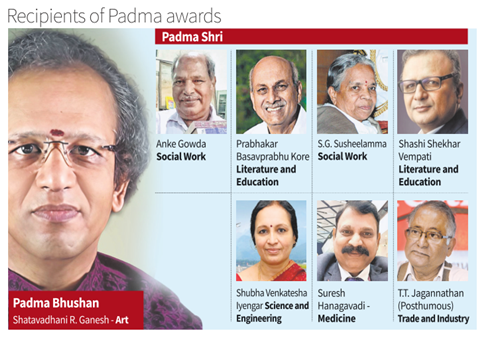
  • Shatavadhani R. Ganesh and former BJP Rajya Sabha member Prabhakar B. Kore are among the eight personalities from Karnataka to feature on the list of Padma awardees this year, announced on the eve of Republic Day.
  • While Dr. Ganesh has been awarded Padma Bhushan in the category of Art, three among the Padma Shri awardees- Anke Gowda M. from Mandya district, Suresh Hanagavadi from Davangere, S.G. Susheelamma from Bengaluru- have been identified as “Unsung heroes.”

Shatavadhani R. Ganesh

  • Sholar and artist, Mr. Ganesh is the only personality from Karnataka to figure in the Padma Bhushan category. He is widely acclaimed for reviving and mastering avadhana, an ancient art form.
  • An alumnus of the Indian Institute of Science and a student of Metallurgy, Dr. Ganesh, a writer in Kannada and Sanskrit, is credited with the revival of the tradition of Avadhana in Kannada. Avadhana requires focus, concentration and alertness among other skills to compose poetry or face literary challenges posed by other scholars simultaneously in a unique literary event. He is also the author of several works.

S.G. Susheelamma

  • A well-known social activist from Bengaluru and the driving force behind the non-profit organisation Sumangali Seva Ashrama, Ms. Susheelamma has been selected for the Padma Shri Award 2026 in recognition of her decades-long commitment to social service.
  • She is widely respected for her work with abandoned women, orphaned children and marginalised sections of society.
  • Ms. Susheelamma told The Hindu that she had never sought accolades or public acknowledgement for her work. She said the award was a result of “divine grace and the goodwill of the people”. Recalling the early days of her organisation, she said the ashram was established in October, 1975, after she encountered children in urgent need of shelter and care. “I decided to take responsibility for their wellbeing, which eventually led to the formation of the institution.” The ashram has expanded its activities to include a nursery and higher primary school, adult literacy initiatives, health check-up camps, etc.

Suresh Hanagavadi

  • JJM medical college professor and founder of the Karnataka Haemophilia Society (KHS), Dr. Hanagavadi began researching Haemophilia after he found that he was suffering from the condition. He founded the KHS with the support of play back singer S.P. Balasubramanyam. Over the years, he has treated several thousand children and adults suffering from Haemophilia.
  • He told reporters in Davangere that he was happy that the cause of Haemophilia had been recognised at the national level due to the award. “After being diagnosed with the condition, I founded the society to try and create awareness about it, and promote further research. I only think of it as my responsibility as a medicine teacher and doctor,’’ he said.

Shubha Venkatesha Iyengar

  • A former National Aerospace Laboratory (NAL) scientist who is noted for her contribution in the development of DRISHTI Transmissometer, which is a runway visibility measuring system and Aviation Weather Monitoring System that has been installed in more than 100 locations across the country.
  • Ms. Shuba joined the NAL in 1974 as a research student and was a scientist in the Material Science Division and Airport Instrument Division. She retired from the NAL in 2020. “It is nice to note that our team’s contribution to the country has been recognised. I want to thank my parents for allowing me to pursue my higher education as it was very different at that time for women to pursue higher education but my father encouraged me to do my PhD,” Ms. Shuba said.

Anke Gowda

  • The 75-year-old runs Pustaka Mane (House of Books) in Haralahalli village of Pandavapura taluk in Mandya district that has a collection of more than 20 lakh books. The institution is regarded as one of the country’s largest personal libraries, offering free access to readers. A book curator and librarian, Mr. Gowda worked as a bus conductor before joining a sugar factory in Pandavapura as a timekeeper, setting aside a major portion of his salary to buy books.
  • He not only sold his site in Mysuru, but also invested his retirement funds to procure books for the library.
  • His collection of books, which he started when he was 20 years old, spans literature, science, technology, mythology and philosophy, and includes rare historical manuscripts dating back to 1832. It also features more than 5,000 dictionaries in multiple languages.

Shashi Shekhar Vempati

  • Former Prasar Bharati Chief Executive Officer Shashi Shekhar Vempati has been selected for the Padma Shri for his contributions to media. Mr. Vempati took charge as CEO of the Prasar Bharati in June 2017 and completed a full five-year term.
  • An alumnus of IIT Bombay, he was the youngest person and the first non-civil servant to head Prasar Bharati since the institution was established in 1997.

Prabhakar Basavprabhu Kore

  • Former chairman of the KLE Society, the 78-year-old educationist has led the KLE Society for over 40 years. The society was running 30 educational institutions in 1985 when he took over. Now, it runs 316 schools, colleges and hospitals with over 18,000 staff and 1.45 lakh students. Its hospitals have over 3,000 beds and provide tertiary specialist treatment to patients in various fields of medicine.

T.T. Jagannathan (Posthumous)

  • Chairman emeritus of T.T.K. Prestige, Mr. Jagannathan passed away in Bengaluru in 2025, at 77. He led TTK to become a market leader in the small appliances industry in the country. He was instrumental in transforming the company to reach a market cap of over one billion dollars.
  • He was the longest-serving director/chairman in the company’s history.

Padma awards 2026

Nation honours 131 personalities with Padma awards

Context: The Centre announced Padma honours for 2026, with five Padma Vibhushan, 13 Padma Bhushan, and 113 Padma Shri awards. The recipients include eight personalities from Kerala, 11 from West Bengal, and 13 from Tamil Nadu, all poll-bound States.

  • A former Kerala Chief Minister and Communist stalwart, the late V.S. Achuthanandan, and the late actor Dharmendra have been posthumously named for the Padma Vibhushan, the country’s second highest civilian award. Former Supreme Court judge K.T. Thomas and educationist P. Narayanan, both from Kerala, and violinist N. Rajam are the other three to get the Padma Vibhushan.
  • A former Jharkhand Chief Minister and tribal leader, the late Shibu Soren, has been named for the Padma Bhushan posthumously.

Diverse disciplines

  • Actor Mammootty, singer Alka Yagnik, banker Uday Kotak, and tennis legend Vijay Amritraj are among the 13 selected for the Padma Bhushan.
  • Prime Minister Narendra Modi congratulated all the awardees for their contribution to diverse fields.
  • “Congratulations to all the Padma Awardees for their outstanding contributions to our nation. Their excellence, dedication, and service enrich the fabric of our society,” he said in a post on X.
  • The Padma awards are given in disciplines such as social work, public affairs, science and engineering, trade and industry, medicine, literature and education, sports, civil service, among others. While the Padma Vibhushan is awarded for exceptional and distinguished service, Padma Bhushan is for distinguished service of high order, and Padma Shri for distinguished service in any field.

The issues surrounding Governors’ address


What do Articles 175 and 176 of the Constitution mandate? How are Governors acting against established constitutional practices when it comes to the yearly address to State legislatures, especially in Opposition-ruled States? What were the recommendations of the Sarkaria and Punchhi Commission?
There have been a series of issues in Opposition-ruled States with respect to the address by the Governor to the State legislature at the commencement of the first session of the year. This has raised constitutional and political questions about the Governor’s role in State legislature.

What is the history?

Section 63 of the Government of India Act, 1935 (GOI Act) provided that the Governor may in his discretion address the provincial legislature. From April 1937, when provincial autonomy started under the GOI act, the Governor’s speech was prepared in consultation with the council of ministers in provinces that laid down the legislative agenda.

Similarly, in the Constituent Assembly, while adopting the Article dealing with Governors’ address to State legislature, it was understood that it would reflect the policy of the elected council of ministers and not the Governor’s personal views.

What are Constitutional provisions?

Article 175 of the Constitution specifies that the Governor may address the house(s) of the State legislature. This is not a mandatory address and may be rarely used by a ruling government. Article 176, on the other hand, provides that the Governor shall address the house(s) of the State legislature at the commencement of the first session after each general election to the Legislative Assembly and at the commencement of the first session of each year. This is a mandatory address to be prepared by the council of ministers, and delivered by the Governor, outlining the government’s achievements in the previous year and its roadmap for policies in the ensuing year. This address is also provided whenever a new assembly is constituted to enable a newly sworn-in council of ministers to outline their policies to the elected representatives and through them to the citizens at large. Article 176 further directs that the rules of procedure of the house(s) shall have provisions for allotment of time for discussion of matters referred in such address. This is the ‘Motion of thanks on Governor’s address’ where the ruling and opposition legislators debate on policy matters announced in the address before voting on the same.

The Supreme Court in Shamsher Singh versus State of Punjab (1974) had held that the Governor is only a constitutional head who acts on the advice of the council of ministers. In Nabam Rebia versus Deputy Speaker (2016), the Supreme Court reiterated that the address under Article 175 or 176 is to be performed by the Governor on the aid and advice of the council of ministers.

What are the current issues?

The current issues arise because Governors in Opposition-ruled States act against established constitutional practices. In Tamil Nadu, the Governor had skipped some portions of the address prepared by the council of ministers in 2022 and 2023. Subsequently, since 2024, the Governor has failed to address the assembly as required under Article 176. In Kerala, the Governor skipped a few portions of the policy address prepared by the State’s cabinet. In Karnataka, the Governor did not read out the address prepared by the council of ministers but instead delivered his own two-line address before leaving the joint session of the legislature.

It is pertinent to note that the Governors take the oath of office under Article 159 that requires them to ‘preserve, protect and defend the Constitution and the law.’ Such actions go against constitutional principles and the law as settled by the highest court of the country. There have been instances of friction between elected governments and nominated governors since the 1960s with respect to the formal yearly address to the State legislature.

However, current instances are more frequent with Governors altogether skipping the address.

What can be the way forward?

Governors act as the nominal head of the State executive just like the President does for the Union executive. Further, the Governor acts as an appointee of the Centre which may be required for maintaining the unity and integrity of the nation in critical times. Nevertheless, federalism is also a basic feature of our Constitution and the Governor’s office should not undermine the powers of popularly elected governments. The underlying issue for conflicts has been the politicisation of the Governor’s post. Many political leaders have called for abolition of the post in the past. But considering our quasi-federal constitutional scheme, such demands for abolition are likely to remain only on paper. The reform that can be implemented is the recommendation of the Sarkaria and Punchhi Commission. As per these recommendations, the Constitution may be amended to provide that the Chief Ministers of States shall be consulted before the appointment of Governors. While this may not be a panacea for all issues between Governors and elected governments, it could be a good starting point to minimise discord on important legislative issues and avoid confrontation on customary practices like the annual address.

Source: The Hindu

ವೆನೆಜುವೆಲಾ: ತೈಲ ಮಸೂದೆ ಚರ್ಚೆ

ಸಂದರ್ಭ: ತೈಲದ ಮೇಲೆ ರಾಷ್ಟ್ರೀಯ ಹಿಡಿತ ಸಡಿಲಿಸುವ ಮಸೂದೆಯ ಕುರಿತ ಚರ್ಚೆಯನ್ನು ವೆನೆಜುವೆಲಾ ಆರಂಭಿಸಿತು.
• ಸಮಾಜವಾದಿ ನಾಯಕ ಹೂಗೋ ಚಾವೆಜ್ ಅವರು 2007ರಲ್ಲಿ ತೈಲೋದ್ಯಮವನ್ನು ರಾಷ್ಟ್ರೀಕರಣಗೊಳಿ-ಸಿದ ನಂತರ ಮೊದಲ ಬಾರಿಗೆ ಈ ಕುರಿತ ಚರ್ಚೆನಡೆದಿದೆ.
• ಈ ಮಸೂದೆಯು ತೈಲ ಉದ್ಯಮದಲ್ಲಿ ಖಾಸಗಿ ಕಂಪನಿಗಳಿಗೆ ಹೂಡಿಕೆ ಮಾಡಲು ಮತ್ತು ಹೂಡಿಕೆ ವಿವಾದಗಳಿಗೆ ಅಂತರರಾಷ್ಟ್ರೀಯ ಮಧ್ಯಸ್ಥಿಕೆಯನ್ನು ಸ್ಥಾಪಿಸಲು ಹೊಸ ಅವಕಾಶಗಳನ್ನು ಸೃಷ್ಟಿಸಲಿದೆ.
• ವೆನೆಜುವೆಲಾದ ಅಧ್ಯಕ್ಷರಾಗಿದ್ದ ನಿಕೋಲಸ್ ಮಡೂರೊ ಅವರನ್ನು ಈ ತಿಂಗಳ ಆರಂಭದಲ್ಲಿ ಟ್ರಂಪ್ ಆಡಳಿತವು ಸೆರೆ ಹಿಡಿದಿತ್ತು.

ಡಬ್ಲ್ಯುಎಚ್ಒದಿಂದ ಅಮೆರಿಕ ಹೊರಕ್ಕೆ

ಸಂದರ್ಭ: ವಿಶ್ವ ಆರೋಗ್ಯ ಸಂಸ್ಥೆಯಿಂದ(ಡಬ್ಲ್ಯುಎಚ್ಒ) ಹೊರಬರುವ ಪ್ರಕ್ರಿಯೆಯನ್ನು ಅಮೆರಿಕ ಪೂರ್ಣಗೊಳಿಸಿದೆ ಎಂದು ಅಧಿಕಾರಿಗಳು ಹೇಳಿದ್ದಾರ.

  • ಡೊನಾಲ್ಡ್‌ ಟ್ರಂಪ್‌ ಅವರು ಕಳೆದ ವರ್ಷ ಅಮೆರಿಕದ ಅಧ್ಯಕ್ಷರಾಗಿ ಅಧಿಕಾರ ವಹಿಸಿಕೊಂಡವೇಳೆ, ‘ಅಮೆರಿಕವು ವಿಶ್ವ ಆರೋಗ್ಯಸಂಸ್ಥೆಯೊಂದಿಗೆ ಹೊಂದಿರುವ 78 ವರ್ಷಗಳ ನಂಟನ್ನು ಕೊನೆಗೊಳಿಸಲಿದೆ’ ಎಂದು ಘೋಷಿಸಿದ್ದರು. ಅದು, ಈಗ ಕಾರ್ಯಗತಗೊಂಡಂತಾಗಿದೆ.
  • ಸಂಸ್ಥೆಗೆ ಅಮೆರಿಕ ತನ್ನ ಪಾಲಿನ ವಂತಿಗೆಯನ್ನು ಬಾಕಿ ಉಳಿಸಿಕೊಂಡಿದೆ. ಈ ಮೊತ್ತ 13 ಕೋಟಿ ಡಾಲರ್‌ ಗೂ (ಅಂದಾಜು ₹1,200 ಕೋಟಿ) ಹೆಚ್ಚು ಎಂದುಡಬ್ಲ್ಯುಎಚ್‌ಒಹೇಳಿದೆ.
  • ‘ಈ ಬೆಳವಣಿಗೆ ಹಲವು ಸಮಸ್ಯೆಗಳಿಗೆ ಕಾರಣವಾಗಲಿದೆ.ವಿವಿಧ ದೇಶಗಳಲ್ಲಿ ಕಂಡುಬರುವ ಸೋಂಕು/ರೋಗಗಳ ಕುರಿತು ಅಧ್ಯಯನ ಕೈಗೊಳ್ಳಲು, ಔಷಧಿ/ಲಸಿಕೆ ಅಭಿವೃದ್ಧಿಪಡಿಸುವುದಕ್ಕೆ ಅಮೆರಿಕದ ವಿಜ್ಞಾನಿಗಳಿಗೆ ಹಾಗೂ ಔಷಧ ಕಂಪನಿಗಳಿಗೆ ಕಷ್ಟವಾಗಲಿದೆ’ ಎಂದುಜಾರ್ಜ್‌ಟೌನ್ ವಿಶ್ವವಿದ್ಯಾಲಯದ ಸಾರ್ಜನಿಕ ಆರೋಗ್ಯಕಾನೂನು ತಜ್ಞ ಲಾರೆನ್ಸ್ ಗಾಸ್ಪಿನ್ ಹೇಳಿದ್ದಾರೆ.

ಲೋಕಪಾಲಕ್ಕೆ ಕಾಲಾವಕಾಶ

ಸಂದರ್ಭ: ‘ಪ್ರಶ್ನೆಗಾಗಿ ಲಂಚ’ ಪ್ರಕರಣದಲ್ಲಿ ಟಿಎಂಸಿ ಸಂಸದೆ ಮಹುವಾಮೊಯಿತ್ರಾ ವಿರುದ್ಧಆರೋಪ ಪಟ್ಟಿಸಲ್ಲಿಸಲು ಸಿಬಿಐಗೆ ಅನುಮತಿ ನೀಡುವ ವಿಚಾರವನ್ನು ಕಾನೂನಿನ ಪ್ರಕಾರ ಪರಿಗಣಿಸಲು ಲೋಕಪಾಲಕ್ಕೆ ನೀಡಿದ್ದ ಕಾಲಾವಕಾಶವನ್ನು ದೆಹಲಿ ಹೈಕೋರ್ಟ್ ಎರಡು ತಿಂಗಳು ವಿಸ್ತರಿಸಿದೆ.

  • ನ್ಯಾಯಮೂರ್ತಿಗಳಾದ ಅನಿಲ್ ಕ್ಷೇತ್ರಪಾಲ್ ಮತ್ತು ಹರೀಶ್ ವೈದ್ಯನಾಥನ್ ಶಂಕ‌ರ್ ಅವರ ಪೀಠವು, ಸಮಯ ವಿಸ್ತರಣೆ ಕೋರಿ ಇನ್ನು ಮುಂದೆ ಸಲ್ಲಿಸುವ ಯಾವುದೇ ಮನವಿಯನ್ನು ಪರಿಗಣಿಸುವುದಿಲ್ಲ ಎಂದು ಹೇಳಿತು.
  • ಮಹುವಾ ಮತ್ತು ಕೇಂದ್ರೀಯ ತನಿಖಾ ಸಂಸ್ಥೆಯ (ಸಿಬಿಐ) ಪರ ವಾದ ಮಂಡಿಸಿದ ವಕೀಲರು, ‘ಕಾಲಾವಕಾಶವನ್ನು ಎರಡು ತಿಂಗಳು ವಿಸ್ತರಿಸಬೇಕೆಂಬ ಲೋಕಪಾಲದ ಮನವಿಯನ್ನು ನಾವು ವಿರೋಧಿಸುತ್ತಿಲ್ಲ’ ಎಂದು ಹೇಳಿದರು.

ಲೋಕಪಾಲ್ (Lokalpal) ಭ್ರಷ್ಟಾಚಾರದ ವಿರುದ್ಧ ತನಿಖೆ ನಡೆಸುವ ಅತ್ಯುನ್ನತ ಸಂಸ್ಥೆಯಾಗಿದೆ. ಲೋಕಪಾಲ್ ಕಾಯ್ದೆ 2013 ರಲ್ಲಿ ಅಂಗೀಕಾರವಾಯಿತು. 1 ಜನವರಿ 2014 ರಿಂದ ಜಾರಿಗೆ ಬಂದಿತು. ಮೊದಲ ಅಧ್ಯಕ್ಷರು: ಪಿನಾಕಿ ಚಂದ್ರ ಘೋಷ್ (P.C. Ghosh).

ಲೋಕಪಾಲ್: ತನಿಖೆ ಮತ್ತು ವಿಚಾರಣೆಯ ಕಾಲಮಿತಿ

ಲೋಕಪಾಲ್ ಸಂಸ್ಥೆಯ ಇತರ ಪ್ರಮುಖ ಅಂಶಗಳು:

ಹಂತಕಾಲಾವಕಾಶ (Time Limit)ವಿಸ್ತರಣೆ (Extension)
ಪ್ರಾಥಮಿಕ ವಿಚಾರಣೆ (Preliminary Inquiry)30 ದಿನಗಳುಅಗತ್ಯವಿದ್ದರೆ ಲಿಖಿತ ಕಾರಣಗಳೊಂದಿಗೆ 3 ತಿಂಗಳವರೆಗೆ ವಿಸ್ತರಿಸಬಹುದು.
ತನಿಖಾ ವರದಿ ಸಲ್ಲಿಕೆ (Inquiry Report)ಪ್ರಾಥಮಿಕ ವಿಚಾರಣೆ ಮುಗಿದ ನಂತರ 60 ದಿನಗಳೊಳಗೆ ಲೋಕಪಾಲ್‌ಗೆ ಸಲ್ಲಿಸಬೇಕು.
ಪೂರ್ಣ ಪ್ರಮಾಣದ ತನಿಖೆ (Investigation)6 ತಿಂಗಳುವಿಶೇಷ ಸಂದರ್ಭಗಳಲ್ಲಿ ಏಕಕಾಲಕ್ಕೆ 6 ತಿಂಗಳವರೆಗೆ ವಿಸ್ತರಿಸಬಹುದು.
ವಿಚಾರಣೆ ಪೂರ್ಣಗೊಳಿಸುವುದು (Trial)1 ವರ್ಷವಿಶೇಷ ಕಾರಣಗಳಿದ್ದರೆ ಗರಿಷ್ಠ 2 ವರ್ಷಗಳವರೆಗೆ ವಿಸ್ತರಿಸಬಹುದು.


ರಚನೆ: ಒಬ್ಬರು ಅಧ್ಯಕ್ಷರು ಮತ್ತು ಗರಿಷ್ಠ 8 ಜನ ಸದಸ್ಯರಿರುತ್ತಾರೆ (ಇದರಲ್ಲಿ 50% ನ್ಯಾಯಾಂಗ ಸದಸ್ಯರು ಮತ್ತು 50% SC/ST/OBC/ಅಲ್ಪಸಂಖ್ಯಾತರು ಹಾಗೂ ಮಹಿಳೆಯರಿರಬೇಕು).

ವ್ಯಾಪ್ತಿ (Jurisdiction): ಪ್ರಧಾನ ಮಂತ್ರಿ (ಕೆಲವು ವಿನಾಯಿತಿಗಳೊಂದಿಗೆ), ಕೇಂದ್ರ ಸಚಿವರು, ಸಂಸತ್ ಸದಸ್ಯರು ಮತ್ತು ಗ್ರೂಪ್ A, B, C, D ಅಧಿಕಾರಿಗಳು ಲೋಕಪಾಲ್ ವ್ಯಾಪ್ತಿಗೆ ಬರುತ್ತಾರೆ.

ಆಯ್ಕೆ ಸಮಿತಿ: ಪ್ರಧಾನ ಮಂತ್ರಿ (ಅಧ್ಯಕ್ಷರು), ಲೋಕಸಭೆಯ ಸ್ಪೀಕರ್, ಲೋಕಸಭೆಯ ವಿರೋಧ ಪಕ್ಷದ ನಾಯಕರು, ಸುಪ್ರೀಂ ಕೋರ್ಟ್ ಮುಖ್ಯ ನ್ಯಾಯಾಧೀಶರು (CJI) ಅಥವಾ ಅವರು ಸೂಚಿಸಿದ ನ್ಯಾಯಾಧೀಶರು ಮತ್ತು ಒಬ್ಬ ಖ್ಯಾತ ನ್ಯಾಯಶಾಸ್ತ್ರಜ್ಞರು ಈ ಸಮಿತಿಯಲ್ಲಿರುತ್ತಾರೆ.

Lokapal: HC gives Lokpal two months to decide on sanction against MP

Context: The Delhi High Court on Friday granted two months’ time to the Lokpal of India to decide on granting sanction to the Central Bureau of Investigation (CBI) to file a chargesheet against Trinamool Congress MP Mahua Moitra in connection with the cash-for-query allegations against her.

  • A Division Bench allowed the application filed by the Lokpal of India seeking additional time to decide the matter.
  • The court also clarified that no further time would be granted.
  • The High Court, on December 19, 2025, had set aside a November order of the Lokpal granting sanction to the CBI to file a chargesheet against the Trinamool MP in the case. It had said the Lokpal’s decision was a clear departure from the procedure expressly mandated under law. The order came on a plea filed by Ms. Moitra challenging the Lokpal’s decision.
  • Ms. Moitra was expelled from the Lok Sabha in December 2024 after BJP MP Nishikant Dubey and advocate Jai Dehadrai alleged that she had taken a bribe from businessman Darshan Hiranandani to ask questions in Parliament. She was accused of compromising her parliamentary privileges and causing national security threats by sharing her Lok Sabha login credentials.

Governors: Gubernatorial walkouts test constitutional limits

Context: The walkouts of Governors from the inaugural State Legislative Assembly sessions in Opposition-ruled Karnataka, Tamil Nadu and Kerala mark a departure from the “limited freewheeling” allowed to them under the Constitution.

  • Article 176 (1) mandates that Governors, at the commencement of the first session of each year, “shall” address the Legislative Assembly or, in the case of a State having a Legislative Council, both Houses assembled together and inform the Legislature of the causes of its summons.
  • Reports said the Karnataka government may approach the Supreme Court for a judicial declaration on the constitutionality of these gubernatorial walkouts after selective or aborted reading of the special address to the assembled legislators, and indirectly to the people they represent in the Assembly. Leaders from these States argue that the Governors have no discretion to skip paragraphs or not read them in toto. The address articulates the policy of the State Cabinet, whose advice the Governors are to abide.
  • The Constituent Assembly Debates quoted Dr. B.R. Ambedkar on the role of the Governor in Parliamentary democracy, “The Governor under the Constitution has no functions which he can discharge by himself; no functions at all. While he has no functions, he has certain duties to perform… He is the representative not of a party; he is the representative of the people as a whole of the State.”
  • The Supreme Court in its judgment in the Tamil Nadu Governor case held that the discretionary powers of the Governor cannot have the “effect of negating the powers of a responsible government”. The following Presidential Reference agreed to term the Governor as a “guide, philosopher and a friend of the government and the people in general”.
  • A seven-judge Bench of the Supreme Court in the 1974 case of Shamsher Singh versus State of Punjab observed that for a centrally appointed constitutional functionary to “take up public stances critical of government policy settled by the Cabinet” amounted to “unconstitutional faux pas and ran counter to Parliamentary system”.
  • The Supreme Court has consistently held that the discretionary powers of Governors are plainly stated in the Constitution. Governors cannot cross the line. A Constitution Bench in the 2016 Nabam Rebia case observed that the Constitution allows Governors elbow room in giving assent or withhold or refer a Bill for Presidential assent, the appointment of the Chief Minister, the dismissal of a government which has lost confidence but refuses to quit since the Chief Minister holds office during the pleasure of the Governor, the dissolution of the House, the Governor’s report under Article 356 (President’s rule), and while exercising gubernatorial responsibility for specific States.
  • The court said addressing the House under Article 175(1) or making a special address under Article 176(1) were “executive functions” performed by the Governor on the aid and advice of the Council of Ministers.
  • The Shamsher Singh judgment spelt out clearly that even the “limited freewheeling” allowed to the Governor was “not left to the sweet will of the Governor but remote-controlled by the Union Ministry which is answerable to Parliament for those actions”.
  • The court reasoned that if discretion was permitted to the Governor in every one of his roles, Parliamentary democracy would become a “dope” and the Head of the State would become a “reincarnation of Her Majesty’s Secretary of State for India, untroubled by even the British Parliament – a little taller in power than the U.S. President”.

Overseas Citizen of India (OCI)

  • OCI quota rules amended
  • The State government has amended the Karnataka Educational Institutions (Prohibition of Capitation Fee) Act, 1984 (Karnataka act 37 of 1984), for admission to government seats in professional educational institutions rules, 2006, and announced the gazette notification draft rules specifying the quotas for Overseas Citizen of India (OCI) in medical education.
  • As per the draft, Overseas Citizen of India born on or before March 4, 2021 or being an OCI card holder before the said date will not be entitled for any reservation applicable to a citizen of India.
  • Meanwhile, the OCI candidates born on or after March 5, 2021 or being an OCI card holder after the date are eligible for admission only against any Non-Resident Indian (NRI) seat or any supernumerary seat.

India to become third largest space-tech economy by 2030: Report

Context: India’s space economy, currently estimated at $13 billion, is set to touch $40 billion by 2030, according to the recent India Spacetech-2026 report by early-stage venture capital (VC) firm, Arkam Ventures.

  • Titled ‘India’s Space Odyssey’, the report forecasts the sector to grow at twice the pace of the global market and that structural shifts in India’s spacetech ecosystem will propel it to the world’s third-largest space-tech economy by 2030. The growth will be fuelled by cost-efficient engineering, deep manufacturing capabilities and a new generation of start-ups building advanced space technologies for customers worldwide, it noted.
  • Over the past five years, more than 300 space-tech start-ups have emerged in India, in areas such as satellite manufacturing, earth observation, launch vehicles, and in-space solutions. “More than two-thirds of the historical capital flows in the Indian spacetech sector have come in the last five years, post the space policy being formulated. We expect $3 billion to $5 billion of private capital flows in the sector over the next couple of years to fund cutting edge space innovations.” the report read. According to the VC, this momentum is built on ISRO’s legacy of low-cost, high-impact missions and its active support for private innovation.
  • “India is uniquely positioned to lead the global spacetech sector fuelled by the unique ecosystem development role played by the ISRO and the support from the government. Over the next five years, we expect $3billion to $3.5 billion of the VC and Private Equity investments in the sector,” said Rahul Chandra, managing director, Arkam Ventures.