English
UPSC/KPSC Current Affairs: 13th December 2025
- Retail inflation moves up marginally to 0.7% in Nov.
Context: Inflation has slowed in seven of the first eight months of the financial year; decline in food prices offsets marginal acceleration in fuel inflation; prices in housing segment stay virtually unchanged.
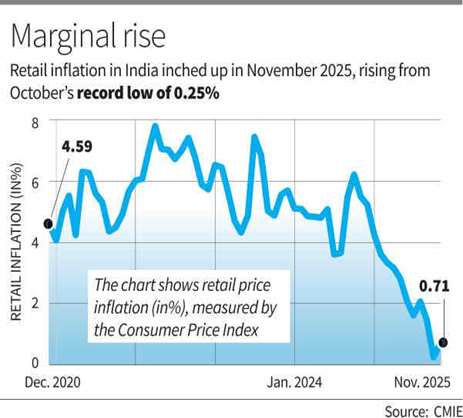
- Retail inflation in India quickened marginally to 0.7% in November 2025, up from the historic low of 0.25% in October 2025, with a continued contraction in food prices offsetting a marginal acceleration in fuel inflation. November’s inflation rate is the second-lowest ever recorded in the current series of the Consumer Price Index (CPI).
- Inflation as measured by the CPI, for which the latest data were released by the Ministry of Statistics and Programme Implementation on Friday, has slowed in seven of the first eight months of this financial year.
- The food and beverages category saw prices contract by 2.8% in November 2025, as compared to a high base of 8.2% in November of last year, and a contraction of 3.7% in October 2025.
- “The factors driving inflation downwards have been the same: base effect and decline in prices of vegetables and pulses,” Madan Sabnavis, chief economist at the Bank of Baroda said. “In particular, potatoes, onions and tomatoes have witnessed a decline, leading to food inflation falling by 3.9%. In the food basket, edible oils witnessed sharp increases though the topline number was down to 7.9%. Mustard and coconut oil were the main drivers of inflation here.”
- This contraction in food prices offset the impact of a quickening in fuel inflation to 2.3% in November 2025, compared to 2% in October, and a contraction of 1.8% in November of last year. Inflation in the pan, tobacco, and intoxicants category quickened marginally in November 2025 to 3% from 2.9% in October.
- The clothing and footwear category, on the other hand, saw inflation ease marginally to 1.5% from 1.7%.
- Inflation in the housing category remained virtually unchanged at 2.95% in November 2025 as compared to 2.96% in October.
- AI Centre of Excellence for Healthcare established at IISc
Context: The Translational AI for Networked Universal Healthcare (TANUH) Foundation has been established at the Indian Institute of Science (IISc) in Bengaluru as a dedicated AI Centre of Excellence in Healthcare to advance AI-driven healthcare innovation at scale in the country.
- This has been established in line with the government of India’s vision of ‘Make AI in India and Make AI Work for India’, and the Ministry of Education has set up four Centres of Excellence in Artificial Intelligence (AI-CoEs), each hosted by a premier academic institution in India, including IISc.
- The institute stated that the TANUH AI-CoE is a Section 8 not-for-profit company that focuses on developing and deploying scalable AI solutions for the effective management of non-communicable diseases (NCDs) at the point of care. The centre operates as a multidisciplinary hub, bringing together clinicians, data scientists, and AI researchers.
- Nine faculty members from IISc, spanning digital health, machine learning, and public health, anchor the centre’s research programmes. TANUH’s core team, comprising executives, engineers, programme managers, and research staff, with significant industry experience, enables the translation of health-AI technologies from the lab to the population scale.
- TANUH’s goal is to design and deploy tools for early detection, risk prediction, monitoring and personalised solutions across high-burden conditions such as oral cancer, breast cancer, retinal diseases, diabetes, and mental health. The tools will help frontline health workers, improve primary and hospital care, and include human decision-making to make sure the care is safe and effective. The solutions are designed to be used directly where patients are treated, follow responsible AI standards, and are created and tested together with doctors and researchers.
- About 31% of SCSP/TSP funds used for guarantee schemes since 2023
Context: Minister defends move stating Section 7(C) of the SCSP/TSP Act allows utilisation of the funds in tune with SC/ST population.
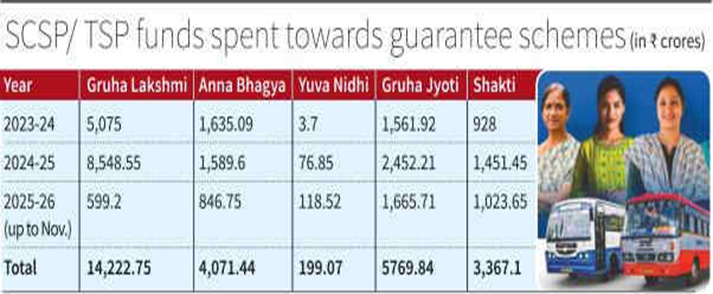
- The State government has used a significant share of the amount earmarked for the Scheduled Castes Sub Plan (SCSP) and Tribal Sub Plan (TSP) towards implementing the five guarantee schemes of the Congress government since 2023.
- According to statistics shared by Social Welfare Minister H.C. Mahadevappa, in response to a question by Hemalatha Nayak in the Legislative Council in Belagavi on Friday, of the total amount spent towards SCSP and TSP, as much as 31%, has been utilised for the guarantee schemes.
- The total amount for SCSP and TSP for the year 2023-24 was ₹35,221.8 crore, and of that, ₹34,369.85 crore was released, and finally, ₹34,245.76 crore was spent. In the year 2024-24, the total amount spent for SCSP and TSP was ₹38,717.74 crore. In the current year, up to November 2025, the government had spent ₹14,938.19 crore towards the SCSP and TSP.
- Since the Congress party came to power in 2023, the government has spent a total of ₹87,901.69 crore for SCSP and TSP. This amount includes ₹27,630.2 crore spent towards the guarantee schemes.
- The Minister, in his reply, defended the utilisation of SCSP/TSP funds for the guarantee schemes, stating that Section 7(C) of the SCSP/TSP Act allows utilisation of the funds in tune with the population of SC and ST.
- He stated that the amount utilised for guarantee schemes reached the beneficiaries of the SC and ST communities.
Bus travellers
- Interestingly, he stated that his department had sought information from the Transport Department about the number of SC and ST women who had benefited from the Shakti scheme, under which women passengers could travel free in KSRTC buses. Ms. Nayak, the MLC, wondered how the Transport Department could share the information of the SC/ST passengers, as they do not collect the caste details while issuing tickets.
- Leader of Opposition Chalavadi Narayanaswamy appealed to Chairman Basavaraj Horatti to allot suitable time for a detailed discussion on the issue.
- Civil society group flags concerns over Karnataka hate speech Bill
Context: A civil society organisation has urged the Karnataka government to subject the proposed Karnataka Hate Speech and Hate Crimes (Prevention) Bill, 2025, to wider public consultation before it is tabled in the Legislative Council. It has already been tabled in the Assembly.
- While welcoming the intent behind the legislation, Campaign Against Hate Speech, the organisation, said the Bill in its present form raises several concerns that warrant careful review.
- In a representation to the government, the group said the Bill marks an important acknowledgement of the harm hate speech and hate crimes inflict on constitutional values of fraternity and dignity. Stating that such acts disproportionately target women, minority and queer communities, they cautioned that the current version risks being ineffective and may leave scope for misuse.
- A key concern is the Bill’s definition of “hate crime”, which is limited to communication of hate speech. “This creates a false equivalence between speech and physical acts of violence, and fails to recognise offences such as mob lynching, punitive demolitions and social or economic boycotts. The Bill also provides no standalone punishment for hate speech, and relies on an emotion-based definition — an approach that has already led to weak enforcement under existing criminal laws,” the memorandum stated.
- The range of punishment for hate crimes was questioned for its lack of clarity, especially since the offence is non-bailable and cognisable. Sections granting broad “preventive” powers to the Executive Magistrate and police were flagged as potentially enabling arbitrary action, as the law does not define the scope of such powers or the due process requirements.
- Another point of concern, the group said, is the provision allowing a designated officer to block or remove online content construed as hate crime material even before trial.
- Emphasising that the Bill has far-reaching implications, the organisation cited the Supreme Court’s emphasis on meaningful public consultation and referred to the Centre’s 2014 Pre-Legislative Consultation Policy.
- Census 2027 to cost ₹11,718 crore, no separate budget earmarked for NPR
Context: The Union Cabinet on Friday approved the proposal for conducting Census of India 2027 at a cost of ₹11,718.24 crore, a government statement said.
- Unlike 2019, the statement does not mention a separate budgetary allocation for updating the National Population Register (NPR), which is the first step for the creation of a countrywide National Register of Citizens (NRC).
- In 2019, the Union Cabinet chaired by Prime Minister Narendra Modi approved ₹3,941.35 crore for updating the NPR and ₹8,754.23 crore for conducting the Census of India 2021, which could not be conducted due to the COVID-19 pandemic.
- NPR, which was first collected in 2010 and updated in 2015 and already has a database of 119 crore residents, was to be updated with the first phase of Census in 2020. On July 29, the government informed the Lok Sabha that no decision has been taken to update the NPR during the forthcoming Census exercise.
- Union Home Minister Amit Shah posted on X, “The outcome of the Census 2027 will serve as the new compass for development, mirroring India’s latest population data with more accuracy. The precision in data will accelerate Modi Ji’s vision of delivering the benefits of good governance and development to citizens of every demographic denomination, making the slogan of ‘Sabka Saath, Sabka Vikas’ a grand reality of New India in the Amrit Kaal.”
- The government’s statement on Friday said that the “largest administrative and statistical exercise in the world” will ensure that data are provided to Ministries in a “clean, machine-readable and actionable format” as part of the “Census-as-a-Service (CaaS)” initiative.
- This will be the first digital Census and the first to enumerate caste in independent India. “The current endeavour would be to make available the coming Census data at the shortest possible time across the country. Efforts will also be made to disseminate Census results with more customised visualisation tools,” the statement said.
- The government said that a nearly 18,600-strong technical workforce will be engaged for about 550 days at the local level.
- “The enumerators, generally government teachers and appointed by the State governments, will be doing the field work of Census in addition to their regular duties,” it said.
- Data will be collected using mobile applications and a dedicated portal, namely Census Management and Monitoring System, has been developed for monitoring the Census process in real time.
- Framework to fight fake news has been made strong: Minister
Context: The government has strengthened the framework to combat fake news and deepfakes across media platforms, Union Minister for Information and Broadcasting Ashwini Vaishnaw said in the Rajya Sabha.
- In response to the questions asked by Mohammed Nadimul Haque (Trinamool Congress), the Union Minister said free speech is protected under Article 19(1) of the Constitution.
- “The government is cognisant of the increasing instances of fake, false, misleading information, and AI-generated deepfakes across media platforms, which can adversely impact democratic processes and public order,” said the reply.
Statutory framework
- A broad statutory and institutional framework already exists to address fake news across various media platforms, the Minister said.
- TV channels follow the Programme Code under the Cable Television Networks (Regulation) Act, which prohibits content that is obscene, defamatory, deliberately false, or that contains suggestive innuendos and half-truths.
- The rules framed under the Act establish a three-tier grievance redressal mechanism to address violations.
- For the print media, Norms of Journalistic Conduct issued by the Press Council of India restrain the publication of fake, defamatory, or misleading news. It can inquire into alleged violations of the norms, examine complaints, and issue warnings.
- There is Code of Ethics under Information Technology Rules 2021 for publishers of news and current affairs on digital media.
- The Fact Check Unit (FCU) has been set up under the Press Information Bureau to check fake news related to the government.
- Govt. likely to rename MGNREGS to ‘Pujya Bapu Gramin Rozgar Yojana’
Context: The government is likely to introduce a Bill in the ongoing Winter session of Parliament amending the Mahatma Gandhi National Rural Employment Guarantee Act (MGNREGA), changing the name of the flagship rural employment scheme to “Pujya Bapu Gramin Rozgar Yojana”.
- According to senior government functionaries, the amended Bill was cleared by the Union Cabinet in its meeting.
- There was no official announcement on the proposal at the Cabinet briefing addressed by Union Minister Ashwini Vaishnaw.
- The original Bill passed by Parliament on August 25, 2005, was called the “National Rural Employment Guarantee Act”. The suffix “Mahatma Gandhi” was added in 2009.
- The flagship scheme guarantees up to 100 days of wage employment in every financial year to every household whose adult members volunteer to do unskilled manual work. The sources also indicated that the government plans to increase this to 125 days.
- As per a written answer by the Minister of State for Rural Development Kamlesh Paswan on Friday in the Rajya Sabha, the average number of days of employment per household during the past five years comes to 50.35 days. He also noted that the scheme was a “fallback option when no better employment opportunity is available”.
- In 2022, the government had appointed a panel headed by former Union Rural Development Secretary Amarjeet Sinha to review the scheme, especially the inter-State variations, and lower expenditure under the scheme in States with higher poverty rates.
- The amended Bill is likely to take into account the panel’s recommendation, introducing exclusionary clauses based on economic indices of a State.
- The government is also likely to tweak the scheme’s funding pattern.
- RS resolution seeks free, compulsory early childhood care
Context: The Rajya Sabha discussed a private member’s resolution moved by nominated member Sudha Murty urging the Union government to consider steps to amend the Constitution to introduce a new Article 21B guaranteeing free and compulsory early childhood care and education (ECCE), including nutrition, health services, and pre-primary learning, for all children between three and six years of age.
- The resolution also sought universal access to quality ECCE through strengthened Anganwadi services and asked the government to focus on ECCE for its central role in securing strong foundations for lifelong learning and development.
- “Children are our future. They are the rising Sun. Their early education should benefit their life. Hence I request through you sir, to our government to consider amending our Constitution to give fundamental right to education from three to 14 years,” Ms. Murty said.
- UNEA adopts India’s proposal on wildfire management
Context: India’s push for a stronger global system to manage and prevent wildfires — centred on early-warning mechanisms and improved risk assessments — was formally adopted at the United Nations Environment Assembly (UNEA-7) in Nairobi, the Environment Ministry said in a statement.
- India’s resolution, titled “Strengthening the Global Management of Wildfires,” calls for a shift from reactive firefighting to proactive prevention. Officials said these measures are essential to address what India called the “cascading ecological, economic and social impacts” of today’s fires.
- ‘Cover doctors deputed for COVID-19 duty under PMGKY’
Context: The Supreme Court observed that the nation must not forget the unwavering sacrifice and heroism of doctors and health workers during the pandemic days while holding that the Pradhan Mantri Garib Kalyan Yojna (PMGKY) insurance package benefits would apply to public and private medical professionals drafted into COVID-19 duties, only to lose their lives in service.
- The Indian Medical Association’s COVID-19 registry records 748 doctors’ deaths in the first wave and hundreds more in subsequent waves.
- The PMGKY package offered a comprehensive personal accident cover of ₹50 lakh for 90 days to a total of around 22.12 lakh public healthcare providers, including community health workers, who were in direct contact and care of COVID-19 patients.
- The verdict came in a petition filed on the death of a doctor who ran a private clinic in Maharashtra. Dr. B.S. Surgade’s wife claimed his services were requisitioned by the government to keep his clinic open during the pandemic. She said he had fatally contracted the virus from his patients.
- ‘PF contributions on wages beyond ₹15,000 voluntary’
Context: The Union Labour and Employment Ministry has clarified that contributions by employers and employees to the Provident Fund in excess of the statutory monthly wage ceiling of ₹15,000 are voluntary, after the Code on Social Security and three other codes came into force on November 21.
- The Code on Social Security replaces the Employees’ Provident Funds and Miscellaneous Provisions Act, 1952 and eight other laws. Similarly, 20 separate laws are subsumed into the other three codes — Code on Wages; Industrial Relations Code, and the Occupational Safety, Health and Working Conditions Code.
- In a post on social media platform X on Wednesday, the Ministry made it clear that “there is no legal requirement” for the contributions made over and above the wage ceiling. “In case the employer and the employee agree, they can voluntarily contribute on wages more than the statutory limit of ₹15,000.”
- It emphasised that there would be no reduction in take-home pay in the light of enforcement of the four codes. The Ministry gave an illustration to substantiate its position.
- Since September 2014, the present limit has been in force. It was against this backdrop that early this month, Kerala MPs Benny Behanan and Dean Kuriakose raised a question in the Lok Sabha whether the ceiling would be increased to ₹30,000.
- Union Labour Minister Mansukh Mandaviya replied that “raising the wage ceiling for coverage under EPFO [Employees’ Provident Fund Organisation] is done based on extensive stakeholders’ consultations, including trade unions and industry associations, as the same will have impact on the take-home salary of employees and on the hiring cost for employers.”
- Centre increases minimum support price for copra
- The Cabinet Committee on Economic Affairs (CCEA), here on Friday, decided to increase the Minimum Support Price (MSP) for copra for the 2026 market season.
- The MSP for fair average quality of milling copra has been fixed at ₹12,027 per quintal and for ball copra at ₹12,500 per quintal.
- The new rate is an increase of ₹445 per quintal for milling copra and ₹400 per quintal for ball copra over the previous season.
- India offers ‘final’ deal to U.S., but tariff removal is focus
Context: Offers ‘immediate’ removal of tariffs on import of items like walnutsand apples, but prioritises removal of 25% tariffs linked to Russian oil.
- India has offered the U.S. a revised “final” deal, but its priority now is the removal of the additional 25% tariffs linked to Russian oil, two different sources have confirmed .
- As per the latest submission, India has offered to “immediately” remove tariffs on the import of items like walnuts, almonds, apples, and industrial goods. However, these would be part of a larger Bilateral Trade Agreement, while India right now is focussing on the removal of the 25% tariffs. A U.S. team led by Deputy U.S. Trade Representative Rick Switzer was in New Delhi for two days until December 12.
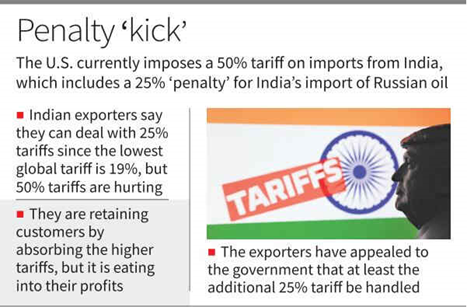
- The U.S. currently imposes a 50% tariff on imports from India, including a 25% reciprocal tariff and a 25% ‘penalty’ for India’s import of Russian oil.
- “India has offered the U.S. team a revised deal,” an official in the Government of India aware of the latest developments in the trade deal told The Hindu on the condition of anonymity given the sensitivity of the issue. “This is the final offer that India can make.”
- “The focus now is on removing the 25% Russian oil tariffs,” the official explained. “Indian exporters have told the government that they can deal with 25% tariffs since the lowest global tariff is 19%, but 50% tariffs are hurting.” Two days ago, U.S. Trade Representative Jamieson Greer, while testifying before the U.S. Senate Appropriations Committee, said that India was a “tough nut to crack”, but that the offers it has made to the U.S. were the “best we’ve ever received as a country”.
- According to a second official, Indian exporters are currently retaining customers by absorbing the higher tariffs as they feel that this is cheaper and easier than losing customers and then trying to reacquire them later. But this is eating into their profits.
- “They have appealed very sincerely to the government that at least the additional 25% tariff be handled and so the government is pushing for that,” the second official said.
- The latest version of India’s offer to the U.S. includes an offer to “immediately” remove tariffs on the import of tree nuts such as almonds and walnuts, apples, industrial goods, and items such as luxury motorcycles in return for the U.S. removing the additional 25% tariff.
- “The two teams of negotiators have broadly done what they can, the ball is in Trump’s court to accept the deal or not,” the second official said.
- This is confirmed by the fact that Commerce Minister Piyush Goyal on Thursday told reporters in Mumbai that Mr. Switzer’s visit was not “centred around negotiations”.
- A previous analysis of government trade data by The Hindu found that India has been cutting back on its Russian oil imports well before the U.S. imposed its penalty tariffs in August.
- ‘Nuclear, insurance opened up’
- India’s Cabinet approved sweeping changes to atomic energy laws and fully opened insurance sector to foreign investors, two government sources said, in a bid to attract billions of dollars in these two critical sectors.
- India, which plans to expand nuclear power capacity 12-fold by 2047, is relaxing rules to end a decades-old State monopoly and overcome a stringent liability provision to allow private participation and attract foreign technology. In insurance, the government proposed removing the 74% cap on foreign ownership of Indian insurers.
- Union Cabinet allows export of coal
Context: Paving the way for further coal exports, the Union Cabinet approved a policy allowing coal acquired through auctioning to be utilised for any industrial use and export.
- The current policy allows coal to be used only for cement, steel, sponge, iron and aluminium, etc. via auctions.
- Effectively, the Policy for Auction of Coal Linkage for Seamless, Efficient and Transparent Utilisation of coal (CoalSETU) would now allow guaranteed supply deals (coal linkages) obtained via auctions to be used for captive consumption, export, or any other purpose (including coal washing), except for resale in India. Those securing coal linkages would be allowed to use it via the window among subsidiaries or group firms.
- In FY25, India produced 1.05 billion tonne of coal.
- Technical textile missionlikely to be extended
Context: The National Technical Textiles Mission (NTTM) introduced by the Ministry of Textiles in 2020 with ₹1,480 crore in total funding, ending in March 2026 will likely be extended by two years.
- An official said with almost 50% of the funds used so far, the Mission is expected to be extended by two years. The Mission has four components — research, innovation and development; market development, export promotion and education and training.
- India frees up business visas for Chinese professionals in major step to boost ties
Context: India has cut red tape to speed business visas for Chinese professionals, two officials said, a major step to boost ties between the Asian giants and end chronic delays that cost output worth billions of dollars because of scarce technicians.
- As Prime Minister Narendra Modi cautiously rekindles ties with Beijing in the face of punishing U.S. tariffs, the officials said New Delhi dropped a layer of bureaucratic scrutiny and shortened visa approval times to less than a month.
- India had blocked virtually all Chinese visits after the nuclear-armed neighbours clashed on their Himalayan frontier in mid-2020, widening its vetting of business visas beyond the home and foreign ministries.
- Following the news, China’s Foreign Ministry said it had noticed “positive action” from India to facilitate people-to-people exchanges in the common interest. “China is willing to maintain communication and consultation with India to continuously enhance the level of facilitation of exchanges,” Ministry spokesperson Guo Jiakun added.
- The removal of red tape comes after Mr. Modi visited China this year for the first time in seven years.
UPSC/KPSC Current Affairs: 9th & 10th December 2025
- T.N. urges CWMA against permitting projects not recognised by CWDT
Context: The Tamil Nadu government on Monday urged the Cauvery Water Management Authority (CWMA) to initiate appropriate steps against Karnataka, which has been consistently facilitating cultivation by implementing projects that have not been recognized by the final verdict of the Cauvery Water Disputes Tribunal (CWDT), as well as by the judgment of the Supreme Court (SC).
- An official release issued by the Tamil Nadu government said Secretary of the Water Resources Department, J. Jayakanthan, and Chairman of the Cauvery Technical Cell, R. Subramanian, represented Tamil Nadu in the 46th meeting of the CWMA chaired by Chairman S.K. Haldar and made the submission.
- Tamil Nadu also urged the CWMA to get information about these projects, it said.
- Officials representing Tamil Nadu also requested the CWMA to ensure that Biligundlu received 7.35 tmc of water due for December, in view of the storage and considerable inflow into reservoirs in Karnataka.
- They informed that the storage in Mettur dam was 87.55 on December 8 and that inflow was 4,282 cusecs and the outflow was 2,986 cusecs for drinking water and industrial purposes.
- The CWMA was also informed that the crops have been affected due to the heavy rains received in districts in the Cauvery delta region last month and due to cyclone Ditwah in the first week of December.
- Officials were involved in ascertaining the actual loss incurred by farmers.
- ‘Provide assurances’ that Indians won’t be targeted ‘selectively’: MEA to China
Context: Reaffirming India’s territorial integrity and sovereignty, the Ministry of External Affairs on Monday urged Chinese authorities to “provide assurances” that Indian citizens will not be targeted “selectively” while they “travel” or “transit” through China.
- The remarks from the Official Spokesperson of the Ministry, Randhir Jaiswal, came approximately a fortnight after an Indian citizen was detained at the Shanghai International Airport, where Chinese authorities refused to recognise her Indian passport as she hailed from Arunachal Pradesh.
- In addition, the Ministry advised Indian nationals to exercise “due discretion” while transiting through China.
- “We expect the Chinese authorities to provide assurances that Indian citizens transiting through Chinese airports will not be selectively targeted, arbitrarily detained or harassed and that regulations governing international air travel would be respected by the Chinese side,” said Mr. Jaiswal. “The MEA would advise Indian nationals to exercise due discretion while travelling to or transiting through China.”
- Official sources said that Monday’s statement which came during a weekly press briefing indicated that New Delhi is displeased by China’s repeated assertions over Arunachal Pradesh. An official source said Monday’s statement was aimed at reminding China of India’s “firm” position on Arunachal Pradesh, which includes the ancient Buddhist region of Tawang as well as vast segments of the Eastern Himalayas.
- The possibility of harassment of Indian nationals in Chinese airports had grown after Pema Thongdok of Arunachal Pradesh announced on social media on November 23 that she was detained at Shanghai airport for “over 18 hours”.
- Putin’s India visit: Chinaseeks stronger trilateral ties
Context: China reacted positively to Russian President Vladimir Putin’s visit to India, framing the three countries as an important part of the Global South and said sound trilateral ties are conducive to regional and global peace and stability, besides their own national interests.
- “China, Russia and India are emerging economies and important members of the Global South,” Chinese Foreign Ministry spokesperson Guo Jiakun told a media briefing in Beijing, reacting for the first time to Mr. Putin’s high-profile visit to New Delhi last week and his interactions with Prime Minister Narendra Modi.
- Mr. Guo said that the three countries maintaining sound relations are not only in line with their own interests but also conducive to regional and global peace. Mr. Putin’s visit was watched closely, considering Beijing’s close and strong ties with Moscow.
- RS clears Bill to impose cess on pan masala units
Context: The Rajya Sabha passed the Health Security se National Security Cess Bill after a debate, where Opposition members argued that the Bill is an encroachment upon the rights of States.
- In her reply to the debate, Union Finance Minister Nirmala Sitharaman said cess as the percentage of the gross tax revenue during the erstwhile United Progressive Alliance regime was 7% and in 2025-26, it was 6.1%. “Far lower cess is being collected now than what was collected under the UPA,” she said, countering the charges that the revenues collected by the Centre as cess were not divided with the States.
‘Clarify on allocation’
- The Bill seeks to impose a cess on manufacturing units of tobacco product pan masala, which will be used to augment expenditure on national security and public health. During the debate, the Opposition asked the government to clarify how allocation will be made to States and Union Territories from the cess as health is a State subject.
- AAP member Ashok Kumar Mittal said the share of cess had increased in the revenue collection of the Central government. “This is causing so much loss to States. The August 25 report of the Comptroller and Auditor-General says the Central government has failed to transfer ₹3.69 lakh crore worth of cess collection to intended reserve,” he said, and added that Section 21 of the Bill provided that any court would take cognisance of a crime only when the commissioner of that department permitted it.
- Trinamool Congress member Saket Gokhale and CPI(M) member John Brittas too expressed similar concerns. DMK member Kanimozhi N.V.N. Somu said Tamil Nadu would never allow the State’s rights, revenues or autonomy to slowly get chipped away under the guise of reforms.
- India ramps up humanitarian aid for cyclone-hit Sri Lanka
Context: As part of the ongoing Operation Sagar Bandhu, launched to provide urgent search and rescue and humanitarian assistance & disaster relief (HADR) to Sri Lanka, the Indian Navy has deployed four additional ships — INS Gharial, LCU 54, LCU 51 and LCU 57 — to deliver relief material to regions affected by Cyclone Ditwah.
- Earlier, INS Vikrant, INS Udaygiri and INS Sukanya had extended critical support, including relief supplies and heli-borne search and rescue operations. According to the Indian Navy, the three LCUs reached Colombo in the morning of December 7. INS Gharial was slated to arrive at Trincomalee on Monday to continue the humanitarian mission.
- ‘Fire count gives a skewed picture of stubble burning’
Context: A research outfiit, iForest, studied multiple satellite datasets that said while government claims over a 90% reduction in Punjab and Haryana, burnt-area measurements show only a 30% decline.
- The use of ‘fire counts,’ — satellite-derived estimates of active fires — to gauge the extent of stubble burning in Punjab and Haryana may be misleading.
- The Environment Ministry has repeatedly claimed that fire counts in Punjab and Haryana fell by 92% and 90% respectively since 2021, citing this as evidence of a sharp decline in stubble burning and proof of the effectiveness of measures in the two states.
- However, when data from a different satellite were used to compute another parameter called ‘burnt area’ — the actual land area affected by fire — the reduction was more gradual, around 30%, falling from about 31,500 sq. km in 2022 to 19,700 sq. km in 2025 (as of November 25), says a study by iForest, a research outfit, that analysed data from multiple satellites used to track stubble burning in Punjab and Haryana.
- “The government should stop using fire counts as a proxy for gauging a decline or increase in stubble burning,” said iForest CEO Chandra Bhushan, adding, “The smoke that is detected by satellite sensors offers better representation of the land burned. Small fires are often missed by satellites.”
- Currently, all of India’s official estimates rely on data provided by the Consortium for Research on Agroecosystem Monitoring and Modelling from Space (CREAMS) of the Indian Agricultural Research Institute (IARI) and are built on NASA’s Moderate Resolution Imaging Spectroradiometer (MODIS) on the Terra and Aqua satellites and the Visible Infrared Imaging Radiometer Suite (VIIRS) on the Suomi-NPP satellites.
- These satellites orbit earth’s poles and observe India only at fixed times of the day, from 10.30 a.m. to 1.30 p.m. Their sensors are only able to capture active fires and unable to compute the actual number of fires over, say, a 24-hour period.
- “These monitoring gaps have far-reaching implications. Fires missed by polar-satellite sensors lead to underestimated emissions, mischaracterised aerosol and particulate-matter loads, and incorrect simulations of air-quality dynamics across India,” a press statement from iForest noted.
- To arrive at their burnt area estimates, iForest used data from the Multi-Spectral Instrument of the Sentinel satellite. Though also a polar-orbiting satellite, passing over India only about once in five days and whose data is available only with a lag of eight to 15 days, it is the only one of its kind able to calculate ‘burnt area’ at a resolution of 100m by 100m.
- Another set of satellite data used in the analysis was the Meteosat 8 and 9, with the sensors Spinning Enhanced Visible and Infrared Imager (SEVIRI). Unlike the other satellites, this one is ‘geostationary,’ meaning it continuously looks at the same spot and can, thus, provide data every 15 minutes.
- “While it might not provide accurate information on fire counts, this satellite data clearly showed that since 2022, most of the fires were concentrated in the evenings – outside the detection time of the polar satellites. Which means that the true number of fires in the state has been undercounted,” said Mr Bhushan.
- 7 states contribute more to total taxes than their sharefrom devolutions
Context: Seven States contribute a higher share in total tax collections in the country than their share in what they get back from the Centre as devolution, an analysis of data shared by the government in Parliament shows.
- Data shared by the Ministry of Finance to the Rajya Sabha showed that Uttar Pradesh accounted for 4.6% of the total tax collected in the country between 2020-21 and 2024-25, but received 15.8% of taxes shared by the Centre during this period.
- That while U.P. had the highest positive difference, where the share in devolution exceeded the share in taxes collected, Maharashtra had the biggest negative difference, where the share in taxes collected exceeded the share in devolution. Maharashtra contributed 36.1% of total revenue but received 6.65% of the Centre’s tax devolution in the period 2020-21 and 2024-25.
- The other States with negative differences include Karnataka, whose share in total taxes collected exceeded its share in devolutions by 8.8 percentage points, Haryana (4.3 pps), Gujarat (3.5 pps), Tamil Nadu (2.95 pps), Telangana (1.4 pps) and Goa (0.04 pps). On the other hand, Bihar’s share in devolution exceeded its contribution to total taxes by 8 pps, Madhya Pradesh’s by 5.5 pps, and Rajasthan by 3.55 pps.
- ‘Crypto transactions crossed ₹51,000 cr.in 2024-25 in India’
Context: The value of cryptocurrency transactions in India crossed ₹51,000 crore in 2024-25, up 41% over the previous year, an analysis of data shared with Parliament showed.
- The data, shared by the Ministry of Finance in reply to a question in the Rajya Sabha, showed that the government collected ₹511.8 crore as Tax Deducted at Source (TDS) on crypto transactions in 2024-25. As the rate of TCS is 1% on every transaction, this means the value of total transactions that year stood at ₹51,180 crore.
- Under the Finance Act 2022, the government had introduced a provision in the Income Tax Act 1961, which has been retained in the I-T Act 2025, mandating a 1% TDS on any transfer of Virtual Digital Assets (VDAs) or cryptocurrencies. The government had collected TCS worth ₹221.3 crore in 2022-23 and ₹362.7 crore in 2023-24, implying transactions worth ₹22,130 crore and ₹36,270 crore were conducted in those two years, respectively.
- What is the India Post’s DHRUVA framework?
- What will be the use cases of the Digital Hub for Reference and Unique Virtual Address (DHRUVA)?
- The Department of Posts in May proposed a framework called Digital Hub for Reference and Unique Virtual Address, or DHRUVA, which would allow for the standardisation and sharing of physical addresses through “labels” that resemble email addresses. DHRUVA will also help with “effective governance, inclusive service delivery, and enhanced user experience,” the postal department said. The government has put out a draft amendment to the Post Office Act, 2023 to enable DHRUVA. This follows the release of DIGIPIN, a 10-digit alphanumeric pin code based on location coordinates.
- What is DHRUVA?
- DHRUVA is being proposed as a Digital Public Infrastructure (DPI) along the lines of Aadhaar and UPI. The service would allow a range of players — from logistics players like India Post to e-commerce and gig platforms like Amazon and Uber — to receive a “label” instead of users having to fill out an address. The label would then be authorised by the end user, which would then allow the platform in question to receive both the “descriptive” address, and the “geo-coded” DIGIPIN.
- DIGIPIN is an open-sourced location pin system, which India Post developed in-house. Every 12 square metre block in India has its own unique DIGIPIN. India Post hopes that, at least within the postal network, it can be useful in rural areas where precise descriptive addresses may not always be available (or possible), and would help mail delivery personnel with a precise location as a fallback, in addition to the PIN code.
- DHRUVA’s ecosystem envisions entities like Address Service Providers who would generate a proxy address or label (like amit@dhruva); Address Validation Agencies who would be able to authenticate addresses; Address Information Agents who would act as intermediaries where users would be able to manage consent for providing their addresses; and a governance entity, along the lines of the National Payments Corporation of India, that would oversee the whole framework.
- How will DHRUVA be used?
- India Post said that a key use case would be consent-based data sharing, where people tokenising their addresses (like UPI addresses tokenise bank accounts) can “regulate when their address information can be accessed, and the duration for which it can be accessed through a consent framework.” Another useful feature will be updating addresses, allowing users to shift routine deliveries seamlessly when they move houses.
- DHRUVA would thus allow users to share their addresses with digital platforms, public and private. The Department said that this would also help users with “service discovery,” by allowing intermediaries to show what doorstep services are available at their location. Since the architecture of such a framework would require data collection, Dvara Research, a non-profit policy research group focusing on issues like financial inclusion, said that a draft law would be needed to authorise it.
- Will it help urban governance?
- Beni Chugh, who leads Dvara’s Future of Finance Initiative, argued that it was unclear if the system would be helpful in enabling urban governance, as the addresses it envisioned were linked to people, and not independently surveyed structures. “The current design relies on collecting personal information along the addresses, which, makes it necessary to have a consent-based mechanism for address sharing,” Ms. Chugh pointed out.
- “However, if citizens consented not to share addresses or generate address codes, it could result in incomplete datasets of built infrastructure or population. This could reduce the effectiveness of this DPI for urban planning and governance mechanisms. In most parts of the world, digitisation of addresses does not include personal information which preempts the need for users’ consent and allows for richer datasets.”
- Citizenship under CAA only if claims verified: SC
Context: Act provides rights to persecuted religious minorities, but their claims must clear official review, says court after petitioner flags panic among refugees from neighbouring nations after SIR began.
- The Supreme Court said conferment of rights associated with Indian citizenship to people claiming to be religious minorities who fled persecution from Pakistan, Afghanistan, and Bangladesh and protected under the Citizenship (Amendment) Act, would be wholly dependent on whether their claims turn out to be true.
- The court said that though the Citizenship (Amendment) Act, 2019, had introduced changes in favour of granting “enforceable rights” to persecuted religious minorities from these countries, every such claim would have to be enquired into and verified by the authorities.
- The oral observations from a Bench of Chief Justice of India Surya Kant and Justice Joymalya Bagchi came on a petition filed by an NGO, Aatmadeep.
- The NGO submitted that these groups, especially those who had fled Bangladesh and were living in West Bengal, were petrified that the ongoing special intensive revision (SIR) of electoral rolls would render them stateless.
- Chief Justice Kant said the conferment of Indian citizenship was not a given for CAA applicants. They should fulfil certain conditions, and in due course, could apply for inclusion in the voters’ list, the Chief Justice said.
- The court, however, issued notice to the Election Commission and the Centre, seeking a response. It posted the case for hearing next week.
- The NGO, in its petition filed through advocate Anish Roy, submitted that the proviso to Section 2(1)(b) of the Citizenship (Amendment) Act (CAA) exempted religious minorities from Afghanistan, Bangladesh, and Pakistan who entered India on or before December 31, 2014, from being considered “illegal migrants”. These communities were Hindus, Sikhs, Buddhists, Jains, Parsis, and Christians. Section 6B of the CAA allows these persons to apply for grant of certificate of registration or certificate of naturalisation. The NGO argued that those who apply for naturalisation should not be deprived of citizens’ rights and privileges.
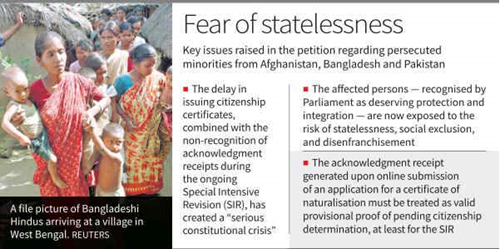
- However, the petition said the authorities had delayed the issuance of the citizenship certificates. This, coupled with the non-recognition of acknowledgment receipts during the ongoing special intensive revision (SIR), has created a serious constitutional crisis.
- “The affected persons, already recognised by Parliament as persecuted minorities of Afghanistan, Bangladesh and Pakistan who entered India deserving protection and integration, are now exposed to the risk of statelessness, social exclusion and disenfranchisement,” the petition alleged.
- Chief Justice Kant said “You are claiming that you are entitled by virtue of these amended provisions in the CAA to become citizens of this country. But you have not been conferred citizenship so far… The amended provisions might have conferred some enforceable rights in your favour to seek citizenship, but each and every statutory requirement has to be determined, like, do you belong to any minority in that country; were you resident of the country of which minority were permitted to come to India; and in what capacity have you come to India.
- The CJI said if the government has made a law, there would be a mechanism that would follow to implement the law.
- State drafts law on menstrual leave
Context: Even as the High Court is set to hear arguments on behalf of the State on Wednesday on its November 20 notification on menstrual leave, the State government has readied a Bill to give legislative teeth to the provisions.
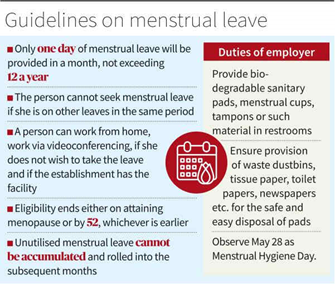
- In what is the first-ever such legislation, the State government has drafted the Karnataka Women Well Being Leave Bill, 2025. It provides menstrual leave not only for working women in the formal sector, but also for female students in educational institutions, transgenders, ASHAs, anganwadi, and midday meal personnel, and those working in mines. The Bill is expected to be introduced in the ongoing legislature session.
- Bill expands the scope of those eligible for leave, but also proposes setting up a Karnataka Women Well Being Authority
- In the first-ever such legislation proposed in the country, the Karnataka government has readied the Karnataka Women Well Being Leave Bill, 2025, which provides menstrual leave not only for working women in the formal sector but also for female students in educational institutions, transgenders, ASHAs, anganwadi, and midday meal personnel, and those working in mines.
Age criteria
- An earlier Government Order had covered the private sector, and last week the government brought its workers under its ambit. Instead of 18 as a minimum age criteria prescribed earlier, the Bill does not propose any lower minimum age limit, but the upper age limit has been capped at 52 or till menopause.
- While the working women will get one day leave per month, the menstrual leave for students will be upto two days in a month and consequently 2% relaxation in the attendance for menstrual issues in educational institutions.
WFH facility
- If the employee does not chose to avail of the leave, she will be entitled for work from home if the facility is available. Not mandating a doctor’s certificate, the leave can be availed through a request on e-mail.
- The proposed Bill is likely to be cleared in the Cabinet on Thursday, following which it will be introduced in the legislature, sources said. This will be the most comprehensive legislation proposed so far in the country.
- When asked if the Bill was in response to the ongoing case in the Karnataka High Court, sources said that the government was working on the Bill for some time now.
- Among other things, the Bill proposes setting up Karnataka Women Well Being Authority, which will be headed by the chairperson of the Karnataka State Commission for Women to redress grievances arising out of complaints.
- Labour officer in the district will be the enforcement officer.
Penalty clause
- A penalty of upto ₹5,000 for each contravention of the provision has been proposed for those who deny menstrual leave, ill treat or discriminate against menstruating women.
- Trump mulls tariffs on rice from India
Context: Days before a U.S. team of negotiators is to visit India to discuss tariffs, U.S. President Donald Trump has hinted at imposing further tariffs on India, this time on rice, to prevent it from “dumping” rice in the U.S.
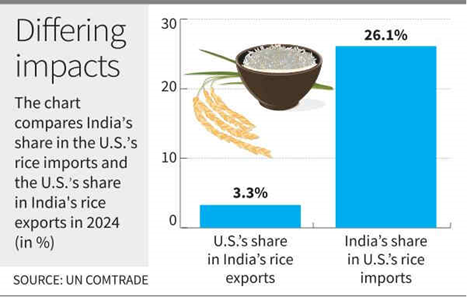
- However, an analysis of trade data between the two countries shows that such tariffs would hurt the U.S. far more than India since only about 3% of India’s rice exports go to the U.S., whereas Indian rice makes up more than one-fourth of the quantity imported into the U.S.
- In other words, for rice, the U.S. is not a major export destination for India, but India is a major import source for the U.S.
- A U.S. team of negotiators led by Deputy U.S. Trade Representative Rick Switzer would be in New Delhi on December 10-12 to discuss tariffs. The U.S. has currently imposed a total of 50% tariffs on imports from India.
- Mr. Trump made his rice tariff comments during a White House meeting in which he unveiled a $12 billion package to support American farmers.
- At a meeting in the White House, when a farmers’ representative complained that India, Thailand and other countries were “dumping” rice in the U.S., Mr. Trump asked the U.S. Secretary of the Treasury Scott Bessent: “Why is India allowed to do that? They have to pay tariffs. Do they have an exemption on rice?” Later, he said the issue can be solved “so quickly with tariffs” on these countries that are “illegally shipping” into the U.S.
- According to data with the Ministry of Commerce and Industry, India exported rice worth $391.74 million to the U.S. in 2023-24, which makes up about 3.1% of India’s total rice shipments. India exports rice to 179 other countries.
- On the other hand, according to data from the World Integrated Trade Solutions website, India accounted for about 26% of the $1.6 billion worth of rice the U.S. imported in 2024.
- “President Trump’s threat to impose new tariffs on Indian rice looks driven more by domestic politics than by trade logic,” Ajay Srivastava, former Director General of Foreign Trade, said.
- Aditya-L1 joins global effort revealing why the 2024 solar storm behaved unusually
Context: India’s first solar observatory Aditya-L1, along with six U.S. satellites, in a major breakthrough, has revealed why the May 2024 solar storm also known as Gannon’s storm behaved so unusually.
- In May 2024, the earth faced the strongest solar storm in more than two decades, which disturbed Earth’s environment severely.
- The solar storm is composed of a series of giant explosions on the Sun, called coronal mass ejections (CMEs). CMEs are like massive bubbles of hot gas and magnetic energy thrown out from the Sun into space. When these bubbles hit Earth, they can shake our planet’s magnetic shield and cause serious trouble for satellites, communication systems, GPS, and even power grids.
- According to the Indian Space Research Organisation (ISRO), during the May 2024 solar storm, the Sun’s magnetic fields, which are like twisted ropes inside a solar storm, were breaking and rejoining within the storm.
- “Usually, a CME carries a twisted “magnetic rope” that interacts with Earth’s magnetic shield as it approaches Earth. But this time, two CMEs collided in space and squeezed each other so firmly that the magnetic field lines inside one of them snapped and rejoined in new ways, a process called magnetic reconnection,” ISRO said. It added that this sudden reversal of the magnetic field made the storm’s impact stronger than expected.
- “At the heart of this discovery is India’s first solar observatory, Aditya-L1, which joined forces with six U.S. satellites (NASA’s Wind, ACE, THEMIS-C, STEREO-A, MMS, and NASA-NOAA joint mission DSCOVR),” the ISRO said.
- “Thanks to precise magnetic field measurements from India’s Aditya-L1 mission, scientists were able to map this reconnection region. They found that the area where the CME’s magnetic field was tearing and reconnecting was enormous — about 1.3 million km across, i.e., nearly 100 times the size of Earth. It was the first time such a giant magnetic breakup and rejoining had ever been seen inside a CME,” it added.
- This discovery is expected to enhance the understanding of how solar storms evolve as they travel from the Sun to Earth.
- ‘India has to move from service provider to a product nation’
Context: India’s maiden full-fledged summit on supercomputing kicks-off in Yelahanka, featuring advanced computer technologies by 175 firms.
- India has a huge need to move from a service provider to a product nation, taking advantage of emerging technologies, including quantum computing, high performance computing and artificial intelligence, said Ashwini Vaishnaw, Minister for Railways, Information and Broadcasting, and Electronics & Information Technology.
- The Minister was addressing online supercomputing experts and entrepreneurs and policy makers gathered from across India and overseas at the inaugural ceremony of the maiden edition of Supercomputing India 2025 (SCI 2025) held at the Manipal Institute of Technology (MIT), Yelahanka.
- Speaking on the occasion, Jitin Prasada, Minister of State for Electronics & Information Technology, highlighted that the government has various mission mode programmes which have been initiated as part of moving towards a product nation.
- Responding to a query on why quantum computing has suddenly received so much hype, Thomas Zacharia, senior vice president, technology partnership at AMD, on the sidelines of the conference, told The Hindu that this technology has been demonstrated as useful in specific cases, and increasingly becoming relevant in recent years.
- “So the excitement is that, while it has been a promise, today quantum computing can be utilised be for very specific and important applications that cannot be done in any other way, which is why it’s exciting,” he explained.
- However, he agreed every technology has a hype cycle, but what we’re talking about here is that quantum computers have very good systems for quantum mechanical systems. So a certain class of problems can be effectively solved using quantum computers. And today, if we have demonstrated with a sufficient number of cubits that we can get real life solutions to where it is applicable, Mr. Zacharia explained.
- SCI 2025 is India’s first comprehensive conference on high-performance computing, artificial intelligence and quantum computing, organised by the Centre for Development of Advanced Computing (C-DAC) under the aegis of the National Supercomputing Mission (NSM) and joined by global collaborators.
- 57,000 cybercrime cases registered in State in last three years: Parameshwara
Context: Karnataka has witnessed over 57,000 cybercrime cases in the last three years, accounting for financial fraud to the tune of ₹5,473 crore, according to Home Minister G. Parameshwara.
In numbers
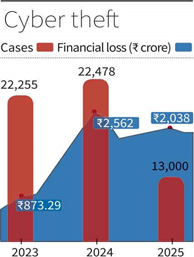
- Replying to BJP member Cement Manju during Question Hour in the Assembly, he said 22,255 cybercrime cases had been filed in 2023 in Karnataka amounting to financial fraud of ₹873.29 crore. In 2024, the number of registered cybercrime cases stood at 22,478, accounting for financial fraud of ₹2,562 crore. So far, in 2025, these cases have stood at 13,000 with a financial fraud of ₹2,038 crore.
- So far, it had been possible to recover only ₹627 crore in these cases of cybercrime, he said, while pointing out that more than 10,700 cases had been solved so far.
- The statistics provided by the Minister shows that Bengaluru city tops the list of cities in terms of cybercrimes in 2025 by accounting for 9,326 cases. Among the districts, Bengaluru Urban district accounted for 384 cases, followed by Vijayapura (340), Tumakuru (243), Ramanagara district (192), Udupi district (171), Mysuru city (166) and Mysuru district (56).
- Listing the efforts by the State government to curb cybercrimes, the Minister said Karnataka had created a cyber vertical led by a DGP like the CID and Prisons Department for the first time in the country. As many as 43 cyber police stations had been set up crack down against cybercrime, he said.
Online betting
- Dr. Parameshwara said that incidents of online betting had increased both within the country and abroad. He said the State government had tried to bring changes to the existing legislation to ban online betting.
- But the Online India Gaming Federation had got a stay from the courts against such changes. The State had now approached the Supreme Court and the case had been listed for December 19, he said. Though the Centre too had brought in a legislation to curb online betting, that legislation too had been stayed, he said.
- Govt. togive ₹5 lakh each to 23 kambalas
Context: The State government has decided to support kambala (slush track buffalo race) by providing financial assistance of ₹5 lakh each to 23 kambala events a year in Dakshina Kannada and Udupi districts.
- Announcing this in the Assembly while replying to Congress member Ashok Kumar Rai during Question Hour, Law Minister H.K. Patil said a sum of ₹5 lakh would be given to each of the kambala events.
- Earlier, the Minister said financial grant had been earmarked for 10 kambala events and that the government was considering increasing it to 20 events. However, all the members from the coastal region, cutting across party affiliations, urged the government to increase it to 23 kambalas, as that would encourage tourism and traditional sport in coastal region. The Minister finally agreed to their demand.
- Ensure free content access for LLMs, says working paper
Context: It says data crawlers for training artificial intelligence models should not be restricted; instead a copyright society should be set up to collect royalties for members and non-members of body.

- A government working paper released on Monday suggested that AI large language models (LLMs) such as ChatGPT should, by default, have access to content freely available online, and that publishers should not have an opt-out mechanism for such content.
- Instead, a copyright society-like non-profit should be set up to collect royalties for both members and non-members of that body.
- The working paper, authored by a committee formed by the Department for Promotion of Industry and Internal Trade (DPIIT), is not final, and is accepting public comments for 30 days. The document is one of the main indicators of how the Indian government is thinking of balancing copyright holders’ fears that AI systems will regurgitate content they invested in without remuneration, and the interests of LLM developers who have routinely consumed massive amounts of data online to train their models.
- Nasscom, which was represented in the DPIIT’s committee, dissented, arguing that forced royalties would amount to a “tax on innovation”, and said that “mining” or scraping the Web for data must be allowed for freely available content without paywalls, and that both “crawlable” and access-restricted content providers should have options to “reserve” their content from being mined for LLM development.
Opt-out not feasible
- The committee rejected Nasscom’s dissent, arguing that small content creators may not have the means to actually enforce such opt-outs.
- The Digital News Publishers Association, which represents traditional news media outlets with a digital presence, including The Hindu, has sued ChatGPT maker OpenAI in the Delhi High Court for copyright infringement. OpenAI denies the allegations. The working paper argues that it may not be prudent to await the outcome of this and other similar litigation.
- The recommendations, if put in place through a law, will eliminate any allegations of improper access to data, by blessing all access, provided a fee is paid. This model is similar to the “compulsory licensing” framework in place for radio stations in India, which are empowered to play music without negotiating rights for them, as long as a statutorily prescribed fee is paid to the rights holders.
- This balancing may face pushback from AI developers and content creators; the former may argue against anything that increases development costs as few AI firms are even profitable at the moment, leaving little appetite to share revenues. Content creators may resist a flat fee if they feel their inputs are more valuable in training a model than those of other royalty recipients.
- A payout to the copyright society set up for distributing AI riches to content creators, will be distributed by considering factors such as Web traffic and social indicators, like how respectable a publisher is. Any decision can be taken to the the court, the working group says.
- SC asks Centre togive nationwide dataon missing children
Context: The Supreme Court directed the Union government to furnish six years of nationwide data on missing children and to appoint a dedicated officer in the Union Home Ministry to ensure effective coordination with the States and Union Territories in compiling such information.
- A Bench of Justices B.V. Nagarathna and R. Mahadevan was hearing a public interest litigation petition filed by the non-profit organisation Guria Swayam Sevi Sansthan, which highlighted the rising number of children who remain untraced across several States.
- The court had earlier directed all States and Union Territories to depute dedicated officers to oversee cases of missing children and to ensure that such details are promptly uploaded on the Mission Vatsalya portal administered by the Women and Child Development Ministry.
- Appearing for the Centre, Additional Solicitor-General Aishwarya Bhati informed the Bench that all States and Union Territories had appointed such officers and uploaded their particulars on the portal. She noted, however, that the effective dissemination of information and coordinated use of the platform remained essential to securing meaningful outcomes.
- The Bench observed that the Home Ministry itself had not nominated a dedicated officer to oversee cases of missing children, despite being the central coordinating agency. It accordingly directed the Ministry to appoint such an officer within two weeks and to upload the officer’s details on the Mission Vatsalya portal.
- “We find that the Ministry of Home Affairs of the Union of India has not appointed a dedicated nodal officer for cases of missing children for the purpose of Mission Vatsalya, and hence an officer may be nominated as a dedicated nodal officer, whose details may also be uploaded on the Mission Vatsalya portal,” the court ordered.
- ‘Rise in global useof Aadhaar-like ID systems dangerous’
Context: Fifty-four civil society groups and over 200 individual signatories have put out an open letter pushing back against the expanding use of Aadhaar-like digital identity systems in countries other than India.
- The two-page letter was signed by organisations such as Internet Freedom Foundation; the Mazdoor Kisan Shakti Sangathan; JNU Students Union; Safai Karmachari Andolan; and People’s Union for Civil Liberties (PUCL). It was also endorsed by individuals such as former Amnesty International India chair Aakar Patel, activist Jean Drèze, and constitutional law scholar Gautam Bhatia.
- The Centre has promoted digital identity systems such as Aadhaar around the world as a key plank of digital public infrastructure, a concept that India is promoting with both policy support and open source tools, such as those provided by the Modular Open Source Identity Platform (MOSIP). MOSIP, which was largely developed by the IIIT Bengaluru, does not use the same technology as Aadhaar.
- Some countries engaged with MOSIP at various degrees include Morocco, the Philippines, Sri Lanka, Ethiopia, and Uganda.
- Cyclone impact sparks fresh calls in Sri Lanka to recast IMF agreement
Context: As Sri Lanka reels from Cyclone Ditwah’s devastation, calls to revisit the ongoing International Monetary Fund (IMF) programme, which critics say imposes punishing austerity, are growing louder.
- At least 638 people died — 191 remain missing — and millions were affected by torrential rains, unprecedented flooding, and multiple landslides that battered Sri Lanka late November. The climate disaster, one of the worst the country has witnessed, has dealt a sharp blow to the island’s tentative recovery, three years after it declared bankruptcy amid a financial meltdown.
- Last week, Opposition Leader Sajith Premadasa urged the Anura Kumara Dissanayake government to renegotiate the IMF deal in the wake of the climate catastrophe, calling for immediate talks with the Fund to suspend or amend conditions that aggravate the people’s hardships.
- A UNDP study in 2022–23 found that the crushing economic crisis in 2022 had left over half of the island’s population “multidimensionally vulnerable”. Although Sri Lanka has since achieved relative fiscal stability, the condition of the country’s poor — hit hardest by IMF-prescribed spending cuts — has worsened.
- In the wake of the recent natural disaster, over 70 civil society groups and activists across Sri Lanka have called for renegotiation of the IMF deal, debt, and climate justice. “While a majority of people are reeling under austerity measures, including regressive tax hikes, subsidy cuts, and inadequate social security measures, the Government of Sri Lanka has become a prisoner of the ongoing Extended Fund Facility programme of the IMF,” said their statement, issued on December 8, 2025.
‘Urgent revision’
- “The IMF controlling government spending not only restricts the ability of the government to respond to the ongoing humanitarian crisis, but severely impedes investment in infrastructure, recuperating livelihoods, and adapting to further climate change impacts,” they contended, demanding an “urgent revision” of Sri Lanka’s debt restructuring agreement, a “massive” debt reduction, a halt on subsidy removals, and an immediate standstill on current and future debt servicing for the country’s recovery.
- In 2026, the government must service debt totalling over $2 billion, while it tries to lift the country out of the deluge, whose full impact is yet to be ascertained. Some development experts have observed that recovery might prove harder than after the Indian Ocean tsunami of 2004.
- Recognising the challenge, President Dissanayake told Newsweek magazine in an interview published on December 8: “Initial estimates indicate that the damage may well be beyond any natural disaster that our island has endured. So we will have to service debt while simultaneously rebuilding from climate disasters. This is why debt sustainability frameworks for climate-vulnerable countries must change.”
- Weighing in on Sri Lanka’s predicament, former President of the Maldives Mohamed Nasheed recently noted that the climate calamity makes it “impossible” for Sri Lanka to stay aligned with the IMF programme. “When Sri Lanka faced its financial crisis in 2022, the IMF approved a four-year Extended Fund Facility after months of negotiation. Yet the Debt Sustainability Analysis (DSA) failed to account for climate shocks,” he said in a social media post, as the cyclone’s impact began unfolding.
- Not just Sri Lanka, but several climate-vulnerable, debt-distressed countries are in a similar plight. The Climate Vulnerable Forum — an international alliance of over 70 highly climate-vulnerable countries — has long called for reforming the DSA to properly value resilience investments and natural capital, and for a reformed G20 Common Framework that includes automatic debt standstills in response to climate shocks, said Mr. Nasheed, who is also the Secretary-General of the Forum.
Emergency financing
- However, there are no signs yet that the Sri Lankan government may veer away from the IMF programme. In fact, the government has sought a $200 million Rapid Financing Instrument from the Fund. An IMF spokesman confirmed that Sri Lanka’s request for emergency financing will take precedence over the scheduled fifth review of the ongoing Extended Fund Facility (EFF).
- Meanwhile, activists have demanded that the government urgently prioritise equitable relief, focusing on economically and socially marginalised communities most affected by the disaster. “The highest [number of] casualties were reported from Badulla, Kandy, Kegalle, Matale, and Nuwara Eliya districts — areas especially prone to landslides and home to already marginalised and vulnerable working-class tea plantation workers,” the Feminist Collective for Economic Justice, a network of feminist activists across Sri Lanka, said in a statement. Demanding universal social protection schemes, the Collective called for urgent negotiations with the IMF and other creditors “to cancel debt repayment and reverse austerity policies in this crisis context.”
Source: The Hindu
UPSC/KPSC Current Affairs: 8th December 2025
- With only 26% deaths having certified cause, Karnataka keen to enhance rate
Context: Following concerns that only 26.73% of registered deaths in Karnataka currently have medically certified causes — a major gap affecting disease surveillance and health planning — the State Health Department has issued a set of directives to improve the coverage and quality of Medical Certification of Cause of Death (MCCD) reporting in the State.
- In a circular issued by Harsh Gupta, Principal Secretary, Health and Family Welfare, the department noted that reliable cause-specific mortality data is critical. The MCCD system, mandated under the Registration of Births and Deaths (RBD) Act, 1969 (as amended in 2023), is intended to provide cause-specific mortality data at the State and national level.
- Mr. Gupta told The Hindu that the recent amendment to the Karnataka Registration of Births and Deaths Rules, 2024, effective from January 16, 2025, has made it mandatory for all government and private health facilities to issue a certificate of the cause of death in Form 4 for hospital deaths and Form 4A for deaths occurring at home or other locations.
Through e-JanMa
- All registered hospitals — public and private — must issue medical cause of death certificates in Form 4 for hospital deaths and submit them electronically through e-JanMa to the local registrar, while also providing a copy to the next of kin.
- For deaths occurring outside medical institutions — homes, transit, prisons, old-age homes and similar facilities — attending doctors must issue Form 4A for free.
- Hospitals are also required to report monthly death counts and submit “nil reports” where no deaths occur.
- Local registrars must ensure that every reported death (Form 2) is accompanied by a cause-of-death certificate.
- For non-hospital deaths, priority for issuing the certificate is assigned to the doctor who treated the deceased during the final illness, any doctor familiar with the patient’s medical history or government medical officers (PHCs, CHCs, taluk and district hospitals).
- In medico-legal cases, the certifying doctor must provide the cause of death following an inquest or autopsy. Deaths must be reported and certified within 21 days across rural and urban areas. Private hospitals must report deaths occurring under their care to the respective registrar.
- To ensure compliance and improve data quality, each district will establish a review and monitoring committee headed by the District Health Officer, with experts from clinical and public health departments. The committee will meet monthly to review samples of certificates, support local registrars and hospitals, and organise training.
- Post pandemic, new families get on the ‘silk road’ in Karnataka
Context: After a dip during the pandemic years, over 13,000 new families have taken up sericulture in Karnataka over the past five years, contributing a 43% rise in cocoon production and a nearly 20% jump in raw silk output.
- Several factors including support from the government, better cocoon prices and better availability of high-quality chawki (carefully reared young silkworms essential for good yields) have helped the industry regain momentum and expanded mulberry cultivation to 1.18 lakh hectares in 2024–25, the largest area under sericulture in 15 years.
- Farmers also believe that demand for Karnataka silk has strengthened after the Centre banned China silk, which earlier dominated the market because of its lower cost. “The price of silk is around ₹7,000 to ₹7,500 a kg now, and in the coming months it may touch ₹9,000. During COVID, it had fallen below ₹2,000,” M. Pemme Kumar, a sericulturist said.
- “Karnataka’s traditional silk belts- Ramanagara and Sidlaghatta which are known for producing some of India’s best cocoons- had witnessed farmers gradually exit sericulture, moving to horticulture over the past decade, largely due to volatile prices and competition from cheaper imported silk. The ban on China silk has brought some stability back to the market,” Bhupat Rajan, another grower said.
- Officials from the Central Silk Board, however, believe that Chinese imports were not the primary reason for the earlier price crash, noting that the price of Chinese silk remains around ₹5,000 a kg.
- The growers pointed out that government support has revived the industry significantly. “The State government raised the incentive for bivoltine cocoon producers from ₹10 to ₹30 a kg in the 2024–25 Budget. This attracted many growers,” Shantamma Nagaraju, a sericulturist said.
Reelers in decline
- While demand has strengthened and prices have recovered from the pandemic lows, the sector continues to grapple with a shrinking number of reelers, a link in the value chain whose decline has itself contributed to the higher price of raw silk in recent years, the growers said.
- While the State government had announced an annual subsidy of ₹12 crore for raw silk reelers through the Karnataka Minority Development Corporation during last year’s Budget, many, specifically younger generations, are no longer entering into reeling because of low and irregular incomes, demanding working conditions and lack of mechanisation.
- “Reeling, a labour-intensive process of extracting fine silk fibre from cocoons, is struggling to survive as this altogether lacks machinery and relies on skill, precision and hours of manual labour to produce high-grade yarn,” a grower said.
- State revises maize procurement norms; raises cap to 50 quintals per farmer
Context: Following protests by maize growers over procurement limits, the State government on Sunday revised its order on Minimum Support Price (MSP) operations, increasing the maximum quantity that can be purchased from each farmer to 50 quintals.
- A corrigendum issued in this regard stated that the earlier cap of 20 quintals per farmer has now been enhanced. Procurement would be based on landholding data available on the FRUITS platform, with up to 12 quintals per acre allowed and a ceiling of 50 quintals per farmer at the support price of ₹2,400 per quintal. The order states that priority will be accorded to procurement through Primary Agricultural Credit Societies located near distilleries.
- The decision comes after maize growers staged demonstrations alleging “unfair treatment” in procurement operations and demanded wider coverage under the MSP window.
- The government had recently permitted poultry feed manufacturers to directly buy maize from growers. In a separate order issued on December 4, the government had allowed poultry feed producers to procure maize directly from farmers at MSP rates for the 2025–26 kharif marketing season. The move is expected to ensure better price realisation, reduce intermediary involvement, and expand marketing channels for growers.
- The decision followed a meeting chaired by Chief Minister Siddaramaiah where industry representatives were urged to source an estimated five lakh tonnes of maize.
- The Karnataka Poultry Farmers and Breeders’ Association has committed to initially procure 5,000 tonnes with a 20% advance payment.
- Procurement will adhere to MSP quality specifications with a maximum moisture content of 12% for poultry feed suitability. The government said the latest measure would run parallel with procurement by the Karnataka State Co-operative Marketing Federation, which supplies maize to distilleries.
- The evolution of pension reforms in India
Context: There has been a gradual but decisive shift from a welfare-based social assistance to a more participatory inclusion framework.
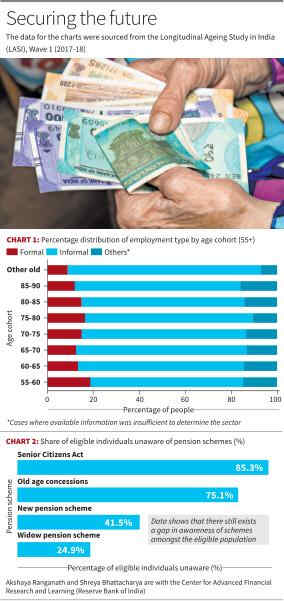
- India’s rapidly ageing population is emerging as a pivotal pension challenge. Today, over 153 million Indians are aged over 60. This is projected to double to 347 million by 2050. While a small section of older Indians has benefited from the rise of formal sector retirement, more than 88% of today’s senior citizens continue to work, in the sprawling informal economy, without access to pensions or reliable social security rather than retiring (Chart 1). We revisit the evolution of pension schemes for financial inclusivity of the Indian informal sector.
- The Indira Gandhi National Old Age Pension Scheme (IGNOAPS) is a social assistance programme launched in 1995 for persons aged over 65, living below the poverty line (BPL). Subsequent changes expanded scheme eligibility and strengthened financial support, leading to a significant rise in enrolment. It is a first among national-level efforts taken to provide a direct, regular source of income to the older population in the unorganised and economically vulnerable section of society. Similarly, formal sector government employees were covered under the government-sponsored Old Pension Scheme (OPS).
- Research finds that unlike social benefit schemes, contributory pension schemes in developing countries encourage household formal savings behaviour. Announced in Budget 2015-16, the Atal Pension Yojana (APY) is a contributory pension scheme for individuals aged 18-40, where periodic contributions are made to a pension account. At retirement, the accumulated amount, including returns, is disbursed, with the government guaranteeing a minimum pension if returns fall short. Taking into consideration the seasonal nature of informal sector income, especially agriculture, the APY allows for not just monthly but also quarterly and half-yearly instalments.
- For the formal sector, OPS was replaced by the contributory-model New Pension Scheme (NPS) in 2004. The NPS also has a corporate sector model which extends to all corporate sector employees with a savings account. Recently, the NPS 2.0 was launched allowing total allotment to 100% equity and a flexible multiple scheme framework (MSF) — an attractive change for younger high-risk, high-reward-type investors. The APY and NPS models form a comprehensive long-term financial security framework that ensures inclusion in the formal financial system, despite the sectoral divide.
- The Labour Codes introduced a uniform definition of ‘wages’, requiring that basic pay make up at least 50% of total earnings. This closes a long-standing loophole that allowed employers to shrink basic pay by inflating allowances. With pension, gratuity, and social security benefits now calculated on a higher base, workers stand to gain stronger financial protection.
- The progression of pension schemes in India reflects a hierarchical pattern in which each stage builds on the needs identified before it. Through an equity and social-welfare lens, the government first introduced IGNOAPS and OPS to meet the basic needs of older adults. Having secured social protection, the focus shifted to more sophisticated goals such as financial inclusion and savings and investment behaviour through the NPS and the NPS 2.0. To bridge sectoral divide, similar behavioural nudges were extended to informal-sector workers via the APY.
- Many of these schemes are explicitly targeted at BPL individuals, and are therefore designed to extend coverage to informal-sector workers who lack access to formal retirement provisions. However, there still exists a gap in awareness of schemes amongst the eligible population. Our findings from the Longitudinal Ageing Survey of India (LASI) show that as of 2017-18, 42% of individuals aged over 55 were still unaware of NPS and its eligibility criteria and requirements (Chart 2).
- To tackle limited awareness and fragmented access to welfare programs, the e-SHRAM portal was launched as a national database for informal sector workers. Through this, workers can register and obtain information about social security schemes for which they are eligible. Our analysis of the LASI data shows that over age 55, about 75.6% of women and 68% of men work in this sector.
- While this is a significant step towards integrating the informal workforce into the country’s formal social protection system, realising e-SHRAM’s full potential depends on overcoming challenges related to registration, awareness, and effective disbursement of benefits. For instance, registration requires Aadhaar to phone number linkage and a savings bank account, which is susceptible to errors of exclusion. Moreover, according to the Comprehensive Annual Modular Survey of India (2022-23), 63% of the elderly population do not know how to use the Internet. This risks leaving the most economically vulnerable among them behind.
- The evolution of pension schemes in India has seen a gradual but decisive shift from a welfare-based social assistance to a more participatory inclusion framework. While the challenges of unawareness still remain, initiatives such as e-SHRAM signal a data-driven approach to policy targeted at the older age population. The trajectory of these continuing revisions and initiatives will pave the way for inclusive policies and dignify the contributions of the elderly in their later years of life.
- U.S. official begins five-day India visit to advance strategic partnership
Context: A day after Russian President Vladimir Putin’s visit to India, the U.S. Under Secretary of State for Political Affairs, Allison Hooker, started her five-day visit on Sunday. The visit will cover New Delhi and Bengaluru and include meetings between Ms. Hooker and senior Indian officials, including Foreign Secretary Vikram Misri.
- “Under Secretary Hooker’s visit will focus on advancing the U.S.-India strategic partnership, deepening economic and commercial ties, including increasing American exports, and fostering collaboration in emerging technologies, including artificial intelligence and space exploration,” said the Department of State in an announcement.
- During her stay in New Delhi, Under Secretary Hooker will participate in the Foreign Office Consultations with Foreign Secretary Misri. Her discussion will include regional security, economic cooperation and “shared priorities” in the Indo-Pacific, said the official announcement.
- Ms. Hooker took charge as the Under Secretary of state earlier this year and ever since has held a number of meetings with officials from the region. India was supposed to host the Quad summit in 2025, but the summit meeting has not been scheduled so far, and there is no official information about it.
- In Bengaluru, Ms. Hooker will visit the Indian Space Research Organisation and meet leading figures from India’s space, energy and technology sectors with the goal to “promote innovation in U.S.-India research partnership and explore opportunities for expanded cooperation,” the official announcement said.
- The Foreign Office Consultation comes against the backdrop of the continuation of the penalty tariffs by the U.S. on India. Latest reports suggest that India has made a considerable reduction in the purchase of Russian energy, though relations with Russia remain on track, with Prime Minister Narendra Modi on December 5 describing the bilateral relationship as important as the “Pole Star” (Dhruva Tara).
- ‘It is essential to nurture inheritance and pass it on to future generations’
Context: The world is indeed becoming “more multi-polar”, which makes a compelling case for “deeper multilateralism”, and collectively, prosperity can only come through mutual respect and understanding, External Affairs Minister S. Jaishankar said.
- In his address at the opening ceremony of a key UNESCO meeting on Safeguarding of Intangible Cultural Heritage (ICH) at the Red Fort complex here, he also told delegates from various countries that in the “shared quest for progress and prosperity”, it is essential to nurture inheritance, build on it and pass it on to the future generations.
- The 20th session of the Intergovernmental Committee for the Safeguarding of Intangible Cultural Heritage will take place at the Red Fort from December 8 to 13.
- Mr. Jaishankar underlined that India, besides being home to many UNESCO World Heritage Sites, has itself undertaken many preservation and conservation projects across the world. A key dimension of that engagement is preservation of intangible heritage.
- “The world is a fundamentally pluralistic landscape, a landscape whose richness lies in its diversity and intricacy. Far from being flat, it has a vast range of specificities and characteristics,” he said. “What humankind has generated over the centuries will only be fully appreciated when that heritage is carefully nurtured,” he said.
- He emphasised that challenges in that context arise when efforts are made to “dominate, to sideline, to dismiss or even to erode”.
- But as “decolonisation” took place and the world began returning to its “natural diversity”, political and economic rebalancing started to unfold, Mr. Jaishankar said.
- “Voices across geographies that were suppressed found expression again. But that process will remain incomplete until there is also cultural rebalancing,” he added.
- Cheetah cub from Kuno run over by vehicle in Gwalior
- A cheetah cub died on Sunday in Madhya Pradesh’s Gwalior district after being hit by a vehicle on the Agra-Mumbai National Highway (NH-46), making it the second death of a big cat at the Kuno National Park (KNP) in just two days.
- Two 20-month-old Indian-born male cubs, offspring of the South African female cheetah named Gamini, had ventured out of Kuno’s boundaries, and were being tracked by a cheetah tracking team and local forest staff, when one of them was hit by a speeding vehicle. The incident took place around 6.30 a.m. when the two cubs were crossing the NH-46 near Ghatigaon in Gwalior.
- Rajnath unveils border infrastructure projects
Context: Minister inaugurates 125 BRO projects across Ladakh, J&K and seven States, describes them as a testament to the government’s commitment to border infrastructure under vision of Viksit Bharat.
- Defence Minister Rajnath Singh on Sunday inaugurated 125 strategically vital infrastructure projects of the Border Roads Organisation (BRO) from Ladakh, the highest number ever dedicated to the nation in one event.
- The Defence Ministry said the projects, worth around ₹5,000 crore, span the Union Territories of Ladakh and Jammu and Kashmir and seven States — Arunachal Pradesh, Sikkim, Himachal Pradesh, Uttarakhand, Rajasthan, West Bengal, and Mizoram. The initiatives comprise 28 roads, 93 bridges, and four other key assets, marking the largest value inauguration in the BRO’s history.
- Addressing the ceremony held on the Darbuk Shyok Daulat Beg Oldie Road at the Shyok Tunnel site, Mr. Singh described the projects as a testament to the government’s commitment to border infrastructure under the vision of Viksit Bharat.
- The 920-metre Shyok Tunnel, a major highlight, is engineered to provide all-weather connectivity to one of the world’s most challenging terrains. He said the tunnel would significantly improve mobility, security and rapid deployment capabilities during extreme winters, when the region experiences avalanches and heavy snowfall.
- Mr. Singh also virtually inaugurated the Galwan War Memorial, built to honour the courage and sacrifice of Indian soldiers. Emphasising the multi-dimensional value of robust border connectivity, he said such infrastructure strengthened national security, enhanced logistics movement, boosted tourism, and generated employment while reinforcing people’s faith in development.
- Referring to Operation Sindoor, the Minister credited strong connectivity for enabling the armed forces to conduct the operation with precision and coordination. He praised the synergy between the forces, civil administration and border residents, describing it as the “unique identity” of the nation.
- Mr. Singh also highlighted the BRO’s humanitarian work in Uttarakhand, Sikkim and Jammu and Kashmir, and acknowledged its technological advancements, including indigenous Class 70 modular bridges developed under Aatmanirbhar Bharat.
- Citing a record BRO expenditure of ₹16,690 crore in FY 2024 25 and an enhanced outlay for FY 2025 26, he reiterated the government’s commitment to strengthening border infrastructure and achieving self-reliance in defence manufacturing.
- In the past two years, 356 BRO projects have been dedicated to the nation, underlining the organisation’s capability across diverse terrains.
- National intelligence grid gains traction as Central agencies, police scour for information
Context: The National Intelligence Grid (NATGRID), a platform for the police and investigating agencies to securely access government and private databases in real time, is getting around 45,000 requests a month, government officials told.
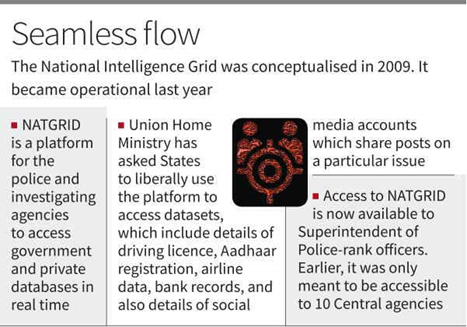
- The platform, accessible only to security agencies, became operational last year after first being conceptualised in 2009 in the aftermath of the 26/11 Mumbai terror attacks.
- At the recent conference of Directors-General of Police, chaired by Prime Minister Narendra Modi in Raipur, the law enforcement agencies, including State police, were asked to scale up the use of NATGRID in all investigations.
- The Union Home Ministry has asked States to liberally use the platform to access datasets, which include details of driving licence, Aadhaar registration, airline data, bank records, and also details of social media accounts which share posts on a particular issue.
- Access to NATGRID is now available to Superintendent of Police-rank officers. Earlier, it was only meant to be accessible to 10 Central agencies, such as the Intelligence Bureau, Research and Analysis Wing, National Investigation Agency, Enforcement Directorate, Financial Intelligence Unit, Narcotics Control Bureau, and the Directorate of Revenue Intelligence.
- Several State police officials told that they faced certain hurdles while accessing the information on the platform.
Time consuming
- An official said that logging on the portal required a lot of time, while another official said they had to wait longer to get the desired information, even though the platform is supposed to provide real-time data.
- The platform, which had been in the works for over a decade and was first envisaged under Congress leader P. Chidambaram, received a fresh momentum under Home Minister Amit Shah in 2019. Under Mr. Shah, the differences between various security agencies were ironed out, and the application was made accessible to even the State police.
- The government is taking several steps to enhance security and maintain the sanctity of data in the wake of repeated cyberattack attempts on critical infrastructure in the country, official sources said.
- In 2024, India witnessed over 20.41 lakh cybersecurity-related incidents, the highest number of incidents since 2020.
- “Instead of security agencies seeking data from multiple sources, NATGRID provides the information on a single platform. The confidentiality of the user is maintained, and the registration of a first information report (FIR) is not necessary. Information can be secured to join the dots during an investigation or to develop intelligence,” said another government official.
- Top agricultural research body urges varsities to startcourses in natural farming
Context: Indian Council of Agricultural Research (ICAR) Director-General M.L. Jat has written to the Vice-Chancellors of all State and Central agriculture universities, as well as universities with agriculture departments, urging them to launch undergraduate and postgraduate courses and research programmes in natural farming.
- Though natural farming was already offered as an elective subject in various institutions and four universities had dedicated courses on the subject, it is the first time that the ICAR has urged all affiliated colleges and State government institutions to introduce courses on the topic.
- In the letter, Dr. Jat said natural farming had emerged as a subject of national importance, aligned with India’s strategic priorities for sustainable agriculture and farmer welfare. He said the B.Sc. (Hons.) agriculture – natural farming programme, developed as per the Sixth Deans’ Committee recommendations and National Education Policy (NEP) 2020 guidelines, has already been finalised, approved, and circulated to all agricultural universities. “Some universities have successfully initiated this programme from the academic year 2023-24, marking a transformative milestone in agricultural higher education. I hope remaining universities will introduce this course by next academic year,” he said.
- On strengthening postgraduate education and advanced research on the subject, he said that given the expanding national demand for chemical-free food systems, resilient agro-ecosystems, soil health restoration, and low-emission farming, it was imperative that the State agricultural universities, deemed universities, and Central agricultural universities develop PG programmes in natural farming and allied domains.
UPSC/KPSC Current Affairs: 7th December 2025
Amit Shah says circular economy will raise dairy farmers’ income in 5 years
Union Home and Cooperation Minister Amit Shah on Saturday expressed confidence that the implementation of the circular economy model across the country will increase dairy farmers’ income by 20% over the next five years.Mr. Shah was addressing cattle rearers associated with Banas Dairy at an event held at Sanadar village in Gujarat’s Vav-Tharad district to mark the inauguration of the dairy’s bio-CNG and fertilizer plant and the ground-breaking of its milk powder plant.He praised Banas Dairy’s management for successfully developing a model for a circular economy in the dairy sector, which includes generating extra income for farmers through various means.Mr. Shah informed the audience that he had brought several MPs to Banaskantha to understand the circular economy model of Banas Dairy.“So far, our cooperative dairies have received huge success in procuring milk from farmers and giving back the income generated from selling milk products. Now, the time has come to focus on the circular economy. You will get your share from the income generated by the dairy by selling biogas and fertilizer produced from cattle dung procured from farmers,” he said.Mr. Shah also informed the gathering that chairpersons and managing directors of all the major cooperative dairies will visit Banas Dairy in January 2026 to understand more about the initiatives taken by the dairy, considered Asia’s largest dairy with a turnover of ₹24,000 crore.“Apart from the usual milk products like paneer and curd, there are many products that are in demand across the globe, but they are not produced in India. If we focus on those products, dairy farmers can earn extra income,” he said.The Minister said Prime Minister Narendra Modi has created a system wherein dairies will get the required finance and technology to adopt this circular economy model, which also includes leather production from hides harvested from the cattle that die naturally.He expressed confidence that targets set by Prime Minister under the ‘White Revolution 2.0’ initiative will be achieved through collective efforts.Mr. Shah also praised women dairy farmers for their contribution and efforts in strengthening the sector in this arid region of Gujarat.
NGO in Rajasthan targets 38 districts to end child marriageChittorgarh and Bhilwara districts have a child marriage prevalence of over 40%, while nine other districts have a 30% to 40% prevalence; NGO to focus on community efforts, legal interventions
A civil society network has selected 38 high-risk districts in Rajasthan to conduct an intensive drive to completely weed out the practice of child marriage over the next year, through community efforts and legal interventions.
The drive will extend support to the State government’s actions and use the resources of village panchayats to spread awareness in far-off areas.
Just Rights for Children (JRC), working with 17 partner organisations in the State, claims to have prevented 22,480 child marriages in Rajasthan during the last year.
The villages falling within the 38 districts selected for the drive have been identified as “high-prevalence areas” in terms of child marriages, according to the National Family Health Survey-5 (NFHS-5), conducted from 2019 to 2021.
As per the NFHS-5, the prevalence of child marriage in Rajasthan is 25.4%, barely above the national average of 23.3% (the share of women aged 20-24 who married before turning 18). Various districts in the State, however, show huge disparity. Chittorgarh and Bhilwara districts have a child marriage prevalence of over 40%, while nine districts — Jhalawar, Tonk, Sawai Madhopur, Bundi, Bharatpur, Karauli, Bikaner, Alwar, and Pratapgarh — have a prevalence of over 30%. There are nine more districts where the child marriage prevalence is between 23% and 29.9%.
JRC founder Bhuwan Ribhu said here on Saturday that community groups, faith leaders, village panchayats, and citizens would play an important role in the drive. “Child marriage is a crime against children. We will make every possible effort to completely eliminate child marriages through collective work,” Mr. Ribhu said.
The Union Ministry of Women and Child Development also launched a 100-day nationwide movement on Friday to help end child marriage in the country by 2030. India has committed to the global target of eliminating the practice by that date, in line with the UN’s Sustainable Development Goals.
Assam govt. reinforces two-child policy for jobs, electoral participation
The Assam government has notified an amendment to a 2017 policy on population and women empowerment to reinforce the two-child norm for eligibility in government jobs, self-help groups (SHGs), and electoral participation.Certain communities have, however, been allowed to have up to three children without losing access to government jobs and benefits, and the eligibility to contest elections to panchayats and urban local bodies.These groups are Scheduled Castes (SC), Scheduled Tribes (ST), “Tea Garden Tribes”, and the Matak and Moran communities.‘Effective immediately’The Population and Women Empowerment Policy of Assam (Amendment), 2025, will come into force immediately, the December 5 notification issued by the State’s Health and Family Welfare Department read.According to this notification, candidates with only two children will be eligible for government employment, and existing government servants must strictly adhere to the two-child norm as role models for society.It further said that individuals, male or female, who marry below the legal age, will become ineligible for government jobs or the State’s employment-generation schemes.The revised framework states that the SHGs with members who uniformly adhere to the two-child (three-child for communities enjoying the relaxation) policy will receive special government incentives.The notification says that the government may legislate legal provisions to bar people with more than two children from taking part in panchayat and municipal elections, and consider similar legal provisions for election or nomination to other statutory bodies and committees.“In addition to the two-child norm, Government may, in aid of creating an educated society and population structure, put minimum educational qualifications as eligibility criteria for contesting elections to panchayats and urban local bodies,” the notification reads.“The Government of Assam will take up with the Government of India the issue of ensuring that MLAs adhere to the family planning norms. The two-child norm will be proposed as the yardstick for anyone contesting election to the State legislature. In case any MLA from the State flouts the family planning norms, i.e., having more than two children, he or she may be disqualified from his/her membership and be debarred from contesting polls in future,” it says.
India emerging as a major hub of renewable energy: Joshi
India has emerged as a major player in generating renewable energy, a mark of transition from fossil fuel energy, by adding 31.25 gigawatt (GW), including 24.28 GW of solar power, in the current financial year alone, Union Minister of New and Renewable Energy Pralhad Joshi said.
Speaking at Global Energy Leaders’ Summit 2025, Mr. Joshi said: “It took nearly 70 years to reach the milestone of one Terawatt of power from renewable sources. However, the second Terawatt capacity in renewable energy sector was achieved in just two years.” It is indicative of India’s growth in the renewable energy sector, he said.
“India is a key driver of this explosive global surge in renewable energy. In the last 11 years, the country’s solar capacity has grown from 2.8 GW to around 130 GW, a rise of more than 4,500%. Between 2022 and 2024 alone, India contributed 46 GW to global solar additions, becoming the third-largest contributor,” said the Minister.
Similarly, module manufacturing in 2014 was 2 GW… that has now grown to 120 GW, he informed.
Although India holds the world’s fifth-largest coal reserves and is the second largest consumer of coal, a balanced approach is needed, he said.
Focus Odisha
Mr. Joshi said Odisha was fast emerging as a major renewable energy hub with 3.1 GW renewable energy capacity and 34% clean share in the power mix.
The Union Minister said the Centre had sanctioned 1.5 lakh new rooftop solar systems (1 kW each).
“Over 1.6 lakh households in Odisha applied for rooftop solar; 23,000 installations completed with ₹147 crore subsidy transferred to beneficiaries. Under PM Surya Ghar, 1.5 lakh rooftop solar systems (1 kW each) have been approved for Odisha, benefiting 7-8 lakh people,” he said.
What did Putin’s visit to India achieve?Where do India-Russia relations stand? What did the two sides agree on during the recent summit? What statements did both leaders make on the Ukraine war? Why is Putin’s visit significant at this juncture when India is negotiating a free trade agreement with the U.S.?
Strong ties: President Droupadi Murmu, Russian President Vladimir Putin, Vice-President C.P. Radhakrishnan, and Prime Minister Narendra Modi converse at a state banquet at the Rashtrapati Bhavan on December 5. PTISuhasini HaidarThe story so far:In terms of protocol, the government gave Russian President Vladimir Putin his warmest welcome yet. Prime Minister Narendra Modi received him on the red carpet at the New Delhi tarmac, and then travelled with him to the PM’s residence for a private dinner. At the end of the 30-hour trip, President Droupadi Murmu hosted him for a banquet as well. Mr. Modi called the India-Russia relationship steady like a “pole star (dhruva tara)”. However, the outcome of the Modi-Putin summit has been modest.What are the main takeaways?Ahead of Mr. Putin’s visit, his first since the Russian invasion of Ukraine in February 2022, the India-Pakistan conflict this year, and the downturn in India-U.S. ties, there was considerable speculation that the two sides were working on a substantial set of agreements on defence cooperation, procurement and technology transfer deals in aircraft, air defence systems, drones and missiles. However, the meeting between Defence Minister Rajnath Singh and his Russian counterpart Andrei Belousov before Mr. Putin landed, ended without any announcements. Instead, the focus was squarely on economic cooperation, and taking forward the roadmap on the “Development of Strategic Areas of India — Russia Economic Cooperation till 2030” that was launched during Mr. Modi’s visit to Moscow in 2024. To this end, they announced a “Labour Mobility Agreement” that will facilitate Indian skilled workers to work in Russia, where manpower shortages for three million jobs are expected by the end of the decade. Russian and Indian fertilizer companies also signed an MoU to build a urea plant in Russia. Apart from this, the two sides signed agreements on maritime cooperation, ports and customs. The two sides expected to smooth the path for bilateral trade, particularly via the Chennai-Vladivostok Eastern Maritime Corridor and International North South Transport Corridor. India and Russia agreed to continue working towards enhancing the settlement of bilateral trade in their national currencies. There were no announcements, however, on oil procurement, that made up more than $60 billion of the $69 billion trade last year, nor were there any concrete outcomes on space and nuclear cooperation.Was the Ukraine war a factor?Mr. Putin’s visit to India, at a time the Ukraine war could head into its fourth year, was significant, as it came during intense negotiations over a U.S.-led peace proposal aimed at ending the conflict last week in Moscow. In comments to the media prior to their talks, Mr. Modi thanked Mr. Putin for “always keeping India briefed” about the conflict, and hoping for it to end. “India is not neutral, it stands on the side of peace,” Mr. Modi said. Mr. Putin too said he hoped for peace, and signalled some hope for the U.S. proposal. However, the larger shadow over the talks was of Western sanctions on Russia that have exacted a high cost on India. While Mr. Putin promised “uninterrupted fuel supplies to India”, and the Ministry of External Affairs (MEA) has said it would only bow to “commercial considerations” on oil purchases, it would seem European sanctions on Russian and Indian oil companies as well as the hefty 25% tariff added on to Indian goods by the U.S. have dented India’s resolve. Figures show, that in 2025, the year-on-year intake of Russian oil has been cut drastically (38% y-o-y down in value in October 2025). The two sides may have also stayed away from announcements in the field of defence, space and nuclear cooperation during Mr. Putin’s visit, just in case the U.S. revisits its 2018 CAATSA (Countering America’s Adversaries Through Sanctions Act) law that sanctions strategic purchases from Russia. In addition, a warning shot from three European Ambassadors (the U.K., Germany and France) in an article criticising Russia for the war in Ukraine, that appeared just days before Mr. Putin’s visit, may have given the government some reason to pause, even though the MEA called the article’s “public advice” to India, “unacceptable”. It is also significant that Ukrainian President Volodymyr Zelenskyy, who had last year criticised Mr. Modi for embracing Mr. Putin in Moscow, remained silent on the hugs and bonhomie in Delhi, possibly due to some deft diplomacy by New Delhi, and owing to the sensitive stage the U.S.-led peace talks are at.What can be the way forward?For New Delhi, an end to the conflict in Ukraine will ease the tightrope walk it is currently being forced into due to the deep polarisation between Russia and Europe, and as Russia’s dependency on China grows. Mr. Putin’s visit came just a month before likely visits from German Chancellor Friedrich Merz and the European Union’s top leadership Ursula Von Der Leyen and Antonio Costa for Republic Day. The EU-India Summit is being held after a long gap, and the EU-India Free Trade Agreement is expected to be signed. In February, New Delhi expects French President Emmanuel Macron and other Western leaders at the Artificial Intelligence Summit, and Canadian PM Mark Carney thereafter. Meanwhile, the India-U.S. free trade agreement, that hopes to see a rollback of excessive U.S. tariffs, is also in a decisive phase. In that sense, New Delhi hoped the Putin-visit, that was long delayed, would be a “win-win.” It wanted the visit to be a reaffirmation of its traditional ties with Russia, while ensuring the outcomes did not raise a protest from the West. This would allow India to continue to uphold its decades-old policy of “strategic autonomy.”Western sanctions on Russia that have exacted a high cost on India cast a shadow on the summit.
Jantar Mantar now in Mysuru
UPSC/KPSC Current Affairs: 4th December 2025
- ‘States will have to abide by terms of Samagra Shiksha to receive funds’
Context: Union Education Minister Dharmendra Pradhan reiterated the Centre’s position that all States will have to abide by conditions laid under the Samagra Shiksha to receive funds.
- Answering a question raised by Rajya Sabha MP John Brittas asking for reasons for withholding/ delay in releasing the Central share, Mr. Pradhan in a written reply said: “The release of Central share depends on the submission of the utilisation certificates, audit reports in respect of funds released earlier, physical and financial progress reports, State contributions and compliance with the scheme norms.”
- During the Question Hour, Mr. Brittas cited dues worth ₹1,160.52 crore since 2022-23 under the Samagra Shiksha scheme.
- The scheme was launched in 2018 while the National Education Policy (NEP) was launched in 2020 and the PM-Shri in 2022. He asked if the States were being compelled to accept NEP 2020 or the 2022 scheme as a condition for receiving funds under a 2018 scheme and termed it “arm-twisting”.
- Mr. Pradhan, responding to him, accused Mr. Brittas of “misleading” the House and said it was not a partisan policy. He said non-BJP ruled States like Himachal Pradesh, Karnataka, Punjab and Telangana were getting funds under the scheme.
- The Minister said the government was ready to release all pending dues, subject to fulfilment of the conditions of implementation of NEP.
- In a supplementary question, Dravida Munnetra Kazhagam’s R. Girirajan asked Mr. Pradhan on when the Centre plans to release Tamil Nadu’s dues. The Minister did not directly respond to the question. He instead pointed to the Supreme Court’s recent observations in response to a public interest litigation (PIL) plea, urging the Union and the Tamil Nadu governments to have talks on the issue of establishing Jawahar Navodaya Vidyalayas (JNVs) in the State.
- “Tamil Nadu can’t put conditions, saying this much we will implement, this much we will not implement,” he said.
- NCBC suggests exclusion of 35 communities from West Bengal’s Central OBC list
Context: Even as the Supreme Court is hearing matters related to Muslim communities populating West Bengal’s State OBC lists, the National Commission for Backward Classes (NCBC) has now recommended to the Union government to exclude 35 communities from the State’s Central OBC list, most of which are Muslim.
- “This recommendation was made in continuation of the NCBC’s scrutiny of West Bengal’s OBC list in light of a high number of Muslim communities being listed as OBCs.
- Most of the communities in the list of 35 recommended for exclusion are such Muslim communities. One or two of them may be non-Muslim communities,” said Hansraj Gangaram Ahir, under whose chairpersonship the recommendation was made. West Bengal is months away from its next Assembly election.
- Mr. Ahir, whose tenure as NCBC chairperson ended on December 1 this year, spoke to The Hindu after the Social Justice Ministry told Parliament this week that the Commission had tendered its advice to the government to exclude 35 communities from the Central OBC list of West Bengal. Mr. Ahir, however, refused to specify the communities recommended for exclusion, saying: “That is a matter for the government to decide.”
- The recommendation to exclude these communities came months after the NCBC initiated a probe into 37 communities included in the Central OBC list of West Bengal in 2014, just ahead of the Lok Sabha elections.
- Of these, 35 were Muslim communities. Responding to direct questions about the NCBC’s scrutiny of these 37 communities in Lok Sabha, the Social Justice Ministry said on Tuesday that 35 communities had been recommended for exclusion from West Bengal’s Central OBC list.
- The government said the NCBC tendered its advice on the exclusions in West Bengal in January this year.
- The Ministry is in possession of NCBC advice for inclusion and exclusion in Central OBC lists of nine States.
- Centre is not considering any proposal to classify denotified tribes, RS told
Context: Five years after the Union Government initiated an ethnographic effort to classify 268 denotified, nomadic, and semi-nomadic tribes who were thought to have never been classified before, the Union government told Parliament on Wednesday that it is not considering any proposal to classify these communities into Scheduled Caste, Scheduled Tribe, and OBC categories afresh.
- This comes two years after the Anthropological Survey of India completed the ethnographic study of these communities and recommended their reclassification.
- In their report submitted in 2023, the AnSI had recommended fresh classification of 85 of these communities, reclassification of nine others, and noted that many others were only partially classified.
- This exercise was initiated in 2019 after the government constituted the Development Welfare Board for Denotified, Nomadic, and Semi-Nomadic Communities (DWBDNC). This board was set up following the Idate Commission’s report of 2017, which had also flagged the need for these communities’ proper classification into SC, ST, or OBC lists, as have previous Commissions that have looked into denotified communities.
- While setting up the board, the government entrusted the task of classification of these communities to a NITI Aayog panel, which had commissioned the Anthropological Survey of India to study them.
Pressure for quota
- Responding to questions in Rajya Sabha on Wednesday about this study and the government’s plans to finalise the classification of these communities, the Social Justice Ministry said, “There is no proposal under consideration.”
- This comes even as civil society organisations representing the denotified communities in north India have been pushing the government to recognise them as a separate scheduled category akin to SCs, STs, and OBCs. Their rationale has been that very few States were issuing community certificates to these communities, in the absence of which, they are unable to claim benefits meant for them.
- The Ministry said that the Development Welfare Board was already administering the SEED scheme for the welfare of all denotified, nomadic, and semi-nomadic communities. However, officials of the Board have told The Hindu previously that a major reason for the slow uptake of the SEED scheme was the lack of clarity on how to classify these communities.
- Gyanesh Kumar takes charge at International IDEA council
Context: Chief Election Commissioner Gyanesh Kumar on Wednesday assumed charge as Chairman of the Council of Member States of the International Institute for Democracy and Electoral Assistance (International IDEA) for 2026.
- In his acceptance speech at Stockholm, Sweden, Mr. Kumar highlighted the scale of India’s democratic exercise, noting that the country has over 900 million electors across 28 States and eight Union Territories.
- In the 2024 General Election, India witnessed a breathtaking democratic spectacle in which over 20,000 candidates from 743 political parties, including six national and 67 State parties, participated, he said.
- Man-animal conflict frays India’s wildlife conservation principles
Context: India’s countryside continues to witness a deepening crisis of human-wildlife conflict, with increasing instances of wild animals straying into farmland and towns that often result in deaths of both wildlife and people, and calls to ‘contain’ animal numbers.
- In many parts of Assam, Odisha, Karnataka and other States, farmers now regularly report herds of wild elephants entering paddy, sugarcane or banana fields during the night.
- According to a report by the World Wide Fund for Nature and the UN Environment Programme (UNEP), this kind of human-wildlife conflict has become “one of the main threats to the long-term survival of many emblematic species in India.”
- As India’s infrastructural footprint expands, natural habitats shrink and become fragmented. That fragmentation forces animals to cross into human-dominated landscapes in search of food or migration routes, raising the odds of conflict.
- About 186 elephants were killed after being hit by trains across India between 2009-10 and 2020-21, according to the Ministry of Environment, Forest and Climate Change (MoEFCC).
- As per the data furnished by the Project Elephant Division of the Ministry, Assam accounted for the highest number of elephant casualties on railway tracks (62), followed by West Bengal (57), and Odisha (27).
- “Within a human lifetime, we have witnessed extraordinary and unprecedented changes to our planet,” warns Margaret Kinnaird, Global Wildlife Practice Leader at WWF Global. “Human–wildlife conflict, in tandem with other threats, has decimated species that were once common — and pushed rarer ones to the brink.”
- Agriculture near forests draws elephants into human fields, increasing conflict. Villages in the vicinity of several tiger reserves in India have seen instances of crop raids by nilgai, deer and bison, prompting calls by angry locals to declare these species as ‘vermin’.
- Meanwhile, sensitive scavengers such as vultures suffer silently. Once numbering in the tens of millions across South Asia, several vulture species have seen catastrophic declines — over 95% in some species — driven by a combination of habitat disruption, poisoning from veterinary drugs, and disturbance around their traditional carcass-feeding sites. Without vultures to dispose of animal carcasses, rural India has witnessed a rise in rotting carcasses, stray dogs, and associated public health risks.
- Recognising the urgency, the Centre has rolled out a national-level strategy. The National Human-Wildlife Conflict Mitigation Strategy and Action Plan seeks to address key drivers of conflict — habitat fragmentation, damaged corridors, and retaliatory killing — by promoting mitigation measures, data-driven monitoring, and stronger habitat protection.
- Higher duties on cigarettes will be shared with States: FM
Context: Finance Minister Nirmala Sitharaman clarified that the tax hikes she was proposing on cigarettes was not a cess but an excise duty, which would be part of the divisible pool of taxes that are shared with the States.
- The Lok Sabha passed the Central Excise (Amendment) Bill, 2025.
- Delivering her reply to the debate on the Bill in the Lok Sabha, Ms. Sitharaman said that the duty on cigarettes had been higher in the pre-Goods and Services Tax (GST) regime. It was then reduced to a “nominal” rate under GST as cigarettes also attracted a compensation cess.
- With that compensation cess set to be withdrawn soon once the government repays the interest on loans it had taken to compensate states during the pandemic period, the Centre has introduced this Bill to increase the base excise duty on cigarettes so that the tax incidence on them does not fall.
- “This is not a new law, this is not an additional tax or something that the Centre is taking away,” Ms. Sitharaman said.
- “Many MPs here observed that this is a cess. This is not a cess, this is excise duty. Excise duty existed before GST. The amount will be redistributed to the States as per the Finance Commission’s recommendations.”
- The Finance Minister also sought to address some MPs’ concerns that the new tax would increase the price of beedis and thereby harm the lakhs of beedi workers in the country.
- “There is no change in the tax incidence on beedi,” the FM clarified. “Not even a single paisa of tax has been increased.”
- Ms. Sitharaman also spoke about how tax rates on tobacco were increased annually in the pre-GST period, and how tobacco farmers needed to move away from growing tobacco. “Efforts have been made in the past and continue to be made to raise awareness among farmers about the harms of tobacco farming,” she explained.
- “Under the National Agricultural Development Scheme, the crop diversification programme has been covering 10 major tobacco-producing states—Andhra Pradesh, Bihar, Gujarat, Karnataka, Maharashtra, Odisha, Tamil Nadu, Telangana, Uttar Pradesh, and West Bengal — since 2015, and other efforts have been ongoing for decades.”
- She said between 2018 and 2021-22, more than 1.12 lakh acres of land were shifted away from tobacco cultivation to other crops.