Preliminary Examination
Paper-I: Current Events of National and International Importance
KIA ranked 11th most punctual large airport in Feb.
Context: The Kempegowda International Airport (KIA) was ranked the 11th most punctual airport among large airports in February 2026, according to aviation analytics firm Cirium’s On-time Performance (OTP) monthly report for airlines and airports.
- The KIA, which has led the large airports category as the most punctual airport several times in the past, did not make it to the top 20 most on-time large airports list in January this year.
- According to the report, in February, KIA served 109 routes and recorded an on-time departure of 84.86%.
- The only other large Indian airport to feature in the February list was the Chennai International Airport, which secured the 10th position among the most punctual airports with an on-time departure of 85.23%.
- The Chennai airport served 67 routes. Harbin Taiping International Airport in China was the most punctual large airport, followed by Mexico City Benito Juárez International Airport, and Houston George Bush Intercontinental Airport in February.
- In the Cirium OTP Review 2025, KIA featured among the top 20 in the large airport category. The airport was ranked 11th with an on-time departure of 82.83%.
- The only other Indian airport to feature among the top 20 was the Chennai International Airport which bagged the 12th spot.
Modi sets new record with 8,931 days in public office
Context: Prime Minister Narendra Modi became the longest-serving head of a government in India, serving 8,931 days in office, first as the Chief Minister of Gujarat and now as the Prime Minister. He has surpassed former Sikkim Chief Minister Pawan Chamling’s record of 8,930 days in office.
Longest-Serving Heads of Government (CM and/or PM)
| Rank | Name | Total Days in Office | State / UT Represented |
| 1 | Narendra Modi | 8,931+ | Gujarat (as CM) & India (as PM) |
| 2 | Pawan Kumar Chamling | 8,930 | Sikkim |
| 3 | Naveen Patnaik | 8,800+ | Odisha |
| 4 | Jyoti Basu | 8,539 | West Bengal |
| 5 | Gegong Apang | 8,156 | Arunachal Pradesh |
| 6 | Lal Thanhawla | 7,746 | Mizoram |
| 7 | Virbhadra Singh | 7,642 | Himachal Pradesh |
| 8 | Manik Sarkar | 7,300 | Tripura |
| 9 | M. Karunanidhi | 6,863 | Tamil Nadu |
| 10 | Parkash Singh Badal | 6,835 | Punjab |
Longest-Serving Chief Ministers of Karnataka
| Rank | Name | Total Days in Office | Tenure Highlights |
| 1 | D. Devaraj Urs | 2,907 | Known for land reforms and social justice; served two terms (1972-77 and 1978-80). |
| 2 | S. Nijalingappa | 2,739 | The first CM of Unified Karnataka; served three separate terms (1956-58, 1962-67, 1967-68). |
| 3 | Ramakrishna Hegde | 2,036 | The first non-Congress CM; served three terms between 1983 and 1988. |
| 4 | Siddaramaiah | 2,000+ | Served a full 5-year term (2013-18) and is currently serving his second term (2023–Present). |
| 5 | B. S. Yediyurappa | 1,911 | Served four separate terms; holds the record for most swearings-in as CM in Karnataka. |
| 6 | S. M. Krishna | 1,659 | Credited with the “IT/BT Boom” in Bengaluru (1999-2004). |
Paper-II: Current Events of State Importance and Important Government Schemes and Programs
Main Examination
Paper-I: Essays
Essay – 1: Topic of International/National Importance
“India’s relationship with West Asia is one of its most strategically vital foreign policy priorities, shaped by energy dependence, diaspora ties, trade, and evolving geopolitical challenges. Discuss how India balances economic cooperation with Gulf states, cultural and historical links with Iran and Iraq, and sensitive diplomacy with Israel and Palestine.”
Essay-2: Topic of State importance/Local Importance
“Mahadayi Water Dispute: Balancing Karnataka’s Development Needs with Ecological and Inter-State Concerns”
Paper-II: General Studies 1
Paper-III: General Studies 2
Details sought on inquiry, prosecution wings of the Lokpal
- A parliamentary committee has sought details of what is being done to fully operationalise the inquiry and prosecution wings of the Lokpal, over a decade after a law governing it was enacted.
- The law governing the anti-corruption ombudsman — The Lokpal and Lokayuktas Act 2013 — came into force on January 1, 2014. However, it began functioning only on March 27, 2019, following the appointment of its chairperson and members.
- To discharge its statutory functions, Section 11 of the Act obligates the Lokpal to constitute an inquiry wing to be led by a director of inquiry for conducting a preliminary inquiry into corruption-related offences.
- The Lokpal Act also has a provision for the constitution of a prosecution wing headed by the ‘director of prosecution’ for the prosecution of public servants.
Process ongoing
- In its latest report, the Department-related Parliamentary Standing Committee on Personnel, Public Grievances, Law and Justice noted that the appointment of the director of inquiry and staffing of the inquiry wing in accordance with the approved organogram is still in process.
- The committee, therefore, desires to be apprised of the present status of appointment of the director and the steps taken to operationalise the inquiry wing in its full statutory form, while ensuring coordination with existing investigative agencies, it said.
- The panel, in its 160th report, said the prosecution wing of the Lokpal had been formally constituted through an order dated June 6, 2025.
- The committee noted that, at present, matters relating to prosecution are being handled through the Central Bureau of Investigation (CBI), which has its own prosecution mechanism.
Paper-IV: General Studies 3
India’s dual dependence on West Asia for urea production
Context: Data indicate that the West Asian conflict threatens both domestic urea production and the stability of its global supply chain
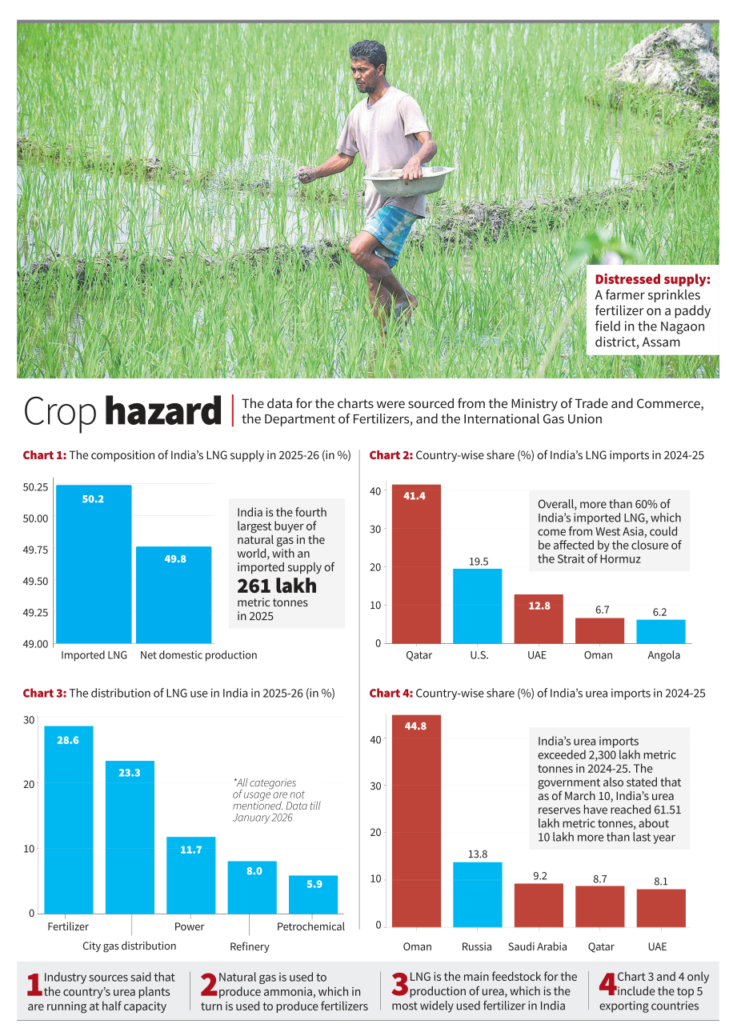
- The ongoing conflict in West Asia has disrupted global trade, leading to LPG shortages and a surge in crude oil prices. Data show that the crisis could also affect India’s supply of Liquefied Natural Gas (LNG), putting at risk the production of urea, a key fertilizer in the country’s majorly agrarian economy.
- The conflict has already started to impact India’s urea supply. As of Sunday, industry sources told PTI that the country’s urea plants are running at half capacity, with Petronet LNG Ltd, which operates India’s largest liquefied natural gas receiving terminal, declaring force majeure amid disruptions to cargoes. The move triggered supply curtailments by state-owned gas distributors GAIL (India) Ltd, Indian Oil Corporation Ltd and Bharat Petroleum Corporation Ltd.
- India is heavily dependent on imports for its LNG supply, exposing many of its sectors to global shocks such as the U.S.-Israel attacks on Iran. Data show that in 2025, India bought more than 50% of its natural gas from the international market (Chart 1). In fact, India is the fourth largest buyer of natural gas in the world, with an imported supply of 261 lakh metric tonnes in 2025.
- A majority of these imports — more than 40% of it — are tied to long-term contracts with suppliers in Qatar (Chart 2). This supply may be in jeopardy as Qatar’s LNG cargoes pass through the Strait of Hormuz, which has now become a central chokepoint in the Iran-Israel conflict. The UAE and Oman also ship LNG along this route, and both countries contribute to India’s imported LNG supply. Overall, more than 60% of India’s imported LNG could be affected by the closure of the Strait.
- In India, natural gas is primarily used to produce ammonia, which in turn is used to produce fertilizers. In FY26, about 30% of India’s LNG supply was used for the production of fertilizers (Chart 3). Demand also comes from industry and gas-fired power and city gas networks which supply to households and vehicles.
- LNG is the main feedstock for the production of urea, which is the most widely used fertilizer in India. Many urea plants use naphtha or fuel oil — both derived from crude oil – as their main input. However, as urea production is a highly energy-intensive process, these plants have switched to natural gas, which produces fewer emissions.
- National urea consumption hit 387 lakh metric tonnes in 2025, following a decade of steady growth. While domestic production has also been increasing (India produced about 306 lakh metric tonnes of urea in 2025), it does not cover the country’s demand. Due to this, India also relies on imports of urea.
- Data indicate that the West Asian conflict threatens both domestic urea production and the stability of its supply chain. In 2025, India’s urea imports exceeded 2,300 lakh metric tonnes, with a staggering 71% of these imports coming from West Asia (Chart 4). This total comprises 45% from Oman and a combined 26% from Saudi Arabia, Qatar, and the UAE, all of which rely on the Strait of Hormuz for transit.
- Amidst this scenario, the Government of India issued the Natural Gas (Supply Regulation) Order, 2026, officially including the fertilizer sector in its priority list.
- The government also stated that as of March 10, India’s urea reserves have reached 61.51 lakh metric tonnes, about 10 lakh more than last year, ahead of the Kharif sowing season. However, only time can tell if India’s import dependence for both domestic production and global supply trade will weather the ongoing geopolitical instability.
Rice, wheat procurement is ‘consistently’ low: panel
Context: Standing Committee led by DMK MP asks Food Ministry to strengthen its procurement planning and coordination with States to minimise the gap between estimated and actual procurement
- Expressing concern that actual procurement of rice and wheat has consistently remained below estimates in recent years and below targets in States such as Bihar, Gujarat, Punjab, and Uttar Pradesh, the Parliamentary Standing Committee on Consumer Affairs, Food, and Public Distribution, headed by DMK MP Kanimozhi, has asked the Union Food Ministry to strengthen its procurement planning and coordination with States to minimise the gap between estimated and actual procurement of both the food grains.
- In a report on the Demands for Grants of the Department of Food and Public Distribution, the panel noted that since 2022-23, the procurement of wheat and rice had been less than 30% of the total production.
- “Moreover, actual procurement of wheat has been 76.71%, 71.35% and 87.29% of the estimate for the years 2023-24, 2024-25 and 2025-26 respectively. Similarly, the actual procurement of rice has been less than target since 2022-23,” the report revealed.
- During the kharif marketing season of 2024-25, the procurement of rice from Andhra Pradesh, Karnataka, and Punjab was 25.60 lakh tonnes, 0.003 lakh tonnes, and 116.13 lakh tonnes against the target of 35 lakh tonnes, 5.29 lakh tonnes, and 124 lakh tonnes, respectively, the panel said.
- Similarly, during the rabi marketing season of 2025-26, the procurement of wheat was less than the target in the States of Bihar, Gujarat, Punjab, and Uttar Pradesh, it added.
Multiple factors at play
- The government told the panel that any fluctuation in estimated production and actual production resulted in variation in procurement. “Procurement depends on multiple factors like production, market surplus, minimum support price (MSP), prevailing market rates, demand-supply situation, and participation of private traders, etc., the government informed.
- Noting these factors, the panel asked the government to strengthen its procurement planning and coordination with the States to minimise the gap between estimated and actual procurement of wheat and rice.
- “While noting the Department’s submission that procurement levels are influenced by multiple factors, the Committee is concerned that actual procurement has consistently remained below estimates in recent years and below targets in several States,” the report said.
- The panel asked the Union government to review the methodology used for estimating procurement requirements, enhance real-time monitoring of production and market arrivals, and work closely with State governments — particularly in States where procurement has significantly fallen short of targets — to ensure that procurement operations are more realistic, responsive and effective. It asked the government to apprise it of the corrective measures taken on the suggestions.
Paper-V: General Studies 4
Source: The Hindu