Preliminary Examination
Paper-I: Current Events of National and International Importance
KIA named best regional airport in India and South Asia for third year
Context: The Kempegowda International Airport (KIA) has been recognised as the Best Regional Airport in India and South Asia for the third consecutive year at the Skytrax World Airport Awards 2026.
- The airport has advanced in the global airport rankings in 2026, moving up from 48 to 41.
- The Skytrax World Airport Awards, widely regarded as a global benchmark for airport excellence, recognise airports that deliver outstanding customer experience across key touchpoints, including check-in, arrivals, transfers, retail, security, immigration and departures.
- “This recognition builds on KIA’s consistent performance across both experience and scale. The airport has received global recognition recently, including being named Best Airport in Arrivals Globally for the fourth time.
- While Terminal 2 became the first in India to receive a 5-star Skytrax rating, the airport has achieved the highest Level 5 Accreditation under ACI’s Airport Carbon,” the Bangalore International Airport Ltd. (BIAL).
- KIA served 43.82 million passengers and handled 520,985 tonnes of cargo in Calendar Year 2025.
Paper-II: Current Events of State Importance and Important Government Schemes and Programs
Main Examination
Paper-I: Essays
Essay – 1: Topic of International/National Importance
“Global climate change is no longer just a subject of debate on international platforms; today, it has arrived at the doorstep of the common farmer’s field. Discuss the impacts of climate change on Karnataka’s agricultural sector and the sustainable measures needed to address them.”
Essay-2: Topic of State importance/Local Importance
“The Development Mantra of New Karnataka and Environmental Protection of the Western Ghats: The conflict between Power, Water, and Tourism projects and the necessity of a Sustainable Balance.”
Paper-II: General Studies 1
RBI injects ₹25,101 cr. in banking system via 3-day VRR auction
Context: The Reserve Bank of India (RBI) injected ₹25,101 crore transient liquidity in the banking system through a three-day variable rate repo (VRR) auction.
- The RBI injected the funds at cut-off and weighted average rates of 5.26%, the central bank.
- The liquidity injected was much lower than the notified amount of ₹75,000 crore, despite a sharp drop in surplus liquidity in the banking system due to advance tax payments. On March 17, the RBI injected ₹48,014 crore liquidity into the banking system via VRR.
A Variable Rate Repo (VRR) auction is a monetary tool used by the Reserve Bank of India (RBI) to manage liquidity (the amount of cash available) within the banking system.
When there is a shortage of funds in the market, the RBI conducts these auctions to inject liquidity for a short period.
Core Features of VRR Auctions
| Feature | Description |
| Objective | To inject liquidity into the banking system when it faces a deficit. |
| Interest Rate | It is not fixed. Banks bid for funds, and the rate is determined by the market demand during the auction. |
| Tenure | Typically 14 days, but can range from 1 to 28 days depending on the requirement. |
| Collateral | Banks must provide Government Securities (G-Secs) to the RBI as collateral to receive funds. |
How the Auction Works
Announcement: When the RBI observes a cash crunch (e.g., due to tax outflows), it announces an auction for a specific amount (e.g., ₹75,000 crore).
Bidding: Commercial banks submit bids stating the amount they need and the interest rate they are willing to pay (usually higher than the fixed Repo rate).
Allotment: The RBI accepts bids starting from the highest interest rate offered until the notified amount is exhausted. This is known as a “Multiple Price Auction.”
Why are VRR Auctions Necessary?
Tax Payments: When corporations pay Advance Tax or GST, large sums of money move from bank accounts to the Government’s account, creating a temporary shortage in the banking system.
Festive Season: During major festivals, public demand for physical cash increases, leading to a dip in bank liquidity.
Government Spending Lapses: If the government collects taxes but delays its own spending, money gets “locked” in the government account instead of circulating in the economy.
VRR vs. Fixed Rate Repo
Fixed Rate Repo: The interest rate is pre-decided by the RBI (currently 6.50%). It is usually available to banks daily up to a certain limit.
VRR: The rate is market-driven. If the demand for money is very high, the VRR auction rate will be significantly higher than the standard Repo rate.
Paper-III: General Studies 2
CAPF Bill gives priority to IPS officers; govt. says new law will curb litigation
Context: The Central Armed Police Forces (General Administration) Bill, 2026, which is likely to be tabled in the Rajya Sabha next week, states that in all Central Armed Police Forces (CAPFs) posts, 50% of the total posts in the rank of Inspector General, at least 67% posts in the rank of Additional Director General and all posts in the rank of Special Director General and Director General shall be filled by Indian Police Service (IPS) officers on deputation.
- Till now, such postings were done based on executive orders, and the Bill will codify the provisions. The Bill seeks to negate a May 23, 2025 Supreme Court judgment which had asked the Ministry of Home Affairs (MHA) to “progressively reduce” IPS deputation in CAPFs up to the rank of I-Gs.
- Retired CAPF officials have opposed the Bill stating that the government is discriminating against cadre officers who won the case after 10 years of litigation. Due to absence of senior-level posts, it takes an officer who joins as an Assistant Commandant in the CAPFs, at least 15-18 years for her/his first promotion. The officers have argued that despite leading operations from the front, they face career stagnation.
- The Bill, circulated among Rajya Sabha members, said the CAPFs perform functions of national security in close coordination with State authorities and, in the interest of maintaining Centre-State relationship, IPS officers are necessary for effective functioning of these forces.
- The statement of objects and reasons by Home Minister Amit Shah said that, in recent years, due to the absence of an umbrella law, regulatory provisions have evolved in a fragmented manner resulting in several litigations on service-related matters. It added that the Bill was being brought to “avoid unnecessary litigations.”
CJI shifts petitions against CEC selection law to another Bench
Context: The Chief Justice of India (CJI) Surya Kant expressed his reluctance to continue hearing a series of petitions challenging a law that replaced the CJI with a Union Minister in the selection panel for the appointments of the Chief Election Commissioner (CEC) and Election Commissioners (ECs).
- Chief Justice Kant said that as the petitions challenging the Chief Election Commissioner and other Election Commissioners (Appointment, Conditions of Service, and Term of Office) Act of 2023 relate to the office of the CJI, he would not like a Supreme Court Bench headed by him to hear the case as that would expose his office to criticism of conflict of interest. Advocate Prashant Bhushan, appearing for one of the petitioners, the Association for Democratic Reforms, suggested the case be shifted to a Bench which does not have a prospective CJI either as the lead or associate judge.
- Acknowledging Mr. Bhushan’s recommendation, the Chief Justice said, “I should mark this matter to a Bench where the judge may not be in line to become the CJI. Then nobody can say anything.” The Bench listed the case on April 7 before an appropriate Bench.
The main contention
- The petitioners argued that the 2023 law was introduced to dilute a Constitution Bench ruling delivered in March 2023 in Anoop Baranwal vs Union of India, which had included the CJI as a member of the high-powered selection committee involved in the appointments of the CEC and the ECs.
- The bone of contention is the validity of Section 7(1) of the statute. The provision mandated that the President would appoint the CECs and ECs on the recommendation of a selection committee comprising the Prime Minister, the Leader of Opposition in the Lok Sabha and a Union Cabinet Minister to be nominated by the Prime Minister. The statute, in short, gave the government an upper hand in appointments to the Election Commission of India.
Paper-IV: General Studies 3
Renewable Energy Ministry demands sweeping powers
Context: Ministry says it should be recognised as ‘Central Government’ in matters pertaining to renewables under Electricity Act; Power Ministry currently exercises primary authority over Act’s provisions.
- The New and Renewable Energy Ministry has made a case before a parliamentary committee for a significant expansion of its administrative authority over India’s renewable energy sector, arguing that it should be recognised as the “Central Government” in all matters pertaining to renewables under the Electricity Act, 2003.
- The demand, part of a detailed reply furnished to the committee in February but made public this month, in response to “stakeholder requests” for a standalone Renewable Energy Act, effectively seeks to redraw the institutional boundaries between the Renewable Energy Ministry and the Power Ministry, which currently exercises primary authority over the Electricity Act’s provisions, including those governing grid-connected renewable energy.
- As of January 31, 2026 — the Renewable Energy Ministry cited in a submission — India has installed 271.96 GW of capacity from non-fossil fuel sources, a little over half the country’s total installed generation capacity of 520.50 GW. Of this, 263.18 GW is from renewable energy. However, the actual electricity generated from non-fossil sources is about 25%.
- While the Ministry conceded that a separate Act was unnecessary as electricity from renewable sources is already integrated into the grid and governed under the existing framework, it laid out a sweeping list of empowerments it believes are needed to bring “institutional clarity and effective administration” to the sector.
- The Ministry wants the power to design electricity markets for renewable energy, prepare and notify bidding guidelines for renewable energy projects, frame tariff determination principles for the Central Electricity Regulatory Commission (CERC), and guide the CERC on matters related to renewables.
- It has also sought oversight of the planning and monitoring of Renewable Purchase Obligations, the mechanism that compels distribution companies and large consumers to procure a minimum share of their electricity from clean sources. Several States are laggards in these aspects.
- The Renewable Energy Ministry has further asked that the Central Electricity Authority (CEA) coordinate with it while framing regulations related to renewable energy, and that the National Committee on Transmission work under the Ministry’s guidance — a significant institutional claim, given that transmission planning has traditionally been the turf of the Power Ministry and the CEA.
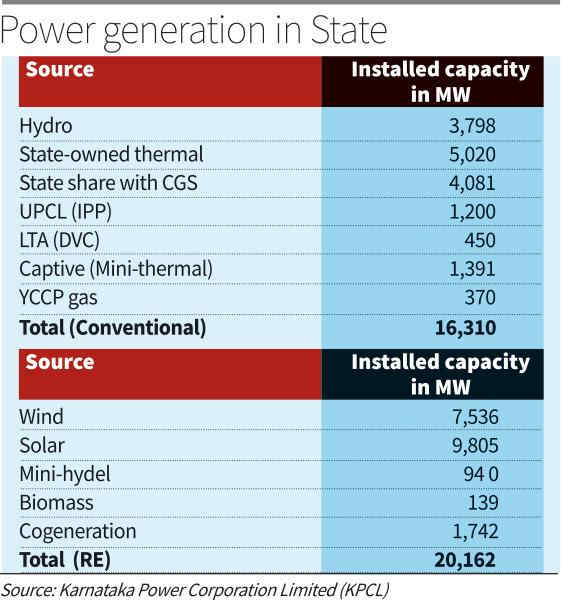
Karnataka’s total installed power generation capacity
Energy mix
- Karnataka currently has a total installed power generation capacity of about 36,472 megawatts (MW), with renewable energy accounting for a larger share than conventional sources. Of the total, around 20,162 MW comes from renewable sources, while 16,310 MW is generated from thermal, hydro, and gas-based plants.
- Among conventional sources, State-owned thermal power plants contribute 5,020 MW, while Karnataka receives 4,081 MW as its share from Central Generating Stations. Hydropower accounts for another 3,798 MW. Additional sources include 1,200 MW from Udupi Power Corporation Limited, 1,391 MW from captive mini-thermal plants, 450 MW from the Damodar Valley Corporation, and 370 MW from the Yelahanka Combined Cycle Power Plant.
- Renewables form the largest portion of the State’s installed capacity, with solar alone contributing about 9,805 MW, followed by wind at 7,536 MW. Other sources include 1,742 MW from co-generation, 940 MW from mini hydel projects, and 139 MW from biomass. Together, these account for more than half of Karnataka’s installed electricity capacity.
- However, despite the rapid expansion of renewable energy in the State, this shift has not translated into viable alternatives for small eateries and commercial kitchens, which continue to rely almost entirely on LPG — a dependence now exposed by the ongoing supply disruption. Most households too continue to depend on LPG.
Practical barriers
- Even in situations where alternatives are considered, operational constraints remain,Other alternatives such as piped natural gas (PNG) and biomass also face constraints. PNG infrastructure remains limited to certain areas, leaving many eateries without access, while installation requires time and upfront investment. Biomass-based fuels, on the other hand, require additional space, ventilation and handling due to smoke and residue, conditions that are difficult to manage in dense urban kitchens.
- Waste-to-energy solutions face a more fundamental challenge; the lack of consistent waste segregation at source. Mixed waste, in practice, significantly reduces the efficiency of such systems.
- Despite policy push and infrastructure in place, poor segregation by households and commercial establishments continues to limit the viability of waste-to-energy at an individual or decentralised level.
Beyond fuel availability
- While alternatives exist, their adoption needs more policy support.
- “If you look purely at the cost of use, electric cooking can turn out to be one of the cheapest option today. Electricity-based cooking is cheaper than both PNG and non-subsidised LPG, and is comparable to subsidised LPG for many consumers. PNG can be around 14% more expensive than electricity-based cooking, and non-subsidised LPG up to 37% more for a family of four in Delhi.”
- However, operating costs alone does not drive adoption. “The real challenge lies in the upfront cost of procurement and awareness. LPG continues to dominate because most users already have the connection, equipment, and utensils. Even for a new connection, the initial cost is relatively low compared to other options,”.
Rooftop solar
- This gap between potential and adoption is also visible in rooftop solar uptake across Bengaluru. According to data from the Energy Ddepartment, 14,944 buildings under the Bangalore Electricity Supply Company Limited have installed rooftop solar systems, including 215 government buildings, together generating about 352.35 MW of electricity.
- Within Bengaluru Urban and Rural districts alone, there are 5,370 such installations, with 4,984 in urban areas.
- Alternatives such as PNG and induction cooking come with higher entry barriers. “For PNG, the upfront cost of getting a connection, including deposits, is significantly higher, and more importantly, it is only available in areas where pipeline infrastructure exists. That geographic limitation itself becomes a constraint.”
- Induction cooking, she added, faces both cost and design challenges. “The cost of buying induction cooktops and compatible utensils is higher, and the design itself can be a barrier. In India, even the most basic cooking setup typically involves at least two burners. Most induction systems are single-cooktop units, and upgrading to multiple units increases costs further. That becomes a constraint, especially for households or commercial kitchens used to cooking multiple dishes simultaneously.”
The way forward
- “In a country like India, no single fuel can replace another entirely,” she added. “The focus should be on optimising different energy sources based on context, which requires long-term planning, not just short-term responses during crises.”
Paper-V: General Studies 4
Public Service and Administrative Responsibility
1. The Scenario
You are the Chief Executive Officer (CEO) of a Zilla Panchayat. Summer has begun, and several villages under your jurisdiction are facing a severe drinking water crisis. Months ago, the government had issued an order to “repair and keep all Reverse Osmosis (RO) water plants ready.” However, due to the negligence of your subordinate officers, more than 70 plants remain non-functional. People are struggling for drinking water, and critical reports against the government are appearing in the media.
Challenges:
Pressure from Above: There is immense pressure from senior officials and Ministers to take immediate action.
Procedural Delays: Utilizing funds reserved for repairs involves technical and bureaucratic processes that take time.
Exploitation: Private tanker mafias are exploiting the situation by overcharging desperate villagers.
2. Ethical Dilemmas
Dereliction of Duty vs. Accountability: Even if subordinates failed to perform, the ultimate accountability rests with you. Should you focus on punishing them first or getting the work done?
Transparency vs. Emergency: Bypassing tender processes during an emergency might lead to “corruption” allegations later. However, following every rule strictly will delay water reaching the people.
Public Interest vs. Administrative Delay: What is more important—saving lives or following office filing procedures?
3. Options Available
Option 1: Following rules strictly (Status Quo).
Consequence: You remain procedurally safe, but water supply is delayed, increasing public anger. This is termed “Bureaucratic Apathy.”
Option 2: Immediate suspension of negligent officers.
Consequence: While it looks like a strict disciplinary move, it doesn’t solve the immediate water crisis and might lead to a shortage of staff to execute repairs.
Option 3: Working in ‘Mission Mode’ and creating alternative arrangements.
Consequence: This is the most ethical path. Responding to public suffering must be the top priority.
4. Recommended Action Plan
As an ethical officer, you should take the following steps:
Immediate Relief: Order the supply of water through hired borewells and tankers until repairs are finished. Use GPS-based monitoring to prevent the tanker mafia from overcharging or skipping deliveries.
Parallel Repair: Appoint technical teams on a “War Footing” to repair the 71 plants. Utilize the “Contingency Fund” to prevent financial delays from hindering the work.
Fixing Responsibility: Issue “show-cause notices” to the officers responsible for the delay. To prevent future recurrences, mandate Annual Maintenance Contracts (AMC) for all plants.
Transparency: Publicly publish data regarding which village is receiving how much water to gain public trust and ensure transparency.
Ethical Lesson:
In civil services, “Service to the public is the highest goal.” Rules are meant to serve the people; people should not suffer for the sake of rules. Responsiveness in times of crisis is the hallmark of an efficient and ethical administrator.
Sources: The Hindu