Context: An Indian Army officer from Bengaluru, Major Swathi Shantha Kumar, has won the UN Secretary-General’s Award 2025 for her project Equal Partners, Lasting Peace.
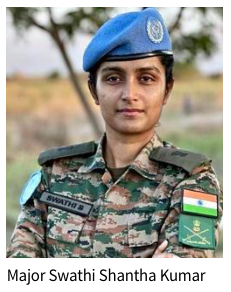
- Major Swathi is currently serving on an United Nations Mission in South Sudan (UNMISS) and her efforts are said to have significantly enhanced gender parity through the effective deployment and integration of the Indian Engagement team, thereby strengthening grassroot level engagement across the area of responsibility.
- Under her initiative and command, the team successfully conducted short- and long-distance patrols, integrated reverie patrols, and dynamic air patrols to far-flung counties of the host nation. These operations contributed substantially to creating a conducive and secure environment for more than 5,000 women, enabling meaningful participation and community confidence-building.
- Major Swathi is an officer in the Corps of Electronics and Mechanical Engineers (EME). Her father, R. Shantha Kumar, said that she did her schooling in Bengaluru and graduated from the New Horizon College of Engineering following which she was commissioned in the Indian Army.
- “We are very proud that our daughter is serving the nation in uniform, but like any other parent I am worried about her as she has to serve in very harsh terrains and conditions. This award is a recognition for her hard work and discipline which makes me a very happy and proud father,” Mr. Kumar said.
- He added that Major Swathi has been in South Sudan for nearly 15 months and is expected to return to India early next month following which she will be posted in Secunderabad.
- United Nations Secretary-General Antonio Guterres recently announced and honored the winners of the Secretary General’s Award 2025.
- In his address Mr. Guterres said that the Mission has further strengthened the gender-inclusive approach by the UNMISS.
- This prestigious award recognises initiatives that advance gender parity and promote gender-responsive peacekeeping in alignment with the UN mandate.
- The team was shortlisted from nominations received across all UN peacekeeping missions and UN agencies worldwide and emerged as the winner in the Gender Category, securing the highest number of votes among four finalists through a UN-wide voting process involving the UN personnel globally.
The United Nations Mission in South Sudan (UNMISS) is the UN’s peacekeeping mission established in 2011 to support the world’s youngest nation. Its mandate—recently extended until 30 April 2026—focuses on protecting civilians, monitoring human rights, supporting peace processes, and facilitating humanitarian aid.
🌍 United Nations Mission in South Sudan (UNMISS) – Complete Overview
🏛️ Background
Established: July 2011, following South Sudan’s independence.
Mandate Authority: UN Security Council Resolution 1996 (2011).
Current Mandate: Extended by Resolution 2779 (May 2025) until 30 April 2026.
Headquarters: Juba, South Sudan.
Personnel: Thousands of uniformed (military, police) and civilian staff from multiple UN member states.
🎯 Core Mandate & Objectives
| Focus Area | Key Actions | Impact & Goal |
| Protection of Civilians (POC) | Deploying peacekeepers to prevent physical violence; protecting women, children, and displaced persons; using force as a last resort. | To ensure the physical safety of non-combatants and vulnerable groups in conflict zones. |
| Human Rights Monitoring | Documenting and reporting violations; supporting accountability for war crimes; advocating for the rule of law. | To prevent future atrocities and ensure that perpetrators are held responsible. |
| Support to Peace Processes | Facilitating dialogue between warring parties; monitoring ceasefires; assisting in the implementation of peace agreements. | To transition a country from active conflict toward a stable, long-term political settlement. |
| Humanitarian Assistance | Securing aid corridors; providing logistics for food/medical delivery; ensuring safe access for NGOs. | To mitigate the immediate human suffering caused by war and displacement. |
| Capacity Building | Training local police and judiciaries; supporting election organization; strengthening national security institutions. | To empower the host nation to maintain its own security and governance independently. |
📌 Recent Developments (2025–26)
Mandate Renewal: Security Council extended UNMISS until April 2026 amid rising instability.
Inclusive Spaces: UNMISS has worked to release recruited children, build peace, and protect vulnerable groups.
Infrastructure Support: Repairs and constructions to connect communities and mitigate climate change effects.
Justice Initiatives: Promoting accountability and strengthening local justice systems
✨ Significance
UNMISS is critical for stabilizing South Sudan, protecting civilians, and supporting peacebuilding.
Its presence reassures international partners and provides a framework for humanitarian aid delivery.
The mission also highlights the UN’s role in conflict prevention and post-conflict state-building.
India’s Contribution to UNMISS
India has been one of the largest and most consistent contributors to UN peacekeeping missions worldwide, and its role in UNMISS is particularly significant.
Troop Contributions
India has deployed over 2,000 personnel to UNMISS, including:
Infantry battalions for civilian protection and area security.
Engineering units for infrastructure development (roads, bridges, shelters).
Medical contingents providing healthcare to both UN staff and local civilians.
Indian peacekeepers are stationed in key regions like Juba, Bor, Malakal, and Bentiu, often in volatile conflict zones.
✨ Significance of India’s Role
Reinforces India’s image as a responsible global peacekeeper.
Strengthens India–Africa relations through humanitarian goodwill.
Demonstrates India’s commitment to the UN Charter and global stability.
Builds trust among local communities, where Indian peacekeepers are often praised for their approachability and compassion.