Context: tiger census got under way in Karnataka across all forest areas of the State, including the Kali, Bhadra, Nagarahole, Bandipur, and B.R.T. Tiger reserves.
- It is the sixth such exercise with the enumeration conducted earlier in 2006, 2010, 2014, 2018 and 2022; in the previous census, it was estimated that Karnataka had around 563 tiger.
- Karnataka has the second highest number of tigers in the country after Madhya Pradesh.
- The census is part of the nationwide tiger estimation exercise which is conducted once every four years.
- The 2026 census is the sixth such exercise with the enumeration conducted earlier in 2006, 2010, 2014, 2018, and 2022. In the previous census, it was estimated that Karnataka had around 563 tigers.
- The census will be carried out in all patrol beats of the 38 forest divisions across every forest range in the State for which training was given to frontline personnel of the all 13 forest circles and the five tiger reserves between October and December last year.
Census in two phases
- During the first phase of the enumeration for three days, teams comprising three members will patrol five km daily in forest areas across the State. They will collect details of pugmarks, scats, and direct sightings of tigers, leopards, and other carnivores and also elephants.
- During the second phase, from January 15 to 17, the estimation will be conducted in 14 forest divisions, during which teams will move through forests to collect data on direct sightings of herbivores such as deer, sambar, wild buffalo, and gaur. “This will help determine where camera traps should be installed.
- Project Tiger Director Ramesh Kumar who has been nominated as the nodal officer to the National Tiger Conservation Authority (NTCA) will oversee this year’s census.
- “He (Ramesh Kumar) has been instructed to list the number of tigers and other carnivores in each area, assess the population of herbivores in each division, understand how many tigers each forest supports and how much prey is available for them, and thereby identify the forest’s carrying capacity,”.
Camera trap surveys
- Using the data collected in the first two phases, camera traps will be installed at suitable locations in the third phase.
- “There are 2,230 camera traps in the five tiger reserves and camera trap surveys have already begun in all five tiger reserves. Of these, the Nagarahole Tiger Reserve has 600 camera traps, Bandipur Tiger Reserve 550, B.R.T. Tiger Reserve 300, Bhadra Tiger Reserve 330, and Kali Tiger Reserve 450 camera traps,”.
- Steps have also been taken to install camera traps outside tiger reserves.
- Nearby tiger reserves that have completed camera trap surveys will provide cameras for this purpose. “It is observed that tigers are increasingly venturing out of forests into human habitations, and it appears that the tiger population in the State has increased this time. It will help to know the exact numbers through this census,”.
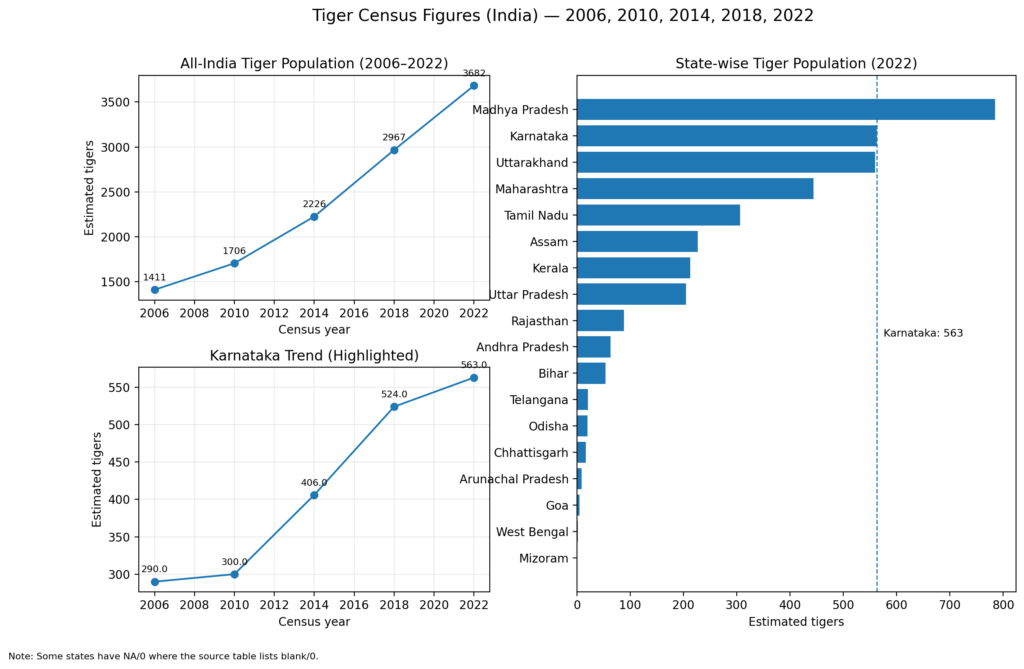
⭐ Karnataka (highlight)
Karnataka’s estimated tiger numbers across census cycles: 290 (2006) → 300 (2010) → 406 (2014) → 524 (2018) → 563 (2022).
In 2022, Karnataka is reported as the #2 state after Madhya Pradesh (785), just above Uttarakhand (560).
Sources: The Hindu