OSIRIS-REx samples from Bennu show the asteroid carries ribose, glucose, amino acids, nucleobases; discovery includes nitrogen-rich polymers, presolar grains of supernova origin, raising questions about how earth acquired life’s ingredients
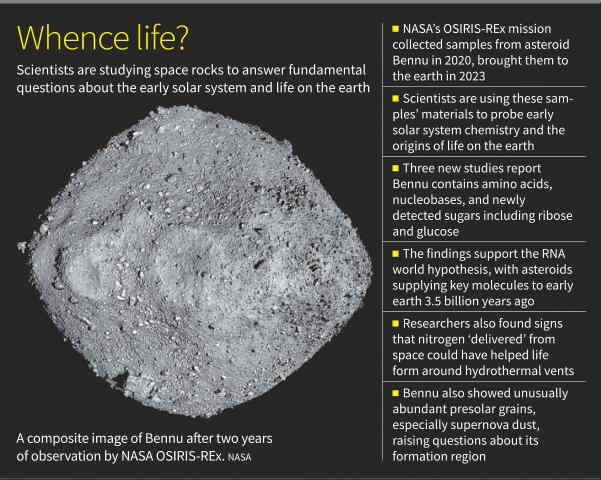
In 2020, a spacecraft more than 3 lakh km away on a small asteroid called Bennu collected samples of its surface. The craft, part of NASA’s OSIRIS REx mission, then launched itself towards the earth, dropping off the canister of samples in September 2023. Since then, scientists in the US and Japan have been studying pieces of Bennu to answer fundamental questions about the formation of the early solar system and life on the earth.
On December 2, three teams published papers reporting Bennu contains sugar and other important molecules required to form RNA, and is also surprisingly abundant in supernova dust from a time before the sun formed.
When the solar system was forming from the cloud of dust and gas swirling around the sun, several smaller rocks were pushed around as well, and often clumped together. Bennu’s larger parent asteroid formed in this way around the same time as the sun, 4.6 billion years ago, somewhere beyond Saturn. When Jupiter migrated to its present orbit, the parent was kicked into the asteroid belt, where it collided with other rocks. Over millennia, fragments from the parent gave rise to Bennu, which today orbits the sun between the earth and Mars.
In a Nature Geoscience paper, scientists led by Tohoku University in Japan reported finding ribose, the sugar molecule present in RNA, and glucose, the sugar molecule required for metabolism, on Bennu. Together with previous findings of amino acids and all the five nucleobases found in DNA and RNA, the entire inventory of molecules scientists believe are needed for life have now been confirmed on Bennu.
“For 5-C to convert to 6-C sugar, the optimal mix of environmental conditions such as very little but liquid brine, the right pH, and extremely low temperatures are required, which the asteroid possessed at formation,” Kuljeet Kaur Marhas, professor and head of the Planetary Labs Analysis Section at the Physical Research Laboratory, Ahmedabad, who works with samples of the asteroid Itokawa, said.
The findings strengthen the ‘RNA world’ hypothesis: that early life used RNA as a source of genetic information and for catalytic functions, before DNA and proteins evolved. According to the study, the abundance of asteroids like Bennu in the inner solar system would have provided sugars and amino acids, leading to the formation of life on the earth more than 3.5 billion years ago.
Chemical reactions
Scientists have also reported evidence of chemical reactions between ices forming polymer molecules before the ices melted. In a Nature Astronomy paper, a second team from NASA thus explained the discovery of polymers of nitrogen- and oxygen-rich materials on Bennu. This material, called carbamate, would have been soft and gummy when it formed, hardening since. Scientists haven’t found this material in extraterrestrial samples before.
At the time Bennu’s parent formed, volatile compound ices like frozen ammonia, known to accumulate on asteroids’ primordial surfaces, could have been heated by random radioactive decay. This would have liquefied the ices, which seeped into rocky pores and deposited the salts and minerals dissolved in them there. Bennu could have ‘inherited’ a piece of this.
Dust and gas in the early presolar system were formed from other exploding stars. By analysing the dust, astronomers hope to find clues about the elements that made up its counterpart in the early solar system, which could help understand how planets formed.
In a third paper also published in Nature Astronomy, a different NASA team showed the presolar grains on Bennu had indeed been disturbed and moved around by moving liquids on the asteroid’s surface. The concentration of presolar grains was at least 6x higher than in other similar asteroid and meteorite samples.
The team also reported signs the grains had been singed by heat released when the great mass of dust collapsed to form our sun.
Studies of the grains revealed they originated from various types of stars and supernovae. Of these, the concentrations of grains of supernovae-origin were the highest, indicating it was present in abundant quantities in the part of space where Bennu’s parent formed.
“Why exactly there is an abundance of supernova-origin presolar grains is the biggest question, as Bennu is just like plenty of other asteroids in its neighbourhood,” Dr. Marhas, who also reviewed the presolar grains paper, said.
“Will we find similar concentrations if we sample previously studied asteroids in different locations or is there something specific that makes the ordinary-seeming Bennu extremely special?”
Source: The Hindu