Bedthi–Varada River Linking Project
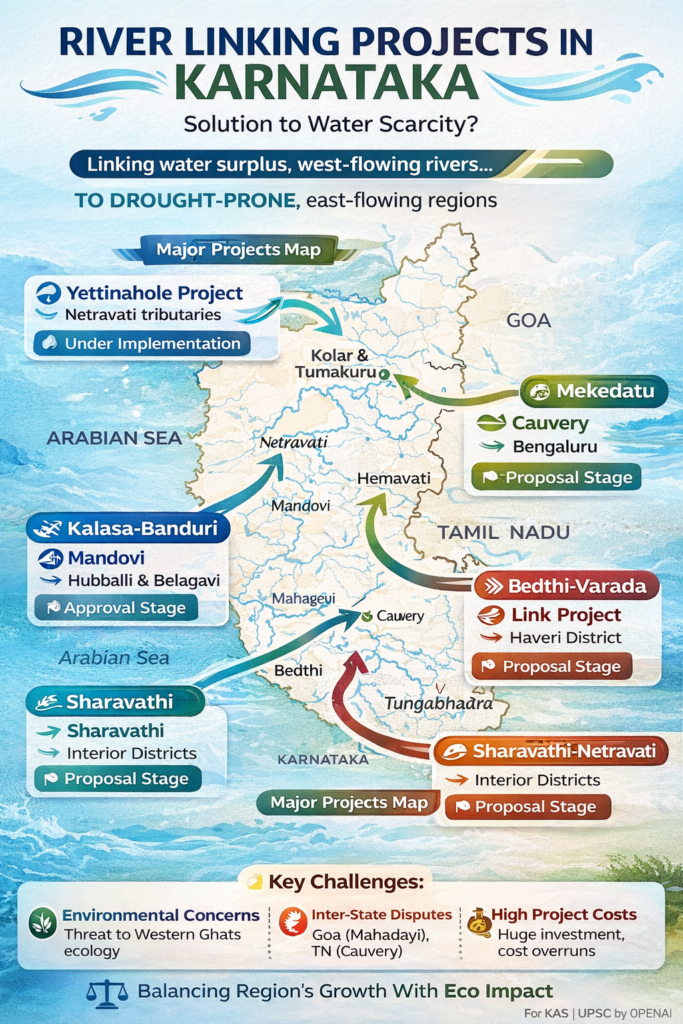
The Bedthi–Varada River Linking Project is one of Karnataka’s most significant proposed intra-state inter-basin water transfer schemes. It aims to address chronic water scarcity in central and northern Karnataka by diverting surplus flows from the west-flowing Bedthi (Gangavali) river to the east-flowing Varada river — a tributary of the Tungabhadra River in the Krishna basin.
Background: Water Scarcity and Interlinking Policy
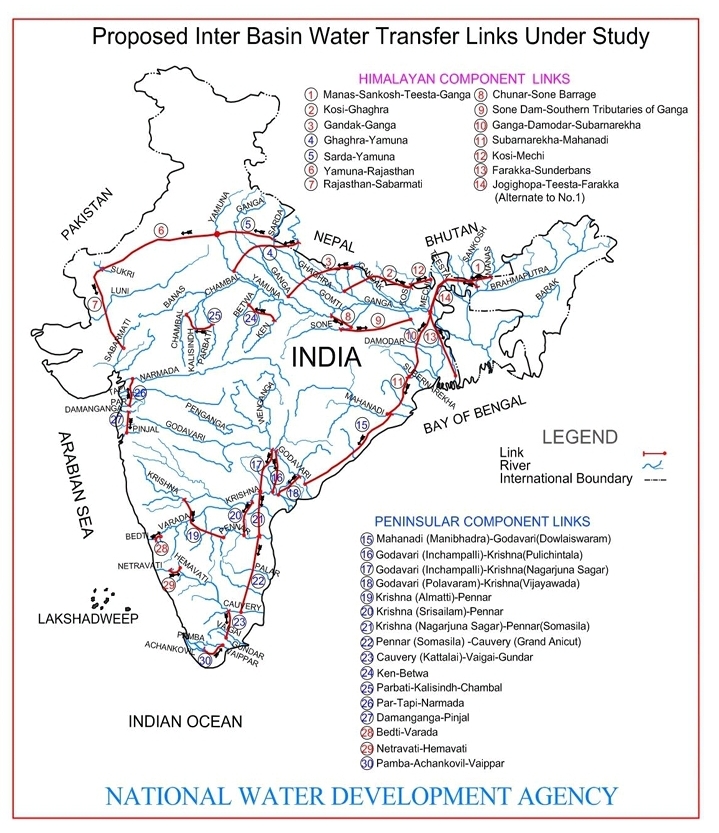
Interlinking rivers has been part of India’s long-term strategy to redistribute water across water-short and water-rich regions. The National Perspective Plan envisaged multiple links, including several in Karnataka’s peninsular river systems. Among these, the Bedthi–Varada project stands out for its intra-state scope and potential to support irrigation and reduce drought stress.
Geographical Features of the Rivers
Bedthi (Gangavali) River
- Originates in the Western Ghats and flows westward into the Arabian Sea.
- Drains the Sirsi–Yellapura region of Uttara Kannada district.
- Known for Magod Falls, one of Karnataka’s highest waterfalls.
- Substantial monsoon flows often go unused due to steep terrain.
Varada River
- Begins in the Western Ghats and flows eastward through Shivamogga and Haveri districts.
- Joins the Tungabhadra River, which feeds into the Krishna basin.
- Supports agriculture in otherwise water-stress regions.
Project Design and Technical Details
According to feasibility studies and pre-feasibility reports:
- The project envisages diversion of surplus waters (around 242 MCM / ~18–18.5 TMC) from the Bedthi basin to the Varada basin.
- Conveyance includes tunnels and lifting systems to transfer the water across the Western Ghats into the Varada river.
- Two link components are proposed:
- Direct lift and tunnel route from Bedthi to Varada.
- Via storage at Dharma reservoir, then conveyed to Varada.
The NWDA has completed draft DPR work and submitted it to the Karnataka government for observations.
Political and Administrative Progress
Government Approval
- The Karnataka government has approved the preparation of the DPR for the Bedthi–Varada linking project, marking an important procedural milestone.
Official Statements
Deputy Chief Minister D.K. Shivakumar confirmed that:
- The state has given go-ahead for the DPR, estimated to cost around ₹10,000 crore.
- The Centre will bear 90% of the cost, while the State will contribute 10%.
- Karnataka has sought an allocation of 40–45 TMC from river linking projects to address wider water needs, including an additional request to release 5 TMC for the Bhima basin.
Water Allocation
- The Bedthi–Varada scheme has been allotted roughly 18.5 TMC for diversion under the overall interlinking effort.
Expected Benefits
The main motivations for the project include:
- Irrigation expansion in drought-prone districts like Gadag, Koppal, Raichur and parts of Haveri.
- Augmentation of water supply for agriculture and allied uses.
- Reduction of monsoon runoff losses into the sea in the Western Ghats.
- Potential socio-economic uplift in rain-shadow regions.
Local farmer associations and political leaders have repeatedly voiced support for expediting implementation.
Environmental and Technical Challenges
Despite its promise, the project has generated opposition and technical critique:
Ecology and Biodiversity
Environmental groups argue that diverting water from the ecologically sensitive Western Ghats could:
- Damage biodiversity hotspots.
- Affect downstream freshwater and estuarine ecosystems.
- Impact local communities reliant on riverine resources.
Technical Feasibility Concerns
Critics contend the project design:
- May not guarantee water delivery to intended areas.
- Risks large forest and agricultural land submergence due to dams/weirs.
- Needs more accurate water availability assessments and field-based studies.
Balancing Development and Sustainability
The Bedthi–Varada project exemplifies the development vs environment dilemma in India’s water governance:
- Water redistribution is crucial for drought-mitigation and agricultural sustainability.
- Yet large infrastructure must respect ecological limits, biodiversity and long-term environmental health.
Policy experts suggest that river links should be paired with demand-management solutions like watershed development, rainwater harvesting and aquifer recharge.
Conclusion
The Bedthi–Varada River Linking Project has advanced from concept to DPR approval phase, backed by political support and central funding patterns. While it holds strong potential to transform water availability for central Karnataka, its technical, ecological and socio-economic implications require thorough evaluation, transparent planning and community engagement.