State prepares roadmap to mitigate losses
Context: According to the Karnataka State Disaster Risk Reduction (KSDRR) Road Map 2025-30, which provides a vulnerability profile of the State, 80% of the State’s geographical area is prone to drought, 22% is prone to moderate earthquake and 24% prone to cyclones, heavy winds, etc.
- With this in the backdrop, Karnataka, which incurred a cumulative loss of over ₹1.22 lakh crore due to natural disasters between 2015 and 2021, has prepared a roadmap and set 2030 as the time frame to cut such losses by 75%.
- The KSDMA has prepared the road map. for a “disaster-resilient Karnataka’’ to reduce mortalities, economic loss and casualties.
- Natural disasters: With ₹1.22-lakh crore losses, State sets timeline for mitigationKarnataka State Disaster Management Authority has prepared the road map for a ‘disaster-resilient Karnataka’ to reduce mortalities, economic loss and casualties1 of 2R.
- Karnataka, which incurred a cumulative loss of over ₹1.22 lakh crore due to natural disasters between 2015 and 2021, has prepared a roadmap and set 2030 as the time frame to cut such losses by 75%.
- The Karnataka State Disaster Management Authority (KSDMA) has prepared the road map for a “disaster-resilient Karnataka’’ to reduce mortalities, economic loss and casualties.
Vulnerability profile
- The preparation of the Karnataka State Disaster Risk Reduction (KSDRR) Road Map 2025-30 entailed drawing up a vulnerability profile, as per which 80% of the State’s geographical area is prone to drought, 22% is prone to moderate earthquake and 24% of the geographical area in the State is prone to cyclones, heavy winds, etc,. Human-induced disasters like road and industrial accidents too are considered for risk assessment and disaster mitigation.
- The KSDRR report, released recently, has set short, medium and long-term plans and stipulates 2029-30 as the year by which the economic loss, infrastructure damage, human and animal mortality and casualties, were to be reduced by 75% of the baseline established in 2026.
- The study, which went into the preparation of the KSDRR Road Map, points out that not only does the State experience disasters of various types and intensities but estimates that nearly 61.10 million people are at risk.
- There is hardly any economic sector which has not been affected by the frequent occurrence of natural disasters but the brunt of it is borne by agriculture.
- While the cumulative loss across various sectors has been pegged at over ₹1.22 lakh crore, the loss between 2015 and 2021 in agriculture was pegged at ₹1.02 lakh crore. The crops over 1.84 lakh hectares were lost, while the loss in horticulture was pegged at ₹10,102.81 crore.
Road infra damages
- Afte agriculture, it is the damage to roads which was the highest and affected 1.12 lakh km of roads during the assessment period and the loss incurred was pegged at ₹17,296 crore.
- A study of drought-affected districts indicated that between 2001 and 2022, Kalaburagi, Gadag, Davangere, Belagavi were afflicted by drought 14 times, while a majority of the remaining districts reported drought on at least 13 occasions.
Climate change impact
- The report was also a pointer to the extremities of nature and the impact of climate change in many districts in recent decades, as prolonged spells of drought were followed by severe floods. This included the districts of Raichur, Ballari, Kalaburgi, Yadgir, Bidar, etc,.
- The socio-economic impact of natural disasters on various departments — from agriculture to education and tourism — has been studied in detail and broad action plans suggested for mitigation.
Timeline for targets
- The road map proposes a department-wise action plan for effective and timely response and better recovery in case of any natural or man-made disaster. It stipulates that by 2026, all departments, districts and gram panchayats should prepare disaster management plans with baseline data of the year 2025-26.
- During 2027-28, the State will collaborate with various stakeholders for technology transfer, knowledge management, etc. for risk reduction.
- La Niña, cold dry air from Siberia contributed to the winter chill
Context: Several districts in north interior Karnataka and Bengaluru experienced a steep drop in temperatures in the past week between December 8 and 14. What contributed to this? An India Meteorological Department (IMD) and a Bangalore Professor have decoded this.
- They have cited an interplay between global La Niña conditions, synoptic advection from the Siberian High and local radiative physics for this phenomenon.
- Kamsali Nagaraja, Professor at the Department of Physics, Bangalore University, and IMD Scientist Chanabasanagouda S. Patil said that to understand why a region geographically closer to the Equator experienced such biting cold, one must look thousands of kilometres away to the Pacific Ocean, where the 2025 winter unfolded under the shadow of La Niña.
- The duo said that this global atmospheric phenomenon, characterised by cooler-than-average sea surface temperatures, acted as a conductor for the planetary weather orchestra.
Why harsher
- It strengthened the trade winds and modified global circulation patterns, effectively loading the dice for a harsher winter over the Indian subcontinent.
- While La Niña set the stage, the primary actor was the Siberian High, a massive, semi-permanent collection of cold, dry air that accumulates over northern Asia. Typically blocked by the Himalayas, a specific pressure configuration this December unlocked the gates, allowing this continental air to escape its usual boundaries, the duo said.
- They added that a perfect synoptic storm facilitated this southward migration of cold air, which resulted in Vijayapura district and Bidar district recording 7 °C and 7.4 °C with a departure of nearly 8°C from the normal. Besides, Bengaluru, which is usually insulated by its urban heat, saw airport temperatures drop to 12.9 °C.
- Prof. Nagaraja and Mr. Patil said that the winds, however, only brought the cold air to Karnataka. They said that the extreme severity of the freeze was dictated by the microscopic physics of the boundary layer, specifically a process known as “nocturnal radiative cooling”.
‘Open window’ effect
- The atmosphere during this week was exceptionally dry, particularly at the mid-tropospheric level, effectively stripping the earth of its natural blanket. Water vapour and clouds usually trap heat radiating from the ground, but with clear skies and arid air, the earth lost its warmth directly to space at a rapid rate after sunset. This “open window” effect caused the mercury to crash by 15 degrees or more from day to night, turning pleasant afternoons into biting nights, Prof. Nagaraja and Mr. Patil said.
- Govt. yet to procure sanitary pads under Shuchi scheme
Context: With four months left for the academic year to end, tenders to procure these sanitary napkins are still under way; the scheme, which was discontinued in 2020 during the pandemic, was resumed in 2024, following a High Court order1 of 2 Under Shuchi scheme, the government distributes 12 Shuchi Kits, each with 10 sanitary napkins, per year for a student.
- There are only four months left for the completion of the academic year 2025-26. But the State government is yet to supply Shuchi kits (sanitary napkin kits) to adolescent girls aged 10 to 18 in government and aided schools, colleges and hostels under the menstrual hygiene programme, Shuchi. Tenders to procure these sanitary napkins are still under way.
- The scheme, that was discontinued in 2020 during the pandemic, was resumed in January 2024, following a High Court order. Sanitary napkins were procured in 2024-25 without tenders after availing an exemption under Section 4G of the Karnataka Transparency in Public Procurements (KTPP) Act, 1999.
- However, this year, the government has called tenders for procurement leading to a delay.
- Responding to a question raised by Congress MLC Madhu G. Madegowda in the ongoing legislature session, Minister for Health and Family Welfare Dinesh Gundu Rao said that the Cabinet had approved the distribution of sanitary pads under the Shuchi programme for the year 2025-26, and a tender had been called by Karnataka State Medical Supplies Corporation Limited (KSMSCL) for the procurement process.
- Under the Shuchi scheme, the State government distributes 12 Shuchi Kits, each with 10 sanitary napkins, per year per student. The State government has identified 19,64,507 beneficiaries for the year 2025-26, and the scheme is expected to cost ₹71.83 crore this year.
Turn to NGOs
- With the State government not supplying sanitary pads to schools and colleges, many institutions have turned to non-governmental organisations (NGOs) to fill the gaps.
- A headmaster of a government school in Laggere, Bengaluru, said that their school had over 150 adolescent girls, and the Shuchi kits provided by the Department of Health and Family Welfare in July were over. “A local donor purchased enough sanitary pads for all the girls in our school for a month. We have approached another NGO for pads next month,” he said.
- The government has identified 19,64,507 beneficiaries for 2025-26
- Kerala Governor says there is judicial overreach in Vice-Chancellor selection
Context: Kerala Governor Rajendra Vishwanath Arlekar openly criticised the Supreme Court over its intervention in the appointment of Vice-Chancellors (V-Cs) in Digital University Kerala (DUK) and APJ Abdul Kalam Technological University (KTU).
- The Governor deplored the tendency of one institution usurping the role of another in a democracy. He said the power to amend the Constitution was vested with Parliament and legislatures, and the courts were there to “interpret the Constitution and not to amend it”.
- Referring to the dispute over Vice-Chancellor appointments, he said the authority to do so rested with the Chancellor as laid down in University Grants Commission regulations.
- “Kannur University verdict honours the right of the Chancellor to select the Vice-Chancellors. But after some time, the very same provisions are being ignored by the Supreme Court and its judges,” he said. He questioned the court’s decision to appoint search committees for selecting the Vice-Chancellors.
- He said such actions amounted to judicial overreach. “Taking [away] the tasks of every institution and doing them themselves [by the courts] is not correct,” he said, while reiterating that the courts must only ensure that the law was followed and that each institution must function within its domain.
- Indian Navy to commission second MH-60R helicopter squadron in Goa
Context: The Navy had commissioned its first squadron of the multi-role MH-60R helicopters on March 6 last year at Kochi.
- The Indian Navy will commission its second MH-60R helicopter squadron, INAS 335 (Ospreys), on December 17 at INS Hansa in Goa, in the presence of the Chief of the Naval Staff, Admiral Dinesh K. Tripathi.
- The event will mark a significant milestone in the Navy’s ongoing drive towards modernisation and capability enhancement.
- The Indian Navy said that equipped with advanced weapons, sensors, and a state-of-the-art avionics suite, the MH-60R is a versatile multi-role platform capable of effectively addressing both conventional and asymmetric threats. The helicopter has been fully integrated with fleet operations and has already demonstrated its operational effectiveness on several occasions.
- The commissioning of INAS 335 will provide a major boost to the Indian Navy’s integral aviation capabilities, significantly enhancing its operational readiness. The induction of the MH-60R will further strengthen India’s blue-water capabilities by extending the Navy’s operational reach and enabling sustained naval operations .
- Deployment of the Seahawk helicopters in the Indian Ocean Region will reinforce the Indian Navy’s maritime presence and deter potential threats.
- The Indian Navy had commissioned its first squadron of the multi-role MH-60R helicopters on March 6 last year at Kochi, marking the beginning of a new chapter in its maritime aviation capability.
- Bill for overhaul of higher education regulatory framework likely soon
Context: In its new Viksit Bharat Shiksha Adhishthan Bill, 2025, set to be introduced in Parliament this Winter Session, the Union government has proposed an “overhaul of the regulatory framework” of higher education in India by establishing a 12-member Viksit Bharat Shiksha Adhishthan (VBSA) umbrella commission, under which separate regulatory (viniyaman), accreditation (gunvatta), and standards (manak) councils will operate.
- This Bill, listed in the Lok Sabha bulletin for the Winter Session, seeks to subsume the functions of the University Grants Commission (UGC), the All India Council for Technical Education, and the National Council for Teachers’ Education.
- It further proposes that the UGC’s grants-disbursal function be performed “through mechanisms devised by the Ministry of Education”.
- Citing its pursuit of the National Education Policy, 2020, the government, in the Statement of Objects and Reasons, said the Bill would “enable and empower universities and other higher educational institutions to achieve excellence in teaching, learning, research and innovation, as an outcome of better co-ordination and determination of standards in institutions for higher education or research and scientific and technical institutions”.
- In this Bill, the government has provided for the creation of the Viksit Bharat Shiksha Adhishthan (VBSA), which will consist of 12 members. The Viksit Bharat Viniyaman Parishad (regulatory), the Viksit Bharat Gunvatta Parishad (accreditation), and the Viksit Bharat Manak Parishad (standards) will operate under this, with up to 14 members each.
- The law is proposed to be applicable to all Central and State universities, colleges, and higher education institutions, including those for technical education, teacher education, architects’ education, institutions of national importance, and institutes of eminence. It has exempted professional programmes in disciplines such as medicine, dentistry, law, pharmacology, nursing, and veterinary sciences.
Foreign universities
- While the Bill gives the Accreditation Council a mandate to develop an “outcome-based institutional accreditation framework”, it has mandated the Regulatory Council to set standards for Centre-approved foreign universities to operate in India, “facilitate high-performing universities” to set up campuses abroad, and develop a “coherent policy to prevent commercialisation of higher education”, among others.
- With new Bill, demand-led job scheme set to turn supply-driven
Context: Viksit Bharat — Guarantee For Rozgar And Ajeevika Mission (Gramin) Bill proposes to increase guaranteed workdaysfrom 100 to 125, but raises the financial burden on States and dismantles the demand-driven structure of the MGNREGA.
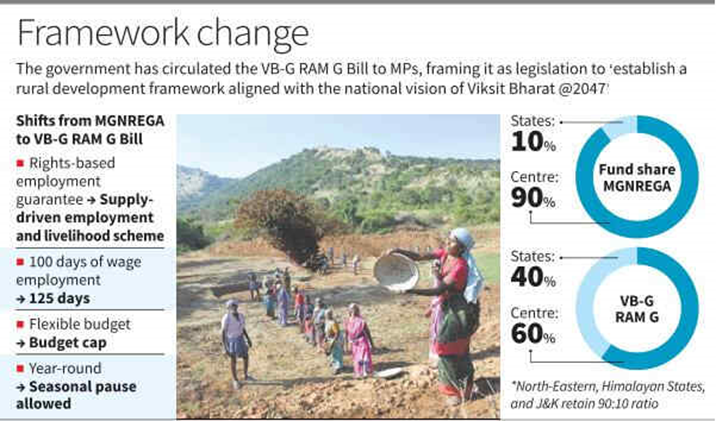
MGNREGA is now Viksit Bharat — Guarantee For Rozgar And Ajeevika Mission (Gramin)
- The Union government is set to introduce the Viksit Bharat — Guarantee For Rozgar and Ajeevika Mission (Gramin) Bill to replace the Mahatma Gandhi National Rural Employment Guarantee Act (MGNREGA), 2005 in the Lok Sabha. The move will mark a shift from a “demand-driven framework” to a “supply-driven scheme”.
- Under the new system, allocations will be capped at a fixed budget determined by the Union government based on “parameters” not yet specified. Employment will be provided only in rural areas notified by the Centre.
- While the VB-G RAM G Bill increases the number of guaranteed workdays from 100 to 125, it significantly raises the financial burden on States from the current 10% share to 40% of total expenditure. The government circulated the Bill among MPs on Monday, framing it as legislation to “establish a rural development framework aligned with the national vision of Viksit Bharat @2047”.
- Under the MGNREGA, the Union government was responsible for 100% of the labour wages and 75% of the material wages.
- New Bill set to shift job scheme to supply-driven
Context: In practice, this translated to a 90:10 cost share between the Centre and the States. However, Section 22(2) of the Bill says “the fund-sharing pattern between the Union government and the State governments shall be 90:10 for the north-eastern States, Himalayan States/Union Territories (Uttarakhand, Himachal Pradesh, and Jammu and Kashmir), and 60:40 for all other States and Union Territories with legislature”.
- While this increases the financial burden on States, the new Bill gives the Centre greater control over where and how the scheme will be implemented. Section 4(5) says: “The Central government shall determine the State-wise normative allocation for each financial year, based on objective parameters as may be prescribed by the Central government.” The MGNREGA was demand-based and allowed flexibility to increase the budget based on need.
- The Centre will not only set the budget for each State but also decide where it will be spent. Section 5(1) empowers the Union government to “notify rural areas in a State” where the scheme will be implemented.
- The new Bill allows for pausing the programme during peak agricultural seasons to “facilitate availability of labour”. Technological interventions introduced under the MGNREGA — such as mobile app-based attendance, Aadhaar-based payment systems, and geotagging of worksites — are now codified into law.
- Nikhil Dey, a founder member of Mazdoor Kisan Shakti Sangathan (MKSS) and one of the architects of the MGNREGA, criticised the move, calling it a retreat from the rights-based framework enjoyed for two decades.
- Trade deficit falls to $6.6 bn. in Nov. due to merchandise export growth
Context: India’s trade deficit plummeted by more than 61% in November to $6.6 billion, due to strong growth in merchandise exports and a fall in merchandise imports. Notably, India’s exports to the U.S. in November 2025 were higher than in October 2025, as well as in November last year.
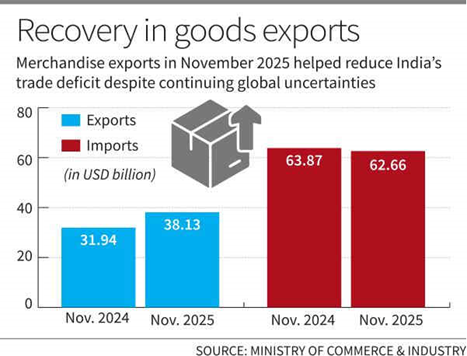
- Data released by the Ministry of Commerce and Industry showed that total exports grew 15.5% to $74 billion in November, while total imports slid 0.6% to $80.6 billion. The further disaggregated data showed that merchandise exports grew 19.4% to $38.1 billion in November. Merchandise exports had fallen 11.8% in October.
- “In terms of merchandise exports, November 2025 has seen the highest exports out of any November in the last 10 years,” Commerce Secretary Rajesh Agrawal said. “The November data takes care of the worries that arose after the October data.”
- The data show that India’s exports to the U.S. grew 22.6% to $6.98 billion in November compared to November 2024. This was also 10.7% higher than in October 2024.
- “…the November data shows our trade relations with the U.S. are going on well, and this is a positive sign,” he said.
- Merchandise imports fell 1.9% to $62.7 billion in November. These were 17.6% lower than in October, when they had surged due to gold imports. Gold imports fell nearly 60% to $4 billion in November compared to November 2024 and by nearly 73% compared to October.
- Govt. to send VBSA Bill to JPC
Context: The Union government on Monday proposed that the new Viksit Bharat Shiksha Adhishthan (VBSA) Bill, 2025, which seeks to overhaul the higher education regulatory framework by replacing the University Grants Commission (UGC), be sent to a Joint Parliamentary Committee with members from both Houses.
- Union Education Minister Dharmendra Pradhan afternoon tabled the Bill even as MPs from across Opposition parties opposed it.
- Opposition MPs from Kerala and Tamil Nadu objected to the nomenclature of the legislation, arguing that by choosing to name the Bill and the new authorities proposed in it in Hindi, the Union government was “imposing Hindi” on non-Hindi-speaking States.
- After hearing the objections to the introduction of the Bill – which will subsume the functions of the UGC, the All India Council for Technical Education, and the National Council for Teacher Education – Mr. Pradhan moved to introduce the Bill amid uproar. Following this, Parliamentary Affairs Minister Kiren Rijiju rose and said the government had decided to propose that this Bill be sent to a joint committee constituted by the Speaker.
- Mr. Rijiju said that in the meeting of the Lok Sabha’s Business Advisory Committee, “Many members have requested that this is an extensive Bill and we need further deliberation on it.”
- The Coordination Committee Against HECI (VBSA) held a press conference in New Delhi, insisting that the Bill was a “revived” version of the 2018 Higher Education Commission of India Bill, which had received thousands of adverse reactions and was subsequently put on hold. The committee, a coalition of over 30 teacher and student associations and unions, argued that this Bill was a “structural shift to dismantle public-funded higher education in India”.
- Government holds back Bill seeking amendment to Anti Cow Slaughter Act
Context: The State government is learnt to have decided to drop its earlier plan to bring the Karnataka Prevention of Slaughter and Preservation of Cattle (Amendment) Bill, 2025, before the ongoing legislature session in Belagavi.
- The Bill that seeks to provide for release of vehicles seized during the illegal transportation of cattle for slaughtering on submission of “indemnity bond” instead of “Bank guarantee”, that is equivalent of the value of vehicle as prescribed in the Act, will not come up before the ongoing winter session, according to sources in the government.
- The government had desisted from tabling it, though it had been mentioned in the Legislative Assembly’s agenda last week among other Bills that were to be tabled in the House. The Bill had been cleared by the State Cabinet for bringing up before the winter session, at the Cabinet meeting held in Bengaluru on December 12.
- Sources in the government said that the decision to put the Bill on hold had been taken as the government did not want any controversy to erupt at this point of time.
- It is learnt that a section of the ruling party MLAs have expressed a view that the Bill, though aimed at helping poor vehicle owners who earn their livelihood by operating on a hire basis, may provide a handle to the Opposition to launch an attack at the government on communal lines.
- Protests had been staged by Hindutva organisations against the proposed Bill in some parts of the State soon after the Cabinet gave clearance to bring it up before the winter session.
- The government had earlier stated that it was planning to bring such an amendment to substitute the word “indemnity bond” in the place of “bank guarantee” in the Act in tune with the Karnataka High Court’s order dated October 27, 2022. It had directed the authorities to release the vehicle seized in connection with illegal transportation of cattle on production of “indemnity bond”.
- Sources in the government said that though the Bill sought to provide for “only a very minor amendment”, it was decided that it would not be taken up now as it could turn controversial.
- The Karnataka Prevention of Slaughter and Preservation of Cattle Act, 2020, had been notified by the then BJP government in February, 2021. The legislation prescribes a ban on slaughtering of all cattle, including cow, calf, and bull. It seeks to ban the slaughter of buffalo if the animals are below 13 years of age.
- ‘Wasps can playa big role in controlling pests’
Context: Wasps have a great potential to be beneficial insects and can play a larger ecological role in controlling pests, said Raghavendra Gadagkar, professor and National Science Chair, Centre for Ecological Sciences, IISc.
- Delivering the T.N. Ananthakrishnan Birth Centenary Lecture on “You are how much you eat: Caste and nutrition in the Indian paper wasp, Ropalidia marginata”, Dr. Gadagkar said that for a long time the focus on beneficial insects has been bees and that nobody really looked at the wasps.
- “But in recent years, it has been recorded that wasps are excellent predators of pests and they are being used now for pest control. In the last five to 10 years people have woken up to the possibilities of wasps playing a larger ecological role especially in terms of pest control,” Dr. Gadagkar said.
- He added that nutrition is the key and that wasps which eat more become egg-layers, and well-fed larvae develop into adults who feed more and become egg layers.
- “Wasps who feed more develop ovaries early. Behaviourally dominant and well- fed wasps tend to leave their natal nets to find new nests either alone or jointly. They prepare for this future by altering their behaviour both on and off the nest,” he added.
- S.N. Puri, former Vice-Chancellor, MPKV, Rahuri & Central Agricultural University, Imphal, emphasised the importance of research on technologies used in natural farming and standardisation of drone application for delivering various biocontrol agents.
- J.P. Singh, Plant Protection Adviser, Government of India, briefed about the National Pest Surveillance Scheme and stressed the importance of pest scouting for deciding the right dose and use of pesticides.
- State orders immediate solar connectivity for government hospitals
Context: The Karnataka Power Transmission Corporation Ltd. (KPTCL) has directed all electricity supply companies (Escoms) to immediately provide connectivity to solar rooftop systems installed in government hospitals, after it was found that several facilities had been denied integration due to long-pending dues.
- In a communication to the Managing Directors of Bescom, Hescom, Mescom, Gescom, and Chamundeshwari Electricity Supply Corporation (CESC), the KPTCL noted that hospitals, given their essential and uninterrupted public service role, cannot be deprived of solar power on account of financial arrears.
- The government has taken a serious view of the delays, the letter said, and instructed all field officers to facilitate immediate connection and ensure compliance without further lapse.
Units in 3,600 places
- The directive comes as the Health Department accelerated efforts to bring down electricity expenditure through large-scale solar adoption.
- Karnataka has emerged as the first State in the country to install solar power units in 3,600 government health centres within a year, achieving 80% to 85% savings in electricity bills, according to officials.
- The installations are supported through CSR funds under the Saura Swasthya scheme, implemented in partnership with the SELCO Foundation. The initiative aims to ensure uninterrupted power supply across rural health institutions, benefiting more than three crore people.
- Since its launch in November 2024, solar units have been installed in around 3,000 centres, with over 1,150 facilities fully solarised. Work is under way in nearly 1,300 sub-centres, and the department expects to reach 3,700 installations by the year-end.
- By 2026, Karnataka plans to solarise 5,000 health facilities, including 2,877 sub-centres, 1,971 Primary Health Centres (PHCs), 28 Urban PHCs, 12 Community Health Centres and 112 taluk hospitals.
- The sub-centres are equipped with 0.25 kW to 1 kW rooftop units, PHCs with 4kW to 5 kW systems, and taluk hospitals with capacities of up to 10 kW.
Reduction in bills
- The ₹120-crore project has already generated power savings of more than three megawatts and reduced electricity bills by up to 70% in covered facilities. Monthly savings are expected to touch ₹50 lakh, amounting to over ₹100 crore over a decade, by reducing reliance on grid power and diesel generators.
- Minister for Health Dinesh Gundu Rao told The Hindu that the project would help strengthen healthcare delivery in rural pockets. “Saura Swasthya will not only ensure uninterrupted healthcare services but also lead to immense savings in electricity bills, which can be utilised to improve hospital infrastructure and patient care,” he said.
- Beyond installation, the SELCO Foundation is working on a long-term system sustainability through strengthened operation and maintenance (O&M). Remote Monitoring Systems enable real-time tracking, while a dedicated Saura e-Mitra mobile app allows health staff to raise service requests.
- Of the 626 complaints logged so far, 314 have been resolved, and more than 2,000 personnel have been trained in maintenance.
- The State has also set up India’s first Solar O&M Learning Centre for health institutions in Raichur, aimed at building local technical capacity. “The initiative is lowering electricity costs, reducing CO2 emissions, and strengthening uninterrupted healthcare delivery for last-mile communities,” said SELCO Foundation director Huda Jaffer.
- Raj Kumar Goyal takes oath as CIC; 8 more sworn in
Context: President Droupadi Murmu on Monday administered the oath of office to former Indian Administrative Service (IAS) officer Raj Kumar Goyal as the Chief Information Commissioner of the Central Information Commission. Mr. Goyal took charge and administered the oath of office to eight new Information Commissioners in the presence of two incumbent Information Commissioners, Anandi Ramalingam and Vinod Kumar Tiwari
- The new appointees are Surendra Singh Meena, Ashutosh Chaturvedi, Swagat Das, Sudha Rani Relangi, P.R. Ramesh, Khushwant Singh Sethi, Jaya Varma Sinha, and Sanjeev Kumar Jindal. The Central Information Commission, set up under the RTI Act with up to 10 members, now has a full panel for the first time in nine years.
- PM Modi arrives in Jordan, says his visit will boost bilateral linkages
Context: Prime Minister Narendra Modi said that his visit to Jordan will boost bilateral linkages between the two nations. He was speaking after arriving in Amman on the first leg of his three-nation trip aimed at further strengthening ties.
- In a special gesture emblematic of the close ties between the two countries, Mr. Modi was warmly received by Jordanian Prime Minister Jafar Hassan at the airport and accorded a ceremonial welcome.
- “Landed in Amman. Thankful to Mr. Jafar Hassan, Prime Minister of the Hashemite Kingdom of Jordan, for the warm welcome at the airport,” Mr. Modi said in a post on social media.
- “I am sure this visit will boost bilateral linkages between our nations,” he added. This full-fledged bilateral visit to Jordan is taking place after 37 years, coinciding with the 75th anniversary of the establishment of diplomatic relations between the two countries.
- Jordan is the first leg of Modi’s four-day, three-nation tour, which will also take him to Ethiopia and Oman.
- “It is an honour to welcome Prime Minister @narendramodi of the Republic of India to Jordan today, as a valued guest, in a visit that reflects seventy-five years of close and enduring relations,” the Jordanian Prime Minister said in a post on social media.
- “We look forward to broader horizons of cooperation between our two countries, particularly in the economic, investment, and technological fields,” he added.
- Modi will meet King Abdullah II ibn Al Hussein for a one-on-one talk followed by a delegation-level meeting. On Tuesday, the Prime Minister and the King would address an India-Jordan business event, which will be attended by leading businessmen from both countries.
- The Prime Minister, along with the Crown Prince, is scheduled to visit Petra, the historic city that shares ancient trade linkages with India, subject to weather conditions.
- According to the Ministry of External Affairs, this is Prime Minister Modi’s first full-fledged bilateral visit to Jordan.
- Modi had transited through Jordan in February 2018, while on his way to Palestine.
- India and Jordan share strong economic ties, with New Delhi being Amman’s third-largest trading partner.
- SHANTI Bill to allow private sector to make, run nuclear power plants
Context: The Centre introduced in the Lok Sabha on Monday the SHANTI Bill that aims to incentivise private sector participation, both Indian and foreign, into nuclear power production. It does this by replacing India’s existing laws — the Atomic Energy Act, 1962, and the Civil Liability for Nuclear Damage (CLND) Act, 2010, — with the Sustainable Harnessing and Advancement of Nuclear energy for Transforming India (SHANTI) Bill, 2025.
- The latter creates an atomic energy regulatory structure that is answerable to Parliament, removes the Nuclear Power Corporation of India’s monopoly over operating nuclear plants, and restricts the instances under which nuclear power plant operators can claim compensation from suppliers of equipment in case of an accident.
- Simultaneously, it also buffers operators by introducing limits on the extent of their liability, in case of violating the laws under the Act, based on the size of the plants they operate, and limits the maximum penalty on them to ₹1 crore even in the case of a “severe breach”.
- “The Bill proposes a revised and pragmatic civil liability framework for nuclear damage, confers statutory status on the Atomic Energy Regulatory Board (AERB), and strengthens mechanisms related to safety, security, safeguards, quality assurance and emergency preparedness,” a statement by the Union Ministry of Science and Technology said. Jitendra Singh, Minister of State for Science and Technology, introduced the Bill.
- Privatising the nuclear power sector, which currently makes up 1.5% of India’s installed power capacity, and 3% of the electricity produced, has been on the government’s agenda in recent years to boost clean energy production, improve grid stability, and move towards its 2070 net-zero (zero net-carbon emissions) targets.
- This includes scaling-up installed nuclear power to 100 GW, up from the current 8.8 GW, by 2047; a ₹20,000 crore mission launched in the Union Budget this year to develop ‘small modular reactors’; and a slew of customised 220 MW pressurised heavy water reactors.
- “The Bill gives hope for large-scale innovation in nuclear technology through amendments in patent laws, aligns with global liability conventions, and proposes the expansion of nuclear energy projects through private sector participation. Any explanation regarding the CNLD Act of 2010 seemed inadequate to foreign and domestic suppliers and vendors,” M.P. Ram Mohan, Professor, Indian Institute of Management, Ahmedabad.
- SIR process is based on Constitutional framework: Centre
Context: Citing precedence, Law Minister says EC’s revision took place earlier too under various governments; Opposition continues criticism over exercise.
- The Union government on Monday defended the special intensive revision (SIR) of electoral rolls, and said the guiding principle for the exercise was universal adult franchise.
- During a discussion on electoral reforms in the Rajya Sabha, the Opposition continued to attack the Centre over the SIR.
- Congress leader Digvijaya Singh said elections were not being held in a transparent manner as the BJP wanted to establish a ‘fascist state’ without elections. Former Prime Minister H.D. Deve Gowda said the Opposition would continue to get defeated in elections if it tarnished the image of the Election Commission every time.
- Senior Congress MP Randeep Singh Surjewala demanded that the Chief Justice of India continue to be a part of the committee to select the Chief Election Commissioner and Election Commissioners.
- Participating in the debate, Law Minister Arjun Ram Meghwal said the SIR was based on the constitutional framework created by B.R. Ambedkar. Quoting Dr. Ambedkar, he said the revision of the voters’ list was based on the principle of ‘one person, one vote’, which was a major pillar of election reforms.
- “Our Constitution and electoral process is based on this principle. So, when under SIR, the same is being undertaken to take out people who are not eligible from voter lists, why are they [Opposition parties] opposing it?” the Minister asked, and cited precedence that SIR took place under various governments earlier.
- Mr. Gowda said every party had lost elections, but never mocked any Prime Minister or public institution. “India is a very big country… Remember my friends, please, by using the words ‘vote chori’ (theft) you are going to suffer in the coming days,” he added. Mr. Surjewala said the SIR was a ‘selective ideological removal’ and added that Dr. Ambedkar had wanted the EC not to be under the executive and that right to vote should be a fundamental right.
- Mr. Digvijaya Singh demanded removal of the ceiling on electoral expenses to ensure transparency in the election process.
- Unemployment rate dips to 4.7% in November: PLFS
Context: The unemployment rate (UR) among people aged 15 years and above declined to 4.7% in November, the lowest level since April, when it stood at 5.1%, according to the Periodic Labour Force Survey (PLFS) report for November released.
- The PLFS, conducted by the National Statistical Office (NSO) of the Ministry of Statistics & Programme Implementation (MoSPI), stated that the overall Labour Force Participation Rate (LFPR) increased to 55.8% in November, the highest level recorded since April.
- According to a MoSPI statement based on the PLFS report, the rise in LFPR was primarily driven by rural areas, where it increased to 58.6% in November from 58% in April.
- On a month-on-month basis, the rural LFPR rose from 57.8% in October, while the urban LFPR decreased marginally from 50.5% to 50.4%.
- Overall, the female LFPR showed a steady rise from June 2025 to November 2025, the MoSPI said.
- “It increased from 32% to 35.1% during this period, driven mainly by higher labour force participation in rural areas, while urban female LFPR remained relatively stable. Rural female LFPR recorded a consistent upward movement, rising from 35.2% in June 2025 to 39.7% in November 2025,” it added.
- The Worker Population Ratio (WPR) for persons aged 15 years and above in rural areas increased from 55.4% in April 2025 to 56.3% in November 2025, while the overall WPR rose from 52.8% to 53.2%.
- “Urban WPR remained largely stable. Notably, rural female WPR improved from 36.8% in April 2025 to 38.4% in November 2025, driving the rise in overall female WPR from 32.5% to 33.4% over this period,” the Centre said.
- The NSO surveyed 3,73,229 people for the PLFS. 2,13,337 from rural and 1,59,892 from urban areas were surveyed in this round.
- INR depreciates to anotherall time low of ₹90.78 a dollar
Context: The Indian rupee depreciated to a new low of ₹90.78 a dollar amid continuous foreign investment outflows and elongated period of uncertainty around tariffs.
- The rupee opened at ₹90.5 and depreciated to ₹90.79, before settling at a new all-time low of ₹90.78 against the U.S. dollar. Foreign institutional investors (FIIs) had sold Indian equities worth ₹17,821 crore between December 1 and December 15 alone.
- Thermal power requirement projected to grow to 307 GW
Context: The projected thermal power requirement is expected to grow to 307 gigawatts (GW) by 2035, Union Minister for Commerce Piyush Goyal said in response to a question.
- Speaking to reporters he said progress was being constantly made to meet the energy requirement of the country. He informed that in the previous fiscal 7.2 GW-worth capacity was commissioned.
- India, Mexico in talks to mitigate tariff hike impact, says Agrawal
Context: Commerce secretary says the proposed 50% tariffs would impact $2 bn worth of exports, moots preferential trade pact for quick resolution.
- India and Mexico are discussing ways to mitigate the impact of Mexico’s proposed tariff increases on countries it does not have a free trade agreement with, which includes India, Commerce Secretary Rajesh Agrawal.
- A quick way to resolve the issue would be through a Preferential Trade Agreement, he said, adding that the proposed tariffs would impact about $2 billion worth of exports from India to Mexico.
- The Mexican government had on December 3 re-submitted to its Parliament a previous proposal to hike tariffs to 50% on imports from countries which it had accorded Most Favoured Nation (MFN) status and had not signed a trade agreement with.
- “Tariffs have been increased on a most-favoured nation basis, within the World Trade Organization framework,” Mr. Agrawal said at a press briefing on Monday.
- “When MFN tariffs are increased, it impacts non-Free Trade Agreement and non-Bilateral Trade Agreement partners. That is how it will impact India as well.”
- He added that due to the tariffs being on an MFN basis and within the legal framework of the World Trade Organization (WTO), India would not have recourse at the WTO to challenge the decision. However, it is engaging bilaterally with Mexico to find a way forward.
- “According to the initial proposal that was supposed to come into effect from August 2026, the impact on Indian exports would have been $3.8 billion,” Mr. Agrawal said.
- “Subsequently, we have been engaged with them and we flagged that, though this was within their legal rights to raise these tariffs, it would not be good for trade. The final plan they have come out with will have an impact of $2 billion on India exports.” The tariffs are expected to impact India’s automobile, two-wheelers, auto parts, textiles, iron and steel, plastics, and leather and footwear exports to Mexico.
- “The Embassy of India raised immediate concerns with Mexico’s Ministry of Economy on September 30, which clarified that the measure is not directed against India and reaffirmed its commitment to the bilateral relationship,” Mr. Agrawal said.
- He added that, from what “he has heard”, Mexico’s move is primarily aimed at reducing imports from China.
- “The only fast way forward is to get into a Preferential Trade Agreement, because a Free Trade Agreement would take a lot of time.”
- India-U.S. ‘very close’ to finalising initial framework deal
Context: India and the U.S. are “very close” to finalising an initial trade agreement on reciprocal tariffs, Commerce Secretary Rajesh Agrawal said, although he declined from specifying a deadline for it.
- On the negotiations with the European Union, Mr. Agrawal said both sides are at the final stage where all that is left are the topics where the two sides have differences, which are gradually being resolved.
- “On the India-U.S. trade deal, we have done six formal rounds of negotiations where we have discussed both the full-fledged Bilateral Trade Agreement for which we signed the Terms of Reference in March and also an interim framework deal that can address the reciprocal tariffs,” Mr. Agrawal said at a press conference. “We are very close on at least the framework deal which we feel can be done in a short period of time, but I would not like to put a time period to it,” he added.
- In the case of the negotiations with the European Union on a Free Trade Agreement, the Commerce Secretary said that the two sides are consistently narrowing down their differences.
- “What happens when you reach the closure of a deal, there are a set of differences on the table where we are not able to agree,” Mr. Agrawal said. “Every meeting helps us reduce those differences. Every day our teams are engaged on some issue or the other.”
- “I will not say there will be formal rounds from now, but there will continue to be physical and virtual meetings to take this forward towards conclusion,” he explained.
- On the negotiations with the Eurasian Economic Union (EAEU), which includes Russia, Mr. Agrawal said that talks are still in an early stage but that the next round of negotiations are proposed to be in February 2026.
- “With New Zealand, we did the fourth round in November 2025, which was a formal round,” he said. “After that some physical meetings have taken place as well as virtual.”
- “On the India-Chile FTA, the fourth round happened in early December and we are progressing well there,” he said
- Lawmakers set to debate 100% FDI in insurance proposal
Context: India’s proposal to permit 100% foreign direct investment (FDI) in insurance that figured in Budget FY26 announcements is set to be debated by lawmakers as the Bill mooting this and a clutch of a few other amendments to key insurance laws was circulated to Members of Parliament.
- The aggregate holdings of equity shares by foreign investors, including portfolio investors, in an Indian insurance company may extend up to 100% of the paid-up equity capital.
- The investment will be subject to “such conditions and such manner as may be prescribed,” per the Sabka Bima Sabki Raksha (Amendment of Insurance Laws) Bill, 2025, seeking to raise the FDI limit from 74%.
- The move is aimed at accelerating the growth in the insurance sector, according to the Bill to amend the Insurance Act, 1938; the Life Insurance Corporation Act, 1956; and the Insurance Regulatory and Development Authority Act, 1999.
Source: The Hindu