- Infosys Prize: Kannada scholar among winners
Context: A scholar of Prakrit and Kannada poetics and a Bengaluru-based scientist are among six winners of the Infosys Prize 2025. A scholar of Prakrit and Kannada poetics and a Bengaluru-based scientist are among six winners of the Infosys Prize 2025.
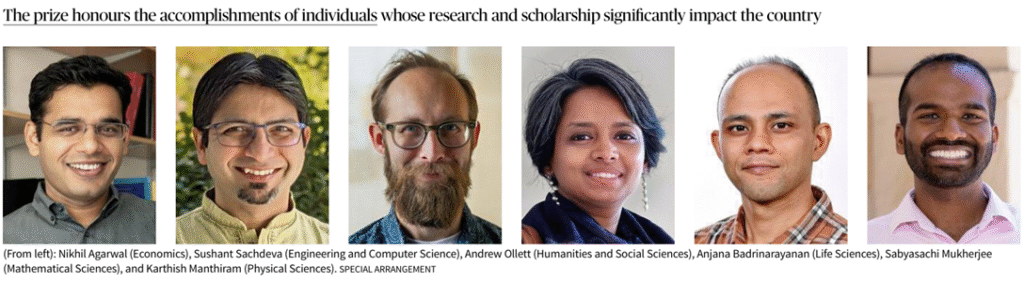
- The Infosys Science Foundation (ISF) announced the winners of the Infosys Prize 2025 in six categories-Economics, Engineering and Computer Science, Humanities and Social Sciences, Life Sciences, Mathematical Sciences, and Physical Sciences.
- The prize honours the accomplishments of individuals whose research and scholarship significantly impact India.
- The prize for each category comprises a gold medal, a citation, and a prize purse of $100,000 (or its equivalent in rupees).
The winners of the Infosys Prize 2025 in the six categories are:
Economics
- Nikhil Agarwal: Paul A. Samuelson Professor of Economics at Massachusetts Institute of Technology, he has won the prize for his pioneering contribution to market design, including the development and implementation of path-breaking methodology for empirical studies of allocation mechanisms, including school choice, medical residency, and kidney exchanges.
Humanities and Social Sciences
- Andrew Ollett: Associate Professor in the Department of South Asian Languages and Civilizations at the University of Chicago, he is regarded the world’s foremost scholar of the Prakrit languages in this generation. His book, Language of the Snakes, is a magisterial analysis of the cultural roles of Prakrit in tandem with Sanskrit and the Indian vernaculars over the last 2,000 years. His linguistic mastery and knowledge ranges from detailed contributions to the study of Sanskrit, Prakrit, Kannada, Tamil, Old Javanese, and Chinese, in addition to his knowledge of the modern European languages, and his training in Greek and Latin.
Engineering and Computer Science
- Sushant Sachdeva: Associate Professor (CSC) of Mathematical and Computational Sciences at the University of Toronto, he has been awarded for his deep insights into mathematical optimisation and the resolution of longstanding open questions in algorithmic theory that has established new standards on achievable performance in computational problems affecting information flows across societal lifelines, including the internet, transportation, and communication networks.
Life Sciences
- Anjana Badrinarayanan: Associate Professor at the National Centre for Biological Sciences, Bengaluru, the award is in recognition of her pioneering contributions to understanding mechanisms of genome maintenance and repair. Through innovative live-cell imaging combined with genetic and cell biological approaches, her work has revealed fundamental principles of how DNA damage is repaired, demonstrated mutagenesis in non-dividing cells, and identified novel pathways of mitochondrial DNA damage responses, illuminating principles central to life and evolution.
Mathematical Sciences
- Sabyasachi Mukherjee: Associate Professor at the School of Mathematics at Tata Institute of Fundamental Research, Mumbai, he has won the prize for his powerful and original work that links two distinct areas of mathematics- the dynamics of Kleinian group actions and the iteration of holomorphic and anti-holomorphic maps in complex dynamics. His results have reshaped our understanding of conformal dynamics, an area of study that has important implications across physics, fluid dynamics, and even data science.
Physical Sciences
- Karthish Manthiram: Professor of Chemical Engineering at the California Institute of Technology (Caltech), he is awarded for his pioneering work on sustainable electrochemical routes to essential chemicals. His breakthroughs in lithium-mediated ammonia synthesis and oxygen-atom transfer catalysis have transformed our understanding of electrified chemical manufacturing, demonstrating how renewable electricity can drive selective, efficient synthesis of chemicals that are fundamental to agriculture and industry.
- State govt. notifies menstrual leave policy
Context: In what brings cheer and relief to the female workforce across Karnataka, the State government notified the menstrual leave policy, allowing one day leave a month, paving the way for its implementation.
- Women between 18 and 52 are eligible to seek menstrual leave, and it will be applicable for permanent, contract or outsourced workforce.
- The policy will be applicable to the workforce employed in establishments registered under the Factories Act, 1948; the Karnataka Shops and Establishments Act, 1961; the Plantation Workers Act 1951; the Beedi and Cigar Workers (Conditions of Employment) Act, 1966, and the Motor Transport Workers Act, 1961.
- The Government Order (GO) does not specify anything on leaves for government employees or anganwadi workers or Accredited Social Health Activists (ASHAs).
- An expert committee that deliberated on the policy earlier had recommended six days annually, which the government increased to 12 when it was approved in the Cabinet. In their feedback, four employers have suggested 12 leaves annually.
- The GO issued by the Labour Department said that the menstrual leave is being extended considering health aspects, and to increase efficiency, besides increasing female participation in the workforce. As per the conditions imposed in the GO, there will be no provision to carry over the leave to the next month and women are not mandated to provide any medical certificate.
- Feedback was received from individuals, organisations and trade unions, among others, of which 56 backed the policy. Twenty six of those who supported the policy were from the management, the GO said.
- Welcoming the GO, Divya Biradar, convener, Karnataka Domestic Workers’ Union, affiliated to AITUC, said: “However, the government should take immediate measures to formalise the policy. A legislation is stronger than a government order.”
- She also said that the policy has to be amended to include a vast section of the female workforce engaged in domestic, agricultural, and construction work, apart from scheme workers such as anganwadis and ASHAs.
- The fixing of the age limit has also been objected to. A senior executive in a reputed organisation said: “Women would not have menopause before 52 in all cases. The policy should accommodate the interest of those people too.”
- Retail inflation hits record low of 0.25%
Context: Retail inflation fell to a historic low of 0.25% in October, with the government attributing this fall to the first full month’s impact of GST rate cuts, a favourable base effect, and drop in inflation of several food items such as vegetables and fruits.
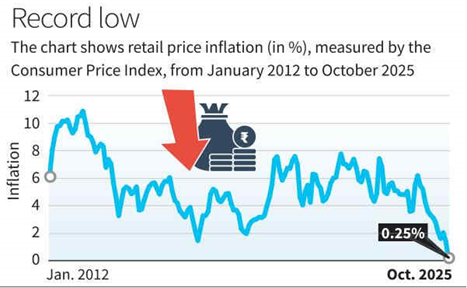
- According to the government, this is the lowest rate of inflation measured in the current series of the Consumer Price Index.
- That is, it is the lowest rate of inflation since January 2012. The data reveal that the fall in overall inflation is largely due to the statistical impact of the base effect on food inflation.
- Most of the other categories in the CPI saw inflation higher in October 2025 than in the same month last year.
- The data show that the food and beverages category saw prices contract 3.7% in October 2025, following up on a contraction of 1.4% in September.
- In fact, food and beverage prices have contracted in four out of the seven months of this financial year so far.
- “The decline in headline inflation and food inflation during the month of October 2025 is mainly attributed to the full month’s impact of decline in Goods and Service Tax [rates], favourable base effect and to drop in inflation of oils and fats, vegetables, fruits, egg, footwear, cereals and products, transport and communication, etc.,” the Ministry of Statistics and Programme Implementation said in its release.
- According to economists, this decline is however due to a statistical base effect rather than an actual fall in prices. That is, because food inflation in the same month of last year was 9.7%, the change in prices this October looks relatively better.
- “Food inflation has come down mainly due to base effects,” Madan Sabnavis, chief economist at the Bank of Baroda, said.
- The data show that this base effect in food inflation was the driving factor behind the fall in overall inflation. For example, inflation in the fuel and light category stood at 2% in October 2025, compared to a contraction of 1.7% in October of the previous year.
- Inflation in the housing category, too, accelerated to 3% in October 2025 from 2.8% in October 2024.
- The clothing and footwear category was one of the few other than food that saw inflation easing in October, to 1.7% from 2.7% in October last year, likely on account of the GST rate cuts.
Inflation on tobacco products
- The pan, tobacco, and other intoxicants category saw inflation quicken to 2.9% in October 2025 from 2.5% in the same month last year.
- The miscellaneous category, which captures all other items not included in the major sub-groups, saw inflation accelerate to 5.7% in October 2025 versus 4.3% in October last year.
- All HCs should upload details of time taken by judges to deliver verdicts: SC
Context: The Supreme Court said all High Courts should put out in the public domain the time taken by their judges to pronounce verdicts in pending cases.
- A Bench of Justices Surya Kant and Joymalya Bagchi was hearing a plea by four life convicts from the Scheduled Tribes and Other Backward Classes.
- They had complained that the Jharkhand High Court had not pronounced its verdicts on their criminal appeals even after reserving the cases for judgment two to three years ago.
- There are no specific timelines within which judges have to deliver verdicts. The convention is that they ought to pronounce judgments within a reasonable time, from two to six months, of reserving cases. However, judges, including in the Supreme Court and the High Courts, have in practice reserved judgments for well over a year before delivering them. This may be due to the complexity of the question of law involved or the burden of work.
- Justice Kant, who is Chief Justice of India-designate, indicated that reforms and transparency in judicial functioning must not be limited to litigants alone, it should also meet the legitimate expectations of the public at large.
- “Let everybody know how many judgments have been reserved by any judge and how many are pronounced; within how many days the judgments are made available in the public domain; and how many days High Courts take to upload judgments,” he observed.
- Justice Bagchi said there ought to be a dashboard on High Court websites, exclusively focusing on the reservation and pronouncement of judgments. “That will show the transparency and accountability of the judiciary to the people,” Justice Bagchi remarked.
- The top court, in its order, directed the State High Courts to file reports on their existing mechanisms to bring into the public domain the dates when pending judgments were reserved, the time taken between the reservation of judgments and their pronouncement, and when a pronounced judgment is actually uploaded on their official websites.
- The Bench specifically sought from the High Courts details of judgments reserved after January 31, 2025, and details of pronouncement of judgments till October 31, 2025. This would include the uploading of the judgments on the websites.
- The High Courts have been asked for their views about framing a uniform mechanism to disclose the dates of reservation, pronouncement of judgments and their uploading on websites.
- The Bench said the High Courts could be frank about their apprehensions about laying bare such details in the public domain. The court underscored that the High Courts must be frank about the adverse consequences that may result from such disclosures.
- In an earlier hearing of the case in September, the top court had emphasised the urgent need to evaluate the performance of High Court judges. “Our intention is not to act as a school principal and monitor everything, but there should be broad guidelines. Judges should know the task before them,” the top court had observed then.
- Eastern Himalayan birds under threat: IISc Study
Context: A new study from the Indian Institute of Science (IISc) has revealed that insectivorous birds found in the understorey of the Eastern Himalayas are under threat due to habitat degradation.
- Researchers at the Centre for Ecological Sciences (CES) studied how changes in forest microclimates after selective logging influence the survival of wild bird populations in the Eaglenest Wildlife Sanctuary, Arunachal Pradesh, over a period of 10 years between 2011 and 2021.
Birds tagged
- The team tagged birds with lightweight aluminium rings and revisited the same sites annually to track their survival and changes in body mass. The IISc said that the team paired this dataset with temperature-humidity loggers placed in both primary and logged forests, to estimate how understorey insectivorous birds which live below the canopy adapt to microclimatic changes.
- “Using these long-term data sets, we can better understand why some species survive after logging while others decline strongly,” said Akshay Bharadwaj, a former Master of Science student at CES and corresponding author of the study.
- Overall, the team found that logged forests are consistently hotter and drier during the day and colder at night in comparison to primary forests, exposing birds to stressful fluctuations due to loss of the forest canopy.
Climate change impact
- These conditions, the scientists say, could intensify with climate change, especially in the Eastern Himalayas where bird species are thermal specialists.
- Their findings reveal that these birds, which utilise very different primary and logged forest microclimatic niches, are most adversely affected in a logged forest and they experience a decline in body mass, and steep declines in long-term survival.
- “Species that can still find microclimates in logged forests similar to their original forest homes are surviving after selective logging. It is those which can’t match their old conditions that face steep declines,” said Mr. Bharadwaj. Based on their findings, the researchers suggest that conservation strategies should prioritise preserving primary forest across elevational gradients.
- The study highlights the significance of understanding why certain species of birds are declining after logging, and how microclimatic niches in disturbed habitats influence population dynamics.
- Union Cabinet clears new royalty rates of critical minerals
Context: Seeking to reduce import dependence and vulnerabilities in the supply chain of critical minerals, the Union Cabinet approved the rationalisation of royalty rates of graphite, caesium, rubidium, and zirconium.
- With the rationalisation structure, graphite, wherein royalty was previously sought on per tonne-basis (that is, a fixed amount for a specific weight of ore), will now be charged on an ad valorem basis.
- Graphite with less than 80% fixed carbon content will be subject to 4% royalty of the average sale price, whilst that with 80% or more carbon content would attract 2%.
- Caesium and rubidium would be subject to a royalty rate of 2% on the average sale price based on the specific metal contained in the ore produced. A royalty rate of 1% would apply to zirconium.
Promoting auction
- In a statement, the Cabinet said that the decision to rationalise would promote the auction of mineral blocks of caesium, rubidium, and zirconium.
- “Today’s approval of the Union Cabinet on the rate of royalty will help the bidders to rationally submit their financial bids in the auction,” the Cabinet statement emphasised.
- Bombay HC criticises govt. over malnutrition deaths in Maharashtra’s tribal regions
Context: The Bombay High Court pulled up the Maharashtra and Union governments for an “extremely casual” approach over handling the malnutrition issue among infants in the State’s tribal regions.
- The Bench comprising Justices Revati Mohite Dere and Sandesh Patil was hearing a series of petitions filed over the infant deaths due to malnourishment in Amravati district’s Melghat region, a tribal-dominant area, where chronic malnutrition has existed for years. The court called the situation “horrific”, saying “the government should be concerned”.
- During the hearing, the petitioner drew attention to the fact that from June 2025 to date, 65 infants in the age group of 0-6 months had died due to malnutrition in Melghat. The court noted that despite several orders since 2001, the problem persists like a plague due to a lack of implementation of those directives.
- However, the State government claimed these deaths happened due to pneumonia and not malnutrition. To this, the court asked, “Whether the 2001 court order to construct a multispecialty hospital in the area was actually implemented?” No answer was received.
‘Extremely casual’
- Calling out the State government, the court said: “This shows your seriousness on the issue. The approach is extremely casual, and many things need answers from you.”
- On the documents presented by the State reflecting the efforts taken, the court stated: “Everything looks good on paper, but far from reality.”
- The court ordered Principal Secretaries of Public Health, Tribal Affairs, Women and Child Development, and Finance departments to submit affidavits on the measures taken in detail and appear in court on November 24.
- India, Botswana announce cheetah translocation pact
Context: India and Botswana formally announced the translocation of eight cheetahs from the African nation during the state visit of President Droupadi Murmu.
- Thanking her counterpart, President Duma Gideon Boko, and the people of Botswana, President Murmu assured Mr. Boko that India would take good care of the animals. Botswana will symbolically hand over the big cats to Ms. Murmu.
- The two heads of state will preside over an event where five of the eight captured cheetahs will be released into a quarantine facility at the Mokolodi nature reserve, marking the symbolic handing over of the hunting cats to India by Botswana as part of Project Cheetah.
- India ninth worst affected by extreme weather: study
Context: A new report, Climate Risk Index (CRI) 2026, published by Germanwatch, released at COP30 in Belém evening, finds that more than 832,000 people died, nearly 5.7 billion were affected, and economic losses exceeded $4.5 trillion (inflation-adjusted) from over 9,700 extreme weather events between 1995 and 2024.
- Germanwatch is a Bonn-based environmental and development organisation that advocates for global equity and sustainability in climate policy.
- India ranks ninth among the countries most affected during this period, facing recurring floods, cyclones, droughts, and increasingly severe heatwaves.
- “Countries such as Haiti, the Philippines, and India – all of which are among the ten most affected – face particular challenges.
- They are hit by floods, heatwaves, or storms so regularly that entire regions can hardly recover from the impacts until the next event strikes,” said Vera Künzel, senior advisor on climate change adaptation and human rights at Germanwatch.
- SC to examine if farmers are evading satellite surveillance
Context: Chief Justice of India asks if farmers get together and decide when to burn stubble; court issues notice to Punjab and Haryana governments to submit latest reports on stubble-burning incidents.
- The Supreme Court decided to examine if farmers were burning crop stubble when satellites were not overhead to avoid surveillance. Stubble burning is considered a major source of air pollution choking the national capital.
- A Bench headed by Chief Justice of India B.R. Gavai appeared incredulous when the amicus curiae, senior advocate Aparajita Singh, told the judges that agriculturists waited for the surveillance satellite to pass overhead before putting the lighted match to the stalks. “They are delaying the burning in tune with the movement of the satellite,” Ms. Singh submitted.
- “Are you saying all the farmers get together and decide when to burn,” Chief Justice Gavai reacted.
- Ms. Singh submitted photographs and data collected from material posted online by a NASA scientist, who claimed to have analysed European and Korean satellites to conclude that stubble-burning had neither gone down or stopped. The amicus curiae, answering the Chief Justice’s question, said satellites passed overhead at a specific time.
- She referred to media reports of farmers on camera saying the State administrations had shared the timing of the satellites with the farmers.
- Ms. Singh raised doubts, under these circumstances, about the veracity of data and information fed to the top court.
- “The scientist has uploaded photographs showing the maze above Punjab. If this is true, it is alarming. Their count [of the number of incidents of stubble-burning] is not true,” the amicus curiae submitted.
- The court issued notice to the States of Punjab and Haryana to submit their latest reports on stubble-burning incidents.
- In September, the top court had suggested a return to criminal prosecution of errant agriculturists, and even a separate law. The Centre had, however, maintained that it was a policy to take farmers along rather than put them behind bars.
- At the time, the debate between the court and the government had broken out after Ms. Singh had pointed out that farmers continued to burn despite “humongous” efforts and funds spent by the Centre to wean them away from an annual practice, which dispels a cloud of toxicity across States in northern India.
- Ms. Singh had said the situation on the ground returns to square one at the beginning of every winter season regardless of the extensive orders from the Supreme Court to curb stubble-burning.
- The amicus curiae and several lawyers, including senior advocate Gopal Sankaranarayanan, urged the court to direct the Commission for Air Quality Management (CAQM) to upgrade anti-pollution restrictions in Delhi-NCR from the current GRAP III stage to the stricter GRAP IV measures, which involve a complete stop in construction and demolition activities. “Your Lordships have asked the CAQM to take steps in anticipation. The AQI has already breached 400. The CAQM must not wait for it to turn ‘severe plus’. It should anticipate and take action now,” Ms. Singh said.
- Jaishankar meets Rubio at CanadaG7 meeting
Context: External Affairs Minister S. Jaishankar met U.S. Secretary of State Marco Rubio on the sidelines of the G7 Foreign Ministers’ meeting in Canada where terror strike near the Red Fort featured.
- “Discussed our bilateral ties, focusing on trade and supply chains. Exchanged views on the Ukraine conflict, the Middle East/West Asia situation and Indo-Pacific,” said Mr. Jaishankar on X after the talks, adding, “Appreciate his condolences on the loss of lives in the blast in Delhi.”
- Mr. Jaishankar also met Canadian Foreign Minister Anita Anand earlier in the day.
- The terror attack drew messages of condemnation and condolences from across the world, including from Israeli Prime Minister Benjamin Netanyahu, incoming U.S. Ambassador to India Sergio Gor and the Foreign Ministry of the United Arab Emirates.
- MEA launches new version of Passport Seva Programme
Context: The Ministry of External Affairs has rolled out the “upgraded version” of its Passport Seva Programme (PSP), the MEA said in a statement.
- The rollout included the Passport Seva Programme (PSP V2.0), the Global Passport Seva Programme and the e-passport for citizens in India and for the Indian citizens living abroad.
- The MEA described the introduction of e-passports alongside PSP V2.0 a “significant milestone for the Ministry”.
- “The new and improved passport website and mobile app give users a better experience through features like auto-filled forms, simpler document uploads, and easy online payments…,” the Ministry said.
- Tuberculosis incidence falling in India by 21% a year: WHO report
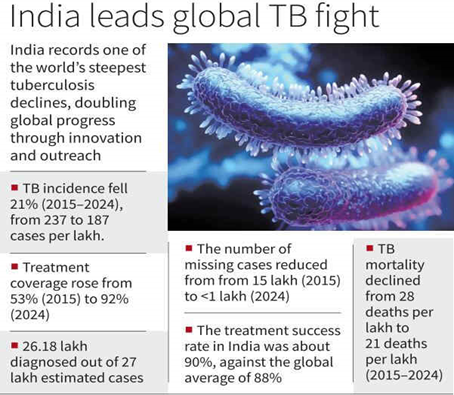
Context: India’s tuberculosis (TB) incidence, with new cases emerging every year, fell by 21% — from 237 TB cases per lakh population in 2015 to 187 per lakh population in 2024 — almost double the pace of decline observed globally, at 12%, according to the World Health Organization (WHO) Global TB Report, 2025, the Union Health Ministry said in a release issued.
- This was one of the highest declines in TB incidence globally, outpacing reductions noted among other high-burden countries.
- “India’s innovative case finding approach, driven by the swift uptake of newer technologies, decentralisation of services, and large-scale community mobilisation, has led to the country’s treatment coverage to surge to over 92% in 2024, from 53% in 2015 — with 26.18 lakh TB patients being diagnosed in 2024, out of an estimated incidence of 27 lakh cases,” the release said.
- The Ministry said this had helped reduce the number of “missing cases” — those who had TB but were not reported to the programme — from an estimated 15 lakh in 2015 to less than one lakh in 2024.
- Also, there is no significant increase in the number of multidrug-resistant (MDR) TB patients in the country, adding that treatment success rate under the TB Mukt Bharat Abhiyan increases to 90%, ahead of the global treatment success rate of 88%.
- India’s TB mortality rate has also decreased from 28 per lakh population in 2015 to 21 per lakh population in 2024, reflecting significant progress in reducing deaths due to TB.
- Since its launch in December 2024, India’s flagship TB elimination mission, the TB Mukt Bharat Abhiyan, has achieved extensive reach, screening over 19 crore vulnerable individuals for TB across the country, leading to the detection of over 24.5 lakh TB patients, including 8.61 lakh asymptomatic TB cases, the report said.
- GI tag fee cut to ₹1,000; Minister promises backing for tribal goods
Context: Commerce and Industry Minister Piyush Goyal announced here that the application fee for the Geographical Indications (GI) tag had been reduced to ₹1,000 from ₹5,000.
- At the inaugural Tribal Business Conclave, he urged tribal artisans to register and protect traditional products and crafts. He further promised the support of his Ministry in creating export and e-commerce linkages for tribal enterprises and international warehouses for their products.
- The conclave, held by the Ministries of Tribal Affairs and Culture and the Department of Promotion of Industry and Internal Trade (DPIIT) at the Yashobhoomi Convention Centre, featured panel discussions and masterclasses on topics such as financing innovations for, and investments in, tribal enterprises, partnerships, industry linkages, and skilling.
- Mr. Goyal said schools, universities, industries, and the government must work together to ensure that products made by tribal artisans reach the larger domestic and global markets.
- The Minister promised the full support of his Ministry and the DPIIT in this mission, by creating export and e-commerce linkages and facilitating international warehouses for tribal goods.
- The conclave was part of the Government of India’s Janjatiya Gaurav Varsh celebrations, to mark the 150th birth anniversary year of tribal icon Birsa Munda.
GI tags distributed
- The event also saw GI tag certificates being distributed for crafts and products such as Kannadippaya (bamboo mat) of Kerala, Apatani textile of Arunachal Pradesh, Marthandam honey of Tamil Nadu, Lepcha Tungbuk of Sikkim, Bodo Aronai of Assam, Ambaji white marble of Gujarat, and Bedu and Badri cow ghee of Uttarakhand.
- The Tribal Affairs Ministry announced a Tribal Affairs Grand Challenge, inviting enterprises to design solutions for tribal communities.
- Puri, Canadian minister discuss hydrocarbons trade
Context: Petroleum Minister Hardeep Singh Puri met Canada’s Minister for International Trade Maninder Sidhu to discuss bilateral hydrocarbon trade between the two nations. Mr. Puri wrote on social media that the bilateral hydrocarbons trade that scaled $226.45 million in the fiscal year 2024-25 also had a “substantial upside potential”.
- The meeting was part of Mr. Sidhu’s official visit to India wherein the North American country is seeking to “find opportunities to advance trade and investment linkages” between the two nations.
- Ottawa is seeking to diversify avenues for hydrocarbons exports, and is at the receiving end of the Trump tariff regime.
- Protesters clash with security at Brazil’s COP30
Context: Dozens of Indigenous protesters forced their way into the COP30 climate summit venue and clashed with security guards at the entrance to demand climate action and forest protection.
- Shouting angrily, protesters demanded access to the UN compound where thousands of delegates from countries around the world are attending this year’s UN climate summit in the Amazon city of Belem, Brazil.
- Some waved flags with slogans calling for land rights or carried signs saying, “Our land is not for sale.”
- Security guards pushed the protesters back and used tables to barricade the entrance. The protesters dispersed shortly after the clash.