- India and China have goodwill towards us, says Sri Lankan PM
Context: India and China have shown enormous goodwill towards Sri Lanka and recognise the island nation as an important partner, Prime Minister Harini Amarasuriya said.
- In an interview to marking one year of the National People’s Power (NPP) government, she said that bringing stability and fostering a new political culture were the government’s biggest successes, even as taking the state machinery along remained a challenge.
- On the ongoing IMF programme and the hardships facing ordinary Sri Lankans since the economic crash three years ago, she said the government could not renegotiate the entire agreement due to the risk of chaos and destabilisation, but had managed to revise certain aspects.
- Weighing in on justice and reconciliation for war-affected Tamils, she stressed the importance of a “home-grown process”, rooted in trust-building, to address wartime human rights violations.
- While economic stability remains a priority the government is also committed to introducing a new Constitution through “a consultative approach”, Ms. Amarasuriya added.
- K-RERA declares BDA a ‘promoter’
Context: The Karnataka Real Estate Regulatory Authority (K-RERA) has held that the Bangalore Development Authority (BDA) is a ‘promoter’ under the Real Estate (Regulation and Development) Act, 2016 (RERA).
- In a landmark ruling, the Karnataka Real Estate Regulatory Authority (K-RERA) has held that the Bangalore Development Authority (BDA) is a ‘promoter’ under the Real Estate (Regulation and Development) Act, 2016 (RERA).
- In a case against them, the BDA had sought exemption from the jurisdiction of the RERA contending that applying the RERA to its schemes would disrupt its statutory duties and financial structure. But the K-RERA dismissed the plea.
- Further, the authority directed the BDA to register its flagship Nadaprabhu Kempegowda Layout (NPKL) as a real estate project within two weeks. The authority directed the BDA to upload all project-related documents, including sanctioned plans, layout approvals, progress reports, and financial disclosures, and refrain from any sale, marketing, or creation of third-party interests in the layout until registration is complete.
- The K-RERA also granted the BDA three weeks to explain why penalty proceedings under Section 59(1) should not be initiated for violation of Section 3 of the Act, which mandates project registration before advertisement or sale.
- The Full Bench of the K-RERA, comprising Chairman Rakesh Singh and member G.R. Reddy, delivered the order on November 7, while hearing a batch of complaints filed by allottees alleging serious breaches by the BDA in the development and allotment of sites under the NPKL scheme.
- The complainants, led by Ramachandra Nayak and others, accused the BDA of violating multiple provisions of the RERA Act. They alleged that although the BDA had collected full or substantial payments from allottees between 2015 and 2016, it failed to complete essential infrastructure such as roads, water supply, sewerage, electricity, and parks, rendering the layout uninhabitable. The complainants further stated that despite these lapses, the BDA continued to invite applications for additional sites and levied arbitrary penalties and interest on allottees for delayed payments. They argued that the BDA’s conduct squarely fell within the purview of the RERA and that the authority’s non-registration of the project was unlawful.
BDA’s defence
- In its defence, the BDA argued that it is a statutory authority constituted under the Bangalore Development Authority Act, 1976, which governs urban planning and land development within the city.
- The authority claimed that layout formation and site allotment were part of planned city development and public welfare functions, not commercial real estate activities, and therefore outside the scope of the RERA.
- The BDA maintained that the relationship between the authority and allottees was governed by the BDA (Allotment of Sites) Rules, 1984, and that disputes should be resolved under those rules. It also contended that applying the RERA to its schemes would disrupt its statutory duties and financial structure, as funds from site allotments were used for citywide development and not confined to a single project.
K-RERA’s findings
- However, the K-RERA rejected the BDA’s arguments in totality. The authority held that the definition of ‘promoter’ under Section 2(zk) of the RERA Act explicitly includes any development authority or public body that develops and sells plots or apartments to the public.
- Citing a 2019 clarification from the Ministry of Housing and Urban Affairs which included the Delhi Development Authority (DDA) under the same definition, the K-RERA ruled that the BDA clearly falls within the scope of a promoter.
- The authority clarified that the RERA applies even to government agencies when they engage in real estate transactions. “The purpose of the RERA is transparency, accountability, and consumer protection and not profit control,” the order stated. “Even welfare or non-profit schemes are subject to the RERA when plots or flats are sold to the public.”
- State records 24% drop in maternal deaths
Context: Karnataka has recorded a 24% reduction in maternal deaths this year compared to the corresponding period in 2024.
- While 483 maternal deaths were reported in the first 10 months of 2024, the number reduced to 366.
- Karnataka has recorded a 24% reduction in maternal deaths this year — from January to October —compared to the corresponding period in 2024.
- While 483 maternal deaths were reported in the first 10 months of 2024, the number has come down to 366 in 2025.
- This follows strict monitoring and audit of every maternal death by a State-level committee that was set up in the aftermath of the Ballari maternal deaths in November last year, according to Health Minister Dinesh Gundu Rao.
Mission zero
- He said to further improve the quality and safety of maternal and newborn care across health facilities, the Health Department had launched the “Mission Zero Preventable Maternal Deaths” initiative.
- As part of this ongoing effort, the State had now issued a new Government Order (GO) to rationalise and optimally deploy key specialists — obstetricians, anaesthetists, and paediatricians — across Karnataka.
- The move aimed to ensure that every taluk hospital and well-performing community health centre (CHC) provided round the clock comprehensive emergency obstetric and newborn care (CEmONC) services, Mr. Gundu Rao said.
- According to the GO, all 147 taluk hospitals and 42 well-performing CHCs (those conducting 30 or more deliveries a month) will be strengthened as CEmONC centres.
- Each centre will have two specialists each in obstetrics, anaesthesia, and paediatrics, along with a radiologist and a physician. Remote areas such as M.M. Hills will continue as full CEmONC facilities, given their hard-to-reach terrain and distance from other referral centres.
Tamil Nadu model
- Harsh Gupta, Principal Secretary, Health, said the rationalisation exercise was based on the Tamil Nadu model.
- “The redeployment will be done through counselling. To achieve equitable distribution of specialists, those currently serving in low-performing CHCs will be redeployed to high-delivery-load facilities. The government will also mobilise 404 medical officers from the existing sanctioned posts. Nurses from underperforming 24/7 primary health centres (PHCs) will be reassigned to strengthen delivery points,” he said, adding that Tamil Nadu had been following this model for four years.
- The Minister also said 104 new radiologist posts and 23 physician posts had been created additionally.
- At the district level, 125 super-specialist posts — including cardiologists, neurologists, nephrologists, oncologists, pulmonologists, and critical care specialists — would be created under the Compulsory Medical Service Scheme to manage advanced maternal and newborn complications, he said.
- He said the exercise will be implemented under Rule 15(1)(c) of the Karnataka Civil Services (Regulation of Transfer of Medical Officers and Other Staff) Rules, 2025. The initiative is designed to be budget-neutral, relying on redeployment and transfers from existing sanctioned posts, he said.
- SC says women are the ‘largest minority’, notes their receding presence in Parliament
Context: The Supreme Court has said women are the “largest minority” in India and their presence in Parliament is steadily receding.
- “Why not give women representation even without reservation,” Justice B.V. Nagarathna, the Supreme Court’s sole woman judge heading a two-judge Bench, observed.
- The Bench, including Justice R. Mahadevan, was hearing a petition filed by Jaya Thakur challenging the provisions of the “Nari Shakti Vandan Adhiniyam”, or the Constitution (106th Amendment) Act, granting 33% reservation to women in the Lok Sabha and Assemblies.
- The law was assented to by President Droupadi Murmu in September 2023, but is yet to be implemented, senior advocate Shobha Gupta and advocate Varun Thakur, submitted in court.
“Why delay the ‘vandan’,” Ms. Gupta asked.
- “This [the Constitution amendment] was an instance of giving women political justice. Political justice is on par with social and economic justice. Women are the largest minority in the country. Women form 48.44% of the total population,” Justice Nagarathna observed.
- She pointed to Article 15(3) of the Constitution which mandates the State to take affirmative action and make special provisions for the empowerment of women.
- The provisions of the 2023 law would be implemented only after the conduct of the next census and the subsequent delimitation exercise — redrawing of Lok Sabha and Assembly constituencies — to determine seats to be reserved for women.
- The quota for women in the Lok Sabha and Assemblies would continue for 15 years and Parliament could later extend the benefit period.
‘Long-pending demand’
- “A Constitutional amendment cannot be held back for an uncertain period… For the last 75 years there has been no adequate representation of women in Parliament as well as in the State legislatures. This has been a long-pending demand for decades,” the petition submitted.
- Ms. Gupta said the Act did not give any specific time period about the census or the delimitation exercise.
- Senior counsel echoed the court’s oral observation about the need for census as a pre-condition to reserve seats for women.
- Justice Nagarathna said the census would quantify the population, based on which the seats would be scientifically reserved for women.
- India and Vietnam move to strengthen defence ties
Context: Defence Secretary Rajesh Kumar Singh met Vietnam’s Minister of National Defence, General Phan Van Giang, on the sidelines of the 15th India-Vietnam Defence Policy Dialogue in Hanoi.
- He conveyed warm greetings from Defence Minister Rajnath Singh, and reaffirmed India’s commitment to further strengthening defence cooperation with Vietnam.
- During the dialogue, co-chaired by Mr. Rajesh Singh and Vietnam’s Deputy Minister of National Defence Senior Lieutenant-General Hoang Xuan Chien, both sides reviewed ongoing defence engagements and explored new areas of collaboration.
MoA signed
- A memorandum of agreement on Mutual Submarine Search and Rescue Support and Cooperation and a letter of intent on Defence Industry Cooperation were signed.
- The discussions underscored that defence partnership continues to be a key pillar of the Comprehensive Strategic Partnership between India and Vietnam, a press statement said.
- Ministry simplifiesrules to boost cornea transplant services
Context: A notification was issued on Nov. 6 removing mandatory requirement of clinical specular equipment in corneal transplantation centres.
- The Union Ministry of Health and Family Welfare has amended the Transplantation of Human Organs and Tissues (Amendment) Rules, 2025 to boost cornea donation and transplant services across the country. A notification in this regard was issued on November 6 under the under the Transplantation of Human Organs and Tissues Act, 1994.
- The mandatory requirement of the clinical specular equipment in corneal transplantation centres has now been removed under this amendment. Clinical specular microscopes are used to assess the health and density of corneal endothelial cells.
- “This change has been introduced after careful consideration of expert recommendations and stakeholder consultations,” said a release issued by the Ministry on Monday. It added that the move also aligns with the government’s vision to promote equitable access to organ and tissue transplantation services.
- The amendment strengthens the National Organ Transplant Programme (NOTP) and streamlines functioning of corneal transplantation centres, the Ministry added.
- It said the amendment is expected to ease infrastructure and operational challenges, particularly for smaller eye centres in rural and semi-urban areas. A corneal transplant is a surgical procedure to replace a damaged or diseased cornea with healthy donor tissue to restore vision and reduce pain.
- The cornea is the clear, front part of the eye that helps focus light; when it becomes cloudy or scarred from injury, infection, or certain medical conditions, vision can be significantly impaired. The transplant can involve replacing the entire cornea or just the affected layers.
- As per an article published in the Indian Journal of Ophthalmology, titled Corneal blindness in India: The care gap, corneal blindness has been the second-leading cause of blindness in the over-50 age group in India. It said the country has an estimated 1.2 million corneal blind persons.
- Petition in SC says GenAI may leadto fake case laws
Context: The Supreme Court agreed to list after a fortnight a petition saying indiscriminate use of Generative Artificial Intelligence (GenAI) in judicial work could lead to “hallucinations”, resulting in fictitious judgments and research material, and even perpetuate bias.
- Chief Justice of India B.R. Gavai, before whose Bench the case came up, reacted that the judges were aware and vocal about the incursions made by AI in judicial functioning.
- Kartikeya Rawal, an advocate represented by his counsel, Abhinav Shrivastava, urged the top court to formulate a strict policy or, at least, frame guidelines for regulated, transparent, secure and uniform use of GenAI in courts, tribunals and other quasi-judicial bodies until a law was put in place.
- The petition warned the opaque use of AI and Machine Learning technologies in the judicial system and governance would trigger constitutional and human rights concerns. The judiciary must avail only data free from bias, and the ownership of that data must be transparent enough to ensure stakeholders’ liability.
- “The skill of GenAI to leverage advanced neural networks and unsupervised learning to generate new data, uncover hidden patterns, and automate complex processes can lead to ‘hallucinations’, resulting in fake case laws, AI bias, and lengthy observations… This process of hallucinations would mean that GenAI would not be based on precedents but on a law that might not even exist,” the petition submitted.
- GenAI was capable of producing original content based on prompts or query. It could create realistic images, generate content such as graphics and text, answer questions, explain complex concepts, and convert language into code. GenAI algorithms could also “replicate, perpetuate, aggravate” pre-existing biases, discrimination, and stereotypical practices, raising ethicalchallenges, Mr. Rawal said.
- Centre yet again seeks auto industry inputs on EV import policy
Context: The policy failed to attract bidders before last month’s deadline expired; industry given three weeks’ time to submit its recommendations.
- The government has once again invited suggestions from the auto industry on its electric vehicle (EV) import policy, which offers duty concessions in exchange for local manufacturing commitments, after failing to attract any bidders before last month’s deadline expired.
- In June, the government invited auto players to submit their interest for the Scheme to Promote Manufacturing of Electric Passenger Cars (SPMEPC) in India, which permits automakers to import up to 8,000 EVs at a reduced duty rate of 15%, compared with the current 70-100%, provided they commit to invest ₹4,150 crore in local EV manufacturing.
- However, the deadline for submissions, which ended on October 21, passed without a single applicant. Subsequently, the Ministry of Heavy Industries held a round of consultation with the auto industry in the last week of October, seeking suggestions. “If these suggestions are viable, we may reopen [the application window],” a government official said.
- The industry has been given three weeks to submit recommendations to the policy. To a question on why auto players did not show interest, the official said one of the reasons was the ongoing negotiations for India-EU trade agreement and the import concessions that could be offered under it.
- The government has also received suggestions to include ICE vehicles under the scheme. However, the official said while “minor changes could be made, the fundamentals cannot be altered.”
- E-com sites may have to disclose country of origin of goods sold
Context: A set of draft rules released on Monday by the Union Department of Consumer Affairs has proposed to make it mandatory for e-commerce platforms to provide ‘searchable and sortable filters’ based on the ‘country of origin’ for packaged commodities sold online.
- “This will enhance consumer empowerment and transparency in online shopping,” the government said in a release.
- The Draft Legal Metrology (Packaged Commodities) (Second) Amendment Rules, 2025, proposes to add in rule 6, in sub-rule (10) of the existing rules that: “Provided that every e-commerce entity selling imported products shall provide a searchable and sortable filter for the country of origin, with their product listings.”
- The release added that the amendment seeks to empower consumers to make informed purchasing decisions by allowing them to easily identify the origin of products while shopping online. “The proposed feature will enable consumers to search and sort products by their country of origin, thereby enhancing transparency and reducing the time required to locate such information across vast product listings,” it said.
- Stakeholders can submit their observations and comment on the draft rules to the government till November 22, 2025. “The amendment directly supports the ‘Atmanirbhar Bharat’ and ‘Vocal for Local’ initiatives by making ‘Made in India’ products easily discoverable,” the Centre added.
- ISMA welcomes sugar export permit announcement
Context: The government’s decision to permit 15 lakh tonnes of sugar for export during the current sugar season will enable the sugar mills to plan their production in advance and channel surplus sugar into global markets, said the Indian Sugar and Bio-Energy Manufacturers Association (ISMA).
As a long-term measure, the ISMA strongly urged for revision of the minimum selling price (MSP) of sugar, which has remained unchanged for over six years.
- TRAI proposes mandating clearer telco-to-telco calls
Context: The Telecom Regulatory Authority of India (TRAI) proposed an overhaul of the interconnect regulations that govern how different networks connect with and compensate each other for call and data traffic.
Specific mandate
- In a consultation paper on “Review of existing TRAI Regulations on Interconnection matters,” the regulator specifically floats the idea of mandating digital (“all-IP”) interconnection between telcos to boost call quality and reliability of service.
- The main wireless telecom operators — Bharti Airtel Ltd., Vodafone Idea Ltd. and Reliance Jio Infocomm Ltd. — have shifted to at least 4G, if not 5G, technologies, which should enable them to provide high speed internet and high quality calls over technologies like VoLTE (voice over LTE) and VoNR (voice over 5G networks).
- However, telcos largely seem to be using analogue interconnection technologies for calls between their subscribers and people on other networks, leading to a noticeable dip in quality in phone calls outside a telecom firm’s network.
- Rural unemployment down, urban joblessness up, finds government survey
Context: The Periodic Labour Force Survey (PLFS) conducted by the Labour Bureau for the July-September 2025 quarter show unemployment rate among persons aged 15 years and above in rural areas declined to 4.4% during the period from 4.8% in the previous quarter.
- The PLFS also showed urban unemployment rate had “edged up slightly”, with rates increasing from 6.1% to 6.2% for males, and from 8.9% to 9.0% for females, during the same period.
- Overall, the unemployment rate among persons aged 15 years and above dropped to 5.2% in July-September, 2025 from 5.4% in the previous quarter, according to the survey.
- Self-employment dominated in rural areas while in urban areas, jobs were based on regular wages or salaried employment. Self-employed persons of age 15 years and above in rural areas increased to 62.8% during July- September, up from 60.7% recorded in the previous quarter of April-June 2025.
- “In urban areas, the share of regular wage/ salaried employment also showed marginal improvement, rising to 49.8% in July-September from 49.4% in April-June, 2025,” the survey found. “On average, 56.2 crore persons (aged 15 years and above) were employed in the country during the quarter of July-September 2025, of which 39.6 crore were male and 16.6 crore were female,” the PLFS stated.
- The rural workforce continued to concentrate in the agriculture sector, and the urban workforce were primarily employed by the tertiary sector. The majority of the rural workers were engaged in the agriculture sector, accounting for 57.7% during the period, up from 53.5% in the previous quarter. “This increase in the share of rural employment in the agriculture sector can be attributed to seasonal agricultural operations. In the urban areas, the tertiary sector remained dominant, engaging 62% of workers during July-September, 2025, slightly higher than 61.7% in April-June, 2025,” the Bureau noted.
- The overall Labour Force Participation Rate (LFPR) among females of age 15 years and above increased to 33.7% in July-September 2025 from 33.4% in the previous quarter. “This improvement was driven largely by the increase in female LFPR in rural areas from 37% in the quarter April-June 2025 to 37.5% in July-September 2025.
- NPCI arm, BENEFIT sign pact for faster remittances
- NPCI International Payments Ltd. (NIPL) has entered into a tie-up with BENEFIT, Bahrain’s fintech and electronic financial transactions company, to enable real-time cross-border remittances between India and Bahrain.
- What is the role of a pay commission?
- The Central government has constituted the 8th Central Pay Commission (CPC) with retired Justice Ranjana Prakash Desai as the Chairperson. It also consists of Professor Pulak Ghosh, faculty at IIM Bangalore, as a part-time member and Pankaj Jain IAS, Secretary to the government of India, as member-secretary. It will submit its report within 18 months.
What is a pay commission?
- Pay commissions are set up in India by an executive order based on a Cabinet decision.
- The role of the CPC is to go into various issues of salary structures, retirement benefits and other service conditions of Central government employees, including defence personnel, and make suitable recommendations on the changes required. The first CPC was set up in 1946.
What are its terms of reference?
- The Terms of Reference (TOR) of the pay commissions are finalised by the Union Cabinet. The TOR of the 8th CPC requires it to consider certain factors while making its recommendations.
- They include economic conditions of the country and the need for fiscal prudence; need to ensure adequate resources for developmental expenditure and welfare measures; unfunded cost of non-contributory pension schemes; impact of recommendations on State government finances that usually adopt the recommendations of the CPC; and the prevailing emolument structure and working conditions available for central public sector undertakings and private sector employees.
What are the international practices?
- Globally, till the 1970s, the compensation system for the public sector was aimed at achieving equity by benchmarking them with similar roles in the private employment market.
- In the 1980s, efficiency replaced equity as the key principle in determining compensation.
- Starting with the 1990s, performance and incentives became the key principle while balancing them with affordability. At present, public sector compensation systems are evolving to recruit and retain individuals with appropriate competencies and skills, while attempting to contain the total cost to the public exchequer.
- As per global standards the key characteristics of fair compensation in the public sector are clear philosophy, ability to attract talent, internal equity, external competitiveness and clarity. In India while internal equity is given adequate weightage, external competitiveness lags behind when it comes to compensation for top positions.
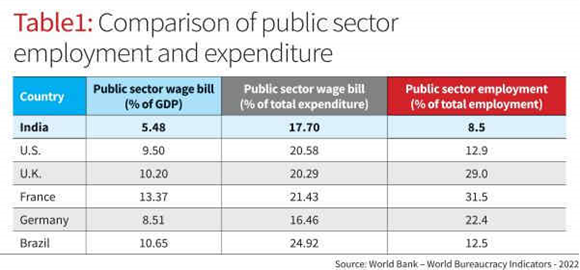
- It is interesting to note some comparative data for large democracies on certain parameters of public sector employment summarised in Table 1. It can be observed that while the general perception in our country is that public sector employment and wages are gargantuan with limited efficiency, it is lesser in almost all parameters when compared to other major democracies.
What next?
- There are certain key aspects of the TOR that require attention. First, the TOR requires the CPC to compare the pay structure of the public sector with the private sector. This has been addressed even in earlier pay commissions.
- Entry level posts in the public sector have significantly higher salaries than their private counterparts while it is the opposite for higher posts and specialist roles. The compression ratio, that is, the ratio of lowest to highest salaries in the Central government has been fixed at 1:12.5 in the seventh CPC.
- Privileges and perks coupled with job security is a significant intangible that makes up for lower salary packages in top government posts. However, this needs to be revisited with respect to certain top posts and specialist roles in order to attract and retain talent. Second, intangibles like learning and development, training, and work environment including flexible working and health promotion are not part of the TOR. It may be expected that the Commission will address these issues in its final report.
- Finally, the 8th CPC has been mandated to consider economic conditions, need to ensure adequate resources for welfare, and unfunded cost of non-contributory pension schemes. The pension bill for the year 2025-26 is estimated at ₹2.76 lakh crore out of the total revenue expenditure of ₹39.44 lakh crore of the central government.
- The impact of non-contributory pension schemes on the government exchequer needs to be borne in mind while making recommendations. However, welfare measures are political decisions that keep evolving. New schemes are announced by the Centre from time to time.
- Considering these factors, a commission with members from the judiciary, academia and bureaucracy may not be equipped to assess the impact. There may also be a case for broad basing the commission with finance and human resource professionals to bring in diverse opinions.