Centre says right to vote different from freedom of voting
Context: The Centre has argued in the Supreme Court that the ‘right to vote’ in an election is different from the ‘freedom of voting’, and while one is a mere statutory right, the second is a part of the fundamental right to freedom of speech and expression.
- The Centre in respons to a petition seeking to declare Section 53(2) of the Representation of the People Act, 1951, and Rule 11 read with Forms 21 and 21B of the Conduct of Elections Rules, 1961, which apply to ‘uncontested elections’, ultra vires the Constitution for violating freedom of speech and expression under Article 19(1)(a). Section 53(2) kicks in when the number of candidates equals the number of seats to be filled in an Assembly or Lok Sabha election.
- In such cases, the provision instructs a Returning Officer (RO) to declare all such candidates as duly elected by filling in Form 21 (in case of a general election) or Form 21B (in case of an election to fill a casual vacancy).
Prevents voters’ right to exercise NOTA
- The petitioners, Vidhi Centre for Legal Policy, represented by advocate Harsh Parashar, and the Association for Democratic Reforms, through advocates Prashant Bhushan and Neha Rathi, submitted that the RO’s declaration without conducting a poll prevented citizens from expressing their right to vote the ‘None of the Above’ or the NOTA option and voice their dissatisfaction about the contesting candidate.
- Both the government and the Election Commission of India have responded to whether declaration of a sole candidate without taking any poll was a violation of the electors’ right to express their unhappiness by voting NOTA.
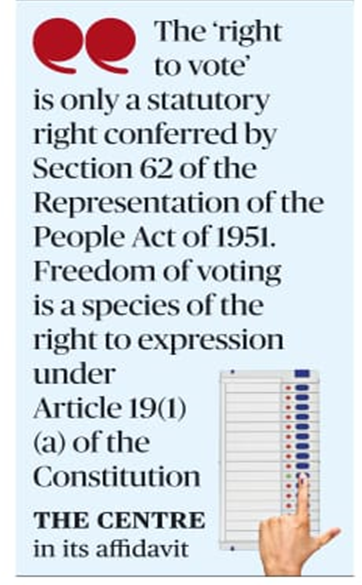
- The Centre’s affidavit in court began with a fundamental lesson on the difference between ‘right to vote’ and the ‘freedom of voting’. It said the ‘right to vote’ was only a statutory right conferred by Section 62 of the Representation of the People Act of 1951, and subject to the limitations given in the statute. Freedom of voting, on the other hand, was a “species of the right to expression under Article 19(1)(a) of the Constitution”.
CM writes to PM seeking meet to address FRP concerns
Context: As the sugarcane growers’ protest demanding a Fair and Remunerative Price (FRP) of ₹3,500 per tonne in the Karnataka State’s northern sugar bowl turned the heat on the government, Chief Minister Siddaramaiah wrote to Prime Minister Narendra Modi seeking an urgent meeting with him to address the issues.
- In the letter that was released to the press, the Chief Minister sought to draw the Prime Minister’s attention to the ongoing agitation by sugarcane farmers in North Karnataka, particularly in Belagavi, Bagalkote, Vijayapura, Vijayanagara, Bidar, Gadag, Hubli-Dharwad and Haveri districts.
- He pointed out that the FRP fixed by the Central government for the 2025-26 season stands at ₹3,550 per tonne for a basic recovery rate of 10.25%.
- “However, after deducting the mandatory harvesting and transport (H & T) costs, which range between ₹800 and ₹900 per tonne, the effective payment reaching the farmer is only about ₹2,600 to ₹3,000 per tonne.
- But due to sharp increases in fertilizer, labour, irrigation and transport costs, this pricing structure has rendered sugarcane cultivation economically unsustainable,” he said.
- He argued that the root of the problem is the Central policy levers, the FRP formula, the stagnating Minimum Support Price (MSP) for sugar, export curbs on sugar and the under-utilised ethanol offtake from sugar-based feedstock.
- Pointing out that it was the Centre that had the authority to revise the FRP, he argued that the State only had the powers to ensure that the sugar factories adhered to the FRP norms.
- “To respond constructively, we request that the Union government should immediately enable a central notification to allow States to fix or endorse a net price to farmers after H&T or mandate that mills absorb H&T so that ₹3,500/tonne net becomes feasible,” he said.
- The letter also sought recalibration of the recovery rate linked calculation of FRP, revision of sugar MSP above ₹31 per kg, export window to relieve mills of unsold stocks, increased ethanol allocation and assured procurement from Karnataka’s sugar-based capacity.
- The decision to write to the Prime Minister was taken at the State Cabinet meeting. The Ministers and district officials had managed to convince the sugar factories to offer an FRP of ₹3,200 per tonne at sugar recovery percentage of 11.25, and ₹3,100 at sugar recovery percentage of 10.25, he said.
- He expressed concern that the Centre had increased the sugar recovery percentage to 10.25 from the level of 9.5 during the erstwhile NDA regime for determining the FRP. This would affect States that had low sugar recovery percentages, he said.
- He alleged that though Karnataka was producing 271 crore litres of ethanol a year, the Centre had given permission for the oil companies to buy only 47 crore litres from the State.
NITI Aayog member advocates for Unified Water Reuse Standards
Context: Vinod K. Paul, a member of NITI Aayog, said that India needs a unified national standard to assure the public about the quality and safety of treated water.
- ‘Reuse of treated water’, Dr. Paul mentioned that deliberations are under way to formulate an integrated policy at the national-level for this purpose.
- Jointly organised by the State government and the Bangalore Water Supply and Sewerage Board (BWSSB), the workshop spotlighted the critical decline in India’s per capita water availability, now below 1,400 cubic metres, and the pressing need for a unified national framework to promote water reuse.
- Dr. Paul called for ambitious national targets: 50% reuse by 2030 and full reuse by 2045.
- Currently, only 11 States have formal reuse policies, highlighting the urgency for a comprehensive national strategy.
- Chief Secretary Shalini Rajneesh showcased Bengaluru’s efforts, including the rejuvenation of 110 lakes and a goal to achieve 100% water reuse and rainwater harvesting by 2028.
- The BWSSB, which supplies 2,225 million litres of water daily, treats 1,350 MLD through 34 sewage treatment plants (STPs), with 12 more under construction, she said.
Tenth-century inscription dating to Ganga dynasty reign found on outskirts of Mysuru
Context: A 10th-century inscription from the Ganga dynasty reign has been found inside the Mahalingeshwara Temple at Nadanahalli on the outskirts of Mysuru.
- The inscription, dating back to the time of Butuga II, a ruler from the dynasty, was discovered on the wall to the right and faces east inside the temple.
- The six-line inscription was carved on white granite which is two feet wide and two-and-a-half feet tall.
- “This inscription, dated 948 A.D., is inscribed in the Kannada script.
- It is believed that during the reign of Butuga II, his bodyguard, Maremma, may have donated the garden to the temple tax-free and entrusted its management to the village chief Vijaketa Gavunda.
- The full text of the inscription cannot be stated as it is corrupted. However, since the inscription references ‘Vijaketa Gavunda Dise’, it can be inferred that the management of the garden was entrusted to Vijaketa Gavunda, the chief of the village,” said a statement here.
- Further, the embossed painting of the temple is symbolically engraved on the inscription, confirming that it was a donation related to the temple, the statement added.
- “Since the Shiva Linga in the Mahalingeshwara Temple, where the inscription was found, is in the Ganga architectural style and the inscription is from the Ganga period, it can be understood that this donation is related to the Mahalingeshwara temple,” the statement further said.
- An embossed sculpture of a cow feeding its calf is also carved at the end of the inscription, which is 1,076 years old.
Cabinet approves policy to help set up 25,000 start-ups in five years
Context: Policy aims to ensure that at least 10,000 of the targeted 25,000 start-ups are set up outside Bengaluru.
- The Karnataka Cabinet approved the Karnataka Startup Policy 2025-30 that seeks to develop the State as a global innovation centre and help set up an additional 25,000 start-ups.
- The policy seeks to set aside a budget of ₹518.27 crore over the next five years to offer financial support to start-ups.
- The policy aims to ensure that at least 10,000 of the targeted 25,000 start-ups are set up outside.
- The policy will seek to create an appropriate ecosystem and work towards building the necessary infrastructure and ensure the availability of the required skilled manpower.
- The Cabinet also approved a proposal to modify the composition of the INDIRA (Integrated Nutrition and Dietary Initiative for Revitalising Anna Bhagya Beneficiaries) food kit under the Anna Bhagya scheme to provide additional quantum of toor dal in proportionate to the cost of the earlier proposed green gram.
Two Census apps, test portal for self-enumeration go live
Context: Enumerators have been trained to use apps to help in digital collection and faster processingof Census data; self-enumeration portal is open to the public in pre-test areas till today.
- The Registrar-General and Census Commissioner of India launched two mobile applications this week in preparation for the trial phase of the country’s first digital Census in 2027.
- The pre-test for the first phase, House Listing and Housing Operations (HLO), when a total of 30 questions on housing amenities will be asked, will be held in select areas across the country from November 10 to 30.
- The enumerators, including block development officials, revenue officials, and government schoolteachers, have been trained to collect data on the two applications available on Google Play Store: Digital Layout Map (DLM) and Census 2027 – Houselist. The apps are compatible with both Android and Apple phones, and can only be downloaded by authorised personnel.
Public participation
- The self-enumeration portal is available for testing from November 1 to 7.
- “To encourage public participation, a Self-Enumeration facility will be made available through the Census Portal from 1st to 7th November 2025, allowing individuals residing in the areas selected for Pre-Test to submit their details online through the website https://test.census.gov.in/se, prior to field visits by enumerators,” a government statement said.
Digital mode
- The DLM app’s description explains the evolution of India’s Census, the world’s largest data collection exercise, into a digital operation.
- “Until the 2011 Census, data was collected on paper schedules, with layout map sketches prepared manually. These paper records were later digitised through scanning, a process that was both time-consuming and prone to inconsistencies.
- With the upcoming 16th Census of India, a historic transformation is taking place. For the first time, Census operations are being carried out in digital mode, ensuring improved accuracy, faster data availability, and enhanced monitoring. A crucial part of this transition is the preparation of Digital Layout Maps and the geo-tagging of all buildings within each Houselisting Block (HLB),” it says.
- It adds that the DLM app replicates the traditional methodology followed by supervisors and enumerators for drawing notional sketches for houselisting blocks, the primary unit for data collection, while introducing digital efficiency, accuracy, and real-time monitoring capabilities.
- The app will record building coordinates (latitude and longitude for each structure), the names of localities, roads or streets, building numbers (if available; otherwise, temporary Census house numbers will be assigned by enumerators), building names (if available), building type (pucca or kutcha), building use (residential, partly residential, and non-residential), landmarks (mandatory), number of floors, and number of Census houses.
- The description emphasised that “no personal information of the residents/ occupants of the buildings are collected through this app.”
- The description for the House Listing Operation app says it was developed as part of the Census of India 2027 to modernise and streamline the data collection process. Both phases of the Census — houselisting and population enumeration — will be completed between April 1, 2026 and February 28, 2027.
CAG plans to create two new cadres for more centralisation
Context: The Comptroller and Auditor-General (CAG) of India has granted in-principle approval for the creation of two new specialised cadres for more centralisation.
- These cadres are within its Indian Audit and Accounts Department, and they will be called the Central Revenue Audit (CRA) Cadre and the Central Expenditure Audit (CEA) Cadre.
- Explaining the benefits of centralisation, K. Subramaniam, Deputy Auditor General (Human Resources, Industrial Relations, Content Delivery Network), said specialisation in the cadre of the CRA and the CEA will lead to deeper domain expertise in revenue and expenditure audits.
- “This reform, which will come into effect from 1st January 2026, aims to build deeper professional expertise and further improve the quality of audit of Central Government finances,”by CAG.
- At present, the audit of Central receipts and expenditure is undertaken by multiple offices with cadre control dispersed across multiple State Civil Audit offices leading to fragmentation.
- The new cadres will consolidate over 4,000 audit professionals out of the total strength of the CAG at 42,000. This measure will also help reduce dependence on deployment and manage manpower in a more flexible manner.
Talks on with RBI, lenders for big, world class banks, says FM
Context: The Centre is holding discussions with the lenders and the Reserve Bank of India (RBI) for creating a ‘lot of big and world-class banks.’
- “We will have to sit and talk with the Reserve Bank and also with the banks themselves to see how they want to take it forward and also discuss with the RBI about how they have an idea of taking or idea of building larger banks,” she said at an event.
- “That work has already commenced. We are discussing with RBI, we are discussing with banks.”
- “It is not by creating from among those which exist today just by amalgamation, that can also be one of the ways but you need an ecosystem and also an environment in which more banks can operate and operate to grow,” she emphasised.
- “So, that environment is actually well established in India but I need it to be a bit more timely. So, some work is happening on it.”
- Since 2017, the government had been facilitating merger of public sector banks to become stronger and further consolidation is on. Under regulatory supervision, private lenders are being strengthened and foreign banks are being encouraged to invest in Indian banks to improve capital base as well as bring in higher levels of corporate governance and financial prudence into the banking ecosystem.
India is capable
- To another question on the impact of global uncertainties and protectionism by way of tariffs on India, she said “I do not want to sound too ambitious or give a statement of overconfidence but I can very clearly see India has shown its capability. In spite of global uncertainties, people of India have responded to next generation GST reforms and every sector saw it even on the first day [September 22, 2025].
- Earlier, she told the gathering the world was today facing slower globalisation, fragile supply chains and rising climate transition costs.
- “These external shocks test the resilience of our economy and underline the need for stronger domestic capabilities and diversified trade partnerships.
- “To sustain high growth, we must invest in people. Our workforce needs continuous upskilling and reskilling to meet the demands of emerging technologies and global competitiveness, ensuring higher labour productivity and better-quality jobs,” the Finance Minister said.
- India to unveil SAF national policy: Naidu
Context: The Centre will soon release a national policy on Sustainable Aviation Fuel (SAF), Minister for Civil Aviation Ram Mohan Naidu said, as he emphasised on India’s unique position as an agriculture powerhouse to cater to the rising global demand for the fuel.
- SAF refers to aviation fuel derived from non-fossil sources.
- At a FICCI event, he said the global need for SAF was 2 million tonne which by 2040 would rise to 183 million tonne. “As an agricultural powerhouse with over 750 million tonne of available biomass, India has the capacity to become the global leader in SAF production”.
- India has a surplus of 213 million tonne of agricultural residue along with adequate manufacturing capacity, he said.
- To achieve 1% blending of SAF by 2027, India will require 30 million litre, while the 2% target for 2028 translates to 62 million litre. Local oil makers collectively have an annual production capacity of 70 million litre. “We are well on course to meet the domestic demand and even emerge as a global production player in SAF”.
- Trump’s nuclear test threat risks upending global test ban regime
Context: On October 29, just minutes before his meeting with Chinese President Xi Jinping in Busan, South Korea, U.S. President Donald Trump said the U.S. would “start testing our nuclear weapons on an equal basis with other nations”. Back in the U.S., Mr. Trump repeated his claims in an interview. “Russia is testing; China is testing, but they don’t talk about it… And certainly North Korea has been testing. Pakistan has been testing.”.
- Mr. Trump is correct about North Korea, which has tested multiple nuclear weapons in the new century. But other nuclear powers, including the U.S., China and Russia, have maintained a moratorium on weapons testing since the 1990s. They, however, have tested weapons that can carry nuclear warheads.
- Mr. Trump’s announcement came immediately after Russia announced that it successfully tested a nuclear-powered cruise missile (Burevestnik) and an undersea torpedo (Poseidon). Both are designed to overcome American missile defence systems and can carry nuclear warheads. But those were not nuclear detonation tests.
- The last time Russia tested a nuclear weapon was in 1990, when the Soviet Union was still alive. The last American nuclear bomb test was held in 1992, and the last Chinese test was in 1996.
- In 1996, the Comprehensive Test Ban Treaty (CTBT) banned all nuclear tests, but it never came into force as the required number of countries did not ratify it. The U.S. and China have signed the treaty but never ratified it. Russia had signed and ratified it, but in 2023, amid mounting tensions with the U.S., it decided to de-ratify it.
Debate in the U.S.
- Russia remains the world’s largest nuclear power with an inventory of 4,309 warheads, according to the Federation of American Scientists.
- The U.S. comes second with 3,700 weapons, while China is believed to have more than 1,000 warheads.
- Historically, the U.S. has carried out the most number of nuclear tests — 1,030 detonations, followed by the Soviet Union (715) and the French (210). China has conducted more than 45 nuclear tests. In total, there have been 2,056 nuclear tests since ‘Trinity’, the first nuclear detonation by the U.S.
- In the U.S., the debate on whether the country should resume nuclear tests has been raging for some time. Those who support tests argue that it is important to bolster the country’s nuclear deterrent — tests can prove that nuclear arsenals actually work, and provide critical data allowing countries to build more powerful, compact and specialised warheads.
- On November 2, U.S. Secretary of Energy Chris Wright said the U.S. would not resume nuclear weapons tests but would conduct “subcritical tests”. A subcritical test uses conventional explosives to compress fissile material (Plutonium 239), without triggering nuclear chain reaction or explosion. But Mr. Trump, in another interview, clearly said, “We are going to test nuclear weapons like other countries do.”
Devastating effects
- The 1963 Partial Test Ban Treaty, signed by the Soviet Union, the U.S. and the U.K., banned all nuclear test detonations in the atmosphere, outer space and underwater. Since then most tests were conducted underground. Even subterranean tests, experts say, could cause devastating environmental damages, including total destruction of ecosystems at test sites and contamination of soil, air and water.
- If the U.S. starts testing weapons, it could cause a domino effect on other nuclear powers. There were reports that China had made preparations at Lop Nur, where Mao detonated China’s first bomb in 1964, in case it decides to resume testing. Russia was unambiguous in its reaction. “If they begin testing, naturally we will do the same,” Russia’s Security Council chief Sergey Shoygu said on October 31.
- If the U.S. and Russia resume tests, China could do the same. And if China does it, India will come under internal pressure to start testing its weapons. Then Pakistan may not stand out. A new phase of nuclear arms race would begin, with long-term consequences for humanity.
- Why the nomination process needs reform
- The Representation of the People Act (RP), 1951 mandates that only qualified candidates can contest an election. However, the process of verifying said qualifications has accumulated complexity over the years, with too much importance being laid on procedural technicalities than actual ‘defects of a substantial character’
Kannan Gopinathan
- A young woman from Dadra and Nagar Haveli called last week about the recent municipal council elections. This is a district in which I once served as Collector and Returning Officer. Her father’s nomination for municipal councillor had been rejected with no hearing or chance at verification. She asked, “Sir, is this how elections work?” The honest answer is yes. And that is the problem.
- One often hears about how nominations of candidates contesting elections are rejected over technicalities without any chance for clarification. However, the fact of that matter is that such rejections are lawful. The most undemocratic part of India’s electoral process occurs before a single vote is cast — at the stage of nomination scrutiny.
The politics of procedure
- India’s electoral nomination process vests extraordinary discretion in a single official — the Returning Officer (RO).
- The Representation of the People Act (RP), 1951, particularly Sections 33 to 36, and the Conduct of Elections Rules, 1961, govern the nomination process. Section 36 authorises the RO to scrutinise nominations and reject those deemed invalid.
- The RO’s power under Section 36(2) to conduct a “summary inquiry” and to reject nominations for “defects of a substantial character” is extraordinarily wide, and largely un-reviewable before polling, since Article 329 (b) bars courts from interfering mid-election. The law says no nomination should be rejected for defects not of a substantial character.
- But there are no written guidelines on what is substantial. And the only remedy to protest it is an election petition after the polls, when the damage is irreversible. In a democracy, this absolutism dressed in legal language has the potential to become a tool of political exclusion.
- In Bihar this year, a Rashtriya Janata Dal (RJD) candidate’s nomination was rejected for leaving some fields blank. Last year in Surat, Opposition candidates were eliminated after proposers denied signatures, delivering a Lok Sabha seat unopposed. In the 2019 elections in Varanasi, decorated BSF jawan Tej Bahadur Yadav was rejected because he could not obtain an Election Commission certificate overnight. In Birbhum, former IPS officer Debasish Dhar was kept off the ballot when his no-dues certificate from the government was delayed. Yet, there is no publicly available consolidated dataset on rejection grounds, patterns, or party-wise breakdowns. This opacity shields the weaponisation of procedure.
Procedural traps
- Section 36 of the RP Act mandates that only qualified candidates can contest. However, the process of verifying qualification has accumulated complexity over the years. Well-intended judicial interventions have paradoxically worsened the problem. Supreme Court directions mandating detailed affidavits on assets, liabilities, and criminal cases were meant to ensure transparency, yet each new disclosure requirement added another opportunity for technical rejection. For example, in Resurgence India versus Election Commission (2013), the Supreme Court held that false declarations lead to prosecution but don’t invalidate nominations, only incomplete ones do. This means that a candidate who lies but fills all columns stays on the ballot, and one who makes a good-faith error can be rejected. The system now punishes incomplete declarations more harshly than dishonest ones.
- A missing signature, a mismatched electoral number, a form filed at 3:05 PM instead of 3:00 PM, a blank column in an affidavit, a delayed oath, a missing no-dues certificate — any of these can end a candidacy. The burden of proof thus lies entirely on the citizen seeking to exercise a legal right, and not on the official denying it. This is constitutionally backwards. The right to be voted for is the necessary twin of the right to vote. Without candidates to choose from, the ballot is ritual without substance. The first principle must be that every qualified citizen has a presumptive right to contest. That right can be denied only when the RO establishes, with clear evidence, a substantive constitutional or statutory disqualification. Technical paperwork errors cannot be a reason for disqualification.
Some of the common procedural technicalities on which nominations are rejected include:
- The oath trap: Every candidate must take an oath before a specified authority after filing nomination but before scrutiny. If its too early, it’s invalid, and if too late, the nomination is rejected. Moreover, if it is not before the specified authority, your form is again bound to be rejected.
- The notarisation trap: Every Form 26 affidavit (an affidavit which needs to be filed by the candidate along with nomination papers) must be notarised by a specified authority. Not having done so can result in rejection of the nomination.
- The certificate trap: Along with nomination papers, the candidate is liable to submit no-dues certificates from municipal bodies, electricity boards, or other government departments; clearance certificates from the Election Commission for government servants; and various other bureaucratic attestations, each of them a veto point when it comes to the time of scrutiny. Thus, each issuing office becomes a potential chokepoint where deliberate delay can eliminate a candidacy.
- These procedures, once designed as safeguards, have turned into potential opportunities for delay and manipulation.
- Here, bureaucratic compliance is being rewarded over democratic legitimacy.
Facilitation, not filtration
- Other democracies show a different approach. In the U.K., ROs help candidates fix errors before deadlines. Canada mandates a 48-hour correction period. Germany requires written notice of problems, time to remedy them, and multiple appeal layers. Australia encourages early submission to allow corrections. The common idea being that officials are facilitators, not sentinels.
- India also has a checklist system. The RO Handbook instructs ROs to point out defects at the time of filing and record them in a checklist. But this checklist has no legal standing. The Handbook itself clarifies that the checklist “will not prevent the Returning Officer from pointing out other defects, if any, discovered later during scrutiny.” A nomination can be marked defect-free at filing, yet rejected at scrutiny for defects the RO discovers later. The candidate has no right to rely on the checklist, and the RO faces no legal obligation to honour it. The checklist thus remains as an illusion of transparency without offering any real protection to the candidate.
- The RO’s role must shift from discretion to duty. When a deficiency exists, the RO must issue a detailed written notice specifying the exact error, the legal provision violated, and the correction needed. Candidates must get a guaranteed 48-hour window to fix it after receiving this notice.
- The law must thus classify deficiencies into three categories: (1) technical or paperwork defects such as missing signatures, blank affidavit columns, clerical errors, no-dues certificates etc. These cannot justify rejection; (2) matters requiring verification of authenticity such as disputed signatures, challenged documents etc. These require investigations before rejection; and (3) constitutional and statutory bars. These should lead to immediate and absolute disqualification. Moreover, every rejection order must be reasoned. The RO must specify which exact requirement was not met, which provision of law was violated, what evidence supports the finding, and why the defect is substantial enough to justify rejection.
A digital solution
- The Election Commission of India (EC) can build a nomination system that is digital-by-default; one that doesn’t depend on excessive paperwork. This is not to argue for a digital-only framework, but a digital-by-default framework that can eliminate disqualifications based on blank columns and misspelt names or typos. The entire nomination process could move to an integrated online portal linked with the electoral roll. The system could automatically validate voter ID, age, and constituency details. Oath, affidavit submission, proposer verification, and deposit payment could all be digital. Moreover, every nomination’s progress such as when it was filed, verified, deficiency notified, corrected, accepted or rejected, should be visible on a public dashboard with timestamps and reasons.
Upholding democracy
- When a nomination is rejected arbitrarily, two rights are violated: the candidate’s right to contest and the voters’ right to choose. The world’s largest democracy deserves a nomination process that is modern, fair, and inclusive, where the burden of proof is on the state to justify exclusion, not on citizens to prove their right to participate.
- The EC should work towards a citizen-friendly nomination process that would end the bureaucratic red tape around disqualifications for blank columns, wrong payment modes, misplaced signatures, misspelt names and typos, no dues certificates or a delayed oath. It should work towards a simplified process that removes the possibility of using procedure as politics.