- Cyclone Montha makes landfall;rain batters several parts of A.P.
Context: The severe cyclonic storm Montha began its landfall near Kakinada in Andhra Pradesh around 7 p.m. on Tuesday, the India Meteorological Department (IMD) said.
- The storm triggered very heavy rain in the State as well as Odisha.
- In Andhra Pradesh, Ulavapadu in SPSR Nellore district recorded the day’s maximum rain of 167 mm.Kakinada received only light showers till 7 p.m.
- The IMD withdrew red alerts issued for a few districts, and issued orange alerts for the districts of Srikakulam, Parvathipuram Manyam, Vizianagaram, Visakhapatnam, Alluri Sitharama Raju, Anakapalli, Eluru, NTR, Krishna, Guntur, Palnadu, Bapatla, and Nandyal.
- Two days of heavy rain left crops on over 43,000 hectares submerged and affected 83,000 farmers, as per the initial assessment by the agricultural department. Paddy and cotton were the worst-hit.
- The estimated loss to the power sector crossed ₹2,200 crore, with massive damage to substations, transformers, and power lines.
- The Kakinada district administration opened 401 relief camps. At least 35,000 people have been evacuated so far.
- “The number of people to be evacuated is expected to rise as 67 villages and five towns and Kakinada city are falling in the cyclone-affected area,” said Kakinada District Collector S. Shan Mohan. Nearly 1,600 school bus services have been deployed to evacuate people.
- Chief Minister N. Chandrababu Naidu directed the NDRF and SDRF teams to be deployed in and around Kakinada.
- Twenty trains, 10 originating in Visakhapatnam, and 11 operating from various divisions of South Central Railway (SCR) in Andhra and one from Bhubaneswar, passing through Visakhapatnam, were cancelled due to heavy rain and gales.
- A total of 32 flights from Visakhapatnam were cancelled. The Vijayawada airport cancelled 16 flights, while four flights from Tirupati were cancelled on Tuesday.
- Crops, power sector bear cyclone’s brunt
Context: Paddy and cotton are the worst hit, together accounting for more than 80% of the total damaged area in Andhra Pradesh; power sector records losses worth around ₹2,200 crore; restoration work under progress; Chandrababu Naidu orders round-the-clock monitoring in vulnerable districts
- Cyclone Montha has inflicted extensive damage on agriculture and power infrastructure across Andhra Pradesh.
- The preliminary assessment by the Agriculture Department reveal that over 43,000 hectares of crops have been submerged, affecting nearly 83,000 farmers across 292 mandals and 1,712 villages.
- According to the three power distribution companies in the State — APEPDCL, APCPDCL, and APSPDCL — the total estimated loss to the power sector would be around ₹2,200 crore, with large-scale damage done to power substations, transformers, poles, and power lines.
Worst- hit crops
- According to the Agriculture department’s data, paddy and cotton are the worst hit, together accounting for more than 80% of the total damaged area.
- Paddy fields in 31,267 hectares were inundated, while cotton crops over 15,680 hectares suffered extensive damage due to continuous rainfall and flooding.
- Among the districts, Dr. B.R. Ambedkar Konaseema reported the highest crop damage with 10,099 hectares being submerged.
- In addition to paddy and cotton, maize over 4,393 hectares and blackgram in 3,004 hectares were damaged, while bajra, redgram, and soybean suffered partial losses. The report noted that 53 hectares of nurseries were affected in several regions, compounding the impact on farmers’ livelihoods.
- The officials said that restoration work of power infrastructure was progressing rapidly, despite heavy rains and flooding in several coastal areas.
- With teams working round-the-clock and power being restored in a phased manner, the authorities hope that supply to all urban centres and essential installations would be normalised within the next 24 hours.
- ‘Rising sea surface temperatures leading to more cyclones’
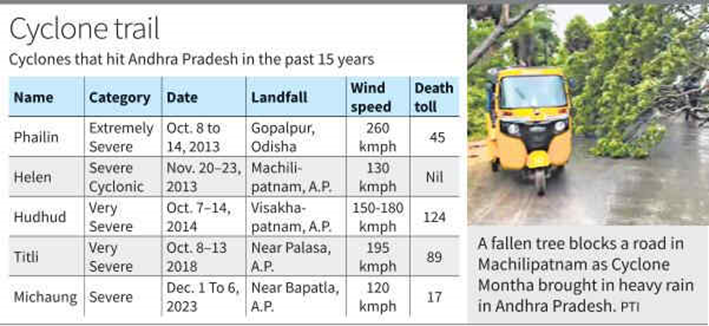
Context: Since 2010, Andhra Pradesh has borne the brunt of at least 10 major tropical cyclones, some of them categorised as severe and very severe cyclonic storms. Tamil Nadu and Odisha have also been affected by these storms.
- Meteorologists have identified a common element in these storms — the high intensity of the storms and the trails of destruction they left — and they blame the rapid rise in sea surface temperature (SST) over the last few decades.
Rising SST
- According to Prof. S.S.V.S. Ramakrishna, former Head of Department (HoD) of Oceanography and Meteorology, Andhra University, the Bay of Bengal has recorded a consistent rise in the SST.
- Sea temperatures have regularly exceeded the 20°C to 30°C mark, creating an ideal environment for the formation of tropical cyclones.
- “As the water gets warmer, latent heat energy increases, increasing the possibility of cyclones. In the last 50 years, studies conducted by IITM Pune have indicated that the SST in Bay of Bengal has gone up by 0.5°C to 1°C,” he said.
- Prof. O.S.R.U. Bhanu Kumar, former HoD, from the same department, attributed the changing factor to global warming and climate change. The warming of the atmosphere increases the capacity of air to hold moisture, leading to heavier rainfall during cyclones.
- In recent times, positive Indian Ocean Dipole (IOD) and La Niña have contributed to more favourable conditions for cyclonic formations over the Bay of Bengal, he said.
- Both experts cautioned that deforestation and degradation of coastal ecosystems like mangroves and wetlands, have reduced the natural buffers, amplifying the damage caused by cyclones.
- Centre approves terms of 8th Central Pay Commission
Context: The panel, headed by Justice Ranjana Desai (retd.), will make its recommendations within 18 months of its constitution; it will propose changes in salaries of Union government employees.
- The Union Cabinet has approved the Terms of Reference of the eighth Central Pay Commission (CPC), the body in charge of deciding the pay structure and retirement benefits of Union government employees, the government announced.
- The government had announced the formation of the CPC in January this year to examine and recommend changes in the salaries and other benefits of Central government employees.
‘Formed in quick time’
- “As you know, the in-principle approval for the formation of the eighth Central Pay Commission was granted only recently in January, and within a short span, the commission has now been formally constituted,” Union Minister Ashwini Vaishnaw said at a press conference announcing the Union Cabinet’s decisions here.
- “This is a major step that involves extensive consultations. Several Ministries with large numbers of Central government employees, such as Defence, Home, Railways, and the Department of Personnel and Training, were part of the process,” he said.
- The Commission will comprise one chairperson, one part-time member and one member-secretary. It will make its recommendations within 18 months of the date of its constitution. Justice Ranjana Prakash Desai (retd.) will act as the chairperson.
- Professor Pulak Ghosh of the Indian Institute of Management, Bangalore, has been appointed a part-time member, while Petroleum Secretary Pankaj Jain will serve as the member-secretary.
- “There are about 50 lakh Central government employees, and consultations were also held with many State governments, most of which extended their cooperation,” Mr. Vaishnaw added.
- The government said the CPC would have to keep several factors in mind while coming up with its recommendations. These included the economic conditions in the country and the need for fiscal prudence, the need to ensure that adequate resources are available for developmental expenditure and welfare measures, the unfunded cost of non-contributory pension schemes, the impact of its recommendations on State finances, as well as the current emolument structure, benefits and working conditions of employees of Central public sector undertakings and the private sector.
- Cabinet increases fertilizer subsidyfor winter crops
Context: The Union Cabinet decided to provide ₹37,952 crore as fertilizer subsidy for the ongoing rabi crop of this winter season. The subsidy on phosphorous (P) and sulphur (S) fertilizers was increased by ₹736 crore, while the subsidy for nitrogen (N) and potash (K) will remain the same as the kharif (summer) crops.
- “The subsidy approved for 2025 rabi season is higher by about ₹14,000 crore from the previous rabi season (2024). During the last rabi season, the subsidy was about ₹24,000 crore,” Union Information and Broadcasting Minister Ashwini Vaishnaw told presspersonjs after the Cabinet meeting.
- The subsidy for phosphate will be increased to ₹47.96 a kg from ₹43.60 a kg in the 2025 kharif season; the subsidy for sulphur will be higher at ₹2.87 a kg, up from ₹1.77 a kg (kharif); and the subsidy rate for nitrogen and potash will remain ₹43.02 a kg and ₹2.38 a kg, respectively.
- The rates will be applicable from October 1, 2025 till March 31, 2026.
- The Centre had fixed the subsidy rate considering the import price, and other factors, including nutrient requirement, subsidy burden, and maximum retail prices, Mr. Vaishnaw said.
- The Centre had provided a special package to ensure adequate availability of di-ammonium phosphate (DAP) and triple super phosphate (TSP) to farmers, he added.
- Union Minister for Agriculture Shivraj Singh Chouhan thanked Prime Minister Narendra Modi on behalf of all farmers for increasing the subsidy.
- Cabinet increases fertilizer subsidyfor wThe Union Cabinet on Tuesday decided to provide ₹37,952 crore as fertilizer subsidy for the ongoing rabi crop of this winter season. The subsidy on phosphorous (P) and sulphur (S) fertilizers was increased by ₹736 crore, while the subsidy for nitrogen (N) and potash (K) will remain the same as the kharif (summer) crops.
- “The subsidy approved for 2025 rabi season is higher by about ₹14,000 crore from the previous rabi season (2024). During the last rabi season, the subsidy was about ₹24,000 crore,” Union Information and Broadcasting Minister Ashwini Vaishnaw told presspersonjs after the Cabinet meeting.
- As SIR expands, questions on EC’s power to conduct it, check citizenship pending in SC
Context: The Election Commission’s authority to conduct the Special Intensive Revision (SIR) of electoral rolls remains under question in the Supreme Court, even as the poll body announced the SIR’s second phase that will cover 51 crore voters in 12 States and Union Territories, including Tamil Nadu, West Bengal, Kerala, and Puducherry.
- The Supreme Court, in a July 10 order, had highlighted the basic questions posed by petitioners challenging the first phase of the SIR exercise in Bihar. These primarily included whether the Election Commission (EC) has the “very powers to undertake the exercise”.
- Second, the court had flagged the petitioners’ objection to the “procedure and the manner in which the SIR exercise is being undertaken”.
Violating voters’ rights
- The court recorded the petitioners’ argument that the SIR, notified on June 24 under Section 21(3) of the Representation of the People Act, 1950, broke that law as well as the Registration of Electors Rules, 1960, apart from violating the fundamental rights of the voters.
- However, later orders of the court on the SIR had diverged into ensuring that voters were not arbitrarily excluded from the electoral rolls in Bihar.
- Though the court did not stay the Bihar SIR exercise, it made several timely interventions to infuse more transparency into the process, order the inclusion of Aadhaar as a 12th document of proof, and to ensure the publication of the draft electoral roll, among other steps.
Learning experience
- An October 9 hearing gave the first indication that a pan-India SIR had more or less become fait accompli, though the court has agreed to hear arguments on the constitutionality of SIR exercise from November 4.
- Addressing the EC’s counsel and senior advocate Rakesh Dwivedi, Justice Surya Kant, who headed the Bench, orally observed that “you [EC] have decided to carry out SIR on a pan-India basis. So, this experience [with Bihar] would have made you wiser now… The next time you introduce a SIR module, owing to what you experienced now, you would also bring some improvements.”
- The second phase of the SIR in 12 States and U.T.s has indeed introduced modifications, such as the inclusion of Aadhaar as a proof of identity and the exemption from filing documents in the enumeration stage. The onus to be included on the voters’ list, however, continues to be on the elector. The process of enumeration itself does not have the benefit of any statutory backing.
- Again, the question about the EC’s jurisdiction to delve into the citizenship claims of an already registered voter without any formal objection lodged against the person continues to remain open.
- A cardinal point raised by petitioners was whether citizenship comes under the EC’s purview when specific statutes like the Citizenship Act and the Foreigners Act address the issues of acquisition of Indian citizenship and illegal aliens, respectively.
- IIP growth dips to 3-month low of 4% as mining, consumer non-durables slip
Context: Industrial activity dipped marginally to a three-month low of 4% in September. The data also show that the growth in industrial activity during the first half of the financial year was the slowest in at least five years.
- Growth in the Index of Industrial Production (IIP), released by the Ministry of Statistics and Programme Implementation, stood at 3.2% in September last year. However, growth had since accelerated to 4.3% by July 2025, following which it slowed again.
- The overall index grew 3% in the April-September period, the first half of the financial year 2025-26. This is the slowest in at least five years, the period for which data are readily available.
- The index grew 24% in the first half of 2021-22, owing to the low base of the previous pandemic-affected year 2020-21. In the first half of 2022-23, the index grew 7%, which slowed to 6.3% and 4.1% in the corresponding periods of 2023-24 and 2024-25.
- In September, the slowdown in industrial growth was mainly led by the mining, primary goods, and consumer non-durables sectors. Activity in the mining sector contracted 0.45% in September 2025 from a growth of 6.6% in August 2025 and a growth of 0.2% in September 2024.
- The consumer non-durables sector continued to contract for the second consecutive month in September 2025, by 2.9%, compared with a contraction of 6.4% in August 2025, and a growth of 2.2% in September last year.
- According to Madan Sabnavis, chief economist at the Bank of Baroda, this could be due to the fact that the Goods and Services Tax (GST) rate cuts were implemented late in the month.
- “As the GST cuts have targeted this industry, it can be assumed that the real impact will be seen in October-November as dealers have been facing a challenge of selling products with the older price labels,” Mr. Sabnavis said.
- ‘Moving villagers from tiger reserves must be voluntary’
Context: The Union Tribal Affairs Ministry has mandated that the relocation of forest-dwelling communities from tiger reserves must be an “exceptional, voluntary, and evidence-based measure”.
- The Ministry’s new policy framework also spells out the mechanisms that allow communities to continue living in the forests and the procedures to be followed for obtaining their consent for relocation.
- The policy calls for a National Framework for Community-Centred Conservation and Relocation, through which the Environment Ministry and the Tribal Affairs Ministry can jointly set procedural standards, timelines, and accountability.
- It also suggests a National Database on Conservation-Community Interface to record and track relocations, compensation, and status post-relocation. It recommends annual independent audits of relocation projects by empanelled agencies that assess compliance with the Forest Rights Act, the Wildlife Protection Act, and human rights standards.
- Communities may choose to continue living in the “traditional forest habitats” while exercising their Individual Forest Rights or Community Forest Rights under the FRA, the policy says, emphasising that this must be an option for villages located within the reserves.
Serious concerns
- This brief, titled “Reconciling conservation and community rights: a policy framework for relocation and coexistence in India’s Tiger Reserves”, was sent last week to the Union Ministry of Environment, Forests, and Climate Change from the office of the Secretary, Ministry of Tribal Affairs.
- The Tribal Affairs Ministry noted that it has been receiving several representations from State governments and Gram Sabhas, flagging “serious concerns” about the non-implementation of the Forest Rights Act, 2006.
- Last year, the National Tiger Conservation Authority’s directive to States asking them to prioritise relocation of villages in core areas of tiger reserves drew protests from several Gram Sabhas and forest rights activists.There were 591 villages and 64,801 families within the core areas of tiger reserves, according to the NTCA.
- Trade talks with EU reduced ‘outstanding issues’, says Goyal
Context: India and the European Union have “significantly” reduced the gaps in their negotiating positions after three days of trade discussions in Brussels, Commerce and Industry Minister Piyush Goyal said.
- Mr. Goyal and his EU counterpart, Commissioner Maroš Šefčovič, held discussions to provide a political push to help get the negotiations for an India-EU Free Trade Agreement (FTA) over the finish line.
- “The talks have significantly reduced our outstanding issues and allowed us to create the framework that will help deliver a win-win for our economies,” Mr. Goyal said on X, describing the discussions as “intense” but “very productive”.
- Mr. Goyal posted a video statement by the two Ministers, in which Mr Šefčovič characterised the talks as having occurred in an atmosphere of “full transparency and trust”. The Commissioner also said that “further work is required”. He said substantial progress had been made in a number of areas and the sides had given specific guidance to their teams on industrial tariffs.
- Mr. Šefčovič confirmed that a high-level EU trade delegation led by Director-General Sabine Weyand would be in New Delhi next week to conclude “technical tariff negotiations”. A trade delegation from the European Parliament is in New Delhi this week to better understand the challenges and opportunities presented by the trade negotiations. Some of the sticking points have included tariffs around agricultural products, a sensitive area for both sides and particularly for India. Tariffs on European automobiles being sold in India have also been under discussion in recent weeks. Regulatory issues, including the EU’s carbon tax on imports (Carbon Border Adjustment Mechanism), have been contentious issues to work through.
- “The negotiations and discussions have laid the foundation for a robust and balanced agreement,” Mr. Goyal said.
- HAL signs pact with Russian firm for civil aircraft production
Context: Aerospace major Hindustan Aeronautics Ltd. (HAL) and the Russian company United Aircraft Corporation (UAC) have signed a memorandum of understanding for production of the civil commuter aircraft SJ-100.
- The SJ-100 is a twin-engine, narrow-body aircraft. As on date, more than 200 aircraft have been produced and are being operated by more than 16 commercial airline operators.
- HAL said the SJ-100 would be a game changer for short-haul connectivity under the UDAN scheme in India. Under this arrangement, HAL will have the rights to manufacture SJ-100 aircraft for domestic customers.
Production in India
- “This collaboration between HAL and UAC is the result of mutual trust between the organisations. This will also be the first instance wherein a complete passenger aircraft will be produced in India. The last such project was HAL’s production of AVRO HS-748, which started in 1961 and ended in 1988,” HAL said.
- It is estimated that over the next 10 years, the Indian aviation sector will require over 200 jets in this category for regional connectivity and an additional 350 aircraft for the Indian Ocean region to serve nearby international tourist destinations, it said.
- “The manufacturing of the SJ-100 aircraft marks the beginning of a new chapter in Indian aviation industry. Manufacturing will also strengthen the private sector and create direct and indirect jobs in the aviation industry,” the Bengaluru-headquartered PSU said.
- The MoU was signed in Moscow, Prabhat Ranjan from HAL and Oleg Bogomolov from UAC.
- Cloud-seeding trials done in Delhi to tackle air pollution
Context: Amid surging pollution levels, the Delhi government, in collaboration with the Indian Institute of Technology, Kanpur, conducted two cloud-seeding trials to induce rain. However, negligible rainfall was observed till late in the evening. The first such trial was conducted on October 23.
- “Today, the clouds had very little moisture content. We are doing a sortie tomorrow morning and the clouds are expected to have higher moisture content than today, and there are better chances of rainfall,” Manindra Agrawal, Director, IIT-Kanpur, said.
- He said they were generating data from the trials. “We are learning a lot, as cloud seeding has never been done for pollution control in Delhi or India before this.”
- As per officials, 0.1 mm rainfall was observed in Noida and 0.2 mm in Greater Noida around 4 p.m.
- Delhi Environment Minister Manjinder Singh Sirsa said more trials would be done in the coming days. He said the humidity was only 15% to 20%.
- NDRF posted teams in five States aheadof cyclone landfall
Context: Ahead of Cyclone Montha’s landfall on Tuesday night, the National Disaster Response Force deployed 25 teams across Andhra Pradesh, Chhattisgarh, Odisha, Puducherry, and Tamil Nadu, while another 20 teams were on standby.
- “The Director General, NDRF, has directed all formations to maintain a high level of readiness to provide immediate response for search, rescue, and relief operations,” the organisation said in a statement.
- Each team is equipped with boats, cutting equipment, communication equipment, and other specialised rescue tools to carry out evacuation, relief and restoration operations.
- Coordination meetings are being held with the National Disaster Management Authority and their State-level counterparts and district administrations. The NDRF teams are also conducting public-awareness campaigns and community-sensitisation activities in vulnerable areas through local administrations to ensure timely evacuation and adherence to safety advisories.
- Railway Minister Ashwini Vaishnaw also reviewed the Indian Railways’ preparedness to deal with the aftermath of the cyclone. The meeting assessed readiness along the east coast, focusing on passenger safety, train regulation and coordination with local administrations.
- UN report finds countries’ emission reductions short of goal set in Paris
Context: Ahead of the Conference of Parties (COP 30) in Belem, Brazil, next month, the United Nations made public a “synthesis report” on Tuesday that finds countries are poised to reduce emissions by only 17% of 2019 levels by 2035 — well below what is required to keep earth from heating up by 1.5 degrees Celsius or even 2 degrees Celsius by the end of the century.
- To keep temperatures below these limits, countries must cut emissions by 37% and 57%, respectively, of 2019 levels by 2035.
- The synthesis is based on countries’ updated nationally determined contributions (NDC), which are promises to cut fossil fuel emissions or plant forests (to capture carbon dioxide) until 2035. Tuesday’s report is only a partial picture as only 64, out of a potential 190 countries, have submitted updated NDCs until September 30. India is among the countries that is yet to submit updated NDCs, after its last submission in August 2022.
- While conversation in the lead-up to climate COPs generally end to weigh heavily towards emissions reductions, the NDCs that have been submitted so far are also stressing two other important pillars of climate action — adaptation and resilience, with 73% of the new NDCs including an ‘adaptation’ component, the report notes. Adaptation refers to steps that must be taken by countries to adapt to ongoing and future impact from warming.
- “All NDCs go beyond mitigation to include elements, inter alia, on adaptation, finance, technology transfer, capacity building and addressing loss and damage, reflecting the comprehensive scope of the Paris Agreement,” the report notes.
- With regard to greenhouse gas emission (GHG) reductions, the total GHG emission level resulting from the implementation of Parties’ new NDCs is projected to be around 13 billion tonnes of CO2 equivalent in 2035, which is 6% below what they promised in their previous NDCs (submitted from 2020-2022).
Domestic pledges
- Afforestation, reforestation and adding solar energy were identified as the options with the greater need for support. Some Parties have announced domestic pledges and projects, such as tripling global renewable energy capacity by 2030, enhancing low-carbon hydrogen production and expanding Carbon Capture Utilisation and Storage (CCUS) capacity.
- ‘Ready to share solar expertise with other parts of the world’
Context: Union Minister for Renewable Energy Pralhad Joshi said India’s experience with PM Surya Ghar and PM Kusum had been ‘excellent’ and it was ready to share its expertise and experience in the solar sector with other countries.
- New Delhi has been looking to showcase the PM-Kusum (Kisan Urja Suraksha Evam Utthan Mahabhiyan) and PM Surya Ghar Yojana to several African countries and island nations, he said at the International Solar Alliance (ISA) here on Tuesday.
- This could be of particular use for Africa, which has so far been able to tap only 4% of its arable land through irrigation due to lack of rural power. “We are ready to share our expertise and experience, and we [the government] are also supporting ISA to expand this in other parts of the world and member countries of ISA,” he said.
- Mr. Joshi informed that 10 lakh solar rooftops had been completed and 21 lakh were nearing completion under PM Surya Ghar.
- India’s diaspora diplomacy and the limits of cultural nationalism abroad
Context: The Indian diaspora has been in the spotlight in various countries in recent weeks. A section of the diaspora has attracted attention for its display of faith and culture, crossing the limits of acceptable public behaviour in developed countries. The immersion of Ganapati statues in waterbodies and the display of Deepavali fireworks in public places are examples.
- After Deepavali revellers set two houses on fire in Edmonton, Canada, an official police statement said: “Light up your home, not your neighbour’s roof.” Three men have been charged with arson. Anti-immigrant and nativist protesters in Australia have singled out Indians, and in the U.S. and Canada, nationalist campaigners have a special focus on people of Indian origin these days.
- The higher visibility of these incidents could also be because a section of Indians aggressively promotes cultural exhibitionism as a matter of community pride and right — for instance, in the use of firecrackers on Deepavali wherever they are. In the midst of all this, the Indian diaspora is being urged by some observers to advocate Indian positions in the United States.
- The Indian national movement was spread around the world in British colonies, and in the U.S. and Canada, but the first Prime Minister, Jawaharlal Nehru, consciously decided to keep the new Republic aloof from PIO (person of Indian origin) politics in foreign countries. He did not want India to be seen as interfering in the domestic politics of another country through the diaspora, and he urged PIO to stay loyal to the countries that they had adopted.
Rise of Hindutva
- Issues of discrimination and racism were not narrow Indian concerns, and were raised as matters of universal human rights. This approach was consistent with the concept of territorial nationalism that guided Indian thinking then, as opposed to cultural nationalism.
- The rise of Hindutva and a parallel fresh surge in the outflow of Indians expanded a global network of cultural nationalists from the 1990s. With the ascent of Narendra Modi as Prime Minister in 2014, this approach gained further momentum. Mr. Modi addressed diaspora rallies in several countries, most notably the U.S.
- Exactly around this time, the fear of foreign interference in domestic politics became a central concern in the U.S., Canada, Australia, and several European countries. At various points in U.S. history, immigrants from specific regions or countries have been subjects of special scrutiny. In recent years, allegations of Chinese and Russian interference have dominated public discourse. Even Israel, which had a free pass as an autonomous actor in U.S. domestic politics for decades, is facing increased scrutiny and resistance. Not only left-leaning figures such as Bernie Sanders, but also Christian conservatives such as Marjorie Taylor Greene and media figure Tucker Carlson now call out Israel’s influence in U.S. domestic politics.
- It may be noted that foreign influence operations per se are not illegal in the US, as long as they are openly registered as such.
- Historically, Indian immigrants were considered a benign presence in the U.S. and diverse within, as followers of all religions and speakers of several languages. But state-sponsored attempts to turn the diaspora into active members of Indian strategy have clashed with a rising fear of foreign interference in the West. India has escaped the kind of hostility that Russia and China face, but there is enough to suggest that New Delhi is not going unnoticed on this count in the West.
Nationalist hype
- India does not allow dual citizenship, but the U.S. does. India gave partial citizenship rights to PIOs through the Citizenship (Amendment) Act, 2003, by adding Sections 7A–7D to the Citizenship Act, 1955. This amendment introduced the Overseas Citizenship of India (OCI), offering lifetime visa-free entry, exemption from police registration, and rights similar to those of NRIs in economic, educational, and financial fields for the community. In 2015, the technical categories of PIO and OCI were merged as OCI. India presents this arrangement as “dual citizenship in spirit, but not in law”.
- U.S. citizens can hold passports of more than one country, but some lawmakers, including Ms. Greene, are seeking more scrutiny on the issue. Fear of foreign interference in domestic politics is a universal concern of parties and state agencies in the West. Expectations from the diaspora to promote Indian interests in the U.S. or any other country must account for the reality that it is negotiating an era of heightened nationalism in host countries. Multi-alignment may not work for diaspora members always. After all, nationalist hype is not an exclusive preserve of India.