- Cyclone setto cross coast; red alert in 16 A.P. districts
Context: Cyclone Montha is very likely to cross the Andhra Pradesh coast between Machilipatnam and Kalingapatnam around Kakinada evening or night as a severe cyclonic storm with a maximum sustained wind speed of 90-100 kmph gusting to 110 kmph, the India Meteorological Department said on Monday. A red alert has been issued for 16 districts in the State.
- The cyclonic storm triggered heavy rainfall in three north coastal districts and moderate rainfall in other stations of the State. Visakhapatnam, Srikakulam, and Anakapalli received moderate to heavy rainfall.
- Stations in the central and south coastal parts of the State received light showers. Chief Minister N. Chandrababu Naidu directed officials to ensure that aid reaches without delay.
- Rainfall data compiled by the State Directorate of Economics and Statistics showed Jathara in Visakhapatnam district receiving the day’s highest rainfall of 92.25 mm, followed by Madhurawada with 86 mm and Kapuluppada with 85.25 mm.
- The alerts for SPSR Nellore, Prakasam, Bapatla, Guntur, Krishna, West Godavari, Dr. B.R. Ambedkar Konaseema, Kakinada, Anakapalli, Visakhapatnam and Vizianagaram, the IMD said.
- Red alerts have been issued for 16 districts and orange alerts for five districts. Except for SPSR Nellore and the eight districts of the Rayalaseema region, all other districts are under red alert as isolated extremely heavy rainfall is likely, with the cyclonic storm likely to intensify into a severe cyclonic storm morning, the IMD added.
- It said the cyclonic storm over west-central and adjoining southwest Bay of Bengal moved northwestwards at a speed of 13 kmph and remained over the same region at 8.30 p.m.
- It was positioned at 400 km east-northeast of Chennai in Tamil Nadu, 410 km south-southeast of Kakinada and 460 km south-southeast of Visakhapatnam in Andhra Pradesh and 640 km south-southwest of Gopalpur in Odisha.
- It is likely to move north-northwestwards and intensify into a severe cyclonic storm by Tuesday morning. Continuing to move further north-northwestwards, it is likely to cross the Andhra Pradesh coast in the evening.
- Holding a high-level review meeting, Mr. Naidu has directed officials to issue hourly bulletins on Cyclone Montha. He also said Prime Minister Narendra Modi personally enquired about the State’s preparedness and has assured all possible help. Mr. Naidu directed officials to keep 3,211 generators ready across 110 mandals for power backup at 2,707 villages. He instructed that National Disaster Response Force (NDRF) and SDRF teams remain on standby, and that the Fire Services, Electricity, Roads and Buildings, and Panchayat Raj departments stay fully alert.
- Kakinada braces for cyclone impact
Context: More than 600 boats return to shore; 142 pregnant women relocated to government hospitals; 269 relief camps opened along the stretch between Kakinada and Uppada, 14,500 inmates of welfare hostels sent home as precautionary measure; special teams mobilised to tackle coastal erosion.
- With the sea churned by Cyclone Montha, the Andhra Pradesh government said that more than 600 boats, including mechanised boats engaged in fishing in the Bay of Bengal, had returned safely to the shore by Monday. As many as 142 pregnant women were shifted to nearby government hospitals as a precautionary measure, it added.
- As many as 269 relief camps have been opened, with evacuation under way mostly along the stretch between Kakinada and Uppada, which witnessed heavy wind and rains on Monday.
- As many as 40 boats and 140 swimmers have been deployed for relief operation along the coast, mostly on the Uppada coast. According to sources, more than 14,500 inmates of all the welfare hostels were sent home.
Emergency meet
- Municipal Administration and Urban Development and Kakinada district in-charge Minister P. Narayana, chairing a meeting on cyclone preparedness, said the Sri Veera Venkata Satyanarayana Swamy Vari Devasthanam in Annavaram, along with the NGO Alluri Sitarama Raju and Akshaya Foundation, would supply 10,000 food packets at the relief camps.
- “As many as 80 personnel including 50 from the National Disaster Response Force have been deployed along the Kakinada coast,” he said.
- A team of 100 personnel of the Electricity Department from the Rayalaseema region have arrived for power restoration works in the district, the Minister said.
- Special teams have been mobilised in Uppada, Kothapalli, Tallarevu, Thondangi, and Kakinada Rural areas in expectation of heavy rain and coastal erosion. The police are guarding the Kakinada-Uppada road which is facing a threat of submergence from sea erosion. Most of the relief camps have been opened between the Kakinada and Uppada coastal belt with essential commodities to meet the requirement for one week, the Minister said.
- As many as 23 ambulances are ready to tackle emergencies. Medical and health staff at the Pithapuram and Tallarevu primary health centres will be dispatched during relief operations.
- Kakinada District Collector S. Shan Mohan, Rajya Sabha member Sana Sateesh, Kakinada City MLA Tangella Uday Srinivas, and Special Officer V.R. Krishna Teja were present at the meeting.
- 10,000 to be evacuated, water release from Godavari canals cut
Context: Nearly 10,000 people are being evacuated in Dr. B.R. Ambedkar Konaseema district, while 126 pregnant women expected to deliver within a fortnight have been shifted to nearby hospitals along the coastline. All of them are under medical care and will remain in government hospitals until Cyclone Montha makes landfall. As many as 120 relief camps have been opened across the district.
- “By Monday, we aim to evacuate 6,000 people out of the 10,000 likely to be affected along the coastline. Those living in thatched houses are being shifted immediately,” said District Collector R. Mahesh Kumar.
- On cyclone preparedness, Mr. Mahesh Kumar said hoardings are being removed along 400 km of State highways and 60 km of National Highway no. 216, as heavy winds are expected in the next two days. Farmers have been advised to stay away from fields.
- At a review meeting, the Collector said the Irrigation Department has been instructed not to release Godavari water into branch canals to prevent inundation of standing paddy crops, with heavy rain expected over the next 48 hours. Two teams each from the NDRF and SDRF have been deployed to respond to emergency calls and assist in relief operations. Irrigation officials have stopped releasing Godavari water into the Western and Central Delta to prevent flooding.
- Cyclone Montha:IMD issues yellow alert for 11 districts
Context: The India Meteorological Department (IMD), Bengaluru, which has forecast fairly widespread rainfall over Karnataka for the next few days owing to Cyclone Montha, has issued a yellow alert for 11 districts till 28th oct.
- C.S. Patil, a scientist at IMD Bengaluru, said that Uttara Kannada, Udupi, Dakshina Kannada, Bidar, Kalaburagi, Yadgir, Vijayapura, Bagalkot, Raichur, Koppal, and Gadag are likely to receive heavy rain.
- IMD synoptic meteorological features stated that Cyclone Montha is likely to move north-northwest wards and intensify into a severe cyclonic storm by Tuesday morning. “Continuing to move further north-northwestwards, it is very likely to cross Andhra Pradesh coast between Machilipatnam and Kalingapatnam around Kakinada on October 28 as a severe cyclonic storm with a maximum sustained wind speed of 90-100 kmph gusting to 110 kmph,” it stated.
- Mr. Patil said that the coastal districts are likely to receive extensive rainfall till Wednesday. He added that rainfall in these districts is expected to continue till November 2.
- He added that on27th oct, the coastal districts received extensive rainfall and many places in south interior and north interior Karnataka received rainfall.
- SIR 2.0 to begin in 12 States, U.T.s, cover 51 crore voters
Context: EC says exercise will be held in poll-bound Tamil Nadu, West Bengal, Kerala, and Puducherry; Assam, which votes next year, is not on list; Trinamool Congress and DMK have raised concerns.
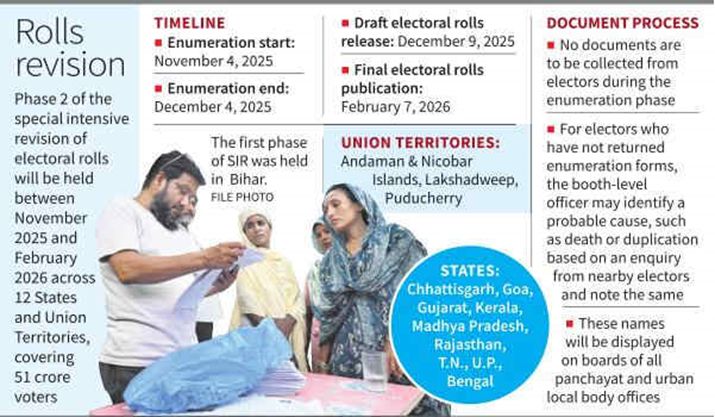
- The Election Commission kicked off the second phase of the special intensive revision of voter lists in 12 States and Union Territories, including poll-bound Tamil Nadu, West Bengal, Kerala, and Puducherry. The revision will cover 51 crore voters.
- With the announcement of the second round, the voter lists of the States and Union Territories were set to be frozen. For now, there will be no SIR in Assam, scheduled to go to the polls next year, and a separate order will be issued later.
- “Under the Citizenship Act, there are separate provisions for citizenship in Assam. Under the supervision of the Supreme Court, the exercise of checking citizenship is about to be completed. The June 24 SIR order was for the entire country. Under such circumstances, this would not have applied to Assam,” Chief Election Commissioner Gyanesh Kumar said at press conference.
- The exercise will be in focus in West Bengal and Tamil Nadu, where the ruling parties — the Trinamool Congress and DMK — have raised concerns. The SIR will be conducted in Uttar Pradesh, Madhya Pradesh, Rajasthan, Chhattisgarh, Goa, Gujarat, Andaman and Nicobar Islands, and Lakshadweep.
- The first phase of the SIR was held in Bihar following which more than 68 lakh names were deleted from the electoral rolls.
- Most States had the last SIR of the voter lists done between 2002 and 2004, and they have nearly completed the mapping of current electors according to the last exercise. Voter mapping involves standardising addresses and correcting discrepancies.
- In this phase of the SIR, the house-to-house enumeration will take place for a month from November 4 to December 4, and the draft rolls will be published on December 9. Claims and objections can be raised from December 9 to January 8. Notices will be issued, and hearings and verifications will take place between December 9 and January 31. Booth-level officers will be trained, and forms will be printed between October 28 and November 3. The final electoral rolls will be published on February 7, the poll body said.
- To a question on the demands for putting off the SIR exercise in Kerala where local body elections are scheduled, Mr. Kumar said the poll notification was yet to be issued.
- On the SIR in West Bengal, where the ruling Trinamool Congress has raised concerns about the exercise, the CEC said the Commission was doing its constitutional duty by carrying out the SIR, and the State government will perform its duties by giving all support and manpower needed.
- The poll body will give new EPIC cards to all voters as stated during the SIR in Bihar, Mr. Kumar said fresh voter IDs will be given to only those who have any change in their particulars.
- ‘Black hole activities suppress the birth of new stars around it’
Context: A new study led by astronomers at the Indian Institute of Astrophysics (IIA) has found that black hole activities suppress the birth of new stars around it. Supermassive black holes at the centres of galaxies are known to drive outflows of gas, and astronomers have long studied how feedback processes from these outflows can in turn determine the evolution of these galaxies.
- However, a key puzzle has been to understand the relative influence of this gas outflow versus radiation from the central regions on the behaviour and evolution of the host galaxy.
- The astronomers have uncovered key insights into these powerful forces shaping the universe.
- The Department of Science and Technology said that the study reveals that both intense radiation from around the black holes as well as the high-speed jets they emit can work together to eject gas from the centres of galaxies, potentially shutting down star formation in their central regions and regulating galactic growth.
- Using cutting-edge archival data from international astronomical facilities like the Sloan Digital Sky Survey (SDSS) Telescope at optical wavelengths and the Very Large Array (VLA) at radio wavelengths, both located in the United States, the researchers studied over 500 relatively nearby galaxies hosting active galactic nuclei (AGN).
- “AGN are energetic galaxy centres that emit copious radiation and gas, powered by matter falling onto their supermassive black holes, many millions of times more massive than our Sun,” the department said.
- “We found that outflows of warm ionized gas are widespread in AGN, and while radiation from the black hole is the main driver, galaxies with radio jets show significantly faster and more energetic outflows,” said Payel Nandi, a Ph.D. student at IIA and the lead author of the study.
- Their investigation further showed that such outflows, which are high-speed streams of gas pushed out from galactic centres, are more than twice as likely in galaxies detected in radio wavelengths (56%) compared to those without radio emission (25%).
- “These powerful winds can travel at speeds of up to 2,000 km per second, fast enough to escape the gravitational pull of the galaxy itself,” the department said.
- Dhruba J. Saikia from the Inter-University Centre for Astronomy and Astrophysics and co-author said that these findings are an important step in understanding the complex inter-relationships between supermassive black holes, radio jets, star formation, and evolution of their host galaxies.
- Man-animal conflict management task force will be formed: Khandre
Context: The announcement comes in the wake of back-to-back tiger attacks in a span of 10 days in Sargur.
- Eshwar B. Khandre, Minister for Forests, Ecology and Environment, stated on Monday that a conflict management task force to address human-wildlife conflict will be constituted in the State.
- While chairing a meeting of the officials in Bandipur, following a tiger attack in which a farmer was killed in Sargur, the Minister said that the task force will be a State-level entity and will comprise local representatives, NGOs and environmental experts.
- The meeting was a fallout of back-to-back tiger attacks in a span of 10 days in Sargur in which one farmer died while the other victim is under treatment but battling for life in a private hospital in Mysuru. Mr. Khandre said that the task force will take up educational awareness activities and sensitise people living in villages along the forest periphery on preventive measures to be taken to avoid conflict. The task force will visit schools in the forest periphery and sensitise students about wildlife and function as a bridge to promote amity between the Forest Department and the villagers, he said.
- The Minister directed the officials and the local administration to clamp down with prohibitory orders to prevent people from crowding during combing operations. The urgency for such a measure stems from the fact that the operations are hindered by the crowd which congregates to watch the exercise and courts a danger. On the imperatives of timely communication to the villagers of the presence of wild animals, the Minister said the public should be informed through loudspeakers if elephants or tigers enter residential areas, and information must also be disseminated through social media for greater reach.
- A command centre will be established for continuous monitoring of the presence of wild animals, and it will be equipped with thermal cameras, drones, and state-of-the-art technology. WhatsApp messages will be forwarded on sighting wild animals close to the villages, the Minister said, calling for its urgent implementation.
- Mr. Khandre emphasised the need to increase foot patrolling in conflict zones so that precautions could be taken to avoid injury or crop loss. To redress staff shortage and fill vacant posts, the officials were directed to initiate the recruitment process. In addition to it, frontline staff could be outsourced, Mr. Khandre said.
- The Minister instructed Chief Wildlife Warden P.C. Rai to submit a report within five days on possible measures that could be taken to prevent elephants and tigers from straying out of the forests. The officials were instructed to take up tentacle fencing, solar fencing, and dig elephant-proof trenches where necessary to supplement the rail barricades being installed in areas that are hotspots for human-elephant conflicts.
- Mr. Khandre said that farmers have attributed the rise in conflict situations to an increase in wildlife safaris and the disturbances being caused in forests and hence he would discuss the issue with officials.
- India’s maritime global trade to get a boost with proposed Great Nicobar project: Shah
Context: India aims to be among the top five ship-building countries and significantly increase the port-handling capability by building new mega ports, Union Home Minister Amit Shah said in Mumbai on Monday, adding that the proposed Great Nicobar project will boost the country’s maritime global trade multiple times.
- He was speaking at the inauguration of the fourth edition of the India Maritime Week 2025.
- The $5-billion Great Nicobar infrastructure project, which will include a power plant, transshipment port and airport, has been criticised by activists and local population, citing environmental concerns and violation of forest rights.
- He said that the government plans to increase the country’s port handling capacity to 10,000 million tonnes per annum (MTPA) from the present 2,700 MTPA (major and non-major ports combined). India’s maritime strength was due to its strategic location, he said.
- “Our coastline of over 11,500 km is spread across 13 coastal States. Maritime business contributes to 60 per cent of our GDP [Gross Domestic Product]. Today, over 100 countries are participating in the India Maritime Week. We have 350 speakers, over 500 companies, over one lakh delegates and we expect an investment of ₹10 lakh crore,” he said.
- Mr. Shah highlighted India’s growing leadership in the Indo-Pacific. “Leveraging its maritime position, democratic stability, and naval capability, India is acting as a bridge between the Indo-Pacific and the Global South, fostering development, security, and environmental progress,” he said.
- Speaking at the event, Union Minister Nitin Gadkari said India would soon bring down the logistics cost to single digit to nine per cent. “We are still at 16 per cent against China and Europe’s 8 per cent and 12 per cent respectively,” he said.
- Union Minister for Ports, Shipping and Waterways, Sarbananda Sonowal, said 680 memoranda of understanding (MoUs) worth ₹10 lakh crore were slated to be signed during the India Maritime Week.
- Justice Surya Kant, part of poll bond, Article 370 verdicts, set to be next CJI
Context: The Chief Justice of India (CJI), B.R. Gavai, recommended Justice Surya Kant, the senior-most judge of the Supreme Court, as his successor to office, and the 53rd Chief Justice of India.
- The government had in the previous week written to Chief Justice Gavai seeking his recommendation.
- However, the CJI was on an official visit to Bhutan. Chief Justice Gavai gave his recommendation immediately on his return and met Justice Kant with the recommendation letter on Monday, the first working day of the court after the Deepavali holidays.
- Chief Justice Gavai is scheduled to retire on November 24.
- Under the Memorandum of Procedure for the appointment of the Chief Justice of India, and Supreme Court Judges, the Union Law Ministry seeks the recommendation of the outgoing Chief Justice for the next appointment, following which the latter replies to the government.
Key cases
- Justice Kant has been a part of several impactful decisions of the apex court, including the abrogation of Article 370 of the Constitution which removed the special status to the erstwhile State of Jammu and Kashmir. He was also part of the Bench which held the electoral bonds scheme unconstitutional. He was a member of the Benches which heard the Pegasus spyware case, and the suspension of the sedition law.
- He was born on February 10, 1962 at Hisar in Haryana. Justice Kant earned his Bachelor’s degree in Law in 1984 from Maharishi Dayanand University, Rohtak. He started his legal practice at the Hisar district court and shifted to Chandigarh in 1985 to practice in the Punjab and Haryana High Court.
- He was the youngest Advocate-General of Haryana on July 7, 2000, and designated as senior advocate in March 2001. He was elevated as a judge of the Punjab and Haryana High Court on January 9, 2004. Justice Kant was appointed as the Chief Justice of the High Court of Himachal Pradesh in October 2018.
- He was appointed as a Supreme Court judge on May 24, 2019. He is due to retire on February 9, 2027.
- India welcomes Gaza peace plan, wishes for early end to Ukraine war: Jaishankar
Context: India recognises that enduring conflicts have the potential to disrupt food security and threaten energy flows, and, therefore, it welcomes the Gaza peace initiative by U.S. President Donald Trump and wishes for an early end to the conflict in Ukraine, External Affairs Minister S. Jaishankar.
- Speaking at the 20th East Asia Summit in Kuala Lumpur, Mr. Jaishankar spoke in favour of deepening maritime connections in the ASEAN region. “We are also witnessing conflicts that have significant repercussions, near and far. Deep human suffering apart, they undermine food security, threaten energy flows and disrupt trade. India, therefore, welcomes the Gaza peace plan. We also seek an early end to the conflict in Ukraine,” he said.
- Earlier, Mr. Jaishankar met Secretary of State Marco Rubio as India-U.S. relations continue to remain uneasy after Mr. Trump imposed penalty tariffs on India for buying Russian crude.
- Mr. Jaishankar, on his part, did not specifically refer to the challenges that India is facing because of Mr. Trump’s campaign to cut down Russian energy exports but pointed at “reliability of supply chains and access to markets” as an area of “growing concerns”. “Energy trade is increasingly constricted, with resulting market distortions. Principles are applied selectively and what is preached is not necessarily practised,” he said, supporting “adjustments” and “resilient solutions”.
- “Multipolarity is not just here to stay but to grow. All these warrant serious global conversations,” he said. He expressed India’s commitment to enhancing maritime cooperation in the ASEAN region.
- NDRF teams on the ground, schools closed in Odisha
Context: The Odisha government on Monday deployed disaster response forces and shut down schools in eight districts, which are likely to be impacted by Cyclone Montha. “We have deployed 24 teams of Odisha Disaster Rapid Action Force and five units of National Disaster Response Force mostly in southern Odisha districts.
- As southern Odisha districts are likely to receive heavy rain under the atmospheric system, we have remained alert,” said Suresh Pujari, State Revenue and Disaster Management Minister. The schools and anganwadi centres have been shut down for two days— keeping the potential heavy rain in mind.
- CIC appointments in ‘two or three’ weeks, Centre tells top court
Context: The Centre informed the Supreme Court on Monday that vacancies in the Central Information Commission (CIC), which has no Chief Information Commissioner and is down to just two Information Commissioners out of a total sanctioned strength of 10, will be filled in “two or three” weeks.
- Appearing before a Bench headed by Justice Surya Kant, Additional Solicitor-General K.M. Nataraj said the shortlisted names of candidates had been forwarded to the high-profile selection committee of the Prime Minister, the Leader of the Opposition, and a nominee of the government.
- However, petitioners, represented by advocate Prashant Bhushan, countered that there was a complete information blackout on the appointment process to the Central Information Commission, and “names are air-dropped without any transparency”.
- Mr. Bhushan, appearing for Anjali Bhardwaj, Commodore Lokesh Batra (retd.) and Amrita Johri, said it was an irony that the appointments to the very apex body under the Right to Information (RTI) Act were shrouded in opacity while pendency was touching 30,000.
- He said even the Chief Information Commissioner had retired. Nothing had been done since the last order of the Supreme Court 10 months ago, directing the government to fill the vacancies. He said the government was applying the slow-choke to RTI.
- “The best way to kill the RTI is to not make any appointments… If they do make appointments, they select persons out of the blue. Names are just air-dropped. There is no information on who is being appointed,” Mr. Bhushan, along with advocates Rahul Gupta and Cheryl D’souza, submitted.
- Mr. Nataraj said the petitioners could not decide the suitability of the candidates, and their eligibility was decided by the RTI Act.
- He said the petitioners ought to wait till the appointments were actually made before complaining.
- Is the Dogri language losing resonance in India?
Context: Is the Dogri language declining at the same rate across rural and urban landscapes in the Jammu region?
Human society is rapidly moving towards the extinction of its linguistic heritage. According to one report by UNESCO, India has topped the list of countries with the maximum number of dialects on the verge of extinction. According to D.G Rao, former Director of the Central Institute of Languages, India has lost over 220 languages in the last 50 years.
Is Dogri in decline?
- In recent years, growing concern has emerged over the gradual decline of the Dogri language in the Jammu region. Globalisation, migration, and the pursuit of economic opportunity often encourage speakers to prioritise widely used languages, while regional ones fade into disuse.
- Political choices and a lack of active interest among native speakers further deepen this crisis. Against this backdrop, Dogri finds itself at a crossroads. Although the J&K Official Languages Bill, 2020 gave it the long-overdue recognition as one of the Union Territory’s five official languages, its status on paper has not translated into meaningful presence on the ground. Unlike other regional languages that have secured space in school curricula or administrative use, Dogri remains largely absent from formal education.
Why is Dogri not being spoken?
- The decline of Dogri in the Jammu region can be looked at through three critical lenses — government policy, generational perspectives, and the rural-urban divide.
- One of the central reasons for the decline of Dogri lies in the absence of sustained government support.
- Unlike Urdu, Kashmiri, and Hindi, Dogri had to wait until 2003 for constitutional recognition. This long delay meant that by the time Dogri gained official status, it had already fallen behind in terms of institutional backing and visibility.
- A survey conducted by the authors further underscores this policy gap. The research employed a random sampling method, selecting households at intervals of three to four units to ensure representativeness. The sample was distributed across 20 different locations in the Jammu region; 130 people filled the survey form completely.
- Nearly half of the respondents (48%) from the Jammu region believe that the government has failed to provide adequate policy support for Dogri. Another 43.2% felt that the language offers little relevance for employment prospects or career advancement.
- Additionally, the survey revealed a stark generational divide in Dogri proficiency. The oldest respondents, those aged 60 and above, displayed the strongest connection to the language, with full proficiency in speaking and an intermediate score in reading and writing.
- However, among respondents aged 41-60, writing proficiency dropped sharply to just 0.25%, reflecting the gradual erosion of literacy in the language. Respondents under 20 years of age show 0% proficiency in reading and writing Dogri.
- The survey also revealed a striking contrast between rural and urban populations in terms of Dogri language usage. Approximately 56% of respondents from rural areas actively speak Dogri, with around 15% demonstrating the ability to write it. In contrast, among urban respondents, only 45% reported speaking Dogri, and only 4% had any proficiency in writing it.
What is the way ahead?
- To address India’s linguistic crisis, two challenges must be addressed. First is technical — with the 2021 Census on hold, one lacks updated data on how many languages are endangered, and where urgent intervention is needed. Without this knowledge, both awareness and policy remain adrift. Secondly, one must shed the mindset that equates English alone with progress. The decolonisation of linguistics is the larger task at hand.