- Imminent need to overhaul Karnataka Cooperative Societies Act: High Court
Context: Observing that “numerous incongruities pervade the Karnataka Cooperative Societies (KCS) Act, 1959 and the KCS Rules, 1960”, the High Court of Karnataka has said that there is an imminent need to overhaul this law, which has become “a patchwork of a series of piecemeal amendments over the decades and no longer suited to the modern socio-economic environment”.
- Pointing out that disputes relating to membership, disqualification, voter eligibility, appointment of administrators, and surcharge proceedings have time and again required judicial intervention in a large number of litigations to harmonise contradictory provisions of the KCS Act and the Rules, the court said recurring litigation indicated a systemic defect in the legislative framework itself. Justice Suraj Govindaraj made these observations while dealing with voter list and other issues related to holding elections to a multi-purpose primary rural agricultural cooperative society, Idagundi in Yellapur taluk of Uttara Kannada district.
- “The courts have attempted to apply the principle of harmonious construction in resolving the issues under this law, but where reconciliation itself becomes impossible, legislative reform is the only viable solution,” the court said.
- “It is therefore my considered opinion that a comprehensive overhaul of the statute is urgently required. Much like The Income-Tax Act, 1961 is being replaced by the Income-Tax Act, 2025… on account of the I-T Act, 1961 having been amended over 65 times in six decades had become overly complex,” observed Justice Govindaraj.
- As the new I-T law, which largely retains existing tax principles, aims to simplify the text and remove redundant provisions to reduce litigation and make compliance easier for taxpayers, a new, consolidated KCS Act for Karnataka is required to replace the current legislation, the court emphasised.
- “Just as the Companies Act was comprehensively revamped to address contemporary requirements, a modernised co-operative law must be framed to ensure efficiency, transparency, and alignment with constitutional principles of cooperative autonomy. Without such reform, cooperatives will remain entangled in unproductive litigation, stifling their true purpose of empowering members economically and socially,” the court observed.
Many areas of conflict
- The areas of conflict in the KCS Act and the Rules are manifold, like membership rights and disqualification, preparation of voter lists, conduct of elections, appointment of administrators, jurisdictional overlaps, surcharge proceedings, and audit obligations, the court said while pointing out that many provisions have been rendered otiose by technological and socio-economic changes. The court also requested the Karnataka State Law Commission to look into the issue and take appropriate action.
- PM SHRI signing a tactical decision: Minister
Context: Minister for General Education V. Sivankutty described Kerala’s decision to sign up for the Centrally sponsored PM School for Rising India (PM SHRI) scheme as a “tactical” move designed to overcome denial of school education funds to the State by the Union government.
- At a press conference held to explain the State government’s position in the wake of strident opposition from coalition partner Communist Party of India (CPI) and others, Mr. Sivankutty said Kerala would continue its fight against the Union government policies of implementing Rashtriya Swayamsevak Sangh’s (RSS) agenda through education. However, the government was not ready to give up on funds for Samagra Shiksha and other projects, especially when the State was facing financial constraints, he said.
- The Minister said the State had lost ₹188.58 crore in the 2023-24 financial year and ₹513.54 crore in 2024-25. It was due ₹456.01 crore this financial year. This totalled ₹1,158.13 crore.
- The PM SHRI scheme would wind up by March 2027, he said. By signing the Memorandum of Understanding (MoU) for PM SHRI, the State would get the arrears due to Samagra Shiksha Kerala and two years of PM SHRI funds, which together came to ₹1,476.13 crore.
- Responding to criticism that by signing up for PM SHRI the State had accepted the National Education Policy (NEP), 2020, the Minister said the argument was purely technical.
- The Union government had declared in October 2022 that the objective of Samagra Shiksha was to help implement the NEP, he said. Even when the State had received Central funds till 2023, it had implemented schemes in keeping with the State’s interests. There would be no change in that position, he said.
CPI opposition
- The Communist Party of India (CPI) State secretariat on Friday expressed its “profound disquiet” over the government inking the MoU for the PM SHRI keeping the Left Democratic Front (LDF) and the Cabinet “in the dark.”
- Baker’s yeast has the resilience to withstand Martian environment, find researchers
Context: Researchers from the Department of Biochemistry, Indian Institute of Science (IISc) and collaborators at the Physical Research Laboratory (PRL), Ahmedabad, have found that Baker’s yeast (Saccharomyces cerevisiae) has the resilience to withstand harsh conditions found in the Martian environment.
- Baker’s yeast (Saccharomyces cerevisiae) is an indispensable ingredient in making bread, beer, and biotechnology products. IISc said that this organism holds clues to how life could survive in extraterrestrial conditions and the findings underscore how baker’s yeast could serve as an excellent model for India’s efforts in astrobiology research.
- It said that the team exposed yeast cells to high-intensity shock waves — similar to those produced by meteorite impacts on Mars — and perchlorate salts, which are toxic chemicals found in Martian soil.
- Using a High-Intensity Shock Tube for Astrochemistry (HISTA) in Bhalamurugan Sivaraman’s lab at PRL, they simulated shock waves reaching Mach 5.6 intensity. The team also treated yeast cells with 100 mM sodium perchlorate either in isolation or in combination with the shockwaves.
- “One of the biggest hurdles was setting up the HISTA tube to expose live yeast cells to shock waves — something that has not been attempted before — and then recovering yeast with minimum contamination for downstream experiments,” said lead author Riya Dhage.
- IISc said that the yeast cells survived when treated with shock waves and perchlorate, although the cells’ growth slowed down.
Key to resilience
- “The likely key to their resilience lies in their ability to produce ribonucleoprotein (RNP) condensates — tiny, membrane-less structures that help protect and reorganise mRNA when the cells are under stress. Shock waves triggered the assembly of two types of RNPs called stress granules and P-bodies, while perchlorate exposure led to the generation of P-bodies alone. Yeast mutants that were unable to form these structures were far less likely to survive,” IISc said.
- It added that the results show how RNP condensates may act as biomarkers for cellular stress under extraterrestrial conditions.
- “What makes this work unique is the integration of shock-wave physics and chemical biology with molecular-cell biology to probe how life might cope with such Mars-like stressors,” said Ms. Dhage.
- “We hope that this study will galvanise efforts to have yeast on board in future space explorations,” said Purusharth I. Rajyaguru, Associate Professor, Department of Biochemistry.
- Trouble in ‘soy State’
Context: Madhya Pradesh is India’s largest soybean producer, but young farmers are losing interest in farming, facing key issues such as improper implementation of minimum support price, seed quality, input cost and the possibility of the import of soybean and soybean meal from the United States.
- The oilseed was quite new to farmers in this area even though others in the State had been sowing it as far back as the late 1970s and early 1980s.
The reasons are many:
- Issues that ranged from climate change to the import-export policies of the Union Government. “The yield is very low.
- The price is also almost a ₹1,000 less used to be 15 years ago.
- Do not have any other alternative crops here as maize, a popular alternate crop, is what the nilgai likes.” The nilgai (Boselaphus tragocamelus) is an antelope species which farmers consider to be a nuisance as it destroys crops.
- Import of soybean from the United States: “The government is already importing soybean oil and other edible oils. But if soybean is imported from the U.S.,crisis will deepen. The government should set its import-export policy right.
The MSP issue
- There is another issue that he and other farmer leaders are engaged with, which is proper implementation of the minimum support price (MSP) and procurement by the government in local markets.
- In the ongoing kharif season, the government had announced ₹5,328 as the MSP for a quintal of soybean. But in the Chhawani grain market of Indore, farmers have been selling their produce for as low as ₹ 3,000 per quintal.
- “The government had promised MSP, but we are not getting even half the MSP after the harvest.
- Soybean cultivation gives huge losses. Both the Centre and State governments claim that they have doubled the income of farmers.
- The Union Government, in a statement on October 6, 2025, had said that the country’s overall oilseed sowing area, during the 2025 kharif season, had decreased by 10.62 lakh hectares compared to the previous year. The decrease in soybean alone was 9.1 lakh hectares. Madhya Pradesh is India’s largest soybean producer — over 40% — harvesting about 52 lakh metric tonnes (LMT) from about 53 lakh hectares.
- Farmers are not recovering even the input cost which is the reason for the decrease in cultivation.
- Earlier used to cultivate coarse cereals, millets and pulses earlier but switched to soybean based on what the government presented to them — soybean cultivation was linked to ensuring self-reliance in edible oil requirements and in meeting the protein needs of a huge population dependent on vegetarian food.
- “Now the prices of millets and pulses have increased and the prices of soybean have come down. We should not have shifted to soybean”.
The threat of imports
- The Executive Director of the Soybean Processors Association of India (SOPA), D.N. Pathak, has seen both the growth and the crisis in the soybean sector. He believes that any shortage in its cultivation will have a direct impact on protein availability as soybean in India is not an oilseed crop. Pathak said, “Only 18% or 19% of the soybean is used to make oil. It is basically a protein crop.” He said SOPA has been requesting the government to ensure that farmers get the correct price. “Productivity is low. It has been low for the last 30 to 40 years. It has not improved. A lot needs to be done to improve productivity. The industry should also work there. The government should certainly make efforts,” he said.
- Pathak said that talk about the import of soybean was being floated by an import lobby with vested interests.
- A trained professional in electronics, Pathak joined SOPA in 1994, as he had a deep interest in agriculture. It comes as no surprise as his family of farmers is from Uttar Pradesh. “We need about 7 million tonnes to 8 million tonnes of soybean meal,” he says. “This means that we must crush about 100 lakh tonnes of soybean, which is our production now. If we grow more, we export. But we cannot compete because our MSP is so high. So, if somebody were to bring soybean from the U.S., what will happen to this soybean which our farmers grow? Or is there a suggestion that we should not grow soybean? U.S. soybean is roughly $380 a tonne. Our soybean is $620 per tonne. So should we bring U.S. soybean at $380?”
The advent of soybean in the State
- In the 1980s, Madhya Pradesh first tried black soybean. The present variety, which is yellow soybean, reached farms by the first decade of 2000.
- Earlier, cooperative societies used to procure soybean till the end of the 1990s and production was good too.
- Losses: The biggest issue was the seeds. Low quality seeds resulted in a decrease in production and companies began to queue up offering fertilizers and pesticides to enhance production. But this did not work. Rather than it being from lab to land, seeds are coming from market to land,” he said.
- “Cultivation is down and yield is less. Traders are also worried about the future of soybean. The Bhavantar scheme is not helping farmers. Unless soybean meal is exported, it will be difficult to survive. If U.S. soybean comes here, it will be a double blow,” he said. Kailash said some farmers are keeping soybean for three to four years expecting that the prices will improve as export picks up. According to SOPA, on an average, India exports about two million tonnes of soybean meal; in this season, it could go down by 1.8 million tonnes. SOPA states that the reason for lack of demand for Indian soybean is its higher price.
- The Chhawani market is one of the biggest soybean markets in India. During the season, traders handle about 2,000 tonnes to 2,500 tonnes of soybean a month. Said Kailash, “Traders of this market brought yellow soybean and provided it to farmers for cultivation after the 1990s. The best time was between 1995 to 2015 when we used to get 6,000 tonnes per month.”
- Varun, a former secretary of the market, nodded in agreement. According to him, traders in the market deal with buyers from across the country. “We have a membership of about 1,500 traders. There are a lot of workers too in this market. The fluctuations in the soybean market have impacted traders. They are losing revenue. Such fluctuations are basically from the policies of the government. The import policy of the government is a problem. If the government allows imports of soybean, it will be a major problem.”
A reposing of faith in soybean
- In another part of Indore, despite the sentiment and arguments expressed from the ground, the scientific community has not lost hope in soybean and its future. The Director of the Indian Council of Agriculture Research (ICAR)’s Indian Institute of Soybean Research, Kunwar Harendra Singh said: “From only 30,000 hectares during the 1970s, the country has now more than 12 million hectares under soybean cultivation. You will not see any other crop having expanded in such a way. So this is the big achievement as far as this crop is concerned.”
- He said that the present decrease in the area of sowing is primarily due to a decline in prices. “The government has been increasing the MSP, but the market rates were declining very fast. And then, other options like maize are in demand,” he said. “This is the only plant based group which has 40% protein… This needs the attention of the government and also different industries to create the awareness on how to use this good quality protein,” he added, pointing to the need for more research on the use of soybean as a human food.
- “The crop basically belongs to China, and in India earlier, only a few States such as Himachal Pradesh, Uttarakhand and some of the northeastern States used to cultivate it. “More than 90% of soya is being used for cattle feed. We do not have value-added products. We can make different nutritional powders from this. But the industry has to come forward for that.”
- Gyan Bharatam Missionto ink pact with institutes
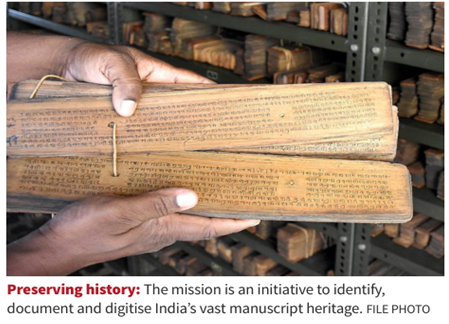
Context: It is a flagship initiative of Culture Ministry for identifying, digitising, preserving, and promoting India’s manuscripts; the institutes will be categorised as cluster centres and independent centres.
- The Gyan Bharatam Mission on manuscripts, under the Union Culture Ministry, will sign Memorandums of Understanding with around 20 institutes across the country for conservation, upkeep, and digitisation of manuscripts.
- While the 20 institutes will sign the MoUs on Saturday, 30 more will do so over the next few days, a senior official of the Union Culture Ministry. Some of these institutes are Asiatic Society Kolkata, University of Kashmir, Srinagar, Hindi Sahitya Sammelan, Prayagraj, and Government Oriental Manuscript Library, Chennai.
- Gyan Bharatam is a flagship initiative of the Ministry of Culture for identifying, documenting, conserving, digitising, preserving, and promoting India’s vast manuscript heritage.
- It was announced during the Union Budget this year.
- The mission’s mandate is to preserve and establish a dedicated digital platform — known as the National Digital Repository (NDR) — to share India’s manuscript heritage worldwide.
- The institutions set to sign MoUs have been categorised into cluster centres and independent centres.
- In the case of a cluster centre, the institution shall be responsible for executing all manuscript-related activities of its own centre, as well as those of its designated cluster partner centres, which shall not exceed 20. In the case of the independent centres, the institution shall be responsible for executing all manuscript-related activities pertaining solely to its own collection.
- Gyan Bharatam shall provide the overarching framework, guidance, monitoring, and support for the execution of activities under this partnership. In addition, it shall also provide funding, necessary equipment, and budgetary allocations to the designated Centres, subject to approval of work plans, milestones, and quality verification.
- The various activities to be provided by the institutes with GB’s support have been categorised into survey and cataloguing, conservation and capacity building, technology and digitisation, linguistics and translation, research, publication, and outreach.
- The centres have also been asked to constitute a dedicated Gyan Bharatam Cell experienced in each vertical, in the spirit of voluntary service, to represent the Centre with sincerity, while also serving as a vital channel of communication to foster collaboration and ensure smooth coordination.
Funds in instalments
- As far as finances are concerned,funds shall be released in phased instalments in accordance with the implementation schedule and milestones outlined in the approved work plan.
- The first instalment (70%) shall be disbursed upon the annual budget, the second (30%) instalment shall be released only upon submission of progress reports, detailed financial report, submission of utilisation certificates (UCs) and other important documents.
- Manipur Nagas declare restrictions ahead of Muivah’s visit to Senapati
Context: The Nagas in Manipur have declared a ‘Genna’ in honour of National Socialist Council of Nagalim (NSCN) leader Thuingaleng Muivah ahead of his visit to the State’s Senapati on October 29.
- Genna, in Naga culture and traditions, refers to restrictions to ensure maximum participation when a national holiday or an important day for the community is observed.
- The NSCN is also referred to as the Isak-Muivah faction of the National Socialist Council of Nagaland, or NSCN (I-M).
- The United Naga Council (UNC), the apex Naga organisation in Manipur, issued a statement on Friday, declaring ‘Genna’ in Senapati “on the occasion of the civic reception in honour” of Mr. Muivah, the Ato Kilonser or “Prime Minister” of the “government” run by the NSCN (I-M). The UNC referred to Senapati as Tahamzam, a Naga name.
- Senapati, the headquarters of the Naga-majority district with the same name, is about 60 km north of Manipur’s capital, Imphal.
- The UNC said the ‘Genna’ requires all educational institutions and shops in Senapati to remain closed on the day of Mr. Muivah’s visit.
- The council also asked all community members to abstain from all other forms of economic and commercial activities, participate in community gatherings and programmes to celebrate the occasion.
- EC warns parties against misuse of AI-generated content during elections
Context: Ahead of the upcoming Bihar Assembly election, the Election Commission on Friday issued an advisory to all political parties on responsible use and disclosure of synthetically generated information and AI-generated content during election.
- In a letter to the heads of all political parties, the poll body said that it had been brought to its notice that “the misuse of hyper-realistic synthetically generated information, including depicting political leaders making electorally sensitive messages, is contaminating the level-playing field in the electoral arena, disrupting fair and equal conditions for all political participants, which is a sine qua non for preserving the integrity of the political campaigning during elections”.
- “The use of technology for creating, generating, modifying and altering information and publishing and transmitting synthetically generated information is a deep threat and challenge because of its ability to masquerade as truth and unwittingly trap political stakeholders into incorrect conclusions and therefore, ECI finds it particularly imperative to ensure that transparency and accountability are maintained to preserve electoral integrity and voter trust,” the letter said.
Previous guidelines
- The EC had issued detailed guidelines in May last year just before the general elections regarding responsible and ethical use of social media platforms, and an advisory, dated January 16, 2025, specifically addressing concerns around labelling of synthetic and AI-generated content used by political parties for election campaigning. The poll body asked political parties, candidates, and campaign representatives to ensure that any AI- generated or AI-altered image, audio, or video used or disseminated for campaigning purposes shall bear a clear, prominent, and legible label such as “AI-Generated”.
- RBI may limit banks’ market exposure
Context: The regulator has proposed that the total direct exposure to capital markets and acquisition financing be capped at 20% of their tier-1 capital. India’s central bank proposed limits to banks’ lending against stocks, bonds in capital markets, and for corporate acquisitions to ensure that lenders keep such businesses in check.
- The Reserve Bank of India (RBI) issued a draft circular proposing that banks’ total direct exposure to capital markets and acquisition financing be capped at 20% of their tier-1 capital, weeks after it said it would ease restrictions on funding mergers and acquisitions.
- Earlier this month, the regulator allowed banks to fund acquisitions and raised the cap on loans for buying shares at initial public offerings, as part of a raft of measures to boost bank lending in the world’s fifth-largest economy.
- It had also permitted unfettered bank lending against listed debt securities, and raised the limit for lending against equity shares from ₹2 million to ₹20 million.
- The RBI proposed that banks’ aggregate capital market exposure, including direct as well as indirect exposure through funds and guarantees, among others, should not exceed40% of their tier 1 capital, and the exposure towards acquisition finance shall not exceed 10%. Tier 1 capital, the highest-quality capital of a bank, includes equity, retained earnings, and certain instruments that can absorb losses.
- The changes allow domestic banks to lend for acquisitions by Indian corporates, a segment so far cornered by foreign lenders and credit funds.
- In its proposed rules for acquisition finance, the RBI said that banks may finance a maximum of 70% of the deal value, with at least 30% to be funded by the acquiring company.
- It said that commercial banks can offer acquisition finance only to listed entities that have a satisfactory net worth and been profitable for the last three years, adding that the loan should be fully secured by the shares of the target company.
NBFCs’ risk-weight
- Separately, it proposed revised risk-weight guidelines for non-banking financial companies’ infrastructure loans, a move that could lower capital requirements for lenders financing established projects.
- Advertising veteran Piyush Pandey passes away at 70
Context: The former chief creative officer, worldwide, and executive chairman of Ogilvy India was known to break Western influence on Indian advertising by popularising Hindi in ad films and taglines that caught the fancy of the masses.
- He was credited with blockbuster campaigns such as the Fevicol bus ad, the fish catch ad for Fevikwik, Pug and Zoozoos campaigns for Vodafone, Har Ghar Kuch Kehta Hay campaign for Asian Paints, Kuch Khass Hay for Cadbury, Chal Meri Luna for Kinetic and the Abki Baar Modi Sarkar ad campaign for the BJP to name a few.
- Born in Jaipur in 1955, Mr. Pandey did his schooling in the city and moved to New Delhi, where he did his post graduation at St. Stephen’s College.
- Japan’s new PM commits to higher defence spend, ties with India, Quad
Context: Takaichi said she ‘looks forward’ to promoting the Japan-India Strategic and Global Partnership; ‘in order to promotethe main pillar of Tokyo’s diplomacy, a Free and Open Indo-Pacific, India is a crucial partner,’ says an Assistant Minister.
- In a dramatic announcement three days after she was sworn in, Japanese Prime Minister Sanae Takaichi said her government will ensure that Japan’s defence spending would increase to 2% of its GDP by March 2026, two years ahead of schedule, even as she pledged support for “security partnerships” like the Quad, which includes India. Ms. Takaichi, who said the government’s first priority is to tackle inflation and boost fiscal spending, was addressing the Japanese Parliament, or Diet, in an inaugural speech about her agenda in office.
- Ms. Takaichi, the country’s first woman Prime Minister, also responded to Prime Minister Narendra Modi’s congratulatory message on her appointment, saying she “looks forward” to promoting the Japan-India Special Strategic and Global Partnership.
- “The free, open, and stable international order with which we have become familiar is being significantly shaken by historical shifts in the balance of power and intensifying geopolitical competition,” Ms. Takaichi said, citing Russia, China and North Korea as “serious concerns” and promising to deepen Japan’s “multilateral security consultations” involving the U.S., South Korea, the Philippines, Australia, and the Quad.
- Toshihiro Kitamura said India was a “unique” country for its leadership of the Global South, and that Ms. Takaichi was committed to following former PM Shinzo Abe’s lead on the Indo-Pacific.
Crucial partner
- “In order to promote the main pillar of the Japanese diplomacy, a Free and Open Indo-Pacific, India is a crucial partner. Prime Minister Takaichi is fully committed to promote further cooperation with India,” Mr. Kitamura said.
- In the parliament speech, Ms. Takaichi also ordered a review of Japan’s National Security, Strategic and Defence plans that included the commitment on raising defence expenditure.
- Japan’s GDP last year was about $4 trillion (591 trillion Yen), and according to the National Security Strategy documents issued in 2022, defence spending was due to reach 11 trillion Yen, or 2%, only by the end of the financial year in 2027. The announcement on defence spending and the Indo-Pacific is significant as it comes a day before Ms. Takaichi leaves for Malaysia where she will meet with counterparts from ASEAN countries on October 26, and then will return to prepare for U.S. President Donald Trump’s three-day visit to Japan beginning October 27.
- Ms. Takaichi promised to elevate the Japan-U.S. relationship to “even greater heights”. It remains to be seen whether Ms. Takaichi will also raise the Quad and scheduling the Summit due to be held in India later this year, which has been stalled due to India-U.S. tensions on trade issues.
- Ms. Takaichi called Japan’s population decline its “biggest problem”, and struck a sharp note on immigration, suggesting controls on foreign nationals working in the country, including restrictions on land acquisition by them.
- Ms. Takaichi gave the parliament address after appointing her Cabinet, which includes several faces familiar to New Delhi. Foreign Minister Toshimitsu Motegi was a minister in the Shinzo Abe cabinet (2017-19), while Internal Minister Yoshimasa Hayashi was the Foreign Minister (2021-23), under former PM Fumio Kishida, and travelled to Delhi for the G20 and Quad Foreign Minister’s meeting. Meanwhile, 44-year-old Defence Minister Shinjiro Koizumi is the son of former Japanese PM Junichiro Koizumi, who travelled to India in 2005 to reset ties, set off strategic talks and launched the practice of annual summits with PM Manmohan Singh.
- India opposed to any move that may affect truce in Gaza
Context: A day after the Israeli Knesset passed a preliminary Bill on annexation of the West Bank, India reiterated that it opposes any “unilateral” moves that has the potential to dismantle the peace initiative of U.S. President Donald Trump.
- Speaking at the UN Security Council’s Quarterly Open Debate convened by Russia, India’s Permanent Representative at the United Nations P. Harish said India’s position is based on its assessment of the “overall Palestinian question” and emphasised that food and other requirements “must flow into Gaza in an unimpeded manner”.
- “The landmark initiative of the United States has generated diplomatic momentum towards peace and all parties must adhere to their obligations in this regard. We also remain firmly opposed to any unilateral moves by parties concerned. Now is the time for all parties to support ongoing peace efforts, rather than to derail them,” said Mr. Harish.
- The remarks came soon after the Knesset approved a Bill to apply Israeli sovereignty in the West Bank. The Bill titled “Application of Israeli Sovereignty in Judea and Samaria, 2025” was initiated by Member of Knesset Avi Maoz and was passed by a narrow margin. It was sent to the Knesset’s Foreign Affairs and Defense Committee for discussion before being submitted for further votes.
Palestinian question
- Mr. Harish did not refer to the Knesset’s move but reminded that India’s position is “firmly rooted in its consistent stance on the developments since October 7, 2023 as well as the overall Palestinian question.”
- “India has clearly condemned terrorism; stressed there must be an end to destruction, despair and suffering of civilians and sought the immediate release of all hostages; held that humanitarian assistance, particularly, food, fuel and other necessities must flow into Gaza in an unimpeded manner,” said Mr. Harish who described President Trump’s peace initiative as an “enabler and catalyst in this regard”.
- He said that India supports “inalienable rights of the Palestinian people to self-determination, national independence and sovereignty” and that the two-state solution is the “only pragmatic path”.
- Mr. Harish highlighted India’s recognition of Palestine in 1988 when India began advocating certain important elements of its policy for the Israel-Palestinian conflict — “a sovereign, independent, viable State of Palestine, living side by side in peace and security with Israel, within secure and recognised borders”.
- The Indian envoy said that the Palestinian people require support from the international community to “rebuild” their lives. He said peace in Palestine has regional implications and India seeks lasting peace in the region. He further reminded the Israeli and Palestinian stakeholders to “honour their respective commitments”.