- Gaza declaration inked as Hamas sets hostages free
Context: Trump, leaders of Egypt, Qatar and Turkiye sign document meant to cement the ceasefire; Hamas releases last of the 20 surviving hostages and Israel hands over 1,968 mostly Palestinian prisoners.
- U.S. President Donald Trump hailed a “tremendous day for the Middle East [West Asia]” as he and regional leaders signed a declaration on Monday meant to cement a ceasefire in Gaza, hours after Israel and Hamas exchanged hostages and prisoners.
- Mr. Trump sat down at a resort in Sharm el-Sheikh with more than two dozen world leaders to discuss the deal. The U.S. President along with leaders of Egypt, Qatar and Turkiye signed the declaration as guarantors to the Gaza deal.
- “The document is going to spell out rules and regulations and lots of other things,” Mr. Trump said before signing, repeating twice that “it’s going to hold up.”
- As part of Mr. Trump’s plan to end the Gaza war, Hamas freed the last 20 surviving hostages it held after two years of captivity in Gaza. In exchange, Israel released 1,968 mostly Palestinian prisoners held in its jails.
- Under the ceasefire agreement, Hamas is also due to return the bodies of 27 hostages who died or were killed in captivity, as well as the remains of a soldier killed in 2014 during a previous Gaza conflict.
- Retail inflation eases to 8-year low of 1.54%
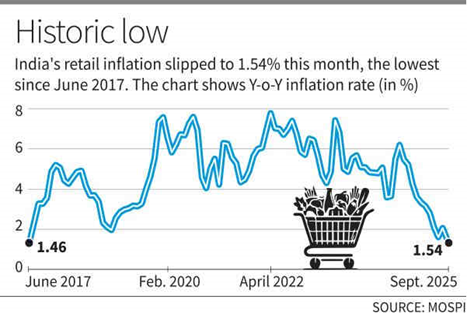
Context: Retail inflation fell to a more than eight-year-low of 1.54% in September on falling food and fuel prices, official data showed. This is once again below the Reserve Bank of India’s lower comfort bound of 2%.
- Inflation, as measured by the Consumer Price Index released by the Ministry of Statistics and Programme Implementation, was last lower in June 2017, when it stood at 1.46%.
- Inflation had fallen below the RBI’s lower comfort limit in July 2025, before rising marginally to 2.1% in August.
- The food and beverages grouping saw a contraction of 1.4% in September, compared with a growth of 0.05% in August and 8.4% inflation in September last year. “Looking ahead, food inflation is likely to stay benign supported by a favourable base and good monsoon,” Rajani Sinha, chief economist at CareEdge Ratings, said.
- “That said, risks remain from the late withdrawal of the monsoon and heavy rain in certain regions, which could risk crop damage.”
- In addition, Ms. Sinha said that persistently high double-digit inflation in edible oils warrants close monitoring, given weak sowing trends, import dependence, and elevated global edible oil prices.
- Inflation in the oil and fats category stood at 18.3% in September, the 11th consecutive month of double-digit inflation in the sub-grouping.
- Inflation in the fuel and light category came in at 1.98% in September, down from 2.3% in August. Save for one month, inflation in this category has been easing since April.
- “The moderation in food and fuel prices has provided much-needed relief to households and improved purchasing power,” Rajeev Juneja, president of the PHDCCI, said.
- Inflation in the clothing and footwear category was 2.28% in September, marginally lower than the 2.33% seen in August 2025 and the 2.7% in September last year. This is the fifth consecutive month of slowing inflation in this category.
- Inflation in the pan, tobacco and other intoxicants category, however, quickened to 2.7% in September from 2.5% in August. Similarly, the housing sector also saw inflation quickening to 4% in September from 3.1% in the previous month.
- Economists say that the low inflation figures, with the RBI’s Monetary Policy Committee revising downwards its inflation forecast for the year for the fourth time in a row, raises hopes of a rate cut again in December.
- ‘India’s rare earth elements strategy should align with global shifts’
Context: India’s rare earth elements strategy should align with global supply chain shifts and geopolitical pressures, aiming to reduce dependency on dominant players like China, said Abhishek Bhatia, Managing Director & Partner at Boston Consulting Group (BGC).
Steady growth
- The country’s rare earth elements market is set to grow steadily, driven mainly by the rising demand for magnets used in green technologies, he said, while elaborating on a topic ‘Critical minerals – Global Scenario and Strategy for India’, at the Critical Mineral Summit organised by Foundation of Science Innovation and Development at Indian Institute of Science.
- The rare earth elements market is expected to grow at over 6% CAGR until 2040, with magnet applications growing even faster at 8 to 9% CAGR.
- According to him, magnets account for just 35% of rare earth element volume but generate over 80% of total industry value, highlighting their economic importance. “This growth is fuelled by demand from electric vehicles, offshore wind power, robotics, and consumer electronics, all relying on permanent magnets,”.
- India invites Carney for AI summit, both sides agree to restart trade talks
Context: India and Canada agree to restore ties against the backdrop of talks held between External Affairs Minister S. Jaishankar and Canadian counterpart Anita Anand; the two countries also begin discussions on SMR nuclear-powered reactors.
- India and Canada agreed on a series of measures to restore relations, including relaunching the energy dialogue, after talks between External Affairs Minister S. Jaishankar and Canadian Foreign Minister Anita Anand.
- Sources said the delegations discussed an invitation for Canadian Prime Minister Mark Carney to visit India in February next year for the Artificial Intelligence (AI) Summit. While Mr. Carney has not yet accepted the invitation, a senior official from the Canadian Prime Minister’s Office was present during the meetings, indicating the visit to India was being considered seriously.
Areas of interest
- Among the major announcements, both sides agreed to begin at the earliest, their ministerial-level discussions on bilateral trade and investments, besides re-establishing the Canada-India Ministerial Energy Dialogue for cooperation on renewables and critical minerals, relaunching the Joint Science and Technology Cooperation Committee, and encouraging Canadian AI companies and researchers to participate in India’s AI Impact Summit from February 19 to 20, 2026.
- India and Canada have also begun preliminary talks on SMR (Small Modular Technology) nuclear-powered reactors and other cooperation in civil nuclear energy.
- The focus on a number of issues that have been put on the back-burner since 2023, when Canada accused Indian “government agents” of being involved in the killing of a Khalistani activist in Canada, was an attempt, said officials on both sides, to not allow the security issues between the two countries to overshadow all other areas of cooperation.
On repair mode
- Since Mr. Carney and Prime Minister Narendra Modi met in June this year, Delhi and Ottawa have intensified talks on repairing relations, and held security level talks separately when Canadian National Security and Intelligence Advisor Catherine Drouin met with National Security Advisor Ajit Doval in Delhi in September.
- “Building on the momentum of Prime Minister Carney’s meeting with PM Modi this summer at the G7 Summit, Canada and India are elevating the relationship between our countries, while maintaining our law enforcement and security dialogue and expanding our economic relationship,“ Ms. Anand said in a statement.
- The officials said that although Mr. Carney and Mr. Modi had agreed during their meeting to restart trade talks for a Comprehensive Economic Partnership Agreement (CEPA), they may now abandon the previous effort, and start from scratch.
- “Our discussions focused on exploring areas of cooperation in the field of energy, technology, and food security. Also, reiterated India’s readiness to reinvigorate mutually beneficial trade, investment, and economic ties based on trust and respect,” Mr. Goyal posted, without speaking specifically about the CEPA.
- Number of births declines; deaths rise slightly: report
Context: The Vital Statistics of India, based on the Civil Registration System report for 2023, shows 86.6 lakh deaths were registered that year, recording a marginal increase from the 86.5 lakh in 2022.
- India registered 2.52 crore births in 2023, around 2.32 lakh fewer than in 2022, the Vital Statistics of India based on the Civil Registration System (CRS) report for the year 2023 shows.
- The report, compiled by the Registrar-General of India (RGI) and released on Monday, stated that 86.6 lakh deaths were registered in 2023, a marginal increase from 86.5 lakh deaths in 2022.
- The report shows that there was no major spike in deaths in 2022 and 2023, despite the COVID-19 dashboard maintained by the Health Ministry showing that the total number of pandemic-induced deaths stood at 5,33,665 as on May 5.
- However, there was a significant rise in deaths in 2021, the second-year of COVID-19 lockdown, which recorded an excess of 21 lakh deaths from the 2020 count.
- There were 81.2 lakh deaths in 2020 and 102.2 lakh in 2021.
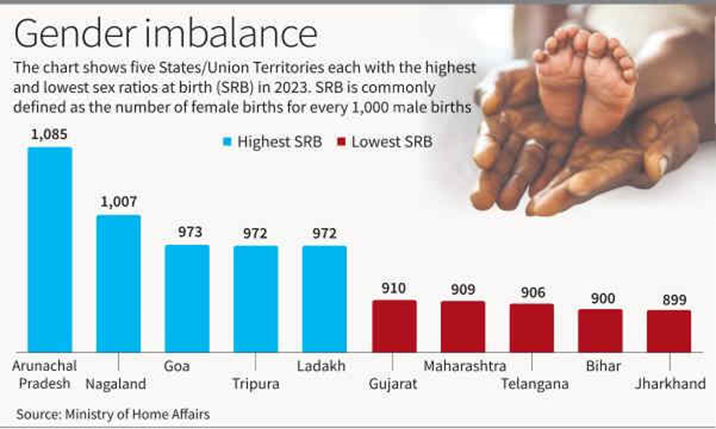
- The report also said that Jharkhand recorded the lowest sex ratio at birth at 899, followed by Bihar at 900, Telangana at 906, Maharashtra at 909, Gujarat at 910, Haryana at 911 and Mizoram at 911. Since 2020, Bihar has been recording the lowest sex ratio, which is defined as the number of females born per 1,000 males.
Sex ratio count
- The highest sex ratio was reported by Arunachal Pradesh at 1,085, followed by Nagaland at 1,007, Goa at 973, Ladakh and Tripura at 972, and Kerala at 967.
- The share of institutional births in total registered births is 74.7 % in 2023. However, the report did not include information from Sikkim. Overall registration of births for the year 2023 stood at 98.4%.
Statewise data
- The report said that 11 States/Union Territories achieved more than 90% registration of births within the prescribed time limit of 21 days.
- These States are Gujarat, Puducherry, Chandigarh, Dadra and Nagar Haveli and Daman & Diu, Tamil Nadu, Lakshadweep, Andaman and Nicobar Islands, Haryana, Himachal Pradesh, Goa and Punjab. Five States — Odisha, Mizoram, Maharashtra, Chhattisgarh and Andhra Pradesh — reported 80-90% registration, while in 14 States — Assam, Delhi, Madhya Pradesh, Tripura, Telangana, Kerala, Karnataka, Bihar, Rajasthan, Jammu & Kashmir, Jharkhand, West Bengal, Meghalaya and Uttar Pradesh — the registration stood at 50-80%.
- Hike in PF pension under consideration of Cabinet: Minister
Context: Union Labour Minister Mansukh Mandaviya told a meeting of the Central Board of Trustees (CBT) of the Employees Provident Fund Organisation (EPFO) here that the Cabinet was actively considering increasing the minimum PF pension.
- Though the issue was not on the agenda, trade union members in the CBT said during the discussions that the minimum PF pension should be revised from the present ₹1,000 a month. “The Minister did not rule it out and said the Cabinet is actively considering the proposal,” a CBT member after the meeting.
- The meeting also discussed the issue of delay in distributing higher pension as per the Supreme Court order. Some CBT members argued that the EPFO must withdraw the guidelines framed on the matter, and said that new guidelines should be implemented in tune with the top court order. “The response was not positive,” another member said.
- The Labour Ministry, in a release, said the meeting took a number of path-breaking decisions, including simplification and liberalisation of the EPF partial withdrawal provisions.
- “To enhance ease of living of EPF members, CBT decided to simplify the partial withdrawal provisions of EPF Scheme by merging 13 complex provisions into a single, streamlined rule categorised into three types namely, Essential Needs (illness, education, marriage), Housing Needs, and Special Circumstances. Now, members will be able to withdraw up to 100% of the eligible balance in the Provident Fund, including employee and employer share,” the Ministry said.
- Withdrawal limits have been liberalised — education withdrawals will be allowed up to 10 times and marriage up to five times (from existing limit of a total of three partial withdrawals for marriage and education in all). “Requirement of minimum service has been uniformly reduced to only 12 months for all partial withdrawals,” it added.
- Uttarakhand eases UCC rules for people from Nepal, Bhutan
- The Uttarakhand government on Monday approved a crucial amendment to the Uniform Civil Code (UCC), bringing relief to citizens of Nepali and Bhutanese origin who are living in the State and do not have an Aadhaar card as identity proof to register their marriage.
- Sources stated that the State has allowed people from Nepal, Bhutan and even Tibet to register their marriage using a certificate from the Foreign Registration Officer. The official added that the aim was to give respite to people of Nepal, Bhutan, and Tibet, who share historic and cultural ties with the State.
- Achieving Centre’s rooftop solar targets to remain a challenge: study
Context: Despite a near four-fold increase in applications between March 2024 and July 2025, only 13.1% of the targeted 1 crore solar rooftop installations, under the PM Surya Ghar Yojana (PMSGY), has been achieved, and just 14.1% of the allocated ₹65,700 crore in subsidies released till July 2025, a report said.
- “In this scenario, the FY2027 target [of 1 crore installations] continues to be viewed as a considerable challenge,” said the report on the performance of the scheme, jointly published by the Institute for Energy Economics and Financial Analysis (IEEFA) and JMK Research and Analytics.
- Reasons included tardy approval processes, which could stretch anywhere from 45 to 120 days, stemming largely from “meter shortages, lack of coordination between consumers, installers, and DISCOMs, and procedural inefficiencies at the utility level,” it noted.
- The PMSGY is a Centre-led endeavour to encourage more homes to install rooftop solar connections. The government provides capital upfront via loans.
- As of July 2025, the period until which the report tracked progress, the PMSGY had received 57.9 lakh applications for residential rooftop solar installations. The scheme has facilitated the installation of 4,946 MW of rooftop solar capacity till July 2025 across various States and Union Territories, indicating “robust on-ground execution”, the report said.
- Subsidy disbursements have crossed ₹9,281 crore ($1.05 billion), benefiting over 16 lakh households. As of July 2025, the 4.9 GW of installations added under the PMSGY accounted for approximately 44.5% of the country’s total residential rooftop capacity.
- The PM solar scheme only incentivises solar installations, whose component parts are entirely manufactured in India. Called “DCR-compliant modules”, they are on average costlier by ₹12/watt over imported variants. “These higher prices are making larger residential installations less economically attractive,” the report said.
- “Establishing clear, time-bound rooftop solar capacity targets at the State level is essential for creating a coherent vision,” said Vibhuti Garg, Director, IEEFA-South Asia, and a contributing author, in a statement.
- Mokyr, Aghion and Howitt win Nobel economics prize
Context: Winners are professors in U.S., French and British universities; prize worth $1.2 mn highlights work on innovation-driven economic growth.
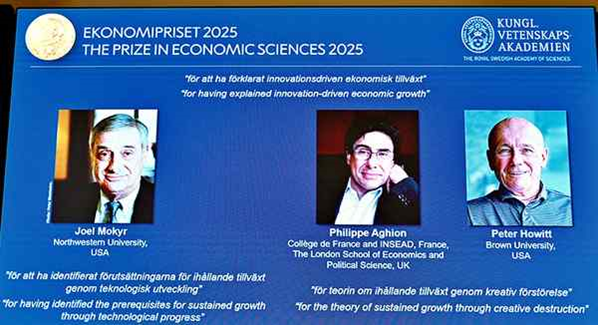
- Joel Mokyr, Philippe Aghion and Peter Howitt won the 2025 Nobel economics prize for “having explained innovation-driven economic growth”, the Royal Swedish Academy of Sciences.
- The prestigious award, formally known as the Sveriges Riksbank Prize in Economic Sciences in Memory of Alfred Nobel, is the final prize to be given out this year and is worth 11 million Swedish Kronor ($1.2 million).
- “The laureates have taught us that sustained growth cannot be taken for granted,” the prize-awarding body said in a statement. Economic stagnation, not growth, has been the norm for most of human history. Their work shows that we must be aware of, and counteract, threats to continued growth.”
- Mr. Mokyr is a professor at Northwestern University, in Evanston in the United States, while Mr. Aghion is professor at the College de France and INSEAD, in Paris, and at the London School of Economics and Political Science, in Britain. Mr. Howitt is a professor at Brown University, in Providence in the United States. Mr. Mokyr was awarded half the prize with the other half being shared between Aghion and Howitt.
- “Joel Mokyr used historical observations to identify the factors necessary for sustained growth based on technological innovations,” John Hassler, member of the Nobel Committee, said.
Creative destruction
- “Philippe Aghion and Peter Howitt produced a mathematical model of creative destruction, an endless process in which new and better products replace the old.”
- The awards for medicine, physics, chemistry, peace and literature were announced last week.
- Those prizes were established in the will of Swedish dynamite inventor and businessman Alfred Nobel and have been handed out since 1901, with a few interruptions mostly due to the world wars.
- The economics prize was established much later, being given out first in 1969 when it was won by Norway’s Ragnar Frisch and Jan Tinbergen from the Netherlands for work in dynamic economic modelling. Tinbergen’s brother Nikolaas also won a prize, taking home Medicine in 1973.
- While few economists are household names, relatively well-known winners include former U.S. Federal Reserve chairman Ben Bernanke, and Paul Krugman and Milton Friedman. Last year’s economics award went to U.S.-based academics Simon Johnson, James Robinson and Daron Acemoglu for research that explored the relationship between colonisation and the establishment of public institutions to explain why some countries have been mired in poverty for decades.
- Snow leopards are the world’s least genetically diverse big cat
Context: A new Stanford-based study explains the implications of this phenomenon for the future of the elusive feline; researchers used whole-genome sequencing data for 37 snow leopards and concluded that the low genetic diversity is likely due to a persistently small population size.
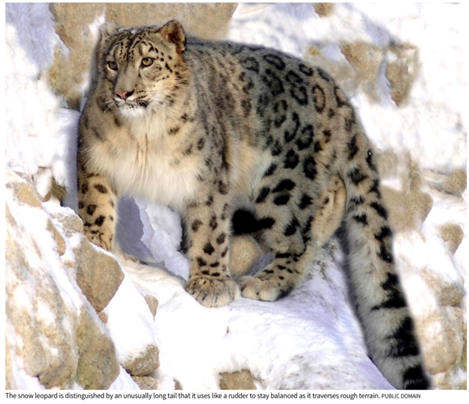
- The snow leopard, the agile “ghost of the mountains” that inhabits the rugged ranges of 12 Asian countries, including India, has the lowest genetic diversity of any big cat species in the world, even lower than that of the dwindling cheetah.
- A new study led by researchers at Stanford University, published in Proceedings of the National Academy of Sciences (PNAS) on October 7, explained the implications of this phenomenon.
- The researchers used whole-genome sequencing data for 37 snow leopards and concluded that the low genetic diversity is, however, “likely due to a persistently small population size throughout their evolutionary history rather than recent inbreeding.”
‘Purging’ of mutations
- This means that “mutations that could potentially cause health issues in snow leopards have been removed from the population over many generations,” lead author Katie Solari, a research scientist in biology at Stanford, told The Hindu.
- The PNAS paper added, “We found snow leopards to have the lowest heterozygosity of any big cat species, with heterozygosity for every snow leopard sample included in this study falling lower than that observed in any other big cat.” This included cheetahs, “which have long been considered the archetype of low heterozygosity in big cats.”
- The good news is that snow leopards, compared to several Panthera species, have a significantly lower highly deleterious homozygous load — genes inherited from the mother and father that have fewer instances of duplicated copies of potentially harmful mutations that are connected with health issues.
- This, the authors said, suggests effective “purging” of bad mutations during their evolutionary history at small population sizes.
- “If a negative trait surfaced, those individuals died before reproducing, or their progeny were less successful. This purging, facilitated by historic inbreeding, allowed the snow leopard population to remain relatively healthy even at their small numbers,” an article in the Stanford Report read.
- In fact, “the inbreeding coefficient of snow leopards is significantly higher than other big cats and was even significantly lower than the Asian leopard and puma, indicating that the lower genetic diversity observed in snow leopards is not explained by higher inbreeding,” per the research paper.
- The very low genetic diversity and small population sizes mean they may not be able to adapt well to future anthropogenic challenges.
Critical to Asia’s mountains
- The wild feline indeed faces a long list of threats today: climate change, habitat loss, decreased availability of primary prey (mountain ungulates such as the Siberian ibex), retaliatory killings for livestock predation, and poaching for their skin. All this while climate change in Asia’s high mountains threatens their future. Despite this, snow leopards, which were first listed as ‘endangered,’ were controversially downlisted to ‘vulnerable’ in 2017, as they did not meet certain criteria for population size.
- There are no more than 4,500 to 7,500 individuals, each critical to the Asian mountain ecosystem “that offers immense ecosystem services — acting as an important source of carbon storage and providing water to almost two billion people.”
- Hearteningly, however, the international community has worked for decades to establish a sustainable zoo population: in 2008, there were 445 snow leopards across 205 institutions globally, the paper read.
- The snow leopard, distinguished by an unusually long tail, which acts as a rudder to help it keep its balance as it traverses its rough terrain, happens to be the least genetically studied of all big cat species. There is, however, evidence of continuous habitat connectivity across at least 75 km in Pakistan and around 1,000 km in Mongolia, and the animal is known to cross long distances between mountain ranges, according to the study.
‘Very poorly studied’
- As for India, a pioneering survey last year estimated that 718 snow leopards exist in the wild: 477 in Ladakh, 124 in Uttarakhand, 51 in Himachal Pradesh, 36 in Arunachal Pradesh, 21 in Sikkim, and nine in Jammu and Kashmir. The Indian snow leopard accounts for 10-15 percent of the global population.
- “Of the 12 countries with wild snow leopards, India has the highest numbers after China and Mongolia. That makes India one of the most important countries for the conservation of this species,” Kulbhushansingh Suryawanshi, with the India programme of the Snow Leopard Trust at the Nature Conservation Foundation (NCF), Mysore.
- He added that the genetic diversity of leopards in India “is very poorly studied … We need to sample across the high mountains to understand the genetic diversity of snow leopards in India.”
- “India’s Project Snow Leopard, dedicated to the conservation of snow leopards, and NGOs such as the NCF, have been working on snow leopard conservation for 27 years. Local community members from snow leopard habitats such as Ladakh, Jammu and Kashmir, Himachal Pradesh, Uttarakhand, Sikkim, and Arunachal are key partners in the conservation of snow leopards,” said Dr. Suryawanshi.
- But the snow leopard in India is threatened by land use change and climate change, he said.
- “Almost the entire snow leopard habitat in India is within 50-100 km of the international border. Large-scale infrastructure is changing the face of this region. Climate change-induced warming and floods are impacting the wildlife of this landscape, including the snow leopards, to a large extent.”
Maintaining integrity
- Dr. Suryawanshi, who is a co-author of the paper, said the main challenge of studying snow leopards is in “getting the samples.” Bureaucratic hurdles in getting permissions to study snow leopards generally slow down research, he said.
- “In addition, the timelines of funding and permissions often do not match. The Stanford study collaborated with researchers around the world, and only then were they able to put together enough samples to make an assessment of the genetic diversity of snow leopards. We need to collect a similar number of samples from within India to understand the genetic diversity of snow leopards in the country.”
- On the future fate of snow leopards of the fragile high-elevation landscape of the Himalayas, “we need to treat these landscapes and the people that live here with respect,” said Dr. Suryawanshi. “The effects of rampant large infrastructure projects are clearly visible in the scale of destruction in the recurrent floods that occur every monsoon.”
- Maintaining the integrity of the snow leopard’s habitat is crucial for the long-term conservation of this charismatic species of the Himalaya, Dr. Suryawanshi added.
- Arctic seals, birds in new ‘red list’of endangered species: IUCN
Context: Arctic seals and birds are coming under increasing threat, mainly due to climate change and human activity, according to an updated list of endangered species released by the world’s top conservation body.
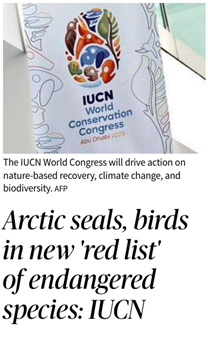
- The International Union for Conservation of Nature (IUCN) said habitat loss driven by logging and agricultural expansion is a threat to birds. At the same time, seals were at risk mostly due to global warming and human activities, including maritime traffic.
- The IUCN said it was changing the status of the hooded seal from vulnerable to endangered while bearded and harp seals are now classified as near threatened.
- “This timely global update highlights the ever increasing impact human activity is having on nature and the climate and the devastating effects this has,” its director general Grethel Aguilar told reporters at its World Conservation Congress in Abu Dhabi.
- The IUCN red list now includes “172,620 species of which 48,646 are threatened with extinction,” it said in a statement.
- Global warming is destroying the natural habitat of animals including seals that live in the cold parts of the world. Maritime traffic, mining and oil extraction, industrial fishing and hunting are among other risks to the species.
- “Global warming is occurring four times faster in the Arctic than in other regions, which is drastically reducing the extent and duration of sea ice cover,” the IUCN said.
- “Ice-dependent seals are a key food source for other animals,” it added.
- They “play a central role in the food web, consuming fish and invertebrates and recycling nutrients” and are one of the “keystone species” of their ecosystem.
- Kit Kovacs, a scientist at the Norwegian Polar Institute, raised the alarm about the Svalbard archipelago, halfway between Norway and the North Pole.
- “When I lived on the archipelago, just a couple of decades ago, we had five months of sea ice cover in areas that are now winter ice-free. It is really hard to express just how rapidly the Arctic is changing,” she said.
- The IUCN said its red list of birds is the fruit of nine years of work by “thousands of experts”.
- “Overall, 61% of bird species have declining populations — an estimate that has increased from 44 percent in 2016,” the IUCN said.
- It studied thousands of bird species worldwide and found that “1,256 (or 11.5%) of the 11,185 species assessed are globally threatened”.
- This year’s update focused on regions where the destruction of tropical forest poses a growing threat to birds. In Madagascar, 14 species were newly classified as near threatened and three others were labelled vulnerable. In West Africa, five more bird species were found to be near threatened in addition to one more in Central America.
- The report also mentioned a positive development. The green turtle is no longer endangered, it said, citing “decades of sustained conservation action” that saw its population recover by 28% since the 1970s.
- Nicolas Pilcher, the Executive Director of the Marine Research Foundation, said this success should spur action not complacency.
- “Just because we have reached this great step in conservation isn’t a reason to sit back and then become complacent,” he said.