- Menstrual leave: Challenges of implementation
Context: The decision to grant one menstrual leave per month has raised concerns about its implementation with many questioning how will workflow be maintained without disruptions.
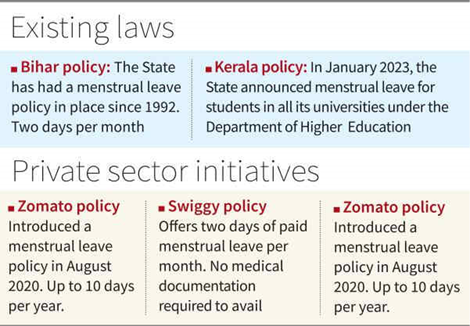
- A union leader pointed out that while many employers argue that menstrual leave will discourage hiring women, similar arguments were raised globally against maternity leave at one point in time.
- A day after the Karnataka Cabinet’s landmark decision to approve the Karnataka Menstrual Leave Policy-2025 that will ensure one day’s paid leave in a month across government and private sectors, many women workers welcomed the move.
- With this decision, Karnataka becomes the first State to cover both the government and private sectors in its menstrual leave policy. Odisha and Bihar have a policy for government employees while Kerala has implemented the policy in universities.
- Gargi M., who works with a semiconductor firm in the city, said that while their work may not involve physical labour, women still need rest during menstruation. She added that the option of working from home does not necessarily help in such situations, and therefore, the policy approval is welcome.
- Meanwhile, union leaders from multiple unorganised sectors stressed the need for inclusion of menstrual leave policy in unorganised sector too, under the provision through Labour Welfare Boards or similar mechanisms.
Menstrual leave: Challenges of implementation
- Umesh A.H., Deputy Labour Commissioner, (Region-1), said that main challenge is workforce adjustments and understanding who will handle the work of those on leave, especially since manpower remains limited in both government and private sectors.
- “Convincing private firms to implement a paid menstrual leave is also a challenge as most companies operate on a five-day work week. However, as society, we can overcome these challenges and will consider these aspects carefully while notifying the policy,” he said.
- India’s Kabul mission to be upgraded to embassy
Context: Jaishankar makes announcement during meeting with Taliban Foreign Minister, raises concerns over forced repatriation of Afghan refugees by Pak., calls ‘cross-border terror’ a common challenge.
- India will upgrade its ‘technical mission’ in Kabul to the status of an embassy, External Affairs Minister S. Jaishankar said.
- The announcement came during Mr. Jaishankar’s meeting with Amir Khan Muttaqi, Foreign Minister of the Taliban administration in Afghanistan, at Hyderabad House. Mr. Jaishankar also raised India’s concerns over the forced repatriation of Afghan refugees by Pakistan and described “cross-border terrorism” as a common challenge to both India and Afghanistan.
- “India is fully committed to the sovereignty, territorial integrity and independence of Afghanistan. Closer cooperation between us contributes to your national development, as well as regional stability and resilience. To enhance that, I am pleased to announce today the upgrading of India’s technical mission in Kabul to the status of Embassy of India,” said Mr. Jaishankar.
- India had shut its embassy in Kabul in 2021 after the U.S.-led forces withdrew from Afghanistan.
- In an interaction at the Embassy of Afghanistan, Mr. Muttaqi welcomed the decision and said, “We will send our diplomats to the Embassy of Afghanistan.” He clarified that the Taliban may not send an ambassador at the beginning.
- Mr. Jaishankar noted that India and Afghanistan share a “common commitment towards growth and prosperity” but cautioned that “these are endangered by the shared threat of cross-border terrorism that both our nations face.” He did not name Pakistan but urged Mr. Muttaqi to “coordinate efforts” to counter the threat.
- The meeting took place hours after an explosion in Kabul reportedly killed Tehreek-e-Taliban Pakistan (TTP) leader Mufti Noor Wali Mehsud, a claim later denied by TTP sources.
- Mr. Jaishankar thanked Kabul for condemning the terror attack in Pahalgam on April 22, saying, “We appreciate your sensitivity towards India’s security concerns.” He also reiterated India’s commitment to facilitating travel for Afghan nationals through a new visa module introduced in April, with more medical, business, and student visas being issued. A joint statement issued after the meeting said that scholarships from the Indian Council for Cultural Relations (ICCR) and other organisations are “under active consideration” to enable more Afghan students to study in India.
- The joint statement welcomed starting of the India-Afghanistan Air Freight Corridor, which is expected to “streamline connectivity and boost bilateral trade”.
- It further said that both sides “agreed to cooperate on hydroelectric projects with a view to addressing Afghanistan’s energy needs and support its agricultural development.”
- Mr. Jaishankar also announced six new health projects for Afghanistan, with details to be shared soon. India will gift 20 ambulances to Afghanistan as a “symbolic step” and provide MRI and CT scan machines to hospitals. He further confirmed that India will continue supplying vaccines, cancer medicines, and relief material to earthquake-affected areas in eastern Afghanistan, adding, “We would like to contribute to the reconstruction of residences in the affected areas.”
- Ceasefire takes effect as Israel forces pull back to agreed area
Context: A ceasefire between Israel and Hamas came into effect in Gaza on Friday, the Israeli military said, hours after Israel’s Cabinet approved a deal to pause the fighting and exchange the remaining hostages for Palestinian prisoners.
- Israeli forces have withdrawn to agreed deployment lines for the first stage of the ceasefire, it added.
- Tens of thousands of people who had gathered in Wadi Gaza in central Gaza started walking north after the military’s announcement at noon. Beforehand, Palestinians reported heavy shelling in parts of Gaza throughout Friday morning, but no significant bombardment was reported after.
- Israeli Prime Minister Benjamin Netanyahu insisted in a televised statement on Friday that the next stages would see Hamas disarmed and Gaza demilitarised.
- “If this is achieved the easy way — so be it. If not — it will be achieved the hard way,” he said.
- Under the deal, all 48 hostages are expected to be released. In exchange, Israel will release around 2,000 Palestinian prisoners.
- The ceasefire marks a key step toward ending a ruinous two-year war that has killed tens of thousands of Palestinians, reduced much of Gaza to rubble, destabilised West Asia, and left dozens of hostages, living and dead, in the territory.
- Israeli Brig. General Effie Defrin, a military spokesman, said that troops had completed their withdrawal to the deployment lines by Friday afternoon, a few hours after the ceasefire officially went into effect.
- Earlier, an Israeli security official, speaking on condition of anonymity, said the military would control around 50% of Gaza in their new positions.
- In Israel’s offensive, more than 67,000 Palestinians have been killed in Gaza and nearly 1,70,000 wounded, according to Gaza’s Health Ministry. The hostage and prisoner releases are expected to begin on Monday, two Egyptian officials briefed on the talks and a Hamas official said, though another official said they could occur as early as Sunday night.
- All living hostages are expected to be released at the same time, followed by the bodies of the deceased, which could take more time.
- Five border crossings are expected to reopen, including the Rafah crossing between Gaza and Egypt, the Egyptian and Hamas officials said. That will allow aid to flow into the territory, parts of which are experiencing famine.
- Private hospitals threaten to halt paediatric surgeries under RBSK
Context: Demanding immediate reimbursement of over ₹23 crore dues pending since 2017 for paediatric surgeries done under Rashtriya Bal Swasthya Karyakram (RBSK), small and medium private hospitals in Karnataka have threatened to suspend their participation in the State’s health schemes.
- The hospitals, which said they are left with no option but to take legal recourse, said if the dues are not cleared at the earliest, they will halt paediatric surgeries under the State’s Ayushman Bharat Arogya Karnataka (AB-ArK) health scheme. The dispute dates back to 2016, when the State government introduced additional procedure codes under RBSK, a centrally-funded health scheme under the National Health Mission (NHM), without prior approval from the Centre.
- Private hospital authorities claimed that they acted in good faith on the published codes and provided critical services to ailing children between 2016 and 2018. However, audits later flagged that these codes lacked central clearance, leaving the claims stuck.
Technical glitch
- Officials attribute the delay to a technical glitch in the listing of procedures on the portal of Suvarna Arogya Suraksha Trust (SAST), the nodal agency implementing the State’s health schemes. The issue is now before the government.
- RBSK was launched in 2013-2014 to improve survival, growth and development of children in the 0-18 years group.
- Focusing on the screening of infants, children and young adults for 4 D’s — Defects at birth, Deficiencies, Diseases, Developmental delays and Disabilities — the scheme initially covered a total of 40 medical procedures which subsequently increased to 104.
- The scheme ensured children diagnosed with illness received follow-up care including early intervention services at the district level and including surgeries at tertiary level, free of cost under NHM. Services not available in government hospitals are made available in private empanelled hospitals.
- Mr. Gupta added that the matter is under review and will be placed before the State Cabinet. He clarified that if the Centre has not approved the additional procedures, the State government will have to bear the expenditure.
- SC gives Centre four weeks to respondto pleas for restoration of J&K Statehood
Context: Urging the Supreme Court to weigh the constitutional implications for India’s federal structure, petitioners on Friday pressed the Union Government to honour its “solemn promise” of restoring Jammu and Kashmir’s Statehood.
- A Bench of Chief Justice of India B.R. Gavai and Justice K. Vinod Chandran asked Solicitor-General Tushar Mehta, appearing for the Union Government, to respond to the submissions within four weeks, even as it acknowledged that “various considerations” had to be factored in while making such a decision, including the April 22 Pahalgam terror attack.
- The Bench was hearing an application seeking the restoration of Statehood within a specified time frame, preferably two months. The petitioners, an academic and a social activist, contended that the continued Union Territory status “violates the idea of federalism”, an essential feature of the Constitution’s basic structure. They further pointed out that the smooth conduct of both the Assembly and Lok Sabha elections showed there were no longer any security concerns hindering the restoration of Statehood.
Institutional promise
- Senior advocate Menaka Guruswamy, appearing for MLA Irfan Hafiz Lone, argued that the assurance of restoring Statehood was not a mere political declaration but an “institutional promise” made by the Centre before a constitutional court. She urged the court to consider the “larger question” of what it would signify for Indian federalism if a State could be reduced to a Union Territory “in this fashion”.
- Senior advocate Gopal Sankaranarayanan, appearing for petitioners Zahoor Ahmad Bhat and Khurshaid Ahmad Malik, read from the Supreme Court’s December 2023 judgment on the abrogation of Article 370 to emphasise that the court had refrained from deciding the Statehood issue only because the Solicitor-General had assured it would be restored after elections.
- Sea phase of KONKAN 25 ends with high operational tempo
- The sea phase of the bilateral maritime exercise KONKAN 25 between the Indian Navy and U.K.’s Royal Navy concluded following a series of high-tempo naval operations designed to enhance interoperability, operational readiness, and maritime cooperation between the participating navies.
- Indian Navy informed that during the sea phase, the forces undertook a wide spectrum of complex maritime drills encompassing tactical air warfare, air defence, surface and anti-submarine operations, and underway replenishment. The sea phase ended with a ceremonial steampast, where participating units exchanged traditional naval courtesies.
- Hydropower project on Chenab gets clearance
Context: The Sawalkote project was first accorded an environmental clearance in 2017; the suspension of the Indus Waters Treaty with Pakistan added momentum to the approval process, says official
- An apex committee of the Environment Ministry has accorded a fresh environmental clearance to the Sawalkote hydroelectric project, proposed to come up on Chenab river in Ramban, Jammu and Kashmir.
- Planned as a run-of-the-river project utilising the flow of the Chenab to generate electricity, it is reportedly the first major hydropower project on the Indus rivers to be accorded environmental clearance following India’s suspension of the Indus Waters Treaty (IWT) on April 23, following the Pahalgam terror attack.
- “The Expert Appraisal Committee (EAC), after examining the information submitted and detailed deliberations, reiterated its earlier recommendation on the project and recommended the proposal for grant of prior Environmental Clearance to Sawalkote H.E. Project,” said the minutes of a meeting conducted on September 26.
- The project was first accorded an environmental clearance by a designated committee in 2017, when it was originally being steered by the Jammu and Kashmir Power Development Corporation (JKPDC). However, the JKPDC signed a deal with the National Hydro Power Corporation (NHPC) Ltd. in 2021 to build and commission the project and be effectively in charge of it until 2061.
- Despite the designated committee’s nod, the Environment Ministry could not clear the project as the JKPDC could not procure a forest clearance – which follows a parallel approval process. In September 2023, the project was first accorded a ‘stage 1 forest clearance’ as per publicly available records.
- While the process of transferring the project to the NHPC has been on since 2021, a slew of approvals from the Central Electricity Authority and the Central Water Commission were accorded in July 2025. Public hearings, required to be done under the provisions of the Forest Rights Act, were done between December 2022 to February 2023.
- “The Sawalkote project was already going through various stages of approval. Given its size — though it does not have a storage dam — it will be the largest project of its kind and has always had certain strategic importance. The suspension of the IWT and the plan to utilise the full potential of the eastern Indus rivers have added momentum to the approval process,” a senior official, aware of the approval process of hydroelectric projects, but declined to be identified.
- Centre issues guidelines for retiring govt. employees; welfare officer to assist them
Context: The Department of Pensions and Pensioners’ Welfare (DPPW) under the Centre said that it has finalised guidelines for timely payment of retirement dues of Union government officials, which entail appointment of a welfare officer, or pension mitra, for each employee.
- The officer would be deputed by the head of office and assigned to each retiring employee to facilitate filling up of forms and other formalities. The officer shall also be responsible for hand-holding the dependents for documentation and verification in the event of death of the pensioner while submitting the claim for family pension.
- The guidelines have been issued for effective inter-ministerial coordination for timely payment of retirement dues (pension and pensionary dues) and issue of Pension Payment Orders (PPOs)/e-PPOs of Central Civil Services (CCS) employees.
- “Major procedural reforms such as clarification on vigilance clearance before the retirement has been included for reducing the delay in issuance of PPOs/ePPOs. It has been clarified that no pension can be delayed for the want of vigilance clearance as per the specific provisions under CCS(Pension) Rules, 2021. It has been underlined that each ministry/department should ensure that vigilance clearance in respect of their retiring employees is issued three months prior to retirement since the validity of the clearance is of three months as per extant norms,” the Department stated.
- 6 State-level RTI panels are defunct; appeals can take years to be heard: report
Context: As the 20th anniversary of the Right to Information Act, 2005 approaches, many State Information Commissions (SICs) and the Central Information Commission (CIC) are either paralysed or so understaffed that hearings could take years to happen, according to a report by a citizens’ group working to promote transparency in government functioning.
- The SICs and the CIC hear appeals and complaints when citizens are dissatisfied with the result of an RTI application. There were over 2.4 lakh appeals in 2024.
- The latest edition of the Satark Nagrik Sangathan (SNS)’s annual assessment shows that six SICs — Jharkhand, Himachal Pradesh, Telangana, Goa, Tripura and Madhya Pradesh — were defunct for varying periods of time between July 1, 2024 to October 7, 2025 as no new Commissioners were appointed upon the incumbents demitting office.”
- The SICs of Karnataka, Maharashtra, Madhya Pradesh, Tamil Nadu and Bihar are functioning without a full strength of Commissioners.
- Meanwhile, the Central Information Commission, which hears appeals against RTI responses to Union government organisations, is functioning with only two Information Commissioners, with nine vacancies, including for the Chief Information Commissioner, and hearings can take over a year to come up.
- The backlog is mounting, with Commissions only able to dispose of 1.8 lakh cases in a year with 2.4 lakh appeals. In some States, the current speed of hearings taking place is far slower: the SNS’s report “shows that the Telangana SIC would take an estimated 29 years and two months — a matter filed on July 1, 2025 would be disposed [of] in the year 2054.”
- Over 4 lakh appeals and complaints were pending as of June, with Maharashtra (95,340), Karnataka (47,825) and Tamil Nadu (41,059) with the largest outstanding backlog.
- Govt. notifies land acquisition to raise Almatti dam height
Context: A total of 1,33,867 acres will be acquired for increasing the height of the dam from 519.60 metres to 524.25 metres.
- The State government has issued a notification for the acquisition of lands for implementing the much-delayed Upper Krishna Project (UKP) Phase III, and the land acquisition process is expected to begin soon.
- A total of 1,33,867 acres would be acquired for increasing the height of the Almatti dam from 519.60 metres to 524.25 metres. Land would be acquired for submergence of land by raising the height of the dam as well for canal projects.
Annual spend
- An estimated ₹75,000 crore would be spent for implementing the project, including land acquisition, reconstruction and rehabilitation, in the next four years.
- Annually, ₹18,000 crore would be provided to the Water Resources Department, it said. The notification said 75,563 acres would be acquired for submerging the land for raising the height of the dam, 6,467 acres for rehabilitation of 20 villages and portion of the Bagalkot town and 51,837 acres for canals.
- When completed, the UKP Phase-III would irrigate 5.94 lakh hectares of land in North Karnataka districts of Vijayapura, Bagalkot, Raichur, Kalaburagi, Yadgir, Koppal and Gadag.
Cabinet clearance
- The special Cabinet meeting held on September 16, 2025, gave clearance for the acquisition of land in one go through “consent award or direct purchase” from farmers.
- The compensation amount, totalling approximately ₹70,000 crore, would be paid over three financial years starting from the current year.
- Farmers whose lands would be submerged due to the increase in dam height would receive ₹40 lakh and ₹30 lakh per acre of wet and dry land, respectively. Farmers whose lands would have to be acquired for building canals would receive ₹30 lakh and ₹25 lakh per acre of wet and dry land, respectively.
- The entire land acquisition process will be taken up through consent or direct purchase to expedite the process, while legal measures would be taken to move the cases related to land acquisition that are pending before various courts to a mediation process.
- Microfinance loan defaults surged in 2024-25: Sa-Dhan data
Context: Bihar performed the worst, not only accounting for the highest amounts of loans outstanding, but also the highest rates of default on these loans.
- The rate of delinquencies of microfinance loans rose sharply in 2024-25, according to the latest report by microfinance self-regulatory body Sa-Dhan. The percentage of microfinance loans overdue by more than 30 days increased to 6.2% from 2.1% in 2023-24.
- Similarly, the share of loans more than 90 days overdue increased to 4.8% by the end of March 2025 compared with 1.6% in the previous year.
- “Delinquency levels have risen across the industry,” the 2025 edition of the annual Bharat Microfinance Report by Sa-Dhan said. “The Portfolio at Risk (PAR) 30+ days past due (dpd) surged to 6.2%, up significantly from 2.1% in the last financial year.”
- “State-wise data further corroborate this upward trend in delinquency across the industry,” the report added.
- According to the data, Bihar had ₹57,712 crore worth of microfinance loans outstanding as of March-end 2025.
- Of these, 7.2% were more than 30 days overdue compared with the national average of 6.2%. About 4.6% of the loans were overdue by more than 90 days, the conventional benchmark used to categorise a loan as a non-performing asset.
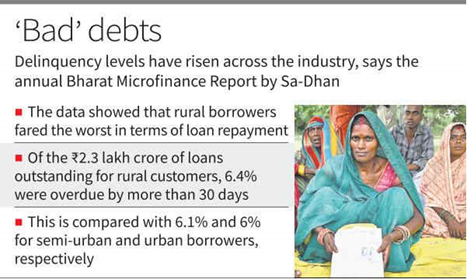
- The data also showed that rural borrowers fared the worst in terms of loan repayment.
- Of the ₹2.3 lakh crore of loans outstanding for rural customers, 6.4% were overdue by more than 30 days, compared with 6.1% and 6% for semi-urban and urban borrowers, respectively.
- India may open retail power to private firms
Context: India plans to open up its retail electricity market for private companies nationwide, ending the dominance of State-run distributors in most States, a draft bill by the federal power ministry showed.
- The move will allow private companies such as Adani Enterprises, Tata Power, Torrent Power and CESC to strengthen their presence across India. A similar attempt in 2022 faced opposition from State distribution companies (discoms).
- Only a handful of India’s electricity distribution zones — including the national capital region, Odisha and industrial States like Maharashtra and Gujarat — are currently privatised as the rules do not specifically provide for it. Most are under State control and are burdened with deep financial losses.
- New Delhi has been pushing State-run power utilities to cut losses, clean up balance sheets and upgrade age-old infrastructure. Earlier this year, the country’s most populous State Uttar Pradesh invited bids to privatise two of its four power distribution companies. As of June, State discoms owed power generators about $6.78 billion.
- Venezuela’s María Machado wins Nobel Peace Prize
Context: Venezuelan Opposition leader María Corina Machado won the Nobel Peace Prize on Friday for her struggle to achieve a democratic transition in the South American nation, winning recognition as a woman “who keeps the flame of democracy burning amid a growing darkness”.
- The former Opposition presidential candidate is a “key, unifying figure” in the once deeply divided Opposition to President Nicolas Maduro’s government, said Jørgen Watne Frydnes, chair of the Norwegian Nobel committee.
- Reacting to the honour, Ms. Machado said she was confident the Opposition would succeed in securing a peaceful transition to democracy in her country.
- “We’re not there yet. We’re working very hard to achieve it, but I’m sure that we will prevail,” she told Kristian Berg Harpviken, the director of the Nobel Institute and secretary of the Nobel Committee.
Dedicates win to Trump
- “I dedicate this prize to the suffering people of Venezuela and to President Trump for his decisive support of our cause!” she later wrote on X.
- Mr. Maduro’s government has routinely targeted its real or perceived opponents.
- Ms. Machado, who turned 58 this week, was set to run against Mr. Maduro in last year’s presidential election, but the government disqualified her.
- The crackdown on dissent only increased after the country’s National Electoral Council, which is stacked with Maduro loyalists, declared him the winner despite credible evidence to the contrary. The election results announced by the Electoral Council sparked protests to which the government responded with force that ended with more than 20 people dead.
- Ms. Machado becomes the 20th woman to win the Nobel Peace Prize.