KAS Current Affairs
Preliminary Examination
Paper-I: Current Events of National and International Importance
LPG Issue and the Strait of Hormuz
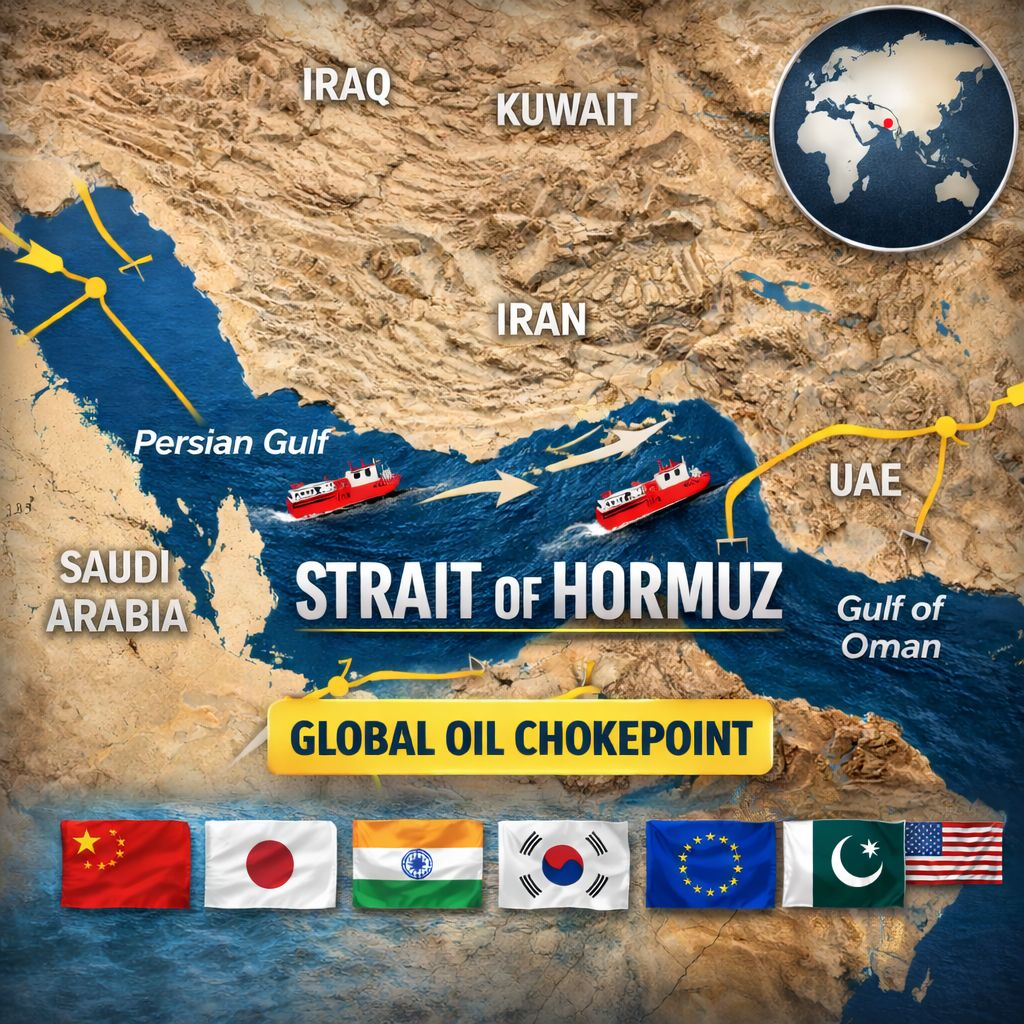
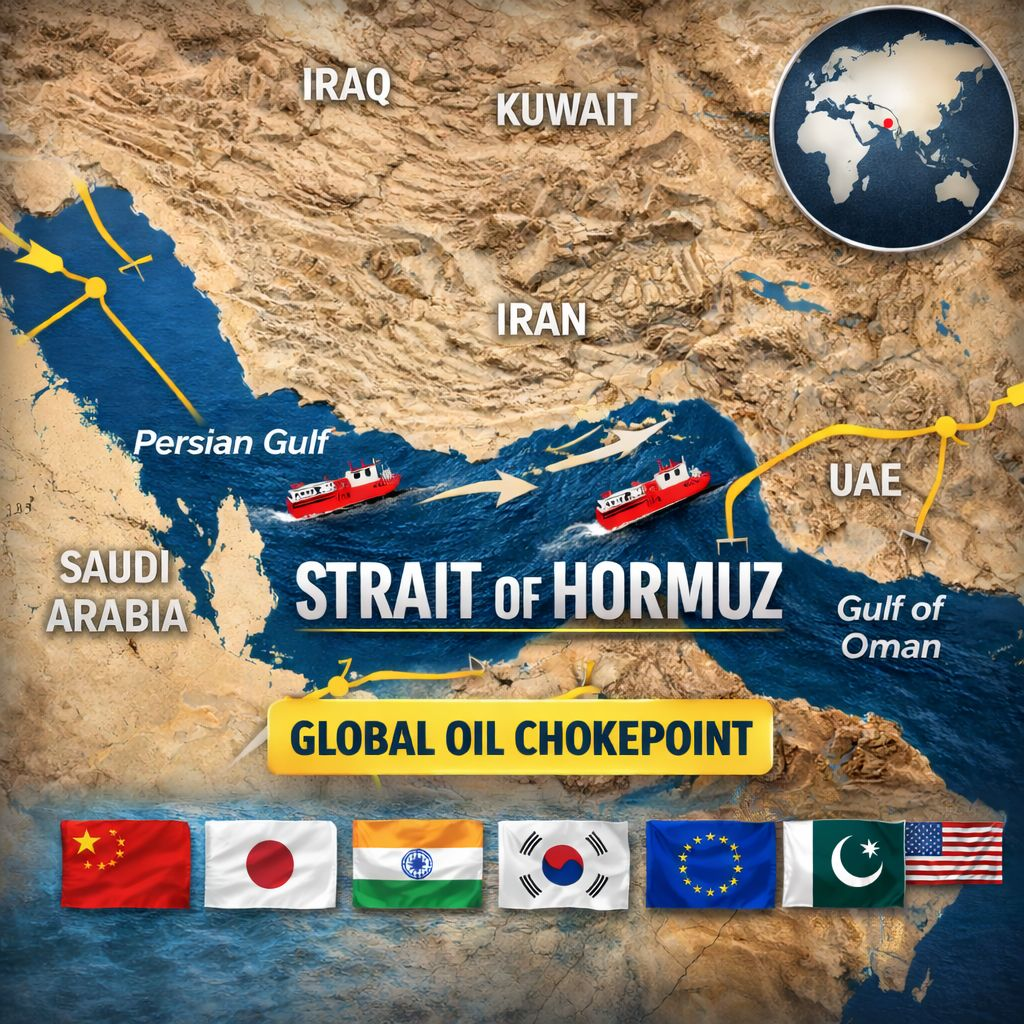
- The Strait of Hormuz is one of the world’s most critical maritime chokepoints, located between Iran and Oman. It serves as the passageway for nearly 20% of global crude oil exports and a significant share of Liquefied Petroleum Gas (LPG) shipments. Many Asian countries—including India, China, Japan, and South Korea—depend heavily on this route for their energy needs.
- If the Strait were to be closed due to geopolitical tensions, LPG supplies would be severely disrupted. This would lead to higher cooking gas prices, increased fertilizer costs (since LPG and natural gas are feedstock for fertilizers), and consequently rising food prices. Beyond energy, the closure would affect shipping costs, insurance premiums, and global supply chains, disproportionately impacting vulnerable populations.
Impact Analysis: LPG Supply Chain & the Strait of Hormuz
| Aspect | Details | Strategic Impact |
| Geography | Located between Iran and Oman | Key global energy transit corridor |
| Global Importance | ~20% of global crude oil & massive LPG volumes | Critical for global energy security |
| Dependent Nations | India, China, Japan, South Korea, etc. | High vulnerability to supply chain shocks |
| Closure Impact (LPG) | Direct supply disruption | Immediate surge in domestic LPG/cooking gas prices |
| Agricultural Link | Dependence on LPG-derived feedstocks | Escalation in fertilizer costs & food inflation |
| Trade & Transport | Shipping fuel & insurance premiums | Increased freight rates & trade logistics costs |
| Social Impact | Burden on vulnerable populations | Reduced purchasing power & social unrest |
| Long-term Effect | Global supply chain instability | Persistent economic uncertainty |
Paper-II: Current Events of State Importance and Important Government Schemes and Programs
Main Examination
Paper-I: Essays
Essay – 1: Topic of International/National Importance
“The relationship between science and war: Many inventions, from penicillin to the internet and from nuclear energy to space satellites, are the ‘children of war’. Is it possible to proactively utilize the effort and money spent on war for human welfare instead? Present your opinions.”
Essay-2: Topic of State importance/Local Importance
“The Ballot Paper Revival: Balancing Electoral Credibility with Technological Progress in Indian Local Governance”
Paper-II: General Studies 1
Panel estimates Lakkundi treasureto be at least 500 years old
Context: Treasure found in Lakkundi of Gadag district which comprised mainly gold ornaments is estimated to be at least 500-600 years old.
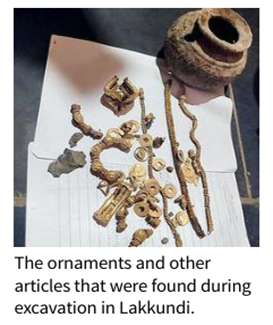
- Members of the Treasure Evaluation Committee led by archaeologist M.S. Krishna Murthy verified and evaluated the gold ornaments in Gadag, before coming out with their assessment on the age of the ornaments.
- “After verification of the size and design of the 466 gm of gold ornaments found in Lakkundi, it is estimated that they may be of the age of Vijayanagar empire. The common public did not use ornaments having faces of lion and keertimukh (face of glory). They appear to be ornaments made for offering to a female deity,” Mr. Krishna Murthy.
- “In the golden ornaments we have found pearls, emerald and blue sapphire,”. “According to the rate of gold, the value of the ornaments will be ₹80 lakh. However, since they are ancient, the value will be 10 times more,”.
‘IT exports from State set to cross ₹5.5 lakh
Context: Karnataka’s IT exports are expected to cross ₹5.50 lakh crore in 2025–26, IT and BT Minister to the Legislative Assembly.
- Bengaluru Urban tops the list with a contribution of 39.9% to GSDP; Kalaburagi, Bengaluru Rural contribute 1.9% each. Karnataka’s IT exports are expected to cross ₹5.50 lakh crore in 2025–26, IT and BT Minister.
- State’s IT/BT exports were ₹3.55 lakh crore in 2022–23, ₹4.09 lakh crore in 2023–24, and ₹4.58 lakh crore in 2024–25.
- Of the projected ₹5.5 lakh crore exports, Mysuru contributes around ₹3,000 crore, while Mangaluru and Udupi together contribute around ₹3,500 crore.
- By contributing 5.4% to the State Gross Domestic Product (GSDP), Dakshina Kannada district ranks second in the State and has the potential to add another 2% to the GSDP.
- Bengaluru Urban district topped the list with a contribution of 39.9% to the GSDP. Kalaburagi and Bengaluru Rural districts contribute 1.9% each to the GSDP.
Paper-III: General Studies 2
SC upholds ‘right to die’ for man in vegetative state
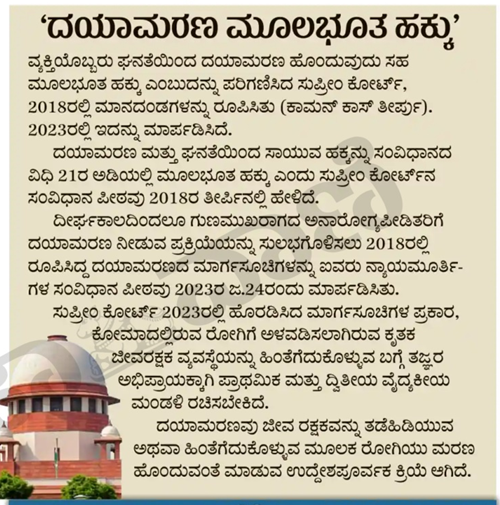
Context: The Supreme Court upheld the right to die with dignity of 32-year-old Harish Rana, who has been in a persistent vegetative state for nearly 13 years, by allowing the withdrawal of clinically assisted nutrition and hydration (CANH).
- A Bench of Justices J.B. Pardiwala and K.V. Viswanathan delivered the judgment in a packed courtroom where emotions bubbled to the surface, even reaching up to the judges’ raised podium where stoicism usually ruled.
- Mr. Rana had sustained severe head injuries and 100% quadriplegic disability after sustaining a fall from the fourth floor of his accommodation as a Panjab University student in in 2013.
- “To Harish’s family, we want to acknowledge the deep emotional weight this decision carries. This decision can feel like an act of surrender, but we believe it is, in truth, an act of profound compassion and courage. You are not giving up on your son. You are allowing him to leave with dignity. It reflects the depth of your selfless love and devotion towards him,” Justice Pardiwala read from his 286-page opinion.
- This was the first time the Supreme Court had implemented its own 2018 Constitution Bench guidelines for what it had then called ‘passive euthanasia’.
- The top court also acknowledged the general consensus that ‘passive euthanasia’ was an obsolete and rather confusing term. “‘Euthanasia’ will refer strictly to active euthanasia, which remains impermissible. ‘Withdrawing or Withholding of Medical Treatment’ will replace the term ‘passive euthanasia’,” Justice Pardiwala said.
- Justice Viswanathan joined his lead colleague on the Bench in a separate and concurrent opinion that the family had left no stone unturned to care for their son and brother. “It is only when the matter reached a point of no return, that to relieve Harish from what he is undergoing, they have resorted to this legal course of action. One can only imagine the agony they would have undergone during this period,” Justice Viswanathan said.
- The court directed AIIMS Delhi to shift Mr. Rana from his residence to their palliative care centre. The process of withdrawal of CANH must be part of a well-structured, tailored, robust and articulated palliative care plan for a PVS patient in his or her most vulnerable phase of life.
- “The right to die with dignity is inseparable from the right to receive quality palliative and End-of-Life (EOL) care. It is imperative to ensure that the withdrawal process is not marred by pain, agony, or suffering,” the Supreme Court held.
- The court directed Chief Medical Officers in all districts to form panels of registered medical practitioners to constitute secondary medical boards to examine applications for the withdrawal of life support.
- The area Judicial Magistrates of First Class must be intimated by hospitals if a primary and second medical boards unanimously recommend withdrawal of life support in cases. The court urged the Centre to initiate a specific legislation detailing the procedure for life support withdrawal.
Legal Milestones of Euthanasia in India:
| Year | Case / Incident | Verdict / Decision | Significance |
| 1990s | “Right to Die with Dignity” Debate | No clear legal provision | Sparked public and legal discourse on the right to end life with dignity. |
| 2011 | Aruna Shanbaug v. Union of India | Conceptual approval of Passive Euthanasia | First landmark judicial verdict on euthanasia in India. |
| 2018 | Common Cause v. Union of India | Constitutional recognition and validity of ‘Living Wills’ | Established the right to die with dignity under Article 21; legalized Advance Directives. |
| 2023 | Supreme Court Amendment | Simplification of Medical Board approval process | Eased complex procedural hurdles for practical implementation. |
| 2026 | Harish Rana v. Union of India | Permission to withdraw life-sustaining treatment | First actual implementation of passive euthanasia in India; Court urged Parliament to enact a comprehensive law. |
Judge distinguishes between active and passive euthanasia
Context: The distinction between “active” and “passive” euthanasia goes beyond the simplistic binary of “act” versus “omission”, Supreme Court judge Justice J.B. Pardiwala said.
- “The true distinction between active and passive euthanasia lies not merely in the nature of the conduct, i.e., acts or omissions, but also in the source of the harm that leads to death,” Justice Pardiwala said in a judgment.
- The judge characterised active euthanasia as causing death by introducing a new, external agency of harm, such as a lethal injection.
- “In such cases, death is not the result of the patient’s underlying illness, but of an intervention that sets a new chain of events in motion. It is for this reason that active euthanasia is understood as an intervention that disrupts the natural path towards death,” Justice Pardiwala observed in the judgment.
Underlying condition
- Conversely, he explained that passive euthanasia should be understood as allowing death to occur. By withdrawing or withholding life support, the physician is not creating a new risk of death. Rather, the doctors are choosing to allow the underlying fatal condition to take its natural course by no longer continuing the medical interventions that were artificially prolonging life.
- “The undeniable fact is that the patient’s affliction, i.e., the underlying medical condition, is not caused by any act or omission of the doctor. Rather, the underlying condition is due to factors independent of the doctor or their actions,” Justice Pardiwala said. However, withdrawing treatment should not violate the duty of care a doctor owes a patient in all circumstances. “The surrendering of any medical effort must not be at loggerheads with the duty of care which joists all medical action,” Justice Pardiwala emphasised.
- The judgment said active euthanasia involved a “positive, overt act” designed to curtail the natural lifespan and extinguish life.
‘Right to dignified death prevails over interest of the state’
Context: The Supreme Court held that the state’s absolute interest to preserve life must become subservient to a patient’s right to dignity at a tipping point when medical interventions become increasingly futile and invasive while the chances of recovery keep dropping.
- “When the degree of bodily invasion progressively increases, and the prognosis for recovery progressively decreases, there arises a certain point when the state’s absolute interest in preserving life must become subservient to the dignity of the individual, though he is unconscious or incompetent,” Justice J.B. Pardiwala said in a judgment upholding the withdrawal of life support to a 32-year-old man in a persistent vegetative state for over 12 years.
- The court said that the interest of the state must not be allowed to overpower the dignity which must be equally assured to individuals in the process of life and death.
- “Dignity is the most sacred possession of a human being. Its possession can neither be said to lose its sanctity in the process of death nor when death occurs,” Justice Pardiwala observed.
- Temporarily keeping alive a terminally ill patient who was brain dead or in PVS, solely because doctors are able to leverage the technological advancements in medicine, and compelling such patients to endure a slow, agonising death, cannot fully be compatible with the Constitutional ideal of dignity, Justice Pardiwala said.
Paper-IV: General Studies 3
Paper-V: General Studies 4
Ethics Case Study: Illegal Mining and Systemic Failure
Background
Allegations of large-scale illegal mining have surfaced in the Obulapuram Mining Company (OMC) region, located on the border between Karnataka and Andhra Pradesh. This illegal activity has resulted in substantial losses to the state exchequer, massive encroachment of reserved forest land, and the deliberate destruction of inter-state boundary markers to facilitate illicit operations. The Supreme Court has now tasked a committee, headed by a retired Justice, to assess the environmental and financial damages.
Ethical Dilemmas
1.Economic Gain vs. Environmental Stewardship: The conflict between industrial expansion and the preservation of protected forest ecosystems.
2.Private Interests vs. Public Service: The misuse of political influence by public office-holders for personal enrichment.
3.Institutional Delay vs. Justice: The erosion of public trust due to the long delay in investigative outcomes (Justice delayed is justice denied).
4.Integrity of Evidence: The moral crisis posed by the deliberate destruction of boundary markers to obscure the truth.
Stakeholders
The Government and Public: The ultimate losers of state revenue and environmental heritage.
The Mining Company/Owners: The entities accused of prioritize profit over legality.
The Judiciary: The body responsible for ensuring accountability and ecological justice.
Forest & Environment Departments: The custodians of the land who failed to prevent the encroachment.
Options for Action (The Six Choices)
As a member of the Supreme Court-appointed committee, you have the following options:
Option 1: The Minimalist Approach
Submit a purely technical report focusing only on the calculation of the financial loss to the state. This ensures a quick resolution but fails to address the root causes of the illegal mining.
Option 2: The Holistic Reform Approach
Recommend financial recovery from the mining company, mandate the use of GIS-based digital boundary mapping, and call for strict departmental action against complicit officials.
Option 3: Environmental Restitution (Polluter Pays)
Beyond financial penalties, mandate that the company fund a multi-decade reforestation and biodiversity restoration project in the affected areas.
Option 4: Administrative Accountability
Conduct a formal inquiry into the state forest and mining officials who were in charge during the period of illegal activity. This addresses systemic corruption rather than just targeting the mining company.
Option 5: Technology-Driven Surveillance
Propose the mandatory implementation of real-time satellite imagery and drone-based monitoring for all border mining zones, creating a permanent, tamper-proof digital oversight system.
Option 6: Community-Led Vigilance (Whistleblower Protection)
Establish a decentralized, anonymous grievance portal for local villagers and forest-dwellers to report suspicious activities, incentivized by legal protection for whistleblowers.
Source: The Hindu