Sat. Feb 7th, 2026

January 2026

ಬನ್ನೇರುಘಟ್ಟ ಪರಿಸರ ಸೂಕ್ಷ್ಮ ಪ್ರದೇಶ ಕಡಿತ: ಸರ್ಕಾರಕ್ಕೆ ಸಿಇಸಿ ತಪರಾಕಿ

ಸಂದರ್ಭ: ಬನ್ನೇರುಘಟ್ಟ ರಾಷ್ಟ್ರೀಯ ಉದ್ಯಾನದ ಪರಿಸರ ಸೂಕ್ಷ್ಮ ಪ್ರದೇಶವನ್ನು (ಇಎಸ್ಝಡ್) 268 ಚದರ ಕಿ.ಮೀ ನಿಂದ 168 ಚದರ ಕಿ.ಮೀ.ಗೆ ಇಳಿಸಿರುವ ಕರ್ನಾಟಕ ಸರ್ಕಾರದ ಕ್ರಮವನ್ನು ಸುಪ್ರೀಂ ಕೋರ್ಟ್ ನೇಮಿಸಿರುವ ಕೇಂದ್ರ ಉನ್ನತಾಧಿಕಾರ ಸಮಿತಿಯು (ಸಿಇಸಿ) ಕಟುವಾಗಿ ಟೀಕಿಸಿದ್ದು. ಈ ಕ್ರಮವು ಉದ್ಯಾನದ ಪರಿಸರದ ಮೇಲೆ ವ್ಯತಿರಿಕ್ತ ಪರಿಣಾಮ ಬೀರಿದೆ ಎಂದು ಅಭಿಪ್ರಾಯಪಟ್ಟಿದೆ.
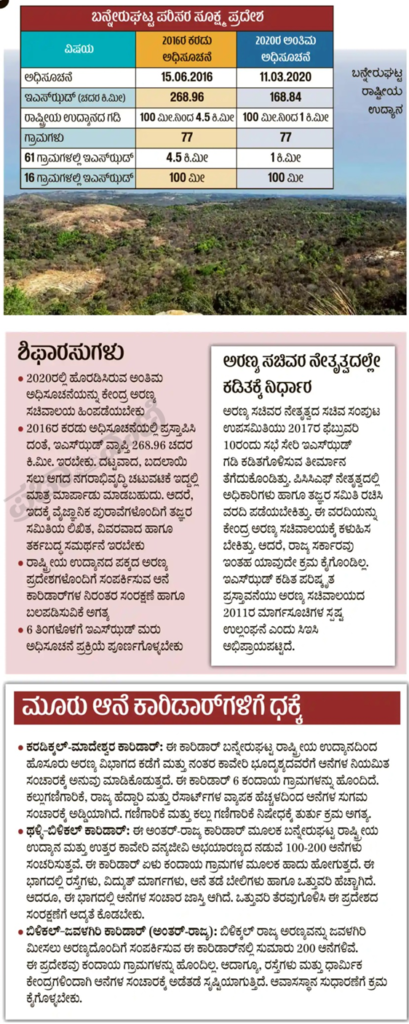
• ಪರಿಸರ ಸೂಕ್ಷ್ಮ ಪ್ರದೇಶವನ್ನು ಇಳಿಸಿರುವ ಸರ್ಕಾರದ ಕ್ರಮ ಪ್ರಶ್ನಿಸಿ ಬೆಂಗಳೂರಿನ ನಿವಾಸಿ ಬೆಳ್ಳಿಯಪ್ಪ ಮತ್ತಿತರರು ಸುಪ್ರೀಂ ಕೋರ್ಟ್ ಮೆಟ್ಟಿಲೇರಿದ್ದರು ಈ ಬಗ್ಗೆ, ಪರಿಶೀಲನೆ ನಡೆಸಿ ವರದಿ ಸಲ್ಲಿಸುವಂತೆ ಸಮಿತಿಗೆ ಸುಪ್ರೀಂ ಕೋರ್ಟ್ ನಿರ್ದೇಶನ ನೀಡಿತ್ತು ಸಮಿತಿಯು ಸುಪ್ರೀಂ ಕೋರ್ಟ್ಗೆ 524 ಪುಟಗಳ ವರದಿ ಸಲ್ಲಿಸಿದೆ ಯಾವುದೇ ವೈಜ್ಞಾನಿಕ, ಪರಿಸರ ಅಥವಾ ಭೂದೃಶ್ಯ ಮಟ್ಟದ ಅಧ್ಯಯನ ಹಾಗೂ ಮೌಲ್ಯಮಾಪನ ನಡೆಸದೆಯೇ ಪರಿಸರ ಸೂಕ್ಷ್ಮ ಪ್ರದೇಶವನ್ನು ನಿರಂತರವಾಗಿ ಕಡಿತ ಮಾಡಲಾಗಿದೆ ಎಂದೂ ಸಮಿತಿ ತಿಳಿಸಿದೆ.
• ಪರಿಸರ ಸೂಕ್ಷ್ಮ ಪ್ರದೇಶದ ಪಕ್ಕದಲ್ಲೇ ಕರ್ನಾಟಕ ವಸತಿ ಇಲಾಖೆಯು ಸೂರ್ಯನಗರ ಲೇಔಟ್ (ಕೆಎಚ್ ಬಿ ಸೂರ್ಯ ಸಿಟಿ) ಎಂಬ ಬೃಹತ್ ವಸತಿ ಯೋಜನೆ ಅನುಷ್ಠಾನಗೊಳಿಸುತ್ತಿದೆ. ಈ ಪ್ರದೇಶವು ಮೊದಲು ಪರಿಸರ ಸೂಕ್ಷ್ಮ ಪ್ರದೇಶದ ಭಾಗವಾಗಿತ್ತು ವಸತಿ ಬಡಾವಣೆಗಳ ನಿರ್ಮಾಣಕ್ಕೆ ನಿರ್ಬಂಧ ವಿಧಿಸಲಾಗಿತ್ತು ನಗರೀಕರಣದ ಒತ್ತಡದ ನೆಪವೊಡ್ಡಿ 2018ರ ಅಧಿಸೂಚನೆಯಲ್ಲಿ ಈ ಪ್ರದೇಶವನ್ನು ಇಎಸ್ಝಡ್ನಿಂದ ಹೊರಗಿಡಲಾಯಿತು.
• ಆ ಬಳಿಕ ವಸತಿ ಯೋಜನೆಯನ್ನು ಸುಗಮಗೊಳಿಸಲು ದೊಡ್ಡ ಪ್ರಮಾಣದ ಭೂ ಸಮತಟ್ಟು ನೈಸರ್ಗಿಕವಾಗಿ ಎತ್ತರದ ಭೂಪ್ರದೇಶವನ್ನು ಸಮತಟ್ಟಾಗಿಸುವುದು ಸೇರಿದಂತೆ ವ್ಯಾಪಕ ಪ್ರಮಾಣದಲ್ಲಿ ಚಟುವಟಿಕೆಗಳನ್ನು ಕೈಗೊಳ್ಳಲಾಯಿತು.
• ಪರಿಸರ ಪರಿಣಾಮದ ಅಧ್ಯಯನ ಹಾಗೂ ವೈಜ್ಞಾನಿಕವಾಗಿ ಮೌಲ್ಯಮಾಪನ ನಡೆಸದೆಯೇ ಈ ಕಾರ್ಯ ನಡೆಸಲಾಯಿತು ಈ ಯೋಜನೆಯು ಕರಡಿಕ್ಕಲ್-ಮಾದೇಶ್ವರ ಕಾರಿಡಾರ್ನ ಪಕ್ಕದಲ್ಲಿಯೇ ಅನುಷ್ಠಾನಗೊಳ್ಳುತ್ತಿದೆ. ಈ ಭಾಗದಲ್ಲಿ ಈಗಾಗಲೇ ಮಾನವ-ವನ್ಯಜೀವಿ ಸಂಘರ್ಷ ಗಣನೀಯ ಪ್ರಮಾಣದಲ್ಲಿ ಹೆಚ್ಚಳವಾಗಿದೆ’ ಎಂದು ಸಮಿತಿಯು ವರದಿಯಲ್ಲಿ ಉಲ್ಲೇಖಿಸಿದೆ.
• ಬೆಂಗಳೂರಿನ ಸುತ್ತಮತ್ತ ತ್ವರಿತ ನಗರ ವಿಸ್ತರಣೆ, ಮೂಲಸೌಕರ್ಯ ಅಭಿವೃದ್ಧಿ ಮತ್ತು ಸಾಂಪ್ರದಾಯಿಕ ಆನೆ ಕಾರಿಡಾರ್ಗಳ ಅವನತಿಯಿಂದಾಗಿ ಸಮಸ್ಯೆ ಮತ್ತು ಬಿಗಡಾಯಿಸಿದ ಬನ್ನೇರುಘಟ್ಟ ರಾಷ್ಟ್ರೀಯ ಉದ್ಯಾನದ ದಕ್ಷಿಣ, ಪಶ್ಚಿಮ, ಆಗ್ನೆಯ ಮತ್ತು ನೈರುತ್ಯ ಭಾಗಗಳಲ್ಲಿ ಮಾನವ-ಆನೆ ಸಂಘರ್ಷ ಪ್ರಕರಣಗಳು ವ್ಯಾಪಕ ಪ್ರಮಾಣದಲ್ಲಿ ಜಾಸ್ತಿ ಆಗಿದೆ ಸುಸ್ತಿರ ಮಾನವ ಅಭಿವೃದ್ಧಿ ಹಾಗೂ ಪರಿಸರ ಸಂರಕ್ಷಣೆ ಸಮತೋಲನದಿಂದ ಸಾಗಲು ಇಎಸ್ಝಡ್ಗಳು ನಿಯಂತ್ರಕಗಳಾಗಿ ಕೆಲಸ ಮಾಡುತ್ತವೆ ಎಂದು ಸಮಿತಿ ಅಭಿಪ್ರಾಯಪಟ್ಟಿದೆ.

Source: Prajavani
ಆರು ಮಸೂದೆಗಳಿಗೆ ರಾಜ್ಯಪಾಲರ ಅಂಕಿತ

ಸಂದರ್ಭ: ಗ್ರೇಟರ್ ಬೆಂಗಳೂರು ಪ್ರಾಧಿಕಾರ (ಜಿಬಿಎ) ಸದಸ್ಯರ ಪಟ್ಟಿಯಲ್ಲಿ ಕೆಲವು ಜನಪ್ರತಿ-ನಿಧಿಗಳ ಹೆಸರುಗಳು ಬಿಟ್ಟು ಹೋಗಿರುವುದರಿಂದ ಅವರ ಹೆಸರು ಸೇರಿಸುವ ಉದ್ದೇಶದ ಗ್ರೇಟರ್ ಬೆಂಗಳೂರು ಆಡಳಿತ ಎರಡನೇ ತಿದ್ದುಪಡಿ ಮಸೂದೆ’ಯೂ ಸೇರಿ ಒಟ್ಟು ಆರು ಮಸೂದೆಗಳಿಗೆ ರಾಜ್ಯಪಾಲರು ಒಪ್ಪಿಗೆ ನೀಡಿದ್ದಾರೆ.
• ಕರ್ನಾಟಕ ಖಾಸಗಿ ವೈದ್ಯಕೀಯ ಸಂಸ್ಥೆಗಳ ಮಸೂದೆ, ಕರ್ನಾಟಕ ಕಲ್ಯಾಣ ನಿಧಿ ತಿದ್ದುಪಡಿ ಮಸೂದೆ, ಕರ್ನಾಟಕ ಹಿಂದೂ ಧಾರ್ಮಿಕ ಸಂಸ್ಥೆಗಳು ಮತ್ತು ಧರ್ಮಾದಾಯ ದತ್ತಿಗಳು ತಿದ್ದುಪಡಿ ಮಸೂದೆ, ನಾಡಪ್ರಭು ಕೆಂಪೇಗೌಡ ಪಾರಂಪರಿಕ ತಾಣದ ಅಭಿವೃದ್ಧಿ ಪ್ರಾಧಿಕಾರ ಮಸೂದೆ, ಬಾಂಬೆ ಪಬ್ಲಿಕ್ ಟ್ರಸ್ಟ್ ಮಸೂದೆಗಳಿಗೆ ರಾಜ್ಯಪಾಲರು ಒಪ್ಪಿಗೆ ನೀಡಿದ್ದಾರೆ.

ಕರ್ನಾಟಕದ ಆರು ಪ್ರಮುಖ ಮಸೂದೆಗಳ ಸಂಕ್ಷಿಪ್ತ ವಿವರಣೆ:

ಮಸೂದೆಯ ಹೆಸರುಮುಖ್ಯ ಉದ್ದೇಶಪ್ರಮುಖ ಬದಲಾವಣೆಗಳು
ಗ್ರೇಟರ್ ಬೆಂಗಳೂರು ಆಡಳಿತ (ಎರಡನೇ ತಿದ್ದುಪಡಿ) ಮಸೂದೆಜಿಬಿಎ (GBA) ಸದಸ್ಯರ ಪಟ್ಟಿಯನ್ನು ಪರಿಷ್ಕರಿಸುವುದು.ಬೆಂಗಳೂರು ನಗರದ ಮತದಾರರ ಪಟ್ಟಿಯಲ್ಲಿರುವ ಎಲ್ಲಾ ಸಂಸದರು (MPs) ಮತ್ತು ಶಾಸಕರು (MLAs) ಅಧಿಕೃತವಾಗಿ ಜಿಬಿಎ ಸದಸ್ಯರಾಗುತ್ತಾರೆ.
ಕರ್ನಾಟಕ ಖಾಸಗಿ ವೈದ್ಯಕೀಯ ಸಂಸ್ಥೆಗಳ (KPME) ತಿದ್ದುಪಡಿ ಮಸೂದೆಖಾಸಗಿ ಆರೋಗ್ಯ ಕೇಂದ್ರಗಳ ಮೇಲೆ ಹೆಚ್ಚಿನ ನಿಗಾ ವಹಿಸುವುದು.ಹೊಸದಾಗಿ ಆರಂಭವಾಗುವ ಸಂಸ್ಥೆಗಳಿಗೆ 6 ತಿಂಗಳ ತಾತ್ಕಾಲಿಕ ನೋಂದಣಿ ಅವಕಾಶ ಹಾಗೂ ಮಾನಸಿಕ ಆರೋಗ್ಯ ಕೇಂದ್ರಗಳನ್ನು ಈ ಕಾನೂನಿನ ವ್ಯಾಪ್ತಿಗೆ ತರುವುದು.
ಕರ್ನಾಟಕ ಕಾರ್ಮಿಕ ಕಲ್ಯಾಣ ನಿಧಿ ತಿದ್ದುಪಡಿ ಮಸೂದೆಹೆಚ್ಚಿನ ಸಂಖ್ಯೆಯ ಕಾರ್ಮಿಕರಿಗೆ ಸೌಲಭ್ಯ ಒದಗಿಸುವುದು.ಈ ಮೊದಲು 50 ಕಾರ್ಮಿಕರಿರುವ ಸಂಸ್ಥೆಗಳಿಗೆ ಮಾತ್ರ ಅನ್ವಯಿಸುತ್ತಿತ್ತು, ಈಗ 10 ಕಾರ್ಮಿಕರಿರುವ ಸಂಸ್ಥೆಗಳೂ ಇದರ ವ್ಯಾಪ್ತಿಗೆ ಬರುತ್ತವೆ.
ಕರ್ನಾಟಕ ಹಿಂದೂ ಧಾರ್ಮಿಕ ಸಂಸ್ಥೆಗಳು ಮತ್ತು ಧರ್ಮಾದಾಯ ದತ್ತಿಗಳು ತಿದ್ದುಪಡಿ ಮಸೂದೆದೇವಸ್ಥಾನಗಳ ಆದಾಯ ಹಂಚಿಕೆ ಸಮತೋಲನಗೊಳಿಸುವುದು.ಶ್ರೀಮಂತ ದೇವಸ್ಥಾನಗಳ ಆದಾಯದ ಒಂದು ಭಾಗವನ್ನು ಬಳಸಿ, ಕಡಿಮೆ ಆದಾಯದ ದೇವಸ್ಥಾನಗಳ ಪುರೋಹಿತರ ಕಲ್ಯಾಣ ಮತ್ತು ಅಭಿವೃದ್ಧಿಗೆ ಧನಸಹಾಯ ನೀಡುವುದು.
ನಾಡಪ್ರಭು ಕೆಂಪೇಗೌಡ ಪಾರಂಪರಿಕ ತಾಣದ ಅಭಿವೃದ್ಧಿ ಪ್ರಾಧಿಕಾರ ತಿದ್ದುಪಡಿ ಮಸೂದೆಐತಿಹಾಸಿಕ ತಾಣಗಳ ಉತ್ತಮ ನಿರ್ವಹಣೆ.2018ರ ಮೂಲ ಕಾಯ್ದೆಗೆ ತಿದ್ದುಪಡಿ ತಂದು, ಅಭಿವೃದ್ಧಿ ಯೋಜನೆಗಳಿಗೆ ಪ್ರಾಧಿಕಾರಕ್ಕೆ ಹೆಚ್ಚಿನ ಆಡಳಿತಾತ್ಮಕ ಅಧಿಕಾರ ನೀಡಲಾಗಿದೆ.
ಬಾಂಬೆ ಪಬ್ಲಿಕ್ ಟ್ರಸ್ಟ್ (ಕರ್ನಾಟಕ ತಿದ್ದುಪಡಿ) ಮಸೂದೆಸಾರ್ವಜನಿಕ ಟ್ರಸ್ಟ್‌ಗಳ ಆಡಳಿತಾತ್ಮಕ ಸುಲಭೀಕರಣ.ಬೆಳಗಾವಿ ಪ್ರಾದೇಶಿಕ ಆಯುಕ್ತರನ್ನು ಚಾರಿಟಿ ಕಮಿಷನರ್ ಆಗಿ ನೇಮಿಸುವುದು ಮತ್ತು ತಹಶೀಲ್ದಾರರಿಗೆ ಉಪ-ಅಧಿಕಾರಗಳನ್ನು ನೀಡುವುದು.

👉 ಈ ಮಸೂದೆಗಳು ನಗರ ಆಡಳಿತ, ಆರೋಗ್ಯ, ಕಾರ್ಮಿಕ ಕಲ್ಯಾಣ, ಧಾರ್ಮಿಕ ಸೇವೆಗಳು ಮತ್ತು ಪಾರಂಪರಿಕ ತಾಣಗಳ ಅಭಿವೃದ್ಧಿ ಕ್ಷೇತ್ರಗಳಲ್ಲಿ ಸಮಗ್ರ ಬದಲಾವಣೆಗಳನ್ನು ತರಲಿವೆ.

Source: Prajavani

ಜಿಡಿಪಿ: ಈ ವರ್ಷದಲ್ಲಿ 87.4 3 7.4ರಷ್ಟು ಬೆಳವಣಿಗೆ

ಸಂದರ್ಭ: ಪ್ರಸಕ್ತ ಹಣಕಾಸು ವರ್ಷದಲ್ಲಿ ದೇಶದ ಅರ್ಥಿಕತೆಯ ಬೆಳವಣಿಗೆ ಅಂದಾಜನ್ನು ಕೇಂದ್ರ ಸರ್ಕಾರ ಬಿಡುಗಡೆ ಮಾಡಿದೆ. ಈ ವರ್ಷದಲ್ಲಿ ಅರ್ಥ ವ್ಯವಸ್ಥೆಯು ಶೇ 7.4ರಷ್ಟು ಬೆಳವಣಿಗೆ ಸಾಧಿಸಲಿದೆ ಎಂದು ಅಂದಾಜಿನಲ್ಲಿ ಹೇಳಲಾಗಿದೆ.
•ಈ ಪ್ರಮಾಣದ ಸಾಧ್ಯವಾದಲ್ಲಿ, ಬೆಳವಣಿಗೆ ಪ್ರವರ್ಧಮಾನಕ್ಕೆ ಬರುತ್ತಿರುವ ಅರ್ಥ ವ್ಯವಸ್ಥೆಗಳ ಪೈಕಿ ಅತ್ಯಂತ ವೇಗದ ಬೆಳವಣಿಗೆಯನ್ನು ಭಾರತ ಸಾಧಿಸಿದಂತಾಗುತ್ತದೆ. ಆದರೆ ದ್ರೋಕರೇಜ್ ಕಂಪನಿ ಗೋಲ್ಡ್ಮನ್ ಸಾಕ್ಸ್ ಸಿದ್ಧಪಡಿಸಿರುವ ವರದಿಯೊಂದರ ಪ್ರಕಾರ ಈ ವರ್ಷದಲ್ಲಿ ಭಾರತದ ಜಿಡಿಪಿ ಬೆಳವಣಿಗೆಯು ಶೇ 7.3ರಷ್ಟು ಆಗಲಿದೆ.
ಭಾರತೀಯ ರಿಸರ್ವ್ ಬ್ಯಾಂಕ್ (ಆರ್ಬಿಐ) ಅಂದಾಜಿನ ಪ್ರಕಾರ ಕೂಡ ಭಾರತದ ಜಿಡಿಪಿ 2025-26ರಲ್ಲಿ ಶೇ 7.3ರಷ್ಟು ಬೆಳೆಯಲಿದೆ. ಜಿಎಸ್ಟಿ ದರ ಇಳಿಕೆ, ಆದಾಯ ತೆರಿಗೆ ಮಿತಿ ಹೆಚ್ಚಳದಂತಹ ಕ್ರಮಗಳು ಆರ್ಥಿಕ ಚಟುವಟಿಕೆ ಚೆನ್ನಾಗಿ ಇರುವುದಕ್ಕೆ ಕಾರಣವಾಗಿವೆ.
ಚೀನಾದ ಬೆಳವಣಿಗೆ ದರವು 2025ರಲ್ಲಿ ಶೇ 4.9ರಷ್ಟು ಇರಲಿದೆ ಎಂದು ವಿಶ್ವ ಬ್ಯಾಂಕ್ ಅಂದಾಜು ಮಾಡಿದೆ.
• ಮೊದಲ ಮುಂಗಡ ಅಂದಾಜನ್ನು ಪ್ರಕಟಿಸಿದ ಕೇಂದ್ರ ಸರ್ಕಾರ: ದೇಶದ ಅರ್ಥ ವ್ಯವಸ್ಥೆಯು ಪ್ರಸಕ್ತ ಹಣಕಾಸು ವರ್ಷದಲ್ಲಿ (2025-26) ಶೇಕಡ 7.4ರಷ್ಟು ಬೆಳವಣಿಗೆ ಕಾಣುವ ನಿರೀಕ್ಷೆ ಇದೆ. ಹಿಂದಿನ ಹಣಕಾಸು ವರ್ಷದಲ್ಲಿ ಬೆಳವಣಿಗೆ ಪ್ರಮಾಣವು ಶೇ 6.5ರಷ್ಟು ಇತ್ತು.
ಸೇವಾ ವಲಯ ಹಾಗೂ ತಯಾರಿಕಾ ವಲಯಗಳಲ್ಲಿ ಚಟುವಟಿಕೆ ಚೆನ್ನಾಗಿ ಇರುವುದು ಈ ಬಾರಿ ಬೆಳವಣಿಗೆಯು ಕಳೆದ ವರ್ಷಕ್ಕಿಂತ ಹೆಚ್ಚಿರುವಂತೆ ಮಾಡಲಿದೆ. ಈ ಮೂಲಕ ಭಾರತವು ಪ್ರಮುಖ ಅರ್ಥವ್ಯವಸ್ಥೆಗಳ ಪೈಕಿ ಅತ್ಯಂತ ವೇಗದ ಬೆಳವಣಿಗೆ ಕಾಣುವ ದೇಶವಾಗಿ ಮುಂದುವರಿಯಲಿದೆ.
2023-24ರಲ್ಲಿ ದೇಶದ ಒಟ್ಟು ಆಂತರಿಕ ಉತ್ಪಾದನೆಯ (ಜಿಡಿಪಿ) ಬೆಳವಣಿಗೆ ಪ್ರಮಾಣವು ಶೇ 9.2ರಷ್ಟು ಇತ್ತು.
• ಪ್ರಸಕ್ತ ಹಣಕಾಸು ವರ್ಷದಲ್ಲಿ ತಯಾರಿಕಾ ವಲಯದಲ್ಲಿನ ಒಟ್ಟು ಮೌಲ್ಯ ಸೇರ್ಪಡೆಯು (ಜಿವಿಎ) ಶೇ 7ರಷ್ಟು ಇರಲಿದೆ ಎಂದು ಅಂದಾಜು ಮಾಡಲಾಗಿದೆ.
• ಇದು ಹಿಂದಿನ ವರ್ಷದ ಶೇ 4.5ರಷ್ಟು ಜಿವಿಎಗಿಂತ ಹೆಚ್ಚಿನದ್ದಾಗಲಿದೆ.
• ಸೇವಾ ವಲಯದಲ್ಲಿನ ಬೆಳವಣಿಗೆಯು ಶೇ 9.1ರಷ್ಟು ಇರಲಿದೆ (ಹಿಂದಿನ ವರ್ಷದಲ್ಲಿ ಇದು ಶೇ 7.2ರಷ್ಟು ಇತ್ತು) ಎಂದು ಕೇಂದ್ರ ಸಾಂಖ್ಯಿಕ ಮತ್ತು ಯೋಜನಾ ಅನುಷ್ಠಾನ ಸಚಿವಾಲಯದ ಅಧೀನದಲ್ಲಿ ಕೆಲಸ ಮಾಡುವ ರಾಷ್ಟ್ರೀಯ ಸಾಂಖ್ಯಿಕ ಕಚೇರಿ (ಎನ್ಎಸ್ಒ) ಬಿಡುಗಡೆ ಮಾಡಿರುವ ಅಂದಾಜಿನಲ್ಲಿ ಹೇಳಲಾಗಿದೆ.
• ಕೃಷಿ ಮತ್ತು ಸಂಬಂಧಿತ ವಲಯ-ಗಳಲ್ಲಿನ ಬೆಳವಣಿಗೆಯು ಈ ವರ್ಷದಲ್ಲಿ ಶೇ 3.1ಕ್ಕೆ ಇಳಿಕೆ ಆಗುವ ಸಾಧ್ಯತೆ ಇದೆ. ಹಿಂದಿನ ವರ್ಷದಲ್ಲಿ ಇದು ಶೇ 4.6ರ ಮಟ್ಟದಲ್ಲಿತ್ತು. ಈ ವರ್ಷದಲ್ಲಿ ನೈಜ ಜಿಡಿಪಿ ಗಾತ್ರವು ₹201.90 ಲಕ್ಷ ಕೋಟಿಯಷ್ಟಾಗುವ ಅಂದಾಜು ಮಾಡಲಾಗಿದೆ. ಅಮೆರಿಕದ ಡಾಲರ್ ಲೆಕ್ಕದಲ್ಲಿ ಜಿಡಿಪಿ ಗಾತ್ರವು 3.97 ಟ್ರಿಲಿಯನ್ ಆಗಲಿದೆ (1 ಡಾಲರ್ 90 ರೂಪಾಯಿಗೆ ಸಮ ಎಂಬ ಅಂದಾಜಿನೊಂದಿಗೆ).
• ಕೇಂದ್ರ ಸರ್ಕಾರವು ಮುಂದಿನ ಹಣಕಾಸು ವರ್ಷದ ಬಜೆಟ್ ಅನ್ನು ಫೆಬ್ರುವರಿ 1ರಂದು ಮಂಡಿಸುವ ನಿರೀಕ್ಷೆ ಇದ್ದು, ಬಜೆಟ್ ಸಿದ್ಧಪಡಿಸುವ ಸಂದರ್ಭದಲ್ಲಿ ಮುಂಗಡ ಅಂದಾಜನ್ನು ಆಶ್ರಯಿಸುತ್ತದೆ.
• “ಜಾಗತಿಕ ಮಟ್ಟದಲ್ಲಿ ಅನಿಶ್ಚಿತತೆ ಗಳು ಹೆಚ್ಚಿದ್ದರೂ, ದೇಶದ ಬೆಳವಣಿಗೆ ದರವು ಕಡಿಮೆ ಆಗಿಲ್ಲ. ಹಣಕಾಸು ಮತ್ತು ವಿತ್ತೀಯ ನೀತಿಗಳು ಹೊಂದಾಣಿಕೆಯ ಗುಣ ಹೊಂದಿದ್ದುದು, ಕಾರ್ಪೊರೇಟ್ ಕಂಪನಿಗಳ ಹಣಕಾಸಿನ ಚೆನ್ನಾಗಿರುವುದು, ಮುಂಗಾರು ಮಳೆ ಚೆನ್ನಾಗಿ ಆಗಿರುವುದು ಹಾಗೂ ಕಚ್ಚಾ ತೈಲದ ಬೆಲೆಯು ಕಡಿಮೆ ಇರುವುದು ಇದಕ್ಕೆ ಕಾರಣ’ ಎಂದು ಕ್ರಿಸಿಲ್ ಸಂಸ್ಥೆಯ ಮುಖ್ಯ ಅರ್ಥಶಾಸ್ತ್ರಜ್ಞ ಹೇಳಿದ್ದಾರೆ.
• ಹಬ್ಬಗಳ ಹೊತ್ತಿನಲ್ಲಿ ನಡೆಯುವ ಉತ್ತಮ ಮಾರಾಟ, ಜಿಎಸ್ಟಿ ದರ ಪರಿಷ್ಕರಣೆ ಹಾಗೂ ಆದಾಯ ತೆರಿಗೆ ಮಿತಿಯಲ್ಲಿನ ವಿನಾಯಿತಿಗಳು ಬೇಡಿಕೆಯನ್ನು ಹೆಚ್ಚಿಸುವ ನಿರೀಕ್ಷೆ ಇದೆ. ಹಬ್ಬಗಳ ನಂತರದಲ್ಲಿಯೂ ಬೇಡಿಕೆ ಉತ್ತಮ ಮಟ್ಟದಲ್ಲಿ ಎಂದು ಮುಂದುವರಿದಿದೆ ಬ್ಯಾಂಕ್ ಆಫ್ ಬರೋಡದ ಮುಖ್ಯ ಅರ್ಥಶಾಸ್ತ್ರಜ್ಞೆ ಹೇಳಿದ್ದಾರೆ.

Source: Prajavani

India scaled 54.51 GW wind energy capacity in 2025

  • India added 6.34 gigawatts (GW)-worth wind energy capacity in the calendar year 2025 with the total capacity in the country scaling 54.51 GW at the end of the year, Union Minister for New and Renewable Energy Pralhad Joshi informed.
  • Notably, the capacity added in 2025 is approximately 85.4% higher than the capacity added in the preceding calendar year. India installed 3.42 GW worth capacity in 2024. It had closed 2024 with 48.16 GW wind capacity.

Source: The Hindu

Census first phase to be held from April 1 to Sept. 30 this year

Context: The houselisting phase will be conducted in each State over a 30-day period; second phase of the count will be carried out in February 2027.

  • The first phase of Census 2027, the houselisting operations (HLO) phase, will be conducted from April 1 to September 30 across all States and Union Territories, the Registrar-General and Census Commissioner of India said in a notification.
  • This phase will be conducted in each State over a 30-day period, with the specific dates to be notified by the States.
  • The self-enumeration option will be available 15 days before the start of the phase.
  • “The houselisting operations of the Census of India 2027 shall take place between 1st April, 2026 and 30th September, 2026 in all States and Union territories in India during the period of thirty days specified by each State and Union territory. There shall also be an option for self enumeration which shall be conducted in fifteen days’ time period just before the start of house to house houselisting operations of thirty days,” Census Commissioner Mritunjay Kumar Narayan said in a Gazette notification.
  • This will be the first digital Census and the first to enumerate caste in Independent India.

Household queries

  • The second phase of the Census is the population enumeration phase in February 2027.
  • Caste identities will be enumerated during this phase.
  • The pre-test or the preparatory exercise for the first phase of the Census was held from November 10 to 30 last year in select areas across the country. It had sought household responses to 35 questions, including the composition of the floor and roof of the house, main cereal consumed, source of drinking water and cooking fuel, and the number of married couples in the house.
  • About 30 lakh field functionaries — including enumerators, supervisors, master trainers, charge officers, and Principal/District Census Officers — will be deployed for data collection, and supervision of Census operations.

Centre seeks comments on draft Pesticides Bill

  • The Agriculture Ministry released the draft Pesticides Management Bill, 2025, seeking public comments on the legislation that aims at replacing the 57-year-old Insecticides Act, 1968, and the Insecticides Rules, 1971, with enhanced penalties for violations.
  • The Ministry has invited feedback from all stakeholders by February 4, 2026, to refine the legislation before it is introduced in Parliament.
  • The proposed farmer-centric legislation introduces several reform measures.
  • The Bill incorporates digital methods and technology to streamline processes while imposing stricter controls on spurious pesticides through higher penalties.
  • Key features include mandatory accreditation of testing laboratories to ensure quality pesticides reach farmers, and provisions for compounding of offences with enhanced penalties to be defined by State-level authorities.

How every ₹100 is spent by Indian households

Context: Indians are shifting from subsistence needs to aspirational and service-oriented spending.

  • The Household Consumption Expenditure Survey (HCES) by the Ministry of Statistics and Programme Implementation (MoS&PI) captures spending pattern of Indian households across various consumption categories.
  • Conducted every five years, the HCES provides granular estimates of Monthly Per Capita Expenditure (MPCE) for both rural and urban populations, covering a wide range of goods and services.
  • The survey rounds for 2022-23 and 2023-24 represent the first comprehensive update to MPCE data in over a decade, offering valuable insights into India’s shifting consumption landscape. These findings are central to revising poverty estimates, informing social sector policy, and understanding the lived realities of India’s expanding middle-income population.
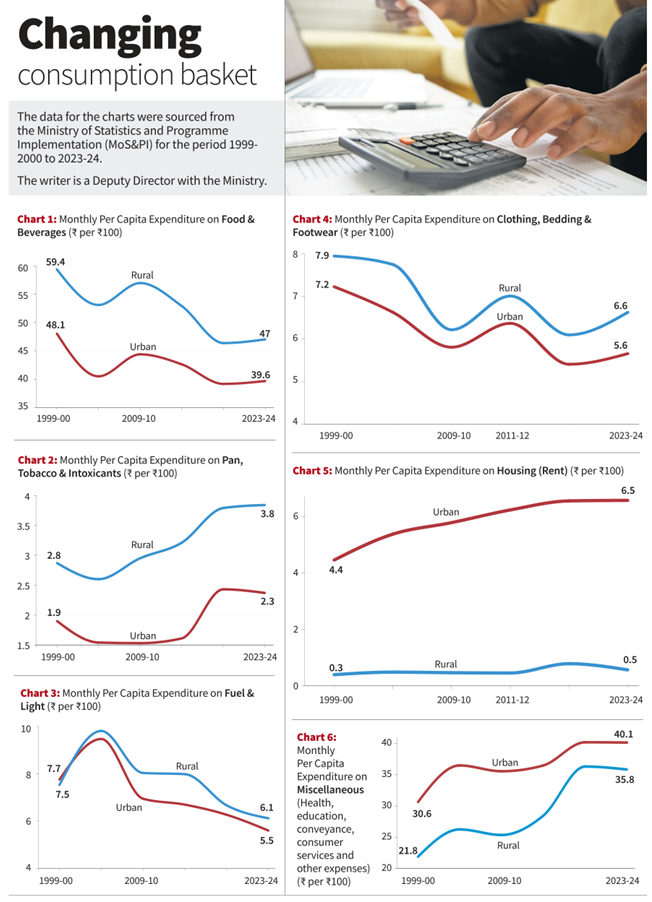
  • This article examines long-term MPCE trends from 1999-2000 to 2023-24, with a focus on six key expenditure categories. In this analysis, MPCE is expressed as the proportional expenditure on an item for every ₹100 of total spending.
  • Decline in MPCE share on food and beverages for both urban (from ₹48 to ₹39 per ₹100) and rural areas (from ₹59 to ₹47 per ₹100) confirms Engel’s Law, which states that as real income rises, the proportion of income spent on food declines, even if absolute expenditure increases. (Chart 1)
  • Further, a fall in expenditure on cereals, alongside higher spending on fruits, eggs, fish, and processed foods, signals a shift from staple-heavy diets to more varied, protein-rich diets — albeit unequally.
  • Despite marginal increases, particularly in rural areas, spending on pan, tobacco, and other intoxicants remains a low share of MPCE, accounting for under ₹3.8 per ₹100 of spending. From a public health perspective, the trend calls for targeted awareness programs in rural belts. (Chart 2)
  • The reduction in per capita fuel spending reflects policy successes, such as Saubhagya (rural electrification) and PM Ujjwala Yojana (LPG access). Lower urban spending may also reflect the use of energy-efficient appliances and access to reliable power supply. Modern fuels, in place of biomass or kerosene, improve quality of life and are an example of expenditure substitution. (Chart 3)
  • The decline in spending on clothing, bedding and footwear is moderate and consistent with the transition from need-based consumption to periodic discretionary spending. Rising competition, fast fashion, and lower textile prices may also have contributed. Rural India’s slightly higher or similar spending may indicate seasonal dependence and growing aspirations. (Chart 4)
  • The urban housing rent share rose significantly (₹4.46 to ₹6.58 per ₹100), aligning with urbanisation, rental stress, and migration to metropolitan hubs. Rural rent remains minimal due to widespread self-owned housing, informal tenure, or rent-free arrangements. (Chart 5)
  • The miscellaneous category includes aspirational expenses such as health, education, conveyance, consumer services, and other similar costs. Its rising share, particularly in rural MPCE (from ₹21.87 to ₹35.82 per ₹100), reflects a broadening of the consumption basket. This trend aligns with inclusive growth, deeper digital penetration, and echoes improved reach and quality of both public and market-based services. (Chart 6)
  • Taken together, these trends reflect that society is undergoing an economic transition, with consumption patterns gradually shifting away from subsistence needs toward more aspirational and service-oriented spending.

Source: The Hindu

ISRO set to launch earth observation satellite mission on January 12

Context: The Indian Space Research Organisation (ISRO) is scheduled to launch the PSLV-C62/EOS-N1 Mission on January 12.

Strategic use

  • The launch of the earth observation satellite (EOS-N1) satellite along with other payloads will take place from the first launch pad of the Satish Dhawan Space Centre at Sriharikota in Andhra Pradesh.
  • EOS-N1 is an earth imaging satellite said to be built for strategic purposes. ISRO has not shared further details about the satellite. “The launch of PSLV-C62 Mission is scheduled on 12 January 2026 at 10:17 hrs IST,” ISRO posted on X.
  • The PSLV-C62/EOS-N1 mission is the first launch for ISRO in 2026 and comes within a few days of successfully launching the U.S.’s BlueBird Block-2 satellite communication satellite in low earth orbit on December 24 onboard the LVM-3 launch vehicle.

Post glitch

  • The launch of the PSLV-C62/EOS-N1 mission will be the 105th launch from Sriharikota.
  • It is also an important launch for the space agency as the Polar Satellite Launch Vehicles (PSLV), which is ISRO’s workhorse, had suffered a glitch during its previous attempt to launch a satellite.
  • On May 18, 2025, while ISRO attempted to launch the EOS-09 satellite aboard the PSLV-C61 it could not accomplish the mission due to an observation in the third stage of the rocket.
  • PSLV-C62/EOS-N1 Mission will also launch payloads developed by start-up and academia from India and abroad.

Source: The Hindu

Govt. pegs FY26 growth at 7.4% amid tariff concerns

Context: Higher estimate comes amid uncertainties and 50% U.S. tariffs hitting labour-intensive sectors hard; with Q1 and Q2 growing at 7.8% and 8.2%, second half will see average growth slow to 6.8%.

  • The Union government has estimated that real growth in the Gross Domestic Product (GDP) of the country will stand at 7.4% in the current financial year 2025-26, up from 6.5% recorded the previous year.
  • In the First Advance Estimates (FAE) of GDP for 2025-26, released by the Ministry of Statistics and Programme Implementation, the government said that nominal growth for the year would be 8%.
  • The FAE for any year is important as it forms the basis for various calculations and ratios used in preparing the Union Budget.
  • The First Advance Estimates, and the Second Advance Estimates, which will be released on February 27, are forecasts of the full year’s growth based on data available up to that point. The Provisional Estimates for 2025-26, based on the full-year’s data, will be released on May 30.
  • Based on the Centre’s assessment that the full year’s growth would be 7.4%, and the fact that Q1 and Q2 saw 7.8% and 8.2% growth respectively, the second half of the year would see average growth slow to 6.8%. 

Braving headwinds

  • In December, the Reserve Bank of India had said that GDP growth in 2025-26 would be 7.3%, with Q3 growing at 7% and Q4 at 6.5%.
  • These projections come at a time when India’s economy is facing several headwinds. The 50% tariff levied by the U.S. on imports from India has hit several labour-intensive sectors such as apparel, textiles, and engineering goods.
  • The government has tried to boost consumer demand through both direct tax and indirect tax rate cuts, but the data show it nevertheless expects Private Final Consumption Expenditure, a metric that captures consumer spending, to grow at 7% in 2025-26, marginally slower than the 7.2% recorded last year.
  • The mining and quarrying sector is estimated to contract in 2025-26 by 0.7%, as compared to a growth of 2.7% the previous year.
  • The tertiary sector, which comprises the service sectors, is expected to see growth quicken to 9.1% in 2025-26 from 7.2% in 2024-25. Within this, the ‘financial, real estate and profession services’, and the ‘public administration, defence, and other services’ sub-groupings are both expected to grow at 9.9% in 2025-26.
  • The ‘trade, hotels, transport and communication’ category is expected to grow at a relatively slower 7.5% in 2025-26, although this is faster than the 6.1% seen in 2024-25.
  • Gross Fixed Capital Formation, on the other hand, is expected to grow at 7.8% in 2025-26, faster than the 7.1% seen in 2024-25.

Source: The Hindu

ರಷ್ಯಾದಿಂದ ₹15 ಲಕ್ಷ ಕೋಟಿ ಮೌಲ್ಯದ ಕಚ್ಚಾ ತೈಲ ಖರೀದಿ

ಸಂದರ್ಭ: ಉಕ್ರೇನ್ ಮತ್ತು ರಷ್ಯಾ ನಡುವೆ ಸಮರ ಆರಂಭವಾದ ನಂತರದಲ್ಲಿ ಭಾರತವು ರಷ್ಯಾದಿಂದ ಅಂದಾಜು 144 ಬಿಲಿಯನ್ ಯೂರೊ (ಸರಿಸುಮಾರು ₹15.19 ಲಕ್ಷ ಕೋಟಿ) ಮೌಲ್ಯದ ಕಚ್ಚಾ ತೈಲವನ್ನು ಆಮದು ಮಾಡಿಕೊಂಡಿದೆ ಎಂದು ಯುರೋಪಿನ ‘ಇಂಧನ ಮತ್ತು ಶುದ್ಧ ಗಾಳಿ ಕುರಿತ ಸಂಶೋಧನಾ ಕೇಂದ್ರ’ (ಸಿಆರ್ಇಎ) ಅಂದಾಜು ಮಾಡಿದೆ.
ಇದೇ ಅವಧಿಯಲ್ಲಿ ಚೀನಾ ದೇಶವು ರಷ್ಯಾದಿಂದ ಅಂದಾಜು 210 ಬಿಲಿಯನ್ ಯೂರೊ ಮೌಲ್ಯದ (ಸರಿಸುಮಾರು ₹22.16 ಲಕ್ಷ ಕೋಟಿ) ಕಚ್ಚಾ ತೈಲವನ್ನು ಖರೀದಿಸಿದೆ.
ಭಾರತವು ರಷ್ಯಾದಿಂದ ಕಚ್ಚಾ ತೈಲ ಮಾತ್ರವೇ ಅಲ್ಲದೆ 18.18 ಬಿಲಿಯನ್ ಯೂರೊ (ಸರಿಸುಮಾರು ₹1.91 ಲಕ್ಷ ಕೋಟಿ) ಮೌಲ್ಯದ ಕಲ್ಲಿದ್ದಲನ್ನು ಕೂಡ ಖರೀದಿಸಿದೆ.
ಚೀನಾ ಕೂಡ ರಷ್ಯಾದಿಂದ ಹಾಗೂ ಅನಿಲವನ್ನು ಕಲ್ಲಿದ್ದಲು ಖರೀದಿಸಿದೆ.
ಇದೇ ಅವಧಿಯಲ್ಲಿ ಐರೋಪ್ಯ ಒಕ್ಕೂಟವು ರಷ್ಯಾದಿಂದ ಒಟ್ಟು 218.1 ಬಿಲಿಯನ್ ಯೂರೊ (ಸರಿಸುಮಾರು ₹23.02 ಲಕ್ಷ ಕೋಟಿ) ಮೌಲ್ಯದ ಪಳೆಯುಳಿಕೆ ಇಂಧನವನ್ನು (ಕಲ್ಲಿದ್ದಲು. ತೈಲ ಮತ್ತು ಅನಿಲ) ಖರೀದಿಸಿದೆ.